
C1 June 2018 Q10
10.
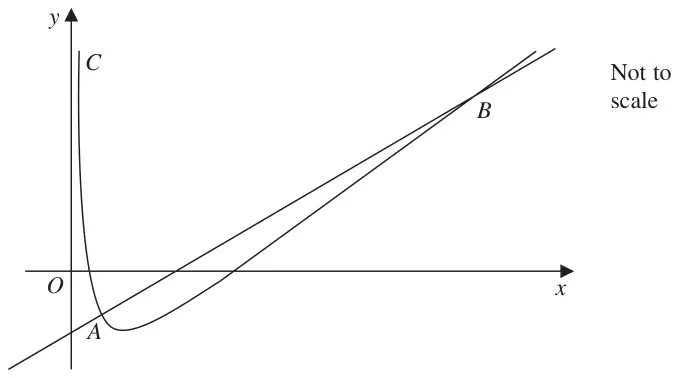
Figure 3 shows a sketch of part of the curve \(C\) with equation\[y = \frac{1}{2}x + \frac{27}{x} - 12, \qquad x > 0\]The point \(A\) lies on \(C\) and has coordinates \(\left(3, -\dfrac{3}{2}\right)\).
The normal to \(C\) at \(A\) meets \(C\) again at the point \(B\), as shown in Figure 3.
| Scheme | Marks |
|---|---|
| \(\dfrac{\mathrm{d}y}{\mathrm{d}x} = \dfrac{1}{2} - \dfrac{27}{x^2}\) | M1A1 |
| \(x = 3 \Rightarrow \dfrac{\mathrm{d}y}{\mathrm{d}x} = \dfrac{1}{2} - \dfrac{27}{9} = \left(-\dfrac{5}{2}\right)\) | M1 |
| \(m_T = -\dfrac{5}{2} \Rightarrow m_N = -1 \div -\dfrac{5}{2}\) \(\Rightarrow y - \left(-\dfrac{3}{2}\right) = \dfrac{2}{5}\left(x - 3\right)\) | M1 |
| \(10y = 4x - 27\,*\) | A1* |
| (5) |
Notes
M1: \(\dfrac{1}{2}\) or \(-\dfrac{27}{x^2}\)
A1: \(\dfrac{\mathrm{d}y}{\mathrm{d}x} = \dfrac{1}{2} - \dfrac{27}{x^2}\) oe e.g. \(\dfrac{1}{2}x^0 - 27x^{-2}\)
M1: Substitutes \(x = 3\) into their \(\dfrac{\mathrm{d}y}{\mathrm{d}x}\) to obtain a numerical gradient
M1: The correct method to find the equation of a normal. Uses \(-\dfrac{1}{m_T}\) with \(\left(3, -\dfrac{3}{2}\right)\) where \(m_T\) has come from calculus. If using \(y = mx + c\) must reach as far as \(c = \ldots\)
A1*: Cso (correct equation must be seen in (a))
| Scheme | Marks |
|---|---|
| \(\dfrac{1}{2}x + \dfrac{27}{x} - 12 = \dfrac{4x - 27}{10}\) or \(y = \dfrac{10y + 27}{8} + \dfrac{108}{10y + 27} - 12\) | M1 |
| \(x^2 - 93x + 270 = 0\) or \(20y^2 - 636y - 999 = 0\) | A1 |
| \((x - 90)(x - 3) = 0 \Rightarrow x = \ldots\) or \(x = \dfrac{93 \pm \sqrt{93^2 - 4\times 270}}{2}\) or \((10y - 333)(2y + 3) = 0 \Rightarrow y = \ldots\) or \(y = \dfrac{636 \pm \sqrt{636^2 - 4\times 20\times\left(-999\right)}}{2\times 20}\) | dM1 |
| \(x = 90\) or \(y = 33.3\) oe | A1 |
| \(x = 90\) and \(y = 33.3\) oe | A1 |
| (5) | |
| (10 marks) |
Notes
M1: Equate equations to produce an equation just in \(x\) or just in \(y\). Do not allow e.g. \(\dfrac{1}{2}x^2 + 27 - 12x = \dfrac{4x - 27}{10}\) Unless \(\dfrac{1}{2}x + \dfrac{27}{x} - 12 = \dfrac{4x - 27}{10}\) was seen previously. Allow sign slips only.
A1: Correct 3 term quadratic equation (or any multiple of). Allow terms on both sides e.g. \(x^2 - 93x = -270\) (The “= 0” may be implied by their attempt to solve)
dM1: Attempt to solve a 3TQ (see general guidance) leading to at least one for \(x\) or \(y\). Dependent on the first method mark.
A1: Cso. The \(x\) must be 90 and the \(y\) an equivalent number such as e.g. \(\frac{333}{10}\)
A1: Cso. The \(x\) must be 90 and the \(y\) an equivalent number such as e.g. \(\frac{333}{10}\)