
June 2023 Paper 2 Q10
10 A piece of wire of length 66 cm is bent to form the five sides of a pentagon.
The pentagon consists of three sides of a rectangle and two sides of an equilateral triangle.
The sides of the rectangle measure \(x\) cm and \(y\) cm and the sides of the triangle measure \(x\) cm, as shown in the diagram below.
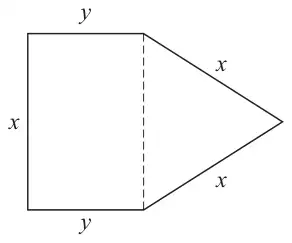
(a)
(i) You are given that \(\sin 60^\circ = \dfrac{\sqrt{3}}{2}\)
Explain why the area of the triangle is \(\dfrac{\sqrt{3}}{4}x^2\) [1 mark]
(ii) Show that the area enclosed by the wire, \(A\) cm2, can be expressed by the formula\[A = 33x - \frac{1}{4}(6 - \sqrt{3})x^2\] [3 marks]
(b) Use calculus to find the value of \(x\) for which the wire encloses the maximum area.
Give your answer in the form \(p + q\sqrt{3}\), where \(p\) and \(q\) are integers.
Fully justify your answer. [7 marks]
| Scheme | Marks | AO |
|---|---|---|
| (i) Explains the result using \(\dfrac{1}{2}ab\sin C\) or other trigonometry AG | E1 | 2.4 |
| (1) | ||
| (ii) Obtains \(3x + 2y = 66\) OE | B1 | 3.1a |
| Uses their expression for \(y\) to give an expression for \(xy\) in terms of \(x\) ACF | M1 | 1.1a |
| Completes correct derivation of given formula AG | R1 | 2.1 |
| (3) |
Typical solution
(i)
Area of a triangle is \(\dfrac{1}{2}ab\sin C\)
Here \(a\) and \(b\) are both \(x\) and \(C = 60^\circ\)
\[A = \frac{1}{2}x^2\frac{\sqrt{3}}{2} = \frac{1}{4}\sqrt{3}x^2\](ii)
\[3x + 2y = 66\]\[y = 33 - \frac{3}{2}x\]\[xy = \left(33 - \frac{3}{2}x\right)x\]\[A = \left(33 - \frac{3}{2}x\right)x + \frac{1}{4}\sqrt{3}x^2\]\[A = 33x - \frac{1}{4}(6 - \sqrt{3})x^2\]| Scheme | Marks | AO |
|---|---|---|
| Differentiates, at least one term correct | M1 | 1.1a |
| Obtains correct derivative | A1 | 1.1b |
| States that for a stationary (OE) point \(\dfrac{\mathrm{d}A}{\mathrm{d}x} = 0\) Must state \(\dfrac{\mathrm{d}A}{\mathrm{d}x} = 0\) not \(\dfrac{\mathrm{d}y}{\mathrm{d}x} = 0\) but allow use of \(\dfrac{\mathrm{d}y}{\mathrm{d}x}\) elsewhere | E1 | 2.4 |
| Solves their linear equation = 0 to obtain \(x\) PI ACF | M1 | 1.1a |
| Obtains correct exact value of \(x\) ACF | A1 | 1.1b |
| Differentiates their \(\dfrac{\mathrm{d}A}{\mathrm{d}x}\) to obtain an expression independent of \(x\) Or Tests \(x\) values either side of \(12 + 2\sqrt{3}\) in \(\dfrac{\mathrm{d}A}{\mathrm{d}x}\) | M1 | 1.1a |
| Completes reasoned argument to deduce the maximum. Must state that \(x = 12 + 2\sqrt{3}\) CSO Can be obtained independently of E1 | R1 | 2.2a |
| (7) | ||
| (11 marks) |
Typical solution
\[\frac{\mathrm{d}A}{\mathrm{d}x} = 33 - \frac{1}{2}(6 - \sqrt{3})x\]At a stationary point \(\dfrac{\mathrm{d}A}{\mathrm{d}x} = 0\)
\[33 - \frac{1}{2}(6 - \sqrt{3})x = 0\]\[(6 - \sqrt{3})x = 66\]\[x = \frac{66}{6 - \sqrt{3}}\]\[x = 12 + 2\sqrt{3}\]\[\frac{\mathrm{d}^2A}{\mathrm{d}x^2} = -\frac{1}{2}(6 - \sqrt{3})\]Negative so maximum