
C1 January 2006 Q9
9.
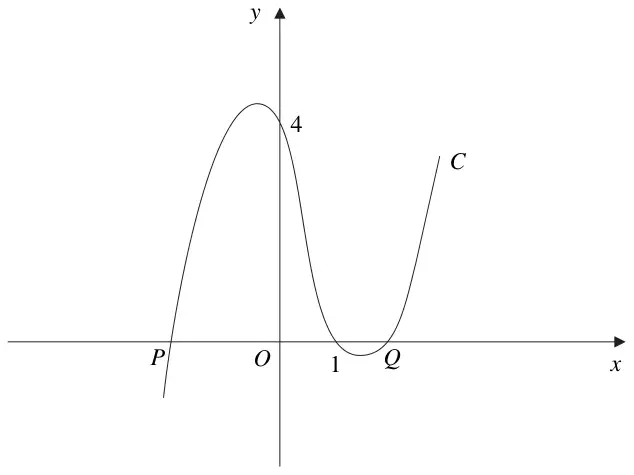
Figure 2 shows part of the curve \(C\) with equation\[y = (x - 1)(x^2 - 4).\]The curve cuts the \(x\)-axis at the points \(P\), \((1, 0)\) and \(Q\), as shown in Figure 2.
The tangent to \(C\) at the point \(R\) is parallel to the tangent at the point \((-1, 6)\).
| Scheme | Marks |
|---|---|
| \(-2\ (P)\), \(2\ (Q)\) (\(\pm 2\) scores B1 B1) | B1, B1 |
| (2) |
| Scheme | Marks |
|---|---|
| \(y = x^3 - x^2 - 4x + 4\) (May be seen earlier) Multiply out, giving 4 terms | M1 |
| \(\dfrac{\mathrm{d}y}{\mathrm{d}x} = 3x^2 - 2x - 4\) (*) | M1 A1cso |
| (3) |
Notes
(b) Alternative:
Attempt to differentiate by product rule scores the second M1:\[\frac{\mathrm{d}y}{\mathrm{d}x} = \{(x^2 - 4)\times 1\} + \{(x - 1)\times 2x\}\]Then multiplying out scores the first M1, with A1 if correct (cso).
| Scheme | Marks |
|---|---|
| At \(x = -1\): \(\dfrac{\mathrm{d}y}{\mathrm{d}x} = 3(-1)^2 - 2(-1) - 4 = 1\) | |
| Eqn. of tangent: \(y - 6 = 1(x - (-1))\), \(y = x + 7\) (*) | M1 A1cso |
| (2) |
Notes
(c) M1 requires full method: Evaluate \(\dfrac{\mathrm{d}y}{\mathrm{d}x}\) and use in eqn. of line through \((-1, 6)\), (n.b. the gradient need not be 1 for this M1).
Alternative:
| Scheme | Marks |
|---|---|
| Gradient of \(y = x + 7\) is 1, so solve \(3x^2 - 2x - 4 = 1\), as in (d)… | M1 |
| to get \(x = -1\). | A1cso |
| Scheme | Marks |
|---|---|
| \(3x^2 - 2x - 4 = 1\) (Equating to “gradient of tangent”) | M1 |
| \(3x^2 - 2x - 5 = 0 \qquad (3x - 5)(x + 1) = 0 \qquad x = \ldots\) | M1 |
| \(x = \dfrac{5}{3}\) or equiv. | A1 |
| \(y = \left(\dfrac{5}{3} - 1\right)\left(\dfrac{25}{9} - 4\right), \quad = \dfrac{2}{3}\times\left(-\dfrac{11}{9}\right) = -\dfrac{22}{27}\) or equiv. | M1, A1 |
| (5) | |
| (12 marks) |
Notes
(d) 2nd and 3rd M marks are dependent on starting with \(3x^2 - 2x - 4 = k\), where \(k\) is a constant.