
C2 June 2012 Q8
8.
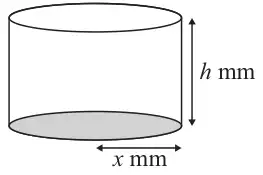
A manufacturer produces pain relieving tablets. Each tablet is in the shape of a solid circular cylinder with base radius \(x\) mm and height \(h\) mm, as shown in Figure 3.
Given that the volume of each tablet has to be 60 mm\(^3\),
The manufacturer needs to minimise the surface area \(A\) mm\(^2\), of a tablet.
| Scheme | Marks |
|---|---|
| \((h =)\dfrac{60}{\pi x^2}\) or equivalent exact (not decimal) expression e.g. \((h =) 60 \div \pi x^2\) | B1 |
| (1) |
Notes
B1: This expression must be correct and in part (a) \(\dfrac{60}{\pi r^2}\) is B0
| Scheme | Marks |
|---|---|
| \((A =) 2\pi x^2 + 2\pi xh\) or \((A =) 2\pi r^2 + 2\pi rh\) or \((A =) 2\pi r^2 + \pi dh\) may not be simplified and may appear on separate lines | B1 |
| Either \((A) = 2\pi x^2 + 2\pi x\left(\dfrac{60}{\pi x^2}\right)\) or As \(\pi xh = \dfrac{60}{x}\) then \((A =) 2\pi x^2 + 2\left(\dfrac{60}{x}\right)\) | M1 |
| \(A = 2\pi x^2 + \left(\dfrac{120}{x}\right)\) * | A1 cso |
| (3) |
Notes
B1: Accept any equivalent correct form – may be on two or more lines.
M1: substitute their expression for \(h\) in terms of \(x\) into Area formula of the form \(kx^2 + cxh\)
A1: There should have been no errors in part (b) in obtaining this printed answer
| Scheme | Marks |
|---|---|
| \(\left(\dfrac{\mathrm{d}A}{\mathrm{d}x}\right) = 4\pi x - \dfrac{120}{x^2}\) or \(= 4\pi x - 120x^{-2}\) | M1 A1 |
| \(4\pi x - \dfrac{120}{x^2} = 0\) implies \(x^3 =\) (Use of \(\gt 0\) or \(\lt 0\) is M0 then M0A0) | M1 |
| \(x = \sqrt[3]{\dfrac{120}{4\pi}}\) or answers which round to 2.12 (\(-2.12\) is A0) | dM1 A1 |
| (5) |
Notes
M1: At least one power of \(x\) decreased by 1 A1 accept any equivalent correct answer
M1: Setting \(\dfrac{\mathrm{d}A}{\mathrm{d}x} = 0\) and finding a value for \(x^3\) (\(x^3 =\) may be implied by answer). Allow \(\dfrac{\mathrm{d}y}{\mathrm{d}x} = 0\)
dM1: Using cube root to find \(x\)
A1: For any equivalent correct answer (need 3sf or more) Correct answer implies previous M mark
| Scheme | Marks |
|---|---|
| \(A = 2\pi(2.12)^2 + \dfrac{120}{2.12},\ = 85\) (only ft \(x = 2\) or 2.1 – both give 85) | M1, A1 |
| (2) |
Notes
M1: Substitute the (+ve) \(x\) value found in (c) into equation for \(A\) and evaluate. A1 is for 85 only
| Scheme | Marks | |
|---|---|---|
| Method 1 | Methods 2 and 3 | |
| Either \(\dfrac{\mathrm{d}^2A}{\mathrm{d}x^2} = 4\pi + \dfrac{240}{x^3}\) and sign considered (May appear in (c)) | Or (method 2) considers gradient to left and right of their 2.12 (e.g at 2 and 2.5) Or (method 3) considers value of \(A\) either side | M1 |
| which is \(\gt 0\) and therefore minimum (most substitute 2.12 but it is not essential to see a substitution) (may appear in (c)) | Finds numerical values for gradients and observes gradients go from negative to zero to positive so concludes minimum OR finds numerical values of \(A\), observing greater than minimum value and draws conclusion | A1 |
| (2) | ||
| 13 marks | ||
Notes
M1: Complete method, usually one of the three listed in the scheme. For first method \(A^{\prime\prime}(x)\) must be attempted and sign considered
A1: Clear statements and conclusion. (numerical substitution of \(x\) is not necessary in first method shown, and \(x\) or calculation could be wrong but \(A^{\prime\prime}(x)\) must be correct. Must not see 85 substituted)