oe 3 terms with at least two terms correct condone \(y = x^2 - 10x + 28\)
\(10^2 - 4 \times 1 \times 28\)
M1
oe must be ft from a quadratic derivative
No real roots stated or \(\sqrt{-12}\) or the gradient is never 0
M1dep
dep on both previous M marks must be from correct \(\dfrac{\mathrm{d}y}{\mathrm{d}x}\) and not ft
Statement to explain why this means the cubic is always an increasing function or the gradient is always positive
A1
eg gradient can’t be 0 and when \(x = 1\) gradient is 19 so increasing function or graph of \(\dfrac{\mathrm{d}y}{\mathrm{d}x}\) against \(x\) is always above the \(x\) axis so \(\dfrac{\mathrm{d}y}{\mathrm{d}x}\) is always positive
may be seen in stages accept \(9 \times 3^{-2}\) for \(\dfrac{9}{3^2}\)
Additional guidance
Alt1 and alt 2 with errors in working is B0 eg Alt 1 \(\ 1 - \dfrac{9}{x^2} = 0 \quad -1 = \dfrac{9}{x^2} \quad x = 3\)
B0
After B1 response ignore non-contradictory statements eg Alt 2 \(\ 1 - \dfrac{9}{3^2} = 0 \quad\) A turning point at (3, 0)
B1
Alt 2 \(\ \dfrac{9}{3^2} = 1 \quad 1 - 1 = 0\)
B1
Alt 2 \(\ \dfrac{9}{3^2} = 1\) with no further correct work
B0
Alt 1 \(\ 1 - \dfrac{9}{x^2} = 0 \quad x = \pm 3\)
B1
Mark scheme (b)
Answer
Mark
Comments
\(18x^{-3}\) with no other terms
M1
oe eg \(-9 \times -2x^{-2 - 1}\) with no other terms
M1 awarded and \(18 \times 3^{-3} \gt 0\) and minimum or M1 awarded and \(\dfrac{18}{27}\) and minimum
A1
oe eg \(18x^{-3}\) with no other terms and this is positive when \(x\) is 3 and minimum or M1 awarded and \(\dfrac{2}{3}\) and minimum allow [0.66, 0.67] for \(\dfrac{18}{27}\) any evaluations of second derivative must be correct
Additional guidance
M1 may be awarded for correct work with no answer or incorrect answer, even if this is seen amongst multiple attempts
\(\dfrac{\mathrm{d}y}{\mathrm{d}x} = 18x^{-3}\) with no other terms is awarded M1 and may be awarded A1 with further correct working
For A1 \(x = 3\) must be used or stated eg \(18x^{-3}\) is positive for all positive values of \(x\) and minimum
M1A0
Only considering signs of \(\dfrac{\mathrm{d}y}{\mathrm{d}x}\) either side of \(x = 3\)
M0A0
Accept eg local min or minima for minimum
After differentiating to \(18x^{-3}\) with no other terms, ignore further differentiation eg \(18x^{-3}\) and \(-54x^{-4}\)
either term correct could have additional incorrect terms
Their \(\dfrac{\mathrm{d}y}{\mathrm{d}x} = 0\)
M1dep
follow through an incorrect differentiation as long as M1 scored
\(x = 2\) and \(x = 0\)
A1
these values could imply M1dep if first M mark awarded
\(\left(\dfrac{\mathrm{d}^2y}{\mathrm{d}x^2} =\right) 6x - 6\) and \(\left(\dfrac{\mathrm{d}^2y}{\mathrm{d}x^2} =\right) 6\) and/or positive (for \(x = 2\)) or \(\left(\dfrac{\mathrm{d}^2y}{\mathrm{d}x^2} =\right) -6\) and/or negative (for \(x = 0\)) or \(\left(\dfrac{\mathrm{d}y}{\mathrm{d}x} =\right) 3x^2 - 6x\) and any correct check for both sides of one correct solution to give one side with a negative gradient and one side with a positive gradient
M1dep
a correct \(x\) value assessed correctly eg \(x = -1\ \dfrac{\mathrm{d}y}{\mathrm{d}x} \gt 0\) and \(x = 1\ \dfrac{\mathrm{d}y}{\mathrm{d}x} \lt 0\) or \(x = 1\ \dfrac{\mathrm{d}y}{\mathrm{d}x} \lt 0\) and \(x = 3\ \dfrac{\mathrm{d}y}{\mathrm{d}x} \gt 0\)
(0, 5) Maximum (2, 1) Minimum
A1
both points must have been assessed correctly
Additional guidance
Final A mark must have everything correct including both stationary points assessed correctly
Just a sketch is not enough to determine the nature of the stationary points
Condone incorrect writing of \(\dfrac{\mathrm{d}y}{\mathrm{d}x}\) and \(\dfrac{\mathrm{d}^2y}{\mathrm{d}x^2}\) even if it’s just \(y =\) as long as it’s recovered to get the correct nature of the turning points
3 The equation of a curve is \(\quad y = x^4 - 3kx^2 \quad\) where \(k\) is a constant.
When \(x = 2\) the rate of change of \(y\) with respect to \(x\) is 23
Work out the value of \(k\). [3 marks]
Mark scheme
Answer
Mark
Comments
\(4x^3\) or \(-6kx\)
M1
oe eg \(4x^{4-1}\) or \(-2 \times 3kx^{2-1}\)
\(4 \times 2^3 - 6k \times 2 = 23\) or \(32 - 12k = 23\) or \(12k = 9\)
M1dep
oe substitutes \(x = 2\) into their 2-term derivative and equates to 23 their 2-term derivative must have one term involving \(x\) and one term involving \(k\) and \(x\)
0.75 or \(\dfrac{3}{4}\)
A1
oe value eg \(\dfrac{9}{12}\)
Additional guidance
Ignore simplification or conversion attempt after correct answer seen
\(4x^3 - 3kx\) (for \(4x^3\)) \(32 - 6k = 23\) (used their 2-term derivative with conditions met)
M1 M1
\(4x^3 - 6kx\) (for \(4x^3\) or \(-6kx\)) \(16 - 12k = 23\) (16 is incorrect)
\(3a(-2)^2 + 2b(-2) = 0\) or \(12a - 4b = 0\) or \(3a - b = 0\) or \(3a(-2)^2 + 2(1 + 2a)(-2) = 0\) (this would come from doing the third M mark before the differentiation)
M1dep
when \(\dfrac{\mathrm{d}y}{\mathrm{d}x} = 0\) oe can follow through from an error in first M mark (as long as there are at least two terms in \(x^n\))
\(11 = a(-2)^3 + b(-2)^2 + 7\) or \(-8a + 4b = 4\) or \(-2a + b = 1\) or \(11 = a(-2)^3 + 3a(4) + 7\)
M1
oe
\(a = 1\) or \(b = 3\)
A1
dependent on M3 awarded
\(a = 1\) and \(b = 3\)
A1
Additional guidance
Correct answer could come from incorrect working (follow usual guidance)
\(a = 1\) and \(b = 3\) not from incorrect working will be full marks
M3 A2
Only one correct answer without working is 0 marks
Working with = 0 does not score 3rd M unless recovered to the correct answer eg \(3ax^3 - 2ax + 5x \qquad 9ax^2 - 2a + 5 = 0 \qquad a = 2.5\) Answer \(a \lt 2.5\)
M1M1 M1A1
Working with \(\lt 0\) (or \(\leqslant 0\)) does not score 3rd M and cannot be recovered eg \(3ax^3 - 2ax + 5x \qquad 9ax^2 - 2a + 5 \lt 0\) \(-2a + 5 \lt 0 \qquad\) Answer \(a \lt 2.5\)
M1M1M0 A0
Correct answer may come from other incorrect methods eg \(3ax^3 - 2ax + 5x \qquad -2ax + 5x \gt 0\) \(-2a + 5 \gt 0 \qquad\) Answer \(a \lt \dfrac{5}{2}\)
M1M0 M0A0
Allow the first two marks for fully correct use of the product rule for differentiation (M0M0 if not fully correct) eg \(ax \times 6x + (3x^2 - 2) \times a + 5\)
M1M1
\(3ax^3 - 2ax + 5x\) \(9x^2 - 2a + 5\)
M1 M0
\(3ax^2 - 2ax + 5x\) \(6ax - 2a + 5\)
M0 M1
\(3ax^3 - 2ax\) \(9ax^2 - 2a\) (their derivative does not contain 3 terms)
M1 M0
Ignore higher derivatives
Allow interval notation eg (0, 2.5]
Condone \(0 \leqslant a \lt 2.5\) or \(0 \leqslant a \leqslant 2.5\)
oe eg \(x^2 = 49\) must come from fully correct first M
7
A1
do not accept \(-7\) or \(\pm 7\)
Additional guidance
M1 dep (and hence A1) can only be gained if the first M mark is fully correct (no incorrect terms and no additional terms) eg an answer of \(\dfrac{1}{3}x^3 + 6x + 4\) would be allowed for M1 but as it’s not fully correct would lose the following 2 marks
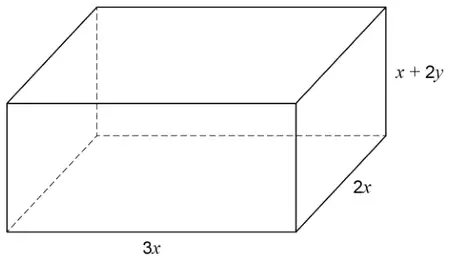
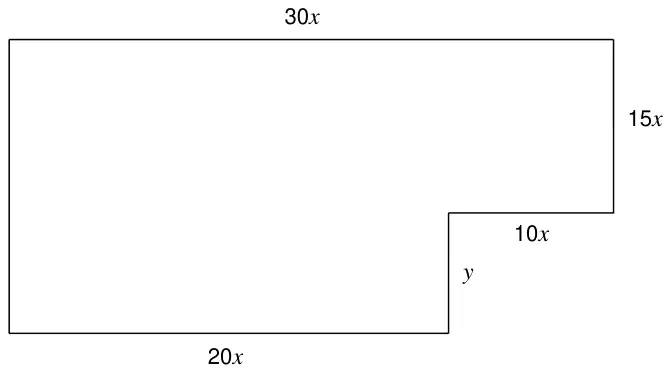
9 The dimensions of the cuboid are given in centimetres.
The total length of all 12 edges is 300 cm
(a) Show that \(\quad y = \dfrac{75 - 6x}{2}\) [2 marks]
(b) The volume of the cuboid is \(V\text{ cm}^3\)
Show that \(\quad V = 450x^2 - 30x^3\) [2 marks]
(c) Use calculus to work out the maximum value of \(V\) as \(x\) varies. [3 marks]
Mark scheme (a)
Answer
Mark
Comments
Expression for length of all edges = 300 or expression for length of the 3 given edges \(= \dfrac{300}{4}\)
M1
must have terms in \(x\) and \(y\) on one side and 300 or \(\dfrac{300}{4}\) on the other side eg \(4(3x + 2x + x + 2y) = 300\) or \(12x + 8x + 4x + 8y = 300\) or \(24x + 8y = 300\) or \(6x + 2y = \dfrac{300}{4}\) do not award M1 if only seen from working back from \(y = \dfrac{75 - 6x}{2}\) only \(6x + 2y = 75\) is M0
M1 seen and shows correct simplification to \(y = \dfrac{75 - 6x}{2}\)
A1
must see at least one intermediate equation after M1 with terms in \(x\) and \(y\) fully simplified and no incorrect equations seen
Additional guidance
Condone eg \(\dfrac{8y = 300 - 24x}{8}\) as not being an incorrect equation
Missing brackets must be recovered
Ignore units and working involving areas or volumes
from \(y = (\text{their } 14)\,x + c\) must be evidence of differentiation to get this mark
\(y = 14x - 16\)
A1
Additional guidance
Negative reciprocal of 14 to find the normal rather than the tangent ie. \(-2 = \dfrac{-1}{14} \times 1 + c\) or \(y - -2 = \dfrac{-1}{14}(x - 1)\)
M3 A0
14 from incorrect differentiation eg \(6x^4 + 8\) in differentiation with correct answer then ft correct eg \(6x^4 + 8x\) in differentiation with correct answer then ft correct
could be written as \(x(x^2 - 9) = 0\) or \(4x(x^2 - 9) = 0\) follow through an incorrect differentiation as long as it has at least one term correct
\(4x(x + 3)(x - 3)\;\;(= 0)\)
M1dep
oe eg \(x(x + 3)(x - 3)\;\;(= 0)\) solutions could be gained by using the factor theorem
\((-3, -81) \quad (0, 0) \quad (3, -81)\)
A1
may be seen in calculation rather than put in coordinates at this stage
\(\left(\dfrac{\mathrm{d}^2y}{\mathrm{d}x^2} =\right) 12x^2 - 36\) and when \(x = -3\) \(\left(\dfrac{\mathrm{d}^2y}{\mathrm{d}x^2}\right)\) = 72 and/or positive or when \(x = 0\) \(\left(\dfrac{\mathrm{d}^2y}{\mathrm{d}x^2}\right)\) \(= -36\) and/or negative or when \(x = 3\) \(\left(\dfrac{\mathrm{d}^2y}{\mathrm{d}x^2}\right)\) = 72 and/or positive or any check to both sides of one of their solutions to give one side with a negative gradient and one side with a positive gradient
M1dep
dependent on M3 oe correct y coordinates not required for this M mark any one point assessed correctly (don’t need to state max or min at this stage) but if the value of f’’(x) is worked out incorrectly then penalise. The value of f’’(x) may not be shown and then the correct statement will suffice. eg \(x = -4 \quad \dfrac{\mathrm{d}y}{\mathrm{d}x} \lt 0\) \(x = -1 \quad \dfrac{\mathrm{d}y}{\mathrm{d}x} \gt 0\) \(x = 1 \quad \dfrac{\mathrm{d}y}{\mathrm{d}x} \lt 0\) \(x = 4 \quad \dfrac{\mathrm{d}y}{\mathrm{d}x} \gt 0\)
\((-3, -81)\) Minimum \((0, 0)\) Maximum \((3, -81)\) Minimum
A1
all three points must have been determined correctly to gain this mark this could imply the previous mark by use of a correct sketch graph or a statement that says a positive quartic has these stationary points
Additional guidance
Condone incorrect writing of \(\dfrac{\mathrm{d}y}{\mathrm{d}x}\) and \(\dfrac{\mathrm{d}^2y}{\mathrm{d}x^2}\) even if it’s just \(y =\) as long as it’s recovered to get the correct nature of the turning points
12 Work out the gradient of the curve \(\qquad y = \dfrac{12x^3 - 8x + 3}{4x^2}\)
at the point where \(\quad x = -1\)
You must show your working.[5 marks]
Mark scheme
Answer
Mark
Comments
\(3x\) or \(-2x^{-1}\) or \(0.75x^{-2}\)
M1
oe must have powers of \(x\) simplified eg \(\dfrac{12x}{4}\) or \(-\dfrac{2}{x}\) or \(\dfrac{3}{4x^2}\)
\(3x\) and \(-2x^{-1}\) and \(0.75x^{-2}\)
M1dep
oe must have powers of \(x\) simplified eg \(\dfrac{12x}{4}\) and \(-\dfrac{2}{x}\) and \(\dfrac{3}{4x^2}\)
Any one of \(3x\) and \(3(x^0)\) or \(-2x^{-1}\) and \(2x^{-2}\) or \(0.75x^{-2}\) and \(-1.5x^{-3}\)
M1
oe eg \(\dfrac{12x}{4}\) and \(\dfrac{12}{4}x^{1 - 1}\) or \(-\dfrac{2}{x}\) and \(\dfrac{2}{x^2}\) or \(-\dfrac{2}{x}\) and \(- -2x^{-2}\) or \(\dfrac{3}{4x^2}\) and \(-\dfrac{3}{2x^3}\) implies 1st M1 for the derivatives \(x\) may be \((-1)\)
At least two of \(3x\) and \(3(x^0)\) or \(-2x^{-1}\) and \(2x^{-2}\) or \(0.75x^{-2}\) and \(-1.5x^{-3}\)
M1dep
oe dep on 3rd M1 for the derivatives \(x\) may be \((-1)\)
All three terms and their derivatives correct and 6.5
A1
oe eg all three terms and their derivatives correct and \(\dfrac{13}{2}\) for the derivatives \(x\) may be \((-1)\) SC3 104
Additional guidance
Up to M4 may be awarded for correct work with no, or incorrect answer, even if this is seen amongst multiple attempts
\(\dfrac{3}{4x^2}\) seen but subsequently incorrectly simplified eg \(12x^{-2}\) (subsequent marks may be scored)
(1st) M1
Correct answer after correct use of quotient rule or product rule
M4A1
Incorrect answer after use of quotient rule or product rule
Zero
Condone \(y = 3 + 2x^{-2} \ldots\) etc
All three terms and their derivatives correct and 6.5 in working but different answer eg \(y = 6.5x \ldots\)
M4A0
SC3 is for multiplying the numerator by \(4x^{-2}\) with no subsequent errors
M1 may be awarded for correct work with no, or incorrect answer, even if this is seen amongst multiple attempts
Ignore extra terms eg \(3x^2 - 10x + c\)
M1
\(3x^2 - 10x = 4\) (even if \(3x^2 - 10x - 4 = 0\) in (b))
M1A0
\(3x^2 - 10x - 4\) (even if \(3x^2 - 10x - 4 = 0\) in (b))
M1A0
\(3x^2 - 10x - 4 = 0\) seen in working with \(3x^2 - 10x - 4\) on answer line
M1A1
Condone for M1 \(\;y = 3x^2 \ldots\) etc (may still score A1 if recovered)
Answer \(y = 3x^2 - 10x - 4 = 0\)
M1A0
Mark scheme (b)
Answer
Mark
Comments
\(\dfrac{- -10 \pm \sqrt{(-10)^2 - 4 \times 3 \times -4}}{2 \times 3}\) or \(\dfrac{10 \pm \sqrt{148}}{6}\) or \(\dfrac{5}{3} \pm \sqrt{\dfrac{37}{9}}\) or two correct solutions with at least one not to 3 sf
M1
oe eg \(\dfrac{5 \pm \sqrt{37}}{3}\) correct attempt to solve their \(ax^2 + bx + c\;(= 0)\) from (a) \(a\), \(b\) and \(c\) all non-zero eg 3.69(4…) and \(-0.36(09\ldots)\) or 3.7 and \(-0.36(09\ldots)\)
3.69 and \(-0.361\)
A1ft
correct or ft any answers that have at least 4 sf must be rounded to 3 sf at least one answer must have at least 4 sf
Additional guidance
\(-10^2\) used for \((-10)^2\) is M0 unless recovered
\(10^2\) is equivalent to \((-10)^2\)
Not using \(\pm\) is M0 unless recovered
A short dividing line or a short square root symbol is M0 unless recovered
√((–10)\(^2\) – 4 × 3 × –4) is correct for \(\sqrt{(-10)^2 - 4 \times 3 \times -4}\)
Correct factorisation of their \(ax^2 + bx + c\;(= 0)\) from (a) scores at least M1
for either \(2x^4\) differentiated correctly multiplied by the bracket or the bracket differentiated correctly multiplied by \(2x^4\) eg \(8x^3\left(x^3 + 2 - \dfrac{3}{x}\right)\)
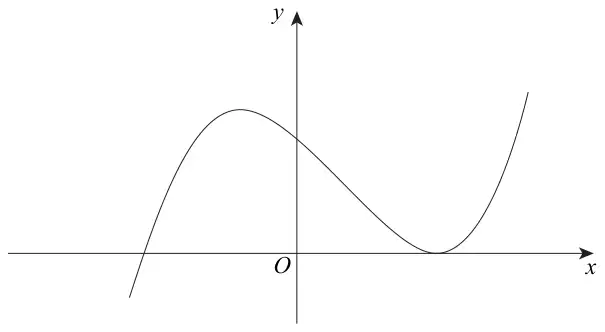
19 \(y = \mathrm{f}(x) \quad\) is the graph of a cubic function.
\(y \lt 0 \quad\) for \(\quad x \lt 5\) \(y \geqslant 0 \quad\) for \(\quad x \geqslant 5\)
The function is
increasing for \(\quad x \lt -1\) decreasing for \(\quad -1 \lt x \lt 2\) increasing for \(\quad x \gt 2\)
Draw a possible sketch of \(\quad y = \mathrm{f}(x) \quad\) for values of \(x\) from \(-2\) to 6 [4 marks]
Mark scheme
Answer
Mark
Comments
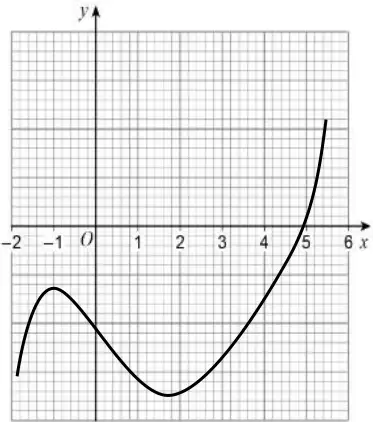
Cubic curve from \(x = -2\) to \(x = 6\) and maximum point at \((-1, a)\) where \(a\) is negative and minimum point at \((2, b)\) where \(b\) is less than \(a\) and increasing through (5, 0)
B4
B3 curve from \(x = -2\) to \(x = 6\) and maximum point at \((-1, c)\) where \(c\) is any value and minimum point at \((2, d)\) where \(d\) is less than \(c\) and \(d\) is negative and increasing through (5, 0) or a B4 response apart from cubic curve not drawn from \(x = -2\) to \(x = 6\)
B2 curve with maximum point at \((-1, e)\) where \(e\) is any value and minimum point at \((2, f)\) where \(f\) is less than \(e\)
B1 curve with maximum point at \((-1, g)\) where \(g\) is negative or curve with minimum point at \((2, h)\) where \(h\) is negative or curve increasing through (5, 0) SC2 max and min correct and increasing through (5, 0) but with straight lines rather than a curve.
13 \(P\) is the point on the curve \(\quad y = ax^3 + 10x^2 \quad\) where \(\quad x = 2\)
The gradient of the normal to the curve at \(P\) is \(-\dfrac{1}{4}\)
Work out the value of \(a\). [4 marks]
Mark scheme
Answer
Mark
Comments
\(3ax^2\) or \(20x\)
M1
oe eg \(3 \times ax^{3-1}\) or \(2 \times 10x^{2-1}\)
\(3a \times 2^2 + 20 \times 2\) or \(12a + 40\)
M1
ft substitution of \(x = 2\) into their derivative must have attempted differentiation and have two terms with one involving \(a\) may be seen in a denominator
their \((12a + 40) = -1 \div -\dfrac{1}{4}\) or their \((12a + 40) = 4\)
M1dep
oe eg \(-\dfrac{1}{\text{their } (12a + 40)} = -\dfrac{1}{4}\) dep on 2nd M1
Work out an expression for the rate of change of \(y\) with respect to \(x\). [3 marks]
Mark scheme
Answer
Mark
Comments
\(2x^5 - 7x^4\)
M1
\(10x^4\) or \((-)\ 28x^3\)
M1
oe eg \(5 \times 2x^{5-1}\)
\(\left(\dfrac{\mathrm{d}y}{\mathrm{d}x} =\right)\ 10x^4 - 28x^3\) with no additional terms
A1
do not award for \(y =\) or \(\dfrac{\mathrm{d}^2y}{\mathrm{d}x^2} =\) on the answer line SC2 \(2x^4 - 7x^3 + 8x^4 - 21x^3\) SC1 \(2x^4 - 7x^3 + x(8x^3 - 21x^2)\)
Additional guidance
Allow \(y = \ldots\) for M marks but must be recovered for A1
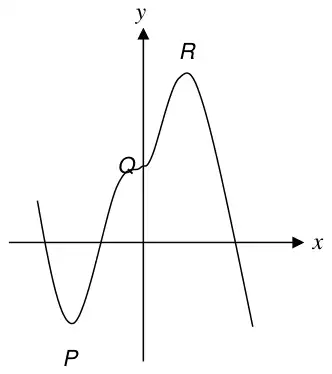
has a maximum point at \(L\ (-1, 13)\) has a minimum point at \(M\ (2, -14)\) intersects the \(y\)-axis at \(N\).
The curve crosses the \(x\)-axis at three distinct points.
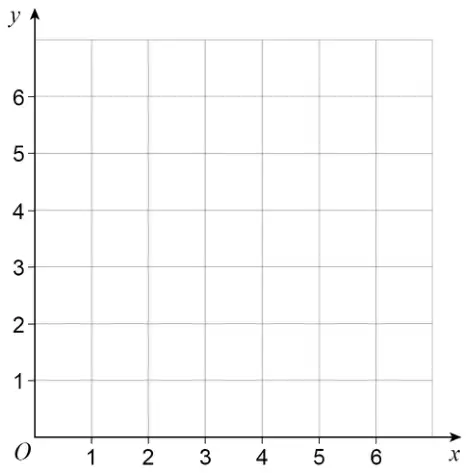
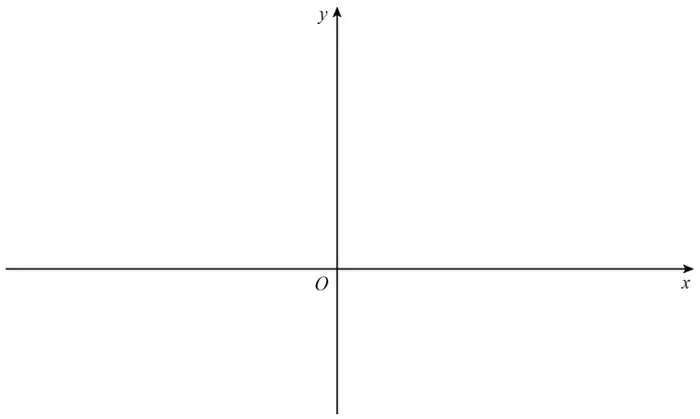
On the axes below, sketch the curve.
Label the points \(L\), \(M\) and \(N\) on your sketch. [3 marks]
Mark scheme
Answer
Mark
Comments
Correct shape curve crossing \(x\)-axis twice for \(x \gt 0\) crossing \(x\)-axis once for \(x \lt 0\) maximum point \(L\) labelled minimum point \(M\) labelled \(N\ (0, 6)\) labelled
B3
B2 Correct shape curve crossing \(x\)-axis twice for \(x \gt 0\) crossing \(x\)-axis once for \(x \lt 0\) with incomplete labelling B1 Identifies \(N\) as (0, 6)
27 The curve \(\quad y = \mathrm{f}(x) \quad\) has \(\quad \dfrac{\mathrm{d}y}{\mathrm{d}x} = (x + 2)^6 + (x + 2)^4\)
The curve has exactly one stationary point at \(P\) where \(\quad x = -2\)
Use the expression for \(\dfrac{\mathrm{d}y}{\mathrm{d}x}\) to show that \(P\) is a point of inflection. [3 marks]
Mark scheme
Answer
Mark
Comments
Alternative method 1
Shows substitution of a value of \(x \lt -2\) into \(\dfrac{\mathrm{d}y}{\mathrm{d}x}\) and shows substitution of a value of \(x \gt -2\) into \(\dfrac{\mathrm{d}y}{\mathrm{d}x}\)
allow \((-1)^6 + (-1)^4 = 2\) with \(x = -3\) stated and \((1)^6 + (1)^4 = 2\) with \(x = -1\) stated
Statement with M2 seen
A1
eg either side of \(P\ \dfrac{\mathrm{d}y}{\mathrm{d}x} \gt 0\) with M2 seen
SC2 states two values of \(x\) (one \(\lt -2\) and one \(\gt -2\)) and shows the correct value of \(\dfrac{\mathrm{d}y}{\mathrm{d}x}\) for each and makes a statement
SC1 states two values of \(x\) (one \(\lt -2\) and one \(\gt -2\)) and shows the correct value of \(\dfrac{\mathrm{d}y}{\mathrm{d}x}\) for each
Alternative method 2
\(x \lt -2\) and \((-)^6 + (-)^4\) and \(x \gt -2\) and \((+)^6 + (+)^4\)
M1
allow without brackets allow less than for \(\lt\) etc
\(x \lt -2\) and \((-)^6 + (-)^4 \gt 0\) and \(x \gt -2\) and \((+)^6 + (+)^4 \gt 0\)
M1dep
allow without brackets allow \(= +\) for \(\gt 0\)
Statement with M2 seen
A1
eg either side of \(P\ \dfrac{\mathrm{d}y}{\mathrm{d}x} \gt 0\) with M2 seen
SC2 states two values of \(x\) (one \(\lt -2\) and one \(\gt -2\)) and shows the correct value of \(\dfrac{\mathrm{d}y}{\mathrm{d}x}\) for each and makes a statement
SC1 states two values of \(x\) (one \(\lt -2\) and one \(\gt -2\)) and shows the correct value of \(\dfrac{\mathrm{d}y}{\mathrm{d}x}\) for each
Additional guidance
For A1 a clear statement is needed after M2 scored
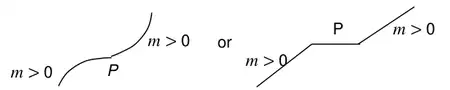
Examples of acceptable statements with M2 seen eg1 For \(x \lt -2\) gradient is + and for \(x \gt -2\) gradient is + eg2 To the left of \(P\ \ m \gt 0\) \(\phantom{eg2}\) To the right of \(P\ \ m \gt 0\) eg3 (When both of their substitutions correctly evaluate to the same value) They are the same positive value eg4 Both gradients are the same sign eg5 \(m\) is + both times eg6 Gradient is always positive (apart from at \(P\)) eg7 Function (or curve) is increasing (either side of \(P\))
Allow a statement to be made using a diagram with M2 seen eg accept for eg2 above
Allow a statement to be made using a table with M2 seen eg accept for eg1 above
−3
−2
−1
+
0
+
When both of their substitutions correctly evaluate to the same positive value condone for the statement with M2 seen Gradients are the same (implies both positive)
Do not accept for the statement eg1 Gradient is increasing eg2 \(m\) is positive eg3 Gradient is positive eg4 \(P\) is a point of inflection
Allow gradient or \(m\) for \(\dfrac{\mathrm{d}y}{\mathrm{d}x}\)
For evaluations allow rounding or truncating to 1 sf or better
Ignore higher derivatives
Ignore substitution of \(x = -2\)
\(x = -3 \quad\) gradient \(= 2\) \(x = -1 \quad\) gradient \(= 2\) either side of \(P\) gradient \(\gt 0\)
12 A curve has the equation \(\quad y = x^3 + ax^2 - 7 \quad\) where \(a\) is a constant.
The gradient of the curve when \(x = 4\) is twice the gradient of the curve when \(x = -1\)
Work out the value of \(a\). You must show your working. [5 marks]
Mark scheme
Answer
Mark
Comments
\(3x^2 + 2ax\)
M1
allow a derivative with at least one term correct and a term in \(a\) eg \(3x^2 + 2ax + 7\) or \(3x^2 + 2a\)
\(3(4)^2 + 2a(4)\) or \(48 + 8a\)
A1ft
\(3(-1)^2 + 2a(-1)\) or \(3 - 2a\)
A1ft
\(48 + 8a = 2(3 - 2a)\)
M1dep
oe ft if first M1 earned
\((a =)\ -3.5\)
A1
oe
Additional guidance
Minimum expected working is to see the correct derivative in the first M mark. If no working seen then no marks can be awarded
If the word “twice” is interpreted the wrong way round ie equation becomes \(2(48 + 8a) = 3 - 2a\) this gives an answer of \(a = -5\tfrac{1}{6}\) or \(-5.1666\ldots\)
The curve has gradient function \(\quad \dfrac{x^5 - 17}{10}\)
The tangent to the curve at \(P\) is parallel to the line \(\quad 3x - 2y = 9\)
Work out the \(x\)-coordinate of \(P\). [4 marks]
Mark scheme
Answer
Mark
Comments
\((y =)\ \dfrac{3}{2}x\ldots\) or \((y =)\ 1.5x\ldots\) or \(\dfrac{3}{2}\) or 1.5
M1
oe eg \((y =)\ \dfrac{3x - 9}{2}\)
\(\dfrac{x^5 - 17}{10} = \dfrac{3}{2}\)
M1dep
oe implies M2
\(x^5 = \dfrac{3}{2} \times 10 + 17\) or \(\sqrt[5]{32}\) or correctly rearranges \(\dfrac{x^5 - 17}{10} = k\) to the form \(x^5 =\) (\(k\) any non-zero value)
M1
oe eg \(x^5 = 15 + 17\) or \(x^5 = 32\) or \(\sqrt[5]{15 + 17}\) must rearrange to the form \(x^5 =\)
2
A1
Additional guidance
Condone error seen in rearrangement of \(3x - 2y = 9\) if gradient is \(\dfrac{3}{2}\) May go on to score M3A1
\(\dfrac{x^5 - 17}{10} = \dfrac{3}{2}x\)
M1M0M0A0
(gradient \(=\)) 3 \(\dfrac{x^5 - 17}{10} = 3\) \(x^5 = 30 + 17 \quad\) (3rd M is not dependent) 2.16
M0M0dep
M1 A0
\(\dfrac{3}{2}\) \(\dfrac{x^5 - 17}{10} = -\dfrac{2}{3}\) \(x^5 = -\dfrac{2}{3} \times 10 + 17 \quad\) (3rd M is not dependent) 1.595
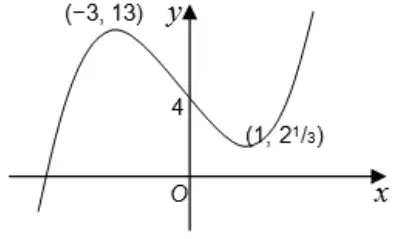
The \(y\)-coordinate of the minimum point is \(2\dfrac{1}{3}\) The \(y\)-coordinate of the maximum point is 13
\((0,\ 4)\) is a point on the curve. The tangent at \((0,\ 4)\) has a negative gradient.
Sketch the curve on the grid below. Show the coordinates of the stationary points. [4 marks]
Mark scheme
Answer
Mark
Comments
factorising to get \((x + 3)(x - 1)\ (= 0)\) or completing the square and getting as far as \(x + 1 = \pm 2\) or using the quadratic formula and getting as far as \(x = \dfrac{-2 \pm 4}{2}\)
M1
\(x = -3\) and \(x = 1\)
A1
\((-3,\ 13)\) as a maximum point and \((1,\ 2\tfrac{1}{3})\) as a minimum point, plotted
M1
Smooth correct curve which must have the stationary points plotted in the correct quadrants and must cross the negative \(x\)-axis
A1
Additional guidance
SC1 for a fully correct sketch with the stationary points in the correct quadrants but lacking any detail in terms of the \(x\) coordinates of the stationary points, or with incorrect values of the stationary points, and with no evidence of a valid method to obtain \(x = -3\) and \(x = 1\)
Work out the value of \(x\) when \(\quad \dfrac{\mathrm{d}y}{\mathrm{d}x} = 133\) [4 marks]
Mark scheme
Answer
Mark
Comments
\(\dfrac{2x^6}{3}\) or \(\dfrac{2}{3}x^6\) or \(\dfrac{15x}{3}\) or \(5x\)
M1
implied by \(\dfrac{2x^6 + \mathrm{a}}{3}\) or \(\dfrac{\mathrm{b} + 15x}{3}\) a can be numerical or algebraic b can be numerical or algebraic allow 0.66… or 0.67 for \(\dfrac{2}{3}\)
\(6 \times \dfrac{2x^5}{3}\) or \(\dfrac{12x^5}{3}\) or \(4x^5\) or \(\dfrac{15}{3}\) or 5
M1dep
correct differentiation of one correct term implied by \(\dfrac{6 \times 2x^5 + \mathrm{a}}{3}\) or \(\dfrac{\mathrm{b} + 15}{3}\)
\(4x^5 + 5 = 133\) or \(4x^5 = 128\) or \(x^5 = 32\) or \(\sqrt[5]{32}\)
A1
oe both correct terms differentiated and simplified correctly and equated to 133
Work out \(\quad \dfrac{\mathrm{d}y}{\mathrm{d}x}\)
Simplify your answer. [2 marks]
Mark scheme
Answer
Mark
Comments
\(\dfrac{6x^5}{2}\) or \(3x^5\) or \(\dfrac{4x^3}{4}\) or \(x^3\)
M1
oe eg \(\dfrac{12x^5}{4}\)
\(3x^5 + x^3\)
A1
or a correct factorised version eg \(x^3(3x^2 + 1)\)
Additional guidance
Do not ignore further work, eg correct answer followed by \(4x^8\) scores M1 A0 They must use the powers of \(x\) as given in the question, so no misread possible here
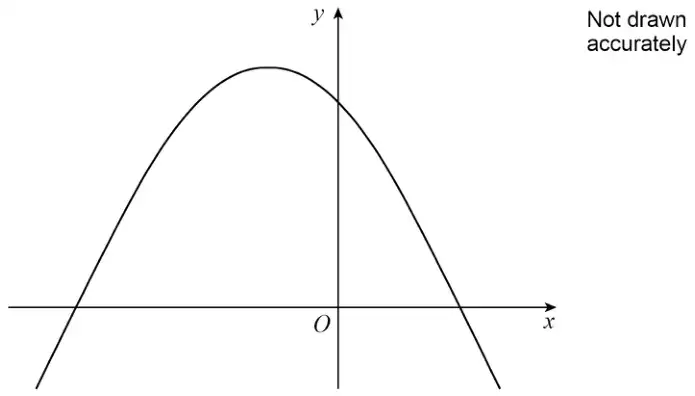
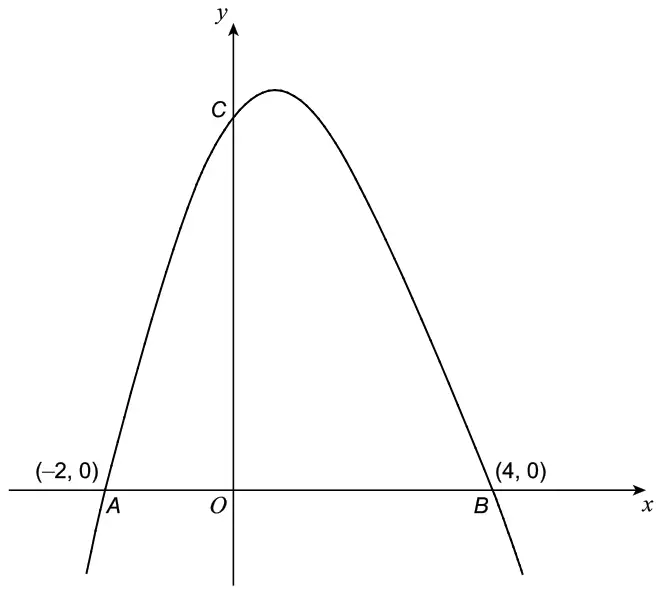
21 Here is a sketch of \(\quad y = (x + 2)(4 - x)\)
The graph intersects the axes at \(A\) (\(-2\), 0), \(B\) (4, 0) and \(C\).
Not drawn accurately
(a) Work out the coordinates of \(C\). [1 mark]
(b) Work out the gradient function of the curve. [3 marks]
(c) The normal to the curve at \(C\) intersects the \(x\)-axis at \(D\).
Show that \(\qquad\) length \(BD = 2 \times\) length \(AB\) [5 marks]
Mark scheme (a)
Answer
Mark
Comments
(0, 8)
B1
Additional guidance
Answer line takes precedence over working lines and diagram
Answer line blank with \(C\) labelled (0, 8) on diagram
B1
Answer line blank with 8 written next to \(C\) on diagram
B0
(8, 0)
B0
Answer 8
B0
Mark scheme (b)
Answer
Mark
Comments
\(-x^2 - 2x + 4x + 8\)
M1
Allow one error but no omission Must have an \(x^2\) term Terms may be seen in a grid Implied by \(-x^2 + 2x + k \quad k \neq 0\) or \(ax^2 + 2x + 8 \quad a \neq 0\)
\(-x^2 - 2x + 4x + 8\) or \(-x^2 + 2x + 8\)
A1
\(-x^2 - 2x + 4x + 8\) but an error in any collection of terms is M1A0
\(-2x - 2 + 4\) or \(-2x + 2\) or \(-2(x - 1)\) or \(2(1 - x)\)
A1ft
oe ft their quadratic in \(x\) with M1 awarded
Additional guidance
\(2 - 2x\) with final answer 2 (from substituting in \(x = 0\))
M1A1A0
Condone \(y = 2 - 2x\) or \(\mathrm{f}(x) = 2 - 2x\) in working for M1A1 If (\(\dfrac{\mathrm{d}y}{\mathrm{d}x}\) or \(\mathrm{f}'(x)\) =) \(2 - 2x\) on answer line also award final A1
\(y = 2 - 2x\) or \(\mathrm{f}(x) = 2 - 2x\) on answer line
M1A1A0
When marking (b), a maximum of M1A1A0 can be awarded from an expansion seen on the previous page if not contradicted by an expansion in (b) The final A1 must be seen in (b) eg1 (b) no expansion seen with an answer of \(2x + 2\) At top of previous page \(\ -x^2 + 2x + 8\) eg2 (b) no expansion seen with an answer of \(-2x + 6\) In (a) \(\ -x^2 + 2x + 4x + 8 = -x^2 + 6x + 8\)
M1A1A0
M1A0A1ft
Correct use of product rule and gradient function \(= -2x + 2\)
3 marks
Mark scheme (c)
Answer
Mark
Comments
Alternative method 1
(gradient of curve at \(C\) =) 2
B1ft
Correct or ft their (b) when \(x = 0\) May be implied
\(-\dfrac{1}{\text{their } 2}\) or \(-\dfrac{1}{2}\)
M1
oe ft their 2 Only ft a non-zero numerical value (gradient of normal =) \(-\dfrac{1}{2}\) is B1M1
\(y = \left(\text{their } -\dfrac{1}{2}\right)x +\) their 8 or \(y -\) their \(8 =\) their \(-\dfrac{1}{2}(x - 0)\)
M1dep
Must have used gradient of normal not gradient of tangent Correct or ft their 8 from (a) in the form (0, \(k\))
\(0 = \left(\text{their } -\dfrac{1}{2}\right)x +\) their 8 or \(0 -\) their \(8 =\) their \(-\dfrac{1}{2}(x - 0)\) or \(x = 16\)
M1dep
Correct or ft their 8 from (a) in the form (0, \(k\))
\(x = 16\) and \(BD = 12\) and \(AB = 6\) with correct method seen
A1
oe
Alternative method 2
(gradient of curve at \(C\) =) 2
B1ft
Correct or ft their (b) when \(x = 0\) May be implied
\(-\dfrac{1}{\text{their } 2}\) or \(-\dfrac{1}{2}\)
M1
oe ft their 2 Only ft a non-zero numerical value (gradient of normal =) \(-\dfrac{1}{2}\) is B1M1
\(\dfrac{0 - \text{their } 8}{x - 0} =\) their \(-\dfrac{1}{2}\) or \(x = -\)their \(8 \div\) their \(-\dfrac{1}{2}\) or \(x = 16\)
M2dep
oe Correct or ft their 8 from (a) in the form (0, \(k\))
\(x = 16\) and \(BD = 12\) and \(AB = 6\) with correct method seen
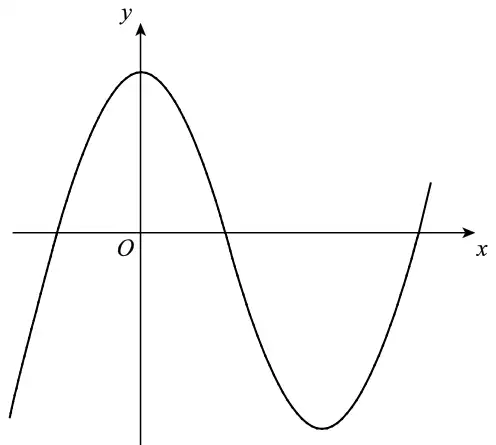
17 Here is a sketch of \(\quad y = x^3 - 6x^2 + 7\)
Not drawn accurately
(a) Use differentiation to work out the coordinates of the stationary point that is a minimum.
You must show your working. [4 marks]
(b) The three roots of \(\quad x^3 - 6x^2 + 7 = 0 \quad\) are the \(x\)-coordinates of the points where the graph intersects the \(x\)-axis.
Show that \(\ x = -1\ \) is one root of \(\quad x^3 - 6x^2 + 7 = 0\) [1 mark]
(c) Hence, work out the other two roots of \(\quad x^3 - 6x^2 + 7 = 0\)
Give your answers to 2 decimal places.
You must show your working. [5 marks]
Mark scheme (a)
Answer
Mark
Comments
\(3x^2\) or \((-)12x\)
M1
Attempt at \(\dfrac{\mathrm{d}y}{\mathrm{d}x}\)
their \((3x^2 - 12x) = 0\)
M1dep
Must have at least 2 terms for their \(\dfrac{\mathrm{d}y}{\mathrm{d}x}\) The \(= 0\) can be implied by sight of a correct non-zero solution to their \((3x^2 - 12x) = 0\)
\(x = 4\) (and \(x = 0\))
A1ft
ft M2 if their \(\dfrac{\mathrm{d}y}{\mathrm{d}x}\) is a 2-term quadratic
(4, \(-25\)) with correct expression for \(\dfrac{\mathrm{d}y}{\mathrm{d}x}\) seen
A1
Additional guidance
Condone \(y = 3x^2 - 12x\) etc
M1
Ignore working for second derivative or testing for minimum point
Stating \(\dfrac{\mathrm{d}y}{\mathrm{d}x} = 0\) is not sufficient for second M mark but may be implied by correct solution(s) seen
Mark scheme (b)
Answer
Mark
Comments
Alternative method 1
\((-1)^3 - 6(-1)^2 + 7 = 0\) with no incorrect evaluations seen or \(-1 - 6 + 7 = 0\)
B1
Must have \(= 0\)
Alternative method 2
\((x + 1)(x^2 - 7x + 7) = 0\) and \((x + 1) = 0\) and \(x = -1\)
oe eg \(\dfrac{7}{2} \pm \sqrt{\dfrac{21}{4}}\) Correct attempt to solve their 3-term quadratic Allow recovery of brackets Allow \(7^2\) for \((-7)^2\) Implied by correct solutions to their 3-term quadratic seen
oe eg \(\dfrac{7}{2} \pm \sqrt{\dfrac{21}{4}}\) Correct attempt to solve their 3-term quadratic Allow recovery of brackets Allow \(7^2\) for \((-7)^2\) Implied by correct solutions to their 3-term quadratic seen
5.79 and 1.21 with \(x^2 - 7x + 7\ (= 0)\) seen
A1
Must both be to 2 dp
Additional guidance
Final A1 mark can be awarded if both answers seen in working with \(x^2 - 7x + 7\ (= 0)\) seen but only one answer is written on answer line
\((x + 1)\) followed by 5.79 and 1.21 without \(x^2 - 7x + 7\ (= 0)\) seen
M1M0A0 M0A0
\((x - 1)\) instead of \((x + 1)\) can score a maximum of M0M0A0M1A0
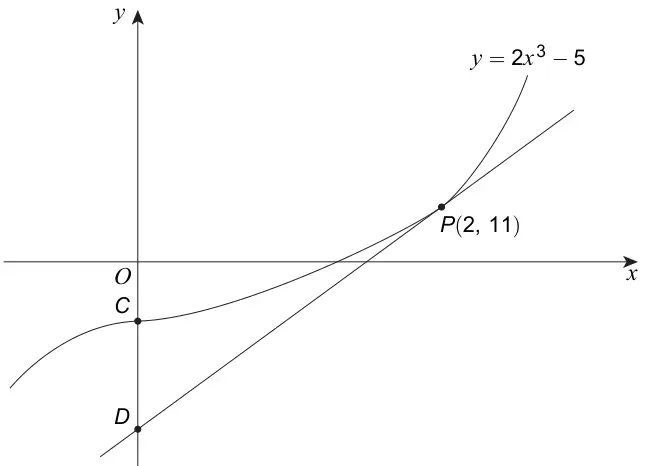
25 The curve \(\ y = 2x^3 - 5\ \) intersects the \(y\)-axis at \(C\).
The tangent to the curve at \(P(2, 11)\) intersects the \(y\)-axis at \(D\).
Not drawn accurately
Work out the length \(CD\). [6 marks]
Mark scheme
Answer
Mark
Comments
\(y\)-coordinate of \(C\) is \(-5\) or \((0, -5)\)
B1
May be on diagram or implied by final answer
\(3 \times 2x^2\) or \(6x^2\)
M1
Differentiates correctly
\(6 \times 2 \times 2\) or 24
M1
Substitutes \(x = 2\) in their \(\dfrac{\mathrm{d}y}{\mathrm{d}x}\) their \(\dfrac{\mathrm{d}y}{\mathrm{d}x}\) must be a function of \(x\) but cannot be \(2x^3 - 5\)
\(y - 11 =\) their \(24\,(x - 2)\) or \(y =\) their \(24x + c\) and substitutes (2, 11) or \(y = 24x - 37\)
M1dep
dep on 2nd M1
\(y - 11 =\) their \(24\,(0 - 2)\) or \(y = 0 - 37\) or \(y = -37\) or (\(y\)-coordinate of \(D =\)) \(-37\)
M1dep
Substitutes \(x = 0\) into their linear equation dep on 3rd M1 May be seen on diagram 11 − 2 × their 24 scores 3rd M1 and 4th M1
32
A1ft
ft B0 M4 with a positive length from their \(y\)-coordinate of \(C - -37\)
Additional guidance
\(-32\)
A0
\((-5, 0)\) is B0 unless recovered
1st M1 Allow \(6x^2 + c\) (\(c\) an unknown constant) if \(c\) subsequently rejected
Differentiates to \(6x^2 - 5\) 1st M0 gradient \(= 6 \times 2^2 - 5 = 19\) 2nd M1 Could continue and gain 3rd M1 and 4th M1
3rd M1 Cannot be the equation of the normal at (2, 11)
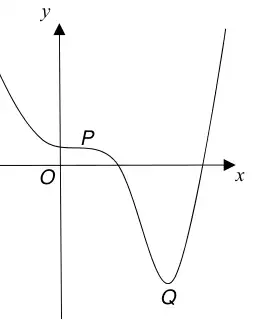
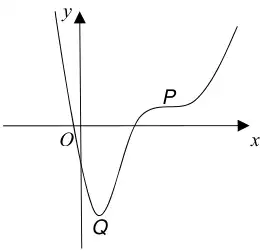
19 The continuous curve \(\ y = \mathrm{g}(x)\ \) has exactly two stationary points.
The stationary points are
a point of inflection at \(P(1, 2)\)
a minimum point at \(Q(a, b)\) where \(a \gt 1\) and \(b \lt 0\)
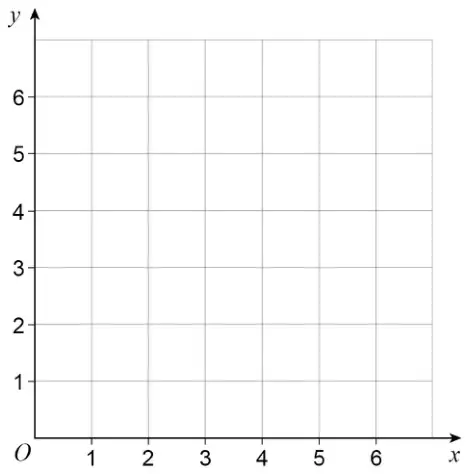
On the axes below, sketch the curve.
Label points \(P\) and \(Q\) on your sketch. [3 marks]
Mark scheme
Answer
Mark
Comments
Continuous curve with point of inflection, labelled \(P\) or (1, 2), in first quadrant and minimum point, labelled \(Q\) or \((a, b)\), in fourth quadrant, with \(x\)-coordinate of Q > \(x\)-coordinate of \(P\) eg
B3
For B3, allow the labelling of one coordinate as sufficient for each point B2 As B3 but not sufficiently labelled B1 Curve with point of inflection, labelled \(P\) or (1, 2), in first quadrant or curve with minimum point, labelled \(Q\) or \((a, b)\), in fourth quadrant
For B1, allow labelling using one coordinate as sufficient
SC2 As B3 but \(x\)-coordinate of Q < \(x\)-coordinate of \(P\) eg
Additional guidance
For B3, curve does not have to cross the \(x\)-axis after \(Q\) and does not have to cross the \(y\)-axis before \(P\)
For a stationary point, curve must not stop at the point
At \(P\), the curve must change from concave upward to concave downward for B3 or B2 or vice-versa for B1 or SC2
Note that other non-stationary points of inflection may also be seen (up to B3 possible)
Curve may have horizontal asymptotes as \(x \to \pm\infty\) (up to B3 possible)
Mark intention for stationary points, positioning of labels and smoothness of curve
More than 1 stationary point of inflection and/or more than 1 minimum point and/or maximum point(s) can score a maximum of B1
Labelling using a coordinate or coordinates may be seen by labelling on an axis or on axes (axes may also show other numbers)