B1 answers may be embedded eg1 \(0 \leqslant n^2 \lt 25\) eg2 \(-25 \lt n^2 \leqslant 25\)
B1 B1
Accept equivalents throughout eg \(25 \geqslant n^2 \geqslant 0\)
B2
B2 or B1 response in working with integer(s) on answer line is awarded B1 Condone integer(s) linked to \(n\) or \(n^2\) eg1 \(n^2 \leqslant 25\) in working Answer 1 2 3 4 5 eg2 \(0 \leqslant n^2 \leqslant 25\) in working Answer \(n^2 = 25\)
Work out all the possible integer values of \(n\). [2 marks]
Mark scheme
Answer
Mark
Comments
\(-2\quad -1\quad 0\quad 1\quad 2\) with no other values
B2
B1 \(-2\quad -1\quad 0\quad 1\quad 2\) with one other value or four of \(-2\quad -1\quad 0\quad 1\quad 2\) with no other values SC1 \(-2 \leqslant n \leqslant 2\) or \(-3 \lt n \lt 3\) or 5 with B2 response in working
Additional guidance
Mark the answer line eg B2 seen in working with \(-2\quad -1\quad 1\quad 2\) on answer line
B1
Integers can be in any order
Accept eg \(x\) for \(n\)
\([-2, 2]\) is equivalent to \(-2 \leqslant n \leqslant 2\)
SC1
\((-3, 3)\) is equivalent to \(-3 \lt n \lt 3\)
SC1
Answer \(-2\quad -1\quad 0\quad 1\quad 2\) and \(-2 \leqslant n \leqslant 2\)
Working with = 0 does not score 3rd M unless recovered to the correct answer eg \(3ax^3 - 2ax + 5x \qquad 9ax^2 - 2a + 5 = 0 \qquad a = 2.5\) Answer \(a \lt 2.5\)
M1M1 M1A1
Working with \(\lt 0\) (or \(\leqslant 0\)) does not score 3rd M and cannot be recovered eg \(3ax^3 - 2ax + 5x \qquad 9ax^2 - 2a + 5 \lt 0\) \(-2a + 5 \lt 0 \qquad\) Answer \(a \lt 2.5\)
M1M1M0 A0
Correct answer may come from other incorrect methods eg \(3ax^3 - 2ax + 5x \qquad -2ax + 5x \gt 0\) \(-2a + 5 \gt 0 \qquad\) Answer \(a \lt \dfrac{5}{2}\)
M1M0 M0A0
Allow the first two marks for fully correct use of the product rule for differentiation (M0M0 if not fully correct) eg \(ax \times 6x + (3x^2 - 2) \times a + 5\)
M1M1
\(3ax^3 - 2ax + 5x\) \(9x^2 - 2a + 5\)
M1 M0
\(3ax^2 - 2ax + 5x\) \(6ax - 2a + 5\)
M0 M1
\(3ax^3 - 2ax\) \(9ax^2 - 2a\) (their derivative does not contain 3 terms)
M1 M0
Ignore higher derivatives
Allow interval notation eg (0, 2.5]
Condone \(0 \leqslant a \lt 2.5\) or \(0 \leqslant a \leqslant 2.5\)
14 Solve \(\quad \dfrac{8}{x} + 3x \leqslant 10 \quad\) where \(x\) is positive. [4 marks]
Mark scheme
Answer
Mark
Comments
\(3x^2 - 10x + 8\) or \(-3x^2 + 10x - 8\)
M1
Factorising \((3x - 4)(x - 2)\) or completing the square \(\left(x - \dfrac{5}{3}\right)^2 - \dfrac{1}{9}\) or \(3\left(x - \dfrac{5}{3}\right)^2 - \dfrac{1}{3}\) or formula \(\dfrac{10 \pm \sqrt{4}}{6}\)
M1dep
\((3x - 4)(3x - 6)\) is acceptable for M1dep here
\(\dfrac{4}{3}\) and 2
M1 dep
oe – such as \(1.\dot{3}\) or \(1\dfrac{1}{3}\) or \(\dfrac{4}{3}\) or \(\dfrac{8}{6}\) can be seen in any format or inequality (correct or incorrect) eg \(\dfrac{4}{3} \gt x\)
\(\dfrac{4}{3} \leqslant x \leqslant 2\)
A1
oe – could be written as two separate inequalities but do not accept \(\dfrac{8}{6}\) at this stage as an oe \(\dfrac{4}{3} \leqslant x\) and \(x \leqslant 2\) must see the word ‘and’ in this format incorrect inequality signs is A0
Additional guidance
Candidates may presume that there may be a negative solution and reverse the inequality They may however work this through and then realise it is giving the incorrect values when they test it. They can then correct themselves to still gain full marks
M3 A0
M3 A1
Students attempting T&I to get the solutions would need to get both solutions to get M3. If they then put that into the correct inequality it will be M3 A1
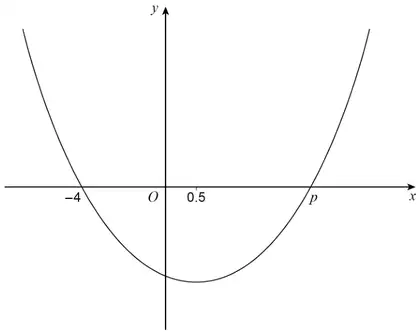
7 Here is a sketch of the curve \(\quad y = ax^2 + bx + c \quad\) where \(a\), \(b\) and \(c\) are constants.
The curve intersects the \(x\)-axis at \((-4, 0)\) and \((p, 0)\)
The turning point has \(x\)-coordinate 0.5
(a) Work out the value of \(p\). [1 mark]
(b) Solve \(\quad ax^2 + bx + c \gt 0\) [2 marks]
Mark scheme (a)
Answer
Mark
Comments
5
B1
condone (5, 0) but not (0, 5)
Additional guidance
Condone 5 or (5, 0) next to \(p\) on sketch if answer line blank
B1
Mark scheme (b)
Answer
Mark
Comments
Either of \(x \lt -4 \qquad x \gt \text{their } 5\)
M1
oe eg \(-4 \gt x\) correct or ft their 5 in (a) their 5 in (a) must be greater than 0.5 condone \(\leqslant\) for \(\lt\) condone \(\geqslant\) for \(\gt\)
Both of \(x \lt -4 \qquad x \gt \text{their } 5\)
A1ft
correct or ft their 5 in (a) their 5 in (a) must be greater than 0.5 must be two separate inequalities
Additional guidance
Ignore the use of or/and eg1 \(x \lt -4\) or \(x \gt 5\) eg2 \(x \lt -4\) and \(x \gt 5\)
M1A1 M1A1
Condone embedded even if in an invalid statement for M1 but not A1 eg1 \(-4 \gt x \gt 5\) eg2 \(-4 \gt x \gt 6\)
M1A0 M1A0
If answer to (a) is 4 \(x \lt -4 \qquad x \gt 4\)
M1A1ft
If answer to (a) is blank eg1 \(x \lt -4\) eg2 \(x \lt -4 \qquad x \gt 5\)
M1A0 M1A1
\(-4 \lt x \lt 5\)
M0A0
If answer to (a) is eg (0, 4) take their 5 to be 4
Condone eg \(x = \lt -4\) for M1 but not A1
Allow eg \((-\infty, -4)\) for \(x \lt -4\) (condone eg \([-\infty, -4)\) for M1 but not A1)
5 Work out all the negative integer values of \(x\) for which \(\quad 3x^2 \lt 48\) [3 marks]
Mark scheme
Answer
Mark
Comments
\(-3 \quad -2 \quad -1\) with no other values
B3
any order B2 \(-3 \quad -2 \quad -1\) with one other value or any two of \(-3 \quad -2 \quad -1\) with no other values or inequality for which the only integer values are \(-3 \quad -2 \quad -1\) eg \(-4 \lt x \lt 0\) or \(-3 \leqslant x \leqslant -1\) or \(-4 \lt x \leqslant -1\) B1 \(-4 \lt x \lt 4\) or \(-3 \quad -2 \quad -1 \quad (0) \quad 1 \quad 2 \quad 3\) with no other values or one of \(-3 \quad -2 \quad -1\) with no other values or \(x^2 \lt \dfrac{48}{3}\) or \(x^2 \lt 16\) or \(3(x + 4)(x - 4) \lt 0\) or \((x + 4)(x - 4) \lt 0\)
Additional guidance
B1 may be awarded for correct work with no, or incorrect answer, even if this is seen amongst multiple attempts
Answer \(-3 \quad -2 \quad -1\) with no other values (no need to check working)
B3
\(-4 \lt x \lt 0\) is equivalent to the two inequalities \(x \gt -4 \quad x \lt 0\) etc
B2
For B1 allow equivalent factorised inequalities or equivalent inequalities with coefficient 1 for \(x^2\) eg1 \((3x + 12)(x - 4) \lt 0\) eg2 \(3(4 + x)(4 - x) \gt 0\) eg3 \(x^2 - \dfrac{48}{3} \lt 0\)
B1 B1 B1
\((-4, 0)\) or \([-3, -1]\) etc
B2
\((-4, 4)\)
B1
Only \(x \gt -4\) or only \(x \lt \pm 4\) or only \(x \lt 4\)
B0
Condone B3 response in working with any inequality on answer line
B3
Condone B3 response in working with 3 on answer line (3 is likely to be the number of integers)
B3
Only invalid inequalities with no or incorrect answer
(a) Work out all the integer values of \(x\) for which
\(-5 \lt 4x + 3 \leqslant 13\) [3 marks]
(b) Work out the range of values of \(x\) for which
\(x^2 - 11x + 28 \gt 0\)
You must show your working. [3 marks]
Mark scheme (a)
Answer
Mark
Comments
\(-5 - 3 \lt 4x \leqslant 13 - 3\) or \(-8 \lt 4x \leqslant 10\) or \(-1.25 \lt x + 0.75 \leqslant 3.25\) or \(x \leqslant 2.5\) or \(x \gt -2\) or \(x \leqslant 2\) or \(x \geqslant -1\)
M1
could be embedded eg \(-2 \leqslant x \leqslant 2.5\)
\(\dfrac{\text{their } -8}{4} \lt x \leqslant \dfrac{\text{their } 10}{4}\) or their \(-1.25 - 0.75 \lt x \leqslant\) their \(3.25 - 0.75\) or \(-2 \lt x \leqslant 2.5\) or \(-2 \lt x \leqslant 2\) or \(-1 \leqslant x \leqslant 2.5\) or \(-1 \leqslant x \leqslant 2\) or \(x \leqslant 2.5\) and \(x \gt -2\) or \(x \leqslant 2\) and \(x \gt -2\) or \(x \leqslant 2.5\) and \(x \geqslant -1\) or \(x \leqslant 2\) and \(x \geqslant -1\)
M1dep
oe eg \((-2,\ 2.5]\) or \([-1,\ 2.5]\)
\(-1 \quad 0 \quad 1 \quad 2\) with no incorrect working
A1
Additional guidance
Answer only \(\ -1 \quad 0 \quad 1 \quad 2\)
M2A1
Answer only \(\ -1 \quad 1 \quad 2\)
Zero
\(x = 2.5\) and \(x = -2\) (from solving equations) followed by \(\ -1 \quad 0 \quad 1 \quad 2\)
M2A1
\(x = 2.5\) and \(x = -2\) (from solving equations)
Zero
\(-1 \quad 0 \quad 1 \quad 2\ \) with no incorrect working and a correct inequality on answer line
M2A1
\(-1 \quad 0 \quad 1 \quad 2\ \) in working but \(\ -1 \quad 1 \quad 2\ \) on answer line
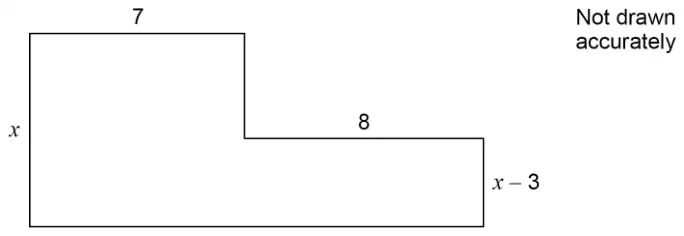
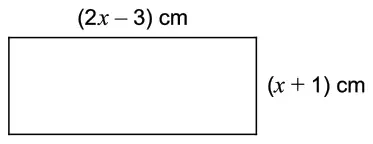
(a) Show that the area of the rectangle is \(\quad 2x^2 - x - 3\) cm\(^2\) [1 mark]
(b) The area of the rectangle is greater than 7 cm\(^2\)
Work out the range of possible values of \(x\).
Give your answer as an inequality. [4 marks]
Mark scheme (a)
Answer
Mark
Comments
\(2x^2 - 3x + 2x - 3\)
B1
terms can be written in any order
Additional guidance
Must show all four terms.
Mark scheme (b)
Answer
Mark
Comments
\(2x^2 - x - 10\) (\(\gt 0\))
M1
oe must have three terms eg \(2x^2 \gt x + 10\) Condone \(2x^2 - x - 10\) (\(= 0\)) oe eg \(2x^2 - x = 10\)
correct factors \(\quad (2x - 5)(x + 2)\)
M1dep
For use of quadratic formula ... condone one numerical or sign error
Sight of 2.5 and \(-2\)
A1
\(x \gt 2.5\)
A1
oe Must have seen \(x = 2.5\) and \(x = -2\) and reject the negative solution
Additional guidance
This is a quadratic inequality so we need to see an attempt at finding the two critical values then making a decision as to the correct solution
SC1 for \(x \gt 2.5\) with no working SC1 for \(x \gt 2.5\) from T&I
If T&I done such that both critical values (2.5 and \(-2\)) have been identified and tested (eg they give 7 when substituted in the expression \(2x^2 - x - 3\)) then it is possible to score 3 marks or 4 marks
\(x \leqslant -\dfrac{3}{2}\) or \(x \leqslant -1.5\) or \(x \lt -\dfrac{3}{2}\) or \(x \lt -1.5\) or \(x \leqslant -2\) or \(-2, -3\) (, \(-4\), ....)
A1
\(-2.2 \lt x \leqslant -1.5\) or \(-2 \leqslant x \leqslant -1.5\) implies M1A1M1A1
\(-2\) with no other values given
A1
Must have gained M1A1M1A1
Alternative method 2
Shows that \(-2\) satisfies either \(-11 \lt 5x \leqslant 5\) or \(6x + 7 \leqslant 4x + 4\)
M1
eg \(-11 \lt -10 \leqslant 5\) or \(5x = -10\) and yes
Shows that \(-2\) satisfies both \(-11 \lt 5x \leqslant 5\) and \(6x + 7 \leqslant 4x + 4\)
A1
Shows that \(-1\) does not satisfy \(6x + 7 \leqslant 4x + 4\) or shows that \(-3\) does not satisfy \(-11 \lt 5x \leqslant 5\)
M1
eg \(-6 + 7 \gt -4 + 4\)
Shows that \(-1\) does not satisfy \(6x + 7 \leqslant 4x + 4\) and shows that \(-3\) does not satisfy \(-11 \lt 5x \leqslant 5\)
A1
\(-2\) with no other values given
A1
Must have gained M1A1M1A1
Alternative method 3
\(-\dfrac{11}{5} \lt x \leqslant \dfrac{5}{5}\) or \(-2.2 \lt x \leqslant \dfrac{5}{5}\)
M1
oe eg \(x \leqslant \dfrac{5}{5}\) and \(x \gt -\dfrac{11}{5}\)
\(-\dfrac{11}{5} \lt x \leqslant 1\) or \(-2.2 \lt x \leqslant 1\) or \(-2 \leqslant x \leqslant 1\) or \(-2, -1, 0, 1\)
A1
oe eg \(x \leqslant 1\) and \(x \gt -\dfrac{11}{5}\)
Shows that \(-2\) satisfies \(6x + 7 \leqslant 4x + 4\) or shows that \(-1\) does not satisfy \(6x + 7 \leqslant 4x + 4\)
\(x \leqslant -\dfrac{3}{2}\) or \(x \leqslant -1.5\) or \(x \lt -\dfrac{3}{2}\) or \(x \lt -1.5\) or \(x \leqslant -2\) or \(-2, -3\) (, \(-4\), ....)
A1
Shows that \(-2\) satisfies \(-11 \lt 5x \leqslant 5\) or shows that \(-3\) does not satisfy \(-11 \lt 5x \leqslant 5\)
M1
eg \(-11 \lt -10 \leqslant 5\) or \(5x = -10\) and yes
Shows that \(-2\) satisfies \(-11 \lt 5x \leqslant 5\) and shows that \(-3\) does not satisfy \(-11 \lt 5x \leqslant 5\)
A1
\(-2\) with no other values given
A1
Must have gained M1A1M1A1
Additional guidance
Allow eg max 1 and min \(-2.2\) for \(-2.2 \lt x \leqslant 1\), unless contradicted by a list of values
Condone omission of non-critical values from lists eg \(-2, -1, 1\)
Using = signs when solving inequalities can score M marks only unless recovered
Incorrect notation eg \(\leqslant\) for \(\lt\) can score M marks only
If answers to trials evaluated they must be correct
Choose the scheme that favours the student
\(-2\) identified as the only integer with no valid working