June 2025 Paper 1 Q13
13 Here are four sketch graphs.
Circle the letter of the sketch graph that represents \(\quad y = 5^x\) [1 mark]
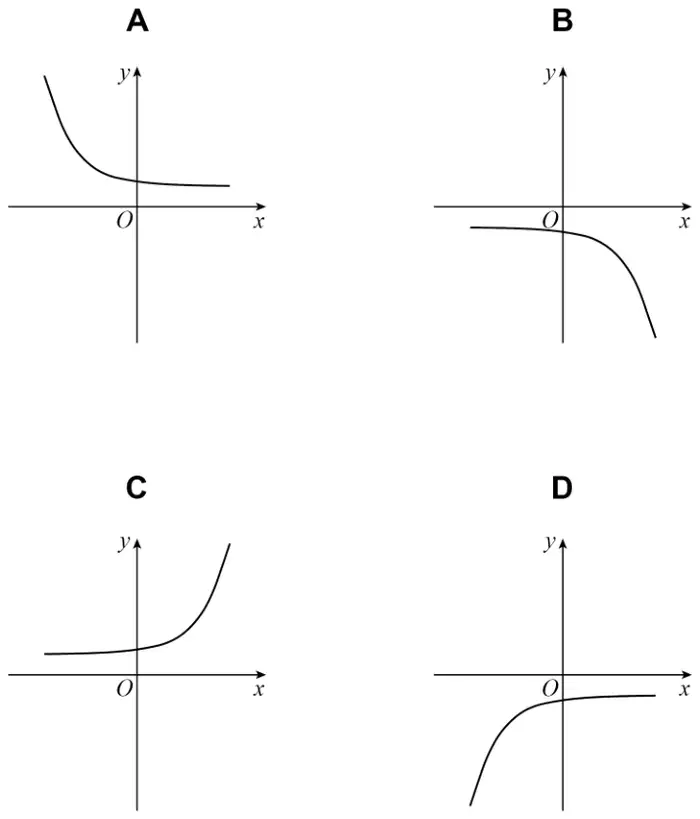
- A
- B
- C
- D
| Answer | Mark | Comments |
|---|---|---|
| C | B1 |

Understand it. Practise it. Enjoy it. All for free.
Course Support Current PowerPoint version
More questions on this topic: GCSE Algebra: Indices (178) IGCSE Algebra: Indices (174)
13 Here are four sketch graphs.
Circle the letter of the sketch graph that represents \(\quad y = 5^x\) [1 mark]
| Answer | Mark | Comments |
|---|---|---|
| C | B1 |
8 Work out \(\quad \left(\dfrac{x^{\frac{9}{2}}}{x^{\frac{1}{2}}}\right)^3 \quad\) as a power of \(x\).
Circle your answer. [1 mark]
| Answer | Mark | Comments |
|---|---|---|
| \(x^{12}\) | B1 |
7
\(2^{5a + 1} = 2^a\)
Work out the value of \(a\). [2 marks]
\(3^{-7} \div 3^c = \left(3^{-3}\right)^{2c}\)
Work out the value of \(c\). [3 marks]
| Answer | Mark | Comments |
|---|---|---|
| \(5a + 1 = a\) or \(2^{5a - a + 1} = 1\) or \(2^{5a - a + 1} = 2^0\) | M1 | oe linear equation eg \(4a = -1\) or oe index equation in the form \(2^{\mathrm{f}(a)} = 1\) or \(2^{\mathrm{f}(a)} = 2^0\) |
| \(-\dfrac{1}{4}\) or \(-0.25\) | A1 | oe value |
| Only \(\dfrac{2^{5a + 1}}{2^a} = 1\) | M0 |
| Answer | Mark | Comments |
|---|---|---|
| \(3^{-7 - c}\) or \(3^{-6c}\) or \(-7 - c\) and \(-6c\) | M1 | oe eg \(\dfrac{1}{3^{7 + c}}\) or \(\dfrac{1}{3^{6c}}\) or \(3^{-3 \times 2c}\) implied by a correct equation equating powers of 3 eg \(3^{-7} = 3^{-5c}\) |
| \(-7 - c = -6c\) | M1dep | oe linear equation eg \(5c = 7\) |
| \(\dfrac{7}{5}\) or 1.4 | A1 | oe value condone \(\dfrac{-7}{-5}\) |
| \(\dfrac{1}{3^7} \div 3^c\) needs further processing for M1 | |
| \(\dfrac{1}{(3^3)^{2c}}\) needs further processing for M1 |
21
\[\left(2^{x + 3}\right)^{4x + 1} = 8^{x - 1}\]Work out the possible values of \(x\). [5 marks]
| Answer | Mark | Comments |
|---|---|---|
| \(2^{(4x + 1)(x + 3)}\) or \(2^{4x^2 + 13x + 3}\) | M1 | lhs |
| \(\left(2^3\right)^{x - 1}\) or \(2^{3(x - 1)}\) or \(2^{3x - 3}\) | M1 | rhs |
| \(4x^2 + 12x + x + 3 = 3x - 3\) or \(4x^2 + 10x + 6\ (= 0)\) or \(2x^2 + 5x + 3\ (= 0)\) | M1dep | oe with expanded brackets dependent on both M marks \(4x^2 + 12x + x + 3\) implies first M mark \(3x - 3\) implies second M mark |
| \((2x + 3)(x + 1)\ (= 0)\) or if quadratic formula used \(\dfrac{-5 \pm \sqrt{5^2 - 24}}{4}\) or better | M1dep | oe factorised |
| \(-1\) and \(-1\dfrac{1}{2}\) or \(\dfrac{-3}{2}\) or \(-1.5\) | A1 |
| Both answers correct without working will get all marks | M4A1 |
| Only one solution correct without working scores nothing | M0A0 |
| No oe for A mark | |
| Possible to make both sides powers of 8. Mark to the equivalent of this MS |
16 Simplify \(\quad \dfrac{\sqrt{x^3}\left(\sqrt{x^3} + x^3\right)}{\sqrt{x}}\)
Give your answer in the form \(\quad x^{\frac{a}{b}} + x^c \quad\) where \(a\), \(b\) and \(c\) are integers. [3 marks]
| Answer | Mark | Comments |
|---|---|---|
| \(x^{\frac{5}{2}} + x^4\) | B3 | B2 \(x^{\frac{5}{2}}\ (+ \ldots)\) or \((\ldots +)\ x^4\) B1 correct expansion of numerator eg \(\sqrt{x^3} \times \sqrt{x^3} + \sqrt{x^3} \times x^3\) or \(x^3 + x^{\frac{9}{2}}\) or correct expression with fraction eliminated eg \(\sqrt{x^2}\left(\sqrt{x^3} + x^3\right)\) or \(x\left(\sqrt{x^3} + x^3\right)\) or \(\sqrt{x^3}\left(\sqrt{x^2} + x^{\frac{5}{2}}\right)\) |
| B1 may be awarded for correct work with no answer or incorrect answer, even if this is seen amongst multiple attempts | |
| B1 may be awarded after multiplication by \(\dfrac{\sqrt{x}}{\sqrt{x}}\) eg \(\dfrac{\sqrt{x^3}\left(\sqrt{x^3} + x^3\right)}{\sqrt{x}} \times \dfrac{\sqrt{x}}{\sqrt{x}} = \dfrac{\sqrt{x^4}\left(\sqrt{x^3} + x^3\right)}{x}\) \(\dfrac{\sqrt{x^7} + x^3\sqrt{x^4}}{x}\) (B1 at this stage for correct expansion of numerator) | B1 |
| Check the answer line and award B3 or B2 if possible Otherwise check the working for B2 or B1 | |
| Condone \(x^4 + x^{\frac{5}{2}}\) | B3 |
| Accept oe values for fractional powers for up to B2 | |
| Accept eg \(x^{\frac{10}{4}} + x^4\) | B3 |
14 \(P\) is the point on the graph \(\quad y = 3^{-x} \quad\) that has \(x\)-coordinate \(-2\)
\(Q\) is a point on the graph \(\quad y = 1152 \times \left(\dfrac{1}{2}\right)^x\)
\[y\text{-coordinate of } P = y\text{-coordinate of } Q\]Work out the \(x\)-coordinate of \(Q\). [3 marks]
| Answer | Mark | Comments |
|---|---|---|
| \(3^2\) or 9 | M1 | oe value for \(y\) eg \(3^{--2}\) |
| \(\left(\dfrac{1}{2}\right)^x = \dfrac{\text{their } 9}{1152}\) or \(\dfrac{1}{2^x} = \dfrac{1}{128}\) | M1dep | oe equation with exponential term isolated eg \(2^{-x} =\) [0.0078, 0.007813] or \(2^x = 128\) |
| 7 | A1 |
| M1 may be awarded for correct work with no answer or incorrect answer, even if this is seen amongst multiple attempts | |
| Missing brackets must be recovered eg1 \(\dfrac{1}{2}^{x} = \dfrac{9}{1152}\) with no further correct work eg2 \(\dfrac{1}{2}^{x} = \dfrac{9}{1152}\) with answer 7 | M1M0A0 M2A1 |
| Logarithms may be seen eg \(\log\left(\dfrac{1}{2}\right)^x = \log\dfrac{9}{1152}\) or \((x =)\ \log_{0.5}\dfrac{1}{128}\) | M1M1 |
8
\[y = \frac{1}{2}x^2 + \frac{3}{4x^4}\]Work out \(\quad \dfrac{\mathrm{d}^2y}{\mathrm{d}x^2}\)
Give your answer in the form \(\quad a + bx^n \quad\) where \(a\), \(b\) and \(n\) are integers. [3 marks]
| Answer | Mark | Comments |
|---|---|---|
| \(1 + 15x^{-6}\) | B3 | B2 answer \((\ldots +)\ 15x^{-6}\) or answer \((\ldots +)\ \dfrac{15}{x^6}\) or \(x\) and \(-3x^{-5}\) B1 \(x\) or \(-3x^{-5}\) SC2 \(1 - 15x^{-6}\) |
| Answer must be in the required form | |
| eg \(1 + 15x^{-6}\) in working with answer \(1 + \dfrac{15}{x^6}\) | B2 |
| Accept equivalents for \(x\) eg \(\dfrac{1}{2} \times 2x^{2-1}\) | |
| Accept equivalents for \(-3x^{-5}\) eg \(-\dfrac{3}{x^5}\) or \(\dfrac{3}{4} \times -4 \times x^{-4-1}\) | |
| \(\ldots\) may be incorrect or blank | |
| Condone \(15x^{-6} + 1\) | B3 |
| Condone \(1 + -15x^{-6}\) or \(1 + -\dfrac{15}{x^6}\) | SC2 |
| Condone eg \(y = x - 3x^{-5}\) | B2 |
5
\[y = \frac{4x^3 + x^7}{x^4}\]Work out \(\quad \dfrac{\mathrm{d}y}{\mathrm{d}x}\) [3 marks]
| Answer | Mark | Comments |
|---|---|---|
| \(4x^{-1}\) or \(\dfrac{4}{x}\) or \(x^3\) | M1 | either term correct (ignore additional terms) |
| \(-4x^{-2}\) or \(3x^2\) | A1 | a correct term differentiated correctly (must be just two terms before differentiation) accept \(-\dfrac{4}{x^2}\) |
| \(\left(\dfrac{\mathrm{d}y}{\mathrm{d}x} =\right) -4x^{-2} + 3x^2\) | A1 | both terms correct accept \(-\dfrac{4}{x^2}\) |
| Quotient rule or product rule used to achieve correct simplified answer | M1A2 |
| Quotient rule or product rule used with incorrect or unsimplified answer | M0A0 |
| \(\dfrac{-4 + 3x^4}{x^2}\) | M1A2 |
| Penalise additional incorrect further working eg \(\dfrac{-1}{4x^2}\) for the final A mark |
1 Work out the value of \(\quad \sqrt{\dfrac{t}{20}} \quad\) where \(\quad t = 2.42 \times 10^3\) [2 marks]
| Answer | Mark | Comments |
|---|---|---|
| 2420 or 121 or \(1.21 \times 10^2\) | M1 | doesn’t need to be seen in a correct expression |
| 11 | A1 | accept \(\pm 11\) |
| Condone \(t = 11\) | M1A1 |
| Condone \(1.1 \times 10^1\) or \(1.1 \times 10\) | M1A1 |
| \(\dfrac{1210}{10}\) or \(\dfrac{242}{2}\) | M1 |
| \(\dfrac{\sqrt{121}}{10}\) whilst incorrect would gain the method mark for 121 | M1 |
15 The function g is given by \(\quad \mathrm{g}(x) = a \times b^x \quad\) where \(a\) and \(b\) are constants.
The domain of the function is \(\quad -1 \leqslant x \leqslant 2\)
\(P\left(0, \dfrac{1}{2}\right)\) and \(Q\left(1, \dfrac{3}{2}\right)\) are points on the graph \(\quad y = \mathrm{g}(x)\)
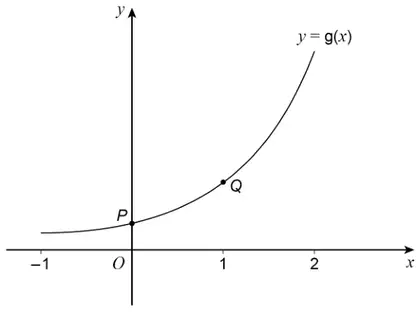
Not drawn accurately
Work out the range of the function. [4 marks]
| Answer | Mark | Comments |
|---|---|---|
| \(\dfrac{1}{2} = a \times b^0\) or \(a = \dfrac{1}{2}\) or \(\dfrac{3}{2} = a \times b^{(1)}\) | M1 | oe eg \(a \times 1 = 0.5\) or \(ab = 1.5\) |
| (\(a =\)) \(\dfrac{1}{2}\) and (\(b =\)) 3 | A1 | oe values may be implied eg \(y = \dfrac{1}{2} \times 3^x\) |
| their \(\dfrac{1}{2} \times (\text{their } 3)^{-1}\) or \(\dfrac{1}{2} \times \dfrac{1}{3}\) or \(\dfrac{1}{6}\) and their \(\dfrac{1}{2} \times (\text{their } 3)^2\) or \(\dfrac{1}{2} \times 3^2\) or \(\dfrac{9}{2}\) | M1 | oe neither their \(\dfrac{1}{2}\) nor their 3 can be 0 or 1 \(\dfrac{1}{6}\) and \(\dfrac{9}{2}\) is M1A1M1 ignore other calculations or values |
| \(\dfrac{1}{6} \leqslant \mathrm{g}(x) \leqslant \dfrac{9}{2}\) or both of \(\mathrm{g}(x) \geqslant \dfrac{1}{6} \qquad \mathrm{g}(x) \leqslant \dfrac{9}{2}\) | A1ft | oe eg \(\left[\dfrac{1}{6}, \dfrac{9}{2}\right]\) only ft M1A0M1 |
| Ignore words if answer given as separate inequalities eg1 \(\mathrm{g}(x) \geqslant \dfrac{1}{6}\) or \(\mathrm{g}(x) \leqslant \dfrac{9}{2}\) eg2 \(\mathrm{g}(x) \geqslant \dfrac{1}{6}\) and \(\mathrm{g}(x) \leqslant 4.5\) | M1A1M1A1 M1A1M1A1 |
| \(a = \dfrac{1}{2}\) and \(b = 2\) \(\dfrac{1}{4} \leqslant \mathrm{g}(x) \leqslant 2\) | M1A0 M1A1ft |
| Condone \(\mathrm{g}(x)\) replaced by eg \(y\) or g or g\(x\) or \(\mathrm{f}(x)\) or f or f\(x\) or \(a \times b^x\) | |
| Do not allow \(\mathrm{g}(x)\) to be replaced by \(x\) for the final mark eg \(\dfrac{1}{6} \leqslant x \leqslant \dfrac{9}{2}\) | M1A1M1A0 |
| Equivalent inequalities may be seen eg \(\dfrac{9}{2} \geqslant \mathrm{g}(x) \geqslant \dfrac{1}{6}\) | M1A1M1A1 |
| Inequality symbols must be correct eg \(\dfrac{1}{6} \lt \mathrm{g}(x) \leqslant \dfrac{9}{2}\) or \(\dfrac{1}{6} \leqslant \mathrm{g}(x) \geqslant \dfrac{9}{2}\) | M1A1M1A0 |
| \(\dfrac{1}{6} \leqslant \mathrm{g}(x) \leqslant \dfrac{9}{2}\) in working with list of integers on answer line | M1A1M1A0 |
| Only a list of integers | M0A0M0A0 |
| Allow 0.16(…) or 0.17 for \(\dfrac{1}{6}\) | |
| Correct answer followed by incorrect further work eg \(\dfrac{1}{6} \leqslant \mathrm{g}(x) \leqslant \dfrac{9}{2}\) and \(\left(\dfrac{9}{2} - \dfrac{1}{6} =\right) \dfrac{13}{3}\) | M1A1M1A0 |
15 Solve \(\quad \left(x^{\frac{1}{2}} - x^{\frac{3}{2}}\right)^2 = x^2 + x\) [4 marks]
| Answer | Mark | Comments |
|---|---|---|
| \(x - x^2 - x^2 + x^3 \quad (= x^2 + x)\) | M1 | allow error in 1 term but must not have missing terms (could be seen in a grid) if they go straight to \(x - 2x^2 + x^3\) then M1 if they go straight to \(x - kx^2 + x^3\) where \(k\) is not 2 then this could be more than one error so M0 |
| \(x^3 - 3x^2 = 0\) or \(x^3 = 3x^2\) | M1dep | no ft |
| \(x^2(x - 3)(= 0)\) | M1 | factorising their equation fully and correctly (must have \(x^3\) plus/minus other term(s) in \(x^n\) where n\(\neq\)0). |
| (\(x =\)) 0 and (\(x =\)) 3 | A1 | condone \(x = 0\) \(x = 0\) \(x = 3\) |
| First M mark could be done in root form but would still need to end up with \(x - x^2 - x^2 + x^3 \quad (= x^2 + x)\) for M1 | |
| Candidates may divide by \(x\) at some point during the method. If they do this and state that \(x = 0\) is a solution at this point, the method can be continued to a correct outcome for full marks or \(x^2 - 3x = 0\) or \(x^2 = 3x\) would be M1dep and \(x(x - 3)(= 0)\) would be the third M mark eg \(x - x^2 - x^2 + x^3 = x^2 + x\) \(1 - x - x + x^2 = x + 1\) with \(x = 0\) \(x^2 - 3x = 0\) If they do not state \(x = 0\) is a solution and continue to a correct solution then award full marks but if it’s not stated and they don’t get to the correct solution then no further marks available as soon as the division is done eg \(x - x^2 - x^2 + x^3 = x^2 + x\) \(1 - x - x + x^2 = x + 1\) (no mention of \(x = 0\) being a possible solution) \(x^2 - 3x = 0\) | M1 M1dep M1 M0dep |
| If no other marks awarded then \(x = 0\) or \(x = 3\) seen on answer line (or the last thing they have written) | SC1 |
| \(x = 0\) and \(x = 3\) not from incorrect working | M3 A1 |
13
Work out the least possible values of \(c\) and \(d\). [3 marks]
| Answer | Mark | Comments |
|---|---|---|
| \(\dfrac{3}{x^7}\) | B1 |
| Answer | Mark | Comments |
|---|---|---|
| \(\dfrac{3w^2}{4}\) or \(0.75w^2\) | B2 | B1 unsimplified equivalent fraction with brackets processed eg \(\dfrac{12w^8}{16w^6}\) or \(\dfrac{12w^2}{16}\) or \(\dfrac{6w^2}{8}\) or \(\dfrac{3w^5}{4w^3}\) SC1 \(\dfrac{3w^3}{4}\) or \(0.75w^3\) or \(3w^2\) |
| B1 may be awarded for correct work with no answer or incorrect answer, even if this is seen amongst multiple attempts | |
| \(\dfrac{3}{4}w^2\) is equivalent to \(\dfrac{3w^2}{4}\) etc |
| Answer | Mark | Comments |
|---|---|---|
| \(c = 6\) and \(d = 5\) | B3 | B2 \(y^{\frac{5k}{6k}}\) or \(\sqrt[6k]{y^{5k}}\) or \(\left(y^{5k}\right)^{\frac{1}{6k}}\) or \(\left(y^{\frac{1}{6k}}\right)^{5k}\) where \(k\) is an integer \(\geqslant 1\) or \(\left(\dfrac{1}{2} + \dfrac{1}{3} =\right) \dfrac{5}{6}\) oe fractions or \(\left(\dfrac{c}{2} + \dfrac{c}{3} =\right) \dfrac{5c}{6}\) oe fractions or \(5c = 6d\) oe equation B1 \(y^{\frac{1}{2}}\) or \(y^{\frac{1}{3}}\) or \(y^{\frac{c}{2}}\) or \(y^{\frac{c}{3}}\) or \(\left(y^c\right)^{\frac{1}{2}}\) or \(\left(y^c\right)^{\frac{1}{3}}\) or \(y^{\frac{d}{c}}\) or \(\left(y^{\frac{1}{c}}\right)^d\) or \(\left(y^d\right)^{\frac{1}{c}}\) or \(\dfrac{1}{2} + \dfrac{1}{3}\) oe sum of fractions or \(\dfrac{c}{2} + \dfrac{c}{3}\) oe sum of fractions SC2 \(c = 6k\) and \(d = 5k\) where \(k\) is an integer \(\geqslant 2\) |
| Up to B2 may be awarded for correct work with no answer or incorrect answer, even if this is seen amongst multiple attempts | |
| \(\dfrac{3}{6} + \dfrac{2}{6} = \dfrac{5}{6}\) | B2 |
| \(\dfrac{3}{6} + \dfrac{2}{6}\) | B1 |
| \(\dfrac{10}{12}\) or \(y^{\frac{10}{12}}\) | B2 |
| \(c = 18\) and \(d = 15\) | SC2 |
| \(\dfrac{1}{2}\) may be 0.5 | |
| Only trialling numerical values for \(y\) is B0 or B3 |
22 Using powers of 2 or otherwise, work out the non-zero value of \(x\) for which
\[\left(16^x\right)^x = \dfrac{1}{2^{3x}}\]You must show your working. [4 marks]
| Answer | Mark | Comments |
|---|---|---|
| Alternative method 1 Uses powers of 2 | ||
| \((16^x =)\; 2^{4x}\) or \(((16^x)^x =)\; (2^4)^{x^2}\) | M1 | implied by \(((16^x)^x =)\; 2^{4x^2}\) may be implied by 3rd M1 |
| \(((16^x)^x =)\; 2^{4x^2}\) | M1dep | implied by \(2^{4x^2 + 3x}\) may be implied by 3rd M1 |
| Correct quadratic equation or correct linear equation or correct equation involving indices with the same base | M1dep | eg \(4x^2 = -3x\) or \(4x^2 + 3x = 0\) or \(4x = -3\) or \(2^{4x^2} = 2^{-3x}\) or \(2^{4x^2 + 3x} = 2^0\) do not allow if the equation is from incorrect working do not allow if the only equation is \(x = -\dfrac{3}{4}\) |
| M3 and \(-\dfrac{3}{4}\) | A1 | oe ignore inclusion of answer 0 |
| Alternative method 2 Uses powers of 16 | ||
| \(((16^x)^x =)\; 16^{x^2}\) or \(\left(\dfrac{1}{2^{3x}} =\right) \dfrac{1}{\left(16^{\frac{1}{4}}\right)^{3x}}\) | M1 | implied by \(\left(\dfrac{1}{2^{3x}} =\right) \dfrac{1}{16^{\frac{3x}{4}}}\) or \(\left(\dfrac{1}{2^{3x}} =\right) 16^{-\frac{3x}{4}}\) may be implied by 3rd M1 |
| \(((16^x)^x =)\; 16^{x^2}\) and \(\left(\dfrac{1}{2^{3x}} =\right) \dfrac{1}{16^{\frac{3x}{4}}}\) | M1dep | oe eg \(((16^x)^x =)\; 16^{x^2}\) and \(\left(\dfrac{1}{2^{3x}} =\right) 16^{-\frac{3x}{4}}\) may be implied by 3rd M1 |
| Correct quadratic equation or correct linear equation or correct equation involving indices with the same base | M1dep | eg \(x^2 = -\dfrac{3}{4}x\) or \(4x^2 + 3x = 0\) or \(16^{x^2} = 16^{-\frac{3x}{4}}\) do not allow if the equation is from incorrect working do not allow if the only equation is \(x = -\dfrac{3}{4}\) |
| M3 and \(-\dfrac{3}{4}\) | A1 | oe ignore inclusion of answer 0 |
| Alternative method 3 Uses powers of 4 | ||
| \((16^x =)\; 4^{2x}\) or \(((16^x)^x =)\; (4^2)^{x^2}\) or \(\left(\dfrac{1}{2^{3x}} =\right) \dfrac{1}{\left(4^{\frac{1}{2}}\right)^{3x}}\) | M1 | implied by \(((16^x)^x =)\; 4^{2x^2}\) or \(\left(\dfrac{1}{2^{3x}} =\right) \dfrac{1}{4^{\frac{3x}{2}}}\) or \(\left(\dfrac{1}{2^{3x}} =\right) 4^{-\frac{3}{2}x}\) may be implied by 3rd M1 |
| \(((16^x)^x =)\; 4^{2x^2}\) and \(\left(\dfrac{1}{2^{3x}} =\right) \dfrac{1}{4^{\frac{3x}{2}}}\) | M1dep | oe \(((16^x)^x =)\; 4^{2x^2}\) and \(\left(\dfrac{1}{2^{3x}} =\right) 4^{-\frac{3}{2}x}\) may be implied by 3rd M1 |
| Correct quadratic equation or correct linear equation or correct equation involving indices with the same base | M1dep | eg \(2x^2 = -\dfrac{3}{2}x\) or \(4x^2 + 3x = 0\) or \(4^{2x^2} = 4^{-\frac{3}{2}x}\) do not allow if the equation is from incorrect working do not allow if the only equation is \(x = -\dfrac{3}{4}\) |
| M3 and \(-\dfrac{3}{4}\) | A1 | oe ignore inclusion of answer 0 |
| Alternative method 4 Takes the \(x\)th root of each side and uses powers of 2 | ||
| \((16^x =)\; 2^{4x}\) or \(16^x = \left(\dfrac{1}{2^{3x}}\right)^{\frac{1}{x}}\) | M1 | oe eg \(16^x = \sqrt[x]{\dfrac{1}{2^{3x}}}\) or \(16^x = \dfrac{1}{2^3}\) or \(16^x = 2^{-3}\) may be implied by 3rd M1 |
| \(2^{4x} = \left(\dfrac{1}{2^{3x}}\right)^{\frac{1}{x}}\) | M1dep | oe eg \(2^{4x} = \dfrac{1}{2^3}\) may be implied by 3rd M1 |
| Correct quadratic equation or correct linear equation or correct equation involving indices with the same base | M1dep | eg \(4x = -3\) or \(2^{4x} = 2^{-3}\) do not allow if the equation is from incorrect working do not allow if the only equation is \(x = -\dfrac{3}{4}\) |
| M3 and \(-\dfrac{3}{4}\) | A1 | oe ignore inclusion of answer 0 |
| Up to M2 may be awarded for correct work with no, or incorrect answer, even if this is seen amongst multiple attempts | |
| Allow \(2^{4 \times x \times x}\) for \(2^{4x^2}\) etc | |
| Responses using other powers eg powers of 8 can be escalated | Escalate |
| Ignore simplification or conversion if correct answer seen |
15 Simplify fully \(\qquad \left(\dfrac{x}{2} + \dfrac{3x}{5}\right) \div \sqrt{\dfrac{x^6}{4}}\) [5 marks]
| Answer | Mark | Comments |
|---|---|---|
| Alternative method 1 Processes the brackets then divides | ||
| \(\dfrac{5x}{10} + \dfrac{6x}{10}\) | M1 | oe valid common denominator with both numerators correct eg \(\dfrac{10x}{20} + \dfrac{12x}{20}\) |
| \(\dfrac{11x}{10}\) | A1 | oe single term eg \(\dfrac{22x}{20}\) or \(1.1x\) may be implied eg by single term with roots evaluated that is equivalent to \(\dfrac{11}{5x^2}\) |
| \(\dfrac{x^{6 \div 2}}{2}\) or \(\dfrac{x^3}{2}\) | M1 | may be implied eg by multiplication by \(\dfrac{2}{x^3}\) |
| their \(\dfrac{11x}{10} \times \dfrac{2}{x^3}\) or \(\dfrac{22x}{10x^3}\) or \(\dfrac{22}{10x^2}\) or \(\dfrac{11x}{5x^3}\) or \(\dfrac{22}{10}x^{-2}\) | M1dep | oe multiplication eg \(\dfrac{11x}{10} \times 2x^{-3}\) their \(\dfrac{11x}{10}\) can be unprocessed dep on 2nd M1 |
| \(\dfrac{11}{5x^2}\) or \(\dfrac{11}{5}x^{-2}\) or \(2.2x^{-2}\) | A1 | allow \(2\dfrac{1}{5}x^{-2}\) or \(\dfrac{2.2}{x^2}\) |
| Alternative method 2 Divides then expands the brackets | ||
| \(\dfrac{x^{6 \div 2}}{2}\) or \(\dfrac{x^3}{2}\) | M1 | may be implied eg by multiplication by \(\dfrac{2}{x^3}\) |
| \(\left(\dfrac{x}{2} + \dfrac{3x}{5}\right) \times \dfrac{2}{x^3}\) | M1dep | oe multiplication eg \(\left(\dfrac{x}{2} + \dfrac{3x}{5}\right) \times 2x^{-3}\) |
| \(\dfrac{2x}{2x^3} + \dfrac{6x}{5x^3}\) or \(\dfrac{1}{x^2} + \dfrac{6}{5x^2}\) | M1dep | oe expansion of brackets |
| \(\dfrac{10x}{10x^3} + \dfrac{12x}{10x^3}\) or \(\dfrac{5}{5x^2} + \dfrac{6}{5x^2}\) or \(\dfrac{22x}{10x^3}\) or \(\dfrac{22}{10x^2}\) or \(\dfrac{11x}{5x^3}\) or \(\dfrac{22}{10}x^{-2}\) | M1dep | oe valid common denominator with both numerators correct eg \(\dfrac{10x^4}{10x^6} + \dfrac{12x^4}{10x^6}\) or \(\dfrac{22x^4}{10x^6}\) roots must be processed |
| \(\dfrac{11}{5x^2}\) or \(\dfrac{11}{5}x^{-2}\) or \(2.2x^{-2}\) | A1 | allow \(2\dfrac{1}{5}x^{-2}\) or \(\dfrac{2.2}{x^2}\) |
| Any single fraction with roots evaluated that is equivalent to \(\dfrac{11}{5x^2}\) | 4 marks |
| Allow inclusion of \(\pm\) from the square root for up to 4 marks | |
| \(\dfrac{11}{5x^2}\) in working with answer \(\dfrac{11}{5}x^2\) | 4 marks |
| Alt 1 \(\dfrac{11x}{10}\) subsequently squared and not recovered | M1A1 M0M0A0 |
13 Simplify fully \(\quad (6x^3y^{-2} + 9x^5y) \div 3x^2y^{-3}\) [3 marks]
| Answer | Mark | Comments |
|---|---|---|
| 2 and 3 | B1 | coefficients |
| \(x\) and \(x^3\) | B1 | |
| \(y\) and \(y^4\) | B1 |
| \(2xy + 3x^3y^4\) or \(xy(2 + 3x^2y^3)\) scores B3 If no B marks awarded then \(3x^3(2y^{-2} + 3x^2y)\) or \(3x^3y(2y^{-3} + 3x^2)\) or \(3x^3y^{-2}(2 + 3x^2y^3)\) or \(3x^2(2xy^{-2} + 3x^3y)\) or \(3x^2y(2xy^{-3} + 3x^3)\) or \(3x^2y^{-2}(2x + 3x^3y^3)\) seen in the working for the numerator Penalise incorrect further working for the B marks | B3 SC1 |
12 Work out the gradient of the curve \(\qquad y = \dfrac{12x^3 - 8x + 3}{4x^2}\)
at the point where \(\quad x = -1\)
You must show your working. [5 marks]
| Answer | Mark | Comments |
|---|---|---|
| \(3x\) or \(-2x^{-1}\) or \(0.75x^{-2}\) | M1 | oe must have powers of \(x\) simplified eg \(\dfrac{12x}{4}\) or \(-\dfrac{2}{x}\) or \(\dfrac{3}{4x^2}\) |
| \(3x\) and \(-2x^{-1}\) and \(0.75x^{-2}\) | M1dep | oe must have powers of \(x\) simplified eg \(\dfrac{12x}{4}\) and \(-\dfrac{2}{x}\) and \(\dfrac{3}{4x^2}\) |
| Any one of \(3x\) and \(3(x^0)\) or \(-2x^{-1}\) and \(2x^{-2}\) or \(0.75x^{-2}\) and \(-1.5x^{-3}\) | M1 | oe eg \(\dfrac{12x}{4}\) and \(\dfrac{12}{4}x^{1 - 1}\) or \(-\dfrac{2}{x}\) and \(\dfrac{2}{x^2}\) or \(-\dfrac{2}{x}\) and \(- -2x^{-2}\) or \(\dfrac{3}{4x^2}\) and \(-\dfrac{3}{2x^3}\) implies 1st M1 for the derivatives \(x\) may be \((-1)\) |
| At least two of \(3x\) and \(3(x^0)\) or \(-2x^{-1}\) and \(2x^{-2}\) or \(0.75x^{-2}\) and \(-1.5x^{-3}\) | M1dep | oe dep on 3rd M1 for the derivatives \(x\) may be \((-1)\) |
| All three terms and their derivatives correct and 6.5 | A1 | oe eg all three terms and their derivatives correct and \(\dfrac{13}{2}\) for the derivatives \(x\) may be \((-1)\) SC3 104 |
| Up to M4 may be awarded for correct work with no, or incorrect answer, even if this is seen amongst multiple attempts | |
| \(\dfrac{3}{4x^2}\) seen but subsequently incorrectly simplified eg \(12x^{-2}\) (subsequent marks may be scored) | (1st) M1 |
| Correct answer after correct use of quotient rule or product rule | M4A1 |
| Incorrect answer after use of quotient rule or product rule | Zero |
| Condone \(y = 3 + 2x^{-2} \ldots\) etc | |
| All three terms and their derivatives correct and 6.5 in working but different answer eg \(y = 6.5x \ldots\) | M4A0 |
| SC3 is for multiplying the numerator by \(4x^{-2}\) with no subsequent errors |
10 Here are four sketch graphs.
Circle the letter of the sketch graph that represents \(\quad y = 3 \times 2^x\) [1 mark]
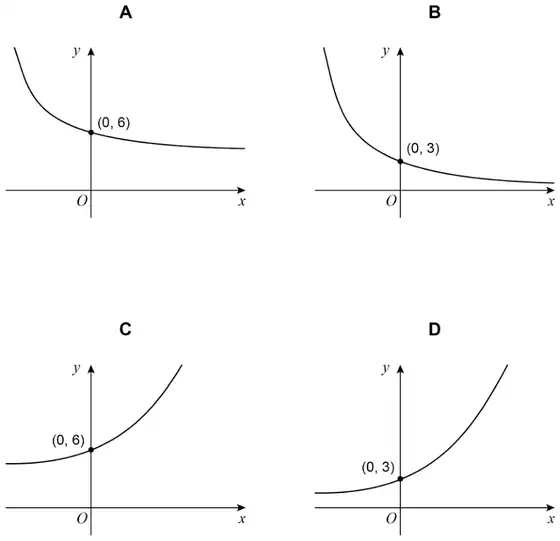
| Answer | Mark | Comments |
|---|---|---|
| D | B1 |
22 Solve \(\quad 8^x = \dfrac{2^{56} - 4^{26}}{30}\) [4 marks]
| Answer | Mark | Comments |
|---|---|---|
| Alternative method 1 Working with powers of 2 | ||
| \(2^{3x}\) or \(2^{52}\) | B1 | from \(8^x\) and \(4^{26}\) |
| \(2^{52}(2^4 - 1)\) or \(2^{52} \times 15\) or \(2 \times 8^x = 2^{52}\) or \(2 \times 2^{3x} = 2^{52}\) | M1 | oe |
| \(2^{3x + 1} = 2^{52}\) or \(3x + 1 = 52\) | M1dep | oe eg \(2^{3x} = 2^{51}\) |
| 17 | A1 | |
| Alternative method 2 Working with powers of 4 | ||
| \(4^{1.5x}\) or \(4^{28}\) | B1 | from \(8^x\) and \(2^{56}\) |
| \(4^{26}(4^2 - 1)\) or \(4^{26} \times 15\) or \(2 \times 4^{1.5x} = 4^{26}\) | M1 | oe |
| \(4^{1.5x} = \dfrac{4^{26}}{4^{0.5}}\) or \(1.5x = 26 - 0.5\) | M1dep | oe eg \(4^{1.5x} = 4^{25.5}\) |
| 17 | A1 | |
| Alternative method 3 Working with powers of 8 | ||
| \(8^{\frac{56}{3}}\) or \(8^{\frac{52}{3}}\) | B1 | from \(2^{56}\) and \(4^{26}\) |
| \(8^{\frac{52}{3}}\left(8^{\frac{4}{3}} - 1\right)\) or \(8^{\frac{52}{3}} \times 15\) or \(2 \times 8^x = 8^{\frac{52}{3}}\) | M1 | oe |
| \(8^x = 8^{\frac{52}{3}} \div 8^{\frac{1}{3}}\) or \(x = \dfrac{52}{3} - \dfrac{1}{3}\) | M1dep | oe eg \(8^x = 8^{17}\) |
| 17 | A1 | |
13 Here is a sketch of \(\quad y = k^x \quad\) where \(\quad k \gt 0\)
\(A\left(2,\ 3\frac{1}{16}\right)\) is a point on the curve.
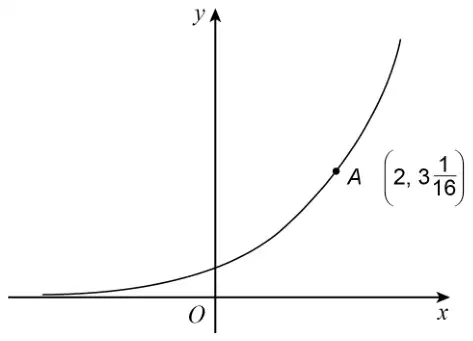
Not drawn accurately
Work out the \(y\)-coordinate of \(B\). [1 mark]
| Answer | Mark | Comments |
|---|---|---|
| \(k^2 = \dfrac{49}{16}\) or \(k = \sqrt{\dfrac{49}{16}}\) | M1 | oe |
| \(\dfrac{7}{4}\) | A1 | oe |
| \(-\dfrac{7}{4}\) or \(\pm\dfrac{7}{4}\) will not gain the A mark unless recovered | M1A0 |
| Answer | Mark | Comments |
|---|---|---|
| \(\dfrac{4}{7}\) | B1ft | oe allow decimal rounded to 2dp or better ft their (a) but not if \(k = 0\) or 1 |
| \(\dfrac{1}{\frac{4}{7}}\) | B0 |
7
Work out the value of \(m\) for which \(\quad (a^m)^4 = (a^5)^{2m}\) [2 marks]
Write \(y\) in terms of \(w\) and \(x\).
Give your answer in its simplest form. [2 marks]
| Answer | Mark | Comments |
|---|---|---|
| \(a^{4m}\) or \(a^{10m}\) or \(4m = 10m\) | M1 | oe eg \(a^{4 \times m}\) |
| 0 | A1 |
Allow \(a\) to be replaced by any value greater than 1
| Answer | Mark | Comments |
|---|---|---|
| \(w^{13}x^7 \div w^3x^2\) or \(w^{10}x^5\) or \(x^2y^5 = w^{10}x^7\) or \(y^5 = \dfrac{w^{10}x^7}{x^2}\) or \(w^3y^5 = w^{13}x^5\) or \(y^5 = \dfrac{w^{13}x^5}{w^3}\) | M1 | oe eg \(\dfrac{w^{13}x^7}{w^3x^2}\) may be embedded eg \(\sqrt[5]{w^{10}x^5}\) |
| \(w^2x^{(1)}\) | A1 | oe eg \(xw^2\) |
| \(y = w^{10}x^5\) | M1A0 |
18 Solve \(\quad x^{-\frac{2}{3}} = 12\dfrac{1}{4}\) [3 marks]
| Answer | Mark | Comments |
|---|---|---|
| \(\left(x^{-\frac{2}{3}} =\right)\ \dfrac{49}{4}\) or \(x^{\frac{2}{3}} = \dfrac{4}{49}\) | M1 | |
| \(\left(\dfrac{49}{4}\right)^{\frac{3}{2}}\) or \(\left(\dfrac{4}{49}\right)^{\frac{3}{2}}\) | M1dep | oe |
| \(\dfrac{8}{343}\) | A1 |
17 By multiplying both sides of the equation by \(x^{\frac{1}{2}}\)
Solve \(\quad 2x^{\frac{3}{2}} - 3x^{\frac{1}{2}} = 7x^{-\frac{1}{2}} \qquad\) for \(\quad x \gt 0\)
Give your answer to 3 significant figures.
You must show your working. [4 marks]
| Answer | Mark | Comments |
|---|---|---|
| \(2x^2 - 3x = 7\) | M1 | at least two terms correct |
| \(2x^2 - 3x - 7\ (= 0)\) | A1 | oe 3-term quadratic equation |
| \(\dfrac{--3 \pm \sqrt{(-3)^2 - 4 \times 2 \times -7}}{2 \times 2}\) or \(\dfrac{3}{4} \pm \sqrt{\dfrac{65}{16}}\) | M1 | oe correct attempt to solve their 3-term quadratic equation |
| 2.77 | A1 | 2.77 and \(-1.27\) is A0 |
15 Here is a sketch of the curve \(\quad y = ab^{-x} \quad\) where \(a\) and \(b\) are positive constants.
(0, 3) and (2, 0.48) lie on the curve.
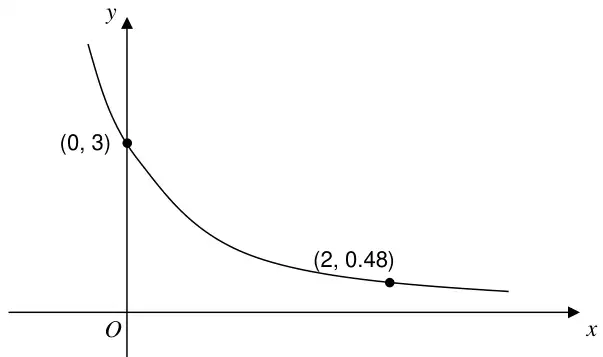
Not drawn accurately
Work out the values of \(a\) and \(b\). [4 marks]
| Answer | Mark | Comments |
|---|---|---|
| \(a = 3\) | B1 | |
| \(0.48 =\) their \(3 \times b^{-2}\) | M1 | oe |
| \(b^2 = \dfrac{\text{their } 3}{0.48}\) or \(b^2 = 6.25\) \(\sqrt{\dfrac{\text{their } 3}{0.48}}\) or \(\sqrt{6.25}\) | M1dep | oe |
| \(b = 2.5\) | A1ft | ft B0M2 |
10 \(\mathrm{f}(x) = \left(\dfrac{9x}{2}\right)^{-1}\)
\(\mathrm{g}(x) = \sqrt{1 - px^3} \qquad\) where \(p\) is a constant.
Given that \(\ \mathrm{f}\left(\dfrac{1}{3}\right) = \mathrm{g}\left(\dfrac{1}{3}\right)\ \) work out the value of \(p\). [5 marks]
| Answer | Mark | Comments |
|---|---|---|
| \(\dfrac{9}{2} \times \dfrac{1}{3}\) or \(\dfrac{3}{2}\) or \(\dfrac{2}{9x}\) | M1 | oe |
| \(\dfrac{2}{3}\) | A1 | |
| their \(\dfrac{2}{3} = \sqrt{1 - p \times \left(\dfrac{1}{3}\right)^3}\) | M1dep | oe |
| \(\left(\text{their } \dfrac{2}{3}\right)^2 = 1 - p \times \left(\dfrac{1}{3}\right)^3\) | M1dep | oe |
| 15 | A1 |
10
\[y = \frac{6x^9 + x^8}{2x^4}\]Work out the value of \(\quad \dfrac{\mathrm{d}^2y}{\mathrm{d}x^2} \quad\) when \(\quad x = 0.5\) [5 marks]
| Answer | Mark | Comments |
|---|---|---|
| \(\dfrac{6x^9}{2x^4} + \dfrac{x^8}{2x^4}\) or \(3x^5\) or \(\dfrac{1}{2}x^4\) | M1 | |
| \(3x^5 + \dfrac{1}{2}x^4\) | A1 | |
| \(15x^4\) or \(2x^3\) | M1dep | differentiates at least one term correctly |
| \(60x^3 + 6x^2\) | M1dep | differentiates their 2-term \(\dfrac{\mathrm{d}y}{\mathrm{d}x}\) correctly |
| 9 | A1 |
5
\[y = 2x^{10} - \frac{3}{x^2}\]Work out \(\dfrac{\mathrm{d}y}{\mathrm{d}x}\) [3 marks]
| Answer | Mark | Comments |
|---|---|---|
| \(-3x^{-2}\) | M1 | |
| \(20x^9\) or \(+6x^{-3}\) | M1 | |
| \(20x^9 + 6x^{-3}\) | A1 | no additional terms |
2 Solve \(\quad \sqrt[3]{7x - 13} = 2\) [2 marks]
| Answer | Mark | Comments |
|---|---|---|
| \(7x - 13 = 2^3\) or \(7x - 13 = 8\) | M1 | oe |
| 3 | A1 |
1
Circle the value of \(m\). [1 mark]
Work out the value of \(n\). [1 mark]
Work out the value of \(p\). [2 marks]
| Answer | Mark | Comments |
|---|---|---|
| 3 | B1 |
| Answer | Mark | Comments |
|---|---|---|
| 0 | B1 |
| Answer | Mark | Comments |
|---|---|---|
| \(c^{5p}\) or \(c^{12}\) or \(5p = 12\) | M1 | |
| 2.4 or \(\dfrac{12}{5}\) or \(2\dfrac{2}{5}\) | A1 | oe |
9 Factorise fully \(\quad (p + 6)^{11} - (p + 6)^{10}\) [2 marks]
| Answer | Mark | Comments |
|---|---|---|
| \((p + 6)^{10}(p + 5)\) or \((p + 5)(p + 6)^{10}\) | B2 | B1 \((p + 6)^{10}(p + 6 - 1)\) or states \(x = p + 6\) and \(x^{10}(x - 1)\) (any letter for \(x\) other than \(p\)) or correct partial factorisation eg \((p + 6)[(p + 6)^{10} - (p + 6)^9]\) or \((p + 6)^2[(p + 6)^9 - (p + 6)^8]\) |
| Any shape of bracket may be used | |
| \((p + 6)^{10}((p + 6) - 1)\) | B1 |
| Missing brackets must be recovered eg \(\ p + 5\,(p + 6)^{10}\) not recovered and B1 response not seen | B0 |
| Condone \(\ (p + 6)^{10}(p + 5\) | B2 |
| Condone \(\ (p + 6)^{10}(p + 6 - 1\) | B1 |
| \((p + 6)^{10}(p + 5)\) followed by expansion attempt | B1 |
| B1 response followed by expansion attempt | B1 |
| \((p + 6)^{10} \times (p + 5)\) | B1 |
| Condone multiplication signs for B1 eg \(\ (p + 6)^{10} \times (p + 6 - 1)\) | B1 |
| \((p + 6)^{11}\left[1 - \dfrac{1}{p + 6}\right]\) | B1 |
5 Solve \(\quad \sqrt[3]{\left(2\sqrt{x} - 10\right)} = 2\) [3 marks]
| Answer | Mark | Comments |
|---|---|---|
| \(2\sqrt{x} - 10 = 2^3\) or \(2\sqrt{x} - 10 = 8\) or \(2\sqrt{x} = 18\) | M1 | |
| \(\sqrt{x} = \dfrac{2^3+10}{2}\) or \(\sqrt{x} = \dfrac{8+10}{2}\) or \(\sqrt{x} = 9\) or \(4x = 18^2\) or \(x = 9^2\) | M1dep | |
| \(x = 81\) | A1 | \(\pm 81\) scores A0 |
5
| Answer | Mark | Comments |
|---|---|---|
| \(a^{-2}\) | B2 | B1 applies an index law or changes fourth root to fractional or decimal power in a correct expression eg \(\sqrt[4]{a^{-8}}\) or \((a^{-8})^{\frac{1}{4}}\) or \((a^8)^{-\frac{1}{4}}\) or \(a^{-\frac{8}{4}}\) or \(\dfrac{1}{a^{\frac{8}{4}}}\) or \(\dfrac{1}{a^2}\) or \(a^{\frac{1}{4}} \times a^{-\frac{9}{4}}\) or \(a^{\frac{1}{4}} \times \dfrac{1}{a^{\frac{9}{4}}}\) or \(\left(\dfrac{1}{a^8}\right)^{\frac{1}{4}}\) or \(\sqrt[4]{\dfrac{1}{a^8}}\) or \(\sqrt[4]{a \times \dfrac{1}{a^9}}\) or \((a \times a^{-9})^{\frac{1}{4}}\) or \(\left(a \times \dfrac{1}{a^9}\right)^{\frac{1}{4}}\) |
| \(a^{\frac{-8}{4}}\) or \(a^{\frac{8}{-4}}\) | B1 |
| \(a^{-2}\) in working with \(-2\) on answer line | B1 |
| \(a^{-2}\) in working with \(\dfrac{1}{a^2}\) on answer line | B1 |
| B1 response followed by further work is still awarded B1 | |
| Allow 0.25 for \(\dfrac{1}{4}\) etc | |
| Allow recovery of missing brackets |
| Answer | Mark | Comments |
|---|---|---|
| \(32c^2d^2\) or \(32(cd)^2\) | B3 | B2 (numerator \(=\)) \(64c^3d^6\) or single term answer with two of 32, \(c^2\) and \(d^2\) (not in a denominator) B1 single term answer with one of 32, \(c^2\) and \(d^2\) (not in a denominator) SC2 factorised correct expression eg \(16cd(2cd)\) |
| \(2c^2d^2\) or \(32c^2d\) or \(32c^2\) or \(\dfrac{32d^2}{c^3}\) or \(\dfrac{c^2d^2}{32}\) or \(64(cd)^2\) etc | B2 |
| \(32c^3d\) or \(c^2\) or \(\dfrac{d^2}{c}\) or \(\dfrac{c^2d}{32}\) or \(\dfrac{32}{c^2}\) etc | B1 |
| \(\dfrac{32c^2d^2}{1}\) or \(\dfrac{32(cd)^2}{1}\) | B2 |
| Allow denominator of 1 in a B2 or B1 answer eg \(\dfrac{32c^2d}{1}\) | B2 |
| Multiplication signs in a correct expression eg \(32 \times c^2 \times d^2\) | B2 |
| Allow multiplication signs in a B2, SC2 or B1 answer eg \(32 \times c^3 \times d\) | B1 |
| Do not accept \(2^5\) for 32 eg \(2^5c^2d\) | B1 |
| If answer line scores B1 or B0 check working lines for possible response for up to 2 marks | |
| \(32c^2d^2\) in working with different answer on answer line | B2 |
24 Work out the value of \(p\) when
\(9^{0.5p} \times 81 = 27^{2p - 1}\) [4 marks]
| Answer | Mark | Comments |
|---|---|---|
| Alternative method 1 Powers of 3 | ||
| \((3^2)^{0.5p}\) or \((3^3)^{2p - 1}\) or \(3^{2 \times 0.5p + 4}\) | M1 | oe powers of 3 eg \(3^p\) or \(3^{6p - 3}\) or \(3^{p + 4}\) brackets not needed if intention clear eg \(3^{2^{0.5p}}\) |
| \((3^2)^{0.5p}\) and \(3^4\) and \((3^3)^{2p - 1}\) or \(3^{2 \times 0.5p + 4}\) and \((3^3)^{2p - 1}\) | M1dep | oe powers of 3 eg \(3^p\) and \(3^4\) and \(3^{6p - 3}\) or \(3^{p + 4}\) and \(3^{6p - 3}\) |
| \(2 \times 0.5p + 4 = 3(2p - 1)\) or \(p + 4 = 6p - 3\) | M1dep | oe equation dep on M2 |
| 1.4 or \(\dfrac{7}{5}\) | A1 | oe |
| Alternative method 2 Powers of 9 | ||
| \(9^{0.5p + 2}\) or \((9^{1.5})^{2p - 1}\) | M1 | oe power of 9 eg \(9^{3p - 1.5}\) brackets not needed if intention clear eg \(9^{1.5^{2p - 1}}\) |
| \(9^2\) and \((9^{1.5})^{2p - 1}\) or \(9^{0.5p + 2}\) and \((9^{1.5})^{2p - 1}\) | M1dep | oe powers of 9 eg \(9^2\) and \(9^{3p - 1.5}\) or \(9^{0.5p + 2}\) and \(9^{3p - 1.5}\) |
| \(0.5p + 2 = 1.5(2p - 1)\) or \(0.5p + 2 = 3p - 1.5\) | M1dep | oe equation dep on M2 |
| 1.4 or \(\dfrac{7}{5}\) | A1 | oe |
| Alternative method 3 Powers of 27 | ||
| \(\left(27^{\frac{2}{3}}\right)^{0.5p}\) | M1 | oe power of 27 eg \(27^{\frac{2}{3} \times 0.5p}\) or \(27^{\frac{1}{3}p}\) brackets not needed if intention clear eg \(27^{\frac{2}{3}^{0.5p}}\) |
| \(\left(27^{\frac{2}{3}}\right)^{0.5p}\) and \(27^{\frac{4}{3}}\) | M1dep | oe powers of 27 eg \(27^{\frac{2}{3} \times 0.5p}\) and \(27^{\frac{4}{3}}\) or \(27^{\frac{1}{3}p}\) and \(27^{\frac{4}{3}}\) M2 \(\ 27^{\frac{2}{3} \times 0.5p + \frac{4}{3}}\) or \(27^{\frac{1}{3}p + \frac{4}{3}}\) |
| \(\dfrac{2}{3} \times 0.5p + \dfrac{4}{3} = 2p - 1\) or \(\dfrac{1}{3}p + \dfrac{4}{3} = 2p - 1\) | M1dep | oe equation dep on M2 |
| 1.4 or \(\dfrac{7}{5}\) | A1 | oe |
| Alternative method 4 Powers of 81 | ||
| \((81^{0.5})^{0.5p}\) or \((81^{0.75})^{2p - 1}\) or \(81^{0.5 \times 0.5p + 1}\) | M1 | oe powers of 81 eg \(81^{0.25p}\) or \(81^{1.5p - 0.75}\) or \(81^{0.25p + 1}\) brackets not needed if intention clear eg \(81^{0.5^{0.5p}}\) |
| \((81^{0.5})^{0.5p}\) and \((81^{0.75})^{2p - 1}\) or \(81^{0.5 \times 0.5p + 1}\) and \((81^{0.75})^{2p - 1}\) | M1dep | oe powers of 81 eg \(81^{0.25p}\) and \(81^{1.5p - 0.75}\) or \(81^{0.25p + 1}\) and \(81^{1.5p - 0.75}\) |
| \(0.5 \times 0.5p + 1 = 0.75(2p - 1)\) or \(0.25p + 1 = 1.5p - 0.75\) | M1dep | oe equation dep on M2 |
| 1.4 or \(\dfrac{7}{5}\) | A1 | oe |
| Mark positively if potentially more than one scheme used | |
| Answer 1.4 | M3A1 |
| Correct equation implies M3 | |
| Just seeing expressions not in an equation and not as powers scores zero eg Alt 1 \(\ 6p - 3\) and \(p + 4\) not in an equation and not as powers of 3 | M0M0M0 |
| Allow recovery of missing brackets | |
| Use of logs with answer not 1.4 - escalate |
14 Work out the value of \(\quad \left(3^{\frac{1}{2}} + 3^{\frac{3}{2}}\right)^2\)
You must show your working. [3 marks]
| Answer | Mark | Comments |
|---|---|---|
| Alternative method 1 | ||
| \(3^{\frac{1}{2}} \times 3^{\frac{1}{2}} + 3^{\frac{1}{2}} \times 3^{\frac{3}{2}} + 3^{\frac{1}{2}} \times 3^{\frac{3}{2}} + 3^{\frac{3}{2}} \times 3^{\frac{3}{2}}\) or \(\sqrt{3}\sqrt{3} + \sqrt{3}\sqrt{27} + \sqrt{3}\sqrt{27} + \sqrt{27}\sqrt{27}\) | M1 | oe allow an error in one term |
| 3 or 9 or 27 | M1dep | |
| 48 | A1 | |
| Alternative method 2 | ||
| \(\sqrt{3}\) and \(3\sqrt{3}\) | M1 | \(3\sqrt{3}\) must come from correct working |
| \((4\sqrt{3})^2\) | M1dep | |
| 48 | A1 | |
| Alternative method 3 | ||
| \(\left(3^{\frac{1}{2}}\right)^2(1 + 3)^2\) | M1 | oe |
| \(3 \times 4^2\) | M1dep | oe |
| 48 | A1 | |
| Alt 1 mark scheme … likely to see a 3 (or 9 or 27) somewhere, so need to be careful that the M1 mark has been earned before awarding A1 | |
| In alt 1, for the first M1, we want to see an attempt at the full expansion of the correct terms. Probably 4 terms, but there could be 3 if they combine the middle two terms. eg \((\sqrt{3} + 27)(\sqrt{3} + 27)\) scores M0 because it ought to be \(\sqrt{27}\) not 27 |
9 \(y = \dfrac{2x^7 + 15x^2}{3x}\)
Work out the value of \(x\) when \(\quad \dfrac{\mathrm{d}y}{\mathrm{d}x} = 133\) [4 marks]
| Answer | Mark | Comments |
|---|---|---|
| \(\dfrac{2x^6}{3}\) or \(\dfrac{2}{3}x^6\) or \(\dfrac{15x}{3}\) or \(5x\) | M1 | implied by \(\dfrac{2x^6 + \mathrm{a}}{3}\) or \(\dfrac{\mathrm{b} + 15x}{3}\) a can be numerical or algebraic b can be numerical or algebraic allow 0.66… or 0.67 for \(\dfrac{2}{3}\) |
| \(6 \times \dfrac{2x^5}{3}\) or \(\dfrac{12x^5}{3}\) or \(4x^5\) or \(\dfrac{15}{3}\) or 5 | M1dep | correct differentiation of one correct term implied by \(\dfrac{6 \times 2x^5 + \mathrm{a}}{3}\) or \(\dfrac{\mathrm{b} + 15}{3}\) |
| \(4x^5 + 5 = 133\) or \(4x^5 = 128\) or \(x^5 = 32\) or \(\sqrt[5]{32}\) | A1 | oe both correct terms differentiated and simplified correctly and equated to 133 |
| 2 | A1 |
| \(\dfrac{14x^6 + 30x}{3}\) | Zero |
16
Circle the correct expression for \(\dfrac{1}{a}\) [1 mark]
Circle the correct expression for \(25y\) [1 mark]
Circle the correct expression for \(w^3\) [1 mark]
| Answer | Mark | Comments |
|---|---|---|
| \(3^{-2b}\) | B1 |
| Answer | Mark | Comments |
|---|---|---|
| \(5^{x+2}\) | B1 |
| Answer | Mark | Comments |
|---|---|---|
| \(2^{3m}\) | B1 |
13 Solve \(\qquad x^{-\frac{1}{4}} = 0.2\) [3 marks]
| Answer | Mark | Comments |
|---|---|---|
| Handling the negative power first ... \(\dfrac{1}{x^{\frac{1}{4}}} = 0.2\) or \(\dfrac{1}{x^{\frac{1}{4}}} = \dfrac{1}{5}\) or \(\dfrac{1}{0.2} = x^{\frac{1}{4}}\) or \(5 = x^{\frac{1}{4}}\) or \(\dfrac{1}{\sqrt[4]{x}} = 0.2\) or \(\sqrt[4]{x} = \dfrac{1}{0.2}\) | M1 | Handling the 4th root first ... \(x^{-1} = 0.2^4\) or \(x = 0.2^{-4}\) |
| All of these are valid 2nd steps following any of the above 1st steps \(\dfrac{1}{x} = 0.2^4\) or \(\dfrac{1}{x} = \dfrac{1}{5^4}\) or \(x = 5^4\) or \(x = \dfrac{1}{0.2^4}\) or \(x = \left(\dfrac{1}{0.2}\right)^4\) | M1 | |
| (\(x\) =) 625 | A1 |
The two method marks are for handling the negative power and for handling the 4th root ... and an error in one of the 1st steps does not mean that you cannot give credit for a correct 2nd step
eg \(-\sqrt[4]{x} = 0.2\) (incorrect) followed by \(x = 0.2^4 = 0.0016\) scores M0 M1
\(-\sqrt[4]{x} = 0.2\) (incorrect) followed by \(-x = 0.2^4 = 0.0016\), \(x = -0.0016\) is M0 M0 because the 4th power of \(-\sqrt[4]{x}\) would be a positive quantity
\(\dfrac{1}{0.0016}\) scores M1 M1 A0 0.0016 or \(\dfrac{1}{625}\) will score M1 M0 A0 unless other valid working seen
4 Solve \(\qquad \dfrac{56}{\sqrt[3]{x}} = 4\) [2 marks]
| Answer | Mark | Comments |
|---|---|---|
| \(\left(\dfrac{56}{4}\right)^3\) or \(14^3\) or \(4^3x = 56^3\) or \(64x = 175\,616\) or \(\dfrac{56^3}{x} = 4^3\) | M1 | oe oe equation in \(x^{(1)}\) or \(\dfrac{1}{x^{(1)}}\) |
| 2744 | A1 |
| \(\sqrt[3]{x} = \dfrac{56}{4}\) or \(\sqrt[3]{x} = 14\) with no correct further work | M0 |
| \(56x^{-\frac{1}{3}} = 4\) | M0 |
| Solving \(\dfrac{56}{3x} = 4\) | M0 |
| Answer \(14^3\) with 2744 not seen in working | M1A0 |
| Embedded solution | M1A0 |
15
| Answer | Mark | Comments |
|---|---|---|
| \(\sqrt{x} = \dfrac{5}{2}\) or \(\sqrt{x} = 2.5\) or \(\sqrt{x} = \dfrac{1}{0.4}\) or \(\dfrac{4}{25}x = 1\) or \(4x = 25\) | M1 | oe Must have \(\sqrt{x} = \ldots\) or have eliminated \(\sqrt{\phantom{x}}\) with no errors |
| \(\dfrac{25}{4}\) or 6.25 | A1 | oe |
| \(2\sqrt{x} = 5\) (no further correct work) | M0 |
| Allow unprocessed values for M1 eg \(\dfrac{4}{25}x = 1^2\) or \(\left(\dfrac{2}{5}\right)^2x = 1\) | M1 |
| \(\sqrt{x}\) may be seen as \(x^{\frac{1}{2}}\) or \(x^{0.5}\) |
| Answer | Mark | Comments |
|---|---|---|
| \(x^2(x - 5)\ (= 0)\) or \(x^2(5 - x)\ (= 0)\) or \((x =)\ 0\) or \((x =)\ 5\) | M1 | oe factorisation eg1 \((x^2 - 0)(x - 5)\) eg2 \(x(x^2 - 5x)\) |
| 0 and 5 with no other solutions | A1 |
| For A1, the word ‘and’ is not needed If their answer has both 0 and 5 with no other solutions award M1 A1 eg 0, 5 with no other solutions | M1 A1 |
| 0, 5, \(-5\) | M1 A0 |
| Either or both solutions seen embedded | M1 A0 |
10 \(\sqrt[4]{x} = 2 \ \) and \(\ y^{-2} = 25\)
\(x \gt 0\) and \(y \lt 0\)
Work out the value of \(\dfrac{x}{y}\) [4 marks]
| Answer | Mark | Comments |
|---|---|---|
| \(x = 2^4\) or \(x = 16\) | B1 | |
| \(\dfrac{1}{y^2} = 25\) or \(y^2 = \dfrac{1}{25}\) or \(25y^2 = 1\) or \(y = \sqrt{\dfrac{1}{25}}\) or \(y = \left(\dfrac{1}{25}\right)^{\frac{1}{2}}\) | M1 | |
| (\(y\) =) \(-\dfrac{1}{5}\) or \(\pm\dfrac{1}{5}\) or \(\dfrac{1}{5}\) | A1 | oe eg 0.2 |
| \(-80\) | A1 |
Condone \(4^2\) for the 1st M1
80 seen is likely to be 3 marks ... but check
(\(y\) =) \(-\dfrac{1}{5}\) or \(\pm\dfrac{1}{5}\) or \(\dfrac{1}{5}\) with no incorrect working seen implies M1 A1
(\(y\) =) \(-\dfrac{1}{5}\) or \(\pm\dfrac{1}{5}\) or \(\dfrac{1}{5}\) from clearly incorrect working scores M0 A0
8 Solve \(\qquad (3 - \sqrt{x})^{\frac{1}{3}} = -2\) [3 marks]
| Answer | Mark | Comments |
|---|---|---|
| \((-2)^3\) or \(-8\) seen | B1 | |
| \(-\sqrt{x} =\) (their \(-8\)) \(- 3\) or \(-\sqrt{x} = -11\) or \(\sqrt{x} = 11\) | M1 | |
| 121 | A1 |
\(-2^3\) (no brackets) is B0 unless \(-8\) seen
For M1 it must say \(\sqrt{x} = \ldots\ldots\) or \(-\sqrt{x} = \ldots\ldots\) Note: ... (their \(-8\)) cannot be \(-2\)
... and it must be correct manipulation from their \(-8\)
eg \(\quad 3 - \sqrt{x} = (-2)^3\) or \(3 - \sqrt{x} = -8 \qquad\) B1
\(\sqrt{x} = -11 \qquad\) M0 (error in manipulating terms)
\(x = 121 \qquad\) A0 (correct answer from wrong working)
7 Simplify fully \(\quad \left(\dfrac{2}{3}x^3y\right)^3\) [2 marks]
| Answer | Mark | Comments |
|---|---|---|
| \(\dfrac{8}{27}x^9y^3\) or \(\dfrac{8x^9y^3}{27}\) | B2 | oe B1 Two of the three components correct and simplified |
| Allow multiplication signs for B2 and B1 | |
| Allow \(0.\dot{2}9\dot{6}\) or \(0.\dot{2}\dot{9}\dot{6}\) as a correct component | |
| \(0.296x^9y^3\) | B1 |
| \(\dfrac{8}{27}x^9y^3\) followed by incorrect further work (only penalise B2 responses) | B1 |
| \(8x^9y^3 \div 27\) | B1 |
| \(\left(\dfrac{2}{3}\right)^3x^9y^3\) | B1 |
| \(\dfrac{8}{27}x^9\) | B1 |
| \(8x^9 \times 27y^3\) | B1 |
| \(\dfrac{8}{27}x^9 + y^3\) | B0 |
No questions match these filters.