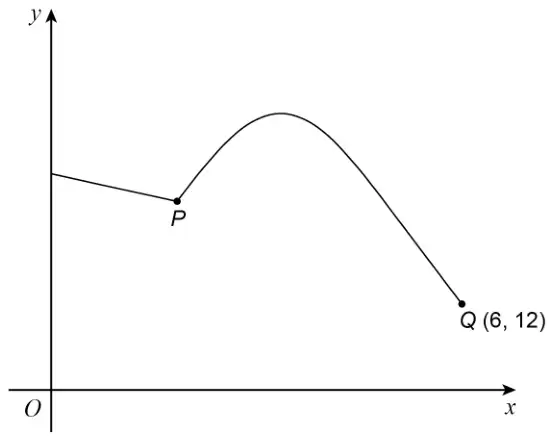
The function f is given by \(\quad \mathrm{f}(x) = 5x + 3\)
The range is \(\quad \mathrm{f}(x) \lt 23\)
Work out the domain of the function, giving your answer as an inequality. [1 mark]
(b)
The function g is given by \(\quad \mathrm{g}(x) = x^3 - 4\)
The domain is \(\quad -3 \lt x \lt 2\)
Work out the range of the function, giving your answer as an inequality. [2 marks]
(c)
The function h is given by \(\quad \mathrm{h}(x) = \sqrt{2x + 1}\)
Work out \(\mathrm{h}^{-1}(x)\) [2 marks]
Mark scheme (a)
Answer
Mark
Comments
\(x \lt 4\) or \(4 \gt x\)
B1
Additional guidance
Incorrect inequality symbol eg \(x \leqslant 4\)
B0
\(\mathrm{f}(x) \lt 4\) or just \(\lt 4\) or just 4 (even if correct answer seen in working)
B0
\(=\) used in working but correct answer
B1
\(a \lt x \lt 4\)
B0
\(x \leqslant 3\)
B0
\(\{x : x \lt 4\}\)
B1
Nothing on answer line then mark final line of working
B1 response with a list of integers on answer line
B0
Only a list of integers
B0
Mark scheme (b)
Answer
Mark
Comments
\(-31 \lt \mathrm{g}(x) \lt 4\)
B2
oe eg \(4 \gt \mathrm{g}(x) \gt -31\) word ‘and’ or ‘\(\cap\)’ must be included if writing two inequalities for B2 or B1 eg \(-31 \lt \mathrm{g}(x)\) and \(\mathrm{g}(x) \lt 4\) B1 \(k \lt \mathrm{g}(x) \lt 4\) where \(k\) is less than 4 or \(k \leqslant \mathrm{g}(x) \lt 4\) where \(k\) is less than 4 or \(-31 \lt \mathrm{g}(x) \lt m\) where \(m\) is greater than \(-31\) or \(-31 \lt \mathrm{g}(x) \leqslant m\) where \(m\) is greater than \(-31\) or \(-31\) and 4 seen from correct working (but within parameters of the Additional Guidance notes about listing integers)
Additional guidance
Condone \(\mathrm{g}(x)\) replaced by eg \(y\) or g or g\(x\) or f or f\(x\) or G or G\(x\) or \(x^3 - 4\) eg1 \(-31 \lt \mathrm{f}(x) \lt 4\) eg2 \(-31 \lt y \lt 4\)
B2
Condone \(\mathrm{g}(x)\) replaced by eg \(y\) or g or g\(x\) or f or f\(x\) or G or G\(x\) or \(x^3 - 4\) for any of the B1 answers. eg1 \(k \lt \mathrm{f}(x) \lt 4\) where \(k\) is less than 4 eg2 \(-31 \lt y \lt m\) where \(m\) is greater than \(-31\)
B1
Do not condone \(\mathrm{g}(x)\) replaced by \(x\) but could still score B1 for \(-31\) and 4 seen from correct working
\((-31, 4)\) or \(\{\mathrm{g}(x) : -31 \lt \mathrm{g}(x) \lt 4\}\)
oe \(\mathrm{gf}(x)\) with elimination of brackets and fractions eg \(8 - 8x + 2x^2 + 10 - 5x\) dep on M3 \(2x^2 - 16x + 20\) is B1M4
\(a = 2 \quad b = -16 \quad c = 20\)
A1ft
ft their \(2 - 3x\) if B0M4 their \(2 - 3x\) must be of the form \(px + q\) with \(p\) and \(q\) non-zero their \(2 - 3x\) cannot be \(\dfrac{2 - x}{3}\)
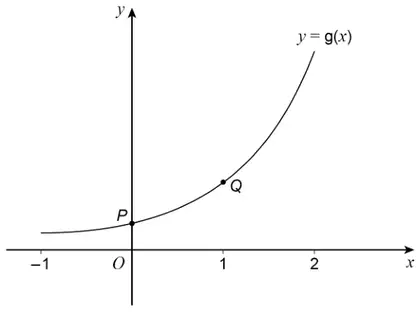
15 The function g is given by \(\quad \mathrm{g}(x) = a \times b^x \quad\) where \(a\) and \(b\) are constants.
The domain of the function is \(\quad -1 \leqslant x \leqslant 2\)
\(P\left(0, \dfrac{1}{2}\right)\) and \(Q\left(1, \dfrac{3}{2}\right)\) are points on the graph \(\quad y = \mathrm{g}(x)\)
Not drawn accurately
Work out the range of the function. [4 marks]
Mark scheme
Answer
Mark
Comments
\(\dfrac{1}{2} = a \times b^0\) or \(a = \dfrac{1}{2}\) or \(\dfrac{3}{2} = a \times b^{(1)}\)
M1
oe eg \(a \times 1 = 0.5\) or \(ab = 1.5\)
(\(a =\)) \(\dfrac{1}{2}\) and (\(b =\)) 3
A1
oe values may be implied eg \(y = \dfrac{1}{2} \times 3^x\)
their \(\dfrac{1}{2} \times (\text{their } 3)^{-1}\) or \(\dfrac{1}{2} \times \dfrac{1}{3}\) or \(\dfrac{1}{6}\) and their \(\dfrac{1}{2} \times (\text{their } 3)^2\) or \(\dfrac{1}{2} \times 3^2\) or \(\dfrac{9}{2}\)
M1
oe neither their \(\dfrac{1}{2}\) nor their 3 can be 0 or 1 \(\dfrac{1}{6}\) and \(\dfrac{9}{2}\) is M1A1M1 ignore other calculations or values
\(\dfrac{1}{6} \leqslant \mathrm{g}(x) \leqslant \dfrac{9}{2}\) or both of \(\mathrm{g}(x) \geqslant \dfrac{1}{6} \qquad \mathrm{g}(x) \leqslant \dfrac{9}{2}\)
A1ft
oe eg \(\left[\dfrac{1}{6}, \dfrac{9}{2}\right]\) only ft M1A0M1
Additional guidance
Ignore words if answer given as separate inequalities eg1 \(\mathrm{g}(x) \geqslant \dfrac{1}{6}\) or \(\mathrm{g}(x) \leqslant \dfrac{9}{2}\) eg2 \(\mathrm{g}(x) \geqslant \dfrac{1}{6}\) and \(\mathrm{g}(x) \leqslant 4.5\)
Condone \(\mathrm{g}(x)\) replaced by eg \(y\) or g or g\(x\) or \(\mathrm{f}(x)\) or f or f\(x\) or \(a \times b^x\)
Do not allow \(\mathrm{g}(x)\) to be replaced by \(x\) for the final mark eg \(\dfrac{1}{6} \leqslant x \leqslant \dfrac{9}{2}\)
M1A1M1A0
Equivalent inequalities may be seen eg \(\dfrac{9}{2} \geqslant \mathrm{g}(x) \geqslant \dfrac{1}{6}\)
M1A1M1A1
Inequality symbols must be correct eg \(\dfrac{1}{6} \lt \mathrm{g}(x) \leqslant \dfrac{9}{2}\) or \(\dfrac{1}{6} \leqslant \mathrm{g}(x) \geqslant \dfrac{9}{2}\)
M1A1M1A0
\(\dfrac{1}{6} \leqslant \mathrm{g}(x) \leqslant \dfrac{9}{2}\) in working with list of integers on answer line
M1A1M1A0
Only a list of integers
M0A0M0A0
Allow 0.16(…) or 0.17 for \(\dfrac{1}{6}\)
Correct answer followed by incorrect further work eg \(\dfrac{1}{6} \leqslant \mathrm{g}(x) \leqslant \dfrac{9}{2}\) and \(\left(\dfrac{9}{2} - \dfrac{1}{6} =\right) \dfrac{13}{3}\)
Common errors from Alt 2 will come from getting \(\mathrm{fg}(x)\) incorrect and might include (but must include the function clearly stated): \(\mathrm{fg}(x) = 4x^2 + 1\) followed by \(\mathrm{fg}(3) = 37\) \(\mathrm{fg}(x) = x^2(2x + 1)\) followed by \(\mathrm{fg}(3) = 63\)
B0 B1ft
\(\mathrm{ff}(x)\) doesn’t get any marks
B0 B0
Common errors from Alt 1 will come from getting \(\mathrm{g}(x)\) incorrect and might include g(3) = 6 then fg(3) = 13 g(3) = 3 then fg(3) = 7
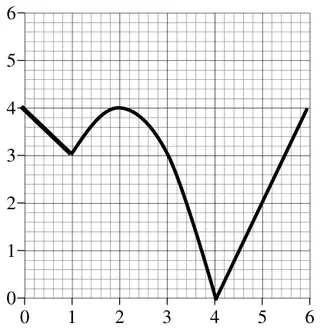
(a) \[\begin{aligned} \mathrm{f}(x) &= 4 - x &&\quad 0 \leqslant x \lt 1 \\ &= 4x - x^2 &&\quad 1 \leqslant x \lt 4 \\ &= 2x - 8 &&\quad 4 \leqslant x \leqslant 6 \end{aligned}\]
On the grid, draw the graph of \(\quad y = \mathrm{f}(x)\) [4 marks]
(b) \(\mathrm{g}(x) = 6 - 3x\)
Work out \(\;\mathrm{g}^{-1}(x)\). [2 marks]
Mark scheme (a)
Answer
Mark
Comments
Line joining (0,4) and (1,3)
B1
may be drawn free hand
(2, 4) plotted as a maximum value
M1
needs to be some sort of graph showing a maximum value
Curve drawn through (1, 3), (2, 4), (3, 3) and (4, 0)
A1
all points should be within half a square horizontally or vertically
Line joining (4,0) and (6,4)
B1
may be drawn free hand
Additional guidance
Maximum mark available if either or both of the straight lines include a curve (they haven’t used a ruler) is B1M1A1 Maximum mark available if any part of the quadratic curve (it must be a quadratic curve that is concave and not convex at any point) is drawn with a ruler is B2M1 (a clear vertex at (3,3) may show the use of a ruler) Maximum mark available if any of the lines go beyond their correct domain by more than half a square is B2M1 or B1M1A1 They could lose marks for both the quadratic and straight lines Ignore slight feathering
Mark scheme (b)
Answer
Mark
Comments
Alternative method 1
Rearranging first to get \(x = \dfrac{6 - \mathrm{g}(x)}{3}\)
M1
oe eg \(x = \dfrac{6 - y}{3}\) or \(2 - \dfrac{y}{3}\) \(y - 6 = -3x\) is not enough to gain M1
\(\mathrm{g}^{-1}(x) = \dfrac{6 - x}{3}\)
A1
oe eg \(\mathrm{g}^{-1}(x) = \dfrac{x - 6}{-3}\) or \(\mathrm{g}^{-1}(x) = -\dfrac{x - 6}{3}\) or \(\mathrm{g}^{-1}(x) = \dfrac{x}{-3} + 2\)
Alternative method 2
Putting the correct terminology in to get \(\;x = 6 - 3\mathrm{g}^{-1}(x)\)
M1
oe eg \(x = 6 - 3y\) or \(3y = 6 - x\)
\(\mathrm{g}^{-1}(x) = \dfrac{6 - x}{3}\)
A1
oe eg \(\mathrm{g}^{-1}(x) = \dfrac{x - 6}{-3}\) or \(\mathrm{g}^{-1}(x) = -\dfrac{x - 6}{3}\) or \(\mathrm{g}^{-1}(x) = \dfrac{x}{-3} + 2\)
Additional guidance
Answer left as \(y = \dfrac{6 - x}{3}\) should gain M1 on either scheme
M1A0
\(x = \dfrac{6 - y}{3}\) can gain M1 but not A1
M1A0
Condone \(\mathrm{g}^{-1}(x)\) missed on answer line (as long as nothing else is written in its place) Flow charts may be used. Mark as oe Penalise additional incorrect working
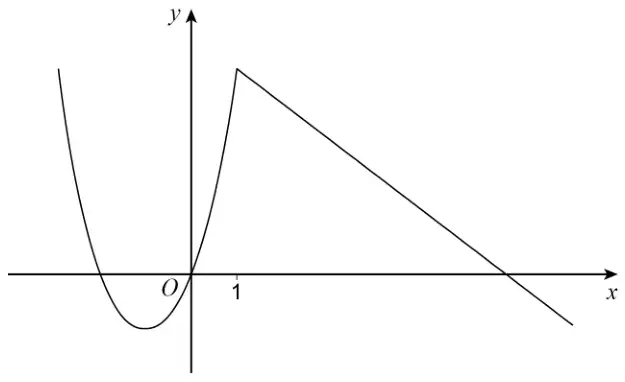
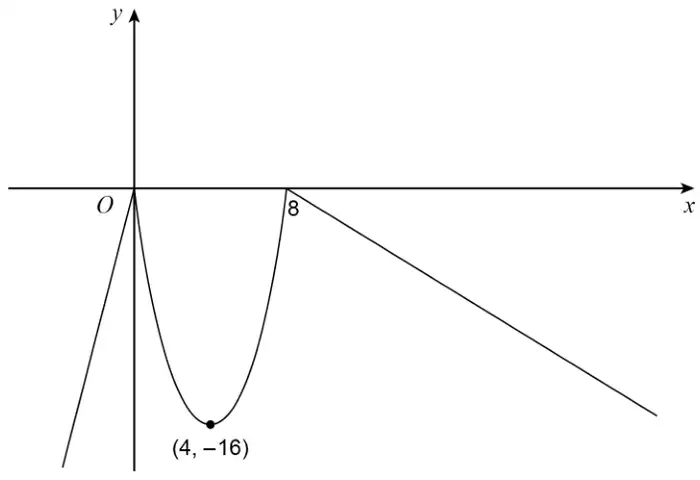
\[\begin{aligned} \mathrm{f}(x) &= 4x && x \lt 0 \\ &= x^2 - 8x && 0 \leqslant x \leqslant 8 \\ &= 16 - 2x && x \gt 8 \end{aligned}\]
A sketch of \(\quad y = \mathrm{f}(x) \quad\) is shown.
Not drawn accurately
Work out all the values of \(x\) for which \(\quad \mathrm{f}(x) = -12\) [4 marks]
Mark scheme
Answer
Mark
Comments
\(-3 \quad 2 \quad 6 \quad 14\) with no other solutions
B4
B3 three correct with at most one incorrect B2 two correct with at most two incorrect B1 one correct with at most three incorrect SC2 \(-3 \quad 2 \quad 6 \quad 14\) with no other values seen SC1 Two or three of \(-3 \quad 2 \quad 6 \quad 14\) with no other values seen
Additional guidance
Solutions may be in any order eg1 \(-3 \quad 14 \quad 6 \quad 2\) eg2 \(14 \quad -3\)
B4 B2
\(x \lt -3 \quad 2 \lt x \lt 6 \quad x \gt 14\)
SC2
\(2 \leqslant x \leqslant 6\)
SC1
\(-3 \quad 2 \quad 6 \quad 14\) seen in working with no other values and answer line \(-3 \leqslant x \leqslant 14\)
(a) The function f is given by \(\quad \mathrm{f}(x) = 3x - 5\)
The range is \(\quad 13 \lt \mathrm{f}(x) \lt 19\)
Work out the domain of the function. [1 mark]
(b) The function g is given by \(\quad \mathrm{g}(x) = x^2 - 4 \quad\) with domain \(\quad -1 \lt x \lt 3\)
Work out the range of the function. [2 marks]
(c) The function h is given by \(\quad \mathrm{h}(x) = \dfrac{3 + x}{2}\)
Work out \(\mathrm{h}^{-1}(x)\) [2 marks]
Mark scheme (a)
Answer
Mark
Comments
\(6 \lt x \lt 8\) or \(x \lt 8\) and \(x \gt 6\)
B1
oe eg \(8 \gt x \gt 6\) word ‘and’ must be included if writing two inequalities
Additional guidance
[6, 8]
B1
Condone eg \(x =\ 6 \lt x \lt 8\)
B1
Incorrect inequality symbol eg \(6 \leqslant x \lt 8\) or \(6 \lt x \gt 8\)
B0
\(6 \lt \mathrm{f}(x) \lt 8\)
B0
B1 response with a list of integers on answer line
B0
Only a list of integers
B0
Mark scheme (b)
Answer
Mark
Comments
\(-4 \leqslant \mathrm{g}(x) \lt 5\) or \(\mathrm{g}(x) \lt 5\) and \(\mathrm{g}(x) \geqslant -4\)
B2
oe eg \(5 \gt \mathrm{g}(x) \geqslant -4\) word ‘and’ must be included if writing two inequalities for B2 or B1 or SC1 B1 \(-4 \lt \mathrm{g}(x) \lt 5\) or \(-4 \lt \mathrm{g}(x) \leqslant 5\) or \(-4 \leqslant \mathrm{g}(x) \leqslant 5\) or \(\mathrm{g}(x) \lt 5\) and \(\mathrm{g}(x) \gt -4\) or \(\mathrm{g}(x) \leqslant 5\) and \(\mathrm{g}(x) \gt -4\) or \(\mathrm{g}(x) \leqslant 5\) and \(\mathrm{g}(x) \geqslant -4\) or \(\mathrm{k} \lt \mathrm{g}(x) \lt 5\) where k is less than 5 or \(\mathrm{k} \leqslant \mathrm{g}(x) \lt 5\) where k is less than 5 or \(-4 \leqslant \mathrm{g}(x) \lt \mathrm{m}\) where m is greater than \(-4\) SC1 \(-4 \leqslant x \lt 5\) or \(x \lt 5\) and \(x \geqslant -4\) or only \(-4\) and 5 seen (condone 9 given as a range in this case)
Additional guidance
Condone \(\mathrm{g}(x)\) replaced by eg \(y\) or g or g\(x\) or f or f\(x\) or G or G\(x\) or \(x^2 - 4\) eg1 \(-4 \leqslant \mathrm{f}(x) \lt 5\) eg2 \(-4 \leqslant y \leqslant 5\)
B1 \(1 \leqslant \mathrm{g}(x) \lt 5\) or \(1 \lt \mathrm{g}(x) \leqslant 5\) or \(1 \lt \mathrm{g}(x) \lt 5\) or \(\mathrm{g}(x) \geqslant 1\) and \(\mathrm{g}(x) \leqslant 5\) or \(1 \leqslant \mathrm{g}(x) \leqslant k\) where \(k\) is a constant \(\gt 1\) or \(p \leqslant \mathrm{g}(x) \leqslant 5\) where \(p\) is a constant \(\lt 5\)
SC1 \(1 \leqslant x \leqslant 5\)
Additional guidance
Condone \(\mathrm{g}(x)\) replaced by eg \(y\) or g or g\(x\) or f(\(x\)) or f or f\(x\) or \(5 - x^2\) in B2 or B1 responses
Equivalent inequalities may be seen eg \(\ 5 \geqslant \mathrm{g}(x) \gt 1\)
B1
Only \(\mathrm{g}(x) \geqslant 1\) given as the answer
B0
Only \(\mathrm{g}(x) \leqslant 5\) given as the answer
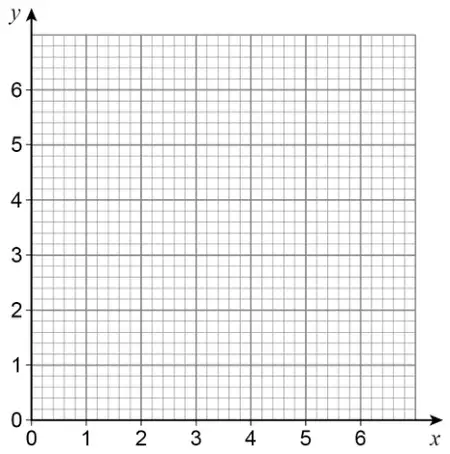
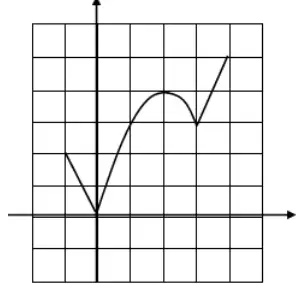
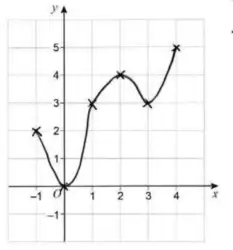
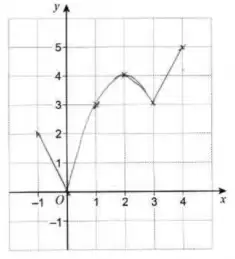
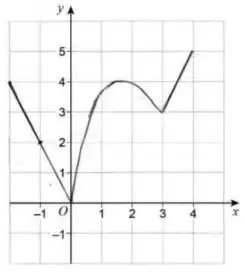
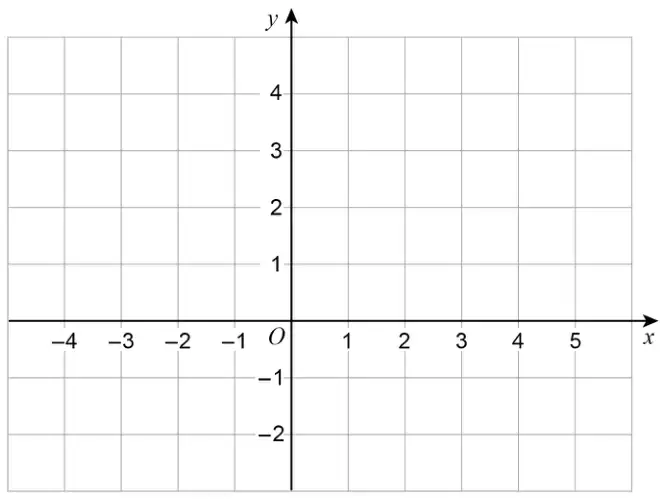
Draw the graph of \(\quad y = \mathrm{f}(x) \quad\) on the grid. [4 marks]
Mark scheme
Answer
Mark
Comments
B4
B1 for a straight line from \((-1,\ 2)\) to \((0,\ 0)\). This should be drawn with a ruler (give BOD)
B1 for a quadratic style curve through \((0,\ 0)\), \((1,\ 3)\), \((2,\ 4)\) and \((3,\ 3)\) within tolerance. Condone one straight line between only one of the sections between \((0,\ 0)\) and \((1,\ 3)\), \((1,\ 3)\) and \((2,\ 4)\) or \((2,\ 4)\) and \((3,\ 3)\)
B1 for any quadratic graph drawn with correct curvature and no straight lines (see examples) with clear vertices at \((0,0)\) and \((3,3)\) and within tolerance for these points. There needs to be evidence of a maximum turning point drawn.
B1 for a straight line from \((3,\ 3)\) to \((4,\ 5)\). This should be drawn with a ruler (give BOD)
SC1 for all six stated points plotted correctly and clearly defined (don’t need to be joined up or could be joined up incorrectly). If any incorrect points plotted then no marks can be awarded
Additional guidance
Tolerance of plot \(\pm\) 2mm for each stated point (these are 1cm squares)
For \(\mathrm{f}(x) = -2x\) extending to the left of \(x = -1\) or \(\mathrm{f}(x) = 2x - 3\) extending to the right of \(x = 4\) greater than 2mm, award maximum 1 mark from B1 B1 only for a section that would have otherwise scored ie. If both lines extended then B0 B1
If more than one line drawn in any section then choice so loss of marks
Ignore shading under or over the lines as long as the graph is clear
This would score for the second B mark only
Some feathering but close enough to score B4
B0 but had the line stopped at (4,5) it would have gained B1
Straight lines both correct but penalised one mark for the first one extending beyond the domain B1. Quadratic out of tolerance for (1,3) B0. Correct curvature and vertices B1
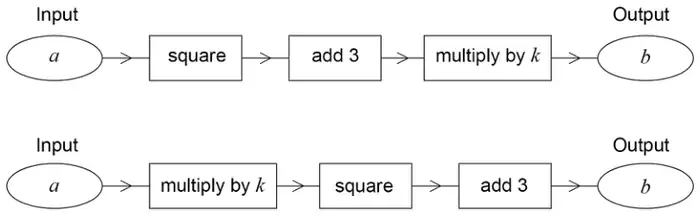
23 For each of these two function machines, when the input is \(a\) the output is \(b\).
\(k \gt 0 \quad\) and \(\quad k \ne 1 \quad\) and \(\quad a \gt 0\)
Work out an expression for \(a\) in terms of \(k\). Give your answer in its simplest form. [6 marks]
Mark scheme
Answer
Mark
Comments
\((a^2 + 3) \times k\) or \(ka^2 + 3k\)
M1
oe eg \(b = ka^2 + 3k\) may be seen on diagram
\((ak)^2 + 3\) or \(a^2k^2 + 3\)
M1
oe eg \(b = a^2k^2 + 3\) may be seen on diagram
\(ka^2 + 3k = a^2k^2 + 3\)
M1dep
oe equates and expands brackets correctly dep on M2 may include \(-b\) on each side
\(a^2(k - k^2) = 3 - 3k\) or \(ka^2(1 - k) = 3 - 3k\) or \(ka^2 - a^2k^2 = 3(1 - k)\) or \(a^2(k - k^2) = 3(1 - k)\) or \(ka^2(1 - k) = 3(1 - k)\) or \(a^2(k^2 - k) = 3k - 3\) or \(ka^2(k - 1) = 3k - 3\) or \(k^2a^2 - ka^2 = 3(k - 1)\) or \(a^2(k^2 - k) = 3(k - 1)\) or \(ka^2(k - 1) = 3(k - 1)\)
M1dep
oe eg \((a^2 =)\ \dfrac{3 - 3k}{k - k^2}\) or \((a =)\ (\pm)\sqrt{\dfrac{3 - 3k}{k - k^2}}\) or \((a^2 =)\ \dfrac{3k - 3}{k^2 - k}\) or \((a =)\ (\pm)\sqrt{\dfrac{3k - 3}{k^2 - k}}\) collects terms in \(a^2\) and factorises correctly on at least one side must use \(a^2\) as a factor if awarding mark for factorising \(\ ka^2 - a^2k^2\) dep on M3
B1 \(\mathrm{g}(x) \geqslant -11\) or \(\mathrm{g}(x) \leqslant 13\) on their own or embedded within an inequality or \(-11 \lt \mathrm{g}(x) \lt 13\) or \([-11,\ 13]\) or \(-11 \leqslant x \leqslant 13\)
Additional guidance
\(\mathrm{g}(x)\) may be replaced by \(y\) or g or g\(x\) or f(\(x\)) or f or f\(x\) or \(1 - 3x\) in B2 or B1 responses
oe eg \(-\dfrac{3}{4} \pm \sqrt{\dfrac{15}{2} + \left(\dfrac{3}{4}\right)^2}\) correct method to solve their 3-term quadratic implied by correct solutions to their 3-term quadratic to at least 2 dp
2.089 \(\quad -3.589\)
A1ft
correct or ft M1A0M1 or M0A0M1 must both be rounded to 3 decimal places
Additional guidance
2nd M1 Allow correct factorisation of their 3-term quadratic if it does factorise
2nd M1 Allow correct use of formula even if discriminant is negative
Two ‘correct’ solutions to at least 2 decimal places implies M1A1M1 eg 2.09 and \(-3.59\)
M1A1M1A0
2.089 and \(-3.589\) in working but only one on answer line
M1A1M1A0
Answers only 2.089 \(\quad -3.589\)
M1A1M1A1
Answer only 2.089
Zero
Answer only \(-3.589\)
Zero
\(2x^2 - 7\) from incorrect expansion leading to 1.386 \(\quad -2.886\)
M0A0M1A1ft
\(x^2 - 14\) from incorrect expansion leading to 2.653 \(\quad -5.653\)
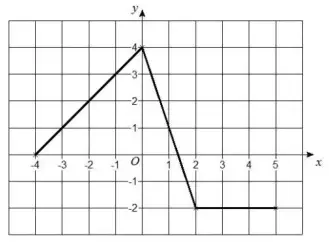
5 On the grid, draw the graph of \(\quad y = \mathrm{f}(x)\)
\[\begin{aligned} \mathrm{f}(x) &= x + 4 &\qquad& -4 \leqslant x \lt 0 \\ &= 4 - 3x && 0 \leqslant x \lt 2 \\ &= -2 && 2 \leqslant x \leqslant 5 \end{aligned}\]
[4 marks]
Mark scheme
Answer
Mark
Comments
Line from \((-4,\ 0)\) to \((0,\ 4)\)
M1
mark intention
Line from \((0,\ 4)\) to \((2,\ -2)\)
M1
lines do not have to be straight but must pass through all integer points
Line from \((2,\ -2)\) to \((5,\ -2)\)
M1
only condone the first instance of a line that extends beyond the given domain
Straight line from \((-4,\ 0)\) to \((0,\ 4)\) and straight line from \((0,\ 4)\) to \((2,\ -2)\) and straight line from \((2,\ -2)\) to \((5,\ -2)\)
A1
all straight lines must be the correct length with no other lines graph must be accurate SC3 \((-4,\ 0)\) and \((-3,\ 1)\) and \((-2,\ 2)\) and \((-1,\ 3)\) and \((0,\ 4)\) and \((1,\ 1)\) and \((2,\ -2)\) and \((3,\ -2)\) and \((4,\ -2)\) and \((5,\ -2)\) plotted (any other points plotted must be correct ones for the graph) SC2 \((-4,\ 0)\) and \((0,\ 4)\) and \((2,\ -2)\) and \((5,\ -2)\) plotted (any other points plotted must be correct ones for the graph)
Additional guidance
(crosses do not have to be shown)
M3A1
Dashed or dotted lines can score up to M3A0
Points may be implied by a correct line
M mark examples eg1 2 correct lines and 1 extended line (but otherwise correct) eg2 1 correct line and 2 extended lines (but otherwise correct) eg3 3 extended lines (but otherwise correct)
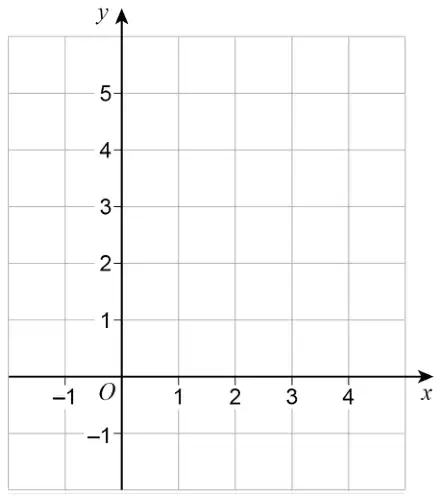
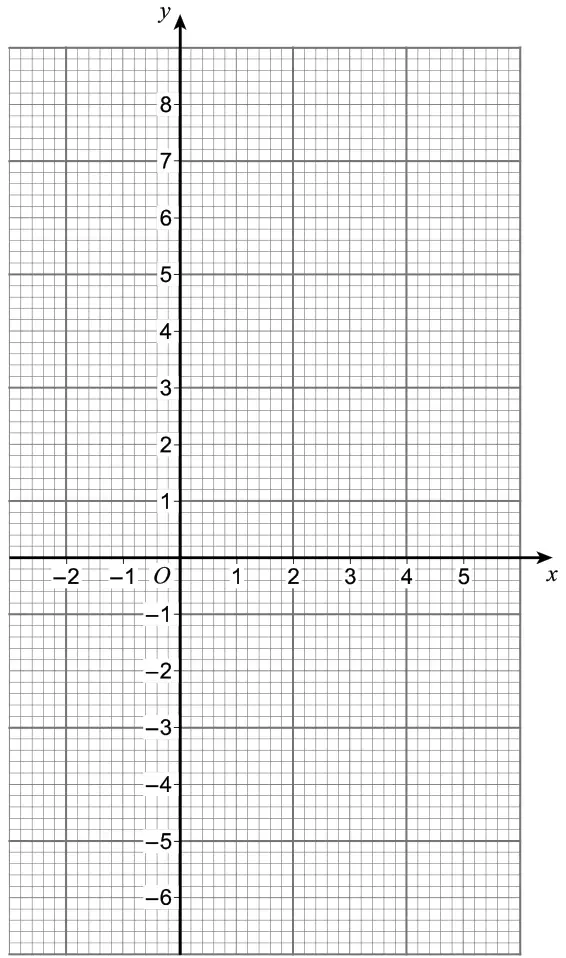
(a) Draw the graph of \(\quad y = \mathrm{f}(x) \quad\) on the axes below. [4 marks]
(b) State the range of \(\ \mathrm{f}(x)\) [2 marks]
Mark scheme (a)
Answer
Mark
Comments
Straight line between (\(-2\), 7) and (0, 3)
B1
Tolerance of ±1 small square Allow line to be extended
Points (0, 3) (1, 4) (2, 3) (3, 0) (4, \(-5\))
M1
Tolerance of ±1 small square May be plotted or seen in a table Points can be implied
Correct smooth parabolic curve with maximum at (1, 4)
A1
Tolerance of ±1 small square Allow (ruled) straight line between (3, 0) and (4, \(-5\)) Curve passing through all correct points within tolerance scores M1A1
Straight line between (4, \(-5\)) and (5, 0)
B1
Tolerance of ±1 small square Allow line to be extended
Additional guidance
Ignore extra points plotted
Tolerance of ±1 small square means it is on the edges of or within the shaded area
Points only can score a maximum of M1
Ruled straight lines for curve apart from between (3, 0) and (4, \(-5\))
A0
If all 4 marks would be awarded but either (i) graph has a line or a curve that extends beyond the individual domains or (ii) the curve does not meet a line at a cusp
3 marks
Mark scheme (b)
Answer
Mark
Comments
\(-5 \leqslant \mathrm{f}(x) \leqslant 7\) or \(7 \geqslant \mathrm{f}(x) \geqslant -5\) or [\(-5\), 7]
B2ft
Correct or ft their graph in (a) for B2 ft their graph in (a) for B1
B1ft \(-5 \leqslant \mathrm{f}(x)\) or \(\mathrm{f}(x) \leqslant 7\) on their own or embedded within an interval for \(\mathrm{f}(x)\) or only \(-5\) and 7 chosen eg \(-5 \lt \mathrm{f}(x) \lt 7\)
Additional guidance
Allow \(\mathrm{f}(x)\) to be \(y\) or f or f\(x\) eg1 \(-5 \leqslant y \leqslant 7\) eg2 \(\mathrm{f} \leqslant 7\)
B2 B1
Allow as two inequalities \(\quad \mathrm{f}(x) \geqslant -5\) (and/or) \(\mathrm{f}(x) \leqslant 7\)
B2
ft their graph if incomplete eg no graph drawn for \(-2 \leqslant x \lt 0\) but otherwise correct and answer \(-5 \leqslant \mathrm{f}(x) \leqslant 4\)
B2ft
ft their graph if drawn for \(x\) values beyond [\(-2\), 5] eg1 straight line from (\(-3\), 8) to (6, \(-1\)) and answer \(-1 \leqslant y \leqslant 8\) eg2 straight line from (\(-3\), 8) to (6, \(-1\)) and answer \(\mathrm{f}(x) \leqslant 8\)
B2ft B1ft
Straight line from (\(-2\), 9) to (6, \(-7\)) and answer \(-7 \leqslant y \leqslant 9\)
B2ft
Straight line from (0, 9) to (5, \(-4\)) and answer \(-4 \leqslant \mathrm{f}(x) \leqslant 9\)
B2ft
B2ft (or B1ft) can be awarded for a range beyond [\(-7\), 9] if it is clear from working (eg a table of values) where the answer is from
\(-5\) to 7 inclusive is B2 whereas \(-5\) to 7 is B1
B1 for a correct inequality embedded eg1 \(-5 \lt \mathrm{f}(x) \leqslant 7\) eg2 \(-5 \leqslant \mathrm{f}(x) \leqslant 0\) eg3 \(-2 \leqslant y \leqslant 7\)
B1 B1 B1
For B1 ignore incorrect notation if only \(-5\) and 7 chosen eg1 \(-5 \leqslant x \leqslant 7\) eg2 \(-5 \lt x \leqslant 7\) eg3 \(-5 \geqslant \mathrm{f}(x) \geqslant 7\) eg4 \(-5\), 7
B1 B1 B1 B1
{\(-5, -4, -3, -2, -1, 0, 1, 2, 3, 4, 5, 6, 7\)}
B0
Working out a statistical range eg \(-5\) to \(7 = 12\)
Correct answer followed by incorrect further work However, \(\dfrac{1}{(2x + 3)(2x + 1)}\) with an attempt to expand the denominator should not be penalised even if their expansion is not correct
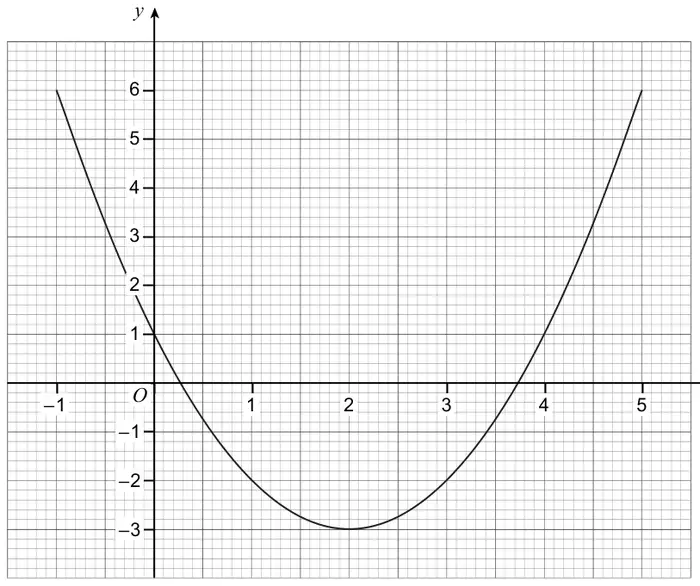
2 The function \(\quad \mathrm{f}(x) = x^2 - 4x + 1 \quad\) has domain \(\ -1 \leqslant x \leqslant 5\)
Here is the graph of \(\quad y = \mathrm{f}(x)\)
(a) Write down the equation of the line of symmetry of the graph. [1 mark]
(b) Use the graph to work out the solutions of \(\quad x^2 - 4x + 1 = 5\)
Give your answers to 1 decimal place. [2 marks]
(c) Write down the range of \(\mathrm{f}(x)\) for domain \(\ -1 \leqslant x \leqslant 5\) [2 marks]
Mark scheme (a)
Answer
Mark
Comments
\(x = 2\)
B1
Additional guidance
\(2 = x\)
B1
\(y = 2\)
B0
2
B0
Mark scheme (b)
Answer
Mark
Comments
\(-0.8\) and 4.8 with no other answers
B2
Both correct in either order B1 One correct and one incorrect or missing
Additional guidance
The word ‘and’ is not needed If their answer has both \(-0.8\) and 4.8 with no other solutions award B2 eg 4.8, \(-0.8\) with no other solutions
B2
Mark scheme (c)
Answer
Mark
Comments
\(-3 \leqslant \mathrm{f}(x) \leqslant 6\) or \(6 \geqslant \mathrm{f}(x) \geqslant -3\) or [\(-3\), 6]
B2
oe
B1 \(\mathrm{f}(x) \geqslant -3\) or \(\mathrm{f}(x) \leqslant 6\) on their own or embedded within an interval for \(\mathrm{f}(x)\) or only \(-3\) and 6 chosen
Additional guidance
Allow as two inequalities \(\mathrm{f}(x) \geqslant -3 \quad \mathrm{f}(x) \leqslant 6\)
B2
\(-3\) to 6 inclusive
B2
\(\mathrm{f}(x)\) may be replaced by f or \(y\) or \(x^2 - 4x + 1\) for B2 and B1
B1 may be seen with an incorrect inequality eg1 \(-3 \lt \mathrm{f}(x) \leqslant 6\) eg2 \(-3 \leqslant \mathrm{f}(x) \lt 6\) eg3 \(-3 \leqslant \mathrm{f}(x) \leqslant 5\)
B1 B1 B1
For B1 ignore incorrect notation if only \(-3\) and 6 chosen eg1 \(-3 \leqslant x \leqslant 6\) eg2 \(-3 \lt x \leqslant 6\) eg3 \(-3\) to 6 eg4 \(-3\) to \(6 = 9\) (working out a statistical range) eg5 \(-3 \geqslant \mathrm{f}(x) \geqslant 6\) eg6 \(-3\), 6