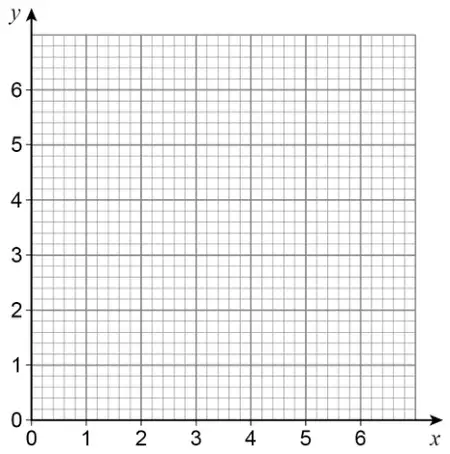
(a) \[\begin{aligned} \mathrm{f}(x) &= 4 - x &&\quad 0 \leqslant x \lt 1 \\ &= 4x - x^2 &&\quad 1 \leqslant x \lt 4 \\ &= 2x - 8 &&\quad 4 \leqslant x \leqslant 6 \end{aligned}\]
On the grid, draw the graph of \(\quad y = \mathrm{f}(x)\) [4 marks]
(b) \(\mathrm{g}(x) = 6 - 3x\)
Work out \(\;\mathrm{g}^{-1}(x)\). [2 marks]
Mark scheme (a)
Answer
Mark
Comments
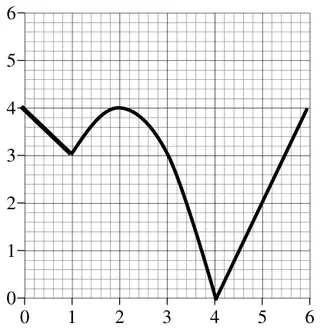
Line joining (0,4) and (1,3)
B1
may be drawn free hand
(2, 4) plotted as a maximum value
M1
needs to be some sort of graph showing a maximum value
Curve drawn through (1, 3), (2, 4), (3, 3) and (4, 0)
A1
all points should be within half a square horizontally or vertically
Line joining (4,0) and (6,4)
B1
may be drawn free hand
Additional guidance
Maximum mark available if either or both of the straight lines include a curve (they haven’t used a ruler) is B1M1A1 Maximum mark available if any part of the quadratic curve (it must be a quadratic curve that is concave and not convex at any point) is drawn with a ruler is B2M1 (a clear vertex at (3,3) may show the use of a ruler) Maximum mark available if any of the lines go beyond their correct domain by more than half a square is B2M1 or B1M1A1 They could lose marks for both the quadratic and straight lines Ignore slight feathering
Mark scheme (b)
Answer
Mark
Comments
Alternative method 1
Rearranging first to get \(x = \dfrac{6 - \mathrm{g}(x)}{3}\)
M1
oe eg \(x = \dfrac{6 - y}{3}\) or \(2 - \dfrac{y}{3}\) \(y - 6 = -3x\) is not enough to gain M1
\(\mathrm{g}^{-1}(x) = \dfrac{6 - x}{3}\)
A1
oe eg \(\mathrm{g}^{-1}(x) = \dfrac{x - 6}{-3}\) or \(\mathrm{g}^{-1}(x) = -\dfrac{x - 6}{3}\) or \(\mathrm{g}^{-1}(x) = \dfrac{x}{-3} + 2\)
Alternative method 2
Putting the correct terminology in to get \(\;x = 6 - 3\mathrm{g}^{-1}(x)\)
M1
oe eg \(x = 6 - 3y\) or \(3y = 6 - x\)
\(\mathrm{g}^{-1}(x) = \dfrac{6 - x}{3}\)
A1
oe eg \(\mathrm{g}^{-1}(x) = \dfrac{x - 6}{-3}\) or \(\mathrm{g}^{-1}(x) = -\dfrac{x - 6}{3}\) or \(\mathrm{g}^{-1}(x) = \dfrac{x}{-3} + 2\)
Additional guidance
Answer left as \(y = \dfrac{6 - x}{3}\) should gain M1 on either scheme
M1A0
\(x = \dfrac{6 - y}{3}\) can gain M1 but not A1
M1A0
Condone \(\mathrm{g}^{-1}(x)\) missed on answer line (as long as nothing else is written in its place) Flow charts may be used. Mark as oe Penalise additional incorrect working