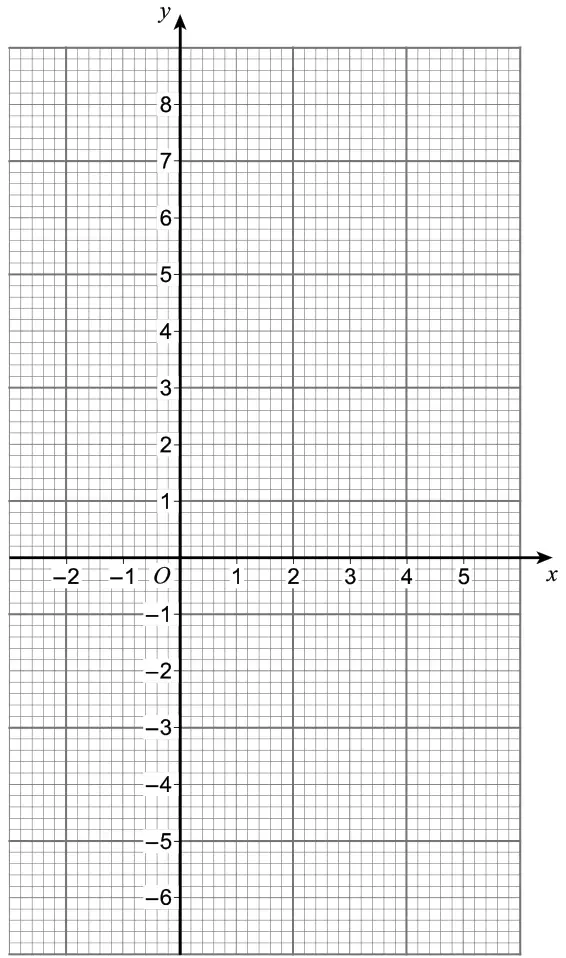
(a) Draw the graph of \(\quad y = \mathrm{f}(x) \quad\) on the axes below. [4 marks]
(b) State the range of \(\ \mathrm{f}(x)\) [2 marks]
Mark scheme (a)
Answer
Mark
Comments
Straight line between (\(-2\), 7) and (0, 3)
B1
Tolerance of ±1 small square Allow line to be extended
Points (0, 3) (1, 4) (2, 3) (3, 0) (4, \(-5\))
M1
Tolerance of ±1 small square May be plotted or seen in a table Points can be implied
Correct smooth parabolic curve with maximum at (1, 4)
A1
Tolerance of ±1 small square Allow (ruled) straight line between (3, 0) and (4, \(-5\)) Curve passing through all correct points within tolerance scores M1A1
Straight line between (4, \(-5\)) and (5, 0)
B1
Tolerance of ±1 small square Allow line to be extended
Additional guidance
Ignore extra points plotted
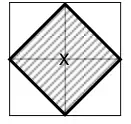
Tolerance of ±1 small square means it is on the edges of or within the shaded area
Points only can score a maximum of M1
Ruled straight lines for curve apart from between (3, 0) and (4, \(-5\))
A0
If all 4 marks would be awarded but either (i) graph has a line or a curve that extends beyond the individual domains or (ii) the curve does not meet a line at a cusp
3 marks
Mark scheme (b)
Answer
Mark
Comments
\(-5 \leqslant \mathrm{f}(x) \leqslant 7\) or \(7 \geqslant \mathrm{f}(x) \geqslant -5\) or [\(-5\), 7]
B2ft
Correct or ft their graph in (a) for B2 ft their graph in (a) for B1
B1ft \(-5 \leqslant \mathrm{f}(x)\) or \(\mathrm{f}(x) \leqslant 7\) on their own or embedded within an interval for \(\mathrm{f}(x)\) or only \(-5\) and 7 chosen eg \(-5 \lt \mathrm{f}(x) \lt 7\)
Additional guidance
Allow \(\mathrm{f}(x)\) to be \(y\) or f or f\(x\) eg1 \(-5 \leqslant y \leqslant 7\) eg2 \(\mathrm{f} \leqslant 7\)
B2 B1
Allow as two inequalities \(\quad \mathrm{f}(x) \geqslant -5\) (and/or) \(\mathrm{f}(x) \leqslant 7\)
B2
ft their graph if incomplete eg no graph drawn for \(-2 \leqslant x \lt 0\) but otherwise correct and answer \(-5 \leqslant \mathrm{f}(x) \leqslant 4\)
B2ft
ft their graph if drawn for \(x\) values beyond [\(-2\), 5] eg1 straight line from (\(-3\), 8) to (6, \(-1\)) and answer \(-1 \leqslant y \leqslant 8\) eg2 straight line from (\(-3\), 8) to (6, \(-1\)) and answer \(\mathrm{f}(x) \leqslant 8\)
B2ft B1ft
Straight line from (\(-2\), 9) to (6, \(-7\)) and answer \(-7 \leqslant y \leqslant 9\)
B2ft
Straight line from (0, 9) to (5, \(-4\)) and answer \(-4 \leqslant \mathrm{f}(x) \leqslant 9\)
B2ft
B2ft (or B1ft) can be awarded for a range beyond [\(-7\), 9] if it is clear from working (eg a table of values) where the answer is from
\(-5\) to 7 inclusive is B2 whereas \(-5\) to 7 is B1
B1 for a correct inequality embedded eg1 \(-5 \lt \mathrm{f}(x) \leqslant 7\) eg2 \(-5 \leqslant \mathrm{f}(x) \leqslant 0\) eg3 \(-2 \leqslant y \leqslant 7\)
B1 B1 B1
For B1 ignore incorrect notation if only \(-5\) and 7 chosen eg1 \(-5 \leqslant x \leqslant 7\) eg2 \(-5 \lt x \leqslant 7\) eg3 \(-5 \geqslant \mathrm{f}(x) \geqslant 7\) eg4 \(-5\), 7
B1 B1 B1 B1
{\(-5, -4, -3, -2, -1, 0, 1, 2, 3, 4, 5, 6, 7\)}
B0
Working out a statistical range eg \(-5\) to \(7 = 12\)