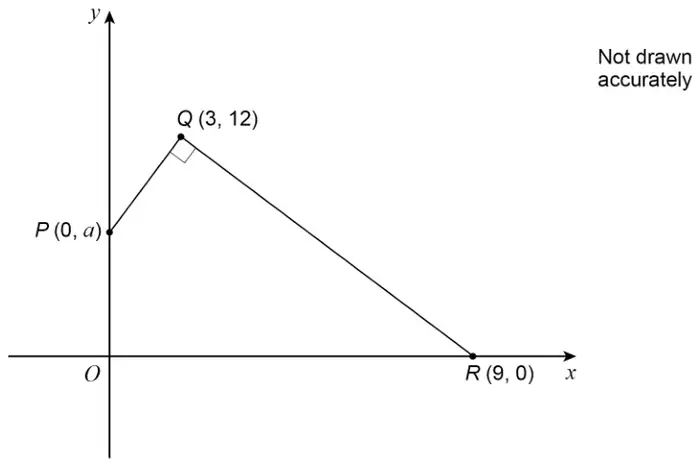
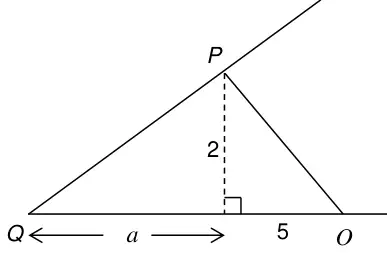
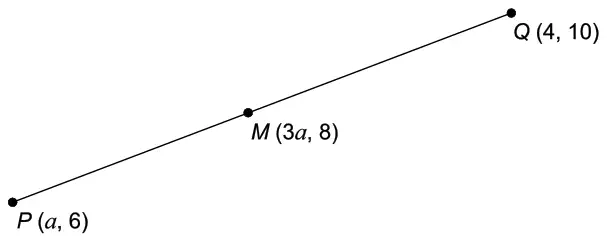
oe implies M3 and must be fully correct condone \(c\) instead of \(a\)
\(10\dfrac{1}{2}\) or \(\dfrac{21}{2}\) or 10.5
A1
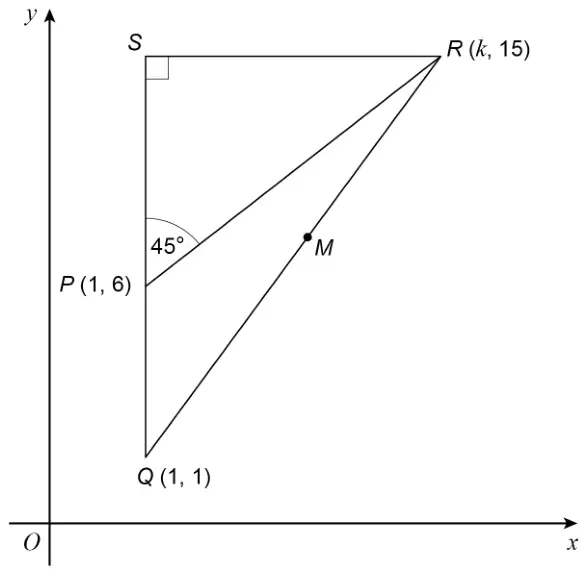
Alternative method 2: using Pythagoras
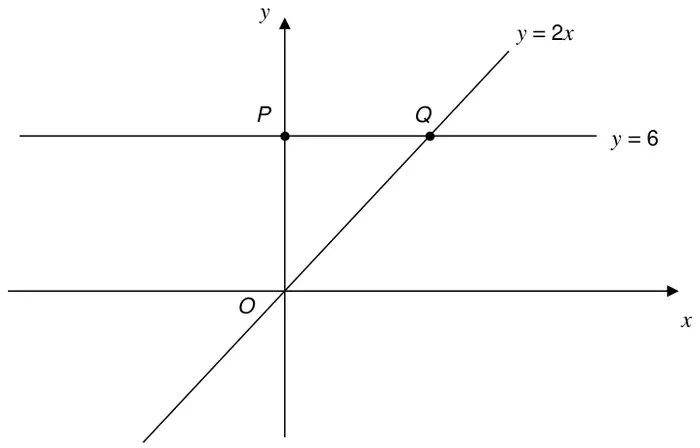
\((QR =)\ \sqrt{6^2 + 12^2}\) or \((QR^2 =)\ 6^2 + 12^2\) or \((PQ =)\ \sqrt{3^2 + (12 - a)^2}\) or \((PQ^2 =)\ 3^2 + (12 - a)^2\) or \((PR =)\ \sqrt{9^2 + a^2}\) or \((PR^2 =)\ 9^2 + a^2\)
M1
could be seen on diagram
\((QR =)\ \sqrt{6^2 + 12^2}\) or \((QR^2 =)\ 6^2 + 12^2\) and \((PQ =)\ \sqrt{3^2 + (12 - a)^2}\) or \((PQ^2 =)\ 3^2 + (12 - a)^2\) and \((PR =)\ \sqrt{9^2 + a^2}\) or \((PR^2 =)\ 9^2 + a^2\)
M1
\(81 + a^2 = 9 + (12 - a)^2 + 180\)
M1dep
oe dep on M2 must be a correct equation
\(10\dfrac{1}{2}\) or \(\dfrac{21}{2}\) or 10.5
A1
Additional guidance
Condone further incorrect simplification of fraction on answer line
Common incorrect gradients of QR in Alt 1 will give answers of: 13.5 from gradient of \(QR = 2\) 18 from gradient of \(QR = \dfrac{1}{2}\) 6 from gradient of \(QR = -\dfrac{1}{2}\) These could be M2M0A0 or M0M1M0A0 depending on whether the first mark can be awarded
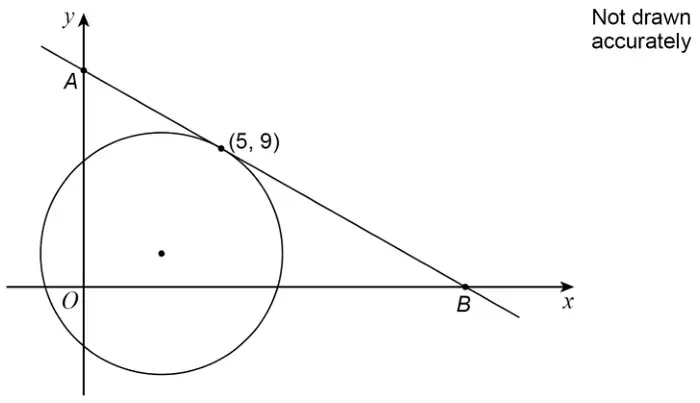
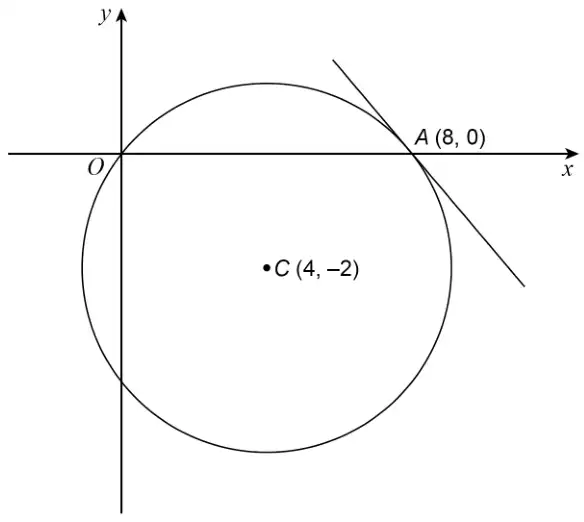
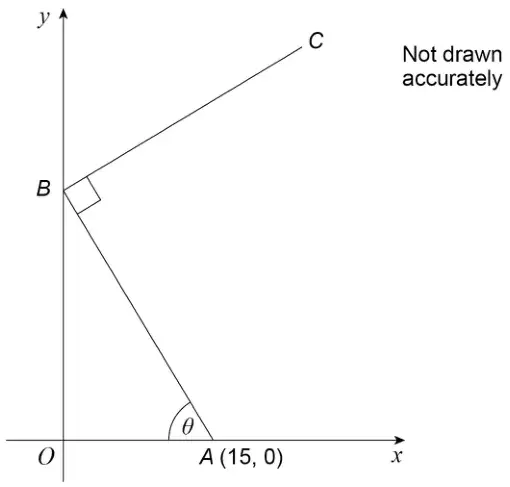
20 \(AB\) is the tangent to the circle \(\quad (x - 3)^2 + (y - 4)^2 = 29 \quad\) at the point \((5, 9)\)
Work out the area of triangle \(AOB\). [5 marks]
Mark scheme
Answer
Mark
Comments
\(\dfrac{9 - 4}{5 - 3}\) or \(\dfrac{5}{2}\)
M1
oe gradient of radius through (5, 9)
\(-1 \div\) their \(\dfrac{5}{2}\) or \(-\dfrac{2}{5}\)
M1
oe gradient of \(AB\) may be seen in equation of \(AB\) eg \(y = -\dfrac{2}{5}x + c\) their \(\dfrac{5}{2}\) cannot be \(\sqrt{29}\) or 29 gradient of \(AB = -\dfrac{2}{5}\) with no incorrect working is M1M1
\(\dfrac{y - 9}{0 - 5} =\) their \(-\dfrac{2}{5}\) or \((y =)\ 11\) or \(\dfrac{9 - 0}{5 - x} =\) their \(-\dfrac{2}{5}\) or \((x =)\ \dfrac{55}{2}\)
M1
oe eg \(y = -\dfrac{2}{5} \times 0 + 11\) or \(0 = -\dfrac{2}{5} \times x + 11\) must have scored 2nd M1 or must have scored 1st M1 and their ‘perpendicular’ gradient must be either \(1 \div\) their \(\dfrac{5}{2}\) or \(-\) their \(\dfrac{5}{2}\) \((y =)\ 11\) or \((x =)\ \dfrac{55}{2}\) may be seen on diagram
\(\dfrac{y - 9}{0 - 5} =\) their \(-\dfrac{2}{5}\) or \((y =)\ 11\) and \(\dfrac{9 - 0}{5 - x} =\) their \(-\dfrac{2}{5}\) or \((x =)\ \dfrac{55}{2}\)
M1dep
oe eg \(y = -\dfrac{2}{5} \times 0 + 11\) and \(0 = -\dfrac{2}{5} \times x + 11\) dep on 3rd M1 \((y =)\ 11\) and \((x =)\ \dfrac{55}{2}\) may be seen on diagram
\(\dfrac{605}{4}\) or \(151\dfrac{1}{4}\) or 151.25
A1
oe value
Additional guidance
Ignore conversion or simplification attempt after correct answer seen
3rd M1 and 4th M1 If using the equation of \(AB\) in the form \(y = mx + c\) they must use their gradient and have either (i) a correct value for \(c\) or (ii) a correct calculation for \(c\) eg for (ii) if \(c\) should be \(-2\) for their gradient a correct calculation for \(c\) might be \(c = 1 - 3\)
After M0M0 no other marks can be awarded
\(\dfrac{9}{5}\) (gradient of radius) \(\quad -\dfrac{5}{9}\) (gradient of \(AB\)) \(y = -\dfrac{5}{9}x + \dfrac{106}{9}\) (correct equation of \(AB\) for their gradient) \(y = \dfrac{106}{9} \quad x = \dfrac{106}{5}\) (two correct values for their line)
M0M1
M1M1A0
\(\dfrac{5}{2}\) (gradient of radius) \(\quad \dfrac{2}{5}\) (gradient of \(AB\)) \(y = \dfrac{2}{5}x + 7\) (correct equation of \(AB\) for their gradient) \(y = 7 \quad x = -\dfrac{35}{2}\) (two correct values for their line)
\(y = 3x + 4\) from first line or \(y = 3x - \dfrac{5}{6}\) from second line
M1
oe where one equation is rearranged correctly to match the other eg \(6y = 18x + 24\) from first line
\(y = 3x + 4\) and \(y = 3x - \dfrac{5}{6}\) and a statement that they have the same gradient so are parallel
A1
allow \(y - 3x = 4\) and \(y - 3x = -\dfrac{5}{6}\) eg same gradient so parallel same gradient but different \(y\) intercept so parallel \(m_1 = m_2\) so parallel
Alternative method 2
2 correct points on at least one line found and at least one correct calculation using \(\dfrac{y_2 - y_1}{x_2 - x_1}\) to get \(m = 3\)
M1
eg (1, 7) & (2, 10) or \(\left(0, -\dfrac{5}{6}\right)\) & \(\left(1, \dfrac{13}{6}\right)\) and \(\dfrac{10 - 7}{2 - 1}\) or \(\dfrac{\frac{13}{6} - -\frac{5}{6}}{1 - 0}\) or \(\dfrac{\text{rise}}{\text{run}} = \dfrac{3}{1}\)
\(m = 3\) for both lines calculated using \(\dfrac{y_2 - y_1}{x_2 - x_1}\) and a statement that they have the same gradient so are parallel
A1
eg. same gradient so parallel same gradient but different \(y\) intercept so parallel \(m_1 = m_2\) so parallel must see two separate calculations
Additional guidance
In Alt 1 both equations must be correctly rearranged for A mark
Condone \(3x\) as gradient rather than 3
Gradient \(= 18\) (must rearrange to get gradient of 3 to gain A mark in Alt 1)
A0
Condone \(m\) or \(\dfrac{\mathrm{d}y}{\mathrm{d}x}\) used for gradient
A statement that only mentions gradient and doesn’t say they are parallel
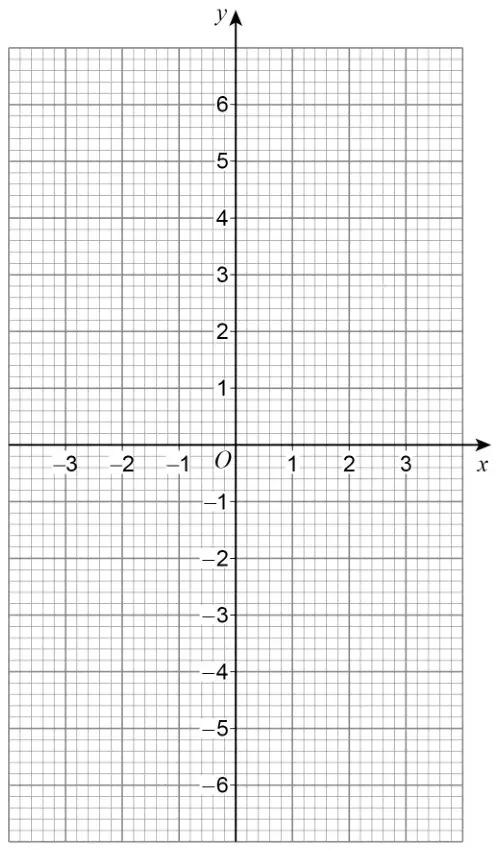
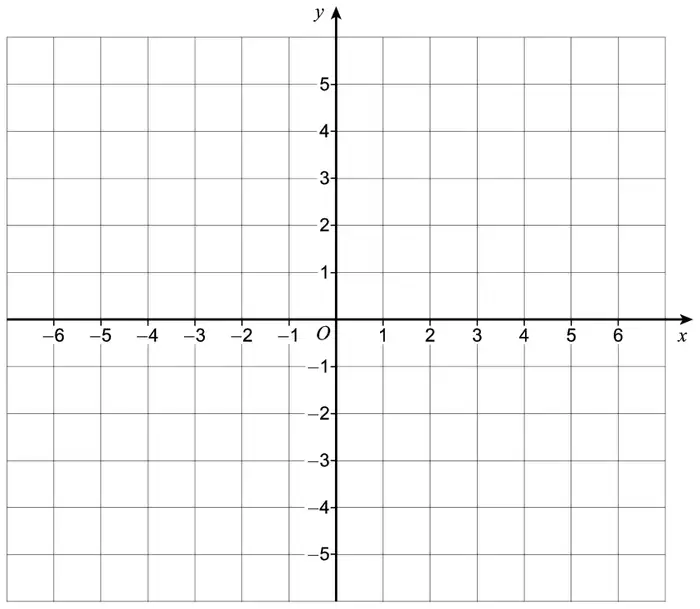
Draw the line for values of \(x\) from \(-3\) to \(3\) [3 marks]
Mark scheme
Answer
Mark
Comments
Line from \((-3, -4)\) to \((3, 5)\)
B3
B2 line of at least two squares width with gradient \(\dfrac{3}{2}\) passing through \((-1, -1)\) or line with gradient \(\dfrac{3}{2}\) for values of \(x\) from \(-3\) to 3 or correct equation of line eg \(y = \dfrac{3}{2}x + \dfrac{1}{2}\) or \(y - -1 = \dfrac{3}{2}(x - -1)\) B1 line of at least two squares width with gradient \(\dfrac{3}{2}\) or equation of line with gradient \(\dfrac{3}{2}\) eg \(y = \dfrac{3}{2}x + c\)
Additional guidance
Up to B2 may be awarded for correct work with no answer or incorrect answer, even if this is seen amongst multiple attempts
Mark intention
Ignore any graph drawn for \(x \lt -3\) and/or \(x \gt 3\)
Examples of lines of at least two squares width eg1 Line from \((-3, -4)\) to \((1, 2)\) \(\left(\text{grad} = \dfrac{3}{2} \text{ passing through } (-1, -1)\right)\)
B2
eg2 Line from \((0, 0)\) to \((2, 3)\) \(\left(\text{grad} = \dfrac{3}{2}\right)\)
B1
Correct equation of a line scores B2 even if there are subsequent errors eg \(y + 1 = \dfrac{3}{2}(x + 1)\) followed by \(y + 1 = \dfrac{3}{2}x + 1\)
B2
\(y = \dfrac{3}{2}x + c\) with \(c\) an unknown constant
Line L passes through the points \((3, 6)\) and \((-5, 16)\)
Tick (✓) the correct statement about lines K and L.
The lines are parallel.
The lines are perpendicular.
The lines are neither parallel nor perpendicular.
Show working to support your answer. [3 marks]
Mark scheme
Answer
Mark
Comments
\(y = \dfrac{4}{5}x \ldots\) or \(\dfrac{16 - 6}{-5 - 3}\)
M1
oe eg \(y = \dfrac{-4}{-5}x \ldots\) or \(\dfrac{6 - 16}{3 - -5}\) equation of K must have \(y\) as the subject but the intercept can be ignored allow eg \(y = \dfrac{4x - 17}{5}\)
(gradient of K =) \(\dfrac{4}{5}\) or (gradient of L =) \(-\dfrac{5}{4}\)
M1dep
oe value eg (gradient of K =) 0.8 do not allow a gradient if only seen embedded in an equation unless unambiguously selected (eg circled) condone inclusion of \(x\)
Both gradients correct and valid explanation and middle box ticked
A1
eg \(\dfrac{4}{5} \times \dfrac{10}{-8} = -1\) and middle box ticked do not allow a gradient if only seen embedded in an equation unless unambiguously selected (eg circled) do not allow inclusion of \(x\) in either gradient
Additional guidance
0.8 and \(-1.25\) and states gradients multiply to make \(-1\) and middle box ticked
M1M1A1
\(\dfrac{4}{5}\) and \(-\dfrac{5}{4}\) and states negative reciprocals and middle box ticked
M1M1A1
Condone eg \(\dfrac{10}{-8}\) for the value \(-\dfrac{5}{4}\)
M1 may be embedded in equation of line L eg \(y - 6 = \dfrac{16 - 6}{-5 - 3}(x - 3)\)
M1
(gradient of K =) \(\dfrac{4}{5}x \qquad\) (gradient of L =) \(-\dfrac{5}{4}x\) \(\dfrac{4}{5} \times -\dfrac{5}{4} = -1\) and middle box ticked (recovers to use numerical gradients)
M1M1 A1
(gradient of K =) \(0.8x \qquad\) (gradient of L =) \(-1.25\) \(0.8x \times -1.25 = -1\) (includes \(x\))
4 A line passes through \(P\,(1, k)\) and \(Q\,(r, 6)\) where \(k\) and \(r\) are constants.
The midpoint of \(PQ\) has \(x\)-coordinate 5
The gradient of the line is 2
Work out the value of \(k\). [4 marks]
Mark scheme
Answer
Mark
Comments
Alternative method 1 Works out \(r\) and uses it to work out gradient expression for \(PQ\)
\(\dfrac{1 + r}{2} = 5\) or (\(r =\)) \(5 \times 2 - 1\) or (\(r =\)) \(1 + 4 + 4\) or (\(r =\)) 9
M1
oe equation or calculation eg \(\dfrac{r - 1}{2} + 1 = 5\) or (\(r =\)) \(5 + 5 - 1\) may be seen on a sketch implied by \(Q\,(9, 6)\) implied by correct gradient expression in \(k\)
oe equation eg \(\dfrac{k - 6}{1 - \text{their } 9} = 2\) or \(6 - k = 16\) or \(\dfrac{6 + k}{2} = -8 + 6\) dep on 2nd M1
\(-10\)
A1
Alternative method 2 Works out \(r\) and uses it to work out equation of line \(PQ\)
\(\dfrac{1 + r}{2} = 5\) or (\(r =\)) \(5 \times 2 - 1\) or (\(r =\)) \(1 + 4 + 4\) or (\(r =\)) 9
M1
oe equation or calculation eg \(\dfrac{r - 1}{2} + 1 = 5\) or (\(r =\)) \(5 + 5 - 1\) may be seen on a sketch implied by \(Q\,(9, 6)\)
\(6 = 2 \times \text{their } 9 + c\) or \(c = -12\) or \(y = 2x - 12\)
M1
oe their 9 must be a value their 9 cannot be 1 or 5
\(2 \times 1 + 6 - 2 \times \text{their } 9\)
M1dep
oe eg \(2 - 12\) dep on 2nd M1
\(-10\)
A1
Alternative method 3 Works out \(r\) and uses it to work out difference in \(y\)-coordinates of \(P\) and \(Q\)
\(\dfrac{1 + r}{2} = 5\) or (\(r =\)) \(5 \times 2 - 1\) or (\(r =\)) \(1 + 4 + 4\) or (\(r =\)) 9
M1
oe equation or calculation eg \(\dfrac{r - 1}{2} + 1 = 5\) or (\(r =\)) \(5 + 5 - 1\) may be seen on a sketch implied by \(Q\,(9, 6)\) implied by difference in \(x\)-coordinates of \(P\) and \(Q\) is 8
oe their \(-4\) can only be 4 or \(\dfrac{1}{4}\) implied by a correct equation of B eg \(y - 1 = -4(x - 2)\) or \(y + 4x = 9\) or \(y = -4x + 9\)
\(2d + 4d = \text{their } 9\) or \(2d = (\text{their } -4)d + \text{their } 9\) or \(6d = 9\) or \(9 \div 6\)
M1dep
oe substitution of \((d, 2d)\) into their equation of B equation with no algebraic denominator dep on 2nd M1
\(\dfrac{3}{2}\) or \(1\dfrac{1}{2}\) or 1.5
A1
oe eg \(\dfrac{9}{6}\)
Alternative method 2
\(y + 4x = c\) or \(y = -4x + c\) or gradient \(= -4\)
M1
oe \(c\) can be any value other than 6 may be implied
\(\dfrac{2d - 1}{d - 2} = \text{their } -4\)
M1
oe their \(-4\) can only be 4 or \(\dfrac{1}{4}\) may be implied
\(2d - 1 = \text{their } -4(d - 2)\) or \(6d = 9\) or \(9 \div 6\)
M1dep
oe equation with no algebraic denominator dep on 2nd M1
\(\dfrac{3}{2}\) or \(1\dfrac{1}{2}\) or 1.5
A1
oe eg \(\dfrac{9}{6}\)
Additional guidance
Ignore simplification or conversion if correct answer seen
Condone answer (1.5, 3) oe
gradient \(= -4x\) must be recovered
3rd M1 Allow \((d, 2d)\) to be \((x, 2x)\) etc
3rd M1 Do not allow use of \((2d, d)\) to be a misread
A correct equation in \(d\) with no algebraic denominator implies M1M1M1 eg \(2d - 1 = -4(d - 2)\) or \(2d = -4d + 9\) or \(6d = 9\)
M1M1M1
Alt 1 gradient = 4 \(y = 4x - 7\) \(2d = 4d - 7 \qquad d = 3.5\)
M0 M1 M1A0
Alt 1 gradient \(= \dfrac{1}{4}\) \(y = \dfrac{1}{4}x + \dfrac{1}{2}\) \(2d = \dfrac{1}{4}d + \dfrac{1}{2} \qquad d = \dfrac{2}{7}\)
M0 M1 M1A0
gradient \(-4\) followed by correct method using gradient 4 or \(\dfrac{1}{4}\) for 2nd and 3rd marks can score a maximum of M2 eg Alt 1 gradient \(-4 \qquad 1 = 4 \times 2 + c \qquad 2d = 4d - 7\)
M0M1M1
gradient \(-4\) followed by correct method using gradient 4 or \(\dfrac{1}{4}\) for 2nd mark (but not the 3rd mark) can score a maximum of M1 eg Alt 1 gradient \(-4 \qquad y = \dfrac{1}{4}x + \dfrac{1}{2}\) (no further valid work)
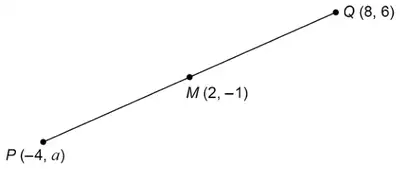
Correctly adding at least 1 multiple of 2 to the right and 3 up eg \(-6 + 2 = -4\) and \(-4 + 3 = -1\)
M1
oe needs to be added to both vertical and horizontal. Could be seen in coordinates eg \((-4, -1)\) could be 1 right and 1.5 up or \(y\) coordinate of \(-4 + 1.5 \times 6\)
(0, 5)
A1
Alternative method 3
Sketch drawn with straight line passing through \((-6, -4)\) and (0, 5) with steps shown
M1
just a line passing through 5 seen on the axis is enough for M1 but won’t gain A1 unless written as coordinates
B1 correct equation or calculation eg \(\dfrac{a + 6}{2} = -1\) or \(a + \dfrac{6 - a}{2} = -1\) or \(-1 - 7\) or \(6 - 7 \times 2\) allow \(a\) to be any letter
Additional guidance
Answer \(-8\) (no need to check working)
B2
Accept \((\ldots, -8)\) or \(\ldots, -8\) (no need to check working)
B2
Allow working in vectors eg \(\begin{pmatrix} 2 \\ -1 \end{pmatrix} - \begin{pmatrix} 6 \\ 7 \end{pmatrix}\)
B1
oe equations may involve equation of the line eg1 grad \(= \dfrac{6 - -1}{8 - 2} \qquad y = \dfrac{7}{6}x - \dfrac{10}{3}\) \(y = \dfrac{7}{6} \times -4 - \dfrac{10}{3}\) eg2 \(-1 - a = \dfrac{7}{6}(2 - -4)\)
A1ft values must be exact or rounded to 1 decimal place or better
Ignore any \(y\)-coordinate of \(B\) calculated after working out the \(x\)-coordinate
Assuming the lines are perpendicular can score a maximum of B1
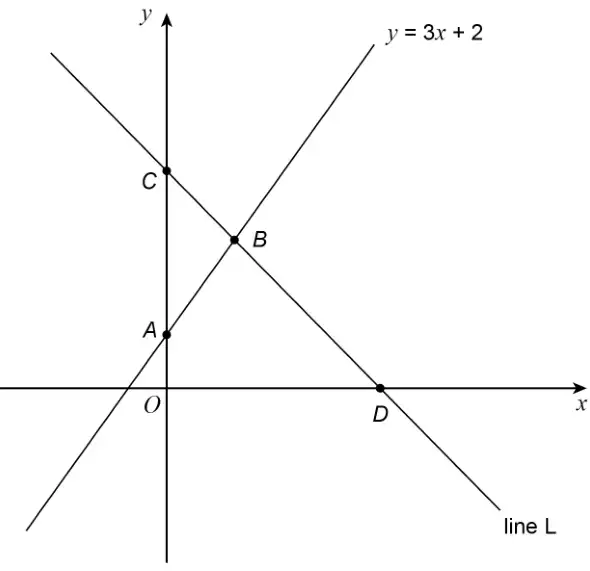
\(y\)-coordinate of \(C = 8\) gradient L \(= -\dfrac{8}{5}\) \(y = -\dfrac{8}{5}x + 8\) \(-\dfrac{8}{5}x + 8 = 3x + 2\) 1.3 \(\left(\text{Note that the exact value is } \dfrac{30}{23}\right)\)
First M1 can be scored using Pythagoras’ theorem and cosine rule eg \((PR^2 =)\ 9^2 + (15 - 6)^2\) or 162 and \((PQ =)\ 6 - 1\) or 5 and (angle \(QPR\) =) \(180 - 45\) or 135 and \((k - 1)^2 + (15 - 1)^2 =\) their 162 \(+\) (their 5)\(^2\) \(-\ 2 \times \sqrt{\text{their } 162} \times\) their 5 \(\times \cos\) their 135
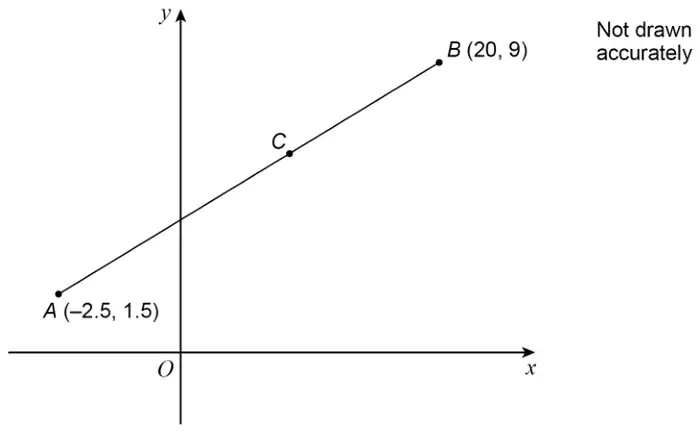
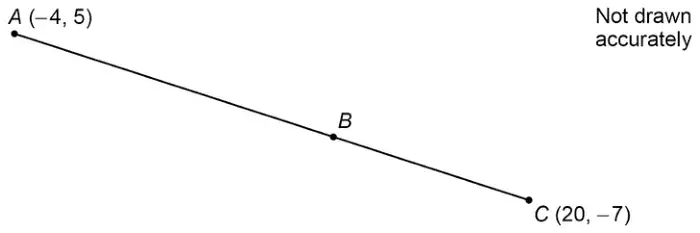
\(A\) is the point \((-4,\ 5)\) \(C\) is the point \((20,\ -7)\) \(AB : BC = 5 : 3\)
Work out the coordinates of \(B\). [4 marks]
Mark scheme
Answer
Mark
Comments
Alternative method 1
\(\pm(20 - -4)\) or \(\pm(5 - -7)\) or \(\pm 24\) or \(\pm 12\) seen
M1
allow on diagram
using \(\dfrac{5}{8}\) or \(\dfrac{3}{8} \times \pm\) their 24 or \(\pm 15\) or \(\pm 9\) or \(\dfrac{5}{8}\) or \(\dfrac{3}{8} \times \pm\) their 12 or \(\pm 7.5\) or \(\pm 4.5\)
The curve has gradient function \(\quad \dfrac{x^5 - 17}{10}\)
The tangent to the curve at \(P\) is parallel to the line \(\quad 3x - 2y = 9\)
Work out the \(x\)-coordinate of \(P\). [4 marks]
Mark scheme
Answer
Mark
Comments
\((y =)\ \dfrac{3}{2}x\ldots\) or \((y =)\ 1.5x\ldots\) or \(\dfrac{3}{2}\) or 1.5
M1
oe eg \((y =)\ \dfrac{3x - 9}{2}\)
\(\dfrac{x^5 - 17}{10} = \dfrac{3}{2}\)
M1dep
oe implies M2
\(x^5 = \dfrac{3}{2} \times 10 + 17\) or \(\sqrt[5]{32}\) or correctly rearranges \(\dfrac{x^5 - 17}{10} = k\) to the form \(x^5 =\) (\(k\) any non-zero value)
M1
oe eg \(x^5 = 15 + 17\) or \(x^5 = 32\) or \(\sqrt[5]{15 + 17}\) must rearrange to the form \(x^5 =\)
2
A1
Additional guidance
Condone error seen in rearrangement of \(3x - 2y = 9\) if gradient is \(\dfrac{3}{2}\) May go on to score M3A1
\(\dfrac{x^5 - 17}{10} = \dfrac{3}{2}x\)
M1M0M0A0
(gradient \(=\)) 3 \(\dfrac{x^5 - 17}{10} = 3\) \(x^5 = 30 + 17 \quad\) (3rd M is not dependent) 2.16
M0M0dep
M1 A0
\(\dfrac{3}{2}\) \(\dfrac{x^5 - 17}{10} = -\dfrac{2}{3}\) \(x^5 = -\dfrac{2}{3} \times 10 + 17 \quad\) (3rd M is not dependent) 1.595
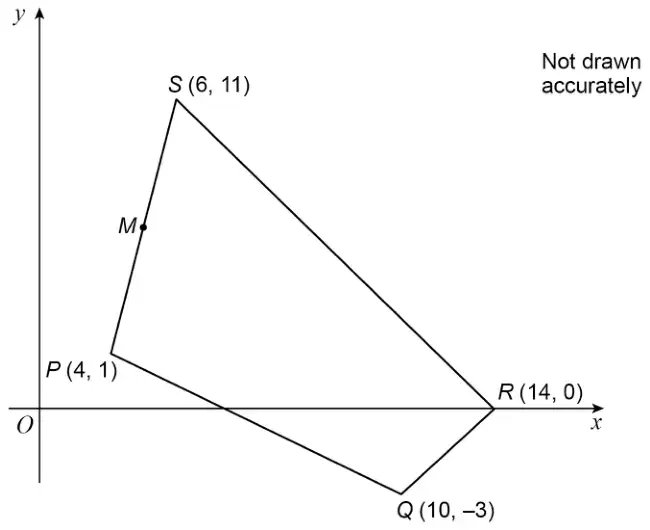
Use gradients to show that \(MR\) is parallel to \(PQ\). [3 marks]
Mark scheme
Answer
Mark
Comments
\(\left(\dfrac{4 + 6}{2},\ \dfrac{1 + 9}{2}\right)\) or \((5,\ 6)\)
M1
oe eg \(\left(4 + \dfrac{6 - 4}{2},\ 1 + \dfrac{11 - 1}{2}\right)\) may be on diagram
\(\dfrac{1 - -3}{4 - 10}\) or \(\dfrac{4}{-6}\) or \(\dfrac{0 - \text{their } 6}{14 - \text{their } 5}\) or \(\dfrac{-6}{9}\)
M1
oe method for at least one gradient or at least one unsimplified gradient seen eg \(\dfrac{-3 - 1}{10 - 4}\) or \(\dfrac{-4}{6}\) or \(\dfrac{\text{their } 6 - 0}{\text{their } 5 - 14}\) or \(\dfrac{6}{-9}\)
\(\dfrac{6 - 0}{5 - 14}\) or \(\dfrac{6}{-9}\) is M1M1
\(\dfrac{1 - -3}{4 - 10}\) or \(\dfrac{4}{-6}\) and \(\dfrac{0 - 6}{14 - 5}\) or \(\dfrac{-6}{9}\) and shows that the gradients are equal
A1
oe method for both gradients or two unsimplified gradients seen and gradients shown to be equal eg \(\dfrac{4}{-6}\) and \(\dfrac{-6}{9}\) and these are both \(-\dfrac{2}{3}\)
SC2 \((5,\ 6)\) and at least one gradient given as \(-\dfrac{2}{3}\) SC1 at least one gradient given as \(-\dfrac{2}{3}\)
Additional guidance
Mark intention for 1st M1 eg condone 5, 6
M1
\(\dfrac{4}{-6} = -\dfrac{2}{3}\) and \(\dfrac{-6}{9} = -\dfrac{2}{3}\)
\(\dfrac{4}{-6}\) and \(\dfrac{-6}{9}\) and parallel
M2A0
\(\dfrac{4}{6}\) is 2nd M0 unless recovered to \(-\dfrac{4}{6}\)
\(\dfrac{4}{6}\) recovered to \(-\dfrac{4}{6}\) and \(\dfrac{6}{9}\) recovered to \(-\dfrac{6}{9}\) could go on to score full marks
both gradients \(= -\dfrac{2}{3}\) with no method or unsimplified gradients seen cannot score the A mark
\(\dfrac{4}{-6}x\) or \(\dfrac{-6}{9}x\) do not score 2nd M1 unless recovered
Equation of a line does not score 2nd M1 unless a method or unsimplified gradient seen
Using the reciprocals of gradients can score a maximum of M1M0A0
Allow \(-0.66\ldots\) or \(-0.67\) for \(-\dfrac{2}{3}\) and \(\dfrac{4}{-6}\) etc Ignore conversion attempt after a correct fraction is seen
or method for \(\dfrac{4}{-6}\) \(1 = 4m + c\) and \(-3 = 10m + c\) \(4 = -6m\) \(\dfrac{4}{-6} = m \qquad\) (similar method possible for \(\dfrac{-6}{9}\))
oe dep on 2nd M1 equation of their tangent with or without substitution of \(y = 0\) implied by \(y = \dfrac{5}{2}x + \dfrac{29}{2}\) oe or \(0 = \dfrac{5}{2}x + \dfrac{29}{2}\) oe
gradient \(BC = \dfrac{3}{5}\) (positive gradient because they can see it from the diagram) equation \(BC\) is \(\ y = \dfrac{3}{5}x + 25\) … this scores 4 marks
similarly, recovery can be from …
gradient \(AB = \dfrac{25}{15} = \dfrac{5}{3}\) … without seeing \(\dfrac{0 - 25}{15 - 0}\) … and can still lead to 4 marks
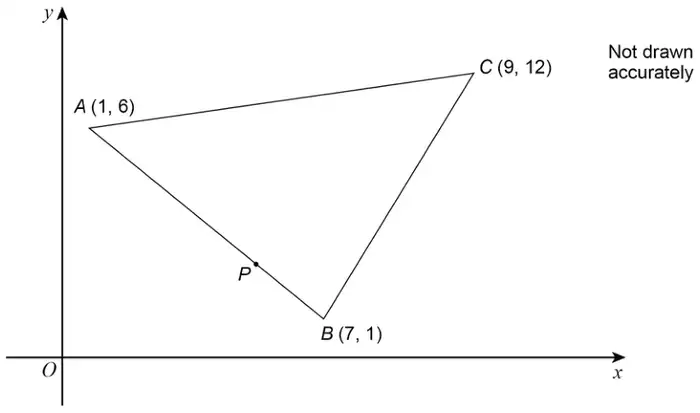
\(P\) is a point on \(AB\). \(AP : PB\) is \(3 : 1\)
Work out the length \(PC\). Give your answer to 4 significant figures. [4 marks]
Mark scheme
Answer
Mark
Comments
Alternative method 1
(\(x\)-coordinate of \(P =\)) 5.5 and (\(y\)-coordinate of \(P =\)) 2.25
B2
oe may be seen on diagram B1 (\(x\)-coordinate of \(P =\)) 5.5 or (\(y\)-coordinate of \(P =\)) 2.25 or \(x\)-coordinate of \(P = 2.25\) and \(y\)-coordinate of \(P = 5.5\)
\((9 - \text{their } 5.5)^2 + (12 - \text{their } 2.25)^2\) or \(3.5^2 + 9.75^2\) or \(12.25 + 95.06(25)\) or \(12.25 + 95.063\) or 107.3(125) or 107.313
M1
oe eg \(\sqrt{3.5^2 + 9.75^2}\) or \(\dfrac{1717}{16}\) \(1 \lt\) their \(5.5 \lt 7\) \(1 \lt\) their \(2.25 \lt 6\)
10.36
A1ft
correct or ft their 5.5 and/or their 2.25 must be rounded to 4 sig figs
Alternative method 2 Uses \(AC = 10\), \(BC = \sqrt{125}\) or \(5\sqrt{5}\) or 11.18… and \(AB = \sqrt{61}\) or 7.81…
\(Q\) is the point \((a,\ 4)\) \(R\) is the point \((6,\ -2)\)
\(Q\) is the midpoint of \(PR\).
Work out the values of \(a\) and \(b\). [3 marks]
Mark scheme
Answer
Mark
Comments
Alternative method 1
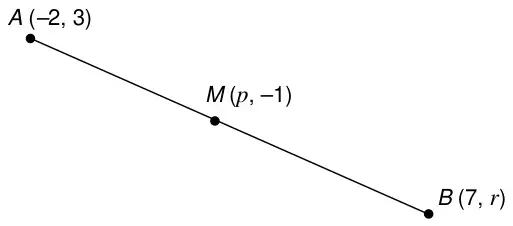
\(\dfrac{6 + (-12)}{2}\) or \(\dfrac{-2 + b}{2}\)
M1
oe eg \(\ 18 \div 2 = 9\) and \(6 - 9\) eg \(\ 6 \times 2 = 12\) and \(-2 + 12\) These come from distances of 18 and 6, as seen in a diagram and used correctly
2 \(P\,(-3,\ -10)\) and \(Q\,(a,\ b)\) are points on a straight line with gradient 12
Work out one possible pair of integer values for \(a\) and \(b\). [2 marks]
Mark scheme
Answer
Mark
Comments
Any pair of integer values for \(a\) and \(b\) for which \(b = 12a + 26\)
B2
B1 Correct equation in any form eg \(\dfrac{b - -10}{a - -3} = 12\) or \(b + 10 = 12(a + 3)\) or \(\dfrac{y - -10}{x - -3} = 12\) or \(y + 10 = 12(x + 3)\) or \(b = 12a + c\) and \(c = 26\) or \(y = 12x + c\) and \(c = 26\) or \(-3 + \mathrm{k}\) and \(-10 + 12\mathrm{k}\) where k is a non-zero integer
Additional guidance
Examples of B2 responses \(a = -4\) and \(b = -22\) or \(a = -2\) and \(b = 2\) or \(a = -1\) and \(b = 14\) or \(a = 0\) and \(b = 26\) or \(a = 1\) and \(b = 38\) or \(a = 2\) and \(b = 50\) or \(a = 3\) and \(b = 62\) or \(a = 4\) and \(b = 74\)
B2
\(a = -3\) and \(b = -10\) is point \(P\) so will not score B2 (B1 possible)
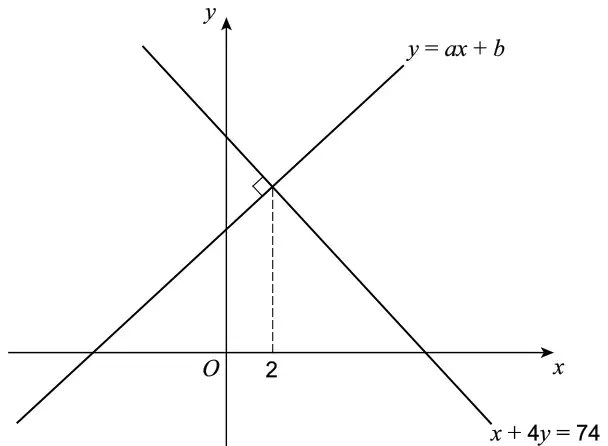
14 The line \(\quad y = ax + b \quad\) is perpendicular to the line \(\quad x + 4y = 74\)
The lines intersect at the point where \(x = 2\)
Not drawn accurately
Work out the values of \(a\) and \(b\). [5 marks]
Mark scheme
Answer
Mark
Comments
Alternative method 1
\(-\dfrac{1}{4}\) or \(-0.25\)
B1
gradient of \(x + 4y = 74\) Do not allow embedded May be implied
(gradient =) \(\dfrac{-1}{\text{their } -\frac{1}{4}}\) or 4
M1
ft their \(-\dfrac{1}{4}\) Only ft a non-zero numerical value Implied by \(y = 4x + b\) or \(a = 4\) (B1M1)
(\(y\) =) \(\dfrac{74 - 2}{4}\) or \(\dfrac{72}{4}\) or 18
M1
oe May be seen on diagram
their \(18 =\) their \(4 \times 2 + b\) or \(y -\) their \(18 =\) their \(4(x - 2)\)
M1dep
oe dep on M2
\(b = 10\)
A1ft
ft \(18 -\) their \(4 \times 2\) if B0M3
Alternative method 2
\(-\dfrac{1}{4}\) or \(-0.25\)
B1
gradient of \(x + 4y = 74\) Do not allow embedded May be implied
(gradient =) \(\dfrac{-1}{\text{their } -\frac{1}{4}}\) or 4
M1
ft their \(-\dfrac{1}{4}\) Only ft a non-zero numerical value Implied by \(y = 4x + b\) or \(a = 4\) (B1M1)
Correct method for elimination of \(y\) from \(x + 4y = 74\) and \(y =\) their \(4x + b\)
M1dep
eg \(x + 4(4x + b) = 74\) or \(17x + 4b = 74\)
Substitutes \(x = 2\) into their equation
M1dep
eg \(34 + 4b = 74\)
\(b = 10\)
A1ft
ft \(18 -\) their \(4 \times 2\) if B0M3
Alternative method 3
\(-\dfrac{1}{4}\) or \(-0.25\)
B1
gradient of \(x + 4y = 74\) Do not allow embedded May be implied
(gradient =) \(\dfrac{-1}{\text{their } -\frac{1}{4}}\) or 4
M1
ft their \(-\dfrac{1}{4}\) Only ft a non-zero numerical value Implied by \(y = 4x + b\) or \(a = 4\) (B1M1)
(\(y\) =) \(\dfrac{74 - 2}{4}\) or \(\dfrac{72}{4}\) or 18
M1
oe May be seen on diagram
Correct method for elimination of \(x\) from \(x + 4y = 74\) and \(y =\) their \(4x + b\) and substitutes \(y =\) their 18
M1dep
eg \(y = 4(74 - 4y) + b\) or \(17y = 296 + b\) and \(306 = 296 + b\) dep on M2
\(b = 10\)
A1ft
ft \(18 -\) their \(4 \times 2\) if B0M3
Additional guidance
\(y = 4x + 10\) will gain full marks unless contradicted
If an error is made in the constant term when rearranging \(x + 4y = 74\) the B1 can still be awarded for gradient \(= -\dfrac{1}{4}\) eg \(y = -\dfrac{1}{4}x + 19\) and gradient \(= -\dfrac{1}{4}\) is B1 (all other marks are possible)
In alt 1 and alt 3 the mark for \(y = 18\) will sometimes be the only mark awarded
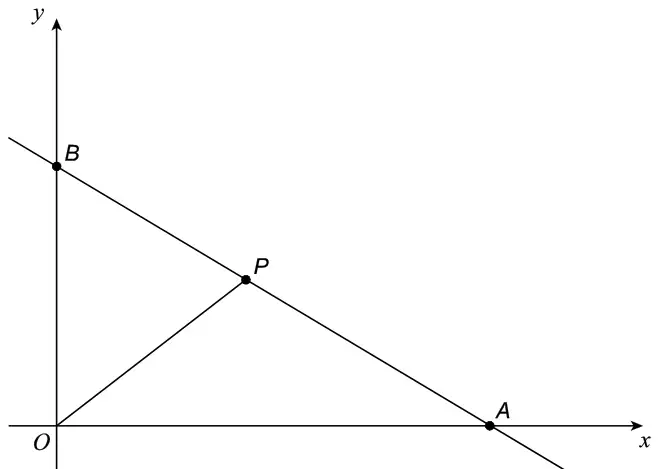
7 The equation of the line through \(B\), \(P\) and \(A\) is \(\quad 4x + 5y = 40\)
\(BP : PA = 2 : 3\)
Not drawn accurately
Work out the area of triangle \(OBP\). [4 marks]
Mark scheme
Answer
Mark
Comments
Alternative method 1
(\(x\)-coordinate of \(A\) =) 10 and (\(y\)-coordinate of \(B\) =) 8
B1
May be implied on diagram eg 10 written next to \(A\) and 8 written next to \(B\)
(\(x\)-coordinate of \(P\) =) \(\dfrac{2}{2 + 3} \times\) their 10 or \(\dfrac{2 \times \text{their } 10 + 3 \times 0}{2 + 3}\) or 4
M1
oe their 10 must be their \(x\)-coordinate of \(A\) May be seen on diagram
(area of triangle \(OBP\) =) \(\dfrac{1}{2} \times\) their \(8 \times\) their 4
M1dep
oe their 8 must be their \(y\)-coordinate of \(B\)
16
A1ft
ft B0M2
Alternative method 2
(\(x\)-coordinate of \(A\) =) 10 and (\(y\)-coordinate of \(B\) =) 8
B1
May be implied on diagram eg 10 written next to \(A\) and 8 written next to \(B\)
(area of triangle \(OAB\) =) \(\dfrac{1}{2} \times\) their \(10 \times\) their 8 or 40
M1
oe
(area of triangle \(OBP\) =) \(\dfrac{2}{2 + 3} \times\) their 40
M1dep
oe eg their \(40 - \dfrac{3}{2 + 3} \times\) their 40
16
A1ft
ft B0M2
Alternative method 3
(\(x\)-coordinate of \(A\) =) 10 and (\(y\)-coordinate of \(B\) =) 8
B1
May be implied on diagram eg 10 written next to \(A\) and 8 written next to \(B\)
(area of triangle \(OAB\) =) \(\dfrac{1}{2} \times\) their \(10 \times\) their 8 or 40
M1
oe
(\(y\)-coordinate of \(P\) =) \(\dfrac{3}{2 + 3} \times\) their 8 or 4.8 and (area of triangle \(OPA\) =) \(\dfrac{1}{2} \times\) their \(10 \times\) their 4.8 or 24 and (area of triangle \(OBP\) =) their \(40 -\) their 24
M1dep
oe their 8 must be their \(y\)-coordinate of \(B\) \(y\)-coordinate of \(P\) may be seen on diagram
16
A1ft
ft B0M2
Alternative method 4
(\(x\)-coordinate of \(A\) =) 10 and (\(y\)-coordinate of \(B\) =) 8
B1
May be implied on diagram eg 10 written next to \(A\) and 8 written next to \(B\)
(\(AB\) =) \(\sqrt{\text{their } 10^2 + \text{their } 8^2}\) or \(\sqrt{100 + 64}\) or \(\sqrt{164}\) or \(2\sqrt{41}\) or 12.8(…) and (\(BP\) =) \(\dfrac{2}{2 + 3} \times\) their 12.8(…) or 5.12(…) and (angle \(OBP\) =) \(\tan^{-1} \dfrac{\text{their } 10}{\text{their } 8}\) or 51.3(…)
M1
oe their 10 must be their \(x\)-coordinate of \(A\) their 8 must be their \(y\)-coordinate of \(B\)
(area of triangle \(OBP\) =) \(\dfrac{1}{2} \times\) their \(8 \times\) their 5.12 \(\times \sin\) their 51.3
M1dep
oe their 8 must be their \(y\)-coordinate of \(B\)
16
A1ft
ft B0M2
Additional guidance
\(A = 10\) and \(B = 8\)
B1
\(A\) (8, 0) and \(B\) (0, 10) is B0 but can subsequently score up to M2A1ft (answer 16)
\(A\) (0, 10) and \(B\) (8, 0) is B0 but can score up to M2A1ft if uses \(x\)-coordinate of \(A\) as 10 and \(y\)-coordinate of \(B\) as 8 (answer 16)
\(A\) (0, 8) and \(B\) (10, 0) is B0 but can score up to M2A1ft if uses \(x\)-coordinate of \(A\) as 8 and \(y\)-coordinate of \(B\) as 10 (answer 16)
Area triangle \(OBP\) may be seen as the sum of two right-angled triangles
Area triangle \(OBP\) may be seen as area trapezium \(OBPX\) – area triangle \(OPX\) \(X\) is on the \(x\)-axis with \(PX\) perpendicular to the \(x\)-axis
Allow marks for valid working seen even if not subsequently used
oe eg \(\dfrac{12}{5} \pm \sqrt{\dfrac{64}{25}}\) or \(-\dfrac{4}{15} \pm \sqrt{\dfrac{256}{225}}\) or \(\dfrac{44}{35} \pm \sqrt{\dfrac{256}{1225}}\) Correct attempt to solve their 3-term quadratic Allow recovery of brackets in formula Allow eg \(24^2\) for \((-24)^2\) Implied by correct solutions to their 3-term quadratic seen
\(\dfrac{4}{5}\) or 0.8
A1
oe Must reject solution 4 or \(-\dfrac{4}{3}\) or \(\dfrac{12}{7}\)
Additional guidance
Terms must be collected but do not have to be processed for M1dep eg (Alt 1) \(a + 4 = 6a\) needs terms collecting to \(4 = 6a - a\) for M1dep
Rejection of solution is implied by only \(\dfrac{4}{5}\) on answer line
4 A straight line passes through the points (\(-4\), 7), (6, \(-5\)) and (8, \(t\))
Use an algebraic method to work out the value of \(t\).
You must show your working. [3 marks]
Mark scheme
Answer
Mark
Comments
Alternative method 1
Intention to work out gradient or reciprocal of gradient or Intention to work out the equation of the straight line
M1
Condone one sign error in the calculation eg \(\dfrac{-5 - 7}{6 - -4}\) or \(\dfrac{-5 - t}{6 - 8}\) or \(\dfrac{7 - t}{-4 - 8}\) or \(-1.2\) oe eg \(7 = -4m + c\) or \(-5 = 6m + c\) eg \(y - 7 = m(x - -4)\)
A correct value for \(m\) or a correct expression for \(m\) and an expression to calculate the value of \(t\) or the value of \(c\) or \(m = -1.2\) and \(c = 2.2\)
M1dep
eg. (\(m\) =) \(\dfrac{7 - -5}{-4 - 6}\) or (\(m\) =) \(\dfrac{-6}{5}\) oe and eg \(\dfrac{t - -5}{8 - 6} = \dfrac{-5 - 7}{6 - -4}\) or \(t = \dfrac{-6}{5}(8) + \left(7 - \dfrac{24}{5}\right)\) or \(7 = \dfrac{-6}{5}(-4) + c\) or \(-5 = \dfrac{-6}{5}(6) + c\)
(\(t\) =) \(-7.4\) or \(-7\frac{2}{5}\) or \(\dfrac{-37}{5}\)
A1
Alternative method 2
\(-4\) to 6 is \(+10\) and 7 to \(-5\) is \(-12\)
M1
oe Condone a sign error
6 to 8 is \(+2\) and \(-5\) to \(t\) is \(\dfrac{-12}{5}\)
M1
oe
(\(t\) =) \(-7.4\) or \(-7\frac{2}{5}\) or \(\dfrac{-37}{5}\)
A1
Alternative method 3
\(\sqrt{[(-4 - 6)^2 + (7 - -5)^2]}\) (\(= \sqrt{244}\)) and stating \(-4\) to 6 is 10 and 6 to 8 is 2
M1
Correct use of Pythagoras and identifying the correct displacements
Look at any diagram they may have drawn for evidence of the alt 2 method
\(\dfrac{7 - -5}{-4 - 6}\) (correct expression) \(= 1.2\) (error) followed by \(7 = (1.2)(-4) + c\) scores M1 M1 but will not lead to a correct final answer, so A0
\(m = -1.2\), but they use 1.2 instead ... \(7 = 1.2(-4) + c\) giving \(c = 11.8\) is M1 M1 A0
\(m = -1.2\), then \(t = -1.2 + 11.8 = 2.2\) scores M1 M1 A0 because this is a correct method for calculating \(c\), and so scores the 2nd M1, even though they think they are calculating \(t\)
11 \(A\left(1\frac{1}{5}, 3\frac{4}{5}\right)\), \(B\left(2, 1\frac{4}{5}\right)\) and \(C(5, 3)\) are points on a coordinate grid.
Show that the line segments \(AB\) and \(BC\) are perpendicular. [3 marks]
Mark scheme
Answer
Mark
Comments
Alternative method 1
Correct method for finding the gradient of either \(AB\) or \(BC\)
M1
\(\dfrac{1\frac{4}{5} - 3\frac{4}{5}}{2 - 1\frac{1}{5}}\) or \(\dfrac{1.8 - 3.8}{2 - 1.2}\) or \(\dfrac{3 - 1\frac{4}{5}}{5 - 2}\) or \(\dfrac{3 - 1.8}{5 - 2}\)
Correct method for finding the gradient of \(AB\) and \(BC\), and at least one of the gradients correct
M1
\(\dfrac{-10}{4}\) or \(\dfrac{-5}{2}\) or \(-2\frac{1}{2}\) or \(-2.5\) or \(\dfrac{-2}{\frac{4}{5}}\) or \(\dfrac{-2}{0.8}\) or \(\dfrac{6}{15}\) or \(\dfrac{2}{5}\) or \(\dfrac{4}{10}\) or 0.4 or \(\dfrac{1\frac{1}{5}}{3}\) or \(\dfrac{1.2}{3}\)
product \(= -1\) clearly shown or clearly showing that one is the negative reciprocal of the other
The \(\dfrac{y\text{-step}}{x\text{-step}}\) calculation, for the first M1, might be on the diagram
The expressions for the gradients can be either way round eg \(\dfrac{3.8 - 1.8}{1.2 - 2} = \dfrac{2}{-0.8}\)
Both gradients numerically correct but both with the wrong sign eg \(\dfrac{10}{4}\) and \(\dfrac{-6}{15}\) scores SC1
For the 2nd M mark we are looking for \(m/n\) where \(m\) and \(n\) are integers, mixed numbers, fractions, improper fractions or decimals eg \(\dfrac{6/5}{3}\)
The gradients for each line can be found by forming two simultaneous equations. It will be very rare, but check their working if you see this method.
\(\tan^{-1}\dfrac{9 - 4}{-2 - -6}\) is the angle \(DE\) makes with the horizontal (= 51.3...) \(\sqrt{(9 - 4)^2 + (-2 - -6)^2}\) is \(DE\) (= \(\sqrt{41}\) or 6.4...)
\(\tan^{-1}\dfrac{9 - 4}{-2 - -6}\) is the angle \(DE\) makes with the horizontal (= 51.3...) \(\sqrt{(9 - 4)^2 + (-2 - -6)^2}\) is \(DE\) (= \(\sqrt{41}\) or 6.4...)
\((-4.5, 5.9)\) or \((-4.5, 5.88)\) is M1 A1 A0 unless 5.875 seen in working
\((5.875, -4.5)\) is SC2 or M1 A1 A1 if \(x = -4.5\) and \(y = 5.875\) seen in working
\(-4.5\) in working that becomes 4.5 on answer line should not be regarded as choice so gains at least M1 A1
2 marks if one coordinate correct and 3 marks if both correct (possibly from accurate drawing or working with midpoints) with no incorrect working for that coordinate
Alts 5 and 6 also have equivalents where the angle \(DE\) makes with the vertical (= 38.6... or 38.7) is used. Mark using the principles of alts 5 and 6 or escalate