
June 2017 Paper 2 Q17
17 Here is a sketch of \(\quad y = x^3 - 6x^2 + 7\)
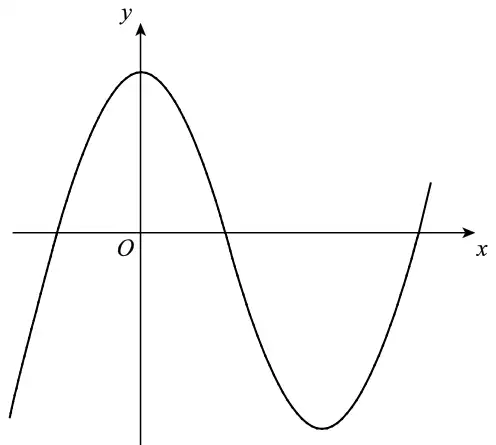
Not drawn accurately
(a) Use differentiation to work out the coordinates of the stationary point that is a minimum.
You must show your working. [4 marks]
(b) The three roots of \(\quad x^3 - 6x^2 + 7 = 0 \quad\) are the \(x\)-coordinates of the points where the graph intersects the \(x\)-axis.
Show that \(\ x = -1\ \) is one root of \(\quad x^3 - 6x^2 + 7 = 0\) [1 mark]
(c) Hence, work out the other two roots of \(\quad x^3 - 6x^2 + 7 = 0\)
Give your answers to 2 decimal places.
You must show your working. [5 marks]
| Answer | Mark | Comments |
|---|---|---|
| \(3x^2\) or \((-)12x\) | M1 | Attempt at \(\dfrac{\mathrm{d}y}{\mathrm{d}x}\) |
| their \((3x^2 - 12x) = 0\) | M1dep | Must have at least 2 terms for their \(\dfrac{\mathrm{d}y}{\mathrm{d}x}\) The \(= 0\) can be implied by sight of a correct non-zero solution to their \((3x^2 - 12x) = 0\) |
| \(x = 4\) (and \(x = 0\)) | A1ft | ft M2 if their \(\dfrac{\mathrm{d}y}{\mathrm{d}x}\) is a 2-term quadratic |
| (4, \(-25\)) with correct expression for \(\dfrac{\mathrm{d}y}{\mathrm{d}x}\) seen | A1 |
Additional guidance
| Condone \(y = 3x^2 - 12x\) etc | M1 |
| Ignore working for second derivative or testing for minimum point | |
| Stating \(\dfrac{\mathrm{d}y}{\mathrm{d}x} = 0\) is not sufficient for second M mark but may be implied by correct solution(s) seen |
| Answer | Mark | Comments |
|---|---|---|
| Alternative method 1 | ||
| \((-1)^3 - 6(-1)^2 + 7 = 0\) with no incorrect evaluations seen or \(-1 - 6 + 7 = 0\) | B1 | Must have \(= 0\) |
| Alternative method 2 | ||
| \((x + 1)(x^2 - 7x + 7) = 0\) and \((x + 1) = 0\) and \(x = -1\) | B1 | |
Additional guidance
| \((-1)^3 - 6(-1)^2 + 7 \quad\) or \(\quad -1 - 6 + 7\) | B0 |
| Allow \(-1^3\) or \((-1^3)\) for \((-1)^3\) | |
| Allow recovery of brackets for \((-1)^2\) eg1 \(-1^3 - 6 \times -1^2 + 7 = 0\) eg2 \(-1^3 - 6 \times -1^2 + 7 = -1 - 6 + 7 = 0\) | B0 B1 |
| Answer | Mark | Comments |
|---|---|---|
| Alternative method 1 | ||
| \((x - -1)\) or \((x + 1)\) seen | M1 | |
| \((x + 1)(x^2 - 7x + c)\) | M1dep | \(c\) can be any non-zero value Implied by \((x + 1)(x^2 + bx + c)\) and \(b + 1 = -6\) or \(b = -7\) |
| \(x^2 - 7x + 7\ (= 0)\) | A1 | |
| \(\dfrac{--7 \pm \sqrt{(-7)^2 - 4 \times 1 \times 7}}{2 \times 1}\) or \(\dfrac{7 \pm \sqrt{21}}{2}\) | M1 | oe eg \(\dfrac{7}{2} \pm \sqrt{\dfrac{21}{4}}\) Correct attempt to solve their 3-term quadratic Allow recovery of brackets Allow \(7^2\) for \((-7)^2\) Implied by correct solutions to their 3-term quadratic seen |
| 5.79 and 1.21 with \(x^2 - 7x + 7\ (= 0)\) seen | A1 | Must both be to 2 dp |
| Alternative method 2 | ||
| \((x - -1)\) or \((x + 1)\) seen | M1 | |
| \(\begin{array}{r} x^2 - 7x \ldots \phantom{+ 7} \\ x + 1 \overline{\big)\, x^3 - 6x^2\ (+\, 0x) + 7} \end{array}\) | M1dep | |
| \(x^2 - 7x + 7\ (= 0)\) | A1 | |
| \(\dfrac{--7 \pm \sqrt{(-7)^2 - 4 \times 1 \times 7}}{2 \times 1}\) or \(\dfrac{7 \pm \sqrt{21}}{2}\) | M1 | oe eg \(\dfrac{7}{2} \pm \sqrt{\dfrac{21}{4}}\) Correct attempt to solve their 3-term quadratic Allow recovery of brackets Allow \(7^2\) for \((-7)^2\) Implied by correct solutions to their 3-term quadratic seen |
| 5.79 and 1.21 with \(x^2 - 7x + 7\ (= 0)\) seen | A1 | Must both be to 2 dp |
Additional guidance
| Final A1 mark can be awarded if both answers seen in working with \(x^2 - 7x + 7\ (= 0)\) seen but only one answer is written on answer line | |
| \((x + 1)\) followed by 5.79 and 1.21 without \(x^2 - 7x + 7\ (= 0)\) seen | M1M0A0 M0A0 |
| \((x - 1)\) instead of \((x + 1)\) can score a maximum of M0M0A0M1A0 | |
| T & I on the cubic equation | Zero |