\(\dfrac{- -8 \pm \sqrt{(-8)^2 - 4 \times 3 \times 2}}{2 \times 3}\) or \(\dfrac{4}{3} \pm \sqrt{\dfrac{10}{9}}\) or [2.38, 2.39] and [0.27, 0.28]
M1
oe use of formula or completing the square or factorising their 3-term quadratic eg \(\dfrac{8 \pm \sqrt{40}}{6}\) or \(\dfrac{4}{3} \pm \dfrac{\sqrt{10}}{3}\) [2.38, 2.39] and [0.27, 0.28] implies M3 \(\dfrac{8 \pm \sqrt{40}}{6}\) oe implies M3
\(\dfrac{3}{2}\) and \(\dfrac{4}{3} + \dfrac{\sqrt{10}}{3}\) and \(\dfrac{4}{3} - \dfrac{\sqrt{10}}{3}\) with no other solutions
A1
oe values eg 1.5 and \(\dfrac{8 \pm \sqrt{40}}{6}\) or \(1\dfrac{1}{2}\) and \(\dfrac{4}{3} + \sqrt{\dfrac{10}{9}}\) and \(\dfrac{4}{3} - \sqrt{\dfrac{10}{9}}\)
Additional guidance
Up to M3 may be awarded for correct work with no answer or incorrect answer, even if this is seen amongst multiple attempts
Up to the first two marks may be seen in a grid eg
\(3x^2\)
\(-8x\)
(+)2
\(2x\)
\(6x^3\)
\(-16x^2\)
\(4x\)
\(-3\)
\(-9x^2\)
\(24x\)
\(-6\)
M1M1
3rd M1 \(\;8^2\) is equivalent to \((-8)^2\)
3rd M1 Use of \(-8^2\) for \((-8)^2\) must be recovered
3rd M1 Completing the square must get as far as numerical answers which must be correct for their quadratic
3rd M1 3-term quadratic means \(ax^2 + bx + c\) with no zero coefficients
3rd M1 Allow correct substitution into quadratic formula for their 3-term quadratic even if it has no real solutions
3rd M1 can be implied by correct solutions of their 3-term quadratic truncated or rounded to 2 dp or better
A quadratic from differentiation can be used to score the 3rd M1
Non-exact solutions cannot score full marks eg 1.5 and 2.38 and 0.28
condone omission of = 0 oe eg \((2x + 6)(3x + 2) = 0\) or \(2(x + 3)(3x + 2) = 0\) or \(-\dfrac{11}{6} \pm \sqrt{-2 + \dfrac{121}{36}}\) or \(-\dfrac{11}{6} \pm \sqrt{\dfrac{49}{36}}\)
\(x = -\dfrac{2}{3}\) and \(x = -3\)
M1dep
allow \([-0.67, -0.66]\) for \(-\dfrac{2}{3}\)
\(x = -\dfrac{2}{3}\) and \((-3, 0)\)
M1dep
allow \([-0.67, -0.66]\) for \(-\dfrac{2}{3}\) ignore \(y\)-coordinate for \(x = -\dfrac{2}{3}\) \((-3, 0)\) may be seen on a graph
M3 and indication that there are exactly two solutions
A1
eg \(x = -\dfrac{2}{3}\) and \((-3, 0)\) and a turning point on the \(x\)-axis so two solutions/roots
Alternative method 3
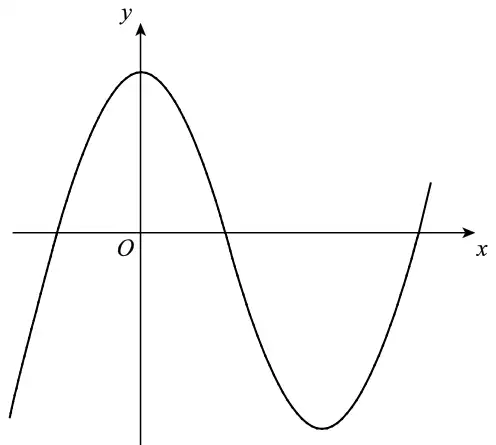
Sketch of cubic graph with maximum turning point at \((-3, 0)\)
M1
condone minimum turning point at \((-3, 0)\)
Sketch of cubic graph with maximum turning point at \((-3, 0)\) and minimum turning point in the third quadrant
M1dep
Sketch of cubic graph with maximum turning point at \((-3, 0)\) and minimum turning point in the third quadrant and intersecting the positive \(x\)-axis at \(\dfrac{1}{2}\)
M1dep
\(-3\) and \(\dfrac{1}{2}\) must both be correctly labelled on the \(x\)-axis
M3 and indication that there are exactly two solutions
A1
eg M3 and 0.5 and \(-3\)
Additional guidance
Up to M3 may be awarded for correct work with no, or incorrect answer, even if this is seen amongst multiple attempts
Alt 1 Up to the first two marks may be seen in a grid eg
\(x^2\)
\(+6x\)
\(+9\)
\(2x\)
\(2x^3\)
\(12x^2\)
\(18x\)
\(-1\)
\(-x^2\)
\(-6x\)
\(-9\)
Condone missing + symbols in top row unless subsequently contradicted
M1M1
Alt 1 \(x^2 + 6x + 9\) or \((x + 3)(x + 3)\) or \((x + 3)^2\)
M1M1
Alt 1 \((2x - 1)(x + 3)(x + 3)\) or \((2x - 1)(x + 3)^2\)
M1M1M1
Alt 1 \((2x - 1)(x + 3)(x + 3)\) with solutions 0.5 and \(-3\)
M1M1M1A1
Alt 1 \(2x^2 + 5x - 3 = (2x - 1)(x + 3) \qquad\) 0.5 and \(-3\)
Zero
Alt 1 Examples of acceptable indications that there are exactly two solutions eg1 \(\;x = 0.5, -3, -3 \quad\) (Only) two solutions eg2 \(\;x = 0.5, -3, -3 \quad\) One root is a repeat eg3 \(\;(2x - 1)\) gives one solution \(\;(x + 3)(x + 3)\) gives one solution eg4 \(\;(2x - 1)(x + 3)(x + 3) \quad\) Two factors (only)
Alt 1 These are not acceptable indications that there are exactly two solutions eg1 \(\;(2x - 1)(x + 3)(x + 3) \quad\) 3 and 0.5 eg2 \(\;(x + 3)(x + 3) \quad\) Exactly two solutions
Alt 1 Ignore other substitution attempts if using factor theorem for 1st M1
Alt 1 Allow absence of multiplication signs in factor theorem eg \(\;2(-3)^3 + 11(-3)^2 + 12(-3) - 9\)
M1
Alt 1 Condone incorrect use of = eg \(\;2(-3)^3 + 11(-3)^2 + 12(-3) = 9 - 9\)
M1
Alt 1 Allow working in stages eg \(\;2(-3)^3 + 11(-3)^2 + 12(-3) = 9 \qquad 9 - 9 = 0\)
M1
Alt 1 Only stating \(\mathrm{f}(-3)\) or only stating \(\mathrm{f}(-3) = 0\)
M0
Alt 1 May be seen as synthetic division eg
2
11
12
−9
−3
−6
−15
9
2
5
−3
0
M1
Working in (a) eg algebraic division that is not used in (b) cannot score in (b) eg (a) \(\begin{array}{r} x^2 + 6x + 9 \\ 2x - 1\,\overline{\big)\,2x^3 + 11x^2 + 12x - 9} \end{array}\) (b) Not attempted
M0
Working in (a) eg algebraic division that is used in (b) can score in (b) eg (a) \((2x - 1)(x^2 + 6x + 9)\) (b) Student shows an arrow from their working in (a)
\((3x + 1)(x^2 - x \ldots)\) or \(\begin{array}{l} \phantom{3x + 1\,)\,}x^2 - x \ldots \\ 3x + 1\,\overline{)\,3x^3 - 2x^2 - 7x - 2} \end{array}\)
M1
\((3x + 1)(x^2 - x - 2)\) or \(\begin{array}{l} \phantom{3x + 1\,)\,}x^2 - x - 2 \\ 3x + 1\,\overline{)\,3x^3 - 2x^2 - 7x - 2} \end{array}\)
A1
\((3x + 1)(x + 1)(x - 2)\)
A1
Alternative method 2
\(\mathrm{f}(-1) = 0\) or \(\mathrm{f}(2) = 0\)
M1
\(\mathrm{f}(-1) = 0\) and \(\mathrm{f}(2) = 0\)
A1
\((3x + 1)(x + 1)(x - 2)\)
A1
Notes
In Alternative method 1 the long division is printed with \(3x^3 + 4x^2 - 2x - 1\) under the division sign (corrected from the printed mark scheme: the cubic being divided is \(\mathrm{f}(x) = 3x^3 - 2x^2 - 7x - 2\)).
\(x^3 + 8x^2 + 5x - 50\) \(\equiv (x - 2)(ax^2 + bx + c)\) \(\equiv ax^3 - 2ax^2 + bx^2 - 2bx + cx - 2c\) and any two of \(a = 1\), \(b = 10\), \(c = 25\)
M1
\(x^2 + 10x + 25\)
A1
\((x - 2)(x + 5)^2\)
A1
oe
Additional guidance
This work might appear in 17a … you can mark it having seen it in 17a unless there is a contradiction with any work in 17b. Also, mark from what you might see in 17a if there is no work in 17b
Ignore further work which gives answers of 2, \(-5\) and \(-5\) (from solving \(\mathrm{f}(x) = 0\))
17 Here is a sketch of \(\quad y = x^3 - 6x^2 + 7\)
Not drawn accurately
(a) Use differentiation to work out the coordinates of the stationary point that is a minimum.
You must show your working. [4 marks]
(b) The three roots of \(\quad x^3 - 6x^2 + 7 = 0 \quad\) are the \(x\)-coordinates of the points where the graph intersects the \(x\)-axis.
Show that \(\ x = -1\ \) is one root of \(\quad x^3 - 6x^2 + 7 = 0\) [1 mark]
(c) Hence, work out the other two roots of \(\quad x^3 - 6x^2 + 7 = 0\)
Give your answers to 2 decimal places.
You must show your working. [5 marks]
Mark scheme (a)
Answer
Mark
Comments
\(3x^2\) or \((-)12x\)
M1
Attempt at \(\dfrac{\mathrm{d}y}{\mathrm{d}x}\)
their \((3x^2 - 12x) = 0\)
M1dep
Must have at least 2 terms for their \(\dfrac{\mathrm{d}y}{\mathrm{d}x}\) The \(= 0\) can be implied by sight of a correct non-zero solution to their \((3x^2 - 12x) = 0\)
\(x = 4\) (and \(x = 0\))
A1ft
ft M2 if their \(\dfrac{\mathrm{d}y}{\mathrm{d}x}\) is a 2-term quadratic
(4, \(-25\)) with correct expression for \(\dfrac{\mathrm{d}y}{\mathrm{d}x}\) seen
A1
Additional guidance
Condone \(y = 3x^2 - 12x\) etc
M1
Ignore working for second derivative or testing for minimum point
Stating \(\dfrac{\mathrm{d}y}{\mathrm{d}x} = 0\) is not sufficient for second M mark but may be implied by correct solution(s) seen
Mark scheme (b)
Answer
Mark
Comments
Alternative method 1
\((-1)^3 - 6(-1)^2 + 7 = 0\) with no incorrect evaluations seen or \(-1 - 6 + 7 = 0\)
B1
Must have \(= 0\)
Alternative method 2
\((x + 1)(x^2 - 7x + 7) = 0\) and \((x + 1) = 0\) and \(x = -1\)
oe eg \(\dfrac{7}{2} \pm \sqrt{\dfrac{21}{4}}\) Correct attempt to solve their 3-term quadratic Allow recovery of brackets Allow \(7^2\) for \((-7)^2\) Implied by correct solutions to their 3-term quadratic seen
oe eg \(\dfrac{7}{2} \pm \sqrt{\dfrac{21}{4}}\) Correct attempt to solve their 3-term quadratic Allow recovery of brackets Allow \(7^2\) for \((-7)^2\) Implied by correct solutions to their 3-term quadratic seen
5.79 and 1.21 with \(x^2 - 7x + 7\ (= 0)\) seen
A1
Must both be to 2 dp
Additional guidance
Final A1 mark can be awarded if both answers seen in working with \(x^2 - 7x + 7\ (= 0)\) seen but only one answer is written on answer line
\((x + 1)\) followed by 5.79 and 1.21 without \(x^2 - 7x + 7\ (= 0)\) seen
M1M0A0 M0A0
\((x - 1)\) instead of \((x + 1)\) can score a maximum of M0M0A0M1A0
Using \(p = -5\) and comparing \(x\) coefficients gives \(a = 1\)
A1
Additional guidance
In alt 1 ... assuming that \(a = 1\) and showing that substituting \(x = 3\) in the expression gives zero is only verifying the result ... and scores SC1 Similarly, assuming \(a = 1\) and working as in alt 2 and alt 3 to verify the result.