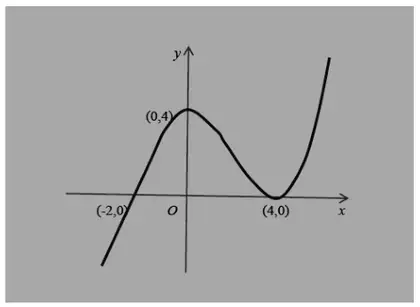
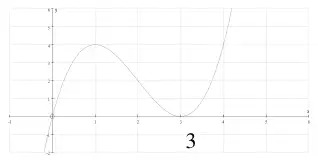
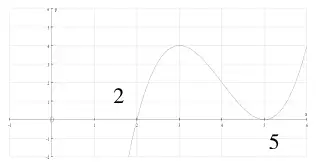
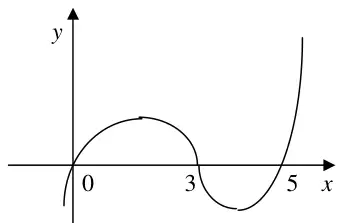
M1: Attempts \(\mathrm{f}(-3) = 0\) leading to an equation in \(a\) and \(b\) only. Condone slips. The = 0 may be implied by further work for this mark.
A1*: Simplifies and rearranges to the given answer with no errors. There must be at least one correct line of working before the given answer and = 0 must be correctly seen at some point in their solution or at the start e.g. stating \(\mathrm{f}(-3) = 0\). Isw if they achieve the given answer but then attempt to make \(a\) or \(b\) the subject. Minimum acceptable is e.g. \(-27a + 9b - 54 + 9 = 0 \Rightarrow -3a + b = 5\,*\) Note: \(-27a + 9b - 54 + 9 \Rightarrow -3a + b = 5\) is M1A0* (we do not see = 0 correctly at some point or e.g. \(\mathrm{f}(-3) = 0\)) Allow invisible brackets to be recovered e.g. \(a \times -3^3 = -27a\) Allow attempts to divide algebraically and tabular/grid/inspection methods e.g.
M1: For an attempt to divide algebraically by \((x + 3)\). Condone slips but they must have a quadratic quotient of the form \(ax^2 + (\ldots a + \ldots b)x\) and proceed to a remainder of the form \(\ldots a + \ldots b + \ldots\) which is then set = 0
Grid method:
\(ax^2\)
\((b-3a)x\)
\(18 - 3b + 9a\)
\(x\)
\(ax^3\)
\((b-3a)x^2\)
\((18 - 3b + 9a)x\)
3
\(3ax^2\)
\(3(b-3a)x\)
\(54 - 9b + 27a\)
So \(9 - (54 - 9b + 27a) = 0\)
M1: Condone slips but they must have a quadratic quotient of the form \(ax^2 + (\ldots a + \ldots b)x\) and the bottom right hand cell of the form \(\ldots a + \ldots b + \ldots\) which is then subtracted from 9 and set = 0
M1: Condone slips but they must have a quadratic factor of the form \(ax^2 + (\ldots a + \ldots b)x + 3\) and then extract the \(x\) terms and set = 18
In all cases, A1 is scored for fully correct work leading to the given equation.
\(-3a + b = 5\) and \(3a + b = -1\) leading to \(a = \ldots\) and \(b = \ldots\)
ddM1
3.1a
\(a = -1\) and \(b = 2\)
A1
2.2a
(5)
Notes
M1: Decreases the power of \(x\) by one for at least one of the terms. Look for \(ax^3 \to \ldots x^2,\ bx^2 \to \ldots x\) or \(18x \to 18\) but not \(9 \to 0\)
dM1: Substitutes \(x = 2\) into their derivative and sets equal to 14 to create a second equation in \(a\) and \(b\) e.g. \(3a(2)^2 + 2b(2) + 18 = 14\)
ddM1: Attempts to solve simultaneously their equation in \(a\) and \(b\) obtained from using \(\mathrm{f}^{\prime}(2) = 14\) and the given equation from part (a) to obtain values for \(a\) and \(b\). Condone copying slips when using the equation from (a) as long as the intention is clear. You do not need to check their working and this may be done on a calculator.
A1: cao \(a = -1\) and \(b = 2\) only. Generally, candidates who use \(\mathrm{f}(2) = 14\) or e.g. \(\mathrm{f}^{\prime}(2) = 0\) will score a maximum of M1A1dM0ddM0A0 in (b).
Note that some candidates may use the result in (a) and substitute to eliminate \(a\) or \(b\) before differentiating e.g.:
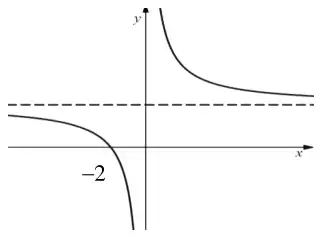
5. The curve \(C_1\) has equation\[y = \frac{6}{x} + 3\]
(a)
(i) Sketch \(C_1\) stating the coordinates of any points where the curve cuts the coordinate axes.
(ii) State the equations of any asymptotes to the curve \(C_1\) (3)
The curve \(C_2\) has equation\[y = 3x^2 - 4x - 10\]
(b) Show that \(C_1\) and \(C_2\) intersect when\[3x^3 - 4x^2 - 13x - 6 = 0\] (2)
Given that the \(x\) coordinate of one of the points of intersection is \(-\dfrac{2}{3}\)
(c) use algebra to find the \(x\) coordinates of the other points of intersection between \(C_1\) and \(C_2\) (Solutions relying on calculator technology are not acceptable.)(4)
Mark scheme (a)
Scheme
Marks
AO
(i)
M1 A1
1.1b 1.1b
(ii) Asymptotes: \(y = 3,\quad x = 0\)
B1
1.1b
(3)
Notes
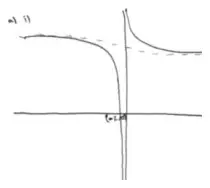
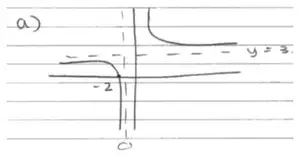
(i) M1: Either
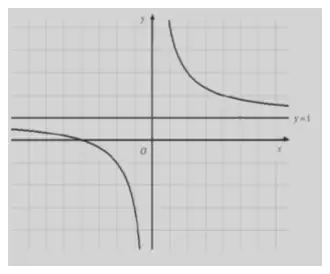
A correct positive reciprocal graph shape with both branches anywhere on a set of axes (ignore any dashed lines / scale and just look at the graph shape drawn)
\(x = -2\) is the only point of intersection of their graph with the axes. Condone labelled as \((0,\ -2)\). Allow if they state the coordinates \((-2,\ 0)\) next to the graph instead but not just \(x = -2\)
Condone poor curvature provided there is not an intention to draw a maximum or minimum for either of the branches. Condone where the branches approach an undrawn horizontal asymptote if the left-hand branch is slightly above the right-hand branch as long as it does not appear intentional.
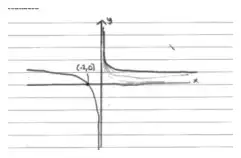
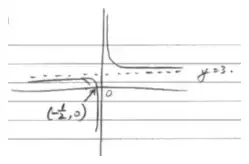
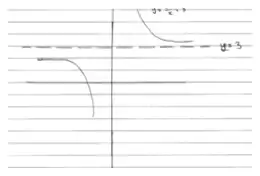
A1: Fully correct graph with an intersection labelled at \(x = -2\) on the graph (condone labelled as \((0,\ -2)\)). If two horizontal or vertical asymptotes are drawn or a vertical asymptote which is not the \(y\)-axis then this mark cannot be scored. (unless the vertical asymptote is labelled as 0 or \(x = 0\)) Allow if they state the coordinates \((-2,\ 0)\) next to the graph instead but not just \(x = -2\)
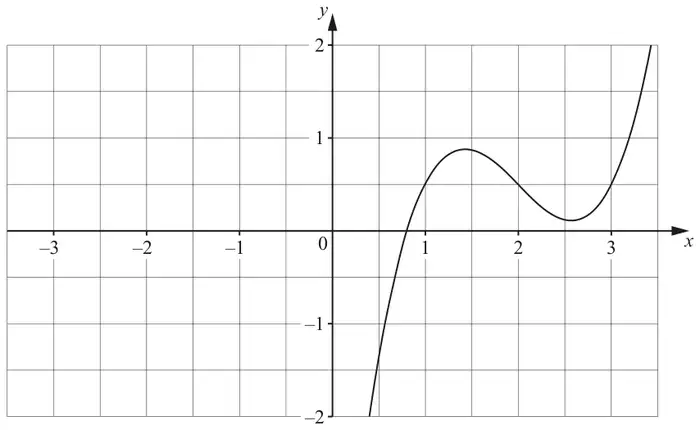
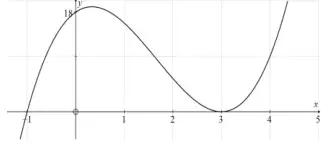
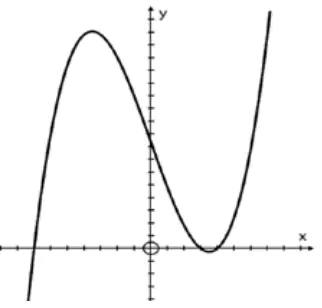
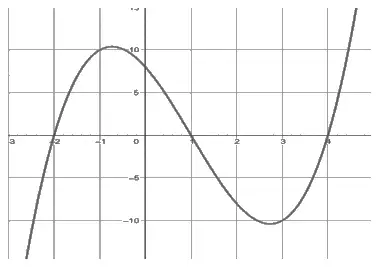
e.g. this scores M1A1
e.g. this scores M1A0
e.g. this scores M1A0
e.g. this scores M1A1
e.g. this scores M1A1 (condone the vertical asymptote drawn as it is labelled as 0 (for \(x = 0\)))
(ii)If no graph is drawn then this mark cannot be scored
B1: \(y = 3,\quad x = 0\) cao (not \(x \neq 0\)) which must be correct for their graph. Check by the question but if there is a contradiction then the equations stated in (ii) of the work takes precedence. Cannot be for just stating 0 underneath the \(y\) axis and 3 on a dashed horizontal line if present.
M1: Sets \(\dfrac{6}{x} + 3 = 3x^2 - 4x - 10\) and rearranges to form a cubic equation. Terms do not need to be collected or all on one side.
A1*: \(3x^3 - 4x^2 - 13x - 6 = 0\) with no errors seen. There must be at least one stage of intermediate working before achieving the given answer. e.g. \(\dfrac{6}{x} + 3 = 3x^2 - 4x - 10 \Rightarrow 3x^3 - 4x^2 - 13x - 6 = 0\) is M1A0* e.g. \(\dfrac{6}{x} + 3 = 3x^2 - 4x - 10 \Rightarrow 6 + 3x = 3x^3 - 4x^2 - 10x \Rightarrow 3x^3 - 4x^2 - 13x - 6 = 0\) is M1A1*
e.g. \((3x + 2)(x - 3)(x + 1) = 0 \Rightarrow x = \ldots\)
dM1
1.1b
\(x = -1,\ x = 3\)
A1cso
1.1b
(4)
(9 marks)
Notes
Note that proceeding to three linear factors with no working is M0A0dM0A0. A quadratic factor is required first.
M1: Attempts to algebraically divide \(3x^3 - 4x^2 - 13x - 6\) by \(3x + 2\) or compare coefficients to achieve \((x^2 - 2x \pm \ldots)\) or \((x^2 \pm \ldots x - 3)\) (or via inspection) Alternatively, attempts to algebraically divide \(3x^3 - 4x^2 - 13x - 6\) by \(x + \dfrac{2}{3}\) or compare coefficients to achieve \((3x^2 - 6x \pm \ldots)\) or \((3x^2 \pm \ldots x - 9)\) (or via inspection) May use the grid method so they must proceed as far as the diagonal for \(x^2\) being correct and achieving \(x^2 - 2x\) on the top. (They should reach the same point if dividing by \(x + \dfrac{2}{3}\))
\(x^2\)
\(-2x\)
\(3x\)
\(3x^3\)
\(-6x^2\)
\(2\)
\(2x^2\)
Any attempts to use \((x + 1)\) or \((x - 3)\) rather than \((3x + 2)\) from the given root please send to review.
dM1: Attempts to solve their resulting quadratic by factorising, using the formula or completing the square. Usual rules apply for solving a quadratic by either of these methods. They cannot simply write down the roots. It is dependent on the previous method mark. Note \((3x^2 - 6x - 9) \Rightarrow (x - 3)(x + 1) \Rightarrow x = \ldots\) is dM0A0
A1cso: \(x = -1,\ x = 3\) only (ignore any reference to \(x = -\dfrac{2}{3}\)) Condone invisible brackets if recovered or implied by further work. Withhold this mark if they reject one of the two solutions.
M1: Attempts \(\mathrm{f}(4) = 0\) leading to an equation in \(a\) and \(b\) only. Condone slips. The \(= 0\) may be implied by further work for this mark. Attempts using algebraic division score M0A0.
A1*: Simplifies and rearranges to the given answer with no errors. There must be at least one intermediate stage of working between their first expression or equation and the given answer and \(= 0\) must be correctly seen at some point in their solution or at the start e.g. stating \(\mathrm{f}(4) = 0\). Isw if they achieve the given answer but then attempt to make \(a\) or \(b\) the subject. Minimum acceptable is e.g. \(128 - 48a + 4b + 8a \Rightarrow 128 - 40a + 4b = 0 \Rightarrow 32 + b = 10a\) Note: \(128 - 48a + 4b + 8a \Rightarrow 128 + 4b = 40a \Rightarrow 32 + b = 10a\) is M1A0* (we do not see \(= 0\) correctly at some point or e.g. \(\mathrm{f}(4) = 0\))
Solve simultaneously \(\Rightarrow a = \ldots\) or \(\Rightarrow b = \ldots\)
dM1
2.1
\(a = 3\) or \(b = -2\) or \(k = 3\)
A1
1.1b
\((\mathrm{f}(x) =)\ (2x + 3)(x - 4)(x - 2)\)
A1
1.1b
(4)
Notes
Note that there are many different equations which can be formed. Sight of \(a = 3\) or \(b = -2\) or \(k = 3\) scores the first 3 marks BUT answers with no working – send to review
M1: Attempts \(\mathrm{f}(2) = 0\) to form another equation in \(a\) and \(b\). Does not need to be simplified. Condone slips substituting in 2 (but not if there is a clear intention to substitute in \(-2\)) and \(= 0\) may be implied by further work. Accept attempts to divide algebraically by \(x - 2\): e.g. condone slips but they must have a quadratic quotient \(2x^2 \pm (\ldots a \pm \ldots)x\) and proceed as far as a remainder of the form \(\ldots a \pm \ldots b \pm \ldots\) which is then set equal to 0. e.g.
In this method condone slips but they need to proceed as far as a quadratic quotient of the form \(2x^2 \pm (\ldots a \pm \ldots)x\) and the bottom right cell of the form \(\ldots a \pm \ldots b \pm \ldots\) which is then set equal to \(8a\). Look out for other valid methods such as
multiplying out \(\mathrm{f}(x) = (2x + k)(x - 4)(x - 2)\) to achieve a cubic where the coefficients of \(x^2\) and \(x\), and the constant term are all in terms of \(k\), and equating coefficients to form two more simultaneous equations
algebraically dividing \(2x^3 - 3ax^2 + bx + 8a\) by \(x^2 - 6x + 8\) and setting their remainder equal to zero. Look for a quotient of the form \(2x \pm \ldots a \pm \ldots\)
substituting \(b = 10a - 32\) into \(\mathrm{f}(x)\) so that the polynomial coefficients are in terms of \(a\) only (or equivalently all in \(b\) only) and using \(\mathrm{f}(2) = 0\) to form an equation in one variable. Send to review if you are unsure.
dM1: Attempts to solve their equations simultaneously to find a value for \(a\) or \(b\) (or they may proceed directly to finding a value for \(k\)). This may be done on a calculator. You do not need to check their method for solving. It is dependent on the previous method mark.
A1: \(a = 3\) or \(b = -2\) or \(k = 3\)
A1: \((\mathrm{f}(x) =)\ (2x + 3)(x - 4)(x - 2)\) (All on one line) (Stating the values of \(a\), \(b\) and \(k\) alone does not score this mark). Allow to be scored if seen in (c).
Alternative Further Maths method using the sum and product of the roots
Achieves \(y = 3\) for both equations and gives a minimal conclusion / statement, e.g., \((1, 3)\) lies on both curves so they intersect at \(x = 1\)
A1
1.1b
(2)
Notes
Must be seen in (a)
M1: As scheme. For M1 A0, allow a statement that \((1, 3)\) lies on both curves without sight of the calculation. Amongst various alternatives are:
Setting \(x^2 - 12x + 14 = 8 - 10x + 6x^2 - x^3\) and attempting to rearrange to \(x^3 - 5x^2 - 2x + 6 = 0\) before substituting in \(x = 1\)
Setting \(x^2 - 12x + 14 = 8 - 10x + 6x^2 - x^3\) and attempting to divide \(x^3 - 5x^2 - 2x + 6\) by \((x - 1)\) either by long division or inspection
A1: For the complete mathematical argument. Requires both correct calculations with a minimal conclusion, which may be as a preamble. e.g., in the alternatives
Allow the use of \(x\) or \(k\) throughout this part.
M1: Sets \(x^2 - 12x + 14 = 8 - 10x + 6x^2 - x^3\) and proceeds to a cubic equation set = 0 Must be seen or used in (b)
dM1: For the key step in realising that \((x - 1)\) is a factor of the cubic. It is for dividing by \((x - 1)\) to get the quadratic factor. For division look for their first two terms, i.e., \(x^2 \pm 4x\) (This will need checking if they have made an error in rearranging the cubic.)
By inspection look for the first and last term \(x^3 - 5x^2 - 2x + 6 = (x - 1)\left(x^2 + px \pm 6\right)\)
A1: \(x^3 - 5x^2 - 2x + 6 = (x - 1)\left(x^2 - 4x - 6\right)\) or just \(x^2 - 4x - 6\) or \(k^2 - 4k - 6\) as their quadratic factor following algebraic division.
ddM1: Attempts to solve their \(x^2 - 4x - 6 = 0\), which must be a 3TQ, by completing the square or the quadratic formula, leading to an exact solution. Their quadratic factor must not factorise. Their quadratic “factor” may come from algebraic division that has a remainder but we will still allow them to score this mark. If using the quadratic formula, they need to have, e.g., \(\dfrac{4 - \sqrt{4^2 - 4(-6)}}{2}\) or \(\dfrac{4 - \sqrt{40}}{2}\) as a minimum (i.e., they must not jump straight to \(2 - \sqrt{10}\) from a calculator).
A1: \(k = 2 - \sqrt{10}\) or exact equivalent but allow the use of \(x\) e.g., \(x = \dfrac{4 - \sqrt{40}}{2}\) If using the quadratic formula, the discriminant must be processed. Must come from a correct quadratic factor. They must have discarded \(2 + \sqrt{10}\) if seen.
(b) Sketch \(C\) showing the coordinates of the points at which the curve cuts the \(x\)-axis. (2)
The line \(l\) has equation \(y = k\) where \(k\) is a constant.
Given that \(C\) and \(l\) intersect at 3 distinct points,
(c) find the range of values for \(k\), writing your answer in set notation. Solutions relying on calculator technology are not acceptable.(3)
Mark scheme (a)
Scheme
Marks
AO
\(9x - x^3 = x(9 - x^2)\)
M1
1.1b
\(9x - x^3 = x(3 - x)(3 + x)\) oe
A1
1.1b
(2)
Notes
M1: Takes out a factor of \(x\) or \(-x\). Scored for \(\pm x(\pm 9 \pm x^2)\) May be implied by the correct answer or \(\pm x(\pm x \pm 3)(\pm x \pm 3)\). Also allow if they attempt to take out a factor of \((\pm x \pm 3)\) so score for \((\pm x \pm 3)(\pm 3x \pm x^2)\)
A1: Correct factorisation. \(x(3 - x)(3 + x)\) on its own scores M1A1. Allow eg \(-x(x - 3)(x + 3)\), \(x(x - 3)(-x - 3)\) or other equivalent expressions Condone an \(= 0\) appearing on the end and condone eg \(x\) written as \((x + 0)\).
Mark scheme (b)
Scheme
Marks
AO
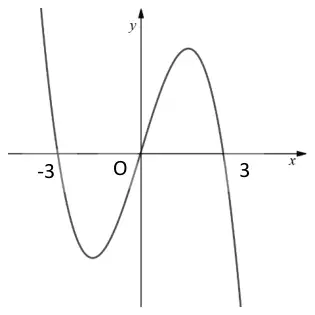
A cubic with correct orientation (B1) Passes though origin, \((3, 0)\) and \((-3, 0)\) (B1)
B1 B1
1.1b 1.1b
(2)
Notes
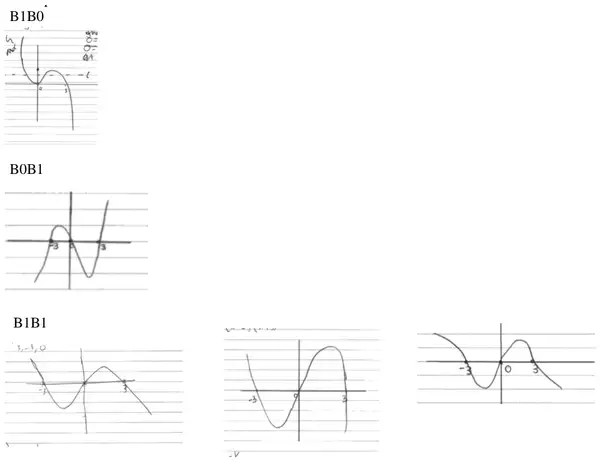
B1: Correct shape (negative cubic) appearing anywhere on a set of axes. It must have a minimum to the left and maximum to the right. Be tolerant of pen slips. Judge the intent of the shape. (see examples)
B1: Passes through each of the origin, \((3, 0)\) and \((-3, 0)\) and no other points on the \(x\) axis. (The graph should not turn on any of these points). The points may be indicated as just 3 and \(-3\) on the axes. Condone \(x\) and \(y\) to be the wrong way round eg \((0, -3)\) for \((-3, 0)\) as long as it is on the correct axis but do not allow \((-3, 0)\) to be labelled as \((3, 0)\).
\(\left\{k \in \mathbb{R} : -6\sqrt{3} \lt k \lt 6\sqrt{3}\right\}\) oe
A1ft
2.5
(3)
(7 marks)
Notes
*Be aware the value of \(y\) can be solved directly using a calculator which is not acceptable*
M1: Uses a correct strategy for the \(y\) value of either the maximum or minimum. E.g. differentiates to achieve a quadratic, solves \(\dfrac{\mathrm{d}y}{\mathrm{d}x} = 0\) and uses their \(x\) to find \(y\)
A1: Either or both of the values \((\pm)6\sqrt{3}\). Cannot be scored for an answer without any working seen.
A1ft: Correct answer in any acceptable set notation following through their \(6\sqrt{3}\). Condone \(\left\{\text{``}{-6\sqrt{3}}\text{''} \lt k \lt \text{``}6\sqrt{3}\text{''}\right\}\) or \(\left\{\text{``}{-6\sqrt{3}}\text{''} \lt k\right\} \cap \left\{k \lt \text{``}6\sqrt{3}\text{''}\right\}\) but not \(\left\{\text{``}{-6\sqrt{3}}\text{''} \lt k\right\} \cup \left\{k \lt \text{``}6\sqrt{3}\text{''}\right\}\) Note: If there is a contradiction of their solution on different lines of working do not penalise intermediate working and mark what appears to be their final answer. Must be in terms of \(k\)
\(\mathrm{f}(-3) = 0 \Rightarrow (x + 3)\) is a factor
A1
2.4
(2)
Notes
M1: Attempts \(\mathrm{f}(-3)\). Attempted division by \((x + 3)\) or \(\mathrm{f}(3)\) is M0 Look for evidence of embedded values or two correct terms of \(\mathrm{f}(-3) = -54 + 45 - 6 + 15 = \ldots\)
A1: Achieves and states \(\mathrm{f}(-3) = 0\), and makes a suitable conclusion. Sight of \(\mathrm{f}(x) = 0\) when \(x = -3\) is also acceptable. It must follow M1. Accept, for example, \(\mathrm{f}(-3) = 0 \Rightarrow (x + 3)\) is a factor This may be seen in a preamble before finding \(\mathrm{f}(-3) = 0\) but in these cases there must be a minimal statement ie QED, "proved", tick etc.
Mark scheme (b)
Scheme
Marks
AO
At least 2 of: \(a = 2,\ b = -1,\ c = 5\)
M1
1.1b
All of: \(a = 2,\ b = -1,\ c = 5\)
A1
1.1b
(2)
Notes
M1: Correct method implied by values for at least 2 correct constants. Allow embedded in their \(\mathrm{f}(x)\) or within their working if they use algebraic division/other methods which may be seen in part (a) and used in part (b).
A1: All values correct. Allow embedded in their \(\mathrm{f}(x)\) or seen as the quotient from algebraic division. Isw incorrectly stated values of \(a\) \(b\) and \(c\) following a correct quadratic expression seen.
\(b^2 - 4ac = -39\) which is \(\lt 0\) so the quadratic has no real roots so \(\mathrm{f}(x) = 0\) has only 1 real root
A1
2.4
(2)
Notes
M1: Either:
considers the discriminant using their \(a\), \(b\) and \(c\) (does not need to be evaluated) \((b^2 - 4ac =)\ (-1)^2 - 4(2)(5)\) (the \((-1)^2\) may appear as \(1^2\) and condone missing brackets for this mark for \(-1^2\)). Discriminant \(= -39\) is sufficient for M1
attempts to complete the square so score for \(2\left(x \pm \dfrac{1}{4}\right)^2 + \ldots\)
attempts to find the roots of the quadratic using the formula. The values embedded in the formula score this mark. \(\dfrac{1 \pm \sqrt{(-1)^2 - 4 \times 2 \times 5}}{2 \times 2}\) (the \((-1)^2\) may appear as \(1^2\) and condone missing brackets for this mark for \(-1^2\))
Sketches a graph of the quadratic. It must be a U shaped quadratic which does not cross the \(x\)-axis.
A1: Provides a correct explanation from correct working. They must
Have a correct calculation
Explanation that the quadratic has no (real) roots
Minimal conclusion stating that \(\mathrm{f}(x) = 0\) has only one root
eg \(b^2 - 4ac = -39 \lt 0\) so only one root is M1A0 (needs to explain the quadratic has no real roots) eg \(2\left(x - \dfrac{1}{4}\right)^2 + \dfrac{39}{8} \gt 0\) so no real roots (for the quadratic) so (\(\mathrm{f}(x)\) has) only one (real) root is M1A1 The value of the discriminant, completed square form \(2\left(x - \dfrac{1}{4}\right)^2 + \dfrac{39}{8}\) or roots of the quadratic \(\left(= \dfrac{1 \pm \sqrt{39}i}{4}\right)\) must be correct. If they sketch the quadratic graph it must be a U shaped quadratic which crosses the \(y\)-axis at 5 and has a minimum in the 1st quadrant. They must explain that the graph does not cross the \(x\)-axis so no real roots for the quadratic so only one root for \(\mathrm{f}(x) = 0\).
M1: Factorises out or cancels by \(x\) to form a quadratic equation.
dM1: Scored for an attempt to find \(x\). May be awarded for factorisation of the quadratic or use of the quadratic formula.
A1: \(x = 0, -\dfrac{1}{3}, 6\) and no extras
Mark scheme (b)
Scheme
Marks
AO
Attempts to solve \((y - 2)^2 = n\) where \(n\) is any solution \(\geqslant 0\) to (a)
M1
2.2a
Two of \(2,\ 2 \pm \sqrt{6}\)
A1ft
1.1b
All three of \(2,\ 2 \pm \sqrt{6}\)
A1
2.1
(3)
(6 marks)
Notes
M1: Attempts to solve \((y - 2)^2 = n\) where \(n\) is any solution \(\geqslant 0\) to (a). At least one stage of working must be seen to award this mark. Eg \((y - 2)^2 = 0 \Rightarrow y = 2\)
A1ft: Two of \(2,\ 2 \pm \sqrt{6}\) but follow through on \((y - 2)^2 = n \Rightarrow y = 2 \pm \sqrt{n}\) where \(n\) is a positive solution to part (a). (Provided M1 has been scored)
A1: All three of \(2,\ 2 \pm \sqrt{6}\) and no extra solutions. (Provided M1A1 has been scored)
\(\mathrm{g}^{\prime\prime}(2) = -\dfrac{33}{2} \lt 0\) hence maximum
A1
2.4
(2)
(9 marks)
Notes
M1: Attempts \(\mathrm{g}^{\prime\prime}(x) = -18x + \dfrac{39}{2}\) and substitutes \(x = 2\). Award for second derivatives of the form \(\mathrm{g}^{\prime\prime}(x) = Ax + B\) with \(x = 2\) substituted in. Alternatively attempts to find the value of their \(\mathrm{g}^{\prime}(x)\) or \(\mathrm{g}(x)\) either side of \(x = 2\) (by substituting a value for \(x\) within 0.5 either side of 2)
A1: \(\mathrm{g}^{\prime\prime}(2) = -\dfrac{33}{2} \lt 0\) hence maximum. (allow embedded values but they must refer to the sign or that it is less than zero) If \(\mathrm{g}^{\prime}(x) = -9x^2 + \dfrac{39}{2}x - 3\) or \(\mathrm{g}(x) = -3x^3 + \dfrac{39}{4}x^2 - 3x\) is calculated either side of \(x = 2\) then the values must be correct or embedded correctly (you will need to check these) they need to compare \(\mathrm{g}^{\prime}(x) \gt 0\) to the left of \(x = 2\) and \(\mathrm{g}^{\prime}(x) \lt 0\) to the right of \(x = 2\) or \(\mathrm{g}(x) \lt 9\) to the left and \(\mathrm{g}(x) \lt 9\) to the right of \(x = 2\) hence maximum. (corrected from the printed mark scheme: it prints “\(\mathrm{g}(x) \gt 9\) to the right of \(x = 2\)”, but for a maximum \(\mathrm{g}(x) \lt 9\) on both sides)
Note If they only sketch the cubic function \(\mathrm{g}(x) = -3x^3 + \dfrac{39}{4}x^2 - 3x\) then award M1A0
\(\mathrm{g}(5) = 0 \Rightarrow (x - 5)\) is a factor, hence \(\mathrm{g}(x)\) is divisible by \((x - 5)\).
A1
2.4
(2)
Notes
M1: Attempts to calculate \(\mathrm{g}(5)\) Attempted division by \((x - 5)\) is M0 Look for evidence of embedded values or two correct terms of \(\mathrm{g}(5) = 250 + 25 - 205 - 70 = \ldots\)
A1: Correct calculation, reason and conclusion. It must follow M1. Accept, for example, \(\mathrm{g}(5) = 0 \Rightarrow (x - 5)\) is a factor, hence divisible by \((x - 5)\) \(\mathrm{g}(5) = 0 \Rightarrow (x - 5)\) is a factor ✓ Do not allow if candidate states \(\mathrm{f}(5) = 0 \Rightarrow (x - 5)\) is a factor, hence divisible by \((x - 5)\) (It is not f) \(\mathrm{g}(x) = 0 \Rightarrow (x - 5)\) is a factor (It is not g(x) and there is no conclusion) This may be seen in a preamble before finding \(\mathrm{g}(5) = 0\) but in these cases there must be a minimal statement ie QED, "proved", tick etc.
M1: Attempts to find the quadratic factor by inspection (correct coefficients of first term and ± last term) or by division (correct coefficients of first term and ± second term). Allow this to be scored from division in part (a)
A1: \((2x^2 + 11x + 14)\) You may not see the \((x - 5)\) which can be condoned
dM1: Correct attempt to factorise their \((2x^2 + 11x + 14)\)
A1: \((\mathrm{g}(x) =)\ (x - 5)(2x + 7)(x + 2)\) or \((\mathrm{g}(x) =)\ (x - 5)(x + 3.5)(2x + 4)\) It is for the product of factors and not just a statement of the three factors Attempts with calculators via the three roots are likely to score 0 marks. The question was "Hence" so the two M’s must be awarded.
Deduces the need to use \(\displaystyle\int_{-2}^{5} \mathrm{g}(x)\,\mathrm{d}x\) \(-\dfrac{1525}{3} - \dfrac{190}{3}\)
M1
2.2a
Area = \(571\frac{2}{3}\)
A1
2.1
(4)
(10 marks)
Notes
M1: For \(x^n \to x^{n+1}\) for any of the terms in \(x\) for \(\mathrm{g}(x)\) so \(2x^3 \to \ldots x^4,\ x^2 \to \ldots x^3,\ -41x \to \ldots x^2,\ -70 \to \ldots x\)
A1: \(\displaystyle\int 2x^3 + x^2 - 41x - 70\,\mathrm{d}x = \frac{1}{2}x^4 + \frac{1}{3}x^3 - \frac{41}{2}x^2 - 70x\) which may be left unsimplified (ignore any reference to \(+C\))
M1: Deduces the need to use \(\displaystyle\int_{-2}^{5} \mathrm{g}(x)\,\mathrm{d}x\). This may be awarded from the limits on their integral (either way round) or from embedded values which can be subtracted either way round.
A1: For clear work showing all algebraic steps leading to area = \(571\frac{2}{3}\) oe So allow \(\displaystyle\int_{-2}^{5} 2x^3 + x^2 - 41x - 70\,\mathrm{d}x = \left[\frac{1}{2}x^4 + \frac{1}{3}x^3 - \frac{41}{2}x^2 - 70x\right]_{-2}^{5} = -\frac{1715}{3} \Rightarrow \text{area} = \frac{1715}{3}\) for 4 marks Condone spurious notation, as long as the algebraic steps are correct. If they find \(\displaystyle\int_{-2}^{5} \mathrm{g}(x)\,\mathrm{d}x\) then withhold the final mark if they just write a positive value to this integral since \(\displaystyle\int_{-2}^{5} \mathrm{g}(x)\,\mathrm{d}x = -\dfrac{1715}{3}\)
Note \(\displaystyle\int_{-2}^{5} 2x^3 + x^2 - 41x - 70\,\mathrm{d}x \Rightarrow \frac{1715}{3}\) with no algebraic integration seen scores M0A0M1A0
\(\mathrm{f}(4) = 0 \Rightarrow (x - 4)\) is a factor
A1
1.1b
(2)
Notes
M1: Attempts to calculate \(\mathrm{f}(4)\). Do not accept \(\mathrm{f}(4) = 0\) without sight of embedded values or calculations. If values are not embedded look for two correct terms from \(\mathrm{f}(4) = 128 - 208 + 32 + 48\) Alternatively attempts to divide by \((x - 4)\). Accept via long division or inspection. See below for awarding these marks.
A1: Correct reason with conclusion. Accept \(\mathrm{f}(4) = 0\), hence factor as long as M1 has been scored. This should really be stated on one line after having performed a correct calculation. It could appear as a preamble if the candidate states "If \(\mathrm{f}(4) = 0\), then \((x - 4)\) is a factor before doing the calculation and then writing hence proven or ✓ oe. If division/inspection is attempted it must be correct and there must be some attempt to explain why they have shown that \((x - 4)\) is a factor. Eg Via division they must state that there is no remainder, hence factor
Attempts to factorise quadratic factor or solve quadratic eqn
dM1
1.1b
\(\mathrm{f}(x) = (x - 4)^2(2x + 3) \Rightarrow \mathrm{f}(x) = 0\) has only two roots, 4 and \(-1.5\)
A1
2.4
(4)
Notes
M1: Attempts to find the quadratic factor by inspection (correct first and last terms) or by division (correct first two terms) So for inspection award for \(2x^3 - 13x^2 + 8x + 48 = (x - 4)\left(2x^2 \ldots x \pm 12\right)\) For division look for
A1: Correct quadratic factor \(\left(2x^2 - 5x - 12\right)\) For division award for sight of this "in the correct place" You don’t have to see it paired with the \((x - 4)\) for this mark. If a student has used division in part (a) they can score the M1 A1 in (b) as soon as they start attempting to factorise their \(\left(2x^2 - 5x - 12\right)\).
dM1: Correct attempt to solve or factorise their \(\left(2x^2 - 5x - 12\right)\) including use of formula Apply the usual rules \(\left(2x^2 - 5x - 12\right) = (ax + b)(cx + d)\) where \(ac = \pm 2\) and \(bd = \pm 12\) Allow the candidate to move from \((x - 4)\left(2x^2 - 5x - 12\right)\) to \((x - 4)^2(2x + 3)\) for this mark.
A1: Via factorisation Factorises twice to \(\mathrm{f}(x) = (x - 4)(2x + 3)(x - 4)\) or \(\mathrm{f}(x) = (x - 4)^2(2x + 3)\) or \(\mathrm{f}(x) = 2(x - 4)^2\left(x + \dfrac{3}{2}\right)\) followed by a valid explanation why there are only two roots. The explanation can be as simple as
hence \(x = 4\) and \(-\dfrac{3}{2}\) (only). The roots must be correct
only two distinct roots as 4 is a repeated root
There must be some understanding between roots and factors. E.g. \(\mathrm{f}(x) = (x - 4)^2(2x + 3)\) with arrows pointing to the two factors and the comment “only two distinct roots” is insufficient. This would require two distinct factors, so there are two distinct roots.
Via solving. Factorsises to \((x - 4)\left(2x^2 - 5x - 12\right)\) and solves \(2x^2 - 5x - 12 = 0 \Rightarrow x = 4, -\dfrac{3}{2}\) followed by an explanation that the roots are \(4, 4, -\dfrac{3}{2}\) so only two distinct roots.
Note that this question asks the candidate to use algebra so you cannot accept any attempt to use their calculators to produce the answers.
Mark scheme (c)
Scheme
Marks
AO
Deduces either three roots or deduces that \(\mathrm{f}(x)\) is moved down two units
M1
2.2a
States three roots, as when \(\mathrm{f}(x)\) is moved down two units there will be three points of intersection (with the \(x\)-axis)
A1
2.4
(2)
Notes
M1: For a valid deduction. Accept either there are 3 roots or states that it is a solution of \(\mathrm{f}(x) = 2\) or \(\mathrm{f}(x) - 2 = 0\)
A1: Fully explains: Eg. States three roots, as \(\mathrm{f}(x)\) is moved down by two units (giving three points of intersection with the \(x\)-axis) Eg. States three roots, as it is where \(\mathrm{f}(x) = 2\) (You may see \(y = 2\) drawn on the diagram)
Mark scheme (d)
Scheme
Marks
AO
For sight of \(k = \pm 4, \pm\dfrac{3}{2}\)
M1
1.1b
\(k = 4, -\dfrac{3}{2}\)
A1ft
1.1b
(2)
(10 marks)
Notes
M1: For sight of \(\pm 4\) and \(\pm\dfrac{3}{2}\) Follow through on \(\pm\) their roots.
A1ft: \(k = 4, -\dfrac{3}{2}\) Follow through on their roots. Accept \(4, -\dfrac{3}{2}\) but not \(x = 4, -\dfrac{3}{2}\)
7. The curve \(C\) has equation\[y = \frac{k^2}{x} + 1 \qquad x \in \mathbb{R},\ x \neq 0\]where \(k\) is a constant.
(a) Sketch \(C\) stating the equation of the horizontal asymptote. (3)
The line \(l\) has equation \(y = -2x + 5\)
(b) Show that the \(x\) coordinate of any point of intersection of \(l\) with \(C\) is given by a solution of the equation\[2x^2 - 4x + k^2 = 0\] (2)
(c) Hence find the exact values of \(k\) for which \(l\) is a tangent to \(C\). (3)
Mark scheme (a)
Scheme
Marks
AO
\(\dfrac{1}{x}\) shape in 1st quadrant
M1
1.1b
Correct
A1
1.1b
Asymptote \(y = 1\)
B1
1.2
(3)
Notes
M1: For the shape of a \(\dfrac{1}{x}\) type curve in Quadrant 1. It must not cross either axis and have acceptable curvature. Look for a negative gradient changing from \(-\infty\) to 0 condoning "slips of the pencil". (See Practice and Qualification for clarification)
A1: Correct shape and position for both branches. It must lie in Quadrants 1, 2 and 3 and have the correct curvature including asymptotic behaviour
B1: Asymptote given as \(y = 1\). This could appear on the diagram or within the text. Note that the curve does not need to be asymptotic at \(y = 1\) but this must be the only horizontal asymptote offered by the candidate.
M1: Attempts to combine \(y = \dfrac{k^2}{x} + 1\) with \(y = -2x + 5\) to form an equation in just \(x\)
A1*: Multiplies by \(x\) (the processed line must be seen) and proceeds to given answer with no slips. Condone if the order of the terms are different \(2x^2 + k^2 - 4x = 0\)
Mark scheme (c)
Scheme
Marks
AO
Attempts to set \(b^2 - 4ac = 0\)
M1
3.1a
\(8k^2 = 16\)
A1
1.1b
\(k = \pm\sqrt{2}\)
A1
1.1b
(3)
(8 marks)
Notes
M1: Deduces that \(b^2 - 4ac = 0\) or equivalent for the given equation. If \(a\), \(b\) and \(c\) are stated only accept \(a = 2, b = \pm 4, c = k^2\) so \(4^2 - 4 \times 2 \times k^2 = 0\) Alternatively completes the square \(x^2 - 2x + \dfrac{1}{2}k^2 = 0 \Rightarrow (x - 1)^2 = 1 - \dfrac{1}{2}k^2 \Rightarrow \text{``}1 - \dfrac{1}{2}k^2\text{''} = 0\)
A1: \(8k^2 = 16\) or exact simplified equivalent. Eg \(8k^2 - 16 = 0\) If \(a\), \(b\) and \(c\) are stated they must be correct. Note that \(b^2\) appearing as \(4^2\) is correct
A1: \(k = \pm\sqrt{2}\) and following correct \(a\), \(b\) and \(c\) if stated
A solution via differentiation would be awarded as follows
M1: Sets the gradient of the curve \(= -2 \Rightarrow -\dfrac{k^2}{x^2} = -2 \Rightarrow x = (\pm)\dfrac{k}{\sqrt{2}}\) oe and attempts to substitute into \(2x^2 - 4x + k^2 = 0\)
(a) Use the factor theorem to show that \((x + 2)\) is a factor of \(\mathrm{g}(x)\). (2)
(b) Hence show that \(\mathrm{g}(x)\) can be written in the form \(\mathrm{g}(x) = (x + 2)(ax + b)^2\), where \(a\) and \(b\) are integers to be found. (4)
Figure 2
Figure 2 shows a sketch of part of the curve with equation \(y = \mathrm{g}(x)\)
(c) Use your answer to part (b), and the sketch, to deduce the values of \(x\) for which
\(\mathrm{g}(-2) = 0 \Rightarrow (x + 2)\) is a factor
A1
2.4
(2)
Notes
M1: Attempts \(\mathrm{g}(-2)\) Some sight of ( \(-2\) ) embedded or calculation is required. So expect to see \(4 \times (-2)^3 - 12 \times (-2)^2 - 15 \times (-2) + 50\) embedded Or \(-32 - 48 + 30 + 50\) condoning slips for the M1 Any attempt to divide or factorise is M0. (See demand in question)
A1: \(\mathrm{g}(-2) = 0 \Rightarrow (x + 2)\) is a factor. Requires a correct statement and conclusion. Both "\(\mathrm{g}(-2) = 0\)" and "\((x + 2)\) is a factor" must be seen in the solution. This may be seen in a preamble before finding \(\mathrm{g}(-2) = 0\) but in these cases there must be a minimal statement ie QED, "proved", tick etc.
M1: Attempts to divide \(\mathrm{g}(x)\) by \((x + 2)\) May be seen and awarded from part (a) If inspection is used expect to see \(4x^3 - 12x^2 - 15x + 50 = (x + 2)\left(4x^2 \ldots\ldots \pm 25\right)\) If algebraic / long division is used expect to see \(\begin{array}{r} 4x^2 \pm 20x \phantom{{} - 15x + 50} \\ x + 2\,\overline{\big)\,4x^3 - 12x^2 - 15x + 50} \end{array}\)
A1: Correct quadratic factor is \(\left(4x^2 - 20x + 25\right)\) may be seen and awarded from part (a)
A1: \((x + 2)(2x - 5)^2\) oe seen on a single line. \((x + 2)(-2x + 5)^2\) is also correct. Allow recovery for all marks for \(\mathrm{g}(x) = (x + 2)(x - 2.5)^2 = (x + 2)(2x - 5)^2\)
Multiplies out expression \((x + 2)(\pm 2x \pm 5)^2\) and compares to \(4x^3 - 12x^2 - 15x + 50\)
M1
All terms must be compared or else expression must be multiplied out and establishes that \(4x^3 - 12x^2 - 15x + 50 = (x + 2)(2x - 5)^2\)
A1
1.1b
(4)
Mark scheme (c)
Scheme
Marks
AO
(i) \(x \leqslant -2\), \(x = 2.5\)
M1 A1ft
1.1b 1.1b
(ii) \(x = -1\), \(x = 1.25\)
B1ft
2.2a
(3)
(9 marks)
Notes
(c)(i)
M1: For identifying that the solution will be where the curve is on or below the axis. Award for either \(x \leqslant -2\) or \(x = 2.5\) Follow through on their \(\mathrm{g}(x) = (x + 2)(ax + b)^2\) only where \(ab \lt 0\) (that is a positive root). Condone \(x \lt -2\) See SC below for \(\mathrm{g}(x) = (x + 2)(2x + 5)^2\)
A1ft: BOTH \(x \leqslant -2\), \(x = 2.5\) Follow through on their \(-\dfrac{b}{a}\) of their \(\mathrm{g}(x) = (x + 2)(ax + b)^2\) May see \(\{x \leqslant -2 \cup x = 2.5\}\) which is fine.
(c)(ii)
B1ft: For deducing that the solutions of \(\mathrm{g}(2x) = 0\) will be where \(x = -1\) and \(x = 1.25\) Condone the coordinates appearing \((-1, 0)\) and \((1.25, 0)\) Follow through on their 1.25 of their \(\mathrm{g}(x) = (x + 2)(ax + b)^2\)
SC: If a candidate reaches \(\mathrm{g}(x) = (x + 2)(2x + 5)^2\), clearly incorrect because of Figure 2, we will award In (i) M1 A0 for \(x \leqslant -2\) or \(x \lt -2\) In (ii) B1 for \(x = -1\) and \(x = -1.25\)
M1: for attempting either \(\mathrm{f}\left(\tfrac{1}{2}\right)\) or \(\mathrm{f}\left(-\tfrac{1}{2}\right)\) – with numbers substituted into expression and put = 30
A1*: Obtaining correct equation correctly (Signs and powers of ½ need to be simplified correctly)
(a) Way 2
M1: for attempting long division of \(\mathrm{f}(x)\) by \((2x - 1)\) obtaining \(12x^2 + \ldots x + \ldots\) as quotient and remainder term put equal to 30
A1*: Obtaining correct equation correctly
Mark scheme (b)
Scheme
Marks
Way 1
Way 2
Used \(\mathrm{f}(-1)\) or \(\mathrm{f}(1) = 0\)
Long division of \(\mathrm{f}(x)\) by \((x + 1)\) as far as remainder put \(= 0\)
M1
Stated \(-24 + A + 3 + B = 0\) so \(A + B = 21\)
Obtains \(B - 21 + A = 0\)
A1
(2)
Notes
(b) Way 1
M1: for calculating \(\mathrm{f}(-1)\) or \(\mathrm{f}(1)\) and put equal to 0 (This may be implied by their equation in part (b))
A1: for obtaining a correct equivalent equation in part (b). (This mark may not be recovered in part (c)) Accept \(A + B = 21\) or \(-A - B = -21\) or \(A + B - 21 = 0\) or \(21 - A - B = 0\) or \(B - 21 + A = 0\) and even \(-24 + A + 3 + B = 0\) as a final answer to part (b).
(b) Way 2
M1: for attempting long division of \(\mathrm{f}(x)\) by \((x + 1)\) obtaining \(24x^2 + \ldots x + \ldots\) as quotient and remainder term put equal to 0 (This may be implied by their equation in part (b))
A1: for obtaining a correct equivalent equation in part (b). (This mark may not be recovered in part (c)) Accept \(A + B = 21\) or \(-A - B = -21\) or \(A + B - 21 = 0\) or \(21 - A - B = 0\) or \(B - 21 + A = 0\) etc..
Mark scheme (c)
Scheme
Marks
Solves to obtain one of \(A\) or \(B\)
M1
Obtains both \(A = -10\) and \(B = 31\)
A1
(2)
Notes
M1: Eliminate one variable and solve to obtain \(A\) or \(B\)
A1: Both correct
Mark scheme (d)
Scheme
Marks
\(\mathrm{f}(x) = (x + 1)(24x^2 - 34x + 31)\) or factor is \((24x^2 - 34x + 31)\)
M1A1
(2)
(8 marks)
Notes
M1: Uses their values of \(A\) and \(B\) in the given cubic (even the wrong way round) and attempts to divide by \((x + 1)\) leading to a 3TQ beginning with the correct term, usually \(24x^2\) and including an \(x\) term and a constant term. This may be done by a variety of methods including long division, comparison of coefficients, inspection etc. (If values of \(A\) and \(B\) were wrong there may be a remainder but this may be ignored) If they used division in part (b) they may substitute \(A\) and \(B\) into their quotient expression from (b).
A1: \(24x^2 - 34x + 31\ldots\) Credit when seen and use isw if miscopied later or if attempt is made to solve
(a) Use the factor theorem to show that \((x + 3)\) is a factor of \(\mathrm{f}(x)\) (2)
(b) Factorise \(\mathrm{f}(x)\) completely. (4)
(c) Hence solve the equation\[6(2^{3y}) + 7(2^{2y}) = 40(2^y) + 21\]giving your answer to 2 decimal places. (3)
Mark scheme (a)
Scheme
Marks
Attempt \(\mathrm{f}(3)\) or \(\mathrm{f}(-3)\) Use of long division is M0A0 as factor theorem was required.
M1
\(\mathrm{f}(-3) = 162 - 63 - 120 + 21 = 0\) so \((x + 3)\) is a factor
A1
(2)
Notes
M1 for attempting either \(\mathrm{f}(3)\) or \(\mathrm{f}(-3)\) – with numbers substituted into expression
A1 for calculating \(\mathrm{f}(-3)\) correctly to 0, and they must state \((x + 3)\) is a factor for A1 (or equivalent ie. QED, \(\blacksquare\) or a tick). A conclusion may be implied by a preamble, “if \(\mathrm{f}(-3) = 0\), \((x+3)\) is a factor”. \(-6(-3)^3 - 7(-3)^2 + 40(-3) + 21 = 0\) so \((x + 3)\) is a factor of \(\mathrm{f}(x)\) is M1A1 providing bracketing is correct.
Or (Way 3) No working three factors \((x + 3)(-3x + 7)(2x + 1)\) otherwise need working
M1A1M1A1
(4)
Notes
1st M1: attempting to divide by \((x + 3)\) leading to a 3TQ beginning with the correct term, usually \(-6x^2\). This may be done by a variety of methods including long division, comparison of coefficients, inspection etc. Allow for work in part (a) if the result is used in (b).
1st A1: usually for \((-6x^2 + 11x + 7)\) … Credit when seen and use isw if miscopied
2nd M1: for a valid* attempt to factorise their quadratic (* see notes on page 6 - General Principles for Core Mathematics Marking section 1)
2nd A1 is cao and needs all three factors together fully factorised. Accept e.g. \(-3(x + 3)\left(x - \tfrac{7}{3}\right)(2x + 1)\) but \((x + 3)\left(x - \tfrac{7}{3}\right)(-6x - 3)\) and \((x + 3)(3x - 7)(-2x - 1)\) are A0 as not fully factorised. Ignore subsequent work (such as a solution to a quadratic equation.)
Way 2: The second M mark needs three roots together so \(\pm 6(x - \alpha)(x - \beta)(x + 3)\) or equivalent where they obtained \(\alpha\) and \(\beta\) by trial, so if correct roots identified, then \((x + 3)(3x - 7)(2x + 1)\) can gain M1A1M1A0.
N.B. Replacing \((-6x^2 + 11x + 7)\) (already awarded M1A1) by \((6x^2 - 11x - 7)\) giving \((x + 3)(3x - 7)(2x + 1)\) can have M1A0 for factorization so M1A1M1A0
Mark scheme (c)
Scheme
Marks
\(2^y = \tfrac{7}{3}, \ \to\ \log\left(2^y\right) = \log\left(\dfrac{7}{3}\right)\) or \(y = \log_2\left(\tfrac{7}{3}\right)\) or \(\dfrac{\log(7/3)}{\log 2}\)
B1, M1
\(\{y = 1.222392421\ldots\} \Rightarrow y =\) awrt 1.22
A1
(3)
[9]
Notes
B1: \(2^y = \tfrac{7}{3}\)
M1: Attempt to take logs to solve \(2^y = \alpha\) or \(2^y = 1/\alpha\), where \(\alpha > 0\) and \(\alpha\) was a root of their factorization.
A1: for an answer that rounds to 1.22. If other answers are included (and not “rejected”) such as \(\ln(-3)\) or \(-1\) lose final A mark
Special case: Those who deal throughout with \(\mathrm{f}(x) = 6x^3 + 7x^2 - 40x - 21\) They may have full credit in part (a). In part (b) they can achieve a maximum of M1A0M1A0 unless they return the negative sign to give the correct answer. This is then full marks. Part (c) is fine. So they could lose 2 marks on the factorisation. (Like a misread)
\(= 0\), and so \((x + 2)\) is a factor. \(\mathrm{f}(-2) = 0\) with no sign or substitution errors and for conclusion.
A1
(2)
Notes
M1 Attempting \(\mathrm{f}(-2)\). (This is not given for f(2))
A1 Must correctly show \(\mathrm{f}(-2) = 0\) and give a conclusion in part (b) only. No simplification of terms is required here.
Note Stating “hence factor” or “it is a factor” or a “tick” or “QED” are possible conclusions. Also a conclusion can be implied from a preamble, eg: “If \(\mathrm{f}(-2) = 0\), \((x + 2)\) is a factor….” Long division scores no marks in part (b). The factor theorem is required.
Mark scheme (c)
Scheme
Marks
\(\mathrm{f}(x) = \{(x + 2)\}(6x^2 + x - 2)\)
M1 A1
\(= (x + 2)(2x - 1)(3x + 2)\)
M1 A1
(4)
8
Notes
1st M1 Attempting to divide by \((x + 2)\) leading to a quotient which is quadratic with at least two terms beginning with first term of \(\pm 6x^2 +\) linear or constant term. Or \(\mathrm{f}(x) = (x + 2)(\pm 6x^2 + \text{linear and/or constant term})\) (This may be seen in part (b) where candidates did not use factor theorem and might be referred to here)
1st A1 \((6x^2 + x - 2)\) seen as quotient or as factor. If there is an error in the division resulting in a remainder give A0, but allow recovery to gain next two marks if \((6x^2 + x - 2)\) is used
2nd M1 For a valid attempt to factorise their three term quadratic.
A1 \((x + 2)(2x - 1)(3x + 2)\) and needs all three factors on the same line. Ignore subsequent work (such as a solution to a quadratic equation).
Special casesCalculator methods: Award M1A1M1A1 for correct answer \((x + 2)(2x - 1)(3x + 2)\) with no working. Award M1A0M1A0 for either \((x + 2)(2x + 1)(3x + 2)\) or \((x + 2)(2x + 1)(3x - 2)\) or \((x + 2)(2x - 1)(3x - 2)\) with no working. (At least one bracket incorrect) Award M1A1M1A1 for \(x = -2, \dfrac{1}{2}, -\dfrac{2}{3}\) followed by \((x + 2)(2x - 1)(3x + 2)\). Award M0A0M0A0 for a candidate who writes down \(x = -2, \dfrac{1}{2}, -\dfrac{2}{3}\) giving no factors. Award M1A1M1A1 for \(6(x + 2)(x - \tfrac{1}{2})(x + \tfrac{2}{3})\) or \(2(x + 2)(x - \tfrac{1}{2})(3x + 2)\) or equivalent Award SC: M1A0M1A0 for \(x = -2, \dfrac{1}{2}, -\dfrac{2}{3}\) followed by \((x + 2)(x - \tfrac{1}{2})(x + \tfrac{2}{3})\).
3.\[\mathrm{f}(x) = 6x^3 + 3x^2 + Ax + B, \quad \text{where } A \text{ and } B \text{ are constants.}\]
Given that when \(\mathrm{f}(x)\) is divided by \((x + 1)\) the remainder is 45,
(a) show that \(B - A = 48\) (2)
Given also that \((2x + 1)\) is a factor of \(\mathrm{f}(x)\),
(b) find the value of \(A\) and the value of \(B\). (4)
(c) Factorise \(\mathrm{f}(x)\) fully. (3)
Mark scheme (a)
Scheme
Marks
\(\mathrm{f}(x) = 6x^3 + 3x^2 + Ax + B\)
Way 1 (a) Attempting \(\mathrm{f}(1) = 45\) or \(\mathrm{f}(-1) = 45\)
M1
\(\mathrm{f}(-1) = -6 + 3 - A + B = 45\) or \(-3 - A + B = 45 \Rightarrow B - A = 48\) * (allow \(48 = B - A\))
A1 * cso
(2)
Notes
Way 2 (a)
Scheme
Marks
Long Division \((6x^3 + 3x^2 + Ax + B) \div (x \pm 1) = 6x^2 + px + q\) and sets remainder = 45
M1
Quotient is \(6x^2 - 3x + (A + 3)\) and remainder is \(B - A - 3 = 45\) so \(B - A = 48\) *
A1*
(a) Way 1: M1: 1 or –1 substituted into \(\mathrm{f}(x)\) and expression put equal to ±45 A1*: Answer is given. Must have substituted – 1 and put expression equal to +45. Correct equation with powers of – 1 evaluated and conclusion with no errors seen.
Way 2: M1: Long division as far as a remainder which is set equal to ±45 A1*: See correct quotient and correct remainder and printed answer obtained with no errors
Mark scheme (b)
Scheme
Marks
Way 1 (b) Attempting \(\mathrm{f}(-\tfrac{1}{2}) = 0\)
M1
\(6\left(-\tfrac{1}{2}\right)^3 + 3\left(-\tfrac{1}{2}\right)^2 + A\left(-\tfrac{1}{2}\right) + B = 0\) or \(-\tfrac{1}{2}A + B = 0\) or \(A = 2B\)
Quotient is \(3x^2 + \dfrac{A}{2}\) and remainder is \(B - \dfrac{A}{2} = 0\)
A1
Then Solve to obtain \(B = -48\) and \(A = -96\) as in scheme above (Way 1)
M1 A1
(b) Way 1: M1: Must see \(\mathrm{f}(-\tfrac{1}{2})\) and “= 0” unless subsequent work implies this. A1: Give credit for a correct equation even unsimplified when first seen, then isw. A correct equation implies M1A1. M1: Attempts to solve the given equation from part (a) and their simplified or unsimplified linear equation in \(A\) and \(B\) from part (b) as far as \(A =\)... or \(B =\) ...(must eliminate one of the constants but algebra need not be correct for this mark). May just write down the correct answers. A1: Both \(A\) and \(B\) correct
Way 2: M1: Long division as far as a remainder which is set equal to 0 A1: See correct quotient and correct remainder put equal to 0 M1A1: As in Way 1
There may be a mixture of Way 1 for (a) and Way 2 for (b) or vice versa.
Mark scheme (c)
Scheme
Marks
Obtain \(\left(3x^2 - 48\right), \left(x^2 - 16\right), \left(6x^2 - 96\right), \left(3x^2 + \dfrac{A}{2}\right), \left(3x^2 + B\right), \left(x^2 + \dfrac{A}{6}\right)\) or \(\left(x^2 + \dfrac{B}{3}\right)\) as factor or as quotient after division by \((2x + 1)\). Division by \((x+4)\) or \((x-4)\) see below
\(= 3(2x + 1)(x + 4)(x - 4)\) (if this answer follows from a wrong \(A\) or \(B\) then award A0) isw if they go on to solve to give \(x = 4, -4\) and \(-1/2\)
A1cso
(3)
[9]
Notes
(c) B1: May be written straight down or from long division, inspection, comparing coefficients or pairing terms
M1: Valid attempt to factorise a listed quadratic (see general notes) so \((3x - 16)(x + 3)\) could get M1A0
A1cso: (Cannot be awarded if \(A\) or \(B\) is wrong) Needs the answer in the scheme or \(-3(2x+1)(4+x)(4 - x)\) or equivalent but factor 3 must be shown and there must be all the terms together with brackets.
Way 2: A minority might divide by \((x - 4)\) or \((x + 4)\) obtaining \(\left(6x^2 + 27x + 12\right)\) or \(\left(6x^2 - 21x - 12\right)\) for B1 They then need to factorise \(\left(6x^2 + 27x + 12\right)\) or \(\left(6x^2 - 21x - 12\right)\) for M1 Then A1cso as before
Special cases: If they write down \(\mathrm{f}(x) = 3(2x+1)(x+4)(x - 4)\) with no working, this is B1 M1 A1 But if they give \(\mathrm{f}(x) = (2x+1)(x+4)(x - 4)\) with no working (from calculator?) give B1M0A0 And \(\mathrm{f}(x) = (2x + 1)(3x + 12)(x - 4)\) or \(\mathrm{f}(x) = (6x + 3)(x + 4)(x - 4)\) or \(\mathrm{f}(x) = (2x + 1)(x + 4)(3x - 12)\) is B1M1A0
\(Q = -4x^2 + (a - 8)x + 2a - 7\) \(R = 4a - 32\) Attempt to divide \(\pm\mathrm{f}(x)\) by \((x - 2)\) to give a quotient at least of the form \(\pm 4x^2 + \mathrm{g}(a)x\) and a remainder that is a function of \(a\)
M1
\(4a - 32 = 0 \Rightarrow a = 8\) cso
A1
Mark scheme (b)
Scheme
Marks
\(\mathrm{f}(x) = (x - 2)(-4x^2 + 9)\)
M1
\(= (x - 2)(3 - 2x)(3 + 2x)\) or equivalent e.g. \(= -(x - 2)(2x - 3)(2x + 3)\) or \(= (x - 2)(2x - 3)(-2x - 3)\)
dM1A1
(3)
Notes
M1: Attempts long division or other method, to obtain \((-4x^2 \pm ax \pm b)\), \(b \neq 0\), even with a remainder. Working need not be seen as this could be done “by inspection.”
dM1: A valid attempt to factorise their quadratic – see General Principles. This is dependent on the previous method mark being awarded, but there must have been no remainder.
A1: cao – must have all 3 factors on the same line. Ignore subsequent work (such as a solution to a quadratic equation.)
M1: Attempt long division to give a remainder that is independent of \(x\) A1: Allow A1ft for the correct numerical value of \(\dfrac{\text{their } a}{4} - 14\).
B1: Take out a common factor, usually \(x\), to produce \(x\left(25 - 9x^2\right)\). Accept \((x \pm 0)\left(25 - 9x^2\right)\) or \(-x\left(9x^2 - 25\right)\) Must be correct. Other possible options are \((5 + 3x)\left(5x - 3x^2\right)\) or \((5 - 3x)\left(5x + 3x^2\right)\)
M1: For factorising their quadratic term, usually \(\left(25 - 9x^2\right) = (5 + 3x)(5 - 3x)\) Accept sign errors If \((5 \pm 3x)\) has been taken out as a factor first, this is for an attempt to factorise \(\left(5x \mp 3x^2\right)\)
A1: cao \(x(5 + 3x)(5 - 3x)\) or any equivalent with three factors e.g. \(x(5 + 3x)(-3x + 5)\) or \(x(3x - 5)(-3x - 5)\) etc including \(-x(3x + 5)(3x - 5)\) isw if they go on to show that \(x = 0,\ \pm\dfrac{5}{3}\)
(a) Use the factor theorem to show that \((x - 2)\) is a factor of \(\mathrm{f}(x)\). (2)
(b) Factorise \(\mathrm{f}(x)\) completely. (4)
Mark scheme (a)
Scheme
Marks
If there is no labelling, mark (a) and (b) in that order
\(\mathrm{f}(x) = 2x^3 - 7x^2 + 4x + 4\)
\(\mathrm{f}(2) = 2(2)^3 - 7(2)^2 + 4(2) + 4\)
M1
\(= 0\), and so \((x - 2)\) is a factor.
A1
(2)
Notes
M1: Attempts \(\mathrm{f}(2)\) or \(\mathrm{f}(-2)\)
A1: \(\mathrm{f}(\mathbf{2}) = 0\) with no sign or substitution errors (\(2(2)^3 - 7(2)^2 + 4(2) + 4 = 0\) is sufficient) and for conclusion. Stating “hence factor” or “it is a factor” or a “tick” or “QED” or “no remainder” or “as required” are fine for the conclusion but not = 0 just underlined and not hence (2 or f(2)) is a factor. Note also that a conclusion can be implied from a preamble, eg: “If \(\mathrm{f}(2) = 0\), \((x - 2)\) is a factor….”
Note: Long division scores no marks in part (a). The factor theorem is required.
Mark scheme (b)
Scheme
Marks
\(\mathrm{f}(x) = \{(x - 2)\}(2x^2 - 3x - 2)\)
M1 A1
\(= (x - 2)(x - 2)(2x + 1)\) or \((x - 2)^2(2x + 1)\) or equivalent e.g. \(= 2(x - 2)(x - 2)(x + \tfrac{1}{2})\) or \(2(x - 2)^2(x + \tfrac{1}{2})\)
dM1 A1
(4)
Total 6
Notes
M1: Attempts long division by \((x - 2)\) or other method using \((x - 2)\), to obtain \((2x^2 \pm ax \pm b)\), \(a \neq 0\), even with a remainder. Working need not be seen as this could be done “by inspection.”
A1: \((2x^2 - 3x - 2)\)
dM1: Factorises a 3 term quadratic. (see rule for factorising a quadratic in the General Principles for Core Maths Marking). This is dependent on the previous method mark being awarded but there must have been no remainder. Allow an attempt to solve the quadratic to determine the factors.
A1: cao – needs all three factors on one line. Ignore following work (such as a solution to a quadratic equation.)
Note \(= (x - 2)(\tfrac{1}{2}x - 1)(4x + 2)\) would lose the last mark as it is not fully factorised
2.\[\mathrm{f}(x) = 2x^3 + x^2 + ax + b, \quad \text{where } a \text{ and } b \text{ are constants.}\]Given that when \(\mathrm{f}(x)\) is divided by \((x - 2)\) the remainder is 25,
(a) show that \(2a + b = 5\) (2)
Given also that \((x + 3)\) is a factor of \(\mathrm{f}(x)\),
(b) find the value of \(a\) and the value of \(b\). (4)
Mark scheme (a)
Scheme
Marks
\(\mathrm{f}(x) = 2x^3 + x^2 + ax + b\)
Way 1
\(\mathrm{f}(2) = 2(2)^3 + (2)^2 + 2a + b = 25\)
M1
\(16 + 4 + 2a + b = 25 \Rightarrow 2a + b = 5\ *\)
A1
(2)
Notes
M1: \(\mathrm{f}(\pm 2) = 25\)
A1: Correct completion to printed answer. If f(2) is not seen explicitly and “\(16 + 4 + 2a + b = 25\)” is incorrect, score M0
Way 2: Alternative by long division
Scheme
Marks
\(2x^3 + x^2 + ax + b \div (x - 2)\) Quotient \(= 2x^2 + 5x + a + 10\) Remainder \(= 2a + b + 20\)
M1
\(2a + b + 20 = 25 \Rightarrow 2a + b = 5\ *\)
A1
(2)
M1: Attempt Quotient & Remainder: Needs a quotient of the form \(2x^2 + kx + \mathrm{f}(a)\) and a remainder that is a function of \(a\) and \(b\)
\(3(2)^2 + 2a(2) + b = 0\) or \((-1)^3 + a(-1)^2 + b(-1) + 4 = 0\)
M1
\(a = -3\)
A1
(5)
M1: \(x^n \to x^{n-1}\) at least once including c → 0
A1: Correct value for \(b\)
B1: Uses \((0, 4)\) to obtain \(c = 4\) (can be just stated)
M1: Obtains an equation in \(a\)
A1: Correct value for \(a\)
Special case: A common incorrect approach is to assume the cubic is of the form e.g. \(f(x) = x(x \pm 1)(x \pm 2) + 4\) This scores B1 only for \(c = 4\)
Mark scheme (b)
Scheme
Marks
Same shape and position (ignore any coordinates) with the maximum on the y-axis
B1
\(y\) intercept = 4 or their ‘\(c\)’
B1ft
\(x\) coordinates at −2 and 4 or marked as coordinates. Allow \((0, -2)\) and \((0, 4)\) if they are marked in the correct position. The curve must cross or at least stop at \(x = -2\)
4.\[\mathrm{f}(x) = ax^3 - 11x^2 + bx + 4, \quad \text{where } a \text{ and } b \text{ are constants.}\]When \(\mathrm{f}(x)\) is divided by \((x - 3)\) the remainder is 55
When \(\mathrm{f}(x)\) is divided by \((x + 1)\) the remainder is \(-9\)
(a) Find the value of \(a\) and the value of \(b\). (5)
Given that \((3x + 2)\) is a factor of \(\mathrm{f}(x)\),
(b) factorise \(\mathrm{f}(x)\) completely. (4)
Mark scheme (a)
Scheme
Marks
Way 1
Way 2
Attempting \(\mathrm{f}(\pm 1)\) or \(\mathrm{f}(\pm 3)\)
Divides by \((x - 3)\) and reaches remainder or divides by \((x + 1)\) and reaches remainder
1st M1: attempting to divide a multiple of their cubic by \((3x + 2)\) or \(\left(x + \tfrac{2}{3}\right)\) leading to a 3TQ beginning with the correct term, usually \(\tfrac{a}{3}x^2\).
A1: for either \((2x^2 - 5x + 2)\) after division by \((3x+2)\) or \((6x^2 - 15x + 6)\) after division by \(\left(x + \tfrac{2}{3}\right)\)
2nd M1: for a valid attempt to factorise their quadratic
2nd A1 is for any equivalent correct answer and needs all three factors together. As shown in scheme Apply isw if candidate continues to “solve” and give \(x = \ldots\)
Or (Way 3): \(\left(2x^3 - 5x^2 + ax + 18\right) \div (x - 3) = 2x^2 + px + q\) where \(p\) is a number and \(q\) is an expression in terms of \(a\)
M1
Sets the remainder \(18 + 3a + 9 = 0\) and solves to give \(a = -9\)
A1* cso
(2)
Notes
M1 for attempting either \(\mathrm{f}(3)\) or \(\mathrm{f}(-3)\) – with numbers substituted into expression
A1 for applying \(\mathrm{f}(3)\) correctly, setting the result equal to 0, and manipulating this correctly to give the result given on the paper i.e. \(a = -9\). (Do not accept \(\boldsymbol{x} = -9\)) Note that the answer is given in part (a). If they assume \(a = -9\) and verify by factor theorem or division they must state \((x - 3)\) is a factor for A1 (or equivalent such as QED or a tick).
Mark scheme (b)
Scheme
Marks
Either (Way 1): \(\mathrm{f}(x) = (x - 3)(2x^2 + x - 6)\)
M1A1
\(= (x - 3)(2x - 3)(x + 2)\)
M1A1
(4)
Way 2
Scheme
Marks
Or (Way 2) Uses trial or factor theorem to obtain \(x = -2\) or \(x = 3/2\)
M1
Uses trial or factor theorem to obtain both \(x = -2\) and \(x = 3/2\)
Or (Way 3) No working three factors \((x - 3)(2x - 3)(x + 2)\) otherwise need working
M1A1M1A1
Notes
1st M1: attempting to divide by \((x - 3)\) leading to a 3TQ beginning with the correct term, usually \(2x^2\). (Could divide by \((3 - x)\), in which case the quadratic would begin \(-2x^2\).) This may be done by a variety of methods including long division, comparison of coefficients, inspection etc.
1st A1: usually for \(2x^2 + x - 6\) … Credit when seen and use isw if miscopied
2nd M1: for a valid* attempt to factorise their quadratic (* see notes on page 6 - General Principles for Core Mathematics Marking section 1)
2nd A1 is cao and needs all three factors together. Ignore subsequent work (such as a solution to a quadratic equation.)
NB: \((x - 3)(x - \tfrac{3}{2})(x + 2)\) is M1A1M0A0, \((x - 3)(x - \tfrac{3}{2})(2x + 4)\) is M1A1M1A0, but \(2(x - 3)(x - \tfrac{3}{2})(x + 2)\) is M1A1M1A1.
\(\{y = 0.3690702\ldots\} \Rightarrow y =\) awrt 0.37
A1
(3)
[9]
Notes
B1: \(\underline{y = 1}\) seen as a solution – may be spotted as answer – no working needed. Allow also for \(\mathrm{g}(1) = 0\).
M1: Attempt to take logs to solve \(3^y = \alpha\) or even \(3^{ky} = \alpha\), but not \(6^y = \alpha\) where \(\alpha > 0\) and \(\alpha \neq 3\) & was a root of \(\mathrm{f}(x) = 0\) (ft their factorization)
A1: for an answer that rounds to 0.37. If a third answer is included (and not “rejected”) such as ln(-2) lose final A mark
2. \(\mathrm{f}(x) = ax^3 + bx^2 - 4x - 3\), where \(a\) and \(b\) are constants.
Given that \((x - 1)\) is a factor of \(\mathrm{f}(x)\),
(a) show that\[a + b = 7\] (2)
Given also that, when \(\mathrm{f}(x)\) is divided by \((x + 2)\), the remainder is 9,
(b) find the value of \(a\) and the value of \(b\), showing each step in your working. (4)
Mark scheme (a)
Scheme
Marks
\(\mathrm{f}(1) = a + b - 4 - 3 = 0\) or \(a + b - 7 = 0\)
M1
\(a + b = 7\ *\)
A1
(2)
Notes
M1: Attempt \(\mathrm{f}(\pm 1)\)
A1: Must be \(\mathrm{f}(1)\) and \(= \mathbf{0}\) needs to be seen
Long Division
Scheme
Marks
\(\left(ax^3 + bx^2 - 4x - 3\right) \div (x - 1) = ax^2 + px + q\) where \(p\) and \(q\) are in terms of \(a\) or \(b\) or both and sets their remainder \(= 0\) NB Quotient \(= ax^2 + (a + b)x + (a + b - 4)\)
Solves the given equation from part (a) and their equation in \(a\) and \(b\) from part (b) as far as \(a = \ldots\) or \(b = \ldots\)
M1
\(a = 2\) and \(b = 5\)
A1
(4)
[6]
Notes
M1: Attempt \(\mathrm{f}(\pm 2)\) and uses \(\mathrm{f}(\pm 2) = 9\)
A1: Correct equation with exponents of \((-2)\) removed
A1:Both correct
Long Division
Scheme
Marks
\(\left(ax^3 + bx^2 - 4x - 3\right) \div (x + 2) = ax^2 + px + q\) where \(p\) and \(q\) are in terms of \(a\) or \(b\) or both and sets their remainder \(= 9\) NB Quotient \(= ax^2 + (b - 2a)x + (4a - 4 - 2b)\)
\(x(1 - 4x^2)\) Accept \(x(-4x^2 + 1)\) or \(-x(4x^2 - 1)\) or \(-x(-1 + 4x^2)\) or even \(4x(\tfrac{1}{4} - x^2)\) or equivalent
B1
quadratic (or initial cubic) into two brackets
M1
\(x(1 - 2x)(1 + 2x)\) or \(-x(2x - 1)(2x + 1)\) or \(x(2x - 1)(-2x - 1)\)
A1
(3 marks)
Notes
B1: Takes out a factor of \(x\) or \(-x\) or even \(4x\). This line may be implied by correct final answer, but if this stage is shown it must be correct. So B0 for \(x(1 + 4x^2)\)
M1: Factorises the quadratic resulting from their first factorisation using usual rules (see note 1 in General Principles). e.g. \(x(1 - 4x)(x - 1)\). Also allow attempts to factorise cubic such as \((x - 2x^2)(1 + 2x)\) etc N.B. Should not be completing the square here.
A1: Accept either \(x(1 - 2x)(1 + 2x)\) or \(-x(2x - 1)(2x + 1)\) or \(x(2x - 1)(-2x - 1)\). (No fractions for this final answer)
Specific situations
Note: \(x(1 - 4x^2)\) followed by \(x(1 - 2x)^2\) scores B1M1A0 as factors follow quadratic factorisation criteria And \(x(1 - 4x^2)\) followed by \(x(1 - 4x)(1 + 4x)\) B1M0A0.
Answers with no working: Correct answer gets all three marks B1M1A1 \(x(2x - 1)(2x + 1)\) gets B0M1A0 if no working as \(x(4x^2 - 1)\) would earn B0
Poor bracketing: e.g. \((-1 + 4x^2) - x\) gets B0 unless subsequent work implies bracket round the \(-x\) in which case candidate may recover the mark by the following correct work.
(a) Use the factor theorem to show that \((x + 2)\) is a factor of \(\mathrm{f}(x)\). (2)
(b) Factorise \(\mathrm{f}(x)\) completely. (4)
Mark scheme (a)
Scheme
Marks
\(f(-2) = 2.(-2)^3 - 7.(-2)^2 - 10.(-2) + 24\)
M1
\(= 0\) so \((x + 2)\) is a factor
A1
(2)
Notes
M1 : Attempts \(\mathrm{f}(\pm 2)\) (Long division is M0) A1 : is for =0 and conclusion
Note: Stating “hence factor” or “it is a factor” or a “√” (tick) or “QED” is fine for the conclusion. Note also that a conclusion can be implied from a preamble, eg: “If \(\mathrm{f}(-2) = 0\), \((x + 2)\) is a factor….” (Not just f(-2)=0)
Mark scheme (b)
Scheme
Marks
\(\mathrm{f}(x) = (x + 2)(2x^2 - 11x + 12)\)
M1 A1
\(\mathrm{f}(x) = (x + 2)(2x - 3)(x - 4)\)
dM1 A1
(4)
6 marks
Notes
1st M1: Attempts long division by correct factor or other method leading to obtaining \((2x^2 \pm ax \pm b)\), \(a \ne 0, b \ne 0\), even with a remainder. Working need not be seen as could be done “by inspection.” Or Alternative Method : 1st M1: Use \((x + 2)(ax^2 + bx + c) = 2x^3 - 7x^2 - 10x + 24\) with expansion and comparison of coefficients to obtain \(a = 2\) and to obtain values for \(b\) and \(c\)
1st A1: For seeing \((2x^2 - 11x + 12)\). [Can be seen here in (b) after work done in (a)]
2nd M1: Factorises quadratic. (see rule for factorising a quadratic). This is dependent on the previous method mark being awarded and needs factors
2nd A1: is cao and needs all three factors together. Ignore subsequent work (such as a solution to a quadratic equation.)
Note: Some candidates will go from \(\{(x + 2)\}(2x^2 - 11x + 12)\) to \(\{x = -2\}, x = \tfrac{3}{2}, 4\), and not list all three factors. Award these responses M1A1M0A0.
Finds \(x = 4\) and \(x = 1.5\) by factor theorem, formula or calculator and produces factors M1 \(\mathrm{f}(x) = (x + 2)(2x - 3)(x - 4)\) or \(\mathrm{f}(x) = 2(x + 2)(x - 1.5)(x - 4)\) o.e. is full marks \(\mathrm{f}(x) = (x + 2)(x - 1.5)(x - 4)\) loses last A1
5. \[\mathrm{f}(x) = x^3 + ax^2 + bx + 3, \quad \text{where } a \text{ and } b \text{ are constants.}\]Given that when \(\mathrm{f}(x)\) is divided by \((x + 2)\) the remainder is 7,
(a) show that \(2a - b = 6\) (2)
Given also that when \(\mathrm{f}(x)\) is divided by \((x - 1)\) the remainder is 4,
(b) find the value of \(a\) and the value of \(b\). (4)
Mark scheme (a)
Scheme
Marks
\(\mathrm{f}(-2) = -8 + 4a - 2b + 3 = 7\)
M1
so \(2a - b = 6\) *
A1
(2)
Notes
M1 : Attempts \(\mathrm{f}(\pm 2) = 7\) or attempts long division as far as putting remainder equal to 7 (There may be sign slips)
A1 is for correct equation with remainder = 7 and for the printed answer with no errors and no wrong working between the two
Long Division
\(\begin{array}{r|l} & x^2 + (a - 2)x + (b - 2a + 4) \\ \hline (x + 2) & x^3 + ax^2 + bx + 3 \\ & x^3 + 2x^2 \\ & \ldots\ldots\ldots\ldots \end{array}\) and reach their “\(3 - 2b + 4a - 8\)” \(= 7\) M1 A marks as before
Mark scheme (b)
Scheme
Marks
\(\mathrm{f}(1) = 1 + a + b + 3 = 4\)
M1 A1
Solve two linear equations to give \(a = 2\) and \(b = -2\)
M1 A1
(4)
6
Notes
M1 : Attempts \(\mathrm{f}(\pm 1) = 4\) or attempts long division as far as putting remainder equal to 4
A1 is for correct equation with remainder = 4 and powers calculated correctly
M1 : Solving simultaneous equations (may be implied by correct answers). This mark may be awarded for attempts at elimination or substitution leading to values for both \(a\) and \(b\). Errors are penalised in the accuracy mark.
A1 is cao for values of \(a\) and \(b\) and explicit values are needed.
Special case: Misreads and puts remainder as 7 again in (b). This may earn M1A0M1A0 in part (b) and will result in a maximum mark of 4/6
Long Division
\(\begin{array}{r|l} & x^2 + (a + 1)x + (b + a + 1) \\ \hline (x - 1) & x^3 + ax^2 + bx + 3 \\ & x^3 - x^2 \\ & \ldots\ldots\ldots\ldots \end{array}\) and reach their “\(3 + b + a + 1\)” \(= 4\) M1 A marks as before
M1 for attempting either \(\mathrm{f}(1)\) or \(\mathrm{f}(-1)\). Can be implied. Only one slip permitted.
M1 can also be given for an attempt (at least two “subtracting” processes) at long division to give a remainder which is independent of \(x\). A1 can be given also for \(-6\) seen at the bottom of long division working. Award A0 for a candidate who finds \(-6\) but then states that the remainder is 6.
and so \((x + 1)\) is a factor. \(\mathrm{f}(-1) = 0\) with no sign or substitution errors and for conclusion.
A1
[2]
Notes
M1: attempting only \(\mathrm{f}(-1)\). A1: must correctly show \(\mathrm{f}(-1) = 0\) and give a conclusion in part (b) only.
Note: Stating “hence factor” or “it is a factor” or a “tick” or “QED” is fine for the conclusion. Note also that a conclusion can be implied from a preamble, eg: “If \(\mathrm{f}(-1) = 0\), \((x + 1)\) is a factor….”
Note: Long division scores no marks in part (b). The factor theorem is required.
Mark scheme (c)
Scheme
Marks
\(\mathrm{f}(x) = \{(x + 1)\}(2x^2 - 9x + 4)\)
M1 A1
\(= (x + 1)(2x - 1)(x - 4)\)
dM1 A1
(Note: Ignore the ePEN notation of (b) (should be (c)) for the final three marks in this part).
[4]
8
Notes
1st M1: Attempts long division or other method, to obtain \((2x^2 \pm ax \pm b)\), \(a \ne 0\), even with a remainder. Working need not be seen as this could be done “by inspection.” \((2x^2 \pm ax \pm b)\) must be seen in part (c) only. Award 1st M0 if the quadratic factor is clearly found from dividing \(\mathrm{f}(x)\) by \((x - 1)\). Eg. Some candidates use their \((2x^2 - 5x - 10)\) in part (c) found from applying a long division method in part (a).
1st A1: For seeing \((2x^2 - 9x + 4)\).
2nd dM1: Factorises a 3 term quadratic. (see rule for factorising a quadratic). This is dependent on the previous method mark being awarded. This mark can also be awarded if the candidate applies the quadratic formula correctly.
2nd A1: is cao and needs all three factors on one line. Ignore following work (such as a solution to a quadratic equation.)
Note: Some candidates will go from \(\{(x + 1)\}(2x^2 - 9x + 4)\) to \(\{x = -1\}, x = \tfrac{1}{2}, 4\), and not list all three factors. Award these responses M1A1M1A0.
Alternative: 1st M1: For finding either \(\mathrm{f}(4) = 0\) or \(\mathrm{f}\left(\tfrac{1}{2}\right) = 0\). 1st A1: A second correct factor of usually \((x - 4)\) or \((2x - 1)\) found. Note that any one of the other correct factors found would imply the 1st M1 mark. 2nd dM1: For using two known factors to find the third factor, usually \((2x \pm 1)\). 2nd A1 for correct answer of \((x + 1)(2x - 1)(x - 4)\).
Alternative: (for the first two marks) 1st M1: Expands \((x + 1)(2x^2 + ax + b)\) {giving \(2x^3 + (a + 2)x^2 + (b + a)x + b\)} then compare coefficients to find values for \(a\) and \(b\). 1st A1: \(a = -9,\ b = 4\)
Not dealing with a factor of 2: \((x + 1)(x - \tfrac{1}{2})(x - 4)\) or \((x + 1)(x - \tfrac{1}{2})(2x - 8)\) scores M1A1M1A0.
Answer only, with one sign error: eg. \((x + 1)(2x + 1)(x - 4)\) or \((x + 1)(2x - 1)(x + 4)\) scores M1A1M1A0. (c) Award M1A1M1A1 for Listing all three correct factors with no working.
1. \[\mathrm{f}(x) = x^4 + x^3 + 2x^2 + ax + b\]where \(a\) and \(b\) are constants.
When \(\mathrm{f}(x)\) is divided by \((x - 1)\), the remainder is 7.
(a) Show that \(a + b = 3\). (2)
When \(\mathrm{f}(x)\) is divided by \((x + 2)\), the remainder is \(-8\).
(b) Find the value of \(a\) and the value of \(b\). (5)
Mark scheme (a)
Scheme
Marks
\(\mathrm{f}(x) = x^4 + x^3 + 2x^2 + ax + b\)
Attempting \(\mathrm{f}(1)\) or \(\mathrm{f}(-1)\).
M1
\(\mathrm{f}(1) = 1 + 1 + 2 + a + b = 7\) or \(4 + a + b = 7 \Rightarrow a + b = 3\) (as required) AG
A1 * cso
(2)
Notes
M1 for attempting either \(\mathrm{f}(1)\) or \(\mathrm{f}(-1)\).
A1 for applying \(\mathrm{f}(1)\), setting the result equal to 7, and manipulating this correctly to give the result given on the paper as \(a + b = 3\). Note that the answer is given in part (a).
Alternative Method of Long Division
M1 for long division by \((x - 1)\) to give a remainder in \(a\) and \(b\) which is independent of \(x\). A1 for \(\{\text{Remainder} =\}\ b + a + 4 = 7\) leading to the correct result of \(a + b = 3\) (answer given.)
Mark scheme (b)
Scheme
Marks
Attempting \(\mathrm{f}(-2)\) or \(\mathrm{f}(2)\).
M1
\(\mathrm{f}(-2) = \underline{16 - 8 + 8 - 2a + b = -8}\ \ \{\Rightarrow -2a + b = -24\}\)
A1
Solving both equations simultaneously to get as far as \(a = \ldots\) or \(b = \ldots\)
dM1
Any one of \(a = 9\) or \(b = -6\)
A1
Both \(a = 9\) and \(b = -6\)
A1 cso
(5)
[7]
Notes
M1: attempting either \(\mathrm{f}(-2)\) or \(\mathrm{f}(2)\).
A1:correct underlined equation in \(a\) and \(b\); eg \(\underline{16 - 8 + 8 - 2a + b = -8}\) or equivalent, eg \(-2a + b = -24\).
dM1: an attempt to eliminate one variable from 2 linear simultaneous equations in \(a\) and \(b\). Note that this mark is dependent upon the award of the first method mark.
A1: any one of \(a = 9\) or \(b = -6\).
A1: both \(a = 9\) and \(b = -6\) and a correct solution only.
Alternative Method of Long Division
M1 for long division by \((x + 2)\) to give a remainder in \(a\) and \(b\) which is independent of \(x\). A1 for \(\{\text{Remainder} =\}\ \underline{b - 2(a - 8) = -8}\ \{\Rightarrow -2a + b = -24\}\). Then dM1A1A1 are applied in the same way as before.
Alternative (long division): Divide by \((x - 3)\) to get \((3x^2 + ax + b)\), \(a \neq 0, b \neq 0\) . [M1] \((3x^2 + 4x - 46)\), and \(-98\) seen. [A1] (If continues to say ‘remainder = 98’, isw)
‘Grid’ method
3
\(3\)
\(-5\)
\(-58\)
\(40\)
\(0\)
\(9\)
\(12\)
\(-138\)
\(3\)
\(4\)
\(-46\)
\(-98\)
Throughout this scheme, allow \(\left(x \pm \dfrac{2}{3}\right)\) as an alternative to \((3x \pm 2)\).
Attempt to factorise 3-term quadratic, or to use the quadratic formula (see general principles at beginning of scheme). This mark may be implied by the correct solutions to the quadratic.
M1
\((3x - 2)(x + 4) = 0\qquad x = \ldots.\quad\) or \(\quad x = \dfrac{-10 \pm \sqrt{100 + 96}}{6}\)
A1 ft
\(\dfrac{2}{3}\) (or exact equiv.), \(-4\), 5 (Allow ‘implicit’ solns, e.g. f(5) = 0, etc.) Completely correct solutions without working: full marks.
A1
(5)
7
Notes
(b) 1st M requires use of \((x - 5)\) to obtain \((3x^2 + ax + b)\), \(a \neq 0, b \neq 0\) . (Working need not be seen… this could be done 'by inspection'.)
‘Grid’ method
5
\(3\)
\(-5\)
\(-58\)
\(40\)
\(0\)
\(15\)
\(50\)
\(-40\)
\(3\)
\(10\)
\(-8\)
\(0\)
\(\to (3x^2 + 10x - 8)\)
2nd M for the attempt to factorise their 3-term quadratic, or to solve it using the quadratic formula. Factorisation: \((3x^2 + ax + b) = (3x + c)(x + d)\), where \(|cd| = |b|\) .
A1ft: Correct factors for their 3-term quadratic followed by a solution (at least one value, which might be incorrect), or numerically correct expression from the quadratic formula for their 3-term quadratic. Note therefore that if the quadratic is correctly factorised but no solutions are given, the last 2 marks will be lost.
Alternative (first 2 marks): \((x - 5)(3x^2 + ax + b) = 3x^3 + (a - 15)x^2 + (b - 5a)x - 5b = 0\), then compare coefficients to find values of \(a\) and \(b\). [M1] \(a = 10,\ b = -8\) [A1]
Alternative 1: (factor theorem) M1: Finding that \(\mathrm{f}(-4) = 0\) A1: Stating that \((x + 4)\) is a factor. M1: Finding third factor \((x - 5)(x + 4)(3x \pm 2)\) . A1: Fully correct factors (no ft available here) followed by a solution, (which might be incorrect). A1: All solutions correct.
Alternative 2: (direct factorisation) M1: Factors \((x - 5)(3x + p)(x + q)\) A1: \(pq = -8\) M1: \((x - 5)(3x \pm 2)(x \pm 4)\) Final A marks as in Alternative 1.
Throughout this scheme, allow \(\left(x \pm \dfrac{2}{3}\right)\) as an alternative to \((3x \pm 2)\).
Eliminating one variable from 2 linear simultaneous equations in \(a\) and \(b\)
M1
\(a = 5\) and \(b = \text{-}\,1\)
A1
(6)
Notes
1st M1 for attempting \(\mathrm{f}(\pm\tfrac{1}{2})\) Treat the omission of the \(-5\) here as a slip and allow the M mark. 1st A1 for first correct equation in \(a\) and \(b\) simplified to three non zero terms (needs \(-5\) used) s.c. If it is not simplified to three terms but is correct and is then used correctly with second equation to give correct answers- this mark can be awarded later. 2nd M1 for attempting \(\mathrm{f}(\mp 2)\) 2nd A1 for the second correct equation in \(a\) and \(b\). simplified to three terms (needs 0 used) s.c. If it is not simplified to three terms but is correct and is then used correctly with first equation to give correct answers - this mark can be awarded later. 3rd M1 for an attempt to eliminate one variable from 2 linear simultaneous equations in \(a\) and \(b\) 3rd A1 for both \(a = 5\) and \(b = \text{-}1\) (Correct answers here imply previous two A marks)
Alternative
M1 for dividing by \((2x - 1)\), to get \(x^2 + \left(\tfrac{a + 1}{2}\right)x +\) constant with remainder as a function of \(\boldsymbol{a}\) and \(\boldsymbol{b}\) , and A1 as before for equations stated in scheme . M1 for dividing by \((x + 2)\), to get \(2x^2 + (a - 4)x\ldots\) (No need to see remainder as it is zero and comparison of coefficients may be used) with A1 as before
Mark scheme (b)
Scheme
Marks
\(2x^3 + 5x^2 - x - 6 = (x + 2)\left(2x^2 + x - 3\right)\)
M1
\(= (x + 2)(2x + 3)(x - 1)\)
M1A1
(3)
[9]
Notes
NB \((x + 2)\left(x + \tfrac{3}{2}\right)(2x - 2)\) is A0 But \(2(x + 2)\left(x + \tfrac{3}{2}\right)(x - 1)\) is A1
1st M1 for attempt to divide by (\(x\)+2) leading to a 3TQ beginning with correct term usually \(2x^2\) 2nd M1 for attempt to factorize their quadratic provided no remainder A1 is cao and needs all three factors Ignore following work (such as a solution to a quadratic equation).
Alternative
M1 for finding second factor correctly by factor theorem, usually (\(x\) – 1) M1 for using two known factors to find third factor , usually \((2x \pm 3)\) Then A1 for correct factorisation written as product \((x + 2)(2x + 3)(x - 1)\)
(b) Sketch the curve with equation\[y = x^3 - 6x^2 + 9x\]showing the coordinates of the points at which the curve meets the \(x\)-axis. (4)
Using your answer to part (b), or otherwise,
(c) sketch, on a separate diagram, the curve with equation\[y = (x - 2)^3 - 6(x - 2)^2 + 9(x - 2)\]showing the coordinates of the points at which the curve meets the \(x\)-axis. (2)
Mark scheme (a)
Scheme
Marks
\(x(x^2 - 6x + 9)\)
B1
\(= x(x - 3)(x - 3)\)
M1 A1
(3)
Notes
B1: for correctly taking out a factor of \(x\)
M1: for an attempt to factorize their 3TQ e.g. \((x + p)(x + q)\) where \(|pq| = 9\). So \((x - 3)(x + 3)\) will score M1 but A0
A1: for a fully correct factorized expression - accept \(x(x - 3)^2\) If they “solve” use ISW
S.C.: If the only correct linear factor is \((x - 3)\), perhaps from factor theorem, award B0M1A0 Do not award marks for factorising in part (b)
Mark scheme (b)
Scheme
Marks
Shape
B1
Through origin (not touching)
B1
Touching \(x\)-axis only once
B1
Touching at \((3, 0)\), or 3 on \(x\)-axis [Must be on graph not in a table]
B1ft
(4)
Notes
For the graphs “Sharp points” will lose the 1st B1 in (b) but otherwise be generous on shape Condone \((0, 3)\) in (b) and \((0, 2)\), \((0,5)\) in (c) if the points are marked in the correct places.
2nd B1: for a curve that starts or terminates at \((0, 0)\) score B0
4th B1ft: for a curve that touches (not crossing or terminating) at \((a, 0)\) where their \(y = x(x - a)^2\)
Mark scheme (c)
Scheme
Marks
Moved horizontally (either way)
M1
\((2, 0)\) and \((5, 0)\), or 2 and 5 on \(x\)-axis
A1
(2)
(9 marks)
Notes
For the graphs “Sharp points” will lose the 1st B1 in (b) but otherwise be generous on shape Condone \((0, 3)\) in (b) and \((0, 2)\), \((0,5)\) in (c) if the points are marked in the correct places.
M1: for their graph moved horizontally (only) or a fully correct graph Condone a partial stretch if ignoring their values looks like a simple translation
A1: for their graph translated 2 to the right and crossing or touching the axis at 2 and 5 only Allow a fully correct graph (as shown above) to score M1A1 whatever they have in (b)
M1 for substituting \(x = 2\) (not \(x = -2\)) and equating to 4 to form an equation in \(k\). If the expression is expanded in this part, condone ‘slips’ for this M mark. Treat the omission of the \(-8\) here as a 'slip' and allow the M mark.
Beware: Substituting \(x = -2\) and equating to 0 (M0 A0) also gives \(k = -1\).
Alternative; M1 for dividing by \((x - 2)\), to get \(3x +\) (function of \(k\)), with remainder as a function of \(k\), and equating the remainder to 4. [Should be \(3x + (4 - 3k)\), remainder \(-4k\) ].
No working: \(k = -1\) with no working scores M0 A0.
1st M1 for multiplying out and substituting their (constant) value of \(k\) (in either order). The multiplying-out may occur earlier. Condone, for example, sign slips, but if the 4 (from part (b)) is included in the f(\(x\)) expression, this is M0. The 2nd M1 is still available.
2nd M1 for an attempt to factorise their three term quadratic (3TQ).
A1 The correct answer, as a product of factors, is required. Allow \(3\left(x - \dfrac{5}{3}\right)(x + 2)\)
Ignore following work (such as a solution to a quadratic equation). If the ‘equation’ is solved but factors are never seen, the 2nd M is not scored.
The remainder when \(\mathrm{f}(x)\) is divided by \((x - 2)\) is equal to the remainder when \(\mathrm{f}(x)\) is divided by \((x + 1)\).
(a) Find the value of \(a\). (5)
Given that \((x + 3)\) is a factor of \(\mathrm{f}(x)\),
(b) find the value of \(b\). (3)
Mark scheme (a)
Scheme
Marks
\(\mathrm{f}(2) = 16 + 40 + 2a + b\) or \(\mathrm{f}(-1) = 1 - 5 - a + b\)
M1 A1
Finds 2nd remainder and equates to 1st \(\Rightarrow\ 16 + 40 + 2a + b = 1 - 5 - a + b\)
M1 A1
\(a = -20\)
A1cso
(5)
Alternative for (a)
Scheme
Marks
(a) Uses long division, to get remainders as \(b + 2a + 56\) or \(b - a - 4\) or correct equivalent
M1 A1
Uses second long division as far as remainder term, to get \(b + 2a + 56 = b - a - 4\) or correct equivalent
M1 A1
\(a = -20\)
A1cso
(5)
Notes
M1 : Attempts \(\mathrm{f}(\pm 2)\) or \(\mathrm{f}(\pm 1)\) A1 is for the answer shown (or simplified with terms collected ) for one remainder M1: Attempts other remainder and puts one equal to the other A1: for correct equation in \(a\) (and \(b\)) then A1 for \(a = -20\) cso
Alternatives
(a) M1: Uses long division of \(x^4 + 5x^3 + ax + b\) by \((x \pm 2)\) or by \((x \pm 1)\) as far as three term quotient A1: Obtains at least one correct remainder M1: Obtains second remainder and puts two remainders (no \(x\) terms) equal A1: correct equation A1: correct answer \(a = -20\) following correct work.
Beware: It is possible to get correct answers with wrong working. If remainders are equated to 0 in part (a) both correct answers are obtained fortuitously. This could score M1A1M0A0A0M1A1A0
(b) Uses long division of \(x^4 + 5x^3 - 20x + b\) by \((x + 3)\) to obtain \(x^3 + 2x^2 - 6x + a + 18\) ( with their value for \(a\) )
M1 A1ft
Giving remainder \(b + 6 = 0\) and so \(b = \text{-}6\)
A1 cso
(3)
[8]
Notes
M1 : Puts \(\mathrm{f}(\pm 3) = 0\) A1 is for f( -3) = 0, (where f is original function), with no sign or substitution errors (follow through on ‘\(a\)’ and could still be in terms of \(a\) ) A1: \(b = \text{-}6\) is cso.
Alternatives
(b) M1: complete long division as far as constant (ignore remainder) A1ft: needs correct answer for their \(a\) A1: correct answer
Beware: It is possible to get correct answers with wrong working. If remainders are equated to 0 in part (a) both correct answers are obtained fortuitously. This could score M1A1M0A0A0M1A1A0
\(x\left(x^2 - 9\right)\) or \((x \pm 0)\left(x^2 - 9\right)\) or \((x - 3)\left(x^2 + 3x\right)\) or \((x + 3)\left(x^2 - 3x\right)\)
B1
\(x(x - 3)(x + 3)\)
M1A1
(3 marks)
Notes
B1: for first factor taken out correctly as indicated in line 1 above. So \(x\left(x^2 + 9\right)\) is B0
M1: for attempting to factorise a relevant quadratic. “Ends” correct so e.g. \(\left(x^2 - 9\right) = (x \pm p)(x \pm q)\) where \(pq = 9\) is OK. This mark can be scored for \(\left(x^2 - 9\right) = (x + 3)(x - 3)\) seen anywhere.
A1: for a fully correct expression with all 3 factors. Watch out for \(-x(3 - x)(x + 3)\) which scores A1 Treat any working to solve the equation \(x^3 - 9x\) as ISW.
(a) Use the factor theorem to show that \((x + 4)\) is a factor of \(\mathrm{f}(x)\). (2)
(b) Factorise \(\mathrm{f}(x)\) completely. (4)
Mark scheme (a)
Scheme
Marks
Attempt to find \(\mathrm{f}(-4)\) or \(\mathrm{f}(4)\). \(\left(\mathrm{f}(-4) = 2(-4)^3 - 3(-4)^2 - 39(-4) + 20\right)\)
M1
\((= -128 - 48 + 156 + 20) = 0\), so \((x + 4)\) is a factor.
A1
(2)
Notes
Long division scores no marks in part (a). The factor theorem is required. However, the first two marks in (b) can be earned from division seen in (a)… … but if a different long division result is seen in (b), the work seen in (b) takes precedence for marks in (b).
A1 requires zero and a simple conclusion (even just a tick, or Q.E.D.), or may be scored by a preamble, e.g. ‘If \(\mathrm{f}(-4) = 0\), \((x + 4)\) is a factor…..’
\(.....(2x - 1)(x - 5)\) (The 3 brackets need not be written together) or \(.....\left(x - \dfrac{1}{2}\right)(2x - 10)\) or equivalent
M1 A1cso
(4)
6
Notes
First M requires use of \((x + 4)\) to obtain \((2x^2 + ax + b),\ a \neq 0, b \neq 0\), even with a remainder. Working need not be seen… this could be done ‘by inspection’. Second M for the attempt to factorise their three-term quadratic. Usual rule: \((kx^2 + ax + b) = (px + c)(qx + d)\), where \(|cd| = |b|\) and \(|pq| = |k|\). If ‘solutions’ appear before or after factorisation, ignore… … but factors must be seen to score the second M mark.
Alternative (first 2 marks): \((x + 4)(2x^2 + ax + b) = 2x^3 + (8 + a)x^2 + (4a + b)x + 4b = 0\), then compare coefficients to find values of \(a\) and \(b\). [M1] \(a = -11,\ b = 5\) [A1]
Alternative: Factor theorem: Finding that \(\mathrm{f}\left(\dfrac{1}{2}\right) = 0\ \therefore\) factor is, \((2x - 1)\) [M1, A1] Finding that \(\mathrm{f}(5) = 0\ \therefore\) factor is, \((x - 5)\) [M1, A1] “Combining” all 3 factors is not required. If just one of these is found, score the first 2 marks M1 A1 M0 A0.
Losing a factor of 2: \((x + 4)\left(x - \dfrac{1}{2}\right)(x - 5)\) scores M1 A1 M1 A0.
Answer only, one sign wrong: e.g. \((x + 4)(2x - 1)(x + 5)\) scores M1 A1 M1 A0
(ii) \(\mathrm{f}(-2) = (-8 - 8 + 8 + 8) = 0\) (B1 on Epen, but A1 in fact) M1 is for attempt at either \(\mathrm{f}(3)\) or \(\mathrm{f}(-3)\) in (i) or \(\mathrm{f}(-2)\) or \(\mathrm{f}(2)\) in (ii).
A1
(3)
Notes
No working seen: Both answers correct scores full marks One correct ;M1 then A1B0 or A0B1, whichever appropriate.
Alternative (Long division) Divide by \((x - 3)\) OR \((x + 2)\) to get \(x^2 + ax + b\), \(a\) may be zero [M1] \(x^2 + x - 1\) and \(+5\) seen i.s.w. (or “remainder = 5”) [A1] \(x^2 - 4x + 4\) and 0 seen (or “no remainder”) [B1]
Mark scheme (b)
Scheme
Marks
\([(x + 2)](x^2 - 4x + 4)\) (= 0 not required) [must be seen or used in (b)]
Solutions: \(x = 2\) or \(-2\) (both) or \((-2, 2, 2)\)
A1
(4)
[7]
Notes
First M1 requires division by a found factor ; e.g \((x + 2)\), \((x - 2)\) or what candidate thinks is a factor to get \((x^2 + ax + b)\), \(a\) may be zero. First A1 for \([(x + 2)](x^2 - 4x + 4)\) or \((x - 2)(x^2 - 4)\) Second M1: attempt to factorise their found quadratic. (or use formula correctly) [Usual rule: \(x^2 + ax + b = (x + c)(x + d)\), where \(|cd| = |b|\).] N.B. Second A1 is for solutions, not factors
Alternative (first two marks) \((x + 2)(x^2 + bx + c) = x^3 + (2 + b)x^2 + (2b + c)x + 2c = 0\) and then compare with \(x^3 - 2x^2 - 4x + 8 = 0\) to find \(b\) and \(c\). [M1] \(b = -4,\ c = 4\) [A1]
(a) Find the remainder when \(\mathrm{f}(x)\) is divided by \((x - 2)\). (2)
Given that \((x + 2)\) is a factor of \(\mathrm{f}(x)\),
(b) factorise \(\mathrm{f}(x)\) completely. (4)
Mark scheme (a)
Scheme
Marks
\(\mathrm{f}(2) = 24 - 20 - 32 + 12 = -16\) (M: Attempt \(\mathrm{f}(2)\) or \(\mathrm{f}(-2)\)) (If continues to say ‘remainder = 16’, isw) Answer must be seen in part (a), not part (b).
M1 A1
(2)
Notes
Answer only (if correct) scores both marks. (16 as ‘answer only’ is M0 A0).
Alternative (long division): Divide by \((x - 2)\) to get \((3x^2 + ax + b),\ a \neq 0, b \neq 0\). [M1] \((3x^2 + x - 14)\), and \(-16\) seen. [A1] (If continues to say ‘remainder = 16’, isw)
Mark scheme (b)
Scheme
Marks
\((x + 2)(3x^2 - 11x + 6)\)
M1 A1
\((x + 2)(3x - 2)(x - 3)\) (If continues to ‘solve an equation’, isw)
M1 A1
(4)
6
Notes
First M requires division by \((x + 2)\) to get \((3x^2 + ax + b),\ a \neq 0, b \neq 0\). Second M for attempt to factorise their quadratic, even if wrongly obtained, perhaps with a remainder from their division. Usual rule: \((kx^2 + ax + b) = (px + c)(qx + d)\), where \(|pq| = |k|\) and \(|cd| = |b|\). Just solving their quadratic by the formula is M0. “Combining” all 3 factors is not required.
Alternative (first 2 marks): \((x + 2)(3x^2 + ax + b) = 3x^3 + (6 + a)x^2 + (2a + b)x + 2b = 0\), then compare coefficients to find values of \(a\) and \(b\). [M1] \(a = -11,\ b = 6\) [A1]
Alternative: Factor theorem: Finding that \(\mathrm{f}(3) = 0\ \therefore\) factor is, \((x - 3)\) [M1, A1] Finding that \(\mathrm{f}\left(\dfrac{2}{3}\right) = 0\ \therefore\) factor is, \((3x - 2)\) [M1, A1] If just one of these is found, score the first 2 marks M1 A1 M0 A0.
Losing a factor of 3: \((x + 2)\left(x - \dfrac{2}{3}\right)(x - 3)\) scores M1 A1 M1 A0.
Answer only, one sign wrong: e.g. \((x + 2)(3x - 2)(x + 3)\) scores M1 A1 M1 A0.
Line in mark scheme in { } does not need to be seen.
M1: Attempting \(\mathrm{f}(\pm 2)\): No \(x\) s; allow invisible brackets for M mark Long division: M0 A0.
A1: \(= 0\) and minimal conclusion (e.g. factor, hence result, QED, ✓, ◻). If result is stated first [i.e. If \(x + 2\) is a factor, \(\mathrm{f}(-2) = 0\)] conclusion is not needed. Invisible brackets used as brackets can get M1 A1, so \(\mathrm{f}(-2) = -2^3 + 4\times -2^2 + -2 - 6\ \{= -8 + 16 - 2 - 6\} = 0,\ \therefore\ x + 2\) is a factor M1 A1, but \(\mathrm{f}(-2) = -2^3 + 4\times -2^2 + -2 - 6 = -8 - 16 - 2 - 6 = 0,\ \therefore\ x + 2\) is a factor M1 A0 Acceptable alternatives include: \(x = -2\) is a factor, \(\mathrm{f}(-2)\) is a factor.
Mark scheme (b)
Scheme
Marks
\(x^3 + 4x^2 + x - 6 = (x + 2)(x^2 + 2x - 3)\)
M1, A1
\(= (x + 2)(x + 3)(x - 1)\)
M1, A1
(4)
Notes
1st M1: requires division by \((x + 2)\) to get \(x^2 + ax + b\) where \(a \neq 0\) and \(b \neq 0\) or equivalent with division by \((x + 3)\) or \((x - 1)\).
A1: \((x + 2)(x^2 + 2x - 3)\) or \((x + 3)(x^2 + x - 2)\) or \((x - 1)(x^2 + 5x + 6)\) [If long division has been done in (a), minimum seen in (b) to get first M1 A1 is to make some reference to their quotient \(x^2 + ax + b\).]
M1: Attempt to factorise their quadratic (usual rules).
A1: “Combining” all 3 factors is not required.
Answer only: Correct M1 A1 M1 A1 Answer only with one sign slip: \((x + 2)(x + 3)(x + 1)\) scores 1st M1 1st A1 2nd M0 2nd A0 \(\phantom{\text{Answer only with one sign slip: }}(x + 2)(x - 3)(x - 1)\) scores 1st M0 1st A0 2nd M1 2nd A1
Answer to (b) can be seen in (c).
5(b) Alternative comparing coefficients
\((x + 2)(x^2 + ax + b) = x^3 + (2 + a)x^2 + (2a + b)x + 2b\) Attempt to compare coefficients of two terms to find values of \(a\) and \(b\)
M1
\(a = 2,\ b = -3\)
A1
Or \((x + 2)(ax^2 + bx + c) = ax^3 + (2a + b)x^2 + (2b + c)x + 2c\) Attempt to compare coefficients of three terms to find values of \(a\), \(b\) and \(c\).
M1
\(a = 1,\ b = 2,\ c = -3\)
A1
Then apply scheme as above
5(b) Alternative using factor theorem
Show \(\mathrm{f}(-3) = 0\); allow invisible brackets
M1
\(\therefore x + 3\) is a factor
A1
Show \(\mathrm{f}(1) = 0\)
M1
\(\therefore x - 1\) is a factor
A1
Mark scheme (c)
Scheme
Marks
\(-3,\ -2,\ 1\)
B1
(1)
(7)
Notes
B1: \(-3, -2, 1\) or \((-3, 0), (-2, 0), (1, 0)\) only. Do not ignore subsequent working. Ignore any working in previous parts of the question. Can be seen in (b)
\((= -54 + 27 + 87 - 60) \quad = 0 \ \therefore (x + 3)\) is a factor
A1
(2)
Notes
A1 requires zero and a simple conclusion (even just a tick, or Q.E.D.).
Mark scheme (c)
Scheme
Marks
\((x + 3)(2x^2 - 3x - 20)\)
M1 A1
\(= (x + 3)(2x + 5)(x - 4)\)
M1 A1
(4)
(8 marks)
Notes
First M requires division by \((x + 3)\) to get \((2x^2 + ax + b),\ a \neq 0, b \neq 0\). Second M for the attempt to factorise their quadratic. Usual rule: \((2x^2 + ax + b) = (2x + c)(x + d)\), where \(|cd| = |b|\).
Alternative (first 2 marks): \((x + 3)(2x^2 + ax + b) = 2x^3 + (6 + a)x^2 + (3a + b)x + 3b = 0\), then compare coefficients to find values of \(a\) and \(b\). [M1] \(a = -3,\ b = -20\) [A1]
Alternative: Factor theorem: Finding that \(\mathrm{f}\left(-\dfrac{5}{2}\right) = 0\ \therefore\) factor is, \((2x + 5)\) [M1, A1] Finding that \(\mathrm{f}(4) = 0\ \therefore\) factor is, \((x - 4)\) [M1, A1] “Combining” all 3 factors is not required. If just one of these is found, score the first 2 marks M1 A1 M0 A0.
Losing a factor of 2: \((x + 3)\left(x + \dfrac{5}{2}\right)(x - 4)\) scores M1 A1 M1 A0.
Answer only, one sign wrong: e.g. \((x + 3)(2x - 5)(x - 4)\) scores M1 A1 M1 A0.
Alternative: \((x^2 - 3x)(x - 1)\) or \((x^2 - x)(x - 3)\) scores the second M1 (allow \(\pm\) for each sign), then \(x(x - 3)(x - 1)\) scores the first M1, and A1 if correct.Alternative: Finding factor \((x - 1)\) or \((x - 3)\) by the factor theorem scores the second M1, then completing, using factor \(x\), scores the first M1, and A1 if correct.Factors “split”: e.g. \(x(x^2 - 4x + 3) \Rightarrow (x - 3)(x - 1)\). Allow full marks.Factor \(x\) not seen: e.g. Dividing by \(x \Rightarrow (x - 3)(x - 1)\). M0 M1 A0.
(b) Show that\[\int_{-4}^{2} x(x - 2)(x + 4)\,\mathrm{d}x = 36\]
Fully justify your answer. [4 marks]
(c) The curve \(C\) has equation\[y = x(x - 2)(x + 4)\]
A sketch of \(C\) is shown in the diagram.
(i) Explain why your answer to part (b) will not give the total area of the shaded region bounded by \(C\) and the \(x\)-axis. [1 mark]
(ii) Find the total area of the shaded region bounded by \(C\) and the \(x\)-axis. [2 marks]
Mark scheme (a)
Scheme
Marks
AO
Obtains \(x^3 + 2x^2 - 8x\)
B1
1.1b
(1)
Typical solution
\[x^3 + 2x^2 - 8x\]
Mark scheme (b)
Scheme
Marks
AO
Integrates their answer to (a) with at least one term correct
M1
1.1a
Completes integration correctly FT their answer to (a) provided it is a three-term cubic expression
A1F
1.1b
Substitutes limits explicitly into their integrated function and subtracts in the correct order
M1
1.1a
Completes reasoned argument to show that \(\displaystyle\int_{-4}^{2} x(x - 2)(x + 4)\,\mathrm{d}x = 36\) AG Must see a correct expression with all powers evaluated prior to obtaining 36
(i) Explains that part of the area is above and part is below the \(x\)-axis Or Explains that any part below the axis will give a negative value when using integration Do not accept comments that reference negative area
E1
2.3
(1)
(ii) Adds their \(\pm\dfrac{128}{3}\) + their \(\pm\dfrac{20}{3}\) to obtain an answer not equal to 36 OE could be in integral form
M1
2.2a
Obtains \(\dfrac{148}{3}\) OE CAO
A1
1.1b
(2)
(8 marks)
Typical solution
(i)
The area is above and below the axis, so cannot be evaluated as a single integral
(a) Sketch the curve\[y = (x - a)^2(3 - x) \qquad \text{where } 0 \lt a \lt 3\]indicating the coordinates of the points where the curve and the axes meet. [4 marks]
(b) Hence, solve\[(x - a)^2(3 - x) \gt 0\]giving your answer in set notation form. [2 marks]
Mark scheme (a)
Scheme
Marks
AO
Draws a correctly orientated cubic graph
B1
1.1b
Draws a graph cutting \(x\) axis at \((3, 0)\) labelled. Condone omission of 0
B1
1.1b
Draws a graph meeting \(x\) axis at \((a, 0)\) labelled. Condone omission of 0
B1
2.2a
Draws a graph cutting \(y\) axis at \((0, 3a^2)\) labelled. Condone omission of 0
B1
1.1b
(4)
Typical solution
\(y = 0\) at 3 and \(a\) (twice)
Mark scheme (b)
Scheme
Marks
AO
Deduces that \(x \lt a\) or \(a \lt x \lt 3\) OE
M1
2.2a
Expresses answer in set notation. Or \(\{x : 0 \lt x \lt 3,\ x \neq a\}\)
\(= 0\) therefore \((2x + 1)\) is a factor (of \(\mathrm{f}(x)\))
A1
2.4
[2]
Notes
M1: Substitute \(x = \pm\tfrac{1}{2}\) into given \(\mathrm{f}(x)\)
A1:AG so conclusion must be given
Mark scheme (c)
Scheme
Marks
AO
\(\mathrm{f}(x) = (2x + 1)(x^2 + bx + c)\)
M1*
1.1
\(x^2 - 2x + 3\)
A1
1.1
\(\Delta = (-2)^2 - 4(1)(3)\)
M1dep*
1.1
\(\Delta \lt 0\) so the only root of the equation is the solution of the linear equation \(2x + 1 = 0\) (which is \(x = -\tfrac{1}{2}\))
A1
2.2a
[4]
Notes
M1*: Attempt to factorise \(\mathrm{f}(x)\) as the product of a linear and quadratic factor (allow any non-zero values for \(b\) and \(c\)) Or by long division to get \(x^2 + px + q\) (possibly with a remainder). Allow any non-zero values for \(p\) and \(q\)
M1dep*: Correctly calculate the discriminant (oe) for their three-term quadratic. This discriminant may be in the quadratic formula Or correctly solve their three-term quadratic by any correct method or BC
A1: Showing the discriminant is negative and an indication of only one real root (e.g. stating the root) Or stating the quadratic has no real roots and an indication of only one real root (e.g. stating the root)
M1: (Applying the given identity) or \((y^2 - 8)(y^2 + 2) = 0\) or \((z - 8)(z + 2) = 0\) or \(y^2 = \dfrac{6 \pm \sqrt{36 + 64}}{2}\) Attempt to factorise or apply formula
A1: or \(y^2 = 8\) or \(-2\) soi
A1: Somehow indicated or \(y^2 = -2\) has no roots
A1: or \(x = -2 + 2\sqrt{2}\) or \(-2 - 2\sqrt{2}\) or \(x = 0.828\) or \(-4.83\) (3 sf)
Answers only receive no credit (DR).
SC B1B1 (max 2/4) for correct answers and ‘no roots’ case \((x = -2)\) if only the working to solve the first quadratic is omitted.
M1: Quadratic factor found with correct coefficient of \(x^2\) and constant term (or second correct root found from factor theorem) Or from long division: \(3x^2\) and an \(x\) term at least for M1
(a) Find the coordinates of the stationary points on the curve \(y = x^3 - 6x^2 + 9x\). [4]
(b) The equation \(x^3 - 6x^2 + 9x + k = 0\) has exactly one real root. Using your answers from part (a) or otherwise, find the range of possible values of \(k\). [2]
Mark scheme (a)
Scheme
Marks
AO
M1
1.1a
\(3x^2 - 12x + 9 = 0\)
A1
1.1
\(x = 3\) or 1
A1f
1.1
\((3, 0)\) and \((1, 4)\)
A1
1.1
[4]
Notes
M1: Attempt differentiate & = 0 May be implied \(x(x-3)^2 = 0\) M1 tp at \(x = 3\) A1
A1: Correct equation. May be implied by ans
A1f:BC ft their equation
A1: Allow When \(x = 3\), \(y = 0\); when \(x = 1\), \(y = 4\) cao. Must be paired
Mark scheme (b)
Scheme
Marks
AO
Sketch (drawn in this part) of "+ve" cubic with two SPs, roughly correct shape, or just two TPs shown OR: \(\mathrm{f}(1) = 0\) and \(\mathrm{f}(3) = 0\), find \(k\) for each
M1
3.1a
\(k \gt 0\) or \(k \lt -4\)
A1f
2.2a
[2]
Notes
M1: Subst \(x = 1\) & \(x = 3\) into \(y = x^3 - 6x^2 + 9x\) ft (a) or identify \(k = -4\) and 0. ft (a)
Attempt find other (quadratic) factor, by any method, but must be seen \((x-1)(2x^2 + 5x - 3)\)
M1
1.1
\((x-1)(2x-1)(x+3)\)
A1f*
1.1
\(x = 1\) or \(\frac{1}{2}\) or \(-3\)
A1
2.2a
[4]
Notes
(i) B1: Correct working and result seen
(ii) B1: stated or implied, eg by attempt \(\div\) by \((x-1)\) or \((2x-1)\) or \((x+3)\) is factor
M1: or show that \(\mathrm{f}(-3) = 0\) or \(\mathrm{f}(\frac{1}{2}) = 0\). Inspection: Must have \(2x^2\) and \(\pm 3\) oe
A1f*: or \(x = \dfrac{-5 \pm \sqrt{25 - 4 \times 2 \times (-3)}}{4}\) ft their quad factor
A1: Dep A1* cao. SC correct answer no working: B1 only eg correct factors, no working B1 only
Mark scheme (b)
Scheme
Marks
AO
\(\sin\theta = 1\) or \(\sin\theta = \dfrac{1}{2}\)
M1
3.2a
\(\theta = 90^\circ, 30^\circ, 150^\circ\)
A3f
3.1a 1.1 1.1
\(\sin\theta = -3\) gives no solution, or it doesn't exist oe or outside range or impossible or not acceptable oe
B1
2.3
[5]
Notes
M1: Use of a root from (a). May be implied
A3f: Three correct, none incorrect: A3 Three correct and \(\geqslant 1\) incorrect: A2 Two correct: A2 One correct: A1 ft their (a) for all A-marks. Ignore any "correct" solutions outside range
B1: Statement needed. Ignore all else. Not incorrect reason, eg "no solutionn because minus": B0 Just "✗" or "Error" not enough because DR
When \(x = 4,\ \frac{\mathrm{d}^2y}{\mathrm{d}x^2}\,[= 14] \gt 0\) so minimum point
A1
2.2a
[4]
Notes
M1: Differentiating their expanded \(\mathrm{f}(x)\)
M1: Substitution seen to give zero Also allow evidence of solving their \(\frac{\mathrm{d}y}{\mathrm{d}x} = 0\) (eg factors, formula or both roots seen) Also allow for max or min stated
M1: Attempt to differentiate their first derivative
A1: Draw a correct conclusion from correct value
Alternative method
Scheme
Marks
AO
When \(x = 3,\ \frac{\mathrm{d}y}{\mathrm{d}x} = -11\) When \(x = 5,\ \frac{\mathrm{d}y}{\mathrm{d}x} = 17\)
M1
Gradient changes from negative to positive so minimum point
A1
M1: Evaluates gradient for points \(-\frac{2}{3} \lt x \lt 4\) and for \(x \gt 4\)
6 The polynomial \(x^3 - 4x^2 + 10x - 21\) is denoted by \(\mathrm{f}(x)\).
(a) Use the factor theorem to show that \((x - 3)\) is a factor of \(\mathrm{f}(x)\). [2]
(b) The polynomial \(\mathrm{f}(x)\) can be written as \((x - 3)(x^2 + bx + c)\) where \(b\) and \(c\) are constants. Find the values of \(b\) and \(c\). [2]
(c) Show that \(x = 3\) is the only real root of the equation \(\mathrm{f}(x) = 0\). [2]
M1: Attempts to divide by \((x - 3)\) as far as linear term. Allow arithmetic slips. Also allow for expanding and equating coefficients.
A1: Allow seen in correct product of factors or correct algebraic division or multiplication grid. Correct factorisation by inspection scores both marks
Mark scheme (c)
Scheme
Marks
AO
[\(\mathrm{f}(x) = 0\) when \(x = 3\)] or when \(x^2 - x + 7 = 0\)
M1: Finds discriminant. Also allow for equivalent argument using quadratic formula or completing the square.
A1: www Clear argument from their negative discriminant. FT their \(b\) and \(c\). Condone missing reference to the fact that \(x = 3\) is a root.
(Corrected from the printed mark scheme: the discriminant is printed as \((-1)^2 - 4 \times 3 \times 7 = -27\); the coefficient of \(x^2\) is 1, so it should read \((-1)^2 - 4 \times 1 \times 7 = -27\).)
6 Show that the expression \(3x^3 + x^2 - 6x - 5\) can be written in the form \((x + 2)(ax^2 + bx + c) + d\) where \(a\), \(b\), \(c\) and \(d\) are constants to be determined. [5]
7In this question you must show detailed reasoning.
(a) Nigel is asked to determine whether \((x + 7)\) is a factor of \(x^3 - 37x + 84\). He substitutes \(x = 7\) and calculates \(7^3 - 37 \times 7 + 84\). This comes to 168, so Nigel concludes that \((x + 7)\) is not a factor.
Nigel’s conclusion is wrong.
Explain why Nigel’s argument is not valid.
Show that \((x + 7)\) is a factor of \(x^3 - 37x + 84\).
[2]
(b) Sketch the graph of \(y = x^3 - 37x + 84\), indicating the coordinates of the points at which the curve crosses the coordinate axes. [5]
(c) The graph in part (b) is translated by \(\begin{pmatrix} 1 \\ 0 \end{pmatrix}\). Find the equation of the translated graph, giving your answer in the form \(y = x^3 + ax^2 + bx + c\) where \(a\), \(b\) and \(c\) are integers. [4]
Mark scheme (a)
Scheme
Marks
AO
DR
Nigel should substitute \(x = -7\) not \(x = 7\); his calculation shows that \((x - 7)\) is not a factor
B1
2.3
\((-7)^3 - 37 \times (-7) + 84 = -343 + 259 + 84 = 0\), so \((x + 7)\) is a factor
B1
2.1
[2]
Notes
B1: Any suitable comment that references the factor theorem
B1: Clear argument needed
Allow for correct algebraic division if comment made about no remainder.
Mark scheme (b)
Scheme
Marks
AO
DR
\(x^3 - 37x + 84 = (x + 7)(x^2 - 7x + 12)\)
M1
3.1a
\(= (x + 7)(x - 3)(x - 4)\)
M1
1.1a
Crosses \(x\)-axis at (−7, 0), (3, 0), (4, 0)
A1 (dep)
1.1
Crosses \(y\)-axis at (0, 84)
B1
1.1
B1
1.1
[5]
Notes
M1: Attempt to divide cubic by \((x + 7)\) or find a quadratic factor by inspection. May be seen above (Allow if at least two correct terms)
M1: Attempt to factorise their quadratic factor oe and find points on \(x\)-axis FT
A1: Accept values shown on sketch graph www. The A mark is dependent on the second M mark
B1: Accept value shown on sketch graph www
B1: Axes labelled and correct general shape FT their values as long as right way up. Exact position of the stationary points is not needed
Mark scheme (c)
Scheme
Marks
AO
DR
Equation of the form \(y = (x - 1)^3 - 37(x - 1) + 84\)
M1
3.1a
\(= (x^3 - 3x^2 + 3x - 1) - 37(x - 1) + 84\)
M1
1.1a
A1
1.1
\(y = x^3 - 3x^2 - 34x + 120\)
A1
1.1
[4]
Notes
M1: Substituting \((x - 1)\) for \(x\) twice
M1: Attempt to expand
A1: Correct expansion of their cubic term
A1: cao (including \(y =\))
Alternative solution
Scheme
Marks
AO
Equation of the form \(y = (x - 1 + 7)(x - 1 - 3)(x - 1 - 4)\)
M1
\(= (x + 6)(x^2 - 9x + 20)\) or \((x - 4)(x^2 + x - 30)\) or \((x - 5)(x^2 + 2x - 24)\)
M1 A1
\(y = x^3 - 3x^2 - 34x + 120\)
A1
M1: Substituting \((x - 1)\) for \(x\) everywhere. Allow for \((x + 6)(x - 4)(x - 5)\)
\(\left(\sqrt{a}\right)^{-\frac{8}{3}}=a^{-\frac{8}{6}}\) or \(\dfrac{1}{a^{\frac{8}{6}}}\) or \(\dfrac{1}{a^{\frac{4}{3}}}\) or \(a^{-\frac{4}{3}}\), si
We'd like to use Google Analytics cookies to count visits and see which pages help most. They're optional, and the site works exactly the same either way. Privacy policy