(b) Show that\[\int_{-4}^{2} x(x - 2)(x + 4)\,\mathrm{d}x = 36\]
Fully justify your answer. [4 marks]
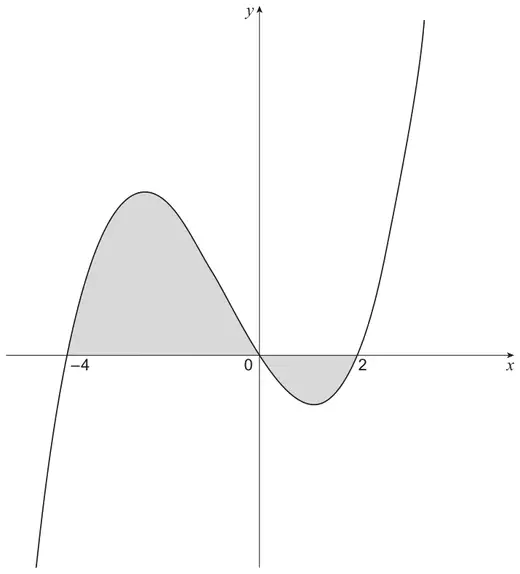
(c) The curve \(C\) has equation\[y = x(x - 2)(x + 4)\]
A sketch of \(C\) is shown in the diagram.
(i) Explain why your answer to part (b) will not give the total area of the shaded region bounded by \(C\) and the \(x\)-axis. [1 mark]
(ii) Find the total area of the shaded region bounded by \(C\) and the \(x\)-axis. [2 marks]
Mark scheme (a)
Scheme
Marks
AO
Obtains \(x^3 + 2x^2 - 8x\)
B1
1.1b
(1)
Typical solution
\[x^3 + 2x^2 - 8x\]
Mark scheme (b)
Scheme
Marks
AO
Integrates their answer to (a) with at least one term correct
M1
1.1a
Completes integration correctly FT their answer to (a) provided it is a three-term cubic expression
A1F
1.1b
Substitutes limits explicitly into their integrated function and subtracts in the correct order
M1
1.1a
Completes reasoned argument to show that \(\displaystyle\int_{-4}^{2} x(x - 2)(x + 4)\,\mathrm{d}x = 36\) AG Must see a correct expression with all powers evaluated prior to obtaining 36
(i) Explains that part of the area is above and part is below the \(x\)-axis Or Explains that any part below the axis will give a negative value when using integration Do not accept comments that reference negative area
E1
2.3
(1)
(ii) Adds their \(\pm\dfrac{128}{3}\) + their \(\pm\dfrac{20}{3}\) to obtain an answer not equal to 36 OE could be in integral form
M1
2.2a
Obtains \(\dfrac{148}{3}\) OE CAO
A1
1.1b
(2)
(8 marks)
Typical solution
(i)
The area is above and below the axis, so cannot be evaluated as a single integral
We'd like to use Google Analytics cookies to count visits and see which pages help most. They're optional, and the site works exactly the same either way. Privacy policy