
June 2022 Paper 1 Q7
7.
The curve \(C\) has equation
\[y = 9x - x^3\]The line \(l\) has equation \(y = k\) where \(k\) is a constant.
Given that \(C\) and \(l\) intersect at 3 distinct points,
Solutions relying on calculator technology are not acceptable. (3)
| Scheme | Marks | AO |
|---|---|---|
| \(9x - x^3 = x(9 - x^2)\) | M1 | 1.1b |
| \(9x - x^3 = x(3 - x)(3 + x)\) oe | A1 | 1.1b |
| (2) |
Notes
M1: Takes out a factor of \(x\) or \(-x\). Scored for \(\pm x(\pm 9 \pm x^2)\) May be implied by the correct answer or \(\pm x(\pm x \pm 3)(\pm x \pm 3)\).
Also allow if they attempt to take out a factor of \((\pm x \pm 3)\) so score for \((\pm x \pm 3)(\pm 3x \pm x^2)\)
A1: Correct factorisation. \(x(3 - x)(3 + x)\) on its own scores M1A1.
Allow eg \(-x(x - 3)(x + 3)\), \(x(x - 3)(-x - 3)\) or other equivalent expressions
Condone an \(= 0\) appearing on the end and condone eg \(x\) written as \((x + 0)\).
| Scheme | Marks | AO |
|---|---|---|
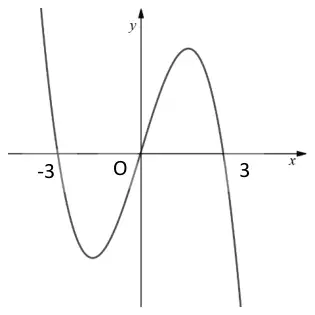 A cubic with correct orientation (B1) Passes though origin, \((3, 0)\) and \((-3, 0)\) (B1) | B1 B1 | 1.1b 1.1b |
| (2) |
Notes
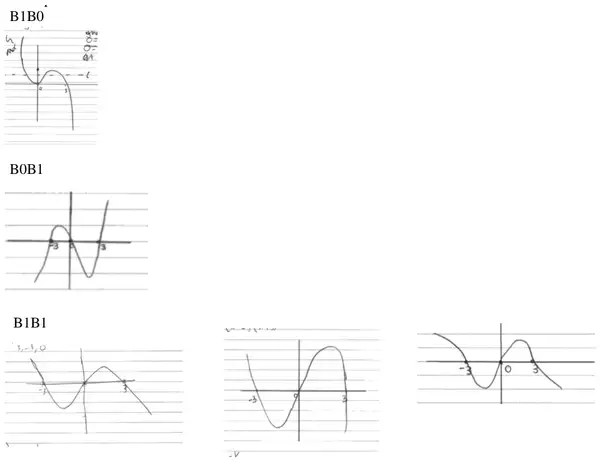
B1: Correct shape (negative cubic) appearing anywhere on a set of axes. It must have a minimum to the left and maximum to the right. Be tolerant of pen slips. Judge the intent of the shape. (see examples)
B1: Passes through each of the origin, \((3, 0)\) and \((-3, 0)\) and no other points on the \(x\) axis. (The graph should not turn on any of these points).
The points may be indicated as just 3 and \(-3\) on the axes. Condone \(x\) and \(y\) to be the wrong way round eg \((0, -3)\) for \((-3, 0)\) as long as it is on the correct axis but do not allow \((-3, 0)\) to be labelled as \((3, 0)\).
Examples
| Scheme | Marks | AO |
|---|---|---|
| \(y = 9x - x^3 \Rightarrow \dfrac{\mathrm{d}y}{\mathrm{d}x} = 9 - 3x^2 = 0 \Rightarrow x = (\pm)\sqrt{3} \Rightarrow y = \ldots\) | M1 | 3.1a |
| \(y = (\pm)6\sqrt{3}\) | A1 | 1.1b |
| \(\left\{k \in \mathbb{R} : -6\sqrt{3} \lt k \lt 6\sqrt{3}\right\}\) oe | A1ft | 2.5 |
| (3) | ||
| (7 marks) |
Notes
*Be aware the value of \(y\) can be solved directly using a calculator which is not acceptable*
M1: Uses a correct strategy for the \(y\) value of either the maximum or minimum. E.g. differentiates to achieve a quadratic, solves \(\dfrac{\mathrm{d}y}{\mathrm{d}x} = 0\) and uses their \(x\) to find \(y\)
A1: Either or both of the values \((\pm)6\sqrt{3}\).
Cannot be scored for an answer without any working seen.
A1ft: Correct answer in any acceptable set notation following through their \(6\sqrt{3}\).
Condone \(\left\{\text{``}{-6\sqrt{3}}\text{''} \lt k \lt \text{``}6\sqrt{3}\text{''}\right\}\) or \(\left\{\text{``}{-6\sqrt{3}}\text{''} \lt k\right\} \cap \left\{k \lt \text{``}6\sqrt{3}\text{''}\right\}\) but not \(\left\{\text{``}{-6\sqrt{3}}\text{''} \lt k\right\} \cup \left\{k \lt \text{``}6\sqrt{3}\text{''}\right\}\)
Note: If there is a contradiction of their solution on different lines of working do not penalise intermediate working and mark what appears to be their final answer.
Must be in terms of \(k\)