In this question you must show all stages of your working.
Solutions relying entirely on calculator technology are not acceptable.
The growth of a particular tree is monitored over a period of time.
The height, \(h\) metres, of this tree, \(t\) years after it was planted, is modelled by the equation\[h = 31 - A\mathrm{e}^{-kt}\]where \(A\) and \(k\) are positive constants.
Given that
exactly 10 years after it was planted, the height of the tree was 6 m
exactly 20 years after it was planted, the height of the tree was 11 m
(a) find a complete equation for \(h\) in terms of \(t\), giving the value of each of \(A\) and \(k\) to 3 significant figures. (4)
Use the equation of the model to answer parts (b), (c) and (d).
According to the model, there is a limit to the height to which this tree can grow.
(b) Deduce this limit. (1)
(c)
(i) Find the initial height of the tree.
(ii) Hence explain whether this is a suitable model for the early growth of the tree. (2)
(d)
(i) Find \(\dfrac{\mathrm{d}h}{\mathrm{d}t}\), giving your answer in simplest form. (2)
(ii) Hence find the value of \(t\) for which the height of the tree is increasing at a rate of 30 cm per year. (3)
e.g. \(\mathrm{e}^{10k} = \dfrac{25}{20} \Rightarrow 10k = \ln\left(\dfrac{25}{20}\right) \Rightarrow k = \dfrac{1}{10}\ln\left(\dfrac{5}{4}\right)\)
dM1
3.1a
\(k = 0.0223\) or \(A = 31.3\)
A1
1.1b
\(h = 31 - 31.3\mathrm{e}^{-0.0223t}\)
A1
3.3
(4)
Notes
M1: Uses \(h = 31 - A\mathrm{e}^{-kt}\) with \(h = 6,\ t = 10\) and \(h = 11,\ t = 20\) to create simultaneous equations and proceeds via correct work to eliminate \(A\) or \(k\). Condone the equations appearing as e.g. \(6\text{ m} = 31 - A\mathrm{e}^{-10k},\ 11\text{ m} = 31 - A\mathrm{e}^{-20k}\) Look for the overall method being correct but condone slips.
\(A\mathrm{e}^{-10k} = 25,\ A\mathrm{e}^{-20k} = 20 \Rightarrow \ln A - 10k = \ln 25,\ \ln A - 20k = \ln 20 \Rightarrow \ln A = 2\ln 25 - \ln 20\)
dM1: Proceeds to find a value for \(A\) or \(k\) using the correct order of operations but condoning slips.
A1: Achieves either \(k =\) awrt 0.0223 or \(A =\) awrt 31.3 (or \(A =\) awrt 31.2) Note the exact values are \(k = \dfrac{1}{10}\ln\dfrac{5}{4}\) or \(A = \dfrac{125}{4}\ (31.25)\) which are acceptable.
A1: cso Proceeds correctly to \(h = 31 - 31.2\mathrm{e}^{-0.0223t}\) or \(h = 31 - 31.3\mathrm{e}^{-0.0223t}\) Exact answer is \(h = 31 - \dfrac{125}{4}\mathrm{e}^{-\frac{1}{10}\ln\frac{5}{4}t}\) o.e., e.g., \(h = 31 - 31.25\mathrm{e}^{\frac{1}{10}\ln\frac{4}{5}t}\) which is acceptable. Finding \(A\) and \(k\) is insufficient for this mark as the question asks for a complete equation, however, allow this mark if the complete correct equation is seen subsequently.
Mark scheme (b)
Scheme
Marks
AO
31 m
B1
2.2a
(1)
Notes
B1: cao 31 m and units are required. Must be seen as their answer to (b). There must be no other values.
Mark scheme (c)
Scheme
Marks
AO
(c)(i) \(-0.3\) m
B1ft
3.4
(ii) The model is unsuitable for the early growth of the tree as it suggests that the tree had a negative height.
B1ft
3.5a
(2)
Notes
(c) (i)
B1ft: Accept \(31 - \text{``}A\text{''}\) with correct units. This must be evaluated correctly for their \(A\). Only penalise the omission of units once from an otherwise acceptable answer in (b) and (c)(i) and penalise it on the first occurrence.
(c) (ii)
B1ft: Concludes that the model is unsuitable because (the initial/early) height is negative Follow through on their (c)(i) here but it must be negative. Alternatively, allow that the model is suitable if they conclude that the depth of the seed is \(\text{``}{-0.3}\text{''}\) m or e.g. suitable as it would be underground.
M1: Achieves the form \(\left\{\dfrac{\mathrm{d}h}{\mathrm{d}t} =\right\} a\mathrm{e}^{-kt}\). It is acceptable to use \(k\) and \(A\) for this mark and allow if \(k \lt 0\) but must be consistent with their \(h\).
A1: \(\left\{\dfrac{\mathrm{d}h}{\mathrm{d}t} =\right\}\) awrt \(0.698\mathrm{e}^{-0.0223t}\) Allow awrt \(0.697\mathrm{e}^{-0.0223t}\) or awrt \(0.696\mathrm{e}^{-0.0223t}\) and allow exact e.g. \(\dfrac{25}{8}\ln\dfrac{5}{4}\mathrm{e}^{-\frac{1}{10}\ln\frac{5}{4}t}\)
(d)(ii)
B1ft: Sets their \(\dfrac{\mathrm{d}h}{\mathrm{d}t} = 0.3\) where \(\dfrac{\mathrm{d}h}{\mathrm{d}t}\) is not their \(h\).
M1: Uses their \(\dfrac{\mathrm{d}h}{\mathrm{d}t} = \ldots\), and proceeds from \(a\mathrm{e}^{-kt} = b\) where \(ab \gt 0\) to \(ct = \ln d\) where \(d \gt 0\) using the correct order of operations but condoning slips. Allow equivalent work e.g. \(0.696\mathrm{e}^{-0.0223t} = 0.3 \Rightarrow \ln 0.696 - 0.0223t = \ln 0.3 \Rightarrow -0.0223t = \ln 0.3 - \ln 0.696\)
A1: cso awrt 37.7 or 37.8 or 37.9 but note that this may be scored if \(k\) is rounded in (a). Ignore any units if given and just look for the value.
In this question you must show all stages of your working.
Solutions relying entirely on calculator technology are not acceptable.
Solve the equation\[2\log_3(x+1) = 1 + \log_3(x+7)\](5)
Mark scheme
Scheme
Marks
AO
\(2\log_3(x+1) = 1 + \log_3(x+7)\)
\(2\log_3(x+1) = \log_3(x+1)^2\)
B1
1.1a
\(\log_3\dfrac{(x+1)^2}{x+7} = 1\)
M1
1.1b
\(\dfrac{(x+1)^2}{x+7} = 3\)
A1
1.1b
\((x+1)^2 = 3(x+7) \Rightarrow x^2 - x - 20 = 0 \Rightarrow x = \ldots\)
M1
1.1b
\(x = 5\) only
A1
2.3
(5)
(5 marks)
Notes
B1: For \(2\log_3(x+1) = \log_3(x+1)^2\) oe e.g. \(2\log_3(x+1) = \log_3\left(x^2 + 2x + 1\right)\)
M1: Uses the subtraction law of logs following the above \(\log_3\dfrac{(x+1)^2}{x+7}\) Alternatively uses the addition or subtraction law following use of \(1 = \log_3 3\) i.e., \(1 + \log_3(x+7) = \log_3\left(3(x+7)\right)\) They must be combining the given terms and not e.g. \(\log_3(x+7) = \log_3 x + \log_3 7 = \log_3 7x\)
A1:Correct equation obtained with logs removed following correct work. Allow equivalent correct equations e.g. \((x+1)^2 = 3(x+7)\)
M1:Depends on the B mark. Simplifies to a 3TQ = 0 and attempts a correct method to solve their quadratic = 0 (usual rules) to obtain a value for \(x\) which may be via a calculator (you may need to check) and the “= 0” may be implied.
A1: cso \(x = 5\) only. If seen, \(-4\) must have been rejected or \(x = 5\) clearly selected. There is no requirement to justify why the \(-4\) has been rejected and any comments can be ignored whether correct or otherwise.
11. The prices of two precious metals are being monitored.
The price per gram of metal \(A\), £\(V_A\), is modelled by the equation\[V_A = 100 + 20\mathrm{e}^{0.04t}\]where \(t\) is the number of months after monitoring began.
The price per gram of metal \(B\), £\(V_B\), is modelled by the equation\[V_B = p\mathrm{e}^{-0.02t}\]where \(p\) is a positive constant and \(t\) is the number of months after monitoring began.
Given that \(V_B = 2V_A\) when \(t = 0\)
(a) find the value of \(p\) (2)
When \(t = T\), the rate of increase in the price per gram of metal \(A\) was equal to the rate of decrease in the price per gram of metal \(B\)
(b) Find the value of \(T\), giving your answer to one decimal place. (Solutions based entirely on calculator technology are not acceptable.)(4)
Mark scheme (a)
Scheme
Marks
AO
At \(t = 0\), \(V_A = 100 + 20 = 120 \Rightarrow p = 2 \times \text{``}120\text{''}\)
M1
1.1b
\((p =)\ 240\)
A1
1.1b
(2)
Notes
M1: Attempts to find the price per gram of metal \(A\) at \(t = 0\), and then doubles this to find the value of \(p\). Can be implied by 240. An expression must be evaluated to score this mark
A1: 240 only (withhold this mark if they find \(V_B = 240\) but proceed to state \(p\) as a different value)
Candidates who state that \(\dfrac{\mathrm{d}V_B}{\mathrm{d}t} = \text{``}4.8\text{''}\mathrm{e}^{-0.02T}\) can still score full marks question (they had already determined that they needed to take the modulus of the gradient function) May be in terms of \(t\) or \(T\)
M1: Attempts to set \(\pm\dfrac{\mathrm{d}V_A}{\mathrm{d}t}\) equal to \(\pm\dfrac{\mathrm{d}V_B}{\mathrm{d}t}\). Look for an equation of the form \(p\mathrm{e}^{0.04T} = q\mathrm{e}^{-0.02T}\) where \(p\) and \(q\) are constants or may be implied by further work. e.g. \(\mathrm{e}^{\pm 0.06T} = \ldots\) (it cannot be for awrt 29.9). Do not allow \(\ldots T\mathrm{e}^{0.04T} = \ldots T\mathrm{e}^{-0.02T}\)
A1ft: \(0.8\mathrm{e}^{0.04T} = \text{``}4.8\text{''}\mathrm{e}^{-0.02T}\). Follow through on their positive value for \(p\). May be implied by further work which is not awrt 29.9.
dM1: Rearranges their \(\dfrac{\mathrm{d}V_A}{\mathrm{d}t} = -\dfrac{\mathrm{d}V_B}{\mathrm{d}t}\) which cannot be the original functions to \(r\mathrm{e}^{\pm 0.06T} = s\) where \(r \times s \gt 0\) \(\dfrac{\mathrm{d}V_B}{\mathrm{d}t} = \text{``}4.8\text{''}\mathrm{e}^{-0.02T} \Rightarrow 0.8\mathrm{e}^{0.04T} = \text{``}4.8\text{''}\mathrm{e}^{-0.02T}\) is allowed (see note at the start of (b). Condone slips. It is dependent on the first method mark. If they take lns of both sides first e.g. \(0.8\mathrm{e}^{0.04T} = \text{``}4.8\text{''}\mathrm{e}^{-0.02T} \Rightarrow \ln 0.8 + 0.04T = \ln\text{``}4.8\text{''} - 0.02T\) they need to rearrange to \(\pm 0.06T = \ldots\) by adding / subtracting.
A1cso: awrt 29.9 provided evidence of solving \(0.8\mathrm{e}^{0.04T} = 4.8\mathrm{e}^{-0.02T}\) is seen. i.e. they cannot proceed from \(\mathrm{e}^{\pm 0.06T} = \ldots\) to the awrt 29.9 in one step. We must see either an expression for \(t\) or e.g. taking lns of both sides. Condone \((T =)\dfrac{50\ln 6}{3}\) or others in the form \((T =)\ a\ln b\) where \(a\) and \(b\) are rational constants e.g. \(\dfrac{\ln 6}{0.06}\). It cannot be scored for an expression.
M1: Uses the laws of logs to write \(\log_{a} 100\) correctly as a sum of logs e.g. \(\log_{a} 100 = \log_{a} 4 + \log_{a} 25\) e.g. \(\log_{a} 100 = \log_{a} 4 + \log_{a} a^q\) e.g. \(\log_{a} 100 = 2\log_{a} 2 + 2\log_{a} 5\) e.g. \(\log_{a} 100 = \dfrac{1}{2}\log_{a} 16 + \dfrac{1}{2}\log_{a} 625\) e.g. \(\log_{a} 100 = \log_{a} 50 + \log_{a} 2\) May also be implied by expressions in \(p\) or \(q\) or a mixture of both e.g. \((p + q =)\ \log_{a} 16 + \log_{a} 25 = \log_{a} 400 = \log_{a} 4 + \log_{a} 100 \Rightarrow p + q - \log_{a} 4 = \log_{a} 100\) Look out for more complex versions of above e.g. e.g. \(\log_{a} 100 = \log_{a} 4 + \log_{a} a^q\) which are acceptable. Do not penalise the omission of base \(a\)
A1: \(\dfrac{1}{2}p + q\) o.e. Correct answer scores full marks but withhold this mark if incorrect log work is seen e.g. \(\log_{a} 100 = \log_{a} 4 \times \log_{a} 25\) or \(\log_{a} 100 = 4\log_{a} 25\)
M1: Uses both the addition and subtraction laws of logs to write the full expression of \(\log_{a} 80 \times \log_{a} 3.2\) correctly in terms of any of the following:
\(\log_{a} 16\ (= p)\)
\(\log_{a} 4\ \left(= \tfrac{p}{2}\right)\)
\(\log_{a} 2\ \left(= \tfrac{p}{4}\right)\)
\(\log_{a} 5\ \left(= \tfrac{q}{2}\right)\)
\(\log_{a} 25\ (= q)\)
e.g. \(\log_{a} 80 \times \log_{a} 3.2 = \left(2\log_{a} 4 + \log_{a} 5\right) \times \left(\log_{a} 16 - \log_{a} 5\right)\) You may see other viable solutions using e.g. \(\log_{a} \dfrac{1}{5}\), \(\log_{a} \dfrac{1}{4}\) but they will need to proceed to either e.g. \(\log_{a} 5\) (an integer value) or proceed to an expression in terms of \(p\) or \(q\) Do not penalise the omission of base \(a\). May be implied by equivalent expressions in \(p\) or \(q\) or a mixture of both.
A1: \(\left(p + \dfrac{1}{2}q\right) \times \left(p - \dfrac{1}{2}q\right)\) or \(p^2 - \dfrac{1}{4}q^2\) o.e. (does not need to be simplified) Correct answer scores full marks but withhold this mark if incorrect log work is seen in their solution. isw once a correct answer in terms of \(p\) and \(q\) is seen.
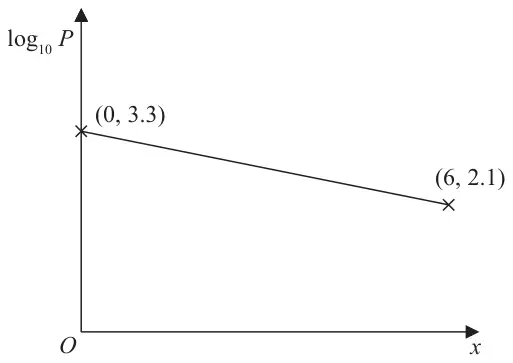
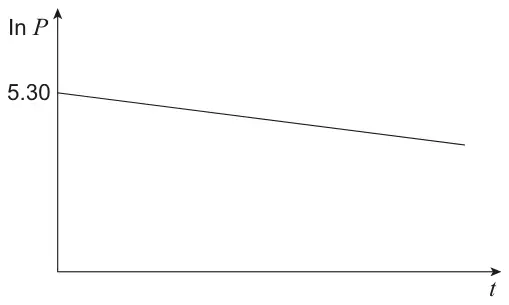
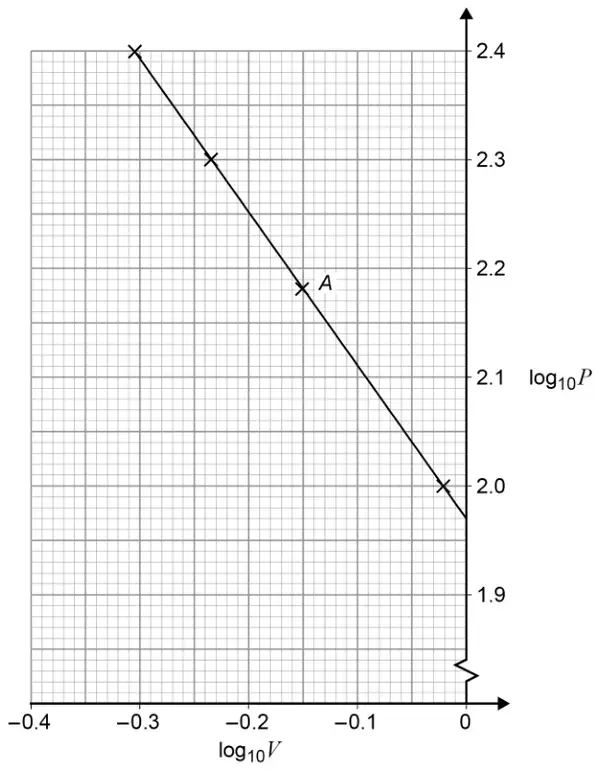
On a particular day, the concentration of smoke particles in the air emitted by this chimney, \(P\) parts per million, is measured at various distances, \(x\) km, from the chimney.
Figure 2 shows a sketch of the linear relationship between \(\log_{10} P\) and \(x\) that is used to model this situation.
The line passes through the point \((0,\ 3.3)\) and the point \((6,\ 2.1)\)
(a) Find a complete equation for the model in the form\[P = ab^x\]where \(a\) and \(b\) are constants. Give the value of \(a\) and the value of \(b\) each to 4 significant figures. (4)
(b) With reference to the model, interpret the value of \(ab\) (1)
Mark scheme (a)
Scheme
Marks
AO
\(\log_{10} a = 3.3\) or \(\log_{10} b = \dfrac{2.1 - 3.3}{6}\ (= -0.2)\) or e.g. \(\log_{10} P = 3.3 - 0.2x\) or \(\log_{10} P = 3.3 + \dfrac{2.1 - 3.3}{6}x\)
M1
1.1b
\(a = 10^{3.3}\) or \(b = 10^{-0.2}\)
A1
1.1b
\(a = 10^{3.3}\) and \(b = 10^{\text{``}{-}0.2\text{''}}\) or \(P = 10^{3.3 - 0.2x} = 10^{3.3} \times 10^{-0.2x}\)
dM1
3.1a
\(P = 1995 \times 0.6310^x\)
A1
3.3
(4)
Notes
M1: Attempts an equation in \(a\) or \(b\). Score for \(\log_{10} a = 3.3\) or \(\log_{10} b = \dfrac{2.1 - 3.3}{6}\ (= -0.2)\) Condone an incorrectly evaluated gradient provided \(\dfrac{2.1 - 3.3}{6}\) o.e. was attempted (may be seen as two simultaneous equations). Alternatively, forms a correct linear equation in \(\log_{10} P\) and \(x\). Do not penalise if base 10 is missing. May be implied by a correct unsimplified value for \(a\) or \(b\). (which could be truncated rather than rounded for \(b\))
A1: A correct unsimplified value for \(a\) or \(b\). This may be within the linear equation in the alternative method e.g. \(P = 10^{3.3} \times 10^{-0.2x}\)
dM1: A correct method to find unsimplified values for \(a\) and \(b\). Allow use of their \(-0.2\) found from a correct attempt at the gradient of the line. Alternatively, correctly uses laws of indices to achieve \(P = 10^{3.3} \times 10^{\text{``}{-}0.2\text{''}x}\). It is dependent on the previous method mark. May be implied by their final correct equation.
A1: Complete equation with \(a =\) awrt 1995 and \(b =\) awrt 0.6310 (condone 0.631)
Mark scheme (b)
Scheme
Marks
AO
The concentration (in parts per million) 1 km from the chimney
B1
3.2a
(1)
(5 marks)
Notes
B1: Must refer to concentration (or e.g. parts per million) and 1km o.e. Condone use of emitted for measured e.g. “concentration of smoke particles emitted 1km from the chimney” Do not accept “amount of smoke particles” or referring to when \(x = 1\) (not in context)
At \(t = 4 \Rightarrow\) Rate of growth is \(0.34\mathrm{e}^{-0.2 \times 4} = 0.15277\ldots\{\text{m / year}\}\)
dM1
3.4
0.153 {m per year} = 15.3 cm {per year} *
A1*
1.1b
(3)
Notes
M1: Links rate of change to gradient and differentiates \(h = 2.3 - 1.7\mathrm{e}^{-0.2t}\) to \(k\mathrm{e}^{-0.2t},\ k \neq -1.7\) Accept, e.g., \(-0.2 \times -1.7\mathrm{e}^{-0.2t}\) Must be seen in (b).
dM1: Substitutes \(t = 4\) into \(k\mathrm{e}^{-0.2t},\ k \neq -1.7\) and calculates its value.
A1*: Fully correct. Requires
sight of \(\left\{\dfrac{\mathrm{d}h}{\mathrm{d}t} =\right\}0.34\mathrm{e}^{-0.2t}\) o.e., e.g., \(\left\{\dfrac{\mathrm{d}h}{\mathrm{d}t} =\right\}\dfrac{17}{50}\mathrm{e}^{-0.2t}\) or \(\left\{\dfrac{\mathrm{d}h}{\mathrm{d}t} =\right\}-0.2 \times -1.7\mathrm{e}^{-0.2t}\)
\(\left\{\dfrac{\mathrm{d}h}{\mathrm{d}t} =\right\}\) awrt 0.153 {metres per year}
changing to awrt 15.3 cm {per year}.
Note: Substituting \(t = 4\) into \(h = 2.3 - 1.7\mathrm{e}^{-0.2t}\) gives \(h = 1.536\ldots\) scores M0dM0A0 unless differentiation and further correct work is seen separately.
Mark scheme (c)
Scheme
Marks
AO
2.3 (m)
B1
2.2a
(1)
(6 marks)
Notes
B1: Allow 2.3, 2.3 m, or 230 cm \(2.2\dot{9}\) and 2.2999… which clearly continues are both acceptable, but 2.29999999 is not.
9. Using the laws of logarithms, solve the equation
\[2\log_{5}(3x - 2) - \log_{5} x = 2\]
(5)
Mark scheme
Scheme
Marks
AO
\(2\log_{5}(3x - 2) - \log_{5} x = 2\)
Uses one correct law e.g. \(2\log_{5}(3x - 2) \to \log_{5}(3x - 2)^2\) or \(2 \to \log_{5} 25\) or \(\log_{5} \ldots = 2 \to \ldots = 5^2\)
B1
1.1a
Uses two correct log laws: either \(2\log_{5}(3x - 2) \to \log_{5}(3x - 2)^2\) and \(2 \to \log_{5} 25\) or \(2\log_{5}(3x - 2) - \log_{5} x \to \log_{5}\dfrac{(3x - 2)^2}{x}\) leading to an equation without logs
M1
3.1a
Correct equation without logs, usually \(\dfrac{(3x - 2)^2}{x} = 25\)
B1: Uses one correct log law. The base does not need to be seen for this mark. This mark is independent of any other errors they make.
M1: This can be awarded for the overall strategy leading to an equation in \(x\) not involving logs. It requires the correct use of two log laws as in the main scheme to reach an equation in \(x\) This mark may not be awarded for correct application of two laws following incorrect log work, but numerical slips are condoned.
A1: For a correct unsimplified equation with logs removed and no incorrect work seen. Ignore any incorrect simplification of their equation. Allow recovery on missing brackets, e.g., \(\log_{5}\dfrac{3x - 2^2}{x} = 2 \to \dfrac{9x^2 - 12x + 4}{x} = 25\) Correct equations are likely to be \(\dfrac{(3x - 2)^2}{x} = 25\) or, e.g., \((3x - 2)^2 = 25x\) but you might see \(9x - 12 + \dfrac{4}{x} = 25\) Sight of a correct equation does not imply either the previous M1 or the A1. Note: \(\dfrac{\log_{5}(3x - 2)^2}{\log_{5} x} = 2 \to \dfrac{(3x - 2)^2}{x} = 25\) may be seen and scores B1M0A0.
dM1: For a correct method to solve their equation, via a 3TQ set = 0 The 3TQ may be solved by calculator - you may need to check their value(s). Can be implied by one correct value for their 3TQ set = 0 correct to 1d.p.
A1: cso \(x = 4\) only. If \(x = \dfrac{1}{9}\) is also given it must be rejected. \(x = 0\) might also be seen and must be rejected. Ignore any reasoning for rejecting any values. Note that calculators can solve the equation at any stage and so full log work must be shown leading to a 3TQ set = 0.
(a) Given that \(p = \log_{3} x\), where \(x \gt 0\), find in simplest form in terms of \(p\),
(i) \(\log_{3}\left(\dfrac{x}{9}\right)\)
(ii) \(\log_{3}\left(\sqrt{x}\right)\) (2)
(b) Hence, or otherwise, solve\[2\log_{3}\left(\frac{x}{9}\right) + 3\log_{3}\left(\sqrt{x}\right) = -11\]giving your answer as a simplified fraction. Solutions relying on calculator technology are not acceptable.(4)
Mark scheme (a)
Scheme
Marks
AO
(i) \(\log_{3}\left(\dfrac{x}{9}\right) = \log_{3} x - \log_{3} 9 = p - 2\)
B1
1.2
(ii) \(\log_{3}\left(\sqrt{x}\right) = \dfrac{1}{2}p\)
B1
1.1b
(2)
Notes
(a)(i) B1: Recalls the subtraction law of logs and so obtains \(p - 2\)
*Be aware this should be solved by non-calculator methods*
M1: Uses their results from part (a) to form a linear equation in \(p\) and attempts to solve leading to a value for \(p\). Allow slips in their rearrangement when solving. Allow a misread forming the equation equal to 11 instead of \(-11\)
A1: Correct value for \(p\)
M1: Uses \(\log_{3} x = p \Rightarrow x = 3^p\) following through on what they consider to be their \(p\). It must be a value rather than \(p\)
A1: \((x =)\ \dfrac{1}{9}\) cao with correct working seen. Must be this fraction. Do not penalise invisible brackets as long as the intention is clear.
Alternative:
M1: Correct use of log rules to achieve an equation of the form \(\log_{3}\ldots = \log_{3}\ldots\) or \(\log_{3}\ldots = \text{a number}\) (typically \(-11\)). Condone arithmetical slips.
A1: Correct equation with logs removed.
M1: Uses inverse operations to find \(x\). Condone slips but look for proceeding from \(x^{\frac{a}{b}} = \ldots \Rightarrow x = \ldots^{\frac{b}{a}}\) where they have to deal with a fractional power.
A1: \((x =)\ \dfrac{1}{9}\) cao with correct working seen. Must be this fraction. Do not penalise invisible brackets as long as the intention is clear.
In this question you must show all stages of your working.
Solutions relying entirely on calculator technology are not acceptable.
The air pressure, \(P\) kg/cm2, inside a car tyre, \(t\) minutes from the instant when the tyre developed a puncture is given by the equation
\[P = k + 1.4\mathrm{e}^{-0.5t} \qquad t \in \mathbb{R} \qquad t \geqslant 0\]
where \(k\) is a constant.
Given that the initial air pressure inside the tyre was 2.2 kg/cm2
(a) state the value of \(k\). (1)
From the instant when the tyre developed the puncture,
(b) find the time taken for the air pressure to fall to 1 kg/cm2 Give your answer in minutes to one decimal place. (3)
(c) Find the rate at which the air pressure in the tyre is decreasing exactly 2 minutes from the instant when the tyre developed the puncture. Give your answer in kg/cm2 per minute to 3 significant figures. (2)
Mark scheme (a)
Scheme
Marks
AO
\((k =)\ 0.8\)
B1
1.1b
(1)
Notes
B1: Completes the equation for the model by obtaining \((k =)\ 0.8\) or equivalent.
\(-0.5t = \ln\left(\dfrac{0.2}{1.4}\right) \Rightarrow t = \ldots\)
M1
1.1b
awrt 3.9 minutes
A1
1.1b
(3)
Notes
*Be aware this could be solved entirely using a calculator which is not acceptable*
M1: For using the model with \(P = 1\) and their value for \(k\) from (a) and proceeding to \(A\mathrm{e}^{\pm 0.5t} = B\). Condone if \(A\) or \(B\) are negative for this mark.
M1: Uses correct log work to solve an equation of the form \(A\mathrm{e}^{\pm 0.5t} = B\) leading to a value for \(t\). They cannot proceed directly to awrt 3.9 without some intermediate working seen. Eg \(t = 2\ln 7\) or \(-2\ln\left(\dfrac{1}{7}\right)\) is acceptable. Also allow \(1.4\mathrm{e}^{-0.5t} = 0.2 \Rightarrow -0.5t = -1.9459\ldots \Rightarrow t = \ldots\) This cannot be scored from an unsolvable equation (eg when their \(k \geqslant 1\) so that \(\mathrm{e}^{\pm 0.5t} \leqslant 0\)).
A1: Accept awrt 3.9 minutes or \(t =\) awrt 3.9 with correct working seen. eg \(1.4\mathrm{e}^{-0.5t} = 0.2 \Rightarrow t = 3.9\) would be M1M0A0
*Be aware this can be solved entirely using a calculator which is not acceptable*
M1: Links rate of change to gradient and differentiates to obtain an expression of the form \(A\mathrm{e}^{-0.5t}\) and substitutes \(t = 2\). Do not accept \(At\mathrm{e}^{-0.5t}\) as the derivative. Beware that substituting \(t = 2\) and proceeding from \(\mathrm{e}^{-1}\) to \(\mathrm{e}^{-2}\) is M0A0
A1: Obtains awrt 0.258 with differentiation seen. (Units not required) Condone awrt \(-0.258\) Awrt \(\pm 0.258\) with no working is M0A0. Isw after a correct answer is seen.
(Ignore in (c) any spurious notation on the LHS when differentiating such as \(P = \ldots\) or \(\dfrac{\mathrm{d}y}{\mathrm{d}x} = \ldots\))
5. The mass, \(A\) kg, of algae in a small pond, is modelled by the equation
\[A = pq^t\]
where \(p\) and \(q\) are constants and \(t\) is the number of weeks after the mass of algae was first recorded.
Data recorded indicates that there is a linear relationship between \(t\) and \(\log_{10} A\) given by the equation
\[\log_{10} A = 0.03t + 0.5\]
(a) Use this relationship to find a complete equation for the model in the form\[A = pq^t\]giving the value of \(p\) and the value of \(q\) each to 4 significant figures. (4)
(b) With reference to the model, interpret
(i) the value of the constant \(p\),
(ii) the value of the constant \(q\). (2)
(c) Find, according to the model,
(i) the mass of algae in the pond when \(t = 8\), giving your answer to the nearest 0.5 kg,
(ii) the number of weeks it takes for the mass of algae in the pond to reach 4 kg. (3)
(d) State one reason why this may not be a realistic model in the long term. (1)
Mark scheme (a)
Scheme
Marks
AO
\(p = 10^{0.5}\) (or \(\log_{10} p = 0.5\)) or \(q = 10^{0.03}\) (or \(\log_{10} q = 0.03\))
M1
1.1b
\(p =\) awrt 3.162 or \(q =\) awrt 1.072
A1
1.1b
\(p = 10^{0.5}\) (or \(\log_{10} p = 0.5\)) and \(q = 10^{0.03}\) (or \(\log_{10} q = 0.03\))
dM1
3.1a
\(A = 3.162 \times 1.072^t\)
A1
3.3
(4)
Notes
M1: A correct equation in \(p\) or \(q\). May be implied by a correct value for \(p\) or \(q\). Also score for rearranging the equation to the form \(A = 10^{0.5} \ldots 10^{0.03t}\)
A1: For \(p =\) awrt 3.162 or \(q =\) awrt 1.072. May be embedded within the equation.
dM1: Correct equations in \(p\) and \(q\). Also score for rearranging the equation to the form \(A = 10^{0.5} \times 10^{0.03t}\)
A1: Complete equation with \(p =\) awrt 3.162 and \(q =\) awrt 1.072. Must be seen in (a) If \(p\) and \(q\) are just stated but the equation is not written with the values embedded then withhold this mark. Withhold the final mark if the correct values for \(p\) and \(q\) result from incorrect working such as \(A = 10^{0.5} + 10^{0.03t} \Rightarrow A = 3.162 \times 1.072^t\). If \(p\) and \(q\) are stated the wrong way round, take the stated equation as their final answer and isw.
Mark scheme (b)
Scheme
Marks
AO
(i) The initial mass (in kg) of algae (in the pond).
B1
3.4
(ii) The ratio of algae from one week to the next.
B1
3.4
(2)
Notes
(i) B1: Must reference mass of algae and relating to initially/at the start/beginning Examples of acceptable answers: The mass of algae originally (in the pond) \(p\) is the mass of algae when \(t = 0\) Examples of answers we would not accept \(p\) is how much algae there is at the beginning The relationship between algae and number of weeks
(ii) B1: Must reference the rate of change/multiplier and the time frame eg per week/every week/each week. Examples of acceptable answers: \(q\) is the rate at which the mass of algae increases for every week The amount of algae increases by 7.2% each week (condone amount for mass in ii) The proportional increase in mass of the algae each week Examples of answers we would not accept: \(q\) is how much algae will increase when \(t\) increases by 1 The amount that grows per unit of time The rate at which the mass of algae in the small pond increases after \(t\) number of weeks The rate in which the algae mass increases
Mark scheme (c)
Scheme
Marks
AO
(i) 5.5 kg
B1
2.2a
(ii) \(4 = \text{``}3.162\text{''}\times\text{``}1.072\text{''}^t\) or \(\log_{10} 4 = 0.03t + 0.5\)
M1
3.4
awrt 3.4 (weeks)
A1
1.1b
(3)
Notes
B1: cao (including units)
M1: Setting up a correct equation to find \(t\) using the given equation or their part (a) Substitution of \(A = 4\) into their equation for \(A\) or the given equation is sufficient for this mark.
A1: awrt 3.4 (weeks). Accept any acceptable method (including trial and improvement) Condone lack of units. isw if they subsequently convert to weeks and days. Allow awrt 3.5 (weeks) following \(p =\) awrt 3.16 and \(q =\) awrt 1.07. An answer of only awrt 3.4 is M1A1, but an answer of 4 (weeks) with no working is M0A0
Mark scheme (d)
Scheme
Marks
AO
The model predicts unlimited growth.
The weather may affect the rate of growth
B1
3.5b
(1)
(10 marks)
Notes
B1: Any reason why the rate of change, growth or the mass of algae might change or why the model in not realistic. Be generous with the awarding of this mark as long as the answer has engaged with the context of the problem or the model Examples of acceptable answers: Seasonal changes (which would affect the growth rate) Overcrowding (as it is a small pond) Algae may stop growing (the model predicts unlimited growth) Algae may die / be removed / eaten (so the rate of growth may not continue at the same rate) Examples of answers we would not accept: There could be other factors that affect the amount of algae (too vague) The mass of algae might change
A1ft: Comments on the suitability of the model. Follow through on their answer. Requires a comment consistent with their answer from using the model. E.g. It is a suitable model as it is only “3” bpm away from the real value ✓ Do not allow an argument stating that it should be the same. It is an unsuitable model as “122” bpm is not equal to 119 bpm ✗
Mark scheme (c)
Scheme
Marks
AO
"\(p\)" would be the (resting) heart rate (in bpm) of a mammal with a mass of 1 kg
B1
3.4
(1)
(7 marks)
Notes
B1: "\(p\)" would be the (resting) heart rate of a mammal with a mass of 1 kg
11. The owners of a nature reserve decided to increase the area of the reserve covered by trees.
Tree planting started on 1st January 2005.
The area of the nature reserve covered by trees, \(A\ \text{km}^2\), is modelled by the equation
\[A = 80 - 45\mathrm{e}^{ct}\]
where \(c\) is a constant and \(t\) is the number of years after 1st January 2005.
Using the model,
(a) find the area of the nature reserve that was covered by trees just before tree planting started. (1)
On 1st January 2019 an area of \(60\ \text{km}^2\) of the nature reserve was covered by trees.
(b) Use this information to find a complete equation for the model, giving your value of \(c\) to 3 significant figures. (4)
On 1st January 2020, the owners of the nature reserve announced a long-term plan to have \(100\ \text{km}^2\) of the nature reserve covered by trees.
(c) State a reason why the model is not appropriate for this plan. (1)
Mark scheme (a)
Scheme
Marks
AO
\(35\ (\text{km}^2)\)
B1
3.4
(1)
Notes
B1: Uses the equation of the model to find that \(35\ (\text{km}^2)\) of the reserve was covered on 1st January 2005. Do not accept eg. \(35\ \text{m}^2\)
dM1: A full and careful method using precise algebra, correct log laws and a knowledge that \(\mathrm{e}^x\) and \(\ln x\) are inverse functions and proceeds to a value for \(c\).
A1: Gives a complete equation for the model \(A = 80 - 45\mathrm{e}^{-0.0579t}\)
Mark scheme (c)
Scheme
Marks
AO
Gives a suitable answer
The maximum area covered by trees is only \(80\ \text{km}^2\)
The "80" would need to be "100"
Substitutes 100 into the equation of the model and shows that the formula fails with a reason eg. you cannot take a log of a negative number
12. An advertising agency is monitoring the number of views of an online advert.
The equation
\[\log_{10} V = 0.072t + 2.379 \qquad 1 \leqslant t \leqslant 30,\ t \in \mathbb{N}\]
is used to model the total number of views of the advert, \(V\), in the first \(t\) days after the advert went live.
(a) Show that \(V = ab^t\) where \(a\) and \(b\) are constants to be found.
Give the value of \(a\) to the nearest whole number and give the value of \(b\) to 3 significant figures.
(4)
(b) Interpret, with reference to the model, the value of \(ab\). (1)
Using this model, calculate
(c) the total number of views of the advert in the first 20 days after the advert went live. Give your answer to 2 significant figures. (2)
Mark scheme (a)
Scheme
Marks
AO
\(\log_{10} V = 0.072t + 2.379\) \(\Rightarrow V = 10^{0.072t + 2.379}\) \(\Rightarrow V = 10^{0.072t} \times 10^{2.379}\) or \(V = ab^t\) \(\Rightarrow \log_{10} V = \log_{10} a + \log_{10} b^t\) \(\Rightarrow \log_{10} V = \log_{10} a + t\log_{10} b\)
B1
2.1
States either \(a = 10^{2.379}\) or \(b = 10^{0.072}\) or States either \(\log_{10} a = 2.379\) or \(\log_{10} b = 0.072\)
M1
1.1b
\(a = 239\) or \(b = 1.18\)
A1
1.1b
Either \(V = 239 \times 1.18^t\) or imply by \(a = 239, b = 1.18\)
A1
1.1b
(4)
Notes
Condone \(\log_{10}\) written \(\log\) or \(\lg\) written throughout the question
B1: Scored for showing that \(\log_{10} V = 0.072t + 2.379\) can be written in the form \(V = ab^t\) or vice versa Either starts with \(\log_{10} V = 0.072t + 2.379\) (may be implied) and shows lines\[V = 10^{0.072t + 2.379} \text{ and } V = 10^{0.072t} \times 10^{2.379}\]Or starts with \(V = ab^t\) (implied) and shows the lines\[\log_{10} V = \log_{10} a + \log_{10} b^t \text{ and } \log_{10} V = \log_{10} a + t\log_{10} b\]
M1: For a correct equation in \(a\) or a correct equation in \(b\)
A1: Finds either constant. Allow \(a =\) awrt 240 or \(b =\) awrt 1.2 following a correct method
A1: Correct solution: Look for \(V = 239 \times 1.18^t\) or \(a = 239, b = 1.18\) Note that this is NOT awrt
Mark scheme (b)
Scheme
Marks
AO
The value of \(ab\) is the (total) number of views of the advert 1 day after it went live.
B1
3.4
(1)
Notes
B1: See scheme. Condone not seeing total. Do not allow number of views at the start or similar.
Mark scheme (c)
Scheme
Marks
AO
Substitutes \(t = 20\) in either equation and finds \(V\) Eg \(V = 239 \times 1.18^{20}\)
M1
3.4
Awrt 6500 or 6600
A1
1.1b
(2)
(7 marks)
Notes
M1: Substitutes \(t = 20\) in either their \(V = 239 \times 1.18^t\) or \(\log_{10} V = 0.072t + 2.379\) and uses a correct method to find \(V\)
8. The temperature, \(\theta\ ^\circ\mathrm{C}\), of a cup of tea \(t\) minutes after it was placed on a table in a room, is modelled by the equation
\[\theta = 18 + 65\mathrm{e}^{-\frac{t}{8}}\qquad t \geqslant 0\]
Find, according to the model,
(a) the temperature of the cup of tea when it was placed on the table, (1)
(b) the value of \(t\), to one decimal place, when the temperature of the cup of tea was \(35\ ^\circ\mathrm{C}\). (3)
(c) Explain why, according to this model, the temperature of the cup of tea could not fall to \(15\ ^\circ\mathrm{C}\). (1)
Figure 2
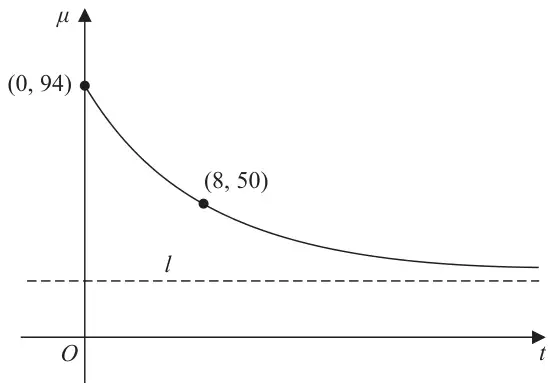
The temperature, \(\mu\ ^\circ\mathrm{C}\), of a second cup of tea \(t\) minutes after it was placed on a table in a different room, is modelled by the equation
\[\mu = A + B\mathrm{e}^{-\frac{t}{8}}\qquad t \geqslant 0\]
where \(A\) and \(B\) are constants.
Figure 2 shows a sketch of \(\mu\) against \(t\) with two data points that lie on the curve.
The line \(l\), also shown on Figure 2, is the asymptote to the curve.
Using the equation of this model and the information given in Figure 2
(d) find an equation for the asymptote \(l\). (4)
Mark scheme (a)
Scheme
Marks
AO
Temperature = \(83^\circ\mathrm{C}\)
B1
3.4
(1)
Notes
B1: Uses the model to state that the temperature \(= 83^\circ\mathrm{C}\) Requires units as well
\(t = -8\ln\left(\dfrac{17}{65}\right)\) or \(\ln 65 - \dfrac{t}{8} = \ln 17 \Rightarrow t = \ldots\)
dM1
1.1b
\(t = 10.7\)
A1
1.1b
(3)
Notes
M1: Uses the information and proceeds to \(P\mathrm{e}^{\pm\frac{t}{8}} = Q\) condoning slips
dM1: A full method using correct log laws and a knowledge that \(\mathrm{e}^x\) and \(\ln x\) are inverse functions. This cannot be scored from unsolvable equations, e.g \(P \gt 0, Q \lt 0\). Condone one error in their solution.
A1: \(t =\) awrt 10.7
Mark scheme (c)
Scheme
Marks
AO
States a suitable reason
As \(t \to \infty, \theta \to 18\) from above.
The minimum temperature is \(18^\circ\mathrm{C}\)
B1
2.4
(1)
Notes
B1: States a suitable reason with minimal conclusion
As \(t \to \infty, \theta \to 18\) from above.
The minimum temperature is \(18^\circ\mathrm{C}\) (so it cannot drop to \(15^\circ\mathrm{C}\))
Substitutes \(\theta = 15\) (or a value between 15 and 18) into \(18 + 65\mathrm{e}^{-\frac{t}{8}} = 15\) (may be impied by \(15 - 18 = -3\) or similar) and makes a statement that \(\mathrm{e}^{-\frac{t}{8}}\) cannot be less than zero or else that \(\ln(-ve)\) is undefined and hence \(\theta \neq 15\). All calculations must be correct
(According to the model) the room temperature is \(18^\circ\mathrm{C}\) (so cannot fall below this)
M1: Attempts to use \((0, 94)\) or \((8, 50)\) in order to form at least one equation in \(A\) and \(B\) Allow this to be scored with an equation containing \(\mathrm{e}^0\)
A1: Correct equations \(A + B = 94\) and \(A + B\mathrm{e}^{-1} = 50\) or equivalent. \(\mathrm{e}^0 = 1\) must have been processed. Condone \(A + B = 94\) and \(A + 0.37B = 50\) where \(\mathrm{e}^{-1} =\) awrt 0.37
dM1: Dependent upon having two equations in \(A\) and \(B\) formed from the information given. It is a full and correct method leading to a value of \(A\). Allow this to be solved from a calculator. Note \(B = 69.6..\) or \(\dfrac{44}{1 - \mathrm{e}^{-1}} \Rightarrow A = 94 - \text{``}B\text{''}\)
A1: Deduces that \(\mu = \dfrac{50\mathrm{e} - 94}{\mathrm{e} - 1}\) or accept \(\mu =\) awrt 24.4. Condone \(y = \ldots\)
M1: Combines the terms in \(x\), factorises and divides to find \(x\). Condone sign slips and ignore any attempts to simplify \(\sqrt{18}\) Alternatively squares both sides \(x\sqrt{2} - \sqrt{18} = x \Rightarrow 2x^2 - 12x + 18 = x^2\)
dM1: Scored for a complete method to find \(x\). In the main scheme it is for making \(x\) the subject and then multiplying both numerator and denominator by \(\sqrt{2} + 1\) In the alternative it is for squaring both sides to produce a 3TQ and then factorising their quadratic equation to find \(x\). (usual rules apply for solving quadratics)
A1: \(x = 6 + 3\sqrt{2}\) only following a correct intermediate line. Allow \(\dfrac{6 + 3\sqrt{2}}{1}\) as an intermediate line. In the alternative method the \(6 - 3\sqrt{2}\) must be discarded.
M1: Uses correct mathematical notation and attempts to set both sides as powers of 2 or 4. Eg \(2^{ax + b} = 2^c\) or \(4^{dx + e} = 4^f\) is sufficient for this mark. Alternatively uses logs (base 2 or 4) to get a linear equation in \(x\). \(4^{3x - 2} = \dfrac{1}{2\sqrt{2}} \Rightarrow \log_2 4^{3x - 2} = \log_2 \dfrac{1}{2\sqrt{2}} \Rightarrow 2(3x - 2) = \log_2 \dfrac{1}{2\sqrt{2}}\). Or \(4^{3x - 2} = \dfrac{1}{2\sqrt{2}} \Rightarrow 3x - 2 = \log_4 \dfrac{1}{2\sqrt{2}}\) Or \(4^{3x - 2} = \dfrac{1}{2\sqrt{2}} \Rightarrow 4^{3x} = 4\sqrt{2} \Rightarrow 3x = \log_4 4\sqrt{2}\)
dM1: Scored for a complete method to find \(x\). Scored for setting the indices of 2 or 4 equal to each other and then solving to find \(x\). There must be an attempt on both sides. You can condone slips for this mark Eg bracketing errors \(4^{3x - 2} = 2^{2 \times 3x - 2}\) or \(\dfrac{1}{2\sqrt{2}} = 2^{-1 + \frac{1}{2}}\) In the alternative method candidates cannot just write down the answer to the rhs. So expect some justification. E.g. \(\log_2 \dfrac{1}{2\sqrt{2}} = \log_2 2^{-\frac{3}{2}} = -\dfrac{3}{2}\) or \(\log_4 \dfrac{1}{2\sqrt{2}} = \log_4 2^{-\frac{3}{2}} = -\dfrac{3}{2} \times \dfrac{1}{2}\) condoning slips as per main scheme or \(3x = \log_4 4\sqrt{2} \Rightarrow 3x = 1 + \dfrac{1}{4}\)
A1: \(x = \dfrac{5}{12}\) with correct intermediate work
14. The value of a car, £\(V\), can be modelled by the equation\[V = 15\,700\mathrm{e}^{-0.25t} + 2300 \qquad t \in \mathbb{R},\ t \geqslant 0\]where the age of the car is \(t\) years.
Using the model,
(a) find the initial value of the car. (1)
Given the model predicts that the value of the car is decreasing at a rate of £500 per year at the instant when \(t = T\),
(b)
(i) show that\[3925\mathrm{e}^{-0.25T} = 500\]
(ii) Hence find the age of the car at this instant, giving your answer in years and months to the nearest month.
(Solutions based entirely on graphical or numerical methods are not acceptable.) (6)
The model predicts that the value of the car approaches, but does not fall below, £\(A\).
(c) State the value of \(A\). (1)
(d) State a limitation of this model. (1)
Mark scheme (a)
Scheme
Marks
AO
(£)18 000
B1
3.4
(1)
Notes
B1: £18 000 There is no requirement to have the units
(ii) \(\mathrm{e}^{-0.25T} = 0.127\ldots \Rightarrow -0.25T = \ln 0.127\ldots\)
M1
1.1b
\(T = 8.24\) (awrt)
A1
1.1b
8 years 3 months
A1
3.2a
(6)
Notes
(b)(i)
M1: Award for making the link between gradient and rate of change. Score for attempting to differentiate \(V\) to \(\dfrac{\mathrm{d}V}{\mathrm{d}t} = k\mathrm{e}^{-0.25t}\) An attempt at both sides are required. For the left hand side you may condone attempts such as \(\dfrac{\mathrm{d}y}{\mathrm{d}x}\)
A1: Achieves \(\dfrac{\mathrm{d}V}{\mathrm{d}t} = -3925\mathrm{e}^{-0.25t}\) or \(\dfrac{\mathrm{d}V}{\mathrm{d}t} = 15700 \times -0.25\mathrm{e}^{-0.25t}\) with both sides correct
A1*: Sets \(-3925\mathrm{e}^{-0.25T} = -500\) oe and proceeds to \(3925\mathrm{e}^{-0.25T} = 500\) This is a given answer and to achieve this mark, all aspects must be seen and be correct. \(t\) must be changed to \(T\) at some point even if just at the end of their solution/proof
SC: Award SC 110 candidates who simply write \(-3925\mathrm{e}^{-0.25T} = -500 \Rightarrow 3925\mathrm{e}^{-0.25T} = 500\) without any mention or reference to \(\dfrac{\mathrm{d}V}{\mathrm{d}t}\) Or \(15700 \times -0.25\mathrm{e}^{-0.25t} = -500 \Rightarrow 3925\mathrm{e}^{-0.25T} = 500\) without any mention or reference to \(\dfrac{\mathrm{d}V}{\mathrm{d}t}\)
(b)(ii)
M1: Proceeds from \(\mathrm{e}^{-0.25T} = A, A > 0\) using ln’s to \(\pm 0.25T = ..\) Alternatively takes lns first \(3925\mathrm{e}^{-0.25T} = 500 \Rightarrow \ln 3925 - 0.25T = \ln 500 \Rightarrow \pm 0.25T = \ldots\) but \(3925\mathrm{e}^{-0.25T} = 500 \Rightarrow \ln 3925 \times -0.25T = \ln 500 \Rightarrow \pm 0.25T = \ldots\) is M0
A1: 8 years 3 months. Correct answer and solution only Answers obtained numerically score 0 marks. The M mark must be scored.
Mark scheme (c)
Scheme
Marks
AO
2 300
B1
1.1b
(1)
Notes
B1: 2 300 but condone £2 300
Mark scheme (d)
Scheme
Marks
AO
Any suitable reason such as
Other factors affect price such as condition/mileage
If the car has had an accident it will be worth less than the model predicts
The price may go up in the long term as it becomes rare
£2300 is too large a value for a car’s scrap price. Most cars scrap for around £400
B1
3.5b
(1)
(9 marks)
Notes
B1: Any suitable reason. See scheme Accept "Scrappage" schemes may pay more (or less) than £2 300. Do not accept "does not take into account inflation" It asks for a limitation of the model so candidates cannot score marks by suggesting other suitable models " the value may fall by the same amount each year"
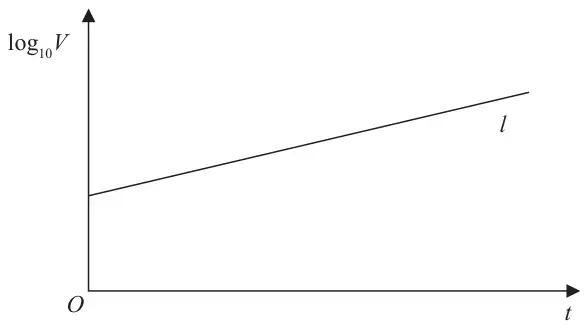
The value of a rare painting, £\(V\), is modelled by the equation \(V = pq^t\), where \(p\) and \(q\) are constants and \(t\) is the number of years since the value of the painting was first recorded on 1st January 1980.
The line \(l\) shown in Figure 3 illustrates the linear relationship between \(t\) and \(\log_{10} V\) since 1st January 1980.
The equation of line \(l\) is \(\log_{10} V = 0.05t + 4.8\)
(a) Find, to 4 significant figures, the value of \(p\) and the value of \(q\). (4)
(b) With reference to the model interpret
(i) the value of the constant \(p\),
(ii) the value of the constant \(q\). (2)
(c) Find the value of the painting, as predicted by the model, on 1st January 2010, giving your answer to the nearest hundred thousand pounds. (2)
Mark scheme (a)
Scheme
Marks
AO
For a correct equation in \(p\) or \(q\) \(p = 10^{4.8}\) or \(q = 10^{0.05}\)
M1
1.1b
For \(p =\) awrt 63100 or \(q =\) awrt 1.122
A1
1.1b
For correct equations in \(p\) and \(q\) \(p = 10^{4.8}\) and \(q = 10^{0.05}\)
dM1
3.1a
For \(p =\) awrt 63100 and \(q =\) awrt 1.122
A1
1.1b
(4)
Notes
(a) This is now being marked M1 A1 M1 A1 and in this order on e pen
M1: For a correct equation in \(p\) or \(q\) This is usually \(p = 10^{4.8}\) or \(q = 10^{0.05}\) but may be \(\log q = 0.05\) or \(\log p = 4.8\)
A1: For \(p =\) awrt 63100 or \(q =\) awrt 1.122
M1: For linking the two equations and forming correct equations in \(p\) and \(q\). This is usually \(p = 10^{4.8}\) and \(q = 10^{0.05}\) but may be \(\log q = 0.05\) and \(\log p = 4.8\)
A1: For \(p =\) awrt 63100 and \(q =\) awrt 1.122 Both these values implies M1 M1
ALT I(a)
M1: Substitutes \(t = 0\) and states that \(\log p = 4.8\)
A1: \(p =\) awrt 63100
M1: Uses their found value of \(p\) and another value of \(t\) to find form an equation in \(q\)
A1: \(p =\) awrt 63100 and \(q =\) awrt 1.122
Mark scheme (b)
Scheme
Marks
AO
(i) The value of the painting on 1st January 1980
B1
3.4
(ii) The proportional increase in value each year
B1
3.4
(2)
Notes
(b)(i)
B1: The value of the painting on 1st January 1980 (is £63 100) Accept the original value/cost of the painting or the initial value/cost of the painting
(b)(ii)
B1: The proportional increase in value each year. Eg Accept an explanation that explains that the value of the painting will rise 12.2% a year. (Follow through on their value of \(q\).) Accept "the rate" by which the value is rising/price is changing. "1.122 is the decimal multiplier representing the year on year increase in value" Do not accept "the amount" by which it is rising or "how much" it is rising by
If they are not labelled (b)(i) and (b)(ii) mark in the order given but accept any way around as long as clearly labelled " \(p\) is………… " and "\(q\) is ……………"
Mark scheme (c)
Scheme
Marks
AO
Uses \(V = 63100 \times 1.122^{30}\) or \(\log V = 0.05 \times 30 + 4.8\) leading to \(V =\)
M1
3.4
\(=\) awrt (£)2000000
A1
1.1b
(2)
(8 marks)
Notes
M1: For substituting \(t = 30\) into \(V = pq^t\) using their values for \(p\) and \(q\) or substituting \(t = 30\) into \(\log_{10} V = 0.05t + 4.8\) and proceeds to \(V\)
A1:For awrt either £1.99 million or £2.00 million. Condone the omission of the £ sign. Remember to isw after a correct answer
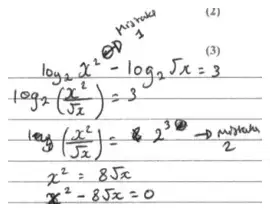
5. A student’s attempt to solve the equation \(2\log_{2} x - \log_{2}\sqrt{x} = 3\) is shown below.
\[\begin{array}{ll}2\log_{2} x - \log_{2}\sqrt{x} = 3 & \\[6pt]2\log_{2}\left(\dfrac{x}{\sqrt{x}}\right) = 3 & \qquad \text{using the subtraction law for logs} \\[6pt]2\log_{2}\left(\sqrt{x}\right) = 3 & \qquad \text{simplifying} \\[6pt]\log_{2} x = 3 & \qquad \text{using the power law for logs} \\[6pt]x = 3^2 = 9 & \qquad \text{using the definition of a log}\end{array}\]
(a) Identify two errors made by this student, giving a brief explanation of each. (2)
(b) Write out the correct solution. (3)
Mark scheme (a)
Scheme
Marks
AO
Identifies one of the two errors "You cannot use the subtraction law without dealing with the 2 first" " They undo the logs incorrectly. It should be \(x = 2^3 = 8\) "
B1
2.3
Identifies both errors. See above.
B1
2.3
(2)
Notes
B1: States one of the two errors. Error One: Either in words states ‘They cannot use the subtraction law without dealing with the 2 first’ or writes ‘that line 2 should be \(\log_{2}\left(\dfrac{x^2}{\sqrt{x}}\right)\) \((= 3)\)’ If they rewrite line two it must be correct. Allow ‘the coefficient of each log term is different so we cannot use the subtraction law’ Allow responses such as ‘it must be \(\log x^2\) before subtracting the logs’ Do not accept an incomplete response such as "the student ignored the 2". There must be some reference to the subtraction law as well. Error Two: Either in words states ‘They undo the log incorrectly’ or writes that ‘if \(\log_{2} x = 3\) then \(x = 2^3 = 8\)’ If it is rewritten it must be correct. Eg \(x = \log_{2} 9\) is B0
\(x^{\frac{3}{2}} = 2^3\) or \(\dfrac{x^2}{\sqrt{x}} = 2^3\)
M1
1.1b
\(x = \left(2^3\right)^{\frac{2}{3}} = 4\)
A1
1.1b
(3)
(5 marks)
Notes
Alternative
Scheme
Marks
\(\dfrac{3}{2}\log_{2}(x) = 3\)
M1
\(x = 2^2\)
M1
\(x = 4\)
A1
M1: Uses a correct method of combining the two log terms. Either uses both the power law and the subtraction law to reach a form \(\log_{2}\left(\dfrac{x^2}{\sqrt{x}}\right) = 3\) oe. Or uses both the power law and subtraction to reach \(\dfrac{3}{2}\log_{2}(x) = 3\)
M1: Uses correct work to "undo" the log. Eg moves from \(\log_{2}\left(Ax^n\right) = b \Rightarrow Ax^n = 2^b\) This is independent of the previous mark so allow following earlier error.
A1: cso \(x = 4\) achieved with at least one intermediate step shown. Extra solutions would be A0
SC: If the "answer" rather than the "solution" is given score 100.
(i) Find the value of \(y\) for which\[1.01^{y-1} = 500\]Give your answer to 2 decimal places. (2)
(ii) Given that\[2\log_4(3x + 5) = \log_4(3x + 8) + 1, \qquad x > -\frac{5}{3}\]
(a) show that\[9x^2 + 18x - 7 = 0\] (4)
(b) Hence solve the equation\[2\log_4(3x + 5) = \log_4(3x + 8) + 1, \qquad x > -\frac{5}{3}\] (2)
Mark scheme (i)
Scheme
Marks
Use of power rule so \((y - 1)\log 1.01 = \log 500\) or \((y - 1) = \log_{1.01} 500\)
M1
625.56
A1
(2)
Notes
M1: Applies power law of logarithms correctly or changes base (Allow missing brackets)
A1: Accept answers which round to 625.56 (This may follow 624.56 + 1 = or may follow \(y = \log_{1.01} 505\) or \(\dfrac{\log 505}{\log 1.01}\) or may appear with no working)
Mark scheme (ii)(a)
Scheme
Marks
Ignore labels (a) and (b) in part ii and mark work as seen
\(\log_4(3x + 5)^2 =\) Applies power law of logarithms
M1
Uses \(\log_4 4 = 1\) or \(4^1 = 4\)
M1
Uses quotient or product rule so e.g. \(\log(3x + 5)^2 = \log 4(3x + 8)\) or \(\log\dfrac{(3x + 5)^2}{(3x + 8)} = 1\)
M1
Obtains with no errors \(9x^2 + 18x - 7 = 0\) *
A1* cso
(4)
Notes
M1: Applies power law of logarithms \(2\log_4(3x + 5) = \log_4(3x + 5)^2\)
M1: Uses \(\log_4 4 = 1\) or \(4^1 = 4\)
M1: Applying the subtraction or addition law of logarithms correctly to make two log terms into one log term in \(x\) (*see note below)
A1cso: This is a given answer and needs a correct algebraic statement such as \(9x^2 + 30x + 25 = 4(3x + 8)\) followed by a conclusion, such as \(9x^2 + 18x - 7 = 0\)
*Special case: States \(\dfrac{\log(3x + 5)^2}{\log(3x + 8)} = \log\dfrac{(3x + 5)^2}{(3x + 8)} = 1\), loses the third M mark in part ii(a) and the A1 cso*
Mark scheme (ii)(b)
Scheme
Marks
Solves given or “their” quadratic equation by any of the standard methods
M1
Obtains \(x = \tfrac{1}{3}\) and \(-\tfrac{7}{3}\) and rejects \(-\tfrac{7}{3}\) to give just \(\tfrac{1}{3}\)
A1
(2)
[8]
Notes
M1: Solves by factorisation or by completion of the square or by correct use of formula (see general principles)
A1: Needs to find two answers and reject one to give the correct \(\tfrac{1}{3}\) (This may be indicated by underlining just the 1/3 for example).
(i) \[2\log(x + a) = \log(16a^6), \text{ where } a \text{ is a positive constant}\]
Find \(x\) in terms of \(a\), giving your answer in its simplest form.
(3)
(ii) \[\log_3(9y + b) - \log_3(2y - b) = 2, \text{ where } b \text{ is a positive constant}\]
Find \(y\) in terms of \(b\), giving your answer in its simplest form.
(4)
Mark scheme (i)
Scheme
Marks
Use of power rule so \(\log(x + a)^2 = \log 16a^6\) or \(2\log(x + a) = 2\log 4a^3\) or \(\log(x + a) = \log(16a^6)^{\frac{1}{2}}\)
M1
Removes logs and square roots, or halves then removes logs to give \((x + a) = 4a^3\) Or \(x^2 + 2ax + a^2 - 16a^6 = 0\) followed by factorisation or formula to give \(x = \sqrt{16a^6} - a\)
M1
\((x =)\ 4a^3 - a\) (depends on previous M’s and must be this expression or equivalent)
A1cao
(3)
Notes
1st M1: Applies power law of logarithms correctly to one side of the equation
M1: Correct log work in correct order. If they square and obtain a quadratic the algebra should be correct. The marks is for \(x + a = \sqrt{16a^6}\) isw so allow \(x + a = \pm 4a^3\) for Method mark. Also allow \(x + a = 4a^4\) or \(x + a = \pm 4a^{5.5}\) or even \(x + a = 16a^3\) as there is evidence of attempted square root. May see the correct \(x + a = 10^{(\log 4 + 3\log a)}\) so \(x = -a + 10^{(\log 4 + 3\log a)}\) which gains M1A0 unless followed by the answer in the scheme.
A1: Do not allow \(x = \pm 4a^3 - a\) for accuracy mark. You may see the factorised \(a(2a + 1)(2a - 1)\) o.e.
Mark scheme (ii)
Scheme
Marks
Way 1 \(\log_3 \dfrac{(9y + b)}{(2y - b)} = 2\) Applies quotient law of logarithms
\((9y + b) = 9(2y - b) \Rightarrow y =\) Multiplies across and makes \(y\) the subject
M1
\(y = \tfrac{10}{9}b\)
A1cso
(4)
Way 2 Or : \(\log_3(9y + b) = \log_3 9 + \log_3(2y - b)\) 2nd M mark
M1
\(\log_3(9y + b) = \log_3 9(2y - b)\) 1st M mark
M1
\((9y + b) = 9(2y - b) \Rightarrow y = \tfrac{10}{9}b\) Multiplies across and makes \(y\) the subject
M1 A1cso
(4)
[7]
Notes
M1: Applying the subtraction or addition law of logarithms correctly to make two log terms into one log term in \(y\)
M1: Uses \(\log_3 3^2 = 2\)
3rd M1: Obtains correct linear equation in \(y\) usually the one in the scheme and attempts \(y =\)
A1cso: \(y = \tfrac{10}{9}b\) or correct equivalent after completely correct work.
Special case: \(\dfrac{\log_3(9y + b)}{\log_3(2y - b)} = 2\) is M0 unless clearly crossed out and replaced by the correct \(\log_3 \dfrac{(9y + b)}{(2y - b)} = 2\) Candidates may then write \(\dfrac{(9y + b)}{(2y - b)} = 3^2\) and proceed to the correct answer – allow M0M1M1A0 as the answer requires a completely correct solution.
(a) Use the factor theorem to show that \((x + 3)\) is a factor of \(\mathrm{f}(x)\) (2)
(b) Factorise \(\mathrm{f}(x)\) completely. (4)
(c) Hence solve the equation\[6(2^{3y}) + 7(2^{2y}) = 40(2^y) + 21\]giving your answer to 2 decimal places. (3)
Mark scheme (a)
Scheme
Marks
Attempt \(\mathrm{f}(3)\) or \(\mathrm{f}(-3)\) Use of long division is M0A0 as factor theorem was required.
M1
\(\mathrm{f}(-3) = 162 - 63 - 120 + 21 = 0\) so \((x + 3)\) is a factor
A1
(2)
Notes
M1 for attempting either \(\mathrm{f}(3)\) or \(\mathrm{f}(-3)\) – with numbers substituted into expression
A1 for calculating \(\mathrm{f}(-3)\) correctly to 0, and they must state \((x + 3)\) is a factor for A1 (or equivalent ie. QED, \(\blacksquare\) or a tick). A conclusion may be implied by a preamble, “if \(\mathrm{f}(-3) = 0\), \((x+3)\) is a factor”. \(-6(-3)^3 - 7(-3)^2 + 40(-3) + 21 = 0\) so \((x + 3)\) is a factor of \(\mathrm{f}(x)\) is M1A1 providing bracketing is correct.
Or (Way 3) No working three factors \((x + 3)(-3x + 7)(2x + 1)\) otherwise need working
M1A1M1A1
(4)
Notes
1st M1: attempting to divide by \((x + 3)\) leading to a 3TQ beginning with the correct term, usually \(-6x^2\). This may be done by a variety of methods including long division, comparison of coefficients, inspection etc. Allow for work in part (a) if the result is used in (b).
1st A1: usually for \((-6x^2 + 11x + 7)\) … Credit when seen and use isw if miscopied
2nd M1: for a valid* attempt to factorise their quadratic (* see notes on page 6 - General Principles for Core Mathematics Marking section 1)
2nd A1 is cao and needs all three factors together fully factorised. Accept e.g. \(-3(x + 3)\left(x - \tfrac{7}{3}\right)(2x + 1)\) but \((x + 3)\left(x - \tfrac{7}{3}\right)(-6x - 3)\) and \((x + 3)(3x - 7)(-2x - 1)\) are A0 as not fully factorised. Ignore subsequent work (such as a solution to a quadratic equation.)
Way 2: The second M mark needs three roots together so \(\pm 6(x - \alpha)(x - \beta)(x + 3)\) or equivalent where they obtained \(\alpha\) and \(\beta\) by trial, so if correct roots identified, then \((x + 3)(3x - 7)(2x + 1)\) can gain M1A1M1A0.
N.B. Replacing \((-6x^2 + 11x + 7)\) (already awarded M1A1) by \((6x^2 - 11x - 7)\) giving \((x + 3)(3x - 7)(2x + 1)\) can have M1A0 for factorization so M1A1M1A0
Mark scheme (c)
Scheme
Marks
\(2^y = \tfrac{7}{3}, \ \to\ \log\left(2^y\right) = \log\left(\dfrac{7}{3}\right)\) or \(y = \log_2\left(\tfrac{7}{3}\right)\) or \(\dfrac{\log(7/3)}{\log 2}\)
B1, M1
\(\{y = 1.222392421\ldots\} \Rightarrow y =\) awrt 1.22
A1
(3)
[9]
Notes
B1: \(2^y = \tfrac{7}{3}\)
M1: Attempt to take logs to solve \(2^y = \alpha\) or \(2^y = 1/\alpha\), where \(\alpha > 0\) and \(\alpha\) was a root of their factorization.
A1: for an answer that rounds to 1.22. If other answers are included (and not “rejected”) such as \(\ln(-3)\) or \(-1\) lose final A mark
Special case: Those who deal throughout with \(\mathrm{f}(x) = 6x^3 + 7x^2 - 40x - 21\) They may have full credit in part (a). In part (b) they can achieve a maximum of M1A0M1A0 unless they return the negative sign to give the correct answer. This is then full marks. Part (c) is fine. So they could lose 2 marks on the factorisation. (Like a misread)
(i) Given that\[\log_3(3b + 1) - \log_3(a - 2) = -1, \qquad a \gt 2\]express \(b\) in terms of \(a\). (3)
(ii) Solve the equation\[2^{2x+5} - 7(2^x) = 0\]giving your answer to 2 decimal places. (Solutions based entirely on graphical or numerical methods are not acceptable.) (4)
Mark scheme (i)
Scheme
Marks
Two Ways of answering the question are given in part (i)
Way 1 \(\log_3\left(\dfrac{3b + 1}{a - 2}\right) = -1\) or \(\log_3\left(\dfrac{a - 2}{3b + 1}\right) = 1\) Applying the subtraction law of logarithms
M1
\(\dfrac{3b + 1}{a - 2} = 3^{-1}\ \left\{= \dfrac{1}{3}\right\}\) or \(\left(\dfrac{a - 2}{3b + 1}\right) = 3\) Making a correct connection between log base 3 and 3 to a power.
M1
\(\{9b + 3 = a - 2 \Rightarrow\}\ b = \dfrac{1}{9}a - \dfrac{5}{9}\) \(b = \dfrac{1}{9}a - \dfrac{5}{9}\) or \(b = \dfrac{a - 5}{9}\)
A1 oe
(3)
Notes
(i) Way 2
In Way 2 a correct connection between log base 3 and “3 to a power” is used before applying the subtraction or addition law of logs
1st M1 Applying either the addition or subtraction law of logarithms correctly to combine any two log terms into one log term.
2nd M1 For making a correct connection between log base 3 and 3 to a power.
A1 \(b = \dfrac{1}{9}a - \dfrac{5}{9}\) or \(b = \dfrac{a - 5}{9}\) o.e. e.g. Accept \(b = \dfrac{1}{3}\left(\dfrac{a}{3} - \dfrac{5}{3}\right)\) but not \(b = \dfrac{a - 2}{9} - \dfrac{3}{9}\) nor \(b = \dfrac{\left(\frac{a}{3} - \frac{5}{3}\right)}{3}\)
Special Case in (i) Writes \(\dfrac{\log_3(3b + 1)}{\log_3(a - 2)} = -1\) and proceeds to \(\dfrac{3b + 1}{a - 2} = 3^{-1}\ \left\{= \dfrac{1}{3}\right\}\) and to correct answer- Give M0M1A1 (special case)
Mark scheme (ii)
Scheme
Marks
Five Ways of answering the question are given in part (ii)
Way 1 (See also common approach below in notes) \(32(2^{2x}) - 7(2^x) = 0\) Deals with power 5 correctly giving \(\times 32\)
M1
So, \(2^x = \dfrac{7}{32}\) \(2^x = \dfrac{7}{32}\) or \(y = \dfrac{7}{32}\) or awrt 0.219
A1 oe
\(x\log 2 = \log\left(\dfrac{7}{32}\right)\) or \(x = \dfrac{\log\left(\frac{7}{32}\right)}{\log 2}\) or \(x = \log_2\left(\dfrac{7}{32}\right)\) A valid method for solving \(2^x = \tfrac{7}{32}\) Or \(2^x = k\) to achieve \(x = \ldots\)
dM1
\(x = -2.192645\ldots\) awrt \(-2.19\)
A1
(4)
7
Notes
Begins with \(2^{2x+5} = 7(2^x)\) (for Way 2 and Way 3) (see notes below)
(ii) Way 2
Scheme
Marks
\((2x + 5)\log 2 = \log 7 + x\log 2\) Correct application of either the power law or addition law of logarithms Correct result after applying the power and addition laws of logarithms.
\(2x - x = \log_2 7 - 5\) \(\Rightarrow x = \log_2 7 - 5\) Collects \(x\) terms to achieve \(x = \ldots\)
dM1
\(x = -2.192645\ldots\) awrt \(-2.19\)
A1
(4)
1st M1 First step towards solution – an equation with one side or other correct or one term dealt with correctly (see five* possible methods above)
1st A1 Completely correct first step – giving a correct equation as shown above
dM1 Correct complete method (all log work correct) and working to reach \(x =\) in terms of logs reaching a correct expression or one where the only errors are slips solving linear equations
2nd A1 Accept answers which round to -2.19 If a second answer is also given this becomes A0
Common approach to part (ii) Let \(2^x = y\) Treat this as Way 1 They get \(32y^2 - 7y = 0\) for M1 and need to reach \(y = \dfrac{7}{32}\) for A1 Then back to Way 1 as before. Any letter may be used for the new variable which I have called \(y\). If they use \(x\) and obtain \(x = \dfrac{7}{32}\), this may be awarded M1A0M0A0 Those who get \(y^2 - 7y + 32 = 0\) or \(y^7 - 7y = 0\) will be awarded M0,A0,M0,A0
Common Presentation of Work in iiMany begin with \(\log\left(2^{2x+5}\right) - \log\left(7(2^x)\right) = 0\). It is possible to reach this in two stages correctly so do not penalise this and award the full marks if they continue correctly as in Way 2. If however the solution continues with \((2x+5)\log 2 - x\log 14 = 0\) or with \((2x+5)\log 2 - 7x\log 2 = 0\) (both incorrect) then they are awarded M1A0M0A0 just getting credit for the \((2x + 5)\log 2\) term.
Note N.B. The answer (+)2.19 results from “algebraic errors solving linear equations” leading to \(2^x = \tfrac{32}{7}\) and gets M1A0M1A0
\(\log_2\dfrac{(11y - 3)}{3y^2} = \log_2 2\) or \(\log_2\dfrac{(11y - 3)}{y^2} = \log_2 6\) (allow awrt 6 if replaced by 6 later)
B1
Obtains \(6y^2 - 11y + 3 = 0\) o.e. i.e. \(6y^2 = 11y - 3\) for example
A1
Solves quadratic to give \(y =\)
ddM1
\(y = \tfrac{1}{3}\) and \(\tfrac{3}{2}\) (need both- one should not be rejected)
A1
(6)
[9]
Notes
(corrected from the printed mark scheme, which gives \(1 + \log_2 3 = 2.58496501\) in the second row)
M1: Applies power law of logarithms replacing \(2\log_2 y\) by \(\log_2 y^2\)
dM1: Applies quotient or product law of logarithms correctly to the three log terms including term in \(y^2\). (dependent on first M mark) or applies quotient rule to two terms and collects constants (allow “triple” fractions) \(1 + \log_2 3\) on RHS is not sufficient – need \(\log_2 6\) or 2.58… e.g. \(\log_2(11y - 3) = \log_2 3 + \log_2 y^2 + \log_2 2\) becoming \(\log_2(11y - 3) = \log_2 6y^2\)
B1: States or uses \(\log_2 2 = 1\) or \(2^1 = 2\) at any point in the answer so may be given for \(\log_2(11y - 3) - \log_2 3 - 2\log_2 y = \log_2 2\) or for \(\dfrac{(11y - 3)}{3y^2} = 2\), for example (Sometimes this mark will be awarded before the second M mark, and it is possible to score M1M0B1in some cases) Or may be given for \(\log_2 6 = 2.584962501..\) or \(2^{2.584962501..} = 6\)
A1: This or equivalent quadratic equation (does not need to be in this form but should be equation)
ddM1: (dependent on the two previous M marks) Solves their quadratic equation following reasonable log work using factorising, completion of square, formula or implied by both answers correct.
A1: Any equivalent correct form – need both answers- allow awrt 0.333 for the answer 1/3 *NB: If “=0” is missing from the equation but candidate continues correctly and obtains correct answers then allow the penultimate A1 to be implied (Allow use of \(x\) or other varable instead of \(y\) throughout)
M1: Applies the power law of logarithms seen at any point in their working
M1: Applies the subtraction or addition law of logarithms at any point in their working
M1: Obtains a correct expression with logs removed and no errors
A1: Correct three term quadratic in any form
dddM1: A valid attempt to factorise or solve their three term quadratic to obtain \(\sqrt{x} = \ldots\) or \(x = \ldots\) Dependent on all previous method marks.
A1:Both \(x = 1\) and \(x = 225\) (If both are seen, ignore any other values of \(x \leqslant 0\) from an otherwise correct solution)
Alternative:
Scheme
Marks
\(2\log_2(x + 15) - 8 = \log_2 x\)
\(\log_2(x + 15)^2 - 8 = \log_2 x\) Applies the power law of logarithms
M1
\(\log_2\left(\dfrac{(x + 15)^2}{x}\right) = 8\) Applies the subtraction law of logarithms
M1
\(\dfrac{(x + 15)^2}{x} = 2^8\) Obtains a correct expression with logs removed
M1
\(x^2 + 30x + 225 = 256x\)
\(x^2 - 226x + 225 = 0\) Correct three term quadratic in any form
A1
\((x - 1)(x - 225) = 0 \Rightarrow x = \ldots\) A valid attempt to factorise or solve their 3TQ to obtain \(x = \ldots\) Dependent on all previous method marks.
dddM1
\(x = 1, 225\) Both \(x = 1\) and \(x = 225\) (If both are seen, ignore any other values of \(x \leqslant 0\) from an otherwise correct solution)
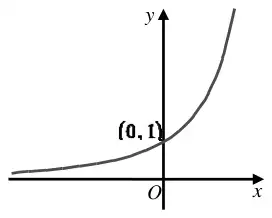
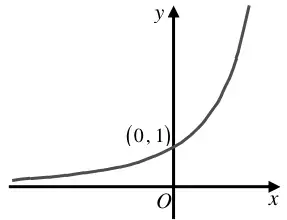
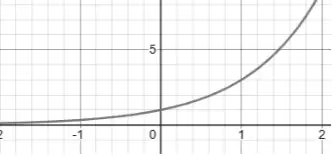
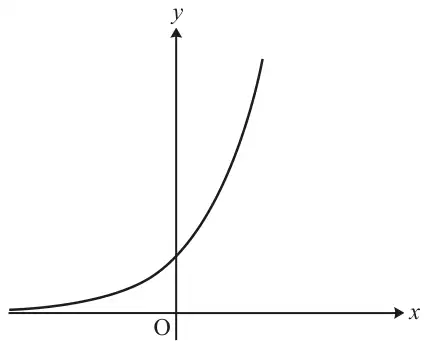
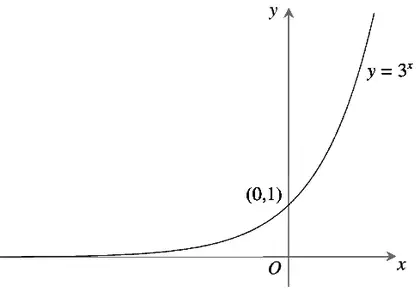
(a) Sketch the graph of\[y = 3^x, \quad x \in \mathbb{R}\]showing the coordinates of any points at which the graph crosses the axes. (2)
(b) Use algebra to solve the equation\[3^{2x} - 9(3^x) + 18 = 0\]giving your answers to 2 decimal places where appropriate. (5)
Mark scheme (a)
Scheme
Marks
Graph of \(y = 3^x\) and solving \(3^{2x} - 9(3^x) + 18 = 0\)
At least two of the three criteria correct. (See notes below.)
B1
All three criteria correct. (See notes below.)
B1
(2)
Notes
Criteria number 1: Correct shape of curve for \(x \geqslant 0\) and at least touches the positive \(y\)-axis.
Criteria number 2: Correct shape of curve for \(x \lt 0\). Must not touch the \(x\)-axis or have any turning points.
Criteria number 3: \((0, 1)\) stated or in a table or 1 marked on the \(y\)-axis. Allow \((1, 0)\) rather than \((0, 1)\) if marked in the “correct” place on the \(y\)-axis.
\(\{3^x = 6 \Rightarrow\}\ x\log 3 = \log 6\) or \(x = \dfrac{\log 6}{\log 3}\) or \(x = \log_3 6\)
dM1
\(x = 1.63092\ldots\)
A1cso
Provided the first M1A1 is scored, the second M1A1 can be implied by awrt 1.63
\(x = 1\)
B1
(5)
Total 7
Notes
M1: Forms a quadratic of the correct form in \(3^x\) or in “\(y\)” where “\(y\)” \(= 3^x\) or even in \(x\) where “\(x\)” \(= 3^x\)
A1:Both \(y = 6\) and \(y = 3\).
dM1: A valid method for solving \(3^x = k\) where \(k \gt 0, k \neq 1, k \neq 3\) to give either \(x\log 3 = \log k\) or \(x = \dfrac{\log k}{\log 3}\) or \(x = \log_3 k\).
A1cso: awrt 1.63
B1: \(x = 1\) stated as a solution from any working.
\(7y + 1 = 2xy\) (Remove logs to obtain this equation or equivalent.)
M1
\(2yx = 7y + 1 \Rightarrow y(2x - 7) = 1\) (Isolate \(y\) correctly to give \(y\) as a function of \(x\). Allow sign errors only. Dependent on the previous method mark.)
dM1
\(y = \dfrac{1}{2x - 7}\) or \(\dfrac{-1}{7 - 2x}\) (cao)
If \(x = -2.498\) appears as well or instead this is A0
Method 1: M1: Uses (a) and (b) results to form an equation in \(a\) (may not be linear) A1: \(a =\) awrt 0.833 M1: Finds \(x\) by use of 3 to a power, or change of base performed correctly A1: \(x = 2.498\) (accept answer which round to this value from 2.498049533…)
Method 2: M1: Use of \(\log(ab) = \log(a) + \log(b)\) in an equation (RHS may be wrong) A1: Equation correct and simplified M1: Tries to undo log by 3 to power correctly, and uses root to obtain \(x\) A1: \(x = 2.498\) (accept answer which round to this value from 2.498049533…) Lose this mark if negative answer is given as well as or instead of positive answer.
(i) Find the exact value of \(x\) for which\[\log_2(2x) = \log_2(5x + 4) - 3\] (4)
(ii) Given that\[\log_a y + 3\log_a 2 = 5\]express \(y\) in terms of \(a\). Give your answer in its simplest form. (3)
Mark scheme (i)
Scheme
Marks
Method 1
\(\log_2\left(\dfrac{2x}{5x + 4}\right) = -3\) or \(\log_2\left(\dfrac{5x + 4}{2x}\right) = 3\), or \(\log_2\left(\dfrac{5x + 4}{x}\right) = 4\) (see special case 2)
M1
\(\left(\dfrac{2x}{5x + 4}\right) = 2^{-3}\) or \(\left(\dfrac{5x + 4}{2x}\right) = 2^3\) or \(\left(\dfrac{5x + 4}{x}\right) = 2^4\) or \(\left(\log_2\left(\dfrac{2x}{5x + 4}\right)\right) = \log_2\left(\dfrac{1}{8}\right)\)
M1
\(16x = 5x + 4 \Rightarrow x =\) (depends on previous Ms and must be this equation or equivalent)
dM1
\(x = \dfrac{4}{11}\) or exact recurring decimal \(0.\dot{3}\dot{6}\) after correct work
A1 cso
(4)
Method 2
Scheme
Marks
\(\log_2(2x) + 3 = \log_2(5x + 4)\)
So \(\log_2(2x) + \log_2(8) = \log_2(5x + 4)\) (3 replaced by \(\log_2 8\))
2nd M1
Then \(\log_2(16x) = \log_2(5x + 4)\) (addition law of logs)
1st M1
Then final M1 A1 as before
dM1A1
Notes
1st M1: Applying the subtraction or addition law of logarithms correctly to make two log terms in \(x\) into one log term in \(x\)
2nd M1: For RHS of either \(2^{-3}\), \(2^3\), \(2^4\) or \(\log_2\left(\dfrac{1}{8}\right)\), \(\log_2 8\) or \(\log_2 16\) i.e. using connection between log base 2 and 2 to a power. This may follow an earlier error. Use of \(3^2\) is M0
3rd dM1: Obtains correct linear equation in \(x\). usually the one in the scheme and attempts \(x =\)
A1: cso Answer of 4/11 with no suspect log work preceding this.
Special case 1: \(\log_2(2x) = \log_2(5x + 4) - 3 \Rightarrow \dfrac{\log_2(2x)}{\log_2(5x + 4)} = -3 \Rightarrow \dfrac{2x}{5x + 4} = 2^{-3} \Rightarrow x = \dfrac{4}{11}\) or \(\log_2(2x) = \log_2(5x + 4) - 3 \Rightarrow \dfrac{\log_2(2x)}{\log_2(5x + 4)} = -3 \Rightarrow \log_2\dfrac{2x}{5x + 4} = -3 \Rightarrow \dfrac{2x}{5x + 4} = 2^{-3} \Rightarrow x = \dfrac{4}{11}\) each attempt scores M0M1M1A0 – special case
Special case 2: \(\log_2(2x) = \log_2(5x + 4) - 3 \Rightarrow \log_2 2 + \log_2 x = \log_2(5x + 4) - 3\), is M0 until the two log terms are combined to give \(\log_2\left(\dfrac{5x + 4}{x}\right) = 3 + \log_2 2\). This earns M1 Then \(\left(\dfrac{5x + 4}{x}\right) = 2^4\) or \(\log_2\left(\dfrac{5x + 4}{x}\right) = \log_2 2^4\) gets second M1. Then scheme as before.
Mark scheme (ii)
Scheme
Marks
\(\log_a y + \log_a 2^3 = 5\)
M1
\(\log_a 8y = 5\) Applies product law of logarithms.
dM1
\(y = \dfrac{1}{8}a^5\)
A1cao
(3)
[7]
Notes
M1: Applies power law of logarithms to replace \(3\log_a 2\) by \(\log_a 2^3\) or \(\log_a 8\)
dM1: (should not be following M0) Uses addition law of logs to give \(\log_a 2^3 y = 5\) or \(\log_a 8y = 5\)
Or (Way 3): \(\left(2x^3 - 5x^2 + ax + 18\right) \div (x - 3) = 2x^2 + px + q\) where \(p\) is a number and \(q\) is an expression in terms of \(a\)
M1
Sets the remainder \(18 + 3a + 9 = 0\) and solves to give \(a = -9\)
A1* cso
(2)
Notes
M1 for attempting either \(\mathrm{f}(3)\) or \(\mathrm{f}(-3)\) – with numbers substituted into expression
A1 for applying \(\mathrm{f}(3)\) correctly, setting the result equal to 0, and manipulating this correctly to give the result given on the paper i.e. \(a = -9\). (Do not accept \(\boldsymbol{x} = -9\)) Note that the answer is given in part (a). If they assume \(a = -9\) and verify by factor theorem or division they must state \((x - 3)\) is a factor for A1 (or equivalent such as QED or a tick).
Mark scheme (b)
Scheme
Marks
Either (Way 1): \(\mathrm{f}(x) = (x - 3)(2x^2 + x - 6)\)
M1A1
\(= (x - 3)(2x - 3)(x + 2)\)
M1A1
(4)
Way 2
Scheme
Marks
Or (Way 2) Uses trial or factor theorem to obtain \(x = -2\) or \(x = 3/2\)
M1
Uses trial or factor theorem to obtain both \(x = -2\) and \(x = 3/2\)
Or (Way 3) No working three factors \((x - 3)(2x - 3)(x + 2)\) otherwise need working
M1A1M1A1
Notes
1st M1: attempting to divide by \((x - 3)\) leading to a 3TQ beginning with the correct term, usually \(2x^2\). (Could divide by \((3 - x)\), in which case the quadratic would begin \(-2x^2\).) This may be done by a variety of methods including long division, comparison of coefficients, inspection etc.
1st A1: usually for \(2x^2 + x - 6\) … Credit when seen and use isw if miscopied
2nd M1: for a valid* attempt to factorise their quadratic (* see notes on page 6 - General Principles for Core Mathematics Marking section 1)
2nd A1 is cao and needs all three factors together. Ignore subsequent work (such as a solution to a quadratic equation.)
NB: \((x - 3)(x - \tfrac{3}{2})(x + 2)\) is M1A1M0A0, \((x - 3)(x - \tfrac{3}{2})(2x + 4)\) is M1A1M1A0, but \(2(x - 3)(x - \tfrac{3}{2})(x + 2)\) is M1A1M1A1.
\(\{y = 0.3690702\ldots\} \Rightarrow y =\) awrt 0.37
A1
(3)
[9]
Notes
B1: \(\underline{y = 1}\) seen as a solution – may be spotted as answer – no working needed. Allow also for \(\mathrm{g}(1) = 0\).
M1: Attempt to take logs to solve \(3^y = \alpha\) or even \(3^{ky} = \alpha\), but not \(6^y = \alpha\) where \(\alpha > 0\) and \(\alpha \neq 3\) & was a root of \(\mathrm{f}(x) = 0\) (ft their factorization)
A1: for an answer that rounds to 0.37. If a third answer is included (and not “rejected”) such as ln(-2) lose final A mark
Solves \(x^2 - 9x + 18 = 0\) to give \(x = \ldots\)
M1
\(x = 3,\ x = 6\)
A1
Total 5
Notes
B1 for this correct use of power rule (may be implied)
M1: for correct use of subtraction rule (or addition rule) for logs N.B. \(2\log_3 x - \log_3(x - 2) = 2\log_3 \dfrac{x}{x - 2}\) is M0
A1. for correct equation without logs (Allow any correct equivalent including \(3^2\) instead of 9.)
M1 for attempting to solve \(x^2 - 9x + 18 = 0\) to give \(x =\) (see notes on marking quadratics) A1 for these two correct answers
Alternative Method
\(\log_3 x^2 = 2 + \log_3(x - 2)\) is B1, so \(x^2 = 3^{2 + \log_3(x - 2)}\) needs to be followed by \((x^2) = 9(x - 2)\) for M1 A1 Here M1 is for complete method i.e.correct use of powers after logs are used correctly
Common Slips
\(2\log x - \log x + \log 2 = 2\) may obtain B1 if \(\log x^2\) appears but the statement is M0 and so leads to no further marks
\(2\log_3 x - \log_3(x - 2) = 2\) so \(\log_3 x - \log_3(x - 2) = 1\) and \(\log_3 \dfrac{x}{x - 2} = 1\) can earn M1 for correct subtraction rule following error, but no other marks
Special Case
\(\dfrac{\log x^2}{\log(x - 2)} = 2\) leading to \(\dfrac{x^2}{x - 2} = 9\) and then to \(x = 3\), \(x = 6\), usually earns B1M0A0, but may then earn M1A1 (special case) so 3/5 [ This recovery after uncorrected error is very common]
Trial and error, Use of a table or just stating answer with both \(x = 3\) and \(x = 6\) should be awarded B0M0A0 then final M1A1 i.e. 2/5
(b) Hence, or otherwise, solve the equation\[1 + 2\log_3 x = \log_3(28x - 9)\] (3)
Mark scheme (a)
Scheme
Marks
\(\log_3 3x^2 = \log_3 3 + \log_3 x^2\) or \(\log y - \log x^2 = \log 3\) or \(\log y - \log 3 = \log x^2\)
B1
\(\log_3 x^2 = 2\log_3 x\)
B1
Using \(\log_3 3 = 1\)
B1
(3)
Notes
B1 for correct use of addition rule (or correct use of subtraction rule)
B1: replacing \(\log x^2\) by \(2\log x\) – not \(\log 3x^2\) by \(2\log 3x\) this is B0
These first two B marks are often earned in the first line of working
B1. for replacing \(\log 3\) by 1 (or use of \(3^1 = 3\))
If candidate has been awarded 3 marks and their proof includes an error or omission of reference to \(\log y\) withhold the last mark. So just B1 B1 B0
These marks must be awarded for work in part (a) only
Mark scheme (b)
Scheme
Marks
\(3x^2 = 28x - 9\)
M1
Solves \(3x^2 - 28x + 9 = 0\) to give \(x = \tfrac{1}{3}\) or \(x = 9\)
M1 A1
(3)
6
Notes
M1 for removing logs to get an equation in \(x\)– statement in scheme is sufficient. This needs to be accurate without any errors seen in part (b).
M1 for attempting to solve three term quadratic to give \(x =\) (see notes on marking quadratics)
A1 for the two correct answers – this depends on second M mark only.
Candidates often begin again in part (b) and do not use part (a). If such candidates make errors in log work in part (b) they score first M0. The second M and the A are earned as before. It is possible to get M0M1A1 or M0M1A0.
Alternative to (b) using \(y\)
Eliminates \(x\) to give \(3y^2 - 730y + 243 = 0\) with no errors is M1 Solves quadratic to find \(y\), then uses values to find \(x\) M1 A1 as before
See extra sheet with examples illustrating the scheme.
3. Find, giving your answer to 3 significant figures where appropriate, the value of \(x\) for which
(a) \(5^x = 10\), (2)
(b) \(\log_3(x - 2) = -1\). (2)
Mark scheme (a)
Scheme
Marks
(a) \(5^x = 10\) and (b) \(\log_3(x - 2) = -1\)
\(x = \dfrac{\log 10}{\log 5}\) or \(x = \log_5 10\)
M1
\(x\ \{= 1.430676558\ldots\} = 1.43\) (3 sf) 1.43
A1 cao
[2]
Notes
M1: for \(x = \dfrac{\log 10}{\log 5}\) or \(x = \log_5 10\). Also allow M1 for \(x = \dfrac{1}{\log 5}\)
1.43 with no working (or any working) scores M1A1 (even if left as \(5^{1.43}\)). Other answers which round to 1.4 with no working score M1A0.
Trial & Improvement Method: M1: For a method of trial and improvement by trialing \(\mathrm{f}(\text{value between } 1.4 \text{ and } 1.43) = \text{Value below } 10\) and \(\mathrm{f}(\text{value between } 1.431 \text{ and } 1.5) = \text{Value over } 10\). A1 for 1.43 cao.
Note: \(x = \log_{10} 5\) by itself is M0; but \(x = \log_{10} 5\) followed by \(x = 1.430676558\ldots\) is M1.
(a) Sketch the graph of \(y = 7^x\), \(x \in \mathbb{R}\), showing the coordinates of any points at which the graph crosses the axes. (2)
(b) Solve the equation\[7^{2x} - 4\left(7^x\right) + 3 = 0\]giving your answers to 2 decimal places where appropriate. (6)
Mark scheme (a)
Scheme
Marks
Graph of \(y = 7^x\), \(x \in \mathbb{R}\) and solving \(7^{2x} - 4\left(7^x\right) + 3 = 0\)
At least two of the three criteria correct. (See notes below.)
B1
All three criteria correct. (See notes below.)
B1
(2)
Notes
B1B0: Any two of the following three criteria below correct. B1B1: All three criteria correct.
Criteria number 1: Correct shape of curve for \(x \geqslant 0\). Criteria number 2: Correct shape of curve for \(x \lt 0\). Criteria number 3: \((0, 1)\) stated or 1 marked on the \(y\)-axis. Allow \((1, 0)\) rather than \((0, 1)\) if marked in the “correct” place on the \(y\)-axis.
\(y = 3,\ y = 1\) or \(7^x = 3,\ 7^x = 1\) Both \(y = 3\) and \(y = 1\).
A1
\(\left\{7^x = 3 \Rightarrow\right\}\ x\log 7 = \log 3\) or \(x = \dfrac{\log 3}{\log 7}\) or \(x = \log_7 3\) A valid method for solving \(7^x = k\) where \(k \gt 0,\ k \ne 1\)
dM1
\(x = 0.5645\ldots\) 0.565 or awrt 0.56
A1
\(x = 0\) \(x = 0\) stated as a solution.
B1
(6)
[8]
Notes
1st M1 is an attempt to form a quadratic equation {using “\(y\)” \(= 7^x\).}
1st A1 mark is for the correct quadratic equation of \(y^2 - 4y + 3\ \{= 0\}\). Can use any variable here, eg: \(y, x\) or \(7^x\). Allow M1A1 for \(x^2 - 4x + 3\ \{= 0\}\). Writing \(\left(7^x\right)^2 - 4\left(7^x\right) + 3 = 0\) is also sufficient for M1A1. Award M0A0 for seeing \(7^{x^2} - 4\left(7^x\right) + 3 = 0\) by itself without seeing \(y^2 - 4y + 3\ \{= 0\}\) or \(\left(7^x\right)^2 - 4\left(7^x\right) + 3 = 0\).
1st A1 mark for both \(y = 3\) and \(y = 1\) or both \(7^x = 3\) and \(7^x = 1\). Do not give this accuracy mark for both \(x = 3\) and \(x = 1\), unless these are recovered in later working by candidate applying logarithms on these. Award M1A1A1 for \(7^x = 3\) and \(7^x = 1\) written down with no earlier working.
3rd dM1 for solving \(7^x = k,\ k \gt 0,\ k \ne 1\) to give either \(x\ln 7 = \ln k\) or \(x = \dfrac{\ln k}{\ln 7}\) or \(x = \log_7 k\). dM1 is dependent upon the award of M1.
2nd A1 for 0.565 or awrt 0.56. B1 is for the solution of \(x = 0\), from any working.
Alternative (b): Method of trial and improvement
Helpful table:
\(x\)
\(y = 7^{2x} - 4\left(7^x\right) + 3\)
0
0
0.1
-0.38348
0.2
-0.72519
0.3
-0.95706
0.4
-0.96835
0.5
-0.58301
0.51
-0.51316
0.52
-0.43638
0.53
-0.3523
0.54
-0.26055
0.55
-0.16074
0.56
-0.05247
0.561
-0.04116
0.562
-0.02976
0.563
-0.01828
0.564
-0.0067
0.565
0.00497
0.57
0.064688
0.58
0.19118
0.59
0.327466
0.6
0.474029
0.7
2.62723
0.8
6.525565
0.9
13.15414
1
24
Scheme
Marks
For a full method of trial and improvement by trialing \(\mathrm{f}(\text{value between } 0.1 \text{ and } 0.5645) = \text{value}\) and \(\mathrm{f}(\text{value between } 0.5645 \text{ and } 1) = \text{value}\)
M1
Any one of these values correct to 1sf or truncated 1sf.
A1
Both of these values correct to 1sf or truncated 1sf.
A1
A method to confirm root to 2 dp by finding by trialing \(\mathrm{f}(\text{value between } 0.56 \text{ and } 0.5645) = \text{value}\) and \(\mathrm{f}(\text{value between } 0.5645 \text{ and } 0.565) = \text{value}\)
M1
Both values correct to 1sf or truncated 1sf and the confirmation that the root is \(x = 0.56\) (only)
A1
\(x = 0\)
B1
(6)
Note: If a candidate goes from \(7^x = 3\) with no working to \(x = 0.5645\ldots\) then give M1A1 implied.
2nd M: After the first mistake above, this mark is available only if there is ‘recovery’ to the required \(\log_3\left(\dfrac{P}{Q}\right) = 1 \Rightarrow P = 3Q\) . Even then the final mark (cso) is lost.
‘Cancelling logs’, e.g. \(\dfrac{\log_3(x - 5)^2}{\log_3(2x - 13)} = \dfrac{(x - 5)^2}{2x - 13}\) will also lose the 2nd M.
A typical wrong solution:\[\log_3 \frac{(x - 5)^2}{2x - 13} = 1\ \Rightarrow\ \underbrace{\log_3 \frac{(x - 5)^2}{2x - 13} = 3}_{\text{(Wrong step here)}}\ \Rightarrow\ \frac{(x - 5)^2}{2x - 13} = 3\ \Rightarrow\ (x - 5)^2 = 3(2x - 13)\]This, with no evidence elsewhere of \(\log_3 3 = 1\), scores B1 M1 B0 M0 A0 However, \(\log_3 \dfrac{(x - 5)^2}{2x - 13} = 1 \Rightarrow \dfrac{(x - 5)^2}{2x - 13} = 3\) is correct and could lead to full marks. (Here \(\log_3 3 = 1\) is implied).
No log methods shown: It is not acceptable to jump immediately to \(\dfrac{(x - 5)^2}{2x - 13} = 3\). The only mark this scores is the 1st B1 (by generous implication).
Mark scheme (b)
Scheme
Marks
(b) \((x - 8)(x - 8) = 0\quad\Rightarrow\quad x = 8\) Must be seen in part (b). Or: Substitute \(x = 8\) into original equation and verify. Having additional solution(s) such as \(x = -8\) loses the A mark. \(x = 8\) with no working scores both marks.
M1 A1
(2)
7
Notes
(b) M1: Attempt to solve the given quadratic equation (usual rules), so the factors \((x - 8)(x - 8)\) with no solution is M0.
M1 for getting out of logs A1 Do not need to see \(x\) = -8 appear and get rejected. Ignore \(x\) = -8 as extra solution. \(x\)= 8 with no working is M1 A1
Alternatives
Change base : (i) \(\dfrac{\log_2 64}{\log_2 x} = 2\), so \(\log_2 x = 3\) and \(x = 2^3\), is M1 or (ii) \(\dfrac{\log_{10} 64}{\log_{10} x} = 2\), \(\log x = \tfrac{1}{2}\log 64\) so \(x = 64^{\frac{1}{2}}\) is M1 then \(x = 8\) is A1 BUT \(\log x = 0.903\) so \(x = 8\) is M1A0 (loses accuracy mark) (iii) \(\log_{64} x = \tfrac{1}{2}\) so \(x = 64^{\frac{1}{2}}\) is M1 then \(x = 8\) is A1
\(\{11 - 6x = 8\left(x^2 - 2x + 1\right)\}\) and so \(0 = 8x^2 - 10x - 3\)
A1
\(0 = (4x + 1)(2x - 3)\quad\Rightarrow x = \ldots\)
dM1
\(x = \dfrac{3}{2},\left[-\dfrac{1}{4}\right]\)
A1
(6)
[8]
Notes
1st M1 for using the \(n\)log\(x\) rule 2nd M1 for using the log\(x\) - log\(y\) rule or the log\(x\) + log\(y\) rule as appropriate 3rd M1 for using 2 to the power– need to see \(2^3\) or 8 (May see \(3 = \log_2 8\) used) If all three M marks have been earned and logs are still present in equation do not give final M1. So solution stopping at \(\log_2\left[\dfrac{11 - 6x}{(x - 1)^2}\right] = \log_2 8\) would earn M1M1M0 1st A1 for a correct 3TQ 4th dependent M1 for attempt to solve or factorize their 3TQ to obtain \(x\) =… (mark depends on three previous M marks) 2nd A1 for 1.5 (ignore -0.25) s.c 1.5 only – no working – is 0 marks
(a) Find the value of \(y\) such that\[\log_2 y = -3\] (2)
(b) Find the values of \(x\) such that\[\frac{\log_2 32 + \log_2 16}{\log_2 x} = \log_2 x\] (5)
Mark scheme (a)
Scheme
Marks
\(\log_2 y = -3\quad\Rightarrow\quad y = 2^{-3}\)
M1
\(y = \tfrac{1}{8}\) or 0.125
A1
(2)
Notes
M1 for getting out of logs correctly. If done by change of base, \(\log_{10} y = -0.903\ldots\) is insufficient for the M1, but \(y = 10^{-0.903}\) scores M1. A1 for the exact answer, e.g. \(\log_{10} y = -0.903 \Rightarrow y = 0.12502..\) scores M1 (implied) A0. Correct answer with no working scores both marks. Allow both marks for implicit statements such as \(\log_2 0.125 = -3\).
Mark scheme (b)
Scheme
Marks
\(32 = 2^5\) or \(16 = 2^4\) or \(512 = 2^9\) [or \(\log_2 32 = 5\log_2 2\) or \(\log_2 16 = 4\log_2 2\) or \(\log_2 512 = 9\log_2 2\,\)] [or \(\log_2 32 = \dfrac{\log_{10} 32}{\log_{10} 2}\) or \(\log_2 16 = \dfrac{\log_{10} 16}{\log_{10} 2}\) or \(\log_2 512 = \dfrac{\log_{10} 512}{\log_{10} 2}\) ]
M1
\(\log_2 32 + \log_2 16 = 9\)
A1
\((\log x)^2 = \ldots\) or \((\log x)(\log x) = \ldots\) (May not be seen explicitly, so M1 may be implied by later work, and the base may be 10 rather than 2)
M1
\(\log_2 x = 3\quad\Rightarrow\quad x = 2^3 = 8\)
A1
\(\log_2 x = -3\quad\Rightarrow\quad x = 2^{-3} = \dfrac{1}{8}\)
A1ft
(5)
[7]
Notes
1st M1 for expressing 32 or 16 or 512 as a power of 2, or for a change of base enabling evaluation of \(\log_2 32\), \(\log_2 16\) or \(\log_2 512\) by calculator. (Can be implied by 5, 4 or 9 respectively). 1st A1 for 9 (exact). 2nd M1 for getting \((\log_2 x)^2 =\) constant. The constant can be a log or a sum of logs. If written as \(\log_2 x^2\) instead of \((\log_2 x)^2\), allow the M mark only if subsequent work implies correct interpretation. 2nd A1 for 8 (exact). Change of base methods leading to a non-exact answer score A0. 3rd A1ft for an answer of \(\dfrac{1}{\text{their } 8}\). An ft answer may be non-exact.
Possible mistakes: \(\log_2\left(2^9\right) = \log_2\left(x^2\right) \Rightarrow x^2 = 2^9 \Rightarrow x = \ldots\) scores M1A1(implied by 9)M0A0A0 \(\log_2 512 = \log_2 x \times \log_2 x \Rightarrow x^2 = 512 \Rightarrow x = \ldots\) scores M0A0(9 never seen)M1A0A0 \(\log_2 48 = \left(\log_2 x\right)^2 \Rightarrow \left(\log_2 x\right)^2 = 5.585 \Rightarrow x = 5.145,\ x = 0.194\) scores M0A0M1A0A1ft
No working (or ‘trial and improvement’): \(x = 8\) scores M0 A0 M1 A1 A0
B1 is awarded for \(2\log x = \log x^2\) anywhere. M1 for correct use of \(\log A - \log B = \log\tfrac{A}{B}\) M1 for replacing 1 by \(\log_k k\) . A1 for correct quadratic
dM1 for attempt to solve quadratic with usual conventions. (Only award if previous two M marks have been awarded) A1 for 4/5 or 0.8 or equivalent (Ignore extra answer).
Then as in first method \((5x - 4)(x + 1) = 0\qquad x = \dfrac{4}{5}\qquad (x = -1)\)
dM1 A1
(6)
[6]
Special cases
Complete trial and error yielding 0.8 is M3 and B1 for 0.8 A1, A1 awarded for each of two tries evaluated. i.e. 6/6 Incomplete trial and error with wrong or no solution is 0/6 Just answer 0.8 with no working is B1 If log base 10 or base e used throughout - can score B1M1M1A0M1A0
\(x = \dfrac{\log 7}{\log 5}\) or \(x = \log_5 7\) (i.e. correct method up to \(x = \ldots\))
M1
1.21 Must be this answer (3 s.f.)
A1
(2)
Notes
1.21 with no working: M1 A1 (even if it left as \(5^{1.21}\)). Other answers which round to 1.2 with no working: M1 A0.
Mark scheme (b)
Scheme
Marks
\((5^x - 7)(5^x - 5)\) Or another variable, e.g. \((y - 7)(y - 5)\), even \((x - 7)(x - 5)\)
M1 A1
\((5^x = 7\ \text{ or }\ 5^x = 5)\) \(x = 1.2\) (awrt) ft from the answer to (a), if used
A1ft
\(x = 1\) (allow 1.0 or 1.00 or 1.000)
B1
(4)
6
Notes
M: Using the correct quadratic equation, attempt to factorise \((5^x \pm 7)(5^x \pm 5)\), or attempt quadratic formula.
Allow \(\log_5 7\) or \(\dfrac{\log 7}{\log 5}\) instead of 1.2 for A1ft.
No marks for simply substituting a decimal answer from (a) into the given equation (perhaps showing that it gives approximately zero).
However, note the following special case: Showing that \(5^x = 7\) satisfies the given equation, therefore 1.21 is a solution scores 0, 0, 1, 0 (and could score full marks if the \(x = 1\) were also found). e.g. If \(5^x = 7\), then \(5^{2x} = 49\), and \(5^{2x} - 12(5^x) + 35 = 49 - 84 + 35 = 0\), so one solution is \(x = 1.21\) (‘conclusion’ must be seen).
To score this special case mark, values substituted into the equation must be exact. Also, the mark would not be scored in the following case: e.g. If \(5^x = 7\), \(5^{2x} - 84 + 35 = 0 \Rightarrow 5^{2x} = 49 \Rightarrow x = 1.21\) (Showing no appreciation that \(5^{2x} = (5^x)^2\))
B1: Do not award this mark if \(x = 1\) clearly follows from wrong working.
5. Given that \(a\) and \(b\) are positive constants, solve the simultaneous equations\[a = 3b,\]\[\log_3 a + \log_3 b = 2.\]Give your answers as exact numbers. (6)
Mark scheme
Method 1 (Substituting \(a = 3b\) into second equation at some stage)
Scheme
Marks
Using a law of logs correctly (anywhere) e.g. \(\log_3 ab = 2\)
M1
Substitution of \(3b\) for \(a\) (or \(a/3\) for \(b\)) e.g. \(\log_3 3b^2 = 2\)
M1
Using base correctly on correctly derived \(\log_3 p = q\) e.g. \(3b^2 = 3^2\)
M1
First correct value \(b = \sqrt{3}\) (allow \(3^{\frac{1}{2}}\))
A1
Correct method to find other value (dep. on at least first M mark)
M1
Second answer \(a = 3b = 3\sqrt{3}\) or \(\sqrt{27}\)
A1
Method 2 (Working with two equations in \(\log_3 a\) and \(\log_3 b\))
Scheme
Marks
“Taking logs” of first equation and “separating” \(\log_3 a = \log_3 3 + \log_3 b\) \((= 1 + \log_3 b)\)
M1
Solving simultaneous equations to find \(\log_3 a\) or \(\log_3 b\) [\(\log_3 a = 1\tfrac{1}{2},\ \ \log_3 b = \tfrac{1}{2}\)]
M1
Using base correctly to find \(a\) or \(b\)
M1
Correct value for \(a\) or \(b\) \(a = 3\sqrt{3}\) or \(b = \sqrt{3}\)
A1
Correct method for second answer, dep. on first M; correct second answer [Ignore negative values]
M1;A1
[6]
Notes
Answers must be exact; decimal answers lose both A marks
There are several variations on Method 1, depending on the stage at which \(a = 3b\) is used, but they should all mark as in scheme.
In this method, the first three method marks on Epen are for (i) First M1: correct use of log law, (ii) Second M1: substitution of \(a = 3b\), (iii) Third M1: requires using base correctly on correctly derived \(\log_3 p = q\)
Allow also the ‘implicit’ answer \(8^{-0.107}\) (M1 A1). Answer only: \(-0.107\) or awrt: Full marks. Answer only: \(-0.11\) or awrt (insufficient accuracy): M1 A0 Trial and improvement: Award marks as for “answer only”.
Mark scheme (b)
Scheme
Marks
\(2\log x = \log x^2\)
B1
\(\log x^2 - \log 7x = \log\dfrac{x^2}{7x}\)
M1
“Remove logs” to form equation in \(x\), using the base correctly: \(\dfrac{x^2}{7x} = 3\)
M1
\(x = 21\) (Ignore \(x = 0\), if seen)
A1cso
(4)
6
Notes
Alternative:
\(2\log x = \log x^2\)
B1
\(\log 7x + 1 = \log 7x + \log 3 = \log 21x\)
M1
“Remove logs” to form equation in \(x\): \(\;x^2 = 21x\)
M1
\(x = 21\) (Ignore \(x = 0\), if seen)
A1
Alternative:
\(\log 7x = \log 7 + \log x\)
B1
\(2\log x - (\log 7 + \log x) = 1\) \(\log_3 x = 1 + \log_3 7\)
M1
\(x = 3^{(1 + \log_3 7)}\ \left(= 3^{2.771...}\right)\) or \(\log_3 x = \log_3 3 + \log_3 7\)
M1
\(x = 21\)
A1
Attempts using change of base will usually require the same steps as in the main scheme or alternatives, so can be marked equivalently.
4. Solve the equation\[5^x = 17,\]giving your answer to 3 significant figures. (3)
Mark scheme
Scheme
Marks
\(x\log 5 = \log 17\) or \(x = \log_5 17\)
M1
\(x = \dfrac{\log 17}{\log 5}\)
A1
\(= 1.76\)
A1
(3)
Notes
N.B. It is never possible to award an A mark after giving M0. If M0 is given then the marks will be M0 A0 A0.
1st M1: Acceptable alternatives include \(x\log 5 = \log 17\); \(\;x\log_{10} 5 = \log_{10} 17\); \(\;x\log_{\mathrm{e}} 5 = \log_{\mathrm{e}} 17\); \(\;x\ln 5 = \ln 17\); \(\;x = \log_5 17\) Can be implied by a correct exact expression as shown on the first A1 mark
1st A1: An exact expression for \(x\) that can be evaluated on a calculator. Acceptable alternatives include \(x = \dfrac{\log 17}{\log 5}\); \(\;x = \dfrac{\log_{10} 17}{\log_{10} 5}\); \(\;x = \dfrac{\log_{\mathrm{e}} 17}{\log_{\mathrm{e}} 5}\); \(\;x = \dfrac{\ln 17}{\ln 5}\); \(\;x = \dfrac{\log_q 17}{\log_q 5}\) where \(q\) is a number This may not be seen (as, for example, \(\log_5 17\) can be worked out directly on many calculators) so this A mark can be implied by the correct final answer or the right answer corrected to or truncated to a greater accuracy than 3 significant figures or 1.8 Alternative: \(x = \dfrac{\text{a number}}{\text{a number}}\) where this fraction, when worked out as a decimal rounds to 1.76. (N.B. remember that this A mark cannot be awarded without the M mark). If the line for the M mark is missing but this line is seen (with or without the \(x =\)) and is correct the method can be assumed and M1 1st A1 given.
2nd A1: 1.76 cao
N.B. \(\sqrt[5]{17} = 1.76\) and \(x^5 = 17,\ \therefore x = 1.76\) are both M0 A0 A0
Answer only 1.76: full marks (M1 A1 A1) Answer only to a greater accuracy but which rounds to 1.76: M1 A1 A0 (e.g. 1.760, 1.7603, 1.7604, 1.76037 etc) Answer only 1.8: M1 A1 A0 Trial and improvement: award marks as for “answer only”.
Examples
\(x = \log 5^{17}\) \(= 1.76\) Working seen, so scheme applied
M0 A0 A0
\(5^{1.76} = 17\) Answer only but clear that \(x = 1.76\)
M1 A1 A1
\(5^{1.8} = 17\) Answer only but clear that \(x = 1.8\)
Answer only 1.29 : Full marks. Answer only, which rounds to 1.29 (e.g. 1.292): M1 A1 A0 Answer only, which rounds to 1.3 : M1 A0 A0 Trial and improvement: Award marks as for “answer only”.
Mark scheme (b)
Scheme
Marks
\(\log_2 \dfrac{x + 1}{x}\) (or \(\log_2 7x\))
B1
\(\dfrac{x + 1}{x} = 7 \quad x = \ldots, \quad \dfrac{1}{6}\) (Allow 0.167 or better)
M1, A1
(3)
(6 marks)
Notes
M1: Form (by legitimate log work) and solve an equation in \(x\).
Answer only: No marks unless verified (then full marks are available).
10 A singer has a social media account with a number of followers. The singer releases a new song and the number of followers grows exponentially.
The number of followers, \(F\), may be modelled by the formula
\[F = a\mathrm{e}^{kt}\]
where \(t\) is the number of days since the song was released and \(a\) and \(k\) are constants.
Two days after the song is released the account has 2050 followers.
Five days after the song is released the account has 9200 followers.
On the graph below \(\ln F\) has been plotted against \(t\) for these two pieces of data.
A line has been drawn passing through these two data points.
(a)
(i) Show that \(\ln F = \ln a + kt\) [2 marks]
(ii) Using the graph, estimate the value of the constant \(a\) and the value of the constant \(k\) [4 marks]
(b)
(i) Show that \(\dfrac{\mathrm{d}F}{\mathrm{d}t} = kF\) [2 marks]
(ii) Using the model, estimate the rate at which the number of followers is increasing 5 days after the song is released. [2 marks]
(c) The singer claims that 30 days after the song is released, the account will have more than a billion followers.
Comment on the singer’s claim. [1 mark]
Mark scheme (a)
Scheme
Marks
AO
(i) Takes logarithms of both sides PI
M1
1.1a
Derives the required equation Must see either: \(\ln F = \ln a + \ln \mathrm{e}^{kt}\) Or \(\ln F = \ln a + kt\ln \mathrm{e}\)
R1
2.1
(2)
(ii) Equates \(\ln a\) to intercept value \(6.55 \leqslant \ln a \leqslant 6.65\) Or Uses one/two points on graph to form 1/2 equations in \(\ln a\) and \(k\)
M1
3.1b
Equates \(k\) to a gradient value Or Solves equation(s) or uses \(F\) to find a value of \(a\) and/or a value of \(k\)
M1
1.1a
Obtains a value for \(a\) AWFW 700 to 773
A1
1.1b
Obtains a value for \(k\) AWFW 0.45 to 0.55
A1
1.1b
(4)
Typical solution
(i)
\[F = a\mathrm{e}^{kt}\]\[\ln F = \ln a\mathrm{e}^{kt}\]\[\ln F = \ln a + \ln \mathrm{e}^{kt}\]\[\ln F = \ln a + kt\]
(ii)
\[\ln a = 6.6\]\[a = 735\]\[\text{gradient} = 0.5 = k\]
Mark scheme (b)
Scheme
Marks
AO
(i) Recalls rate of change of \(\mathrm{e}^{kt}\) is \(k\mathrm{e}^{kt}\) Condone done numerically using their \(a\) and \(k\)
M1
1.2
Obtains given result in algebraic terms only AG
R1
2.1
(2)
(ii) Substitutes their value for \(k\) provided \(0.45 \leqslant k \leqslant 0.55\) and \(F = 9200\) into the differential
M1
3.4
Obtains value for \(\dfrac{\mathrm{d}F}{\mathrm{d}t}\) AWFW 4140 to 5060
\[\frac{\mathrm{d}F}{\mathrm{d}t} = 0.5 \times 9200\]\[= 4600 \text{ per day}\]
Mark scheme (c)
Scheme
Marks
AO
Makes a suitable comment in context to explain why the number of followers will not be/unlikely to be more than 1 billion. E.g.
Realistically the number of followers is too large.
In reality, the number of followers will not continue to grow exponentially
Singer may do something which causes followers to unfollow or lose followers
Song may become less popular
Song may not be to that number of people’s taste
New songs may be released
No individual has a social media following of over 1 billion people
Model only based upon days 2 and 5 so too much extrapolation
People are fickle/lose interest
If any incorrect statement is included with a correct statement(s) then E0
E1
3.5a
(1)
(11 marks)
Typical solution
It is unlikely that the singer will have over one billion followers as that is too high a number. So, the exponential model will not to be valid after 30 days.
Uses subtraction law for logarithms OE PI by \(\log_{a} 8\) OE Condone \(\dfrac{\log_{a} 72}{\log_{a} 9}\) if recovered to \(\log_{a} 8\) Condone omission of the base \(a\)
M1
1.1a
Obtains \(\log_{a} 8\) on right-hand side of equation OE Or \(\log_{a} 9x^3\) on left-hand side Condone omission of the base \(a\)
10 A bottle of water has a temperature of 6 °C when it is removed from a refrigerator.
It is placed in a room where the temperature is 20 °C
10 minutes later, the temperature of the water is 12 °C
The temperature of the water, \(T\) °C, at time \(t\) minutes after it is removed from the refrigerator, may be modelled by the equation\[T = 20 - a\mathrm{e}^{-kt}\]
(a) Find the value of \(a\). [1 mark]
(b) Calculate the value of \(k\), giving your answer to two significant figures. [3 marks]
(c) Using this model, estimate how long it takes the water to reach a temperature of 18 °C after it is taken out of the refrigerator. [3 marks]
(d) Explain why the model may not be appropriate to predict the temperature of the water three hours after it is taken out of the refrigerator. [1 mark]
Mark scheme (a)
Scheme
Marks
AO
Obtains 14
B1
3.3
(1)
Typical solution
\[a = 14\]
Mark scheme (b)
Scheme
Marks
AO
Substitutes 12 and 10 into given equation
M1
3.4
Forms a fully correct equation FT their value for \(a\)
A1F
1.1a
Obtains correct value of \(k\) AWRT
A1
1.1b
(3)
Typical solution
\[12 = 20 - 14\mathrm{e}^{-10k}\]\[k = 0.056\]
Mark scheme (c)
Scheme
Marks
AO
Substitutes their \(k\) and other values correctly into given model
B1
3.4
Solves their model equation to obtain a value for \(t\), where \(t \gt 10\)
M1
1.1a
Obtains correct value of \(t\) including units AWRT 35
Explains that the conditions may change. Eg. Someone may have drunk the water OE OR states that after 3 hours the water will be effectively at room temperature.
E1
3.5b
(1)
(8 marks)
Typical solution
It is not likely that the room temperature will stay at 20 °C over such a long period
‘To find a dog’s equivalent human age in years, multiply the natural logarithm of the dog’s age in years by 16 then add 31.’
(a) Calculate the equivalent age to the nearest human year of a dog aged 5 years. [1 mark]
(b) A dog’s equivalent age in human years is 40 years. Find the dog’s actual age to the nearest month. [3 marks]
(c) Explain why the behaviour of the natural logarithm for values close to zero means that the formula given on the website cannot be true for very young dogs. [2 marks]
Mark scheme (a)
Scheme
Marks
AO
Obtains 57 AWFW 56 to 57
B1
3.3
(1)
Typical solution
\[16\ln 5 + 31 = 57\text{ years}\]
Mark scheme (b)
Scheme
Marks
AO
Uses exponential as inverse of logarithm PI by correct value of ‘\(x\)’
Condone use of \(10^{\frac{9}{16}}\) for M1
M1
1.1a
Calculates the correct value of ‘\(x\)’, AWFW 1.75 to 1.76
Or FT ‘\(x\)’ = 3.65 from using \(10^{\frac{9}{16}}\), AWFW 3.65 to 3.66
A1F
3.4
Obtains 21 months or 1 year 9 months
Or FT Accept 3 years 8 months or 44 months
A1F
3.2a
(3)
Typical solution
\[\ln x = \frac{40 - 31}{16}\]\[x = \mathrm{e}^{\frac{9}{16}}\]\[x = 1.755\]
= 21 months
Mark scheme (c)
Scheme
Marks
AO
States what happens to a logarithm for values approaching zero or gives appropriate example
E1
3.5b
States the consequence for the dog’s equivalent human age as the dog’s age approaches zero
E1
3.5a
(2)
(6 marks)
Typical solution
As \(x\) approaches zero \(\ln(x)\) becomes negative
As the dog age approaches zero the equivalent human age can become negative
7 Scientists observed a colony of seabirds over a period of 10 years starting in 2010.
They concluded that the number of birds in the colony, its population \(P\), could be modelled by a formula of the form\[P = a(10^{bt})\]where \(t\) is the time in years after 2010, and \(a\) and \(b\) are constants.
(a) Explain what the value of \(a\) represents. [1 mark]
(b) Show that \(\log_{10} P = bt + \log_{10} a\) [2 marks]
(c) The table below contains some data collected by the scientists.
Year
2013
2015
\(t\)
3
\(P\)
10 200
12 800
\(\log_{10} P\)
4.0086
(i) Complete the table, giving the \(\log_{10} P\) value to 5 significant figures. [1 mark]
(ii) Use the data to calculate the value of \(a\) and the value of \(b\). [4 marks]
(iii) Use the model to estimate the population of the colony in 2024. [2 marks]
(d)
(i) State an assumption that must be made in using the model to estimate the population of the colony in 2024. [1 mark]
(ii) Hence comment, with a reason, on the reliability of your estimate made in part (c)(iii). [1 mark]
Mark scheme (a)
Scheme
Marks
AO
Explains that \(a\) represents the initial population. OE
E1
2.4
(1)
Typical solution
\(a\) is the population in 2010
Mark scheme (b)
Scheme
Marks
AO
Takes logarithms to base 10 of both sides
M1
1.1a
Completes derivation convincingly AG
R1
2.1
(2)
Typical solution
\[P = a(10^{bt})\]\[\log_{10} P = \log_{10}(a10^{bt})\]\[= \log_{10} a + \log_{10}(10^{bt})\]\[= \log_{10} a + bt\]
Mark scheme (c)
Scheme
Marks
AO
(i) Completes table correctly, figures seen in table or text or used in part (c)(ii)
B1
3.3
(1)
(ii) Uses data to set up a pair of simultaneous equations
M1
3.1a
Solves equations for either \(b\) or \(\log_{10} a\) correct
A1
1.1b
Converts \(\log_{10} a\) to obtain a value of \(a\) or uses their \(b\) and data to calculate \(a\)
M1
1.1a
Obtains both \(b\) and \(a\) correct. AWRT 0.049 and AWFW 7200 to 7300
A1
1.1b
(4)
(iii) Substitutes their values of \(a\) and \(b\) into model and \(t = 14\)
M1
3.4
Calculates correct value of population AWFW 35500 to 35600 FT provided >12800
(a) Using \(y = 2^{2x}\) as a substitution, show that\[16^x - 2^{(2x + 3)} - 9 = 0\]
can be written as
\[y^2 - 8y - 9 = 0\]
[2 marks]
(b) Hence, show that the equation\[16^x - 2^{(2x + 3)} - 9 = 0\]
has \(x = \log_2 3\) as its only solution.
Fully justify your answer. [4 marks]
Mark scheme (a)
Scheme
Marks
AO
Uses rules of indices to express \(2^{(2x + 3)}\) in terms of \(y\) or \(16^x\) in terms of \(y\), must see an intermediary step, either \((2^4)^x\) or \((4^2)^x\), not just \(16^x = (2^{2x})^2\)
M1
1.1a
Completes rigorous solution expressing both terms in terms of \(y\)
Condone working backwards from quadratic in \(y\) to both terms in \(x\). Be convinced
10 As part of an experiment, Zena puts a bucket of hot water outside on a day when the outside temperature is 0°C.
She measures the temperature of the water after 10 minutes and after 20 minutes. Her results are shown below.
Time (minutes)
10
20
Temperature (degrees Celsius)
30
12
Zena models the relationship between \(\theta\), the temperature of the water in °C, and \(t\), the time in minutes, by\[\theta = A \times 10^{-kt}\]where \(A\) and \(k\) are constants.
(a) Using \(t = 0\), explain how the value of \(A\) relates to the experiment. [1 mark]
(b) Show that\[\log_{10}\theta = \log_{10} A - kt\] [1 mark]
(c) Using Zena’s results, calculate the values of \(A\) and \(k\). [4 marks]
(d) Zena states that the temperature of the water will be less than 1°C after 45 minutes.
Determine whether the model supports this statement. [3 marks]
(e) Explain why Zena’s model is unlikely to accurately give the value of \(\theta\) after 45 minutes. [1 mark]
Mark scheme (a)
Scheme
Marks
AO
Substitutes \(t = 0\) to obtain \(\theta = A\) Or States when \(t = 0\), \(10^{-kt} = 1\) and Infers correctly that \(A\) is the initial temperature of the water
R1
2.2b
(1)
Typical solution
\(t = 0\) gives \(\theta = A\)
\(A\) is the starting temperature of the water
Mark scheme (b)
Scheme
Marks
AO
Uses logarithms correctly to achieve given answer Must see clear evidence of use AG \(\log_{10} A \times \log_{10} 10^{-kt}\) scores B0
B1
1.1b
(1)
Typical solution
\[\log_{10}\theta = \log_{10} A + \log_{10} 10^{-kt}\]\[= \log_{10} A - kt\]
Mark scheme (c)
Scheme
Marks
AO
Substitutes correct \(t\) and \(\theta\) values to form at least one correct equation
M1
3.3
Substitutes correct \(t\) and \(\theta\) values to form two correct equations
A1
3.1b
Solves the equations to find exact \(k\) ACF or AWFW 0.039 to 0.04
\[\log_{10} 30 = \log_{10} A - 10k\]\[\log_{10} 12 = \log_{10} A - 20k\]\[k = \frac{1}{10}\log_{10} 2.5 = 0.0398\]\[A = 75\]
Mark scheme (d)
Scheme
Marks
AO
Substitutes ‘their’ calculated values of \(k\), \(A\) and \(t = 45\) into the given equation or Solves \(75 \times 10^{-0.039 \times t} = 1\)
M1
3.4
Obtains correct answer for \(\theta\) AWFW 1.18 to 1.32 Or Obtains \(t = 47.1\) AWFW 46.8 to 48.1
A1
1.1b
Compares AWFW 1.18 to 1.32 with 1 and states that the model does not support Zena’s statement or Compares AWFW 46.8 to 48.1 with 45 and states that the model does not support Zena’s statement
12 Trees in a forest may be affected by one of two types of fungal disease, but not by both.
The number of trees affected by disease A, \(n_{\mathrm{A}}\), can be modelled by the formula
\[n_{\mathrm{A}} = a\mathrm{e}^{0.1t}\]
where \(t\) is the time in years after 1 January 2017.
The number of trees affected by disease B, \(n_{\mathrm{B}}\), can be modelled by the formula
\[n_{\mathrm{B}} = b\mathrm{e}^{0.2t}\]
On 1 January 2017 a total of 290 trees were affected by a fungal disease.
On 1 January 2018 a total of 331 trees were affected by a fungal disease.
(a) Show that \(b = 90\), to the nearest integer, and find the value of \(a\). [3 marks]
(b) Estimate the total number of trees that will be affected by a fungal disease on 1 January 2020. [1 mark]
(c) Find the year in which the number of trees affected by disease B will first exceed the number affected by disease A. [3 marks]
(d) Comment on the long-term accuracy of the model. [1 mark]
Mark scheme (a)
Scheme
Marks
AO
Uses model to form one correct equation (PI by \(a = 200\)) (ACF) Accept \(1.105a + 1.221b = 331\)
M1
3.1b
Forms a second correct equation (ACF)
M1
1.1a
Obtains correct \(a\) AWRT 200 and \(b\) AWRT 90 (AG) Only award if both previous M1’s achieved. Do not award marks retrospectively for correct values of \(a\) and \(b\) used in part (b)
A1
1.1b
(3)
Typical solution
\[290 = a + b\]\[331 = a\mathrm{e}^{0.1} + b\mathrm{e}^{0.2}\]\[290\mathrm{e}^{0.1} = a\mathrm{e}^{0.1} + b\mathrm{e}^{0.1}\]\[b = \frac{(331 - 290e^{0.1})}{(e^{0.2} - e^{0.1})} = 90.3 = 90 \text{ to the nearest integer}\]
so \(a = 200\)
Mark scheme (b)
Scheme
Marks
AO
Substitutes \(t = 3\) and evaluates CAO
B1
3.4
(1)
Typical solution
\[200e^{0.3} + 90e^{0.6} = 434\]
Mark scheme (c)
Scheme
Marks
AO
Forms inequality (accept \(\lt\) or \(\gt\)) (condone use of equation) FT ‘their’ value of \(a\), but \(b\) must be 90
M1
1.1a
Uses logs or calculator to solve ‘their’ inequality (or equation) If using trial and error must see \(t = 7\) and \(t = 8\) tested
Gives one limitation of the model. Eg. Model must break down as both \(n_{\mathrm{A}}\) and \(n_{\mathrm{B}}\) will tend to infinity / model assumes nothing changes / no attempt to control the diseases / all the trees have died / finite number of trees / cure for the disease might be found / other factors such as drought could affect the model / etc.
E1
3.5b
(1)
(8 marks)
Typical solution
Eventually all of the trees will die so the model will no longer be accurate.
Expresses \(2\log_a 6\) as \(\log_a 6^2\) or \(\log_a 36\) divides by 3 inside the log term (PI) e.g. \(2\log_a\left(\frac{6}{3}\right)\) scores M1 but not \(2\frac{\log_a 6}{\log_a 3}\)
M1
1.1a
Obtains correct final answer (condone the omission of base a) CAO
B1: eg rearrange, substitute and obtain the correct simplified 3-term quadratic equation in \(\mathrm{e}^y\) www AG
Mark scheme (b)
Scheme
Marks
AO
DR \((3\mathrm{e}^y + 13)(\mathrm{e}^y - 3)\)
B1
1.1
\(\mathrm{e}^y = 3\) only as \(\mathrm{e}^y \neq -\tfrac{13}{3}\)
B1
2.3
\(\mathrm{e}^y = 3 \Rightarrow y = \ln 3\)
M1
1.1
\(\mathrm{e}^x - 2(3) = 1\) or \(2\mathrm{e}^x + 3(3)^2 = 41\) or \(\mathrm{e}^x - 2\left(\mathrm{e}^{\ln 3}\right) = 1\) or \(2\mathrm{e}^x + 3\left(\mathrm{e}^{\ln 3}\right)^2 = 41\)
M1
1.1
\(P(\ln 7, \ln 3)\) or \(x = \ln 7, y = \ln 3\) only
A1
1.1
[5]
Notes
B1: Correctly factorises the given 3-term quadratic in \(\mathrm{e}^y\) or \(u\) Or \(\dfrac{-4 \pm \sqrt{4^2 - 4(3)(-39)}}{2(3)}\)
B1: Correct value of \(\mathrm{e}^y\) stated and other root rejected. Crossing out rejected answer is acceptable for B1 Both roots must appear and be correct
M1: Correctly solves their \(\mathrm{e}^y = a\ (a \gt 0)\)
M1: Substitute their value of \(\mathrm{e}^y\) or \(y\) to obtain an equation in \(x\) only
M1: Correct use of \(\log\left(\tfrac{a}{b}\right) = \log a - \log b\)
M1: Correctly remove logs from all terms involving \(x\)
M1: Correctly evaluate and remove all remaining logs
A1: Dependent on all 3 method marks.
NB candidates who do not show ‘handling’ of the terms in \(\log_3 2\) can score max. 2/4
Mark scheme (b)
Scheme
Marks
AO
DR \(y^{-\frac{3}{2}} = \tfrac{1}{8}\) oe
M1
1.1
\(y = \left(\tfrac{1}{8}\right)^{-\frac{2}{3}}\) or \(y = \sqrt[-\frac{3}{2}]{\tfrac{1}{8}}\) or \(y^{\frac{3}{2}} = 8 \Rightarrow y = 8^{\frac{2}{3}}\)
M1
2.1
\(y = 4\)
A1
1.1
[3]
Notes
M1: Correctly removing log.
M1: Manipulate to solvable form - must be correct for their equation. An intermediate step must be seen (between first M1 and solution) otherwise M1M0A0.
1In this question you must show detailed reasoning.
Solve the following equations.
(a) \(\sqrt{x^2 - 11} = 5\) [2]
(b) \(y^6 + 7y^3 - 8 = 0\) [4]
(c) \(2^{3z - 10} = 16\) [2]
Mark scheme (a)
Scheme
Marks
AO
DR \(x^2 - 11 = 25\)
M1
1.1
\([x^2 = 36] \Rightarrow x = \pm 6\)
A1
1.1
[2]
Notes
M1: Square both sides
Mark scheme (b)
Scheme
Marks
AO
DR \((y^3)^2 + 7y^3 - 8 = 0\quad\) or \(\quad u = y^3\)
M1
1.1
\((y^3 + 8)(y^3 - 1) = 0\quad\) or \(\quad (u + 8)(u - 1) = 0\)
B1
1.1
\(y^3 = -8\) or \(1\quad\) or \(\quad u = -8\) or \(1\)
A1
1.1
\(y = -2\) or \(1\)
A1
1.1
[4]
Notes
M1: soi (implied by B1) Allow other letters but not \(y = y^3\)
B1: Correct working or use of formula to solve a quadratic in \(u\), \(y^3\) oe. Condone omission of \(= 0\) and sign errors for this mark
(NB answers only without working scores 0/4)
Mark scheme (c)
Scheme
Marks
AO
DR \(3z - 10 = 4\)
M1
1.1
\(z = \tfrac{14}{3}\) or 4.67 (3sf)
A1
1.1
[2]
Notes
M1: May see additional earlier working including logs or \(2^{10}\) etc. but award M1 for a correct linear equation in \(z\) only. Allow alternative forms e.g. \(3z - 10 = \log_2 16\) but must be a linear equation in \(z\)
5 At the point \(P\) on the curve \(y = \mathrm{e}^{3x} - 21x - 8\) the gradient of the tangent is 3.
(a) Determine the \(x\)-coordinate of \(P\). Give your answer in the form \(\ln a\), where \(a\) is an integer to be determined. [4]
(b) Hence determine the equation of the tangent at \(P\). Give your answer in the form \(y = 3x + c\) where \(c\) is an exact constant to be determined. [3]
M1*: Setting derivative equal to 3 and re-arranging to \(\mathrm{e}^{3x} = k\) where \(k \gt 0\)
M1dep*: Correctly taking the natural log of both sides of an equation of the form \(\mathrm{e}^{3x} = k\) or \(\mathrm{e}^{x} = \sqrt[3]{k}\) where \(k \gt 0\)
A1: cao – not necessary to explicitly state \(a = 2\)
B1FT: Substitute their \(x\) involving “ln” to find the corresponding exact \(y\)-coordinate Need not be simplified
M1: Tangent must be of the of the form \(y - \left(\mathrm{e}^{3x_1} - 21x_1 - 8\right) = 3(x - x_1)\) Could use \(y = mx + c\) to obtain \(c = \mathrm{e}^{3x_1} - 24x_1 - 8\) Allow non-exact working
The diagram shows the graphs of \(y = 2^{3x}\) and \(y = 2^{3x+2}\). The graph of \(y = 2^{3x}\) can be transformed to the graph of \(y = 2^{3x+2}\) by means of a stretch.
(a) Give details of the stretch. [2]
The point \(A\) lies on \(y = 2^{3x}\) and the point \(B\) lies on \(y = 2^{3x+2}\). The line segment \(AB\) is parallel to the \(y\)-axis and the difference between the \(y\)-coordinates of \(A\) and \(B\) is 36.
(b) Determine the \(x\)-coordinate of \(A\). Give your answer in the form \(m\log_2 n\) where \(m\) and \(n\) are constants to be determined. [3]
Mark scheme (a)
Scheme
Marks
AO
scale factor 4
B1
1.1
parallel to the \(y\)-axis
B1
2.5
[2]
Notes
B1: Allow s.f. or ‘factor’ but not just 4 or 4 units or ‘scale factor 4 units’ Comments MUST refer to a stretch otherwise B0B0
B1: oe e.g. allow in the \(y\)-direction, vertically, vertically upwards, vertical stretch, in the vertical direction, positive \(y\)-direction, parallel to the positive \(y\)-axis but not just upwards or in/on/about/across/through/along/towards the \(y\)-axis
If B0B0 then SCB1 for re-writing as \((y =)\,4\left(2^{3x}\right)\)
(a) Determine the value of \(x\) when \(y = 10\). [2]
(b) Determine the gradient of the tangent to the curve at the point where \(x = 2\). [2]
Mark scheme (a)
Scheme
Marks
AO
\(10 = \mathrm{e}^{3x}\) \(3x = \ln 10\)
M1
1.1a
\(x = \tfrac{1}{3}\ln 10\) or 0.768
A1
1.1
[2]
Notes
M1: Attempt to take logs of \(10 = \mathrm{e}^{3x}\)
A1: 0.767528… Allow answer in range [0.767, 0.768] Answer only (without working) SCB1
Mark scheme (b)
Scheme
Marks
AO
Gradient \(= 3\mathrm{e}^{3x}\)
M1
1.1a
Gradient of tangent at \(x = 2\) is \(3\mathrm{e}^{6}\) or 1210
A1
1.1
[2]
Notes
M1: soi. Allow \(k\mathrm{e}^{3x}\) for this mark \((k \neq 1)\) or sight of \(3\mathrm{e}^{3(2)}\)
A1: 1210.286… isw if numerical form inaccurate (but do not accept \(-1/m\) if the perpendicular gradient is given as the final answer) Answer only (without working) SCB1
6 During some research the size, \(P\), of a population of insects, at time \(t\) months after the start of the research, is modelled by the following formula.
\(P = 100\mathrm{e}^{t}\)
(a) Use this model to answer the following.
(i) Find the value of \(P\) when \(t = 4\). [1]
(ii) Find the value of \(t\) when the population is 9000. [2]
(b) It is suspected that a more appropriate model would be the following formula.
\(P = ka^{t}\) where \(k\) and \(a\) are constants.
(i) Show that, using this model, the graph of \(\log_{10} P\) against \(t\) would be a straight line. [2]
Some observations of \(t\) and \(P\) gave the following results.
\(t\)
1
2
3
4
5
\(P\)
100
500
1800
7000
19000
\(\log_{10} P\)
2.00
2.70
3.26
3.85
4.28
(ii) On the grid below, draw a line of best fit for the data points \((t, \log_{10} P)\) given in the table. [2]
(iii) Hence estimate the values of \(k\) and \(a\). [4]
Mark scheme (a)
Scheme
Marks
AO
(i) 5460 (3 sf)
B1
1.1
[1]
(ii) \(9000 = 100\mathrm{e}^{t}\) \(t = \ln 90\)
M1
3.1a
\(= 4.50\) (3 sf) Allow 4.5 ISW
A1
1.1
[2]
Notes
(a)(ii)
M1: May be implied by answer
A1: Ignore units. Decimal answer needed
Mark scheme (b)
Scheme
Marks
AO
(i) \(\log_{10} P = \log_{10}(ka^{t})\)
\(\log_{10} P = \log_{10} k + \log_{10}(a^{t})\)
M1
1.1
\(\log_{10} P = \log_{10} k + t\log_{10} a\)
A1
1.1
[2]
(ii) Points plotted correctly \(\pm 0.1\)
B1
1.1
Line of best fit drawn, between \((1, 2.0)\) and \((1, 2.4)\) and between \((5, 4.2)\) and \((5, 4.5)\)
B1f
1.1
[2]
(iii) Read off \(c\) and attempt \(10^{c}\). May be implied by value of \(k\)
M1
3.1a
\(k = 19.9\) to \(63.1\)
A1
2.1
Attempt gradient of their graph AND correct ft equation in \(a\). May be implied by value of \(a\)
M1
1.1
\(a = 3.16\) to \(5.01\) (3 sf)
A1
1.1
[4]
Notes
(b)(i)
First line: No marks yet
M1: At least two terms correct, may be implied by next line
A1: All correct, in this form
(b)(ii)
B1: NB. May be implied by correct line of best fit
B1f: ft reasonable line through their points
(b)(iii)
M1: ft their line. Probably \(c = 1.3\) to \(1.8\), \(k = 10^{1.3}\) to \(10^{1.8}\)
M1: ft their line. Probably \(m = 0.5\) to \(0.7\) AND \(\log_{10} a = 0.5\) to \(0.7\) OR \(a = 10^{0.5}\) to \(10^{0.7}\) scores
NB Use of two points and simultaneous equations: no marks unless the two points used are on their line of best fit.
If first method used for \(k\) or \(a\) and then one point substituted in equation to find the other letter, no marks for second letter unless point used is on line of best fit.
\((x - 2)(x - 6) = 0\) Therefore, the \(x\) coordinate of \(C\) is 2
A1
2.2a
[4]
Notes
B1: Using the power law for logarithms
M1: Using subtraction or addition law for logarithms. oe, e.g. using \(3 = \log_2 8\) etc
M1: Removing logs correctly and re-arranging to a three-term quadratic in \(x\). After sensible work
A1:AG so sufficient working must be shown. If solving BC then need to see \(x = 2\) and \(x = 6\) with \(x = 2\) chosen as \(x\) coordinate
Mark scheme (d)
Scheme
Marks
AO
\(y\)-coordinate of \(C\) is 2
B1
1.1
Area \(= \frac{1}{2}(1.625 - 1)(2)\)
M1*
3.1a
\(0.656 - 0.625\)
M1dep*
1.1
Under-estimate by 0.031 (units\(^2\))
A1
3.2b
[4]
Notes
B1: soi. NB \(x\)-coordinate of \(C\) is 2
M1*: Correct expression for the area of triangle \(ABC\) with their \(x\)-coordinate of \(B\) from (b) and their \(y\)-coordinate. 0.625. Need \(x = 1\)
M1dep*: Difference between their value and 0.656 is calculated
A1: cao (both numerical value and ‘under-estimate’ required). Allow 0.026 (comes from \(x = 1.63\) in (b)). Allow 4.73% or 3.96%
(c) Find the exact solution of the equation \((3^x)^2 = 3 \times 2^x\). [5]
Mark scheme (a)
Scheme
Marks
AO
DR \((x - 2)(x + 3) \gt 0\)
M1 A1
3.1a 1.1
\(x \lt -3\), \(x \gt 2\)
A1
1.1
\(\{x : x \lt -3\} \cup \{x : x \gt 2\}\)
B1ft
2.5
[4]
Notes
M1: Attempt factorise
A1: Correct factors and \(\gt 0\) or \(y \gt 0\)
A1: Any notation. Allow "and", "or", comma etc But NOT \(-3 \lt x \gt 2\) \(x \lt -3\), \(x \gt 2\) seen, with no working or muddled working; SC B1
B1ft: Allow ( ) instead of { } Allow \(x \in (-\infty, -3) \cup (2, \infty)\) ft their factors, dep two separate ranges.
Mark scheme (b)
Scheme
Marks
AO
DR \(\left(x^{\frac{3}{2}} + 1\right)\left(x^{\frac{3}{2}} - 8\right) = 0\)
M1
1.1
\(x^{\frac{3}{2}} = -1\) gives no solution
B1
3.2b
\(x^{\frac{3}{2}} = 8\) or \(x^3 = 64\)
A1
1.1
\(x = 4\)
A1
1.1
[4]
Notes
M1: Attempt factors of form \(\left(x^{\frac{3}{2}} \pm k\right)\) or \((y \pm k)\) or \((y + 1)(y - 8)\) or \(y = -1\) or \(y = 8\) AND \(y = x^{\frac{3}{2}}\) soi Allow \((x + 1)(x - 8)\) AND \(x = x^{\frac{3}{2}}\) seen
B1: Condone inadequate reason
A1: \(y = 8\) not enough for this mark
A1: Indep of previous A1
Mark scheme (c)
Scheme
Marks
AO
DR \(\ln[(3^x)^2] = \ln[3 \times 2^x]\)
M1
3.1a
\(2\ln(3^x)\) or \(\ln(3^{2x})\) or \(x\ln(3^2)\) or \(\ln(9^x)\) or \(2x\ln 3\)
M1: Quadratic factor found with correct coefficient of \(x^2\) and constant term (or second correct root found from factor theorem) Or from long division: \(3x^2\) and an \(x\) term at least for M1
(a) Show that the equation \(2\log_{2}x = \log_{2}(kx - 1) + 3\), where \(k\) is a constant, can be expressed in the form \(x^2 - 8kx + 8 = 0\). [4]
(b) Given that the equation \(2\log_{2}x = \log_{2}(kx - 1) + 3\) has only one real root, find the value of this root. [4]
Mark scheme (a)
Scheme
Marks
AO
\(\log_{2}x^2 \;(= \log_{2}(kx - 1) + 3)\)
B1
1.2
\(\log_{2}\left(\dfrac{x^2}{kx - 1}\right) = 3\)
M1*
2.1
\(\dfrac{x^2}{kx - 1} = 2^3\) \(x^2 = 8(kx - 1)\)
Dep*M1
1.1
\(x^2 - 8kx + 8 = 0\)
A1
1.1
[4]
Notes
B1: Using \(a\log b = \log\left(b^a\right)\)
M1*: Re-arranging and correctly combining both log terms Or re-write 3 as \(\log_{2}8\) and then combining e.g. \(2\log_{2}x = \log_{2}\left(8(kx - 1)\right)\)
Dep*M1: Correctly remove logs \(x^2 = 8(kx - 1)\)
A1:AG Must show sufficient working to justify the given answer (i.e. at least one more line of working from previous M mark)
(a) Write down an expression for the gradient of the curve \(y = \mathrm{e}^{kx}\). [1]
(b) The line L is a tangent to the curve \(y = \mathrm{e}^{\frac{1}{2}x}\) at the point where \(x = 2\). Show that L passes through the point \((0, 0)\). [4]
(c) Find the coordinates of the point of intersection of the curves \(y = 3\mathrm{e}^{x}\) and \(y = 1 - 2\mathrm{e}^{\frac{1}{2}x}\). [6]
(Equation of tangent is) \(y - \mathrm{e} = \frac{1}{2}\mathrm{e}(x - 2)\) or \(y = \frac{1}{2}\mathrm{e}x + c\) AND sub \((2, \mathrm{e})\)
M1
1.1
\(y = \frac{1}{2}\mathrm{e}x\) (cao), Passes through \((0, 0)\) or \(x = 0 \Rightarrow y = 0\) or \(y\)-int is 0 oe
A1
2.2a
[4]
Notes
Allow decimals throughout
M1: Subst \(k = \frac{1}{2}\), \(x = 2\) into their (a)
A1f: ft (a) May be implied by next line. May be implied by 1.36 or 1.35 ft (a)
M1: M1 for attempt find equation of tangent by correct method. ft their gradient, so long as it involves e (possibly implied by decimal)
A1: or verify, eg: \(0 - \mathrm{e} = \frac{1}{2}\mathrm{e}(0 - 2)\) so \(-\mathrm{e} = -\mathrm{e}\) or \(y - 1.36x = 0\), \(0 - 1.36 \times 0 = 0\) A1 for obtain correct equation and state or show or verify that it passes thro' \((0, 0)\) No ft.
\(\mathrm{e}^{\frac{1}{2}x} = -1\): no solutions stated
B1
2.3
\(\mathrm{e}^{\frac{1}{2}x} = \dfrac{1}{3}\) oe
A1
2.1
\(x = 2\ln\dfrac{1}{3}\) or \(\ln\dfrac{1}{9}\) or \(-2\ln 3\) or \(-\ln 9\) or \(-2.20\)
A1
1.1
\(y = 3\exp(\ln\frac{1}{9}) = \dfrac{1}{3}\) or 0.333 Point of intersection is \(\left(\ln\dfrac{1}{9}, \dfrac{1}{3}\right)\)
A1
2.2a
[6]
Notes
Allow decimals throughout
M1: oe
M1: Attempt write quadratic equation in \(\mathrm{e}^{\frac{1}{2}x}\) or attempt a substitution and form QE. Allow one sign error. Allow substitute \(x\) or \(y = \mathrm{e}^{\frac{1}{2}x}\)
The factorised line may not be seen
B1: eg "Cannot be negative" or "Impossible" or just "✗"
A1: or \(\frac{1}{2}x = \ln\frac{1}{3}\) or \(\frac{1}{2}x = -1.10\). not just eg \(u = \frac{1}{3}\)
A1 (final): or equivalent exact or \((-2.20, 0.333)\) (3 sf). If any extra points of intersection: A0 Correct ans, with no working or irrelevant working: SC B2
6 A pan of water is heated until it reaches \(100\,{}^\circ\text{C}\). Once the water reaches \(100\,{}^\circ\text{C}\), the heat is switched off and the temperature \(T\,{}^\circ\text{C}\) of the water decreases. The temperature of the water is modelled by the equation
\[T = 25 + a\mathrm{e}^{-kt},\]
where \(t\) denotes the time, in minutes, after the heat is switched off and \(a\) and \(k\) are positive constants.
(i) Write down the value of \(a\). [1]
(ii) Explain what the value of 25 represents in the equation \(T = 25 + a\mathrm{e}^{-kt}\). [1]
When the heat is switched off, the initial rate of decrease of the temperature of the water is \(15\,{}^\circ\text{C}\) per minute.
(iii) Calculate the value of \(k\). [3]
(iv) Find the time taken for the temperature of the water to drop from \(100\,{}^\circ\text{C}\) to \(45\,{}^\circ\text{C}\). [3]
(v) A second pan of water is heated, but the heat is turned off when the water is at a temperature of less than \(100\,{}^\circ\text{C}\). Suggest how the equation for the temperature as the water cools would be modified by this. [1]
Mark scheme (i)
Scheme
Marks
AO
\((a =)\ 75\)
B1
3.3
[1]
Mark scheme (ii)
Scheme
Marks
AO
25 is the value that \(T\) approaches after a long time So therefore it is the ambient temperature
B1
2.2a
[1]
Notes
B1: oe e.g. room temperature, minimum, lowest, etc. Not e.g. initial, etc.
Mark scheme (iii)
Scheme
Marks
AO
\(-ak\mathrm{e}^{-kt}\)
B1
3.1a
\(-ak = -15\)
M1
3.4
\(k = \dfrac{1}{5}\)
A1ft
1.1
[3]
Notes
B1: Correct rate of change of \(T\)
M1: Substitute \(t = 0\) into their rate of change and equate with \(+/-15\)
12 A student dissolves 0.5 kg of salt in a bucket of water. Water leaks out of a hole in the bucket so the student lets fresh water flow in so that the bucket stays full.
They assume that the salty water remaining in the bucket mixes with the fresh water that flows in, so the concentration of salt is uniform throughout the bucket.
They model the mass \(M\) kg of salt remaining after \(t\) minutes by \(M = ak^t\) where \(a\) and \(k\) are constants.
(a) Show that the model for \(M\) can be rewritten in the form \(\log_{10} M = t\log_{10} k + \log_{10} a\). [1]
The student measures the concentration of salt in the bucket at certain times to estimate the mass of the salt remaining. The results are shown in the table below.
\(t\) minutes
8
13
21
35
50
\(M\) kg
0.4
0.3
0.2
0.1
0.05
The student uses this data and plots \(y = \log_{10} M\) against \(x = t\) using graph drawing software. The software gives \(y = -0.0214x - 0.2403\) for the equation of the line of best fit.
(b)
(i) Find the values of \(a\) and \(k\) that follow from the equation of the line. [3]
(ii) Interpret the value of \(k\) in context. [1]
(c) It is known that when \(t = 0\) the mass of salt in the bucket is 0.5 kg.
Comment on the accuracy when the model is used to estimate the initial mass of the salt. [2]
(d) Use the model to predict the value of \(t\) at which \(M = 0.01\) kg. [2]
(e) Rewrite the model for \(M\) in the form \(M = a\mathrm{e}^{-ht}\) where \(h\) is a constant to be determined. [2]
(f) Find the rate at which the mass of salt is decreasing when \(t = 10\). [2]
Mark scheme (a)
Scheme
Marks
AO
\(\log M = \log(ak^t)\)
\(\log M = \log k^t + \log a\)
\(\log M = t\log k + \log a\)
B1
2.1
[1]
Notes
\(\log M = \log k^t + \log a\): this line of working must be seen as well as the given result
B1:AG
Mark scheme (b)
Scheme
Marks
AO
(i) Intercept \(\log a = -0.2403\)
M1
3.1a
\(a = 10^{-0.2403} = 0.575\)
A1
3.3
Gradient \(\log k = -0.0214\) \(k = 10^{-0.0214} = 0.9519\)
A1
3.3
[3]
(ii) This means that every minute, the mass of salt is reduced to 95% of its mass at the start of the minute
B1
3.3
[1]
Notes
(i) M1: Equates \(\log a\) to the intercept of the given line or equates \(\log k\) to the gradient of the given line
(i) A1: Accept awrt 0.57 or 0.58 Accept one answer in index form
(i) A1: Accept awrt 0.95. Second value must be evaluated
(ii) B1: Also accept that the mass is reduced by 4.8% or 5% per minute FT their value Accept without a value for “the proportion of the mass of salt preserved each minute” oe
Mark scheme (c)
Scheme
Marks
AO
When \(t = 0,\ M\,[= a] = 0.575\)
M1
3.4
Which is quite close to the given value 0.5 kg
A1
3.5a
[2]
Notes
M1: Uses \(t = 0\) and their positive value of \(a\). Also allow for \(\log 0.5 = -0.3010\)
A1: Compares their \(M\) with 0.5 kg or their \(\log 0.5\) with \(-0.2403\) (must be seen) Small percentage error so reasonable model. Allow for not very good fit
Mark scheme (d)
Scheme
Marks
AO
\(\log 0.01 = -0.0214t - 0.2403\)
M1
3.4
\(t = 82.2\)
A1
3.4
[2]
Notes
M1: Uses \(\log 0.01\) in the given equation soi
A1: Allow value between \(82 \leqslant t \leqslant 83\)
Alternative method
Scheme
Marks
AO
When \(0.01 = ak^t\)
M1
\(t = 82.2\)
A1
M1: Uses their values of \(a\) and \(k\) to form an equation for \(t\) and attempt to solve. May be implied by a value for \(t\) seen
A1: To allow for values of \(a\) and \(k\) rounded to 2 sf, allow value \(78 \leqslant t \leqslant 83\)
Mark scheme (e)
Scheme
Marks
AO
\(M = a\mathrm{e}^{-ht} = ak^t\) So \(\mathrm{e}^{-h} = k\)
M1
3.1a
\(h = -\ln k = 0.0493\) \(M = 0.575\mathrm{e}^{-0.0493t}\)
A1FT
1.1
[2]
Notes
M1: Equates expressions for \(M\) soi FT their \(k\) and \(a\)
A1FT: FT their \(a\) only. Allow \(0.049 \lt h \lt 0.052\) Allow \(M = 0.575\mathrm{e}^{t\ln 0.952}\) (corrected from the printed mark scheme: it prints \(M = 0.575\,e^{-\ln 0.952t}\), which has the wrong sign, since \(h = -\ln 0.952\))
Alternative method: uses given value for initial mass
Scheme
Marks
AO
Uses given value for initial mass \(M = 0.01 = 0.5\mathrm{e}^{-ht} = 0.5\mathrm{e}^{-82h}\)
M1
\(h = 0.0477\) so \(M = 0.5\mathrm{e}^{-0.0477t}\)
A1
M1: Allow the use of one of the data points from the table for M1 only
A1: Allow \(0.0471 \lt h \lt 0.0502\)
Alternative method: uses their \(a\) as initial mass
Scheme
Marks
AO
Uses their \(a\) as initial mass \(M = 0.575\mathrm{e}^{-ht}\) \(0.01 = 0.575\mathrm{e}^{-82h}\)
M1
\(h = 0.0494\) so \(M = 0.575\mathrm{e}^{-0.0494t}\)
A1
M1: Allow the use of one of the data points from the table for M1 only Allow their value of \(a\)
A1: Allow \(0.0488 \lt h \lt 0.0519\)
Mark scheme (f)
Scheme
Marks
AO
Rate of decrease is \(ha\mathrm{e}^{-ht}\)
M1
1.2
At \(t = 10\) rate of decrease is \(0.0493 \times 0.575\mathrm{e}^{-0.0493 \times 10} = 0.0173\ldots\) [kg per minute]
A1
3.1a
[2]
Notes
M1: Soi Allow sign error. FT their \(h\) (Q. asks for rate of decrease)
11 A student records the time a pendulum takes to swing for different lengths of pendulum.
The student decides to plot a graph of \(\log_{10} T\) against \(\log_{10} l\) where \(T\) is the time in seconds that the pendulum takes to return to its start position and \(l\) is the length in metres of the pendulum. They use a model for \(\log_{10} T\) in terms of \(\log_{10} l\) of the form \(\log_{10} T = \log_{10} k + n\log_{10} l\).
The student records the following data points.
\(\log_{10} l\)
−0.097
0.146
\(\log_{10} T\)
0.254
0.376
(a) Determine the values of \(k\) and \(n\) that best model the data. Give your values correct to 2 significant figures. [4]
(b) Using these values of \(k\) and \(n\), write the student’s model as an equation expressing \(T\) in terms of \(l\). [2]
10 Layla invests money in the bank and receives compound interest. The amount £\(L\) that she has after \(t\) years is given by the equation \(L = 2800 \times 1.023^t\).
(a)
(i) State the amount she invests. [1]
(ii) State the annual rate of interest. [1]
Amit invests £3000 and receives 2% compound interest per year. The amount £\(A\) that he has after \(t\) years is given by the equation \(A = ab^t\).
(b) Determine the values of the constants \(a\) and \(b\). [2]
(c) Layla and Amit invest their money in the bank at the same time.
Determine the value of \(t\) for which Layla and Amit have equal amounts in the bank. Give your answer correct to 1 decimal place. [3]
Mark scheme (a)
Scheme
Marks
AO
(i) When \(t = 0,\ L = 2800\) She invests £2800
B1
3.1b
[1]
(ii) Each year the amount is multiplied by 1.023 which is 2.3% annual interest
B1
3.1b
[1]
Notes
(i) B1: cao
(ii) B1: cao
Mark scheme (b)
Scheme
Marks
AO
\(A = 3000 \times 1.02^t\) So \(a = 3000\)
B1
1.1b
And \(b = 1.02\)
B1
1.1b
[2]
Notes
Allow for \(a\) and \(b\) given explicitly or embedded in an exponential expression
M1: Equating and attempt to collect terms using their values of \(a\) and \(b\) leading to an equation in which \(t\) appears only once
M1: Uses logarithms leading to a value for \(t\); allow \(\log_{1.003} 1.07\) or \(\dfrac{\log 1.07}{\log 1.003}\) or better for the method mark
A1: Cao must be 1 d.p. Note this is obtained from exact values or using 1.00294 and 1.0714 or better. Allow full credit for trial and improvement that gives 23.5 and £4778 to the nearest pound
11 On the day that a new consumer product went on sale (day zero), a call centre received 1 call about it. On the 2nd day after day zero the call centre received 3 calls, and on the 10th day after day zero there were 200 calls.
Two models were proposed to model \(N\), the number of calls received \(t\) days after day zero.
Model 1 is a linear model \(N = mt + c\).
(a) Determine the values of \(m\) and \(c\) which best model the data for 2 days and 10 days after day zero. [3]
(b) State the rate of increase in calls according to model 1. [1]
(c) Explain why this model is not suitable when \(t = 1\). [1]
Model 2 is an exponential model \(N = \mathrm{e}^{0.53t}\).
(d) Verify that this is a good model for the number of calls when \(t = 2\) and \(t = 10\). [2]
(e) Determine the rate of increase in calls when \(t = 10\) according to model 2. [3]
Mark scheme (a)
Scheme
Marks
AO
Line joining (2, 3) to (10, 200) has gradient \(\dfrac{200 - 3}{10 - 2} = 24.625\)
M1
3.3
Equation of the line is \(N = 24.625t - 46.25\) \(m = \dfrac{197}{8} = 24.625,\ c = -\dfrac{185}{4} = -46.25\)
A1 A1
1.1 1.1
[3]
Notes
M1: Attempt to find the gradient of the line
A1 A1: Each value correct. Accept rounded to 2 or more s.f.
Values may be implied by correct equation
Alternative solution 1
Scheme
Marks
AO
Regression line (BC) for data set (2, 3), (10, 200)
M1
Regression line is \(N = 24.625t - 46.25\) \(m = 24.625,\ c = -46.25\)
A1 A1
M1: Using the calculator to find the regression line (may be implied)
A1 A1: Each value correct. Accept rounded to 2 or more s.f.
Values may be implied by correct equation
Alternative solution 2
Scheme
Marks
AO
Simultaneous equations Using (2, 3) \(2m + c = 3\) and using (10, 200) \(10m + c = 200\)
M1
\(m = \dfrac{197}{8} = 24.625,\ c = -\dfrac{185}{4} = -46.25\)
A1 A1
M1: Attempt to find and solve simultaneous equations (BC)
A1 A1: Each value correct. Accept rounded to 2 or more s.f.
Mark scheme (b)
Scheme
Marks
AO
The number of calls increases by 24.625 per day
B1
3.4
[1]
Notes
B1: FT their \(m\). Condone missing units
Mark scheme (c)
Scheme
Marks
AO
When \(t = 1,\ N = -21.625\) and \(N\) cannot be negative
B1
3.5b
[1]
Notes
B1: Argument from a correct value for \(N\) FT their equation
Mark scheme (d)
Scheme
Marks
AO
When \(t = 2,\ N = \mathrm{e}^{0.53 \times 2} = 2.886 \approx 3\) When \(t = 10,\ N = \mathrm{e}^{0.53 \times 10} = 200.33 \approx 200\)
M1
1.1a
So this is a good model for these two points
E1
3.4
[2]
Notes
M1: Substitution of both values into the model, soi
E1: Conclusion from correct values
Mark scheme (e)
Scheme
Marks
AO
rate of increase \(\dfrac{\mathrm{d}N}{\mathrm{d}t} = 0.53\mathrm{e}^{0.53t}\)
M1
1.1a
When \(t = 10,\ \dfrac{\mathrm{d}N}{\mathrm{d}t} = 0.53\mathrm{e}^{0.53 \times 10}\)
M1
1.1a
106 new calls per day
B1
3.4
[3]
Notes
M1: Using gradient of \(\mathrm{e}^{kx} = k\mathrm{e}^{kx}\)
M1: Substituting \(t = 10\) into their expression
B1: cao Allow for gradient found BC or numerical method
11In this question you must show detailed reasoning.
(a) A student is asked to solve the inequality \(x^{\frac{1}{2}} < 4\).
The student argues that \(x^{\frac{1}{2}} < 4 \Leftrightarrow x < 16\), so that the solution is \(\{x : x < 16\}\).
Comment on the validity of the student’s argument. [1]
(b) Solve the inequality \(\left(\frac{1}{2}\right)^x < 4\). [3]
(c) Show that the equation \(2\log_2(x + 8) - \log_2(x + 6) = 3\) has only one root. [5]
Mark scheme (a)
Scheme
Marks
AO
DR
The argument is not correct. \(x < 16\) includes negative values for \(x\) for which \(x^{\frac{1}{2}}\) does not exist so the statement does not imply that \(x^{\frac{1}{2}} < 4\).
E1
2.3
[1]
Notes
E1: Allow that \(x\) must be positive
Allow the correct solution \(0 \leqslant x < 16\) or \(0 < x < 16\) without further explanation
Mark scheme (b)
Scheme
Marks
AO
DR
Take logs of both sides \(x\log\left(\dfrac{1}{2}\right) < \log 4\)
M1
2.1
Giving \(x > \dfrac{\log 4}{\log\left(\frac{1}{2}\right)}\) [since \(\log\left(\frac{1}{2}\right)\) is negative]
B1
1.1a
\(x > -2\)
A1
2.1
[3]
Notes
M1: Use of laws of logs must be seen
Allow equivalent with natural logs
B1: Award for the boundary value even if only evaluated.
A1: Correct inequality.
Alternative solution
Scheme
Marks
AO
DR
Solve \(\left(\dfrac{1}{2}\right)^x = 4\) by taking logs base \(\dfrac{1}{2}\)
M1
\(\log_{\frac{1}{2}}(4) = -2\)
B1
Test value – eg when \(x = 0\) \(\left(\dfrac{1}{2}\right)^0 = 1 < 4\) So \(x > -2\)
A1
M1: Using log base \(\frac{1}{2}\)
B1: Award for the boundary value even if only seen as part of an equation or incorrect inequality
11 A car is travelling along a stretch of road at a steady speed of 11 \(\text{m s}^{-1}\).
The driver accelerates, and \(t\) seconds after starting to accelerate the speed of the car, \(V\), is modelled by the formula
\(V = A + B\left(1 - \mathrm{e}^{-0.17t}\right)\).
When \(t = 3\), \(V = 13.8\).
(a) Find the values of \(A\) and \(B\), giving your answers correct to 2 significant figures. [3]
When \(t = 4\), \(V = 14.5\) and when \(t = 5\), \(V = 14.9\).
(b) Determine whether the model is a good fit for these data. [2]
(c) Determine the acceleration of the car according to the model when \(t = 5\), giving your answer correct to 3 decimal places. [2]
The car continues to accelerate until it reaches its maximum speed.
The speed limit on this road is 60 \(\text{km h}^{-1}\). All drivers who exceed this speed limit are recorded by a speed camera and automatically fined £100.
(d) Determine whether, according to the model, the driver of this car is fined £100. [3]
Mark scheme (a)
Scheme
Marks
AO
\(A = 11\)
B1
1.1
Substitution of \(t = 3\) and \(V = 13.8\)
M1
3.3
\(B = 7.0\)
A1
1.1
[3]
Notes
B1: from \(t = 0\) and \(V = 11\)
M1: \(13.8 = A + B\left(1 - \mathrm{e}^{-0.17 \times 3}\right)\)
Implied by 7.0086
A1: Allow 7, 7.01, 7.009, etc
Mark scheme (b)
Scheme
Marks
AO
\(t = 4\) and \(V = 14.453681053\ldots\) to 1 or more dp good fit
B1
3.4
\(t = 5\) and \(V = 15.008095476\ldots\) to 1 or more dp good fit
B1
1.1
[2]
Notes
allow SC1 for two correct values with no comment or incorrect comment(s)
If B0B0, allow sc M1 for subst with their values.
Allow full marks if more accurate value of \(B\) used – 14.458 and 15.013
9 In 2012 Adam bought a second hand car for £8500. Each year Adam has his car valued. He believes that there is a non-linear relationship between \(t\), the time in years since he bought the car, and \(V\), the value of the car in pounds. Fig. 9.1 shows successive values of \(V\) and \(\log_{10} V\).
\(t\)
0
1
2
3
4
\(V\)
8500
6970
5720
4690
3840
\(\log_{10} V\)
3.93
3.84
3.76
3.67
3.58
Fig. 9.1
Adam uses a spreadsheet to plot the points \((t, \log_{10} V)\) shown in Fig. 9.1, and then generates a line of best fit for these points. The line passes through the points (0, 3.93) and (4, 3.58). A copy of his graph is shown in Fig. 9.2.
Fig. 9.2
(a) Find an expression for \(\log_{10} V\) in terms of \(t\). [3]
(b) Find a model for \(V\) in the form \(V = A \times b^t\), where \(A\) and \(b\) are constants to be determined. Give the values of \(A\) and \(b\) correct to 2 significant figures. [3]
In 2017 Adam’s car was valued at £3150.
(c) Determine whether the model is a good fit for this data. [1]
A company called Webuyoldcars pays £500 for any second hand car. Adam decides that he will sell his car to this company when the annual valuation of his car is less than £500.
(d) According to the model, after how many years will Adam sell his car to Webuyoldcars? [3]
Mark scheme (a)
Scheme
Marks
AO
\(m = \dfrac{3.58 - 3.93}{4 - 0}\)
M1
1.1
\(\log_{10} V = -0.0875t + 3.93\)
M1 A1
3.3 1.1
[3]
Notes
M1: (\(\pm\)) 0.0875 oe
M1: Allow any value for \(-0.0875\)
A1: condone omission of base. Condone ln
Mark scheme (b)
Scheme
Marks
AO
\(V = 10^{-0.0875t + 3.93}\)
M1
3.1b
\(A = 10^{3.93} = 8500\)
A1
3.3
\(b = 10^{-0.0875} = 0.82\)
A1
1.1
[3]
Notes
M1: Or \(\log V = \log A + \log b^t\)
A1: 8511.38
A1: Accept \(V = 8500 \times 0.82^t\). 0.81752; sc B1 if both answers not to 2 sf. Allow 8500 taken from table (M1A1)
Mark scheme (c)
Scheme
Marks
AO
3151.29 (\(\approx 3150\)) so the model is a (very) good fit
E1
3.4
[1]
Notes
E1: Must see value from model OR find value of \(t\) (approx. 4.98) when model gives 3150
Eg 3107.93 from more accurate values.
Mark scheme (d)
Scheme
Marks
AO
\(8500 \times 0.82^t = 500\) soi
M1
3.1b
take logs of both sides
M1
1.1
(\(t = 14.27\) so) after 15 years
A1
3.5a
[3]
Notes
Ft from (b) for M1M1
M1: eg \(\log 8500 + \log 0.82^t = \log 500\); or \(\log 0.82^t = \log\left(\frac{500}{8500}\right)\); can be implied by 15 or 14.(…)
12 In an experiment 500 fruit flies were released into a controlled environment. After 10 days there were 650 fruit flies present.
Munirah believes that \(N\), the number of fruit flies present at time \(t\) days after the fruit flies are released, will increase at the rate of 4.4% per day. She proposes that the situation is modelled by the formula \(N = Ak^t\).
(i) Write down the values of \(A\) and \(k\). [2]
(ii) Determine whether the model is consistent with the value of \(N\) at \(t = 10\). [2]
(iii) What does the model suggest about the number of fruit flies in the long run? [1]
Subsequently it is found that for large values of \(t\) the number of fruit flies in the controlled environment oscillates about 750. It is also found that as \(t\) increases the oscillations decrease in magnitude.
Munirah proposes a second model in the light of this new information.
\[N = 750 - 250 \times \mathrm{e}^{-0.092t}.\]
(iv) Identify three ways in which this second model is consistent with the known data. [3]
(v)
(A) Identify one feature which is not accounted for by the second model. [1]
(B) Give an example of a mathematical function which needs to be incorporated in the model to account for this feature. [1]
Mark scheme (i)
Scheme
Marks
AO
\(A = 500\)
B1
3.3
\(k = 1.044\)
B1
1.1
[2]
Mark scheme (ii)
Scheme
Marks
AO
\(500 \times 1.044^{10}\)
M1
3.4
\(= 769.1\) which is not close to 650 so not consistent
A1
1.1
[2]
Notes
M1: Ft
A1: www
May use 650 and show \(k\) or \(A\) different
Mark scheme (iii)
Scheme
Marks
AO
exponential growth oe
B1
3.5a
[1]
Notes
OR increase for ever, oe
Mark scheme (iv)
Scheme
Marks
AO
\(t = 0,\ N = 500\)
B1
1.1
\(t = 10,\ N = 650.37 \approx 650\)
B1
1.1
model predicts number of fruit flies tends to 750 in the long run
B1
3.5a
[3]
Notes
B1: Oe ‘\(N\) will not go beyond 750’
Allow shown using large value of \(t\)
Mark scheme (v)(A)
Scheme
Marks
AO
Oscillations
B1
3.5b
[1]
Notes
oe
Mark scheme (v)(B)
Scheme
Marks
AO
cosine or sine oe
B1
3.5c
[1]
Notes
Eg Introducing a multiplier of \((-1)^t\) if \(t\) is a large integer.
11 The intensity of the sun’s radiation, \(y\) watts per square metre, and the average distance from the sun, \(x\) astronomical units, are shown in Fig. 11 for the planets Mercury and Jupiter.
\(x\)
\(y\)
Mercury
0.3075
14 400
Jupiter
4.950
55.8
Fig. 11
The intensity \(y\) is proportional to a power of the distance \(x\).
(i) Write down an equation for \(y\) in terms of \(x\) and two constants. [1]
(ii) Show that the equation can be written in the form \(\ln y = a + b\ln x\). [2]
(iii) Complete the table below for \(\ln x\) and \(\ln y\) correct to 4 significant figures. [2]
\(\ln x\)
\(\ln y\)
Mercury
Jupiter
(iv) Use the values from part (iii) to find \(a\) and \(b\). [3]
(v) Hence rewrite your equation from part (i) for \(y\) in terms of \(x\), using suitable numerical values for the constants. [2]
(vi) Sketch a graph of the equation found in part (v). [2]
(vii) Earth is 1 astronomical unit from the sun. Find the intensity of the sun’s radiation for Earth. [1]
Mark scheme (i)
Scheme
Marks
AO
\(y = kx^n\)
B1
3.3
[1]
Notes
B1: Allow any letters used for constant of proportionality and power.
Mark scheme (ii)
Scheme
Marks
AO
\(\ln y = \ln\left(kx^n\right)\)
M1
2.1
\(\ln y = \ln k + \ln\left(x^n\right) = \ln k + n\ln x\)
E1
2.1
[2]
Notes
M1: Taking natural logs of both sides and one correct use of laws of logs used.
E1: Convincing argument. AG
Scheme for candidates using log base 10
Scheme
Marks
AO
SC1
SC1: Correct use of log instead of ln and no other error
Mark scheme (iii)
Scheme
Marks
AO
\(\ln x\)
\(\ln y\)
Mercury
−1.179
9.575
Jupiter
1.599
4.022
B1 B1
1.1b 1.1b
[2]
Notes
B1: At least 2 correct values
B1: All correct and to 4sf
Scheme for candidates using log base 10
Scheme
Marks
AO
\(\ln x\)
\(\ln y\)
Mercury
−0.5122
4.158
Jupiter
0.6946
1.747
B0 B1
B1: All correct. Must be 4 sf
Mark scheme (iv)
Scheme
Marks
AO
EITHER \(b = \dfrac{9.575 - 4.022}{-1.179 - 1.599} = -1.999\) (\(-2.00\) to 3sf)
M1 A1
1.1a 3.1a
\(a = 7.218\)
A1
1.1b
[3]
Notes
M1: using gradient formula
A1: Allow \(-2\)
A1: \(a\) correct to at least 2 sf
These values could be found using the calculator STATS mode, so allow without working
Alternative (OR)
Scheme
Marks
AO
\(9.575 = a - 1.179b\) \(4.022 = a + 1.599b\)
M1
Giving \(a = 7.218\)
A1
\(b = -1.999\) (\(-2.00\) to 3sf)
A1
[3]
M1: Setting up pair of equations by substitution of their values. Allow one slip.
A1: \(a\) correct to at least 2 sf
A1: \(b\) correct to at least 2 sf
Simultaneous equations can be solved using calculator
Scheme for candidates using log base 10
Scheme
Marks
AO
As in main scheme \(a = 3.1336\) \(b = -1.999\)
M1 A1 A1
Mark scheme (v)
Scheme
Marks
AO
\(y = 1363x^{-2.00}\)
B1 B1
2.2a 3.3
[2]
Notes
FT their equation in (i)
B1: awrt 1300 or 1400, or \(\mathrm{e}^{7.2}\) or better. FT their \(a\)
B1: Allow for \(x^{-2}\) or better. FT their \(b\)
Scheme for candidates using log base 10
Scheme
Marks
AO
\(y = 1360x^{-2}\)
B1 B1
FT their equation in (i)
B1: awrt 1300 or 1400, or \(\mathrm{e}^{3.1}\ (= 22.2)\), \(10^{3.1}\) or better. FT their \(a\)
B1: allow for \(x^{-2}\) or better. FT their \(b\)
Mark scheme (vi)
Scheme
Marks
AO
B1
B1
1.2
1.1b
[2]
Notes
B1: Appropriate curve with at least one horizontal asymptote or vertical asymptote shown
B1: Both asymptotes correct. Ignore \(x < 0\) if shown
FT their equation in (v) provided their function is a decreasing function
17. A function f is defined by \(f(x)=\log_{10}(2-x)\). Another function g is defined by \(g(x)=\log_{10}(5-x)\). The diagram below shows a sketch of the graphs of \(y=f(x)\) and \(y=g(x)\).
(a) The point (\(c\), 1) lies on \(y=f(x)\). Find the value of \(c\). [2]
(b) A point P lies on \(y=f(x)\) and has \(x\)-coordinate \(\alpha\). Another point Q lies on \(y=g(x)\) and also has \(x\)-coordinate \(\alpha\). The distance between P and Q is 1·2 units. Find the value of \(\alpha\), giving your answer correct to three decimal places. [5]
(a) Sketch the graph of \(y=3^x\). Clearly label the coordinates of the point where the graph crosses the \(y\)-axis. [2]
(b) On the same set of axes, sketch the graph of \(y=3^{(x+1)}\), clearly labelling the coordinates of the point where the graph crosses the \(y\)-axis. [2]
Mark scheme (a)
Scheme
Marks
Comments
G1
graph of \(y=3^x\), -ve domain required. \(x\)-axis not crossed.
B1
(0,1) accept all correct methods.
Mark scheme (b)
Scheme
Marks
Comments
B1
graph of \(y=3^{x+1}\), same shape as (a), graphs do not intersect, ft (a) provided G1 awarded.
(a) Two variables, \(x\) and \(y\), are such that the rate of change of \(y\) with respect to \(x\) is proportional to \(y\). State a model which may be appropriate for \(y\) in terms of \(x\). [1]
(b) The concentration, \(Y\) units, of a certain drug in a patient’s body decreases exponentially with respect to time. At time \(t\) hours the concentration can be modelled by \(Y=A\mathrm{e}^{-kt}\), where \(A\) and \(k\) are constants.
A patient was given a dose of the drug that resulted in an initial concentration of 5 units.
(i) After 4 hours, the concentration had dropped to 1·25 units. Show that \(k=0{\cdot}3466\), correct to four decimal places. [2]
(ii) The minimum effective concentration of the drug is 0·6 units. How much longer would it take for the drug concentration to drop to the minimum effective level? [3]
Mark scheme (a)
Scheme
Marks
Comments
\(y=A\mathrm{e}^{-kx}\) or \(y=A\mathrm{e}^{kx}\)
B1
oe Accept numerical values for \(A\neq 0\), and/or \(k\neq 0\).
(a) The graph \(G\) shows the relationship between the variables \(y\) and \(x\), where \(y\propto x\). Sketch the graph \(G\). [1]
(b) Mary and Jeff work for a company which pays its employees by hourly rates. Mary’s hourly rate is twice Jeff’s hourly rate. On a certain day, Jeff worked three times as long as Mary and was paid £120. Calculate Mary’s earnings on that day. [3]
(c) Atmospheric pressure, \(P\) units, decreases as the height, \(H\) metres, above sea level increases. The rate of decrease is 12% for every 1000 m. At sea level, the pressure \(P\) is 1013 units. Write down the model for \(P\) in terms of \(H\) and find the pressure at the top of Mount Everest, which is 8848 m above sea level. [3]
Mark scheme (a)
Scheme
Marks
Comments
B1
Straight line through the origin, positive or negative gradient
Mark scheme (b)
Scheme
Marks
Comments
Mary’s pay \(=120\times\frac{2}{3}\)
M1
Divide by 3 oe e.g. \(3m=120\)
M1
oe \(\times\) by 2
Mary’s pay = £80
A1
Unsupported answer of £80 award M1M1A1
Corrected by Westie's Workshop
The board's mark scheme printed “award M1A1A1”. Changed to “award M1M1A1” because this part has two M marks and one A mark, so a correct answer with no working gets M1M1A1 (full marks).
Original: see the board's mark scheme PDF (link above).
Mark scheme (c)
Scheme
Marks
Comments
\(P=1013\times 0.88^{\frac{H}{1000}}\)
B1
When \(H=8848\), \(P=1013\times 0.88^{\frac{8848}{1000}}\)
M1
e.g. \(P=1013\times 0.88^{H}\) Allow \(P=1013\times 0.988^{H}\)
1. Write down the inverse function of \(y=\mathrm{e}^x\). On the same set of axes, sketch the graphs of \(y=\mathrm{e}^x\) and its inverse function, clearly labelling the coordinates of the points where the graphs cross the \(x\) and \(y\) axes. [3]
Mark scheme
Scheme
Marks
Comments
\(y=\ln x\)
B1
Allow \(y=\log_{\mathrm{e}}x\) May be seen on graph
B1 B1
graph of \(y=\mathrm{e}^x\) and \((0,1)\) graph of \(y=\ln x\) and \((1,0)\)
Notes
If B0 B0
SC1 both graphs correctly drawn, but intercepts missing or incorrect
11. Two quantities are related by the equation \(Q=1{\cdot}25P^3\). Explain why the graph of \(\log_{10}Q\) against \(\log_{10}P\) is a straight line. State the gradient of the straight line and the intercept on the \(\log_{10}Q\) axis of the graph. [4]
Mark scheme
Scheme
Marks
Comments
Attempt to take logs
M1
\(\log_{10}Q=3\log_{10}P+\log_{10}1.25\)
A1
This is the equation of a straight line of the form \(y=mx+c\).
15. The value of a car, £\(V\), may be modelled as a continuous variable. At time \(t\) years, the value of the car is given by \(V=A\mathrm{e}^{kt}\), where \(A\) and \(k\) are constants. When the car is new, it is worth £30 000. When the car is two years old, it is worth £20 000. Determine the value of the car when it is six years old, giving your answer correct to the nearest £100. [6]
We'd like to use Google Analytics cookies to count visits and see which pages help most. They're optional, and the site works exactly the same either way. Privacy policy