
October 2020 Paper 1 Q8
8. The temperature, \(\theta\ ^\circ\mathrm{C}\), of a cup of tea \(t\) minutes after it was placed on a table in a room, is modelled by the equation
\[\theta = 18 + 65\mathrm{e}^{-\frac{t}{8}}\qquad t \geqslant 0\]Find, according to the model,
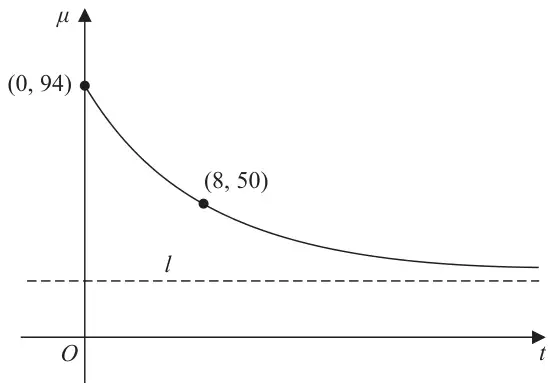
The temperature, \(\mu\ ^\circ\mathrm{C}\), of a second cup of tea \(t\) minutes after it was placed on a table in a different room, is modelled by the equation
\[\mu = A + B\mathrm{e}^{-\frac{t}{8}}\qquad t \geqslant 0\]where \(A\) and \(B\) are constants.
Figure 2 shows a sketch of \(\mu\) against \(t\) with two data points that lie on the curve.
The line \(l\), also shown on Figure 2, is the asymptote to the curve.
Using the equation of this model and the information given in Figure 2
| Scheme | Marks | AO |
|---|---|---|
| Temperature = \(83^\circ\mathrm{C}\) | B1 | 3.4 |
| (1) |
Notes
B1: Uses the model to state that the temperature \(= 83^\circ\mathrm{C}\) Requires units as well
| Scheme | Marks | AO |
|---|---|---|
| \(18 + 65\mathrm{e}^{-\frac{t}{8}} = 35 \Rightarrow 65\mathrm{e}^{-\frac{t}{8}} = 17\) | M1 | 1.1b |
| \(t = -8\ln\left(\dfrac{17}{65}\right)\) or \(\ln 65 - \dfrac{t}{8} = \ln 17 \Rightarrow t = \ldots\) | dM1 | 1.1b |
| \(t = 10.7\) | A1 | 1.1b |
| (3) |
Notes
M1: Uses the information and proceeds to \(P\mathrm{e}^{\pm\frac{t}{8}} = Q\) condoning slips
dM1: A full method using correct log laws and a knowledge that \(\mathrm{e}^x\) and \(\ln x\) are inverse functions. This cannot be scored from unsolvable equations, e.g \(P \gt 0, Q \lt 0\). Condone one error in their solution.
A1: \(t =\) awrt 10.7
| Scheme | Marks | AO |
|---|---|---|
States a suitable reason
| B1 | 2.4 |
| (1) |
Notes
B1: States a suitable reason with minimal conclusion
- As \(t \to \infty, \theta \to 18\) from above.
- The minimum temperature is \(18^\circ\mathrm{C}\) (so it cannot drop to \(15^\circ\mathrm{C}\))
- Substitutes \(\theta = 15\) (or a value between 15 and 18) into \(18 + 65\mathrm{e}^{-\frac{t}{8}} = 15\) (may be impied by \(15 - 18 = -3\) or similar) and makes a statement that \(\mathrm{e}^{-\frac{t}{8}}\) cannot be less than zero or else that \(\ln(-ve)\) is undefined and hence \(\theta \neq 15\). All calculations must be correct
- (According to the model) the room temperature is \(18^\circ\mathrm{C}\) (so cannot fall below this)
| Scheme | Marks | AO |
|---|---|---|
| \(A + B = 94\) or \(A + B\mathrm{e}^{-1} = 50\) | M1 | 3.4 |
| \(A + B = 94\) and \(A + B\mathrm{e}^{-1} = 50\) | A1 | 1.1b |
| Full method to find at least a value for \(A\) | dM1 | 2.1 |
| Deduces \(\mu = \dfrac{50\mathrm{e} - 94}{\mathrm{e} - 1}\) or accept \(\mu =\) awrt 24.4 | A1 | 2.2a |
| (4) | ||
| (9 marks) |
Notes
M1: Attempts to use \((0, 94)\) or \((8, 50)\) in order to form at least one equation in \(A\) and \(B\)
Allow this to be scored with an equation containing \(\mathrm{e}^0\)
A1: Correct equations \(A + B = 94\) and \(A + B\mathrm{e}^{-1} = 50\) or equivalent. \(\mathrm{e}^0 = 1\) must have been processed. Condone \(A + B = 94\) and \(A + 0.37B = 50\) where \(\mathrm{e}^{-1} =\) awrt 0.37
dM1: Dependent upon having two equations in \(A\) and \(B\) formed from the information given. It is a full and correct method leading to a value of \(A\). Allow this to be solved from a calculator.
Note \(B = 69.6..\) or \(\dfrac{44}{1 - \mathrm{e}^{-1}} \Rightarrow A = 94 - \text{``}B\text{''}\)
A1: Deduces that \(\mu = \dfrac{50\mathrm{e} - 94}{\mathrm{e} - 1}\) or accept \(\mu =\) awrt 24.4. Condone \(y = \ldots\)