Hyperbolic Functions

Edexcel

AQA

OCR A

OCR MEI

A2 June 2025 Paper 1 Q9

EdexcelCurrent spec9 marksHyperbolic FunctionsIntegration

9.

(i) The curves with equations\[y = \frac{3}{4}\sinh x \quad \text{and} \quad y = \tanh x + \frac{1}{5}\]intersect at just one point \(P\)
(a) Use algebra to show that the \(x\) coordinate of \(P\) satisfies the equation\[15\mathrm{e}^{4x} - 48\mathrm{e}^{3x} + 32\mathrm{e}^x - 15 = 0\] (3)
(b) Show that \(\mathrm{e}^x = 3\) is a solution of this equation. (1)
(c) Hence state the exact coordinates of \(P\). (1)
(ii) Show that\[\int_{-4}^{0} \frac{\mathrm{e}^{\frac{1}{x}}}{x^2}\,\mathrm{d}x = \mathrm{e}^{-\frac{1}{4}}\] (4)

A2 June 2025 Paper 2 Q8

8. Given that

\[y = \cos x\sinh x \qquad x \in \mathbb{R}\]
(a) show that\[\frac{\mathrm{d}^4y}{\mathrm{d}x^4} = ky\]where \(k\) is a constant to be determined. (5)
(b) Hence determine the first three non-zero terms of the Maclaurin series for \(y\), giving each coefficient in simplest form. (3)

A2 June 2025 Paper 1 Q2

EdexcelCurrent spec5 marksHyperbolic Functions

2.

In this question you must show all stages of your working.

Solutions relying entirely on calculator technology are not acceptable.

Determine the exact values of \(x\) for which

\[\sinh 2x = 3\sinh x\]

(5)

A2 June 2024 Paper 2 Q2

2.

\[\mathrm{f}(x) = \tanh^{-1}\left(\frac{3 - x}{6 + x}\right) \qquad |x| \lt \frac{3}{2}\]
(a) Show that\[\mathrm{f}^{\prime}(x) = -\frac{1}{2x + 3}\] (4)
(b) Hence determine \(\mathrm{f}^{\prime\prime}(x)\) (1)
(c) Hence show that the Maclaurin series for \(\mathrm{f}(x)\), up to and including the term in \(x^2\), is\[\ln p + qx + rx^2\]where \(p\), \(q\) and \(r\) are constants to be determined. (3)

A2 June 2024 Paper 2 Q1

EdexcelCurrent spec7 marksHyperbolic Functions

1.

(a) Using the definition of \(\sinh x\) in terms of exponentials, prove that\[4\sinh^3 x + 3\sinh x \equiv \sinh 3x\] (2)
(b) Hence solve the equation\[\sinh 3x = 19\sinh x\]giving your answers as simplified natural logarithms where appropriate. (5)

A2 June 2023 Paper 2 Q6

EdexcelCurrent spec6 marksHyperbolic FunctionsInduction

6. Given that

\[y = \mathrm{e}^{2x}\sinh x\]

prove by induction that for \(n \in \mathbb{N}\)

\[\frac{\mathrm{d}^n y}{\mathrm{d}x^n} = \mathrm{e}^{2x}\left(\frac{3^n + 1}{2}\sinh x + \frac{3^n - 1}{2}\cosh x\right)\]

(6)

A2 June 2023 Paper 1 Q2

EdexcelCurrent spec6 marksHyperbolic FunctionsIntegration

2.

(a) Write \(x^2 + 4x - 5\) in the form \((x + p)^2 + q\) where \(p\) and \(q\) are integers. (1)
(b) Hence use a standard integral from the formula book to find\[\int \frac{1}{\sqrt{x^2 + 4x - 5}}\,\mathrm{d}x\] (2)
(c) Determine the mean value of the function\[\mathrm{f}(x) = \frac{1}{\sqrt{x^2 + 4x - 5}} \qquad 3 \leqslant x \leqslant 13\]giving your answer in the form \(A\ln B\) where \(A\) and \(B\) are constants in simplest form. (3)

A2 June 2023 Paper 2 Q1

EdexcelCurrent spec4 marksHyperbolic FunctionsPolar Coordinates

1.

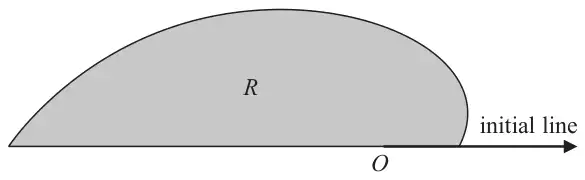
Polar curve starting at the pole O on the initial line, rising in a smooth arc over to the left and meeting the extension of the initial line on the left; the region R enclosed above the line is shaded
Figure 1

Figure 1 shows a sketch of the curve with polar equation

\[r = 2\sqrt{\sinh\theta + \cosh\theta} \qquad 0 \leqslant \theta \leqslant \pi\]

The region \(R\), shown shaded in Figure 1, is bounded by the initial line, the curve and the line with equation \(\theta = \pi\)

Use algebraic integration to determine the exact area of \(R\) giving your answer in the form \(p\mathrm{e}^q - r\) where \(p\), \(q\) and \(r\) are real numbers to be found.

(4)

A2 June 2022 Paper 1 Q9

EdexcelCurrent spec6 marksHyperbolic FunctionsIntegration

9.

(i)
(a) Explain why \(\displaystyle\int_0^{\infty}\cosh x\,\mathrm{d}x\) is an improper integral. (1)
(b) Show that \(\displaystyle\int_0^{\infty}\cosh x\,\mathrm{d}x\) is divergent. (3)
(ii) \[4\sinh x = p\cosh x \qquad \text{where } p \text{ is a real constant}\]Given that this equation has real solutions, determine the range of possible values for \(p\) (2)

A2 June 2022 Paper 2 Q9

9.

\[y = \cosh^n x \qquad n \geqslant 5\]
(a)
(i) Show that\[\frac{\mathrm{d}^2y}{\mathrm{d}x^2} = n^2\cosh^n x - n(n - 1)\cosh^{n-2} x\] (4)
(ii) Determine an expression for \(\dfrac{\mathrm{d}^4y}{\mathrm{d}x^4}\) (2)
(b) Hence determine the first three non-zero terms of the Maclaurin series for \(y\), giving each coefficient in simplest form. (2)

A2 June 2022 Paper 1 Q2

EdexcelCurrent spec4 marksHyperbolic Functions

2.

In this question you must show all stages of your working.

Solutions relying entirely on calculator technology are not acceptable.

Determine the values of \(x\) for which

\[64\cosh^4 x - 64\cosh^2 x - 9 = 0\]

Give your answers in the form \(q\ln 2\) where \(q\) is rational and in simplest form. (4)

A2 October 2021 Paper 1 Q9

EdexcelCurrent spec11 marksHyperbolic FunctionsIntegration

9.

(a) Use a hyperbolic substitution and calculus to show that\[\int\frac{x^2}{\sqrt{x^2 - 1}}\,\mathrm{d}x = \frac{1}{2}\left[x\sqrt{x^2 - 1} + \operatorname{arcosh} x\right] + k\]where \(k\) is an arbitrary constant. (6)
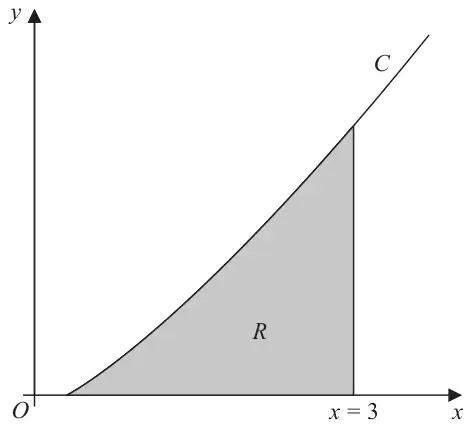
Figure 1: the curve C rising from the x-axis to the right of O; the region R under C between the curve, the x-axis and the line x = 3 is shaded
Figure 1

Figure 1 shows a sketch of part of the curve \(C\) with equation

\[y = \frac{4}{15}x\operatorname{arcosh} x \qquad\qquad x \geqslant 1\]

The finite region \(R\), shown shaded in Figure 1, is bounded by the curve \(C\), the \(x\)-axis and the line with equation \(x = 3\)

(b) Using algebraic integration and the result from part (a), show that the area of \(R\) is given by\[\frac{1}{15}\left[17\ln\left(3 + 2\sqrt{2}\right) - 6\sqrt{2}\right]\] (5)

A2 October 2021 Paper 2 Q7

EdexcelCurrent spec9 marksHyperbolic FunctionsIntegration

7.

Solutions based entirely on graphical or numerical methods are not acceptable.

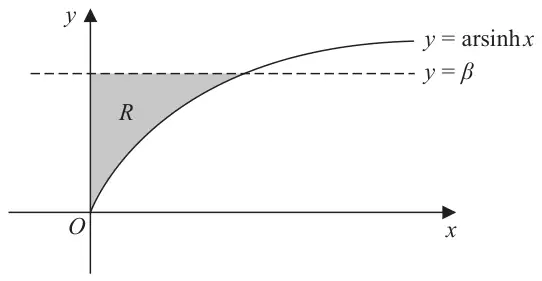
Figure 1: the curve y = arsinh x for x at least 0, rising from the origin, and the dashed horizontal line y = beta; the region R between the y-axis, the curve and the line is shaded
Figure 1

Figure 1 shows a sketch of part of the curve with equation

\[y = \operatorname{arsinh} x \qquad x \geqslant 0\]

and the straight line with equation \(y = \beta\)

The line and the curve intersect at the point with coordinates \((\alpha, \beta)\)

Given that \(\beta = \dfrac{1}{2}\ln 3\)

(a) show that \(\alpha = \dfrac{1}{\sqrt{3}}\) (3)

The finite region \(R\), shown shaded in Figure 1, is bounded by the curve with equation \(y = \operatorname{arsinh} x\), the \(y\)-axis and the line with equation \(y = \beta\)

The region \(R\) is rotated through \(2\pi\) radians about the \(y\)-axis.

(b) Use calculus to find the exact value of the volume of the solid generated. (6)

A2 October 2020 Paper 2 Q1

EdexcelCurrent spec7 marksHyperbolic Functions

1. The curve \(C\) has equation

\[y = 31\sinh x - 2\sinh 2x \qquad x \in \mathbb{R}\]

Determine, in terms of natural logarithms, the exact \(x\) coordinates of the stationary points of \(C\).

(7)

A2 June 2019 Paper 2 Q3

EdexcelCurrent spec6 marksHyperbolic FunctionsIntegration

3.

\[\mathrm{f}(x) = \frac{1}{\sqrt{4x^2 + 9}}\]
(a) Using a substitution, that should be stated clearly, show that\[\int \mathrm{f}(x)\,\mathrm{d}x = A\sinh^{-1}(Bx) + c\]where \(c\) is an arbitrary constant and \(A\) and \(B\) are constants to be found. (4)
(b) Hence find, in exact form in terms of natural logarithms, the mean value of \(\mathrm{f}(x)\) over the interval \([0, 3]\). (2)

A2 June 2019 Paper 2 Q1

EdexcelCurrent spec10 marksHyperbolic Functions

1.

(a) Prove that\[\tanh^{-1}(x) = \frac{1}{2}\ln\left(\frac{1 + x}{1 - x}\right) \qquad -k \lt x \lt k\]stating the value of the constant \(k\). (5)
(b) Hence, or otherwise, solve the equation\[2x = \tanh\left(\ln\sqrt{2 - 3x}\right)\] (5)

A2 June 2025 Paper 1 Q18

AQACurrent spec15 marksHyperbolic FunctionsIntegration

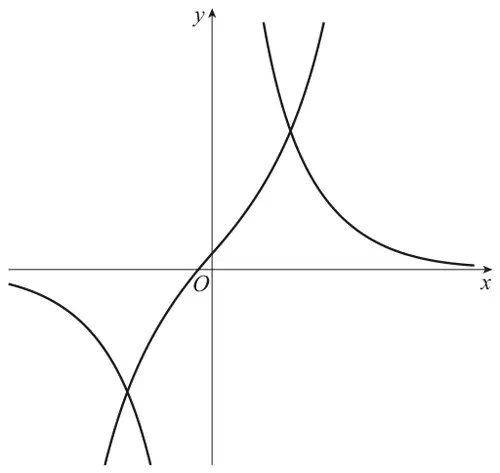
18 The diagram shows part of the graph of \(y = 15\operatorname{cosech} x\) and part of the graph of \(y = 4\sinh x + \dfrac{1}{2}\)

Graphs of y = 15 cosech x (two branches, in the first and third quadrants, asymptotic to both axes) and y = 4 sinh x + 1/2 (an increasing curve crossing the y-axis just above O); the curves intersect once in the first quadrant and once in the third quadrant
(a) Solve the inequality\[15\operatorname{cosech} x \lt 4\sinh x + \frac{1}{2}\]

Give your answer in logarithmic form. [4 marks]

(b) Given that\[\mathrm{f}(x) = \ln\left(\tanh\left(\frac{1}{2}x\right)\right) \qquad (x \gt 0)\]

Show that

\[\mathrm{f}^{\prime}(x) = \operatorname{cosech} x\] [4 marks]
(c) The shaded region \(R\) is enclosed by the positive \(x\)-axis, the positive \(y\)-axis, the graph of \(y = 4\sinh x + \dfrac{1}{2}\), the graph of \(y = 15\operatorname{cosech} x\) and the line \(x = \ln 9\)
The same two graphs, with the region R shaded in the first quadrant: bounded by the y-axis, the x-axis, the curve y = 4 sinh x + 1/2 up to the intersection point, then the curve y = 15 cosech x down to a vertical line

Find the area of \(R\)

Give your answer in the form \(\dfrac{p}{q} + \ln r + s\ln\left(\dfrac{t}{3}\right)\) where \(p\), \(q\), \(r\), \(s\) and \(t\) are integers. [7 marks]

A2 June 2025 Paper 1 Q14

AQACurrent spec6 marksHyperbolic Functions

14

(a) Using the exponential definitions of \(\sinh x\) and \(\cosh x\), prove that\[\coth^{-1}(x) = \frac{1}{2}\ln\left(\frac{x + 1}{x - 1}\right)\] [3 marks]
(b) Hence, solve the equation\[\coth^{-1}(x) = -\ln 5\]

Give your answer in an exact form. [3 marks]

A2 June 2025 Paper 2 Q12

AQACurrent spec5 marksHyperbolic FunctionsIntegration

12 Find the value of

\[\int_1^5 \frac{1}{\sqrt{x^2 + 6x + 5}}\,\mathrm{d}x\]

Give your answer in the form

\[\ln\left(8 + a\sqrt{3} + b\sqrt{5} + c\sqrt{15}\right)\]

where \(a\), \(b\) and \(c\) are integers. [5 marks]

AS June 2025 Paper 1 Q12

AQACurrent spec6 marksHyperbolic Functions

12 Use the definitions of \(\sinh x\) and \(\cosh x\) in terms of \(\mathrm{e}^x\) and \(\mathrm{e}^{-x}\) to solve

\[5\sinh x - 3\cosh x = 6\]

Give your answer in the form

\[x = \ln\left(a + \sqrt{b}\right)\]

where \(a\) and \(b\) are integers.

Fully justify your answer. [6 marks]

AS June 2025 Paper 1 Q7

AQACurrent spec4 marksHyperbolic Functions

7

(a) Geraldine wants to show that\[\tanh^{-1} x = \frac{1}{2}\ln\left(\frac{1 + x}{1 - x}\right)\]

She writes her steps as follows:

\[\begin{aligned} &\text{Let} && y = \tanh^{-1} x \\ &\Rightarrow && \tanh y = x \\ &\Rightarrow && \frac{\mathrm{e}^y + \mathrm{e}^{-y}}{\mathrm{e}^y - \mathrm{e}^{-y}} = x \\ &\Rightarrow && \mathrm{e}^y + \mathrm{e}^{-y} = x\mathrm{e}^y - x\mathrm{e}^{-y} \\ &\Rightarrow && (1 + x)\mathrm{e}^{-y} = (x - 1)\mathrm{e}^y \\ &\Rightarrow && \mathrm{e}^{2y} = \frac{1 + x}{x - 1} \\ &\Rightarrow && 2y = \ln\left(\frac{x + 1}{x - 1}\right) \\ &\therefore && \tanh^{-1} x = \frac{1}{2}\ln\left(\frac{x + 1}{x - 1}\right) \end{aligned}\]

Identify and explain the error in Geraldine’s method. [2 marks]

(b) Use the correct identity to find\[\tanh^{-1}\left(-\frac{24}{25}\right)\]

Give your answer in the form \(\ln a\) where \(a\) is a rational number. [2 marks]

A2 June 2025 Paper 1 Q4

AQACurrent spec1 markHyperbolic Functions

4 Which one of the following statements is always correct?

Tick (✓) one box. [1 mark]

  • \(\sinh^2 x = \dfrac{1}{2}(1 - \cosh 2x)\)
  • \(\operatorname{sech}^2 x + \tanh^2 x = 1\)
  • \(\operatorname{cosech}^2 x + \coth^2 x = 1\)
  • \(\cosh^2 x = \dfrac{1}{2}(\cosh 2x - 1)\)

A2 June 2024 Paper 1 Q17

AQACurrent spec7 marksHyperbolic FunctionsIntegration

17 By making a suitable substitution, show that

\[\int_{-2}^{1} \sqrt{x^2 + 6x + 8}\,\mathrm{d}x = 2\sqrt{15} - \frac{1}{2}\cosh^{-1}(4)\]

[7 marks]

A2 June 2024 Paper 1 Q14

14 Solve the differential equation

\[\frac{\mathrm{d}y}{\mathrm{d}x} + y\tanh x = \sinh^3 x\]

given that \(y = 3\) when \(x = \ln 2\)

Give your answer in an exact form. [7 marks]

A2 June 2024 Paper 1 Q9

AQACurrent spec8 marksHyperbolic Functions

9

(a) It is given that\[p = \ln\left(r + \sqrt{r^2 + 1}\right)\]

Starting from the exponential definition of the sinh function, show that \(\sinh p = r\) [4 marks]

(b) Solve the equation\[\cosh^2 x = 2\sinh x + 16\]

Give your answers in logarithmic form. [4 marks]

AS June 2024 Paper 1 Q6

AQACurrent spec4 marksHyperbolic Functions

6

(a) On the axes below, sketch the graph of\[y = \cosh x\]

Indicate the value of any intercept of the curve with the axes. [2 marks]

Blank axes: x-axis and y-axis crossing at O
(b) Solve the equation\[\cosh x = 2\]

Give your answers to three significant figures. [2 marks]

A2 June 2024 Paper 2 Q3

AQACurrent spec1 markHyperbolic Functions

3 The function \(\mathrm{g}\) is defined by

\[\mathrm{g}(x) = \operatorname{sech} x \qquad (x \in \mathbb{R})\]

Which one of the following is the range of \(\mathrm{g}\)?

Tick (✓) one box. [1 mark]

  • \(-\infty \lt \mathrm{g}(x) \leqslant -1\)
  • \(-1 \leqslant \mathrm{g}(x) \lt 0\)
  • \(0 \lt \mathrm{g}(x) \leqslant 1\)
  • \(1 \leqslant \mathrm{g}(x) \leqslant \infty\)

A2 June 2023 Paper 1 Q12

AQACurrent spec6 marksHyperbolic Functions

12

(a) Starting from the identities for \(\sinh 2x\) and \(\cosh 2x\), prove the identity\[\tanh 2x = \frac{2\tanh x}{1 + \tanh^2 x}\] [2 marks]
(b)
(i) The function \(\mathrm{f}\) is defined by\[\mathrm{f}(x) = \tanh x \qquad (x \gt 0)\]

State the range of \(\mathrm{f}\) [1 mark]

(ii) Use part (a) and part (b)(i) to prove that \(\tanh 2x \gt \tanh x\) if \(x \gt 0\) [3 marks]

AS June 2023 Paper 1 Q6

6

(a) Find and simplify the first five terms in the Maclaurin series for \(\mathrm{e}^{2x}\) [2 marks]
(b) Hence, or otherwise, write down the first five terms in the Maclaurin series for \(\mathrm{e}^{-2x}\) [1 mark]
(c) Hence, or otherwise, show that the Maclaurin series for \(\cosh(2x)\) is\[a + bx^2 + cx^4 + \ldots\]

where \(a\), \(b\) and \(c\) are rational numbers to be determined. [3 marks]

A2 June 2023 Paper 2 Q4

AQACurrent spec1 markHyperbolic Functions

4 It is given that \(\mathrm{f}(x) = \cosh^{-1}(x - 3)\)

Which of the sets listed below is the greatest possible domain of the function \(\mathrm{f}\)?

Circle your answer. [1 mark]

  • \(\{x : x \geqslant 4\}\)
  • \(\{x : x \geqslant 3\}\)
  • \(\{x : x \geqslant 1\}\)
  • \(\{x : x \geqslant 0\}\)

AS June 2023 Paper 1 Q1

AQACurrent spec1 markHyperbolic Functions

1 Which expression below is equivalent to \(\tanh x\)?

Circle your answer. [1 mark]

  • \(\sinh x\cosh x\)
  • \(\dfrac{\sinh x}{\cosh x}\)
  • \(\dfrac{\cosh x}{\sinh x}\)
  • \(\sinh x + \cosh x\)

AS June 2022 Paper 1 Q15

15 The two values of \(\theta\) that satisfy the equation

\[\sinh^2\theta - \sinh\theta - 2 = 0\]

are \(\theta_1\) and \(\theta_2\)

(a) Hamzah is asked to find the value of \(\theta_1 + \theta_2\)

He writes his answer as follows:

The quadratic coefficients are \(a = 1\), \(b = -1\), \(c = -2\)

The sum of the roots is \(-\dfrac{b}{a}\)

So \(\theta_1 + \theta_2 = -\dfrac{-1}{1} = 1\)

Explain Hamzah’s error. [1 mark]

(b) Find the correct value of \(\theta_1 + \theta_2\)

Give your answer as a single logarithm. [5 marks]

A2 June 2022 Paper 1 Q6

AQACurrent spec8 marksHyperbolic Functions

6

(a) Given that \(|x| \lt 1\), prove that\[\tanh^{-1} x = \frac{1}{2}\ln\left(\frac{1 + x}{1 - x}\right)\] [4 marks]
(b) Solve the equation\[20\operatorname{sech}^2 x - 11\tanh x = 16\]

Give your answer in logarithmic form. [4 marks]

A2 June 2022 Paper 2 Q4

AQACurrent spec1 markHyperbolic Functions

4 Which of the following graphs intersects the graph of \(y = \sinh x\) at exactly one point?

Circle your answer. [1 mark]

  • \(y = \operatorname{cosech} x\)
  • \(y = \cosh x\)
  • \(y = \coth x\)
  • \(y = \operatorname{sech} x\)

A2 June 2022 Paper 1 Q3

AQACurrent spec1 markHyperbolic Functions

3 Given that \(y = \operatorname{sech} x\), find \(\dfrac{\mathrm{d}y}{\mathrm{d}x}\)

Tick (✓) one box. [1 mark]

  • \(\operatorname{sech} x \tanh x\)
  • \(-\operatorname{sech} x \tanh x\)
  • \(\operatorname{cosech} x \coth x\)
  • \(-\operatorname{cosech} x \coth x\)

AS June 2022 Paper 1 Q1

AQACurrent spec1 markHyperbolic Functions

1 Which of the following exponential expressions is equivalent to \(2\sinh x\)?

Circle your answer. [1 mark]

  • \(\mathrm{e}^x\)
  • \(\mathrm{e}^x + \mathrm{e}^{-x}\)
  • \(\mathrm{e}^x - \mathrm{e}^{-x}\)
  • \(\mathrm{e}^{-x}\)

A2 June 2021 Paper 1 Q14

AQACurrent spec12 marksHyperbolic FunctionsIntegration

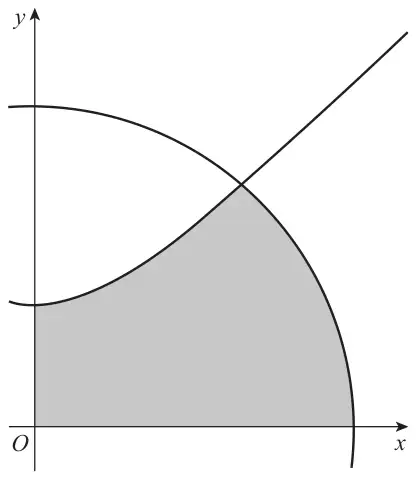
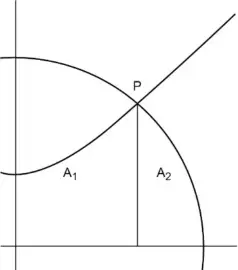
14 The hyperbola \(H\) has equation \(y^2 - x^2 = 16\)

The circle \(C\) has equation \(x^2 + y^2 = 32\)

The diagram below shows part of the graph of \(H\) and part of the graph of \(C\).

First quadrant: the upper branch of the hyperbola H rises from the y-axis and meets the arc of the circle C, which crosses the y-axis higher up and comes down to the x-axis; the region below H and C, above the x-axis and to the right of the y-axis is shaded

Show that the shaded region in the first quadrant enclosed by \(H\), \(C\), the \(x\)-axis and the \(y\)-axis has area

\[\frac{16\pi}{3} + 8\ln\left(\frac{\sqrt{2} + \sqrt{6}}{2}\right)\]

[12 marks]

A2 June 2021 Paper 2 Q12

AQACurrent spec12 marksHyperbolic FunctionsIntegration

12 The integral \(S_n\) is defined by

\[S_n = \int_0^a x^n\sinh x\,\mathrm{d}x \qquad (n \geqslant 0)\]
(a) Show that for \(n \geqslant 2\)\[S_n = n(n - 1)S_{n-2} + a^n\cosh a - na^{n-1}\sinh a\] [7 marks]
(b) Hence show that\[\int_0^1 x^4\sinh x\,\mathrm{d}x = \frac{9}{2}\mathrm{e} + \frac{65}{2}\mathrm{e}^{-1} - 24\] [5 marks]

AS June 2021 Paper 1 Q12

12 The equation \(x^3 - 2x^2 - x + 2 = 0\) has three roots. One of the roots is 2

(a) Find the other two roots of the equation. [1 mark]
(b) Hence, or otherwise, solve\[\cosh^3\theta - 2\cosh^2\theta - \cosh\theta + 2 = 0\]

giving your answers in an exact form. [4 marks]

AS June 2021 Paper 1 Q6

AQACurrent spec2 marksHyperbolic Functions

6 Prove the identity

\[\cosh^2 x - \sinh^2 x = 1\]

[2 marks]

A2 June 2021 Paper 1 Q4

AQACurrent spec5 marksHyperbolic Functions

4 Show that the solutions to the equation

\[3\tanh^2 x - 2\operatorname{sech} x = 2\]

can be expressed in the form

\[x = \pm\ln\left(a + \sqrt{b}\right)\]

where \(a\) and \(b\) are integers to be found.

You may use without proof the result \(\cosh^{-1} y = \ln\left(y + \sqrt{y^2 - 1}\right)\) [5 marks]

A2 June 2020 Paper 1 Q14

AQACurrent spec6 marksHyperbolic FunctionsSeries

14

(a) Given that\[\sinh(A + B) = \sinh A\cosh B + \cosh A\sinh B\]

express \(\sinh(m + 1)x\) and \(\sinh(m - 1)x\) in terms of \(\sinh mx\), \(\cosh mx\), \(\sinh x\) and \(\cosh x\) [1 mark]

(b) Hence find the sum of the series\[C_n = \cosh x + \cosh 2x + \cdots + \cosh nx\]

in terms of \(\sinh x\), \(\sinh nx\) and \(\sinh(n + 1)x\) [5 marks]

A2 June 2020 Paper 1 Q12

AQACurrent spec8 marksHyperbolic Functions

12

(a) Use the definition of the cosh function to prove that\[\cosh^{-1}\left(\frac{x}{a}\right) = \ln\left(\frac{x + \sqrt{x^2 - a^2}}{a}\right) \qquad \text{for } a \gt 0\] [6 marks]
(b) The formulae booklet gives the integral of \(\dfrac{1}{\sqrt{x^2 - a^2}}\) as\[\cosh^{-1}\left(\frac{x}{a}\right) \quad \text{or} \quad \ln\left(x + \sqrt{x^2 - a^2}\right) + c\]

Ronald says that this contradicts the result given in part (a).

Explain why Ronald is wrong. [2 marks]

AS June 2020 Paper 1 Q11

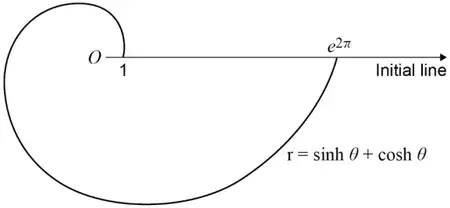
11 Sketch the polar graph of

\[r = \sinh\theta + \cosh\theta\]

for \(0 \leqslant \theta \leqslant 2\pi\) [3 marks]

The initial line, drawn from the pole O

AS June 2020 Paper 1 Q8

AQACurrent spec8 marksHyperbolic Functions

8

(a) Prove that\[\tanh^{-1} x = \frac{1}{2}\ln\left(\frac{1 + x}{1 - x}\right)\]

[5 marks]

(b) Prove that the graphs of\[y = \sinh x \quad \text{and} \quad y = \cosh x\]

do not intersect. [3 marks]

AS June 2019 Paper 1 Q10

10

(a) Using the definition of \(\cosh x\) and the Maclaurin series expansion of \(\mathrm{e}^x\), find the first three non-zero terms in the Maclaurin series expansion of \(\cosh x\). [3 marks]
(b) Hence find a trigonometric function for which the first three terms of its Maclaurin series are the same as the first three terms of the Maclaurin series for \(\cosh(\mathrm{i}x)\). [3 marks]

AS June 2019 Paper 1 Q9

AQACurrent spec7 marksHyperbolic Functions

9

(a) Saul is solving the equation\[2\cosh x + \sinh^2 x = 1\]

He writes his steps as follows:

\[\begin{aligned}2\cosh x + \sinh^2 x &= 1 \\ 2\cosh x + 1 - \cosh^2 x &= 1 \\ 2\cosh x - \cosh^2 x &= 0 \\ \cosh x \neq 0 \;\therefore\; 2 - \cosh x &= 0 \\ \cosh x &= 2 \\ x &= \pm\cosh^{-1}(2)\end{aligned}\]

Identify and explain the error in Saul’s method. [2 marks]

(b) Anna is solving the different equation\[\sinh^2(2x) - 2\cosh(2x) = 1\]

and finds the correct answers in the form \(x = \dfrac{1}{p}\cosh^{-1}(q + \sqrt{r})\), where \(p\), \(q\) and \(r\) are integers.

Find the possible values of \(p\), \(q\) and \(r\).

Fully justify your answer. [5 marks]

A2 June 2019 Paper 1 Q6

AQACurrent spec8 marksHyperbolic Functions

6

(a) Show that\[\cosh^3 x + \sinh^3 x = \frac{1}{4}\mathrm{e}^{mx} + \frac{3}{4}\mathrm{e}^{nx}\]

where \(m\) and \(n\) are integers. [3 marks]

(b) Hence find \(\cosh^6 x - \sinh^6 x\) in the form\[\frac{a\cosh(kx) + b}{8}\]

where \(a\), \(b\) and \(k\) are integers. [5 marks]

AS June 2019 Paper 1 Q6

AQACurrent spec5 marksHyperbolic Functions

6

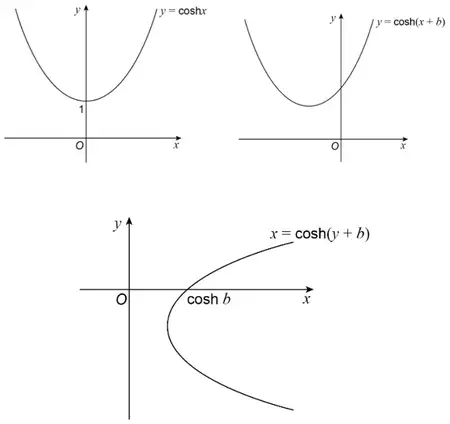
(a) On the axes provided, sketch the graph of\[x = \cosh(y + b)\]

where \(b\) is a positive constant. [4 marks]

Blank axes: x-axis and y-axis crossing at O
(b) Determine the minimum distance between the graph of \(x = \cosh(y + b)\) and the \(y\)-axis. [1 mark]

A2 June 2019 Paper 2 Q5

AQACurrent spec4 marksHyperbolic FunctionsIntegration

5 A curve has equation \(y = \cosh x\)

Show that the arc length of the curve from \(x = a\) to \(x = b\), where \(0 \lt a \lt b\), is equal to

\[\sinh b - \sinh a\] [4 marks]

AS June 2018 Paper 1 Q17

AQACurrent spec4 marksHyperbolic Functions

17 Find the exact solution to the equation

\[\sinh\theta(\sinh\theta + \cosh\theta) = 1\]

[4 marks]

AS June 2018 Paper 1 Q6

AQACurrent spec3 marksHyperbolic Functions

6

(a) Matthew is finding a formula for the inverse function \(\operatorname{arsinh} x\).
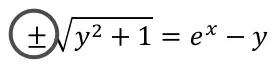
He writes his steps as follows:\[\begin{gathered}\text{Let } y = \sinh x \\ y = \frac{1}{2}(\mathrm{e}^x - \mathrm{e}^{-x}) \\ 2y = \mathrm{e}^x - \mathrm{e}^{-x} \\ 0 = \mathrm{e}^x - 2y - \mathrm{e}^{-x} \\ 0 = (\mathrm{e}^x)^2 - 2y\mathrm{e}^x - 1 \\ 0 = (\mathrm{e}^x - y)^2 - y^2 - 1 \\ y^2 + 1 = (\mathrm{e}^x - y)^2 \\ \pm\sqrt{y^2 + 1} = \mathrm{e}^x - y \\ y \pm \sqrt{y^2 + 1} = \mathrm{e}^x\end{gathered}\]

To find the inverse function, swap \(x\) and \(y\): \(x \pm \sqrt{x^2 + 1} = \mathrm{e}^y\)

\[\begin{gathered}\ln\left(x \pm \sqrt{x^2 + 1}\right) = y \\ \operatorname{arsinh} x = \ln\left(x \pm \sqrt{x^2 + 1}\right)\end{gathered}\]

Identify, and explain, the error in Matthew’s proof. [2 marks]

(b) Solve \(\ln\left(x + \sqrt{x^2 + 1}\right) = 3\) [1 mark]

A2 June 2025 Paper 2 Q10

OCR ACurrent spec8 marksHyperbolic Functions

10

(a) Find \(\frac{1}{2}\mathrm{e}^{-u}\) as a percentage of \(\sinh u\) for the following values of \(u\).
  • \(u = 2\)
  • \(u = 5\)
[1]
(b) Find, as a percentage of \(\sinh u\), the difference between \(\sinh u\) and \(\cosh u\) for the following values of \(u\).
  • \(u = 2\)
  • \(u = 5\)
[1]

A function f is defined for all integers \(n\) by \(\mathrm{f}(n) = \sinh(0.01n) - 5\cosh(0.005n) - 9\tanh n\).

(c) In this question you must show detailed reasoning.
With the help of suitable approximations, use an algebraic method to determine the smallest value of \(n\) for which \(\mathrm{f}(n) \gt 100\). You should verify your answer, once found, by direct calculation. You may assume that the required value of \(n\) is large. [6]

A2 June 2025 Paper 1 Q2

OCR ACurrent spec5 marksHyperbolic Functions

2

(a) Given that \(y = \cosh^{-1}\left(\tfrac{1}{3}x\right)\), find \(\dfrac{\mathrm{d}y}{\mathrm{d}x}\) in terms of \(x\). [1]
(b) Determine an equation of the normal to the curve \(y = \cosh^{-1}\left(\tfrac{1}{3}x\right)\) at the point where \(x = 5\).
Give your answer in the form \(ax + by = c + \ln d\), where \(a\), \(b\), \(c\) and \(d\) are integers. [4]

A2 June 2024 Paper 1 Q7

OCR ACurrent spec9 marksHyperbolic Functions

7

(a) By using the definitions of \(\cosh u\) and \(\sinh u\) in terms of \(\mathrm{e}^u\) and \(\mathrm{e}^{-u}\), show that \(\sinh 2u \equiv 2\sinh u\cosh u\). [2]

The equation of a curve, \(C\), is \(y = 16\cosh x - \sinh 2x\).

(b) Show that there is only one solution to the equation \(\dfrac{\mathrm{d}^2y}{\mathrm{d}x^2} = 0\) [4]

You are now given that \(C\) has exactly one point of inflection.

(c) Use your answer to part (b) to determine the exact coordinates of this point of inflection. Give your answer in a logarithmic form where appropriate. [3]

A2 June 2024 Paper 2 Q7

OCR ACurrent spec10 marksHyperbolic FunctionsIntegration

7

(a) Express \(17\cosh x - 15\sinh x\) in the form \(\mathrm{e}^{-x}\left(a\mathrm{e}^{bx} + c\right)\) where \(a\), \(b\) and \(c\) are integers to be determined. [3]

A function is defined by \(\mathrm{f}(x) = \dfrac{1}{\sqrt{17\cosh x - 15\sinh x}}\). The region bounded by the curve \(y = \mathrm{f}(x)\), the \(x\)-axis, the \(y\)-axis and the line \(x = \ln 3\) is rotated by \(2\pi\) radians about the \(x\)-axis to form a solid of revolution \(S\).

(b) In this question you must show detailed reasoning.
Use a suitable substitution, together with known results from the formula book, to show that the volume of \(S\) is given by \(k\pi\tan^{-1}q\) where \(k\) and \(q\) are rational numbers to be determined. [7]

A2 June 2024 Paper 2 Q6

OCR ACurrent spec11 marksHyperbolic FunctionsPolar Coordinates

6 In polar coordinates, the equation of a curve, \(C\), is \(r = 6\sin(2\theta)\sinh\left(\frac{1}{3}\theta\right)\) for \(0 \leqslant \theta \leqslant \frac{1}{2}\pi\).

The pole of the polar coordinate system corresponds to the origin of the cartesian system and the initial line corresponds to the positive \(x\)-axis.

(a) Explain how you can tell that \(C\) comprises a single loop in the first quadrant, passing through the pole. [3]

The incomplete table below shows values of \(r\) for various values of \(\theta\).

\(\theta\)\(0\)\(\dfrac{1}{12}\pi\)\(\dfrac{1}{6}\pi\)\(\dfrac{1}{4}\pi\)\(\dfrac{1}{3}\pi\)\(\dfrac{5}{12}\pi\)\(\dfrac{1}{2}\pi\)
\(r\)00.2621.851
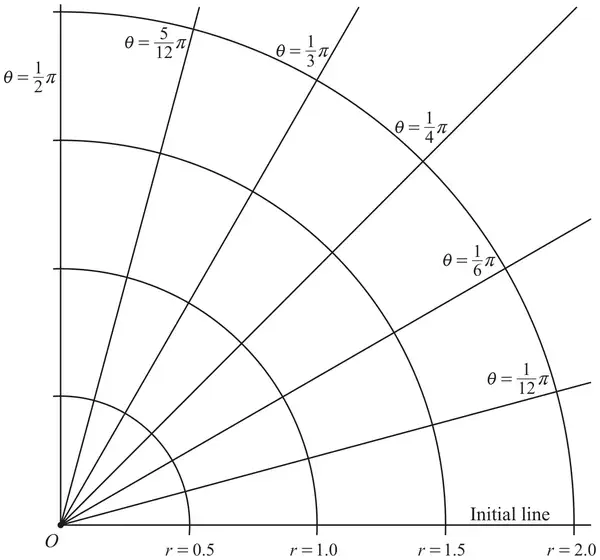
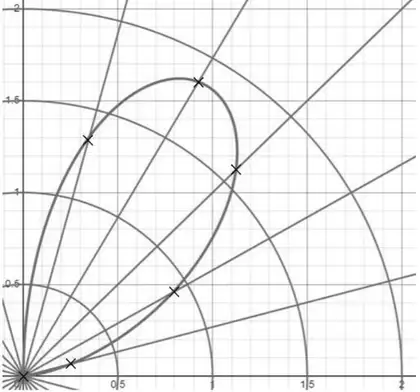
(b) Use the copy of the table and the polar coordinate system diagram given below to complete the table and sketch \(C\). [3]
Polar coordinate grid from the Printed Answer Booklet: the pole O, the initial line, quarter-circle arcs r = 0.5, 1.0, 1.5 and 2.0, and half-lines theta = pi/12, pi/6, pi/4, pi/3, 5pi/12 and pi/2

The point on \(C\) which is furthest away from the pole is denoted by \(A\) and the value of \(\theta\) at \(A\) is denoted by \(\phi\).

(c) Show that \(\phi\) satisfies the equation \(\phi = \dfrac{3}{2}\ln\left(\dfrac{6 - \tan 2\phi}{6 + \tan 2\phi}\right)\) [4]
(d) You are given that the relevant solution of the equation given in part (c) is \(\phi = 1.0207\) correct to 5 significant figures.
Find the distance from \(A\) to the pole. Give your answer correct to 3 significant figures. [1]

A2 June 2023 Paper 2 Q10

10 In this question you must show detailed reasoning.

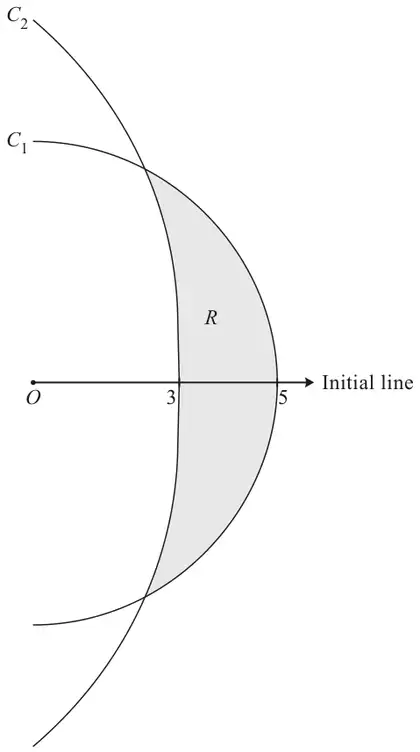
A region, \(R\), of the floor of an art gallery is to be painted for the purposes of an art installation. A suitable polar coordinate system is set up on the floor of the gallery with units in metres and radians. \(R\) is modelled as being the region enclosed by two curves, \(C_1\) and \(C_2\). The polar equations of \(C_1\) and \(C_2\) are

\[\begin{aligned} &C_1: r = 5, &&-\tfrac{1}{2}\pi \leqslant \theta \leqslant \tfrac{1}{2}\pi \\ &C_2: r = 3\cosh\theta, &&-\tfrac{1}{2}\pi \leqslant \theta \leqslant \tfrac{1}{2}\pi \end{aligned}\]

Both curves are shown in the diagram, with \(R\) indicated.

Polar diagram: the semicircular arc C1 of radius 5 and the curve C2, which crosses the initial line at 3 and bends away from the pole; the two curves intersect above and below the initial line, and the shaded region R lies between them, reaching the initial line from 3 to 5

The gallery must buy tins of paint to paint \(R\). Each tin of paint can cover an area of \(0.5\,\text{m}^2\).

Determine the smallest number of tins of paint that the gallery must buy in order to be able to paint \(R\) completely. [7]

A2 June 2023 Paper 1 Q6

OCR ACurrent spec4 marksHyperbolic FunctionsIntegration

6 In this question you must show detailed reasoning.

The power output, \(p\) watts, of a machine at time \(t\) hours after it is switched on can be modelled by the equation \(p = 20 - 20\tanh(1.44t)\) for \(t \geqslant 0\).

Determine, according to the model, the mean power output of the machine over the first half hour after it is switched on. Give your answer correct to 2 decimal places. [4]

A2 June 2023 Paper 2 Q5

OCR ACurrent spec7 marksHyperbolic Functions

5 In this question you must show detailed reasoning.

(a) Using the definitions of \(\sinh x\) and \(\cosh x\) in terms of exponentials, show that \(\sinh 2x \equiv 2\sinh x\cosh x\). [2]
(b) Solve the equation \(15\sinh x + 16\cosh x - 6\sinh 2x = 20\), giving all your answers in logarithmic form. [5]

A2 June 2023 Paper 2 Q3

3

(a) Show that \(\dfrac{\mathrm{d}}{\mathrm{d}u}\left(\sinh^{-1}u\right) = \dfrac{1}{\sqrt{u^2 + 1}}\). [2]
(b) Find the equation of the normal to the graph of \(y = \sinh^{-1}2x\) at the point where \(x = \sqrt{6}\). Give your answer in the form \(y = mx + c\) where \(m\) and \(c\) are given in exact, non-hyperbolic form. [4]

A2 June 2022 Paper 1 Q6

OCR ACurrent spec6 marksHyperbolic FunctionsInduction

6 Let \(y = x\cosh x\).

Prove by induction that, for all integers \(n \geqslant 1\), \(\dfrac{\mathrm{d}^{2n-1}y}{\mathrm{d}x^{2n-1}} = x\sinh x + (2n - 1)\cosh x\). [6]

A2 June 2022 Paper 2 Q5

OCR ACurrent spec7 marksHyperbolic Functions

5

(a) By using the exponential definitions of \(\sinh x\) and \(\cosh x\), prove the identity \(\cosh 2x \equiv \cosh^2 x + \sinh^2 x\). [2]
(b) Hence find an expression for \(\cosh 2x\) in terms of \(\cosh x\). [1]
(c) Determine the solutions of the equation \(5\cosh 2x = 16\cosh x + 21\), giving your answers in exact logarithmic form. [4]

A2 June 2022 Paper 1 Q1

OCR ACurrent spec6 marksHyperbolic FunctionsIntegration

1 In this question you must show detailed reasoning.

(a) Show that \(\cosh(2\ln 3) = \dfrac{41}{9}\). [2]

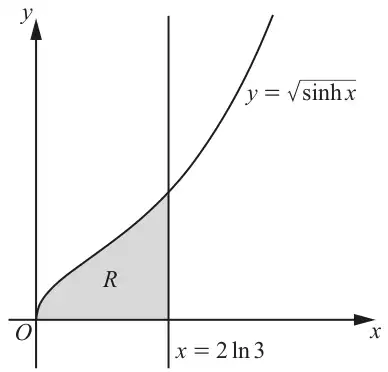
The region \(R\) is bounded by the curve with equation \(y = \sqrt{\sinh x}\), the \(x\)-axis and the line with equation \(x = 2\ln 3\) (see diagram). The units of the axes are centimetres.

Graph of y = root(sinh x) for x at least 0, starting at the origin O, with the vertical line x = 2 ln 3; the region R between the curve, the x-axis and the line is shaded

A manufacturer produces bell-shaped chocolate pieces. Each piece is modelled as being the shape of the solid formed by rotating \(R\) completely about the \(x\)-axis.

(b) Determine, according to the model, the exact volume of one chocolate piece. [4]

A2 October 2021 Paper 1 Q8

OCR ACurrent spec8 marksHyperbolic Functions

8 You are given that \(\mathrm{f}(x) = 4\sinh x + 3\cosh x\).

(a) Show that the curve \(y = \mathrm{f}(x)\) has no turning points. [3]
(b) Determine the exact solution of the equation \(\mathrm{f}(x) = 5\). [5]

A2 October 2021 Paper 2 Q5

OCR ACurrent spec8 marksHyperbolic Functions

5 In this question you must show detailed reasoning.

(a) Using the definition of \(\cosh x\) in terms of exponentials, show that \(\cosh 2x \equiv 2\cosh^2 x - 1\). [2]
(b) Solve the equation \(\cosh 2x = 3\cosh x + 1\), giving all your answers in exact logarithmic form. [6]

A2 October 2020 Paper 2 Q9

OCR ACurrent spec11 marksHyperbolic Functions

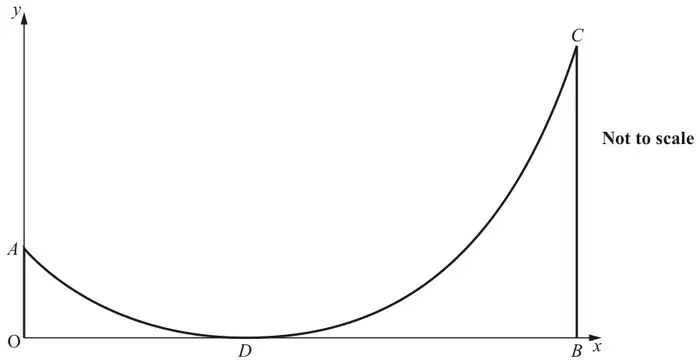
9 Two thin poles, \(OA\) and \(BC\), are fixed vertically on horizontal ground. A chain is fixed at \(A\) and \(C\) such that it touches the ground at point \(D\) as shown in the diagram.

On a coordinate system the coordinates of \(A\), \(B\) and \(D\) are \((0, 3)\), \((5, 0)\) and \((2, 0)\).

Diagram, not to scale: x and y axes with origin O; vertical pole OA on the y-axis and vertical pole BC at B on the x-axis, with C much higher than A; a chain hangs from A down to touch the x-axis at D and rises steeply to C

It is required to find the height of pole \(BC\) by modelling the shape of the curve that the chain forms.

Jofra models the curve using the equation \(y = k\cosh(ax - b) - 1\) where \(k\), \(a\) and \(b\) are positive constants.

(a) Determine the value of \(k\). [2]
(b) Find the exact value of \(a\) and the exact value of \(b\), giving your answers in logarithmic form. [5]

Holly models the curve using the equation \(y = \frac{3}{4}x^2 - 3x + 3\).

(c) Write down the coordinates of the point, \((u, v)\) where \(u\) and \(v\) are both non-zero, at which the two models will agree. [1]
(d) Show that Jofra’s model and Holly’s model disagree in their predictions of the height of pole \(BC\) by 3.32 m to 3 significant figures. [3]

A2 October 2020 Paper 1 Q8

OCR ACurrent spec10 marksHyperbolic FunctionsIntegration

8

(a) Using exponentials, show that \(\cosh 2u \equiv 2\sinh^2 u + 1\). [2]
(b) By differentiating both sides of the identity in part (a) with respect to \(u\), show that
\(\sinh 2u \equiv 2\sinh u\cosh u\). [1]
(c) Use the substitution \(x = \sinh^2 u\) to find \(\displaystyle\int \sqrt{\frac{x}{x + 1}}\,\mathrm{d}x\). Give your answer in the form \(a\sinh^{-1} b\sqrt{x} + \mathrm{f}(x)\) where \(a\) and \(b\) are integers and \(\mathrm{f}(x)\) is a function to be determined. [5]
(d) Hence determine the exact area of the region between the curve \(y = \sqrt{\dfrac{x}{x + 1}}\), the \(x\)-axis, the line \(x = 1\) and the line \(x = 2\). Give your answer in the form \(p + q\ln r\) where \(p\), \(q\) and \(r\) are numbers to be determined. [2]

A2 June 2019 Paper 1 Q7

OCR ACurrent spec6 marksHyperbolic FunctionsIntegration

7 The function \(\mathrm{sech}\,x\) is defined by \(\mathrm{sech}\,x = \dfrac{1}{\cosh x}\).

(a) Show that \(\mathrm{sech}\,x = \dfrac{2\mathrm{e}^x}{\mathrm{e}^{2x} + 1}\). [2]
(b) Using a suitable substitution, find \(\displaystyle\int \mathrm{sech}\,x\,\mathrm{d}x\). [4]

A2 June 2019 Paper 1 Q5

OCR ACurrent spec7 marksHyperbolic FunctionsIntegration

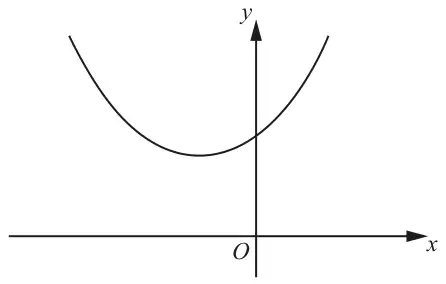
5 The diagram shows part of the curve \(y = 5\cosh x + 3\sinh x\).

Graph of y = 5cosh x + 3sinh x: a U-shaped curve lying above the x-axis, with its minimum point to the left of the y-axis, crossing the positive y-axis
(a) Solve the equation \(5\cosh x + 3\sinh x = 4\) giving your solution in exact form. [4]
(b) In this question you must show detailed reasoning.
Find \(\displaystyle\int_{-1}^{1} (5\cosh x + 3\sinh x)\,\mathrm{d}x\) giving your answer in the form \(a\mathrm{e} + \dfrac{b}{\mathrm{e}}\) where \(a\) and \(b\) are integers to be determined. [3]

A2 June 2025 Paper 1 Q16

OCR MEICurrent spec12 marksHyperbolic FunctionsIntegration

16 In this question you must show detailed reasoning.

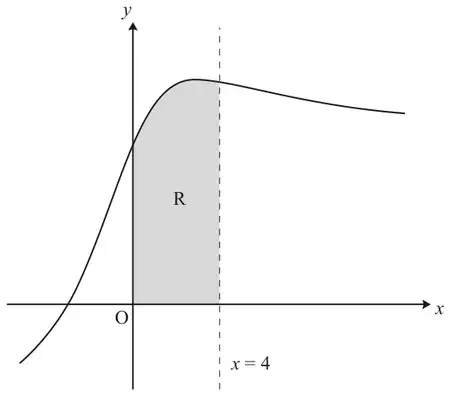
The diagram shows the curve with equation \(y = \dfrac{x + 3}{\sqrt{x^2 + 9}}\).

Curve y = (x + 3) over root(x squared + 9): crosses the negative x-axis, rises through the positive y-axis to a maximum, then decreases slowly; the region R between the curve, the axes and the dashed line x = 4 is shaded

The region R, shown shaded in the diagram, is bounded by the curve, the \(x\)-axis, the \(y\)-axis, and the line \(x = 4\).

(a) Determine the area of R. Give your answer in the form \(p + \ln q\) where \(p\) and \(q\) are integers to be determined. [6]

The region R is rotated through \(2\pi\) radians about the \(x\)-axis.

(b) Determine the volume of the solid of revolution formed. Give your answer in the form \(\pi\left(a + b\ln\left(\dfrac{c}{d}\right)\right)\) where \(a\), \(b\), \(c\) and \(d\) are integers to be determined. [6]

A2 June 2025 Paper 1 Q14

OCR MEICurrent spec10 marksHyperbolic FunctionsMatrices

14

(a) By using the definition of \(\cosh x\) and \(\sinh x\) in terms of \(\mathrm{e}^x\) and \(\mathrm{e}^{-x}\), show that \(\cosh^2 x + \sinh^2 x \equiv \cosh 2x\). [2]
(b) The transformation T of the plane has associated matrix \(\mathbf{M}\), where \(\mathbf{M} = \begin{pmatrix} \cosh x & \sinh x \\ \sinh x & \cosh x \end{pmatrix}\) and \(x \gt 0\).
Show that T transforms the unit square with coordinates \((0, 0)\), \((1, 0)\), \((0, 1)\) and \((1, 1)\) to a rhombus of unit area. [6]
(c) You are given that the length of each side of the rhombus is 2 units.
Determine the exact value of \(x\). Give your answer in logarithmic form. [2]

A2 June 2024 Paper 1 Q16

OCR MEICurrent spec6 marksHyperbolic FunctionsIntegration

16 In this question you must show detailed reasoning.

Show that \(\displaystyle\int_0^1 \frac{1}{\sqrt{x^2 + x + 1}}\,\mathrm{d}x = \ln\left(\dfrac{a + b\sqrt{3}}{c}\right)\), where \(a\), \(b\) and \(c\) are integers to be determined. [6]

A2 June 2024 Paper 1 Q12

OCR MEICurrent spec12 marksHyperbolic Functions

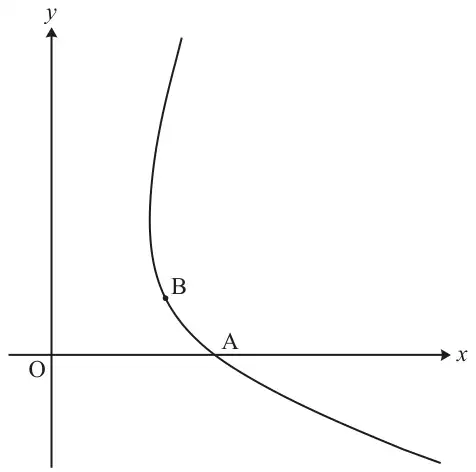
12 The diagram shows the curve with parametric equations

\(x = 2\cosh t + \sinh t,\ y = \cosh t - 2\sinh t\).

Curve in the first and fourth quadrants: it comes down steeply from the top, bends at the point B above the x-axis, crosses the positive x-axis at A and continues downwards to the right
(a) The curve crosses the positive \(x\)-axis at A.
(i) Determine the value of the parameter \(t\) at A, giving your answer in logarithmic form. [4]
(ii) Find the \(x\)-coordinate of A, giving your answer correct to 3 significant figures. [2]
(b) The point B has parameter \(t = 0\).
Determine the equation of the tangent to the curve at B. [6]

A2 June 2023 Paper 1 Q11

11 Solve the differential equation \(\cosh x\dfrac{\mathrm{d}y}{\mathrm{d}x} - 2y\sinh x = \cosh x\), given that \(y = 1\) when \(x = 0\). [7]

A2 June 2022 Paper 1 Q9

9 The function \(\mathrm{f}(x)\) is defined by \(\mathrm{f}(x) = \ln(1 + \sinh x)\).

(a) Given that \(k\) lies in the domain of this function, explain why \(k\) must be greater than \(\ln\left(\sqrt{2} - 1\right)\). [2]
(b)
(i) Find \(\mathrm{f}'(x)\). [2]
(ii) Show that \(\mathrm{f}''(x) = \dfrac{a\sinh x + b}{(1 + \sinh x)^2}\), where \(a\) and \(b\) are integers to be determined. [3]
(c) Hence find a quadratic approximation to \(\mathrm{f}(x)\) for small values of \(x\). [3]
(d) Find the percentage error in this approximation when \(x = 0.1\). [2]

A2 June 2022 Paper 1 Q3

OCR MEICurrent spec6 marksHyperbolic Functions

3 In this question you must show detailed reasoning.

Solve the equation \(3\cosh x = 2\sinh^2 x\), giving your solutions in exact logarithmic form. [6]

A2 October 2021 Paper 1 Q16

OCR MEICurrent spec14 marksHyperbolic FunctionsIntegration

16

(a) Show using exponentials that \(\cosh 2u = 1 + 2\sinh^2 u\). [4]
(b) Show that \(\displaystyle\int_0^2 \frac{x^2}{\sqrt{4 + x^2}}\,\mathrm{d}x = 2\sqrt{2} - 2\ln\left(1 + \sqrt{2}\right)\). [10]

A2 October 2020 Paper 1 Q13

13

(a) Using exponentials, prove that \(\sinh 2x = 2\cosh x\sinh x\). [2]
(b) Hence show that if \(\mathrm{f}(x) = \sinh^2 x\), then \(\mathrm{f}''(x) = 2\cosh 2x\). [2]
(c) Explain why the coefficients of odd powers in the Maclaurin series for \(\sinh^2 x\) are all zero. [2]
(d) Find the coefficient of \(x^n\) in this series when \(n\) is a positive even number. [3]

A2 October 2020 Paper 1 Q10

OCR MEICurrent spec7 marksHyperbolic FunctionsIntegration

10 In this question you must show detailed reasoning.

The region in the first quadrant bounded by curve \(y = \cosh\frac{1}{2}x^2\), the \(y\)-axis, and the line \(y = 2\) is rotated through \(360^\circ\) about the \(y\)-axis.

Find the exact volume of revolution generated, expressing your answer in a form involving a logarithm. [7]

A2 June 2019 Paper 1 Q15

OCR MEICurrent spec8 marksHyperbolic FunctionsIntegration

15 In this question you must show detailed reasoning.

Show that \(\displaystyle\int_{\frac{3}{4}}^{\frac{3}{2}} \frac{1}{\sqrt{4x^2 - 4x + 2}}\,\mathrm{d}x = \frac{1}{2}\ln\left(\frac{3 + \sqrt{5}}{2}\right)\). [8]

A2 June 2019 Paper 1 Q13

OCR MEICurrent spec11 marksHyperbolic FunctionsIntegration

13

(a) Using the logarithmic form of \(\operatorname{arcosh} x\), prove that the derivative of \(\operatorname{arcosh} x\) is \(\dfrac{1}{\sqrt{x^2 - 1}}\). [5]
(b) Hence find \(\displaystyle\int_1^2 \operatorname{arcosh} x\,\mathrm{d}x\), giving your answer in exact logarithmic form. [5]
(c) Ali tries to evaluate \(\displaystyle\int_0^1 \operatorname{arcosh} x\,\mathrm{d}x\) using his calculator, and gets an ‘error’. Explain why. [1]