Polar Coordinates

Edexcel

AQA

OCR A

OCR MEI

A2 June 2025 Paper 2 Q7

EdexcelCurrent spec12 marksPolar Coordinates

7.

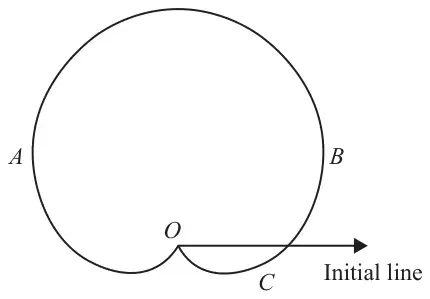
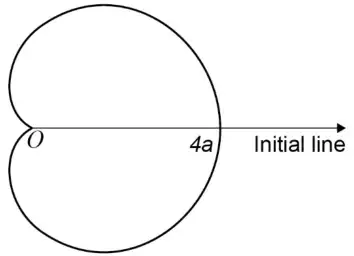
Figure 1: closed curve C through the pole O, with points A and B on the far left and far right of the curve, a small loop C below the initial line near O, and the initial line drawn from O
Figure 1

The curve \(C\) shown in Figure 1 has polar equation

\[r = a(1 + \sin\theta) \qquad -\pi \lt \theta \leqslant \pi\]

where \(a\) is a constant.

The tangents to \(C\) at the points \(A\) and \(B\) are perpendicular to the initial line.

(a) Use calculus to determine the polar coordinates of \(A\) and \(B\) (6)

The curve \(C\) models the perimeter of the surface of a swimming pool.

Given that, according to the model, the distance across the pool from \(A\) to \(B\) is 10 m,

(b) show that \(a = \dfrac{20\sqrt{3}}{9}\) (2)
(c) Use algebraic integration to determine the surface area of the swimming pool, according to the model. (4)

A2 June 2024 Paper 1 Q3

EdexcelCurrent spec8 marksPolar Coordinates

3. In this question you must show all stages of your working.

Solutions relying entirely on calculator technology are not acceptable.

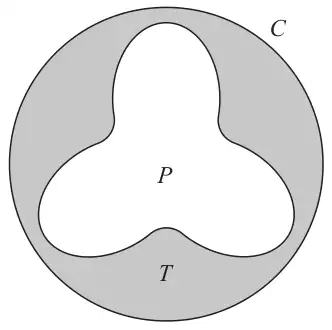
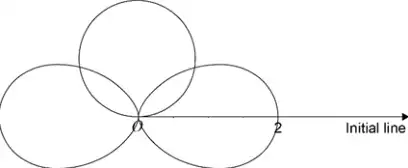
Figure 1: a circle C with the pool P inside it, a three-lobed unshaded shape with the same centre; the shaded region T between the pool and the circle
Figure 1

Figure 1 shows the design for a bathing pool.

The pool, \(P\), shown unshaded in Figure 1, is surrounded by a tiled area, \(T\), shown shaded in Figure 1.

The tiled area is bounded by the edge of the pool and by a circle, \(C\), with radius 6 m.

The centre of the pool and the centre of the circle are the same point.

The edge of the pool is modelled by the curve with polar equation

\[r = 4 - a\sin 3\theta \qquad 0 \leqslant \theta \leqslant 2\pi\]

where \(a\) is a positive constant.

Given that the shortest distance between the edge of the pool and the circle \(C\) is 0.5 m,

(a) determine the value of \(a\). (2)
(b) Hence, using algebraic integration, determine, according to the model, the exact area of \(T\). (6)

A2 June 2023 Paper 2 Q4

EdexcelCurrent spec7 marksPolar Coordinates

4.

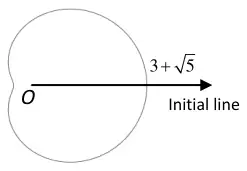
(a) Sketch the polar curve \(C\), with equation\[r = 3 + \sqrt{5}\cos\theta \qquad 0 \leqslant \theta \leqslant 2\pi\]On your sketch clearly label the pole, the initial line and the value of \(r\) at the point where the curve intersects the initial line. (2)

The tangent to \(C\) at the point \(A\), where \(0 \lt \theta \lt \dfrac{\pi}{2}\), is parallel to the initial line.

(b) Use calculus to show that at \(A\)\[\cos\theta = \frac{1}{\sqrt{5}}\] (4)
(c) Hence determine the value of \(r\) at \(A\). (1)

A2 June 2023 Paper 2 Q1

EdexcelCurrent spec4 marksHyperbolic FunctionsPolar Coordinates

1.

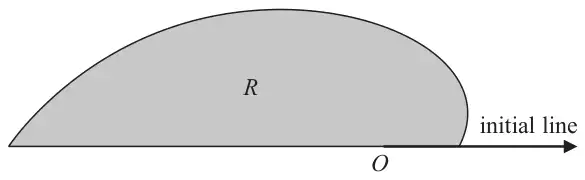
Polar curve starting at the pole O on the initial line, rising in a smooth arc over to the left and meeting the extension of the initial line on the left; the region R enclosed above the line is shaded
Figure 1

Figure 1 shows a sketch of the curve with polar equation

\[r = 2\sqrt{\sinh\theta + \cosh\theta} \qquad 0 \leqslant \theta \leqslant \pi\]

The region \(R\), shown shaded in Figure 1, is bounded by the initial line, the curve and the line with equation \(\theta = \pi\)

Use algebraic integration to determine the exact area of \(R\) giving your answer in the form \(p\mathrm{e}^q - r\) where \(p\), \(q\) and \(r\) are real numbers to be found.

(4)

A2 June 2022 Paper 2 Q7

EdexcelCurrent spec10 marksPolar Coordinates

7.

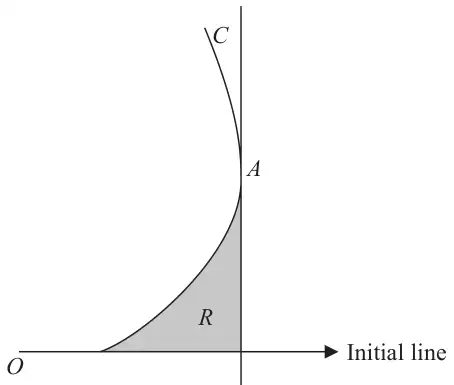
Figure 1: the curve C rising from O on the initial line, touching a vertical tangent line at A and then bending back to the left; the region R between the curve, the tangent and the initial line is shaded
Figure 1

Figure 1 shows a sketch of the curve \(C\) with equation

\[r = 1 + \tan\theta \qquad\qquad 0 \leqslant \theta \lt \frac{\pi}{3}\]

Figure 1 also shows the tangent to \(C\) at the point \(A\).
This tangent is perpendicular to the initial line.

(a) Use differentiation to prove that the polar coordinates of \(A\) are \(\left(2, \dfrac{\pi}{4}\right)\) (4)

The finite region \(R\), shown shaded in Figure 1, is bounded by \(C\), the tangent at \(A\) and the initial line.

(b) Use calculus to show that the exact area of \(R\) is \(\dfrac{1}{2}(1 - \ln 2)\) (6)

A2 October 2021 Paper 2 Q6

EdexcelCurrent spec14 marksPolar Coordinates

6. The curve \(C\) has equation

\[r = a(p + 2\cos\theta) \qquad 0 \leqslant \theta \lt 2\pi\]

where \(a\) and \(p\) are positive constants and \(p \gt 2\)

There are exactly four points on \(C\) where the tangent is perpendicular to the initial line.

(a) Show that the range of possible values for \(p\) is\[2 \lt p \lt 4\] (5)
(b) Sketch the curve with equation\[r = a(3 + 2\cos\theta) \qquad 0 \leqslant \theta \lt 2\pi \quad \text{where } a \gt 0\] (1)

John digs a hole in his garden in order to make a pond.

The pond has a uniform horizontal cross section that is modelled by the curve with equation

\[r = 20(3 + 2\cos\theta) \qquad 0 \leqslant \theta \lt 2\pi\]

where \(r\) is measured in centimetres.

The depth of the pond is 90 centimetres.

Water flows through a hosepipe into the pond at a rate of 50 litres per minute.

Given that the pond is initially empty,

(c) determine how long it will take to completely fill the pond with water using the hosepipe, according to the model. Give your answer to the nearest minute. (7)
(d) State a limitation of the model. (1)

A2 October 2020 Paper 1 Q3

EdexcelCurrent spec9 marksPolar Coordinates

3.

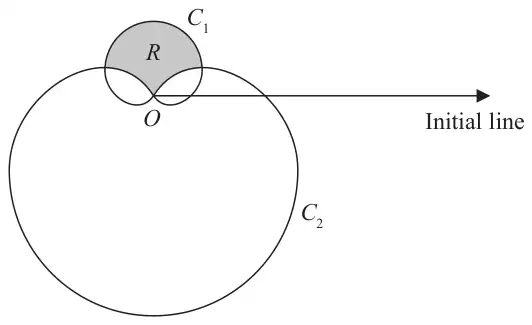
Figure 1: a large curve C2 around the pole O with a small curve C1 above the pole; the region R inside C1 and outside C2 is shaded, with the initial line drawn from O to the right
Figure 1

Figure 1 shows a sketch of two curves \(C_1\) and \(C_2\) with polar equations

\[C_1\colon r = (1 + \sin\theta) \qquad 0 \leqslant \theta \lt 2\pi\]\[C_2\colon r = 3(1 - \sin\theta) \qquad 0 \leqslant \theta \lt 2\pi\]

The region \(R\) lies inside \(C_1\) and outside \(C_2\) and is shown shaded in Figure 1.

Show that the area of \(R\) is

\[p\sqrt{3} - q\pi\]

where \(p\) and \(q\) are integers to be determined.

(9)

A2 June 2019 Paper 1 Q3

EdexcelCurrent spec10 marksPolar Coordinates

3.

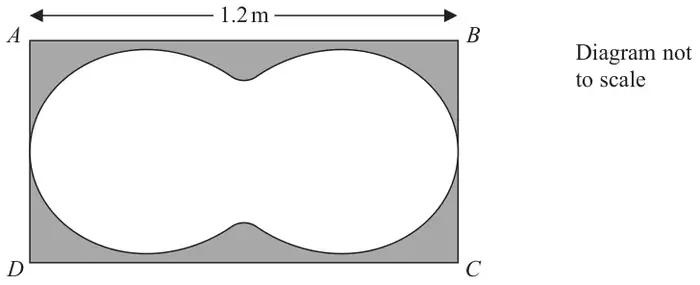
Figure 1: rectangle ABCD with AB = 1.2 m; inside it a closed curve shaped like a peanut, touching all four sides, with the region between the curve and the rectangle shaded. Diagram not to scale
Figure 1

Figure 1 shows the design for a table top in the shape of a rectangle \(ABCD\). The length of the table, \(AB\), is 1.2 m. The area inside the closed curve is made of glass and the surrounding area, shown shaded in Figure 1, is made of wood.

The perimeter of the glass is modelled by the curve with polar equation

\[r = 0.4 + a\cos 2\theta \qquad 0 \leqslant \theta \lt 2\pi\]

where \(a\) is a constant.

(a) Show that \(a = 0.2\) (2)

Hence, given that \(AD = 60\) cm,

(b) find the area of the wooden part of the table top, giving your answer in m2 to 3 significant figures. (8)

AS June 2025 Paper 1 Q15

AQACurrent spec11 marksPolar Coordinates

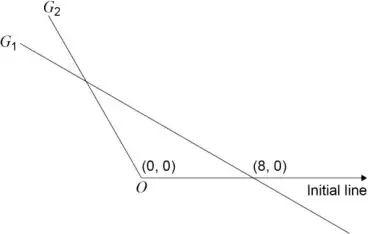
15 The graph \(G_1\) has the polar equation

\[r = \frac{8}{\cos\theta + \sqrt{3}\sin\theta} \qquad -\frac{\pi}{6} \lt \theta \lt \frac{5\pi}{6}\]

The graph \(G_2\) has the polar equation

\[\theta = \frac{2\pi}{3}\]
(a) Show that \(G_1\) is a straight line by writing it as a Cartesian equation in the form \(y = mx + c\) where \(m\) and \(c\) are constants to be found. [3 marks]
(b) On the initial line shown in Figure 1, sketch \(G_1\) and \(G_2\)

Include the polar coordinates of the intersection point of \(G_1\) with the initial line. [3 marks]

Figure 1: the pole O with the initial line drawn horizontally to the right
Figure 1
(c) Find the polar coordinates of the intersection point of \(G_1\) and \(G_2\) [3 marks]
(d) Find the area of the region bounded by the initial line and graphs \(G_1\) and \(G_2\) [2 marks]

A2 June 2025 Paper 2 Q14

AQACurrent spec8 marksPolar Coordinates

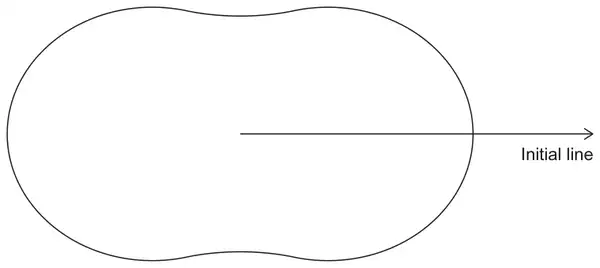
14 A children’s play area in a park contains a paddling pool.

The outline of the paddling pool is modelled by the polar curve

\[r = 6 + 2\cos(2\theta)\]

where \(r\) is measured in metres.

Figure 2 shows the outline of the paddling pool.

Figure 2: the closed curve r = 6 + 2cos(2θ), an oval that is slightly pinched in at the top and bottom, with the initial line drawn from the pole to the right
Figure 2

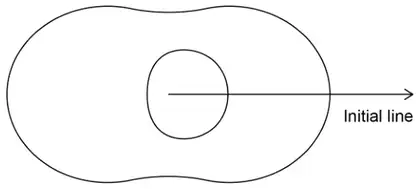
There is a solid concrete island inside the paddling pool.

The boundary of the island is modelled by the polar curve

\[r = 2 + \cos\theta\]

where \(r\) is measured in metres.

(a) Sketch the boundary of the island on Figure 2 [2 marks]
(b) The paddling pool has a constant depth of 0.3 metres.

Find the volume of water in the paddling pool.

Give your answer to four significant figures.

Fully justify your answer. [6 marks]

A2 June 2024 Paper 1 Q16

AQACurrent spec9 marksPolar Coordinates

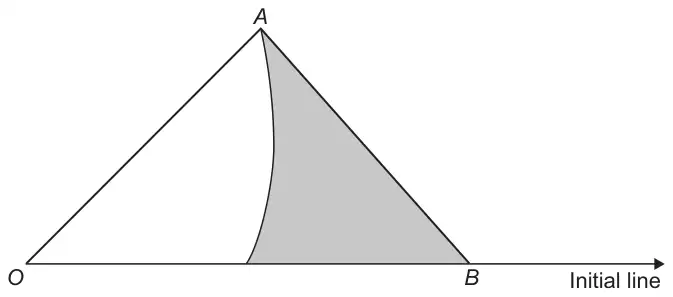
16 The curve \(C\) has polar equation \(r = 2 + \tan\theta\)

The curve \(C\) meets the line \(\theta = \dfrac{\pi}{4}\) at the point \(A\)

The point \(B\) has polar coordinates \((4, 0)\)

The diagram shows part of the curve \(C\), and the points \(A\) and \(B\)

Triangle OAB with O at the pole, B on the initial line and A above, with OA along the line theta = pi/4; the curve C runs from a point on the initial line between O and B up to A, and the region between the curve and the side AB is shaded
(a) Show that the area of triangle \(OAB\) is \(3\sqrt{2}\) units. [2 marks]
(b) Find the area of the shaded region.

Give your answer in an exact form. [7 marks]

AS June 2024 Paper 1 Q16

AQACurrent spec6 marksPolar Coordinates

16 The curve \(C\) has the polar equation

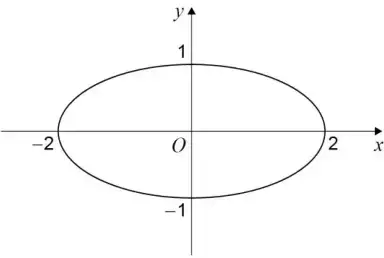
\[r = \frac{2}{\sqrt{\cos^2\theta + 4\sin^2\theta}} \qquad -\pi \lt \theta \leqslant \pi\]
(a) Show that the Cartesian equation of \(C\) can be written as\[\frac{x^2}{a^2} + \frac{y^2}{b^2} = 1\]

where \(a\) and \(b\) are positive integers to be determined. [4 marks]

(b) Hence sketch the graph of \(C\) on the axes below.

Indicate the value of any intercepts of the curve with the axes. [2 marks]

Blank axes: x-axis and y-axis crossing at O

A2 June 2023 Paper 1 Q14

14 The curve \(C\) has polar equation

\[r = \frac{4}{5 + 3\cos\theta} \qquad (-\pi \lt \theta \leqslant \pi)\]
(a) Show that \(r\) takes values in the range \(\dfrac{1}{k} \leqslant r \leqslant k\), where \(k\) is an integer. [2 marks]
(b) Find the Cartesian equation of \(C\) in the form \(y^2 = \mathrm{f}(x)\) [4 marks]
(c) The ellipse \(E\) has equation\[y^2 + \frac{16x^2}{25} = 1\]

Find the transformation that maps the graph of \(E\) onto \(C\) [4 marks]

AS June 2023 Paper 1 Q11

AQACurrent spec8 marksPolar Coordinates

11 A point has Cartesian coordinates \((x, y)\) and polar coordinates \((r, \theta)\) where \(r \geqslant 0\) and \(-\pi \lt \theta \leqslant \pi\)

(a) Express \(r\) in terms of \(x\) and \(y\) [1 mark]
(b) Express \(x\) in terms of \(r\) and \(\theta\) [1 mark]
(c) The curve \(C_1\) has the polar equation\[r(2 + \cos\theta) = 1 \qquad -\pi \lt \theta \leqslant \pi\]
(i) Show that the Cartesian equation of \(C_1\) can be written as\[ay^2 = (1 + bx)(1 + x)\]

where \(a\) and \(b\) are integers to be determined. [4 marks]

(ii) The curve \(C_2\) has the Cartesian equation\[ax^2 = (1 + by)(1 + y)\]

where \(a\) and \(b\) take the same values as in part (c)(i).

Describe fully a single transformation that maps the curve \(C_1\) onto the curve \(C_2\) [2 marks]

A2 June 2022 Paper 1 Q9

AQACurrent spec14 marksMatricesPolar Coordinates

9 Roberto is solving this mathematics problem:

The curve \(C_1\) has polar equation

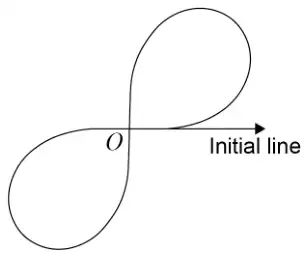
\[r^2 = 9\sin 2\theta\]

for all possible values of \(\theta\)

Find the area enclosed by \(C_1\)

Roberto’s solution is as follows:

\[\begin{aligned} A &= \frac{1}{2}\int_{-\pi}^{\pi} 9\sin 2\theta\,\mathrm{d}\theta \\ &= \left[-\frac{9}{4}\cos 2\theta\right]_{-\pi}^{\pi} \\ &= 0 \end{aligned}\]
(a) Sketch the curve \(C_1\) [2 marks]
The pole O with the initial line drawn from O to the right
(b) Explain what Roberto has done wrong. [2 marks]
(c) Find the area enclosed by \(C_1\) [2 marks]
(d) \(P\) and \(Q\) are distinct points on \(C_1\) for which \(r\) is a maximum.
\(P\) is above the initial line.

Find the polar coordinates of \(P\) and \(Q\) [2 marks]

(e) The matrix \(\mathbf{M} = \begin{bmatrix} 1 & 2 \\ 0 & 1 \end{bmatrix}\) represents the transformation T

T maps \(C_1\) onto a curve \(C_2\)

(i) T maps \(P\) onto the point \(P^{\prime}\)

Find the polar coordinates of \(P^{\prime}\) [4 marks]

(ii) Find the area enclosed by \(C_2\)

Fully justify your answer. [2 marks]

AS June 2022 Paper 1 Q8

AQACurrent spec7 marksPolar Coordinates

8 The curve \(C\) has the polar equation

\[r = 4 - 2\cos\theta \qquad -\pi \lt \theta \leqslant \pi\]
(a) Verify that the point with polar coordinates \(\left(3, \dfrac{\pi}{3}\right)\) lies on \(C\) [1 mark]
(b) Find the exact polar coordinates of the point on \(C\) which is furthest from the pole, \(O\) [3 marks]
(c) Find the exact Cartesian coordinates of the point on \(C\) where \(\theta\) is \(\dfrac{\pi}{6}\) [3 marks]

AS June 2021 Paper 1 Q17

AQACurrent spec10 marksPolar Coordinates

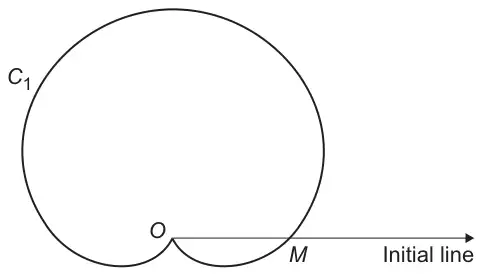
17 The curve \(C_1\) has polar equation \(r = 2a(1 + \sin\theta)\) for \(-\pi \lt \theta \leqslant \pi\) where \(a\) is a positive constant.

The curve C1, a cardioid-shaped closed curve lying mostly above the initial line, with a cusp at the pole O, crossing the initial line at the point M

The point \(M\) lies on \(C_1\) and the initial line.

(a) Write down, in terms of \(a\), the polar coordinates of \(M\) [1 mark]
(b) \(N\) is the point on \(C_1\) that is furthest from the pole \(O\)

Find, in terms of \(a\), the polar coordinates of \(N\) [2 marks]

(c) The curve \(C_2\) has polar equation \(r = 3a\) for \(-\pi \lt \theta \leqslant \pi\)
\(C_2\) intersects \(C_1\) at points \(P\) and \(Q\)

Show that the area of triangle \(NPQ\) can be written in the form

\[m\sqrt{3}a^2\]

where \(m\) is a rational number to be determined. [5 marks]

(d) On the initial line below, sketch the graph of \(r = 2a(1 + \cos\theta)\) for \(-\pi \lt \theta \leqslant \pi\)

Include the polar coordinates, in terms of \(a\), of any intersection points with the initial line. [2 marks]

The initial line, drawn from the pole O

A2 June 2021 Paper 2 Q9

AQACurrent spec14 marksPolar Coordinates

9

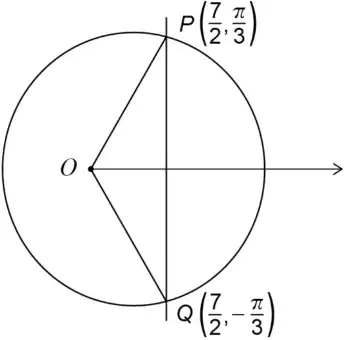
(a) The line \(L\) has polar equation\[r = \frac{7}{4}\sec\theta \qquad \left(-\frac{\pi}{2} \lt \theta \lt \frac{\pi}{2}\right)\]

Show that \(L\) is perpendicular to the initial line. [2 marks]

(b) The curve \(C\) has polar equation\[r = 3 + \cos\theta \qquad (-\pi \lt \theta \leqslant \pi)\]

Find the polar coordinates of the points of intersection of \(L\) and \(C\)

Fully justify your answer. [5 marks]

(c) The region \(R\) is the set of points such that\[r \gt \frac{7}{4}\sec\theta\]

and

\[r \lt 3 + \cos\theta\]

Find the exact area of \(R\) [7 marks]

A2 June 2021 Paper 1 Q3

AQACurrent spec1 markPolar Coordinates

3 The curve \(C\) has polar equation

\[r^2 \sin 2\theta = 4\]

Find a Cartesian equation for \(C\).

Circle your answer. [1 mark]

  • \(y = 2x\)
  • \(y = \dfrac{x}{2}\)
  • \(y = \dfrac{2}{x}\)
  • \(y = 4x\)

AS June 2020 Paper 1 Q17

AQACurrent spec4 marksPolar Coordinates

17 The polar equation of the circle \(C\) is

\[r = a(\cos\theta + \sin\theta)\]

Find, in terms of \(a\), the radius of \(C\).

Fully justify your answer. [4 marks]

A2 June 2020 Paper 2 Q14

AQACurrent spec11 marksPolar Coordinates

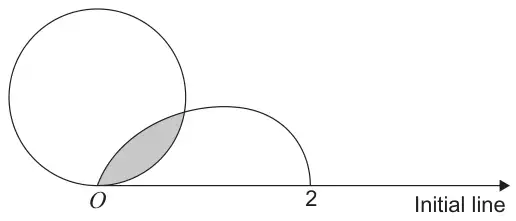
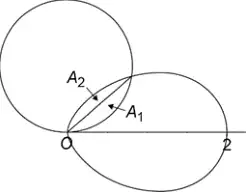
14 The diagram shows the polar curve \(C_1\) with equation \(r = 2\sin\theta\)

The diagram also shows part of the polar curve \(C_2\) with equation \(r = 1 + \cos 2\theta\)

Polar diagram: the circle C1 sits above the initial line touching it at O; part of C2 runs from O up through the circle and over to the point 2 on the initial line; the region inside both curves near O is shaded
(a) On the diagram above, complete the sketch of \(C_2\) [2 marks]
(b) Show that the area of the region shaded in the diagram is equal to\[k\pi + m\alpha - \sin 2\alpha + q\sin 4\alpha\]

where \(\alpha = \sin^{-1}\left(\dfrac{\sqrt{5} - 1}{2}\right)\), and \(k\), \(m\) and \(q\) are rational numbers. [9 marks]

AS June 2020 Paper 1 Q11

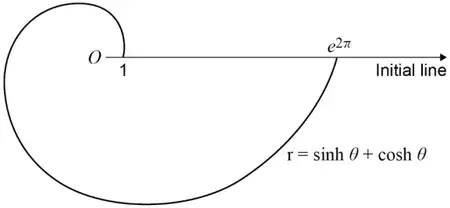
11 Sketch the polar graph of

\[r = \sinh\theta + \cosh\theta\]

for \(0 \leqslant \theta \leqslant 2\pi\) [3 marks]

The initial line, drawn from the pole O

A2 June 2019 Paper 1 Q15

AQACurrent spec11 marksPolar Coordinates

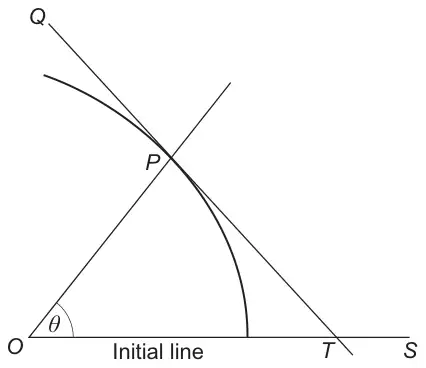
15 The diagram shows part of a spiral curve.

The point \(P\) has polar coordinates \((r, \theta)\) where \(0 \leqslant \theta \leqslant \dfrac{\pi}{2}\)

The points \(T\) and \(S\) lie on the initial line and \(O\) is the pole.

\(TPQ\) is the tangent to the curve at \(P\).

Diagram: a spiral curve meeting the initial line OS between O and T; P is a point on the curve with OP at angle θ to the initial line; the tangent at P runs from Q above P down through P to T on the initial line, with S beyond T
(a) Show that the gradient of \(TPQ\) is equal to\[\frac{\dfrac{\mathrm{d}r}{\mathrm{d}\theta}\sin\theta + r\cos\theta}{\dfrac{\mathrm{d}r}{\mathrm{d}\theta}\cos\theta - r\sin\theta}\] [4 marks]
(b) The curve has polar equation\[r = \mathrm{e}^{(\cot b)\theta}\]

where \(b\) is a constant such that \(0 \lt b \lt \dfrac{\pi}{2}\)

Use the result of part (a) to show that the angle between the line \(OP\) and the tangent \(TPQ\) does not depend on \(\theta\). [7 marks]
AS June 2019 Paper 1 Q4

AQACurrent spec2 marksPolar Coordinates

4 The line \(L\) has polar equation

\[r = \frac{k}{\sin\theta}\]

where \(k\) is a positive constant.

(a) Sketch \(L\). [1 mark]
The initial line, drawn from the pole O
(b) State the minimum distance between \(L\) and the point \(O\). [1 mark]
AS June 2019 Paper 1 Q3

AQACurrent spec1 markPolar Coordinates

3 Point \(P\) has polar coordinates \(\left(2, \dfrac{2\pi}{3}\right)\).

Which of the following are the Cartesian coordinates of \(P\)?

Circle your answer. [1 mark]

  • \((1, -\sqrt{3})\)
  • \((-\sqrt{3}, 1)\)
  • \((\sqrt{3}, -1)\)
  • \((-1, \sqrt{3})\)

AS June 2018 Paper 1 Q4

AQACurrent spec2 marksPolar Coordinates

4 Sketch the graph given by the polar equation

\[r = \frac{a}{\cos\theta}\]

where \(a\) is a positive constant. [2 marks]

The initial line, drawn from the pole O

A2 June 2025 Paper 2 Q6

OCR ACurrent spec6 marksPolar Coordinates

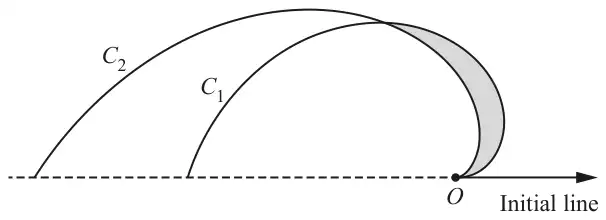
6 One of the regions bounded by two polar curves, \(C_1\) and \(C_2\), is used to model the face of a flat earring.

The polar equations of \(C_1\) and \(C_2\) are

\(C_1: r = 2\theta\)
\(C_2: r = \theta^2\)

where \(0 \leqslant \theta \leqslant \pi\).

The curves \(C_1\) and \(C_2\) are shown in the diagram below with the region used to model the earring shaded.

Two spiral arcs C1 and C2 starting at the pole O and curving anticlockwise above the initial line to end on the dashed line through O, C2 being the outer curve on the left; the thin crescent-shaped region between them near O, to the right, is shaded

You are given that \(C_1\) and \(C_2\) intersect at the pole \(O\).

(a) Find the other point of intersection of \(C_1\) and \(C_2\). Give your answer in polar coordinates. [2]
(b) In this question you must show detailed reasoning.
Determine the area of the face of the earring. [4]

A2 June 2024 Paper 1 Q12

OCR ACurrent spec7 marksPolar Coordinates

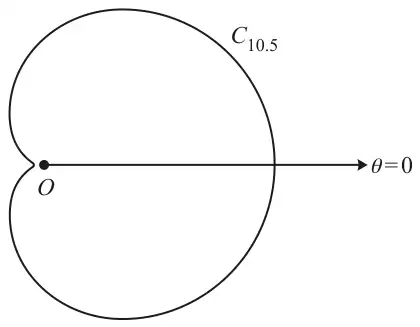
12 For any positive parameter \(k\), the curve \(C_k\) is defined by the polar equation

\(r = k(\cos\theta + 1) + \dfrac{10}{k}, 0 \leqslant \theta \leqslant 2\pi\).

For each value of \(k\) the curve is a single, closed loop with no self-intersections. The diagram shows \(C_{10.5}\) for the purpose of illustration.

Polar curve C10.5: a closed loop around the pole O, shaped like a cardioid with a small dimple at O, symmetrical about the initial line theta = 0

Each curve, \(C_k\), encloses a certain area, \(A_k\).
You are given that there is a single minimum value of \(A_k\).

Determine, in an exact form, the value of \(k\) for which \(C_k\) encloses this minimum area. [7]

A2 June 2024 Paper 2 Q6

OCR ACurrent spec11 marksHyperbolic FunctionsPolar Coordinates

6 In polar coordinates, the equation of a curve, \(C\), is \(r = 6\sin(2\theta)\sinh\left(\frac{1}{3}\theta\right)\) for \(0 \leqslant \theta \leqslant \frac{1}{2}\pi\).

The pole of the polar coordinate system corresponds to the origin of the cartesian system and the initial line corresponds to the positive \(x\)-axis.

(a) Explain how you can tell that \(C\) comprises a single loop in the first quadrant, passing through the pole. [3]

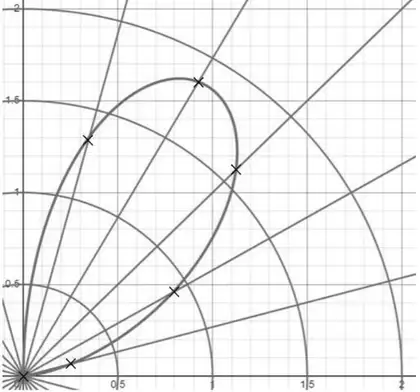
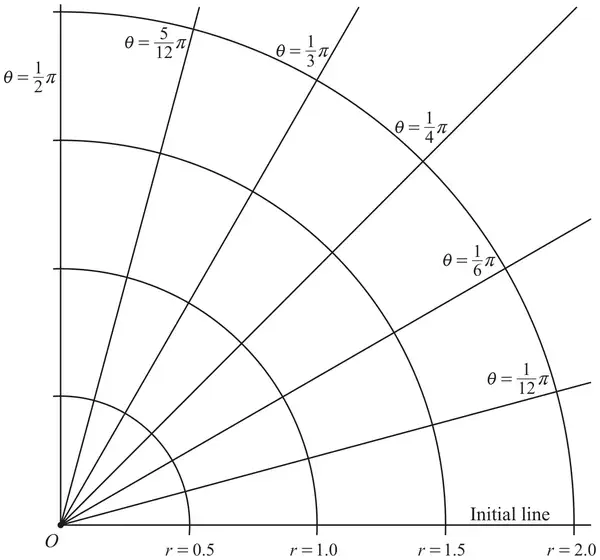
The incomplete table below shows values of \(r\) for various values of \(\theta\).

\(\theta\)\(0\)\(\dfrac{1}{12}\pi\)\(\dfrac{1}{6}\pi\)\(\dfrac{1}{4}\pi\)\(\dfrac{1}{3}\pi\)\(\dfrac{5}{12}\pi\)\(\dfrac{1}{2}\pi\)
\(r\)00.2621.851
(b) Use the copy of the table and the polar coordinate system diagram given below to complete the table and sketch \(C\). [3]
Polar coordinate grid from the Printed Answer Booklet: the pole O, the initial line, quarter-circle arcs r = 0.5, 1.0, 1.5 and 2.0, and half-lines theta = pi/12, pi/6, pi/4, pi/3, 5pi/12 and pi/2

The point on \(C\) which is furthest away from the pole is denoted by \(A\) and the value of \(\theta\) at \(A\) is denoted by \(\phi\).

(c) Show that \(\phi\) satisfies the equation \(\phi = \dfrac{3}{2}\ln\left(\dfrac{6 - \tan 2\phi}{6 + \tan 2\phi}\right)\) [4]
(d) You are given that the relevant solution of the equation given in part (c) is \(\phi = 1.0207\) correct to 5 significant figures.
Find the distance from \(A\) to the pole. Give your answer correct to 3 significant figures. [1]

A2 June 2023 Paper 2 Q10

10 In this question you must show detailed reasoning.

A region, \(R\), of the floor of an art gallery is to be painted for the purposes of an art installation. A suitable polar coordinate system is set up on the floor of the gallery with units in metres and radians. \(R\) is modelled as being the region enclosed by two curves, \(C_1\) and \(C_2\). The polar equations of \(C_1\) and \(C_2\) are

\[\begin{aligned} &C_1: r = 5, &&-\tfrac{1}{2}\pi \leqslant \theta \leqslant \tfrac{1}{2}\pi \\ &C_2: r = 3\cosh\theta, &&-\tfrac{1}{2}\pi \leqslant \theta \leqslant \tfrac{1}{2}\pi \end{aligned}\]

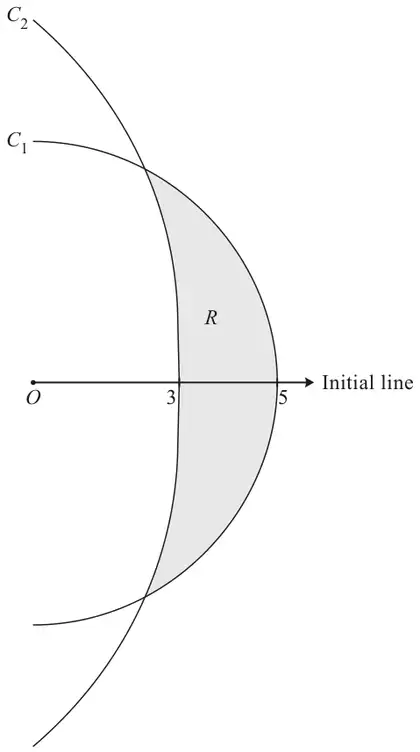
Both curves are shown in the diagram, with \(R\) indicated.

Polar diagram: the semicircular arc C1 of radius 5 and the curve C2, which crosses the initial line at 3 and bends away from the pole; the two curves intersect above and below the initial line, and the shaded region R lies between them, reaching the initial line from 3 to 5

The gallery must buy tins of paint to paint \(R\). Each tin of paint can cover an area of \(0.5\,\text{m}^2\).

Determine the smallest number of tins of paint that the gallery must buy in order to be able to paint \(R\) completely. [7]

A2 June 2022 Paper 1 Q5

OCR ACurrent spec11 marksPolar Coordinates

5 The diagram below shows the curve \(C\) with polar equation \(r = 3(1 - \sin 2\theta)\) for \(0 \leqslant \theta \leqslant 2\pi\).

Polar curve C with two loops meeting at the pole O: one loop in the upper left and one in the lower right; the initial line theta = 0 is drawn from O
(a) Show that a cartesian equation of \(C\) is \(\left(x^2 + y^2\right)^3 = 9(x - y)^4\). [3]
(b) Show that the line with equation \(y = x\) is a line of symmetry of \(C\). [2]
(c) In this question you must show detailed reasoning.
Find the exact area of each of the loops of \(C\). [6]

A2 June 2022 Paper 2 Q2

OCR ACurrent spec5 marksPolar Coordinates

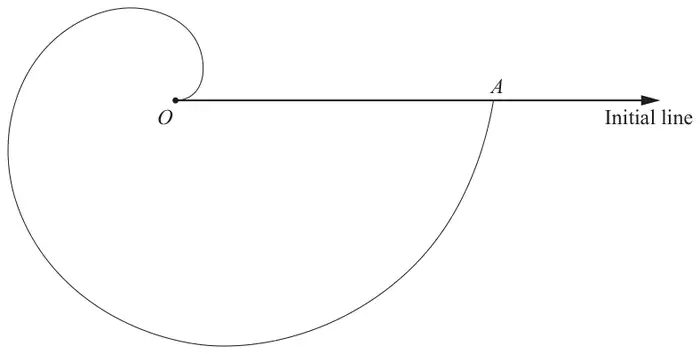
2 Two polar curves, \(C_1\) and \(C_2\), are defined by \(C_1 : r = 2\theta\) and \(C_2 : r = \theta + 1\) where \(0 \leqslant \theta \leqslant 2\pi\).

\(C_1\) intersects the initial line at two points, the pole and the point \(A\).

(a) Write down the polar coordinates of \(A\). [2]
(b) Determine the polar coordinates of the point of intersection of \(C_1\) and \(C_2\). [2]

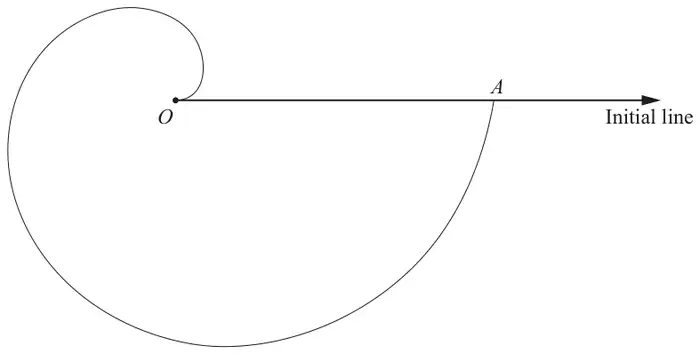
The diagram below shows a sketch of \(C_1\).

Sketch of the spiral C1, r = 2 theta, starting at the pole O, curling up and to the left round below the initial line and meeting the initial line again at A
(c) On the copy of this sketch below, sketch \(C_2\). [1]
Copy of the sketch of C1 with the pole O, the point A and the initial line

A2 October 2021 Paper 1 Q7

OCR ACurrent spec9 marksPolar Coordinates

7 The diagram below shows the curve with polar equation \(r = \sin 3\theta\) for \(0 \leqslant \theta \leqslant \frac{1}{3}\pi\).

A single loop starting and ending at the pole O, lying above the initial line, with the initial line drawn from O to the right and labelled theta = 0
(a) Find the values of \(\theta\) at the pole. [1]
(b) Find the polar coordinates of the point on the curve where \(r\) takes its maximum value. [2]
(c) In this question you must show detailed reasoning.
Find the exact area enclosed by the curve. [4]
(d) Given that \(\sin 3\theta = 3\sin\theta - 4\sin^3\theta\), find a cartesian equation for the curve. [2]

A2 October 2020 Paper 1 Q11

OCR ACurrent spec8 marksPolar Coordinates

11 A curve has cartesian equation \(x^3 + y^3 = 2xy\).

\(C\) is the portion of the curve for which \(x \geqslant 0\) and \(y \geqslant 0\). The equation of \(C\) in polar form is given by \(r = \mathrm{f}(\theta)\) for \(0 \leqslant \theta \leqslant \frac{1}{2}\pi\).

(a) Find \(\mathrm{f}(\theta)\). [2]
(b) Find an expression for \(\mathrm{f}\left(\frac{1}{2}\pi - \theta\right)\), giving your answer in terms of \(\sin\theta\) and \(\cos\theta\). [2]
(c) Hence find the line of symmetry of \(C\). [1]
(d) Find the value of \(r\) when \(\theta = \frac{1}{4}\pi\). [1]
(e) By finding values of \(\theta\) when \(r = 0\), show that \(C\) has a loop. [2]

A2 October 2020 Paper 2 Q6

OCR ACurrent spec6 marksPolar Coordinates

6 The equation of a curve in polar coordinates is \(r = \ln(1 + \sin\theta)\) for \(\alpha \leqslant \theta \leqslant \beta\) where \(\alpha\) and \(\beta\) are non-negative angles. The curve consists of a single closed loop through the pole.

(a) By solving the equation \(r = 0\), determine the smallest possible values of \(\alpha\) and \(\beta\). [2]
(b) Find the area enclosed by the curve, giving your answer to 4 significant figures. [2]
(c) Hence, by considering the value of \(r\) at \(\theta = \dfrac{\alpha + \beta}{2}\), show that the loop is not circular. [2]

A2 June 2019 Paper 2 Q9

9 In this question you must show detailed reasoning.

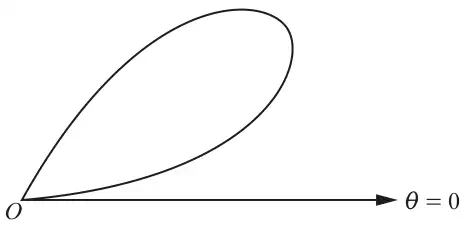
The diagram below shows the curve \(r = \sqrt{\sin\theta}\,\mathrm{e}^{\frac{1}{3}\cos\theta}\) for \(0 \leqslant \theta \leqslant \pi\).

Polar curve: a single closed loop above the initial line, starting and ending at the pole O and tangential to the initial line at O; initial line labelled theta = 0
(a) Find the exact area enclosed by the curve. [4]
(b) Show that the greatest value of \(r\) on the curve is \(\sqrt{\dfrac{\sqrt{3}}{2}}\,\mathrm{e}^{\frac{1}{6}}\). [7]

A2 June 2025 Paper 1 Q6

OCR MEICurrent spec9 marksPolar Coordinates

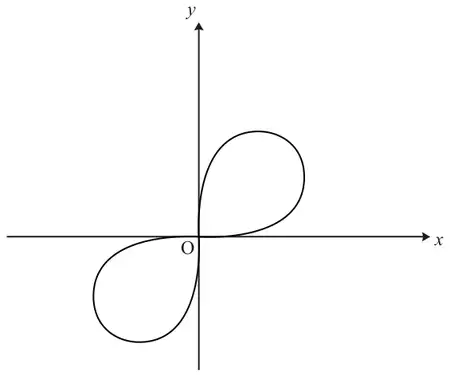
6 The figure below shows the curve with cartesian equation \((x^2 + y^2)^2 = xy\).

Curve (x squared + y squared) squared = xy: two loops through the origin O, one in the first quadrant and one in the third quadrant
(a) Show that the polar equation of the curve is \(r^2 = a\sin b\theta\), where \(a\) and \(b\) are positive constants to be determined. [3]
(b) Determine the exact maximum value of \(r\). [2]
(c) Determine the area enclosed by one of the loops. [4]

A2 June 2024 Paper 1 Q9

OCR MEICurrent spec8 marksPolar Coordinates

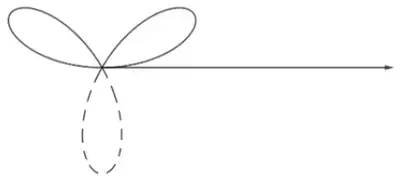
9 A curve has polar equation \(r = a\sin 3\theta\), for \(0 \leqslant \theta \leqslant \pi\), where \(a\) is a positive constant.

(a) Sketch the curve. Indicate the parts of the curve where \(r\) is negative by using a broken line. [3]
(b) In this question you must show detailed reasoning.
Determine the area of one of the loops of the curve. [5]

A2 June 2023 Paper 1 Q7

OCR MEICurrent spec6 marksPolar Coordinates

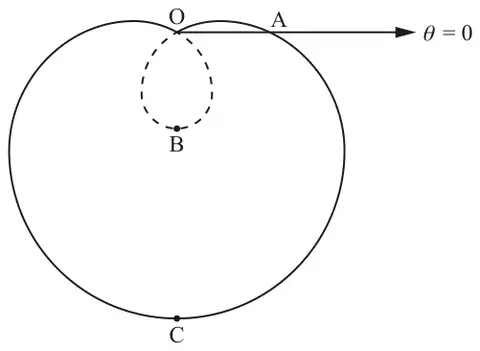
7 The diagram below shows the curve with polar equation \(r = a(1 - 2\sin\theta)\) for \(0 \leqslant \theta \leqslant 2\pi\), where \(a\) is a positive constant.

Polar curve: a large outer loop with a small dashed inner loop inside it, both passing through the pole O; the initial line theta = 0 from O crosses the curve at A; B is the lowest point of the inner loop and C the lowest point of the outer loop

The curve crosses the initial line at A, and the points B and C are the lowest points on the two loops.

(a) Find the values of \(r\) and \(\theta\) at the points A, B and C. [3]
(b) Find the set of values of \(\theta\) for the points on the inner loop (shown in the diagram with a broken line). [3]

A2 June 2022 Paper 1 Q5

OCR MEICurrent spec7 marksPolar Coordinates

5

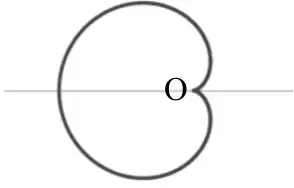
(a) Sketch the polar curve \(r = a(1 - \cos\theta)\), \(0 \leqslant \theta \lt 2\pi\), where \(a\) is a positive constant. [2]
(b) Determine the exact area of the region enclosed by the curve. [5]

A2 October 2021 Paper 1 Q14

OCR MEICurrent spec14 marksPolar Coordinates

14 A curve has polar equation \(r = a(\cos\theta + 2\sin\theta)\), where \(a\) is a positive constant and \(0 \leqslant \theta \leqslant \pi\).

(a) Determine the polar coordinates of the point on the curve which is furthest from the pole. [7]
(b)
(i) Show that the curve is a circle whose radius should be specified. [6]
(ii) Write down the polar coordinates of the centre of the circle. [1]

A2 October 2020 Paper 1 Q5

OCR MEICurrent spec8 marksPolar Coordinates

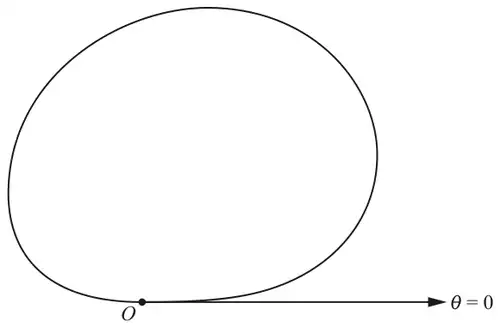
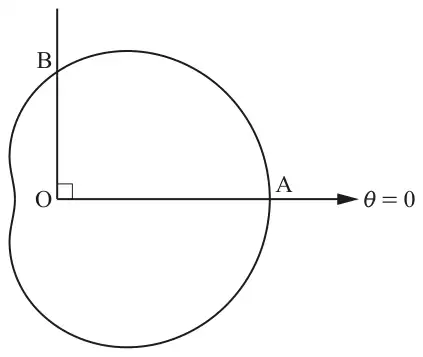
5 Fig. 5 shows the curve with polar equation \(r = a(3 + 2\cos\theta)\) for \(-\pi \leqslant \theta \leqslant \pi\), where \(a\) is a constant.

Fig. 5: a closed curve, slightly dented near the pole, enclosing the pole O; the initial line theta = 0 is drawn from O to the right and meets the curve at A; a line from O perpendicular to the initial line meets the curve at B
Fig. 5
(a) Write down the polar coordinates of the points A and B. [2]
(b) Explain why the curve is symmetrical about the initial line. [2]
(c) In this question you must show detailed reasoning.
Find in terms of \(a\) the exact area of the region enclosed by the curve. [4]

A2 June 2019 Paper 1 Q7

OCR MEICurrent spec8 marksPolar Coordinates

7 A curve has cartesian equation \((x^2 + y^2)^2 = 2c^2xy\), where \(c\) is a positive constant.

(a) Show that the polar equation of the curve is \(r^2 = c^2\sin 2\theta\). [2]
(b) Sketch the curves \(r = c\sqrt{\sin 2\theta}\) and \(r = -c\sqrt{\sin 2\theta}\) for \(0 \leqslant \theta \leqslant \frac{1}{2}\pi\). [3]
(c) Find the area of the region enclosed by one of the loops in part (b). [3]