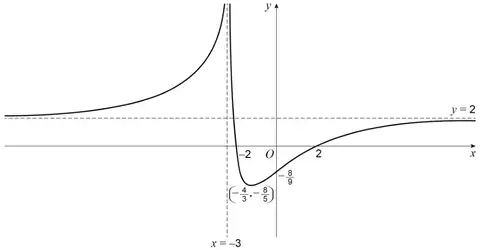
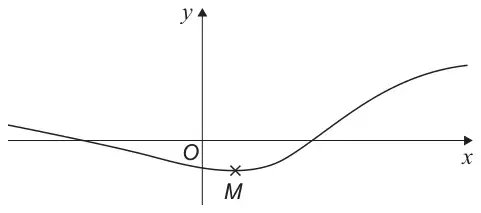
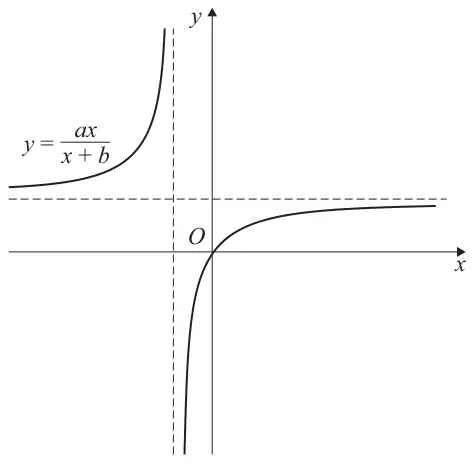
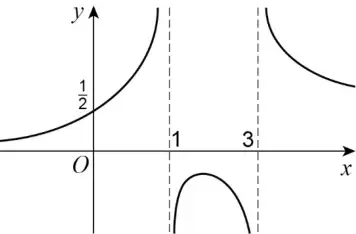
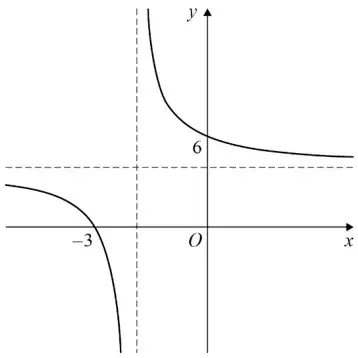
(a) Write down the equations of the asymptotes to the graph of \(y = \mathrm{f}(x)\) [2 marks]
(b) Without using calculus, show that the range of \(\mathrm{f}\) is \(\left\{k : k \geqslant -\dfrac{8}{5}\right\}\) [4 marks]
(c) The graph of \(y = \mathrm{f}(x)\) has one stationary point.
Without using calculus, find the coordinates of this stationary point. [3 marks]
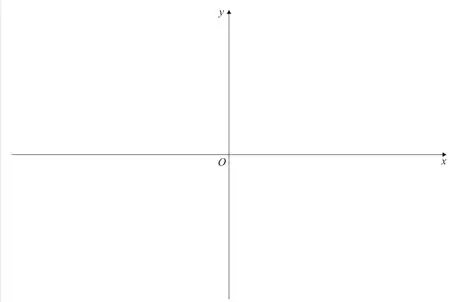
(d) Sketch the graph of \(y = \mathrm{f}(x)\) on the axes below. [4 marks]
Mark scheme (a)
Scheme
Marks
AO
Obtains \(x = -3\) or \(y = 2\)
M1
1.1a
Obtains \(x = -3\) and \(y = 2\) and no other asymptotes.
A1
1.1b
(2)
Typical solution
\[x = -3\]\[y = 2\]
Mark scheme (b)
Scheme
Marks
AO
Forms a quadratic equation in \(x\) involving \(k\) or equivalent.
M1
3.1a
Obtains a quadratic equation with \(k\) in a coefficient and sets the discriminant to zero, either in an equation or inequality.
M1
1.1a
Solves their equation or inequality in \(k\)
M1
1.1a
Completes a reasoned argument, without using calculus, to state that the range is \(\left\{k : k \geqslant -\dfrac{8}{5}\right\}\) AG Allow letters other than \(k\) used.
Draws approximately correct shape of the right-hand branch
B1
1.1b
Draws both branches of the graph approaching the correct asymptotes.
B1
1.1b
Shows at least two correctly labelled axis intercepts.
B1
1.1b
Draws completely correct graph including correctly labelled asymptotes, a stationary point in the third quadrant, and all three correctly labelled axis intercepts. Condone no labelling of stationary point.
Multiplies LHS and RHS by \((3x - 9)^2\) or Subtracts one side from the other and correctly combines the fractions. or Cross multiplies and solves for \(x\)
PI by obtaining at least one correct region or a correct quadratic factor or both \(\frac{2}{3}\) and 4
M1
3.1a
Obtains a correct quadratic factor eg \(3x^2 - 14x + 8\) PI by obtaining \(\frac{2}{3}\) and 4 or States \(x \neq 3\) PI by \(x \gt 3\)
M1
1.1a
Obtains at least one correct region. Condone \(3 \leqslant x \leqslant 4\)
M1
1.1a
Obtains \(x \leqslant \dfrac{2}{3}\), \(3 \lt x \leqslant 4\)
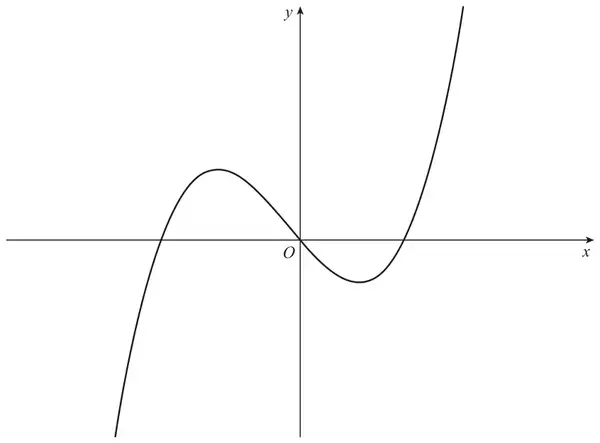
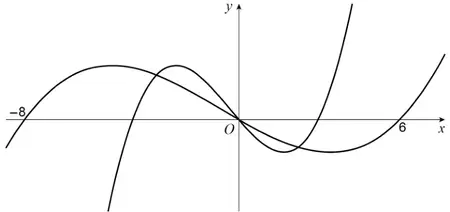
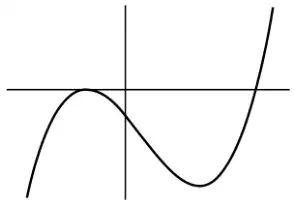
(a) The graph of \(y = \mathrm{f}(x)\) is transformed by a stretch, scale factor 2, parallel to the \(x\)-axis with the \(y\)-axis fixed, to give the graph of \(y = \mathrm{g}(x)\)
On Figure 1, sketch the graph of \(y = \mathrm{g}(x)\), showing the values of \(x\) where the graph crosses the \(x\)-axis. [3 marks]
(b) Find the set of values of \(x\) such that the conditions \(\mathrm{f}(x) \gt 0\) and \(\mathrm{g}(x) \lt 0\) are both satisfied. [2 marks]
Mark scheme (a)
Scheme
Marks
AO
Draws a cubic graph of the correct shape. Condone any horizontal stretch.
B1
1.1b
Draws a cubic graph that crosses \(x\)-axis at \(-8\), 0 and 6 Accept no indication of \(x = 0\) at the origin.
B1
1.1b
Shows local maximum and minimum points which are approximately the same height as in the original graph.
B1
1.1b
(3)
Typical solution
Mark scheme (b)
Scheme
Marks
AO
Obtains a set of values of the form \(\{x : a \lt x \lt 2a\}\) or \(\{x : 2a \lt x \lt a\}\) Condone non-strict inequality. Condone set notation not used.
M1
2.2a
Obtains \(3 \lt x \lt 6\) Condone set notation not used.
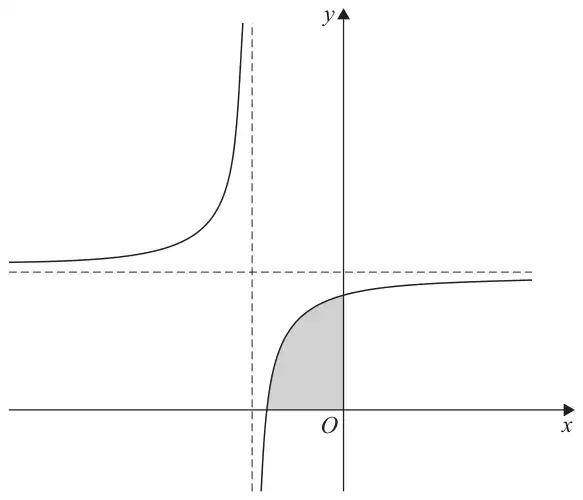
The graph of \(y = \mathrm{f}(x)\) has asymptotes \(x = -2\) and \(y = 3\)
(a) Write down the value of \(a\) and the value of \(b\) [2 marks]
(b) The diagram shows the graph of \(y = \mathrm{f}(x)\) and its asymptotes.
The shaded region \(R\) is enclosed by the graph of \(y = \mathrm{f}(x)\), the \(x\)-axis and the \(y\)-axis.
(i) The shaded region \(R\) is rotated through 360° about the \(x\)-axis to form a solid.
Find the volume of this solid.
Give your answer to three significant figures. [3 marks]
(ii) The shaded region \(R\) is rotated through 360° about the \(y\)-axis to form a solid.
Find the volume of this solid.
Give your answer to three significant figures. [4 marks]
Mark scheme (a)
Scheme
Marks
AO
Deduces that \(a = 3\)
B1
2.2a
Deduces that \(b = 2\)
B1
2.2a
(2)
Typical solution
\[a = 3,\ b = 2\]
Mark scheme (b)
Scheme
Marks
AO
(i) Deduces that \(x\)-intercept is \(-\dfrac{5}{3}\). PI by correct answer.
B1
2.2a
(i) Uses \(\pi\displaystyle\int y^2\,\mathrm{d}x\) Condone missing \(\mathrm{d}x\) and missing/incorrect limits. PI by correct answer.
M1
1.1a
(i) Obtains AWRT 21.2
A1
1.1b
(3)
(ii) Deduces that \(y\)-intercept \(= 2.5\) PI correct answer.
B1
2.2a
(ii) Deduces an expression for \(x\) in terms of \(y\) PI correct answer.
M1
2.2a
(ii) Uses \(\pi\displaystyle\int x^2\,\mathrm{d}y\) Condone missing \(\mathrm{d}y\), use of \(\mathrm{d}x\) and missing/incorrect limits. PI by correct answer.
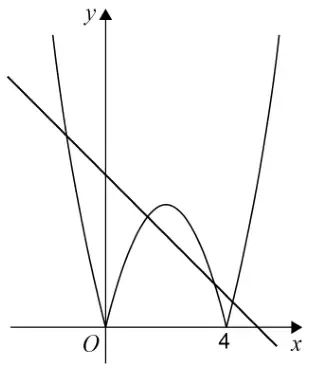
(a) On the diagram above, sketch the graph of \(y = \left|x^2 - 4x\right|\), including all parts of the graph where it intersects the line \(y = 5 - x\)
(You do not need to show the coordinates of the points of intersection.) [3 marks]
(b) Find the solution of the inequality\[\left|x^2 - 4x\right| \gt 5 - x\]
Give your answer in an exact form. [4 marks]
Mark scheme (a)
Scheme
Marks
AO
Draws curve with basically correct shape and no negative \(y\)-values.
B1
1.1b
Their graph intersects line at four distinct points.
B1
1.1b
Value of 4 shown at \(x\)-intercept
B1
1.1b
(3)
Typical solution
Mark scheme (b)
Scheme
Marks
AO
Uses the modulus function to obtain two separate quadratic equations.
M1
3.1a
Obtains four correct \(x\)-values of points of intersection (condone decimal approximations).
A1
1.1a
Uses their graph to obtain at least one subset of the solution set (condone decimal approximations).
M1
2.2a
Deduces a completely correct solution set with exact values.
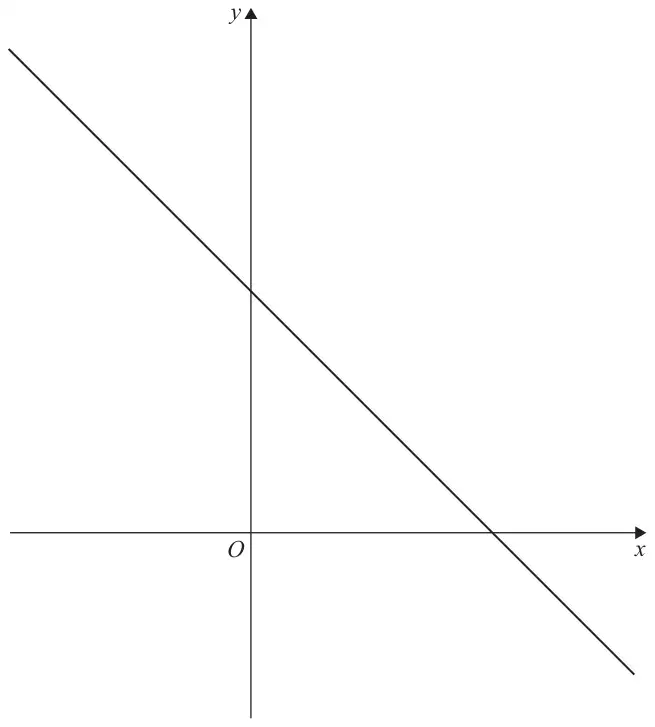
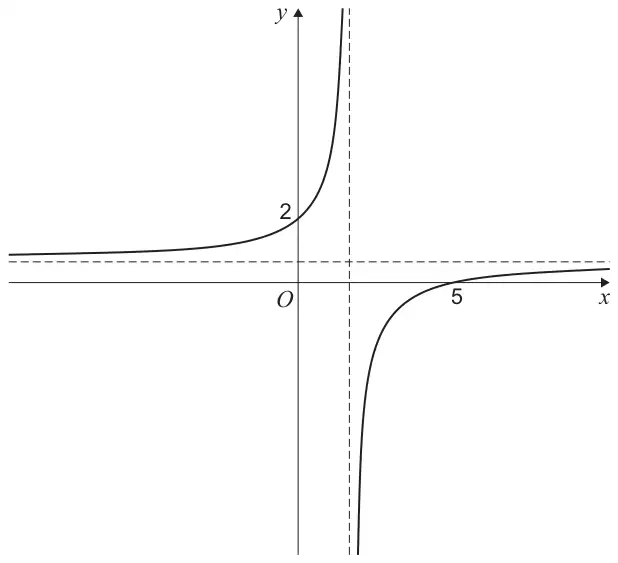
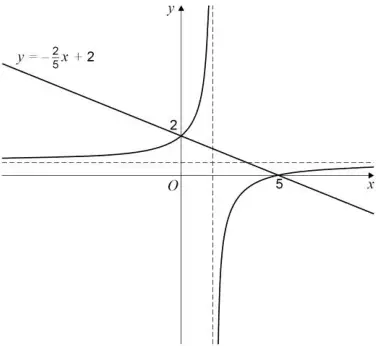
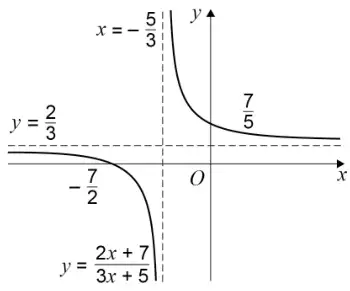
Figure 1 shows the curve \(C\) with its asymptotes.
Figure 1
(a) Write down the equations of the asymptotes of \(C\) [2 marks]
(b) The line \(L\) has equation\[y = -\frac{2}{5}x + 2\]
(i) Draw the line \(L\) on Figure 1[2 marks]
(ii) Hence, or otherwise, solve the inequality\[\frac{2x - 10}{3x - 5} \leqslant -\frac{2}{5}x + 2\] [2 marks]
Mark scheme (a)
Scheme
Marks
AO
States \(x = \dfrac{5}{3}\) or \(y = \dfrac{2}{3}\)
M1
2.2a
States \(x = \dfrac{5}{3}\) and \(y = \dfrac{2}{3}\) and no incorrect equations seen.
A1
2.2a
(2)
Typical solution
\[x = \frac{5}{3}\]\[y = \frac{2}{3}\]
Mark scheme (b)
Scheme
Marks
AO
(i) Draws a straight line with negative gradient passing through \((0, 2)\) Accept freehand if the intention is clear.
M1
1.1a
Draws a straight line passing through \((0, 2)\) and \((5, 0)\)
A1
1.1b
(2)
(ii) Deduces one of the ranges \(x \leqslant 0\) or \(\dfrac{5}{3} \lt x \leqslant 5\) Condone \(\dfrac{5}{3} \leqslant x \leqslant 5\) or \(\dfrac{5}{3} \lt x \lt 5\) for this mark only. Ignore any incorrect ranges.
M1
2.2a
Deduces the solution \(x \leqslant 0\), \(\dfrac{5}{3} \lt x \leqslant 5\)
A1
2.2a
(2)
(6 marks)
Typical solution
(i)
(ii)
\[x \leqslant 0\]\[\frac{5}{3} \lt x \leqslant 5\]
Rearranges to make \(ky^2\) the subject, having correctly removed any square root in their equation. Equation must be in terms of \(x\) and \(y\) only.
(a) Show, without using calculus, that the graph of \(y = \mathrm{f}(x)\) has a stationary point at \(\left(-2, \dfrac{1}{3}\right)\) [3 marks]
(b) Show that \(\displaystyle\int_{-2}^{-\frac{1}{2}} \mathrm{f}(x)\,\mathrm{d}x = \frac{\pi\sqrt{3}}{18}\) [5 marks]
(c) Find the value of \(\displaystyle\int_{-2}^{\infty} \mathrm{f}(x)\,\mathrm{d}x\)
Fully justify your answer. [2 marks]
Mark scheme (a)
Scheme
Marks
AO
Completes the square for denominator. Or Sets \(\mathrm{f}(x) = k\) and forms a quadratic equation in \(x\)
M1
3.1a
Explains that \(\mathrm{f}\) has a stationary point when \(x = -2\) Or Equates the discriminant of the quadratic equation to 0 and solves for \(k\)
E1
2.4
Completes a reasoned argument, without using calculus, to show that the stationary point is at \(\left(-2, \dfrac{1}{3}\right)\) to obtain the required result.
\[\{x : -9 \lt x \lt -3\} \cup \{x : 2 \lt x \lt b\}\]
Find the values of integers \(a\) and \(b\) [4 marks]
Mark scheme
Scheme
Marks
AO
Factorises \(x^2 - 5x - 24\) to \((x + m)(x + n)\) where \(m + n = -5\) or \(mn = -24\) and identifies their \(m, n \gt 2\) as \(b\)
Or uses the coefficients of a quartic to form an equation in \(a\) and/or \(b\) eg \(-(-5 + 7) = -9 + (-3) + 2 + b\) eg \(-24a = -9 \times -3 \times 2 \times b\)
Or multiplies two or more of the factors \((x + 9)\), \((x + 3)\), \((x - 2)\) and \((x - b)\)
M1
3.1a
Obtains \(a = -18\) or \(b = 8\)
A1
1.1b
Expands \((x + 9)(x - 2)\) and identifies the constant term as \(a\)
Or correctly forms two equations in \(a\) and \(b\)
Or divides the expanded quartic by a quadratic or a cubic formed by multiplying two or three of \((x + 9)\), \((x + 3)\), \((x - 2)\) and \((x - b)\)
Or compares coefficients in the expansions of \((x^2 - 5x - 24)(x^2 + 7x + a)\) and \((x + 9)(x + 3)(x - 2)(x - b)\)
M1
3.1a
Obtains \(a = -18\) and \(b = 8\)
A1
1.1b
(4 marks)
Typical solution
\[x^2 - 5x - 24 = (x - 8)(x + 3)\]
\(\therefore\) the critical values include \(-3\) and 8
\[\therefore \ b = 8\]\[(x + 9)(x - 2) = (x^2 + 7x - 18)\]\[\therefore \ a = -18\]
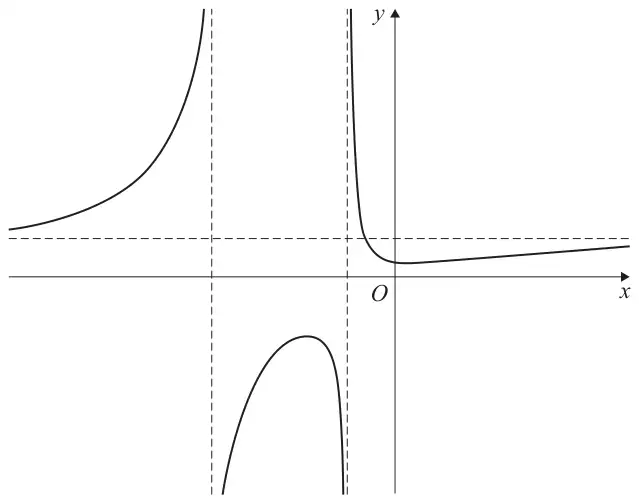
The vertical asymptotes of \(C\) are \(x = -4\) and \(x = -1\)
The curve \(C\) is shown in the diagram below.
(a) Write down the equation of the horizontal asymptote of \(C\) [1 mark]
(b) Find the value of \(m\) and the value of \(p\) [2 marks]
(c) Hence, or otherwise, write down the coordinates of the \(y\)-intercept of \(C\) [1 mark]
(d) Without using calculus, show that the line \(y = -1\) does not intersect \(C\) [5 marks]
Mark scheme (a)
Scheme
Marks
AO
States \(y = 3\)
B1
1.1b
(1)
Typical solution
\[y = 3\]
Mark scheme (b)
Scheme
Marks
AO
Identifies the correct factors of the denominator PI
M1
1.1a
Obtains the correct values.
A1
1.1b
(2)
Typical solution
The denominator is \((x + 4)(x + 1)\)
\[= x^2 + 5x + 4\]\[\therefore \ m = 4 \text{ and } p = 5\]
Mark scheme (c)
Scheme
Marks
AO
Obtains the correct \(y\)-coordinate of the intercept.
Follow through their \(\dfrac{p}{m}\)
B1F
1.1b
(1)
Typical solution
When \(x = 0\), then \(y = \dfrac{p}{m} = \dfrac{5}{4}\)
\(\therefore\) \(y\)-intercept is \(\left(0, \dfrac{5}{4}\right)\)
Mark scheme (d)
Scheme
Marks
AO
Forms an equation to find the intersection point(s) if they exist.
Could equate to a letter, eg \(k\) instead of \(-1\)
M1
1.1a
Rearranges into a three-term quadratic equation. Allow one arithmetic error.
Could be in terms of \(k\)
M1
1.1a
Obtains a correct quadratic equation.
Could be in terms of \(k\) \((k - 3)x^2 + (5k - 4)x + 4k - 5 = 0\)
A1
1.1b
Uses a correct method to deduce that their quadratic equation has no real roots. or Considers the sign of the discriminant in terms of \(k\) \(\Delta = 9k^2 + 28k - 44\)
M1
1.1a
Completes a reasoned argument to conclude that the line \(y = -1\) does not intersect \(C\)
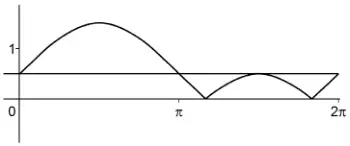
\[\mathrm{f}(x) = \left|\sin x + \frac{1}{2}\right| \qquad (0 \leqslant x \leqslant 2\pi)\]
Find the set of values of \(x\) for which
\[\mathrm{f}(x) \geqslant \frac{1}{2}\]
Give your answer in set notation. [5 marks]
Mark scheme
Scheme
Marks
AO
Sketches graph of \(y = \sin x + \tfrac{1}{2}\) PI by graph of \(y = \left|\sin x + \tfrac{1}{2}\right|\) or considers one equation or inequality without modulus sign eg \(\sin x + \tfrac{1}{2} = \tfrac{1}{2}\) or \(\left(\sin x + \tfrac{1}{2}\right)^2 = \tfrac{1}{4}\)
M1
3.1a
Obtains the set of values \(0 \leqslant x \leqslant \pi\) Condone \(0 \lt x \lt \pi\)
A1
2.2a
Obtains a graph of \(y = \left|\sin x + \tfrac{1}{2}\right|\) with the correct shape or Obtains the other equation or inequality without modulus sign eg \(\sin x + \tfrac{1}{2} = -\tfrac{1}{2}\) or Obtains two critical values from a quadratic in \(\sin x\)
M1
1.1a
Obtains \(3\pi/2\)
A1
1.1b
Obtains a completely correct answer, and expresses it using set notation. eg \([0, \pi] \cup \left\{\dfrac{3\pi}{2}, 2\pi\right\}\) \(\{x : 0 \leqslant x \leqslant \pi\} \cup \left\{x : x = \dfrac{3\pi}{2}\right\} \cup \{x : x = 2\pi\}\) Condone \(\left\{x : 0 \leqslant x \leqslant \pi, \dfrac{3\pi}{2}, 2\pi\right\}\)
Josh says that to solve this problem you must first carry out the transformation on \(C_1\) to find \(C_2\), and then find the asymptotes of \(C_2\)
Zoe says that you will get the same answer if you first find the asymptotes of \(C_1\), and then carry out the transformation on these asymptotes to obtain the asymptotes of \(C_2\)
Show that Zoe is correct. [5 marks]
Mark scheme
Scheme
Marks
AO
States the correct asymptotes of \(C_1\)
B1
1.1b
States the correct equation of \(C_2\)
B1
3.1a
States the correct asymptotes of \(C_2\)
B1
1.1b
Obtains the asymptotes of \(C_2\) by both methods.
M1
3.1a
Shows that both methods lead to the same answer and concludes that Zoe is correct.
R1
2.3
(5 marks)
Typical solution
Josh’s method
Reflection in \(y = x\)
\[C_2 \text{ is } \frac{y^2}{16} - \frac{x^2}{9} = 1\]
The asymptotes of \(C_2\) are \(y = \pm\dfrac{4}{3}x\)
Zoe’s method
The asymptotes of \(C_1\) are \(y = \pm\dfrac{3}{4}x\)
The transformation is a reflection in \(y = x\)
The asymptotes of \(C_2\) are \(y = \pm\dfrac{4}{3}x\)
(i) Multiplies by the denominator and forms a quadratic equation in \(x\)
M1
1.1a
Obtains a correct quadratic equation in \(x\) in the form \(ax^2 + bx + c = 0\)
PI by a correct discriminant.
A1
1.1b
Selects a method to demonstrate the required inequality. Substitutes \(k\) for \(y\) and uses the discriminant to form an inequality in \(k\)
M1
3.1a
Obtains a correct quadratic inequality in \(k\)
A1
1.1b
Completes a rigorous proof to show that \(19k^2 - 16k - 12 \leqslant 0\)
R1
2.1
(5)
(ii) Selects a method to find the \(y\)-coordinate of the minimum point. Obtains at least one correct root of the given quadratic. PI by \(-0.48\) or \(1.32\) or better
(a) Find a sequence of transformations that maps the graph of \(C_1\) onto the graph of \(C_2\) [4 marks]
(b) Find the equations of the asymptotes to \(C_2\)
Give your answers in the form \(ax + by + c = 0\) where \(a\), \(b\) and \(c\) are integers. [3 marks]
Mark scheme (a)
Scheme
Marks
AO
Deduces that a stretch, only along the \(y\)-axis, is required
M1
2.2a
Deduces that a translation with two non-zero components is needed (or a translation parallel to the \(x\)-axis and a translation parallel to the \(y\)-axis)
Translation by vector \(\begin{bmatrix}3 \\ -4\end{bmatrix}\) gives
\[\frac{(x - 3)^2}{25} - (y + 4)^2 = 1\]
which is equivalent to the equation for \(C_2\)
Stretch, scale factor ½, along \(y\)-axis followed by translation by vector \(\begin{bmatrix}3 \\ -4\end{bmatrix}\)
Mark scheme (b)
Scheme
Marks
AO
Obtains the correct asymptotes of \(C_1\) (PI) or uses a correct method to obtain both asymptotes of \(C_2\) directly PI by an equation of the form \(5y \pm x + k = 0\)
M1
1.1a
Correctly applies their sequence of at least two different types of transformations to one asymptote or obtains an equation of the form \(5y \pm x + k = 0\) where \(k\) is a non-zero integer constant
Selects a suitable method to solve the inequality, for example Multiplies by square of denominator or sketches graphs of their \(y = \mathrm{f}(x)\) and \(y = x + 2\)
M1
3.1a
Simplifies their inequality or equation or Indicates points of intersection of the two graphs
M1
1.1a
Obtains at least two critical values of their inequality or equation
A1F
1.1b
Excludes \(x = \dfrac{9}{2}\) (PI by final answer)
A1
2.2a
Deduces correct solution set for their inequality or graph. Condone inclusion of \(x = \dfrac{9}{2}\) Follow through their answers to part a)
A1F
2.2a
Obtains completely correct solution OE with each step clearly shown
16 Curve \(C\) has equation \(y = \dfrac{ax}{x + b}\) where \(a\) and \(b\) are constants. The equations of the asymptotes to \(C\) are \(x = -2\) and \(y = 3\)
(a) Write down the value of \(a\) and the value of \(b\) [2 marks]
(b) The gradient of \(C\) at the origin is \(\dfrac{3}{2}\)
With reference to the graph, explain why there is exactly one root of the equation
\[\frac{ax}{x + b} = \frac{3x}{2}\]
[2 marks]
(c) Using the values found in part (a), solve the inequality\[\frac{ax}{x + b} \leqslant 1 - x\]
[4 marks]
Mark scheme (a)
Scheme
Marks
AO
Obtains \(a = 3\) Accept \(y = \dfrac{3x}{x + b}\) with any non-zero value of \(b\)
B1
2.2a
Obtains \(b = 2\) Accept \(y = \dfrac{ax}{x + 2}\) with any non-zero value of \(a\)
Explains that \(y = \frac{3x}{2}\) is a tangent to the curve. Condone ‘tangent’ only.
B1
2.4
Explains that a tangent to a hyperbola meets the curve exactly once. Accept ‘conic’ instead of ‘hyperbola’. Condone no conclusion given.
B1
2.4
(2)
Typical solution
\(y = \frac{3x}{2}\) is a tangent to the hyperbola.
Any tangent to a hyperbola only intersects once.
So there is exactly one root of the equation.
Mark scheme (c)
Scheme
Marks
AO
Forms a simplified quadratic equation from \(ax - (1 - x)(x + b) = 0\) Accept any inequality sign instead of = PI by \(x^2 + 4x - 2\) or \(-x^2 - 4x + 2\) PI by \(-2 + \sqrt{6}\) or \(-2 - \sqrt{6}\) Or forms a simplified cubic equation from \(ax(x + 2) - (1 - x)(x + b)(x + 2) = 0\)
M1
1.1a
Identifies \(-2 + \sqrt{6}\) or \(-2 - \sqrt{6}\) as a critical value. Follow through their \(a\) and \(b\)
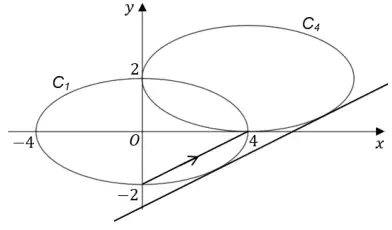
(a) Curve \(C_2\) is a reflection of \(C_1\) in the line \(y = x\)
Write down an equation of \(C_2\) [1 mark]
(b) Curve \(C_3\) is a circle of radius 4, centred at the origin.
Describe a single transformation which maps \(C_1\) onto \(C_3\) [2 marks]
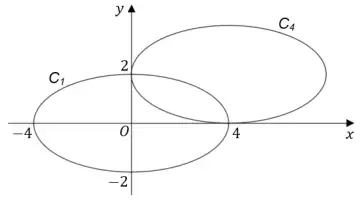
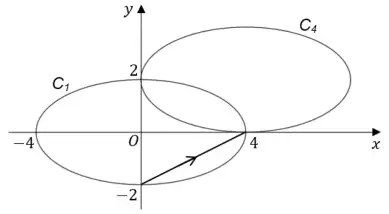
(c) Curve \(C_4\) is a translation of \(C_1\) The positive \(x\)-axis and the positive \(y\)-axis are tangents to \(C_4\)
(i) Sketch the graphs of \(C_1\) and \(C_4\) on the axes below. Indicate the coordinates of the \(x\) and \(y\) intercepts on your graphs. [2 marks]
(ii) Determine the translation vector. [2 marks]
(iii) The line \(y = mx + c\) is a tangent to both \(C_1\) and \(C_4\) Find the value of \(m\) [2 marks]
Mark scheme (a)
Scheme
Marks
AO
Writes down a correct equation.
B1
1.1b
(1)
Typical solution
\[\frac{y^2}{16} + \frac{x^2}{4} = 1\]
Mark scheme (b)
Scheme
Marks
AO
Indicates a stretch. Condone a stretch in any direction.
M1
3.1a
Identifies the correct transformation.
A1
1.1b
(2)
Typical solution
\[y \longrightarrow \frac{y}{2}\]
stretch, parallel to the \(y\)-axis, scale factor 2
Mark scheme (c)
Scheme
Marks
AO
(i) Draws one loop centred on the origin and a second loop, approximately the same shape as the first, in the 1st quadrant with the positive \(x\) and \(y\) axes as tangents. Or draws one correct graph with one correct \(x\)-intercept and one correct \(y\)-intercept.
M1
1.1a
Draws two correct graphs with all four intercepts correctly indicated.
A1
1.1b
(2)
(ii) States a translation vector which contains either \(2\) or \(-2\) and \(4\) or \(-4\) Follow through their intercepts.
M1
3.1a
Obtains the correct translation vector.
A1
1.1b
(2)
(iii) Calculates \(\frac{b}{a}\) or \(\frac{a}{b}\) for their translation vector \(\begin{bmatrix} a \\ b \end{bmatrix}\)
M1
3.1a
Obtains the correct gradient. Follow through their part (cii)
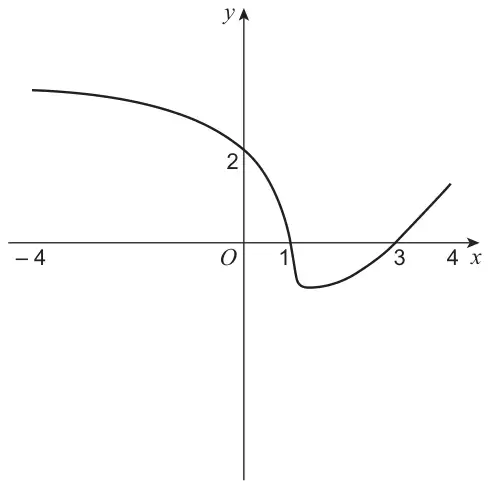
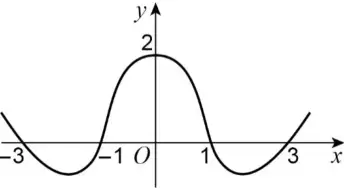
7 The diagram below shows the graph of \(y = \mathrm{f}(x)\) \((-4 \leqslant x \leqslant 4)\)
The graph meets the \(x\)-axis at \(x = 1\) and \(x = 3\)
The graph meets the \(y\)-axis at \(y = 2\)
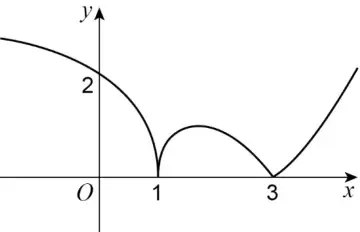
(a) Sketch the graph of \(y = |\mathrm{f}(x)|\) on the axes below.
Show any axis intercepts. [2 marks]
(b) Sketch the graph of \(y = \dfrac{1}{\mathrm{f}(x)}\) on the axes below.
Show any axis intercepts and asymptotes. [3 marks]
(c) Sketch the graph of \(y = \mathrm{f}(|x|)\) on the axes below.
Show any axis intercepts. [2 marks]
Mark scheme (a)
Scheme
Marks
AO
Reflects the part of the graph which lies below the \(x\)-axis in the \(x\)-axis Condone any continuous curve
M1
3.1a
Obtains the correct graph including all the intercepts
A1
1.1b
(2)
Typical solution
Mark scheme (b)
Scheme
Marks
AO
Shows correct asymptotes
B1
2.2a
Draws graph of correct shape: 1) Curve above the \(x\)-axis to left of \(x = 1\) and an increasing function 2) Curve below \(x\)-axis between \(x = 1\) and \(x = 3\), with a local maximum 3) Curve above the \(x\)-axis to right of \(x = 3\) and a decreasing function Condone one wrong asymptote
M1
3.1a
Obtains correct graph including intercept (ignore other details such as the \(y\)-values for minimum and maximum values of \(x\)) Condone one wrong asymptote
A1F
1.1b
(3)
Typical solution
Mark scheme (c)
Scheme
Marks
AO
Sketches and reflects the part of the graph which lies to the right of the \(y\)-axis in the \(y\)-axis Condone reasonable attempt at the graph being symmetric about the \(y\)-axis
M1
1.1a
Correctly shows all the intercepts on their sketch
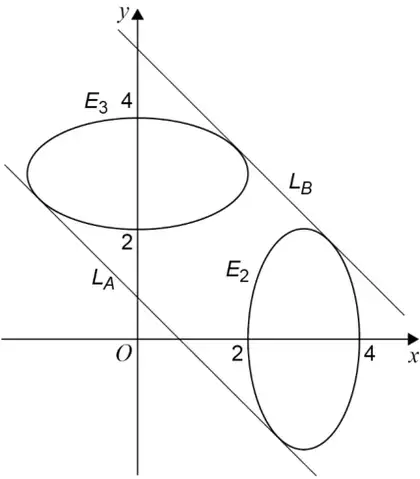
\(E_1\) is translated by the vector \(\begin{bmatrix} 3 \\ 0 \end{bmatrix}\) to give the ellipse \(E_2\)
(a) Write down the equation of \(E_2\) [1 mark]
(b) The ellipse \(E_3\) has equation\[\frac{x^2}{4} + (y - 3)^2 = 1\]
Describe the transformation that maps \(E_2\) to \(E_3\) [1 mark]
(c) Each of the lines \(L_A\) and \(L_B\) is a tangent to both \(E_2\) and \(E_3\)
\(L_A\) is closer to the origin than \(L_B\)
\(E_2\) and \(E_3\) both lie between \(L_A\) and \(L_B\)
Sketch and label \(E_2\), \(E_3\), \(L_A\) and \(L_B\) on the axes below.
You do not need to show the values of the axis intercepts for \(L_A\) and \(L_B\) [4 marks]
(d) Explain, without doing any calculations, why \(L_A\) has an equation of the form\[x + y = c\]
where \(c\) is a constant. [2 marks]
Mark scheme (a)
Scheme
Marks
AO
Obtains the correct equation of \(E_2\)
B1
1.1b
(1)
Typical solution
Equation of \(E_2\) is
\[(x - 3)^2 + \frac{y^2}{4} = 1\]
Mark scheme (b)
Scheme
Marks
AO
Obtains a correct answer Condone a correct sequence of transformations
B1
1.1b
(1)
Typical solution
Reflection in the line \(y = x\)
Mark scheme (c)
Scheme
Marks
AO
Two ellipses, one crossing the positive \(x\)-axis and the other crossing the positive \(y\)-axis
B1
1.1b
Correct axis intercepts shown for both ellipses
B1
1.1b
At least one correct tangent drawn Condone \(x = 2\) or \(y = 2\)
B1
1.1b
Both lines drawn and labelled correctly
B1
2.2b
(4)
Typical solution
Mark scheme (d)
Scheme
Marks
AO
Uses the fact that \(E_3\) is a reflection of \(E_2\) in the line \(y = x\)
E1
2.4
Explains that the tangent is perpendicular to the line \(y = x\) and concludes that its equation is \(x + y = c\)
E1
2.4
(2)
(8 marks)
Typical solution
Points on \(E_2\) and \(E_3\) joined by \(L_A\) are symmetrical about \(y = x\), therefore the line is perpendicular to \(y = x\) and has a gradient of \(-1\) and is of the form \(y = -x + c\) or \(x + y = c\)
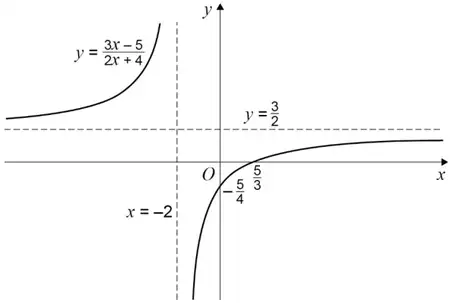
(a) Show that the equation\[y = \frac{3x - 5}{2x + 4}\]
can be written in the form
\[(x + a)(y + b) = c\]
where \(a\), \(b\) and \(c\) are integers to be found. [3 marks]
(b) Write down the equations of the asymptotes of the graph of\[y = \frac{3x - 5}{2x + 4}\]
[2 marks]
(c) Sketch, on the axes provided, the graph of\[y = \frac{3x - 5}{2x + 4}\]
[3 marks]
Mark scheme (a)
Scheme
Marks
AO
Selects a method to find the values of \(a, b, c\). e.g. by expanding \((x + a)(y + b) = c\) or by multiplying the equation by \((2x + 4)\) and expanding or by dividing the numerator of the equation by its denominator.
M1
3.1a
Expresses the original equation in a form that allows comparison with \((x + a)(y + b) = c\).
M1
1.1a
Completes a rigorous argument to show that \(y = \frac{3x - 5}{2x + 4}\) can be written as \((x + 2)\left(y - \frac{3}{2}\right) = -\frac{11}{2}\).
(a) Find the interval \((a, b)\) in which \(\mathrm{f}(x)\) does not take any values.
Fully justify your answer. [5 marks]
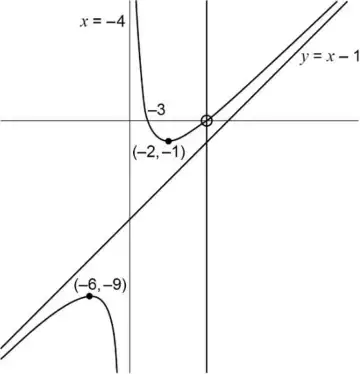
(b) Find the coordinates of the two stationary points of the graph of \(y = \mathrm{f}(x)\) [2 marks]
(c) Show that the graph of \(y = \mathrm{f}(x)\) has an oblique asymptote and find its equation. [2 marks]
(d) Sketch the graph of \(y = \mathrm{f}(x)\) on the axes below. [4 marks]
Mark scheme (a)
Scheme
Marks
AO
Forms an equation \(\dfrac{x(x + 3)}{x + 4} = {}\)‘\(k\)’ or Differentiates using quotient rule.
M1
3.1a
Rearranges their equation into a quadratic in \(x\). or Obtains the correct \(\mathrm{f}^{\prime}(x) = \dfrac{(x + 4) \times (2x + 3) - (x^2 + 3x) \times 1}{(x + 4)^2}\).
M1
1.1a
Explains that the discriminant of this quadratic \(\lt 0\) or Explains that because there is a vertical asymptote the minimum is higher up the graph than the maximum and the two turning points lie on different branches of the graph.
E1
2.4
Forms a quadratic equation or inequality in ‘\(k\)’ from their discriminant. or Equates their \(\mathrm{f}^{\prime}(x)\) or its numerator to 0 and solves
M1
1.1a
Completes a rigorous argument to show that \(\mathrm{f}(x)\) does not take any values in the interval \((-9, -1)\). Condone \(-9 \lt k \lt -1\)
So \(\mathrm{f}(x)\) does not take any values in the interval \((-9, -1)\)
Mark scheme (b)
Scheme
Marks
AO
Substitutes their \(-9\) or \(-1\) into \(y = f(x)\) and forms a quadratic in \(x\) or Differentiates using the quotient rule and equates their \(\mathrm{f}^{\prime}(x)\) or its numerator to 0
M1
1.1a
Finds the coordinates of both stationary points
A1F
1.1b
Typical solution
Stationary points \((-6, -9)\) and \((-2, -1)\)
Mark scheme (c)
Scheme
Marks
AO
Divides the numerator by \(x + 4\) and obtains \(\mathrm{f}(x) = x + \cdots\)
M1
3.1a
Obtains the correct equation of the asymptote \(y = x - 1\)
Selects a correct approach which would lead to solving the inequality eg Multiplies the inequality by \((x - 1)^2\) or Rearranges to an inequality with 0 on LHS or RHS or Replaces “\(\leqslant\)” with “\(=\)” and multiplies by \((x - 1)\)
M1
1.1a
Manipulates their equation/inequality to allow the critical values to be found
M1
1.1a
Obtains critical values of \(-4\), \(1\) and \(2\)
M1
1.1a
Gives one correct region from \(x \geqslant 2\), \(-4 \leqslant x \lt 1\) Condone \(-4 \leqslant x \leqslant 1\) Must have three critical values.
Rearranges \(k = \dfrac{x^2 + x - 6}{x^2 - 1}\) into a non-fractional form. Accept any sensible alternative for \(k\), e.g. \(y\) or f
M1
3.1a
Rearranges their equation into a correct three-term quadratic equation in \(x\) Condone missing \(= 0\) Possibly implied by a correct discriminant.
A1
1.1b
Correctly substitutes their coefficients into \(b^2 - 4ac\) to obtain an expression in \(k\) only. Accept any sensible alternative for \(k\), e.g. \(y\) or f
M1
3.1a
Obtains a correct quadratic equation/inequality in \(k\) – may be unsimplified. Or obtains the correct critical values of \(k\). Accept any sensible alternative for \(k\), e.g. \(y\) or f
A1
1.1b
Obtains the correct critical values. Accept non-exact values to at least 3 sig figs, e.g. 1.05 and 5.95
A1
1.1b
Gives a correct range in terms of \(y\) using exact values. Condone ‘and’. Follow through their critical values if M2 scored and quadratic inequality seen. Do not accept an alternative for \(y\) Accept any equivalent expressions for \(\frac{7 - 2\sqrt{6}}{2}\) and \(\frac{7 + 2\sqrt{6}}{2}\) NMS scores 0/6
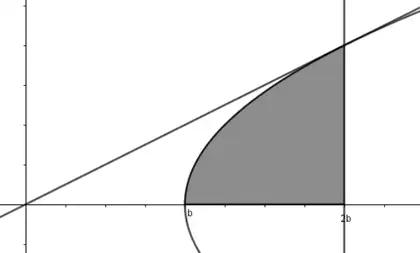
[This can also be done by translating the curve by \(\begin{pmatrix} -b \\ 0 \end{pmatrix}\) and finding \(\pi\int_0^b 4ax\,\mathrm{d}x\), but this must be clearly explained to gain full marks.]
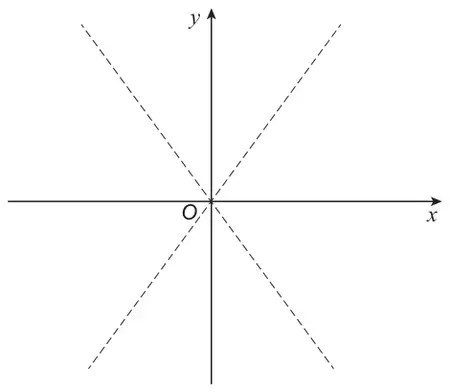
(a) Write down the equations of the asymptotes of \(H\). [1 mark]
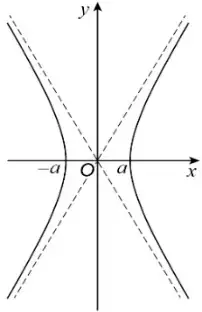
(b) Sketch the hyperbola \(H\) on the axes below, indicating the coordinates of any points of intersection with the coordinate axes. The asymptotes have already been drawn. [2 marks]
(c) The finite region bounded by \(H\), the positive \(x\)-axis, the positive \(y\)-axis and the line \(y = a\) is rotated through \(360^\circ\) about the \(y\)-axis. Show that the volume of the solid generated is \(ma^3\), where \(m = 3.40\) correct to three significant figures. [5 marks]
Mark scheme (a)
Scheme
Marks
AO
Writes the correct equations with \(a\) removed. Accept any equivalent equations, e.g. \(x = \pm\frac{1}{2}y\)
B1
1.1b
Typical solution
\[\frac{x}{a} = \pm\frac{y}{2a}\]\[y = \pm 2x\]
Mark scheme (b)
Scheme
Marks
AO
Draws the correct graph, correctly approaching the asymptotes – mark the intention.
B1
1.1b
Writes \((a, 0)\) and \((-a, 0)\) Accept \(a\) and \(-a\) written close to the intercepts.
B1
1.1b
Typical solution
Mark scheme (c)
Scheme
Marks
AO
Formulates an expression for a volume generated by rotating the hyperbola about an axis – must be a clear intent to integrate. A volume expression must be of the form \(\int \mathrm{f}(x)\) or \(\int \mathrm{f}(y)\) where f is a polynomial function of degree 2. Condone missing limits and/or \(\pi\) and/or \(\mathrm{d}y\) (or \(\mathrm{d}x\)).
M1
3.1a
Expresses the volume as \(\pi\displaystyle\int\left(\frac{y^2}{4} + a^2\right)\mathrm{d}y\) or equivalent. Must include \(\pi\) – may be seen later. Condone missing limits and/or \(\mathrm{d}y\).
A1
1.1b
Correctly integrates their expression. Their expression must be of the form \(cy^2 + d\) or \(cx^2 + d\) where \(c\) and \(d\) are constants.
M1
1.1a
Substitutes correct limits into \(py^3 + qy\), where \(p\) and \(q\) are positive constants. May be unsimplified. Accept substitution of 0 not seen.
A1
1.1b
Completes a rigorous mathematical argument, including either \(ka^3\) where \(k \in [3.4005, 3.4045]\) or \(\frac{13}{12}\pi a^3\) (or equivalent), that the volume can be expressed as \(3.40a^3\) to 3 significant figures. Must use \(\mathrm{d}y\) correctly throughout. Must include an appropriate reference to 3 significant figures, e.g. \(\frac{13\pi}{12} = 3.40\) (3sf) Accept substitution of 0 not seen. This mark can only be awarded if M2A2 scored. NMS scores 0/5
13 The graph of the rational function \(y = \mathrm{f}(x)\) intersects the \(x\)-axis exactly once at \((-3, 0)\)
The graph has exactly two asymptotes, \(y = 2\) and \(x = -1\)
(a) Find \(\mathrm{f}(x)\) [2 marks]
(b) Sketch the graph of the function. [3 marks]
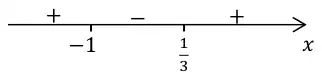
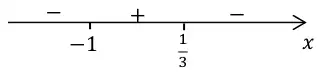
(c) Find the range of values of \(x\) for which \(\mathrm{f}(x) \leqslant 5\) [4 marks]
Mark scheme (a)
Scheme
Marks
AO
Writes any rational function with a horizontal asymptote of \(y = 2\) or one vertical asymptote of \(x = -1\), e.g. \(y = \frac{ax + b}{x + 1}\) or \(y = \frac{2x + b}{x + c}\) or \(y = \frac{ax^n + bx^{n-1} + cx^{n-2} + \ldots\ldots}{dx^n + ex^{n-1} + fx^{n-2} + \ldots\ldots}\) where \(\frac{a}{d} = 2\) Accept any correct rearrangement of \(y = \mathrm{f}(x)\), where \(\mathrm{f}(x)\) is a function as described above.
Sketches any rectangular hyperbola, or rational function, tending to the correct vertical and horizontal asymptotes included or implied.
M1
1.1a
Sketches a correct graph, including the asymptotes. Accept the graph of their function if M1A1 scored in part (a). Accept un-ruled asymptotes – mark intention.
A1
1.1b
Indicates correct axis-intercepts. Follow through their equation if their \(y\)-intercept matches their graph.
A1F
1.1b
Typical solution
Mark scheme (c)
Scheme
Marks
AO
Forms an equation or inequality with \(y = 5\) and their rational function.
M1
1.1a
Obtains correct \(x\)-intercept with \(y = 5\) Follow through their rational function from part (a)
A1F
1.1b
Deduces one correct region \(x \geqslant \frac{1}{3}\) or \(x \lt -1\) Condone \(x \leqslant -1\) for this mark. Follow through their \(\frac{1}{3}\) if greater than \(-1\)
A1F
2.2a
Deduces correct regions. Accept correct regions for their function if M1A1 scored in part (a).
(a) Show that the matrix \(\begin{bmatrix} 5 - k & 2 \\ k^3 + 1 & k \end{bmatrix}\) is singular when \(k = 1\). [1 mark]
(b) Find the values of \(k\) for which the matrix \(\begin{bmatrix} 5 - k & 2 \\ k^3 + 1 & k \end{bmatrix}\) has a negative determinant. Fully justify your answer. [5 marks]
Mark scheme (a)
Scheme
Marks
AO
Substitutes \(k = 1\) and correctly calculates the determinant, and concludes that the matrix is singular.
Finds determinant in terms of \(k\). Allow one error.
M1
1.1a
Obtains a correct inequality in \(k\).
A1
1.1b
Obtains three correct critical values.
A1
1.1b
Deduces one correct region. FT their three real distinct critical values if given as \(a \lt k \lt b\), \(k \gt c\) (o.e.) where \(a \lt b \lt c\)
A1F
2.2a
Deduces the other correct region. FT their three real distinct critical values if given as \(a \lt k \lt b\), \(k \gt c\) (o.e.) where \(a \lt b \lt c\) Condone the use of ‘and’.
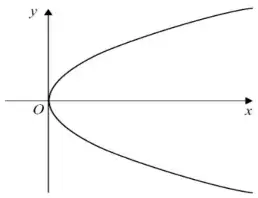
(b) Ben is using a 3D printer to make a plastic bowl which holds exactly \(1000\,\text{cm}^3\) of water. Ben models the bowl as a region which is rotated through \(2\pi\) radians about the \(x\)-axis. He uses the finite region enclosed by the lines \(x = d\) and \(y = 0\) and the curve with equation \(y^2 = 4x\) for \(y \geqslant 0\)
(i) Find the depth of the bowl to the nearest millimetre. [4 marks]
(ii) What assumption has Ben made about the bowl? [1 mark]
Mark scheme (a)
Scheme
Marks
AO
Sketches correct parabola
B1
1.2
Typical solution
Mark scheme (b)
Scheme
Marks
AO
(i) Obtains \(\pi\displaystyle\int 4x\,\mathrm{d}x\) Limits not required for this mark. Condone missing \(\mathrm{d}x\)
M1
3.3
Obtains \(2x^2\) and uses limits of \(d\) and \(0\) (oe).
B1
1.1b
Forms an equation of the form \(kd^2 = \text{volume}\) (oe)
M1
3.4
Correct depth to nearest millimetre. Condone 126 or 12.6 without units. NMS: 126 or 12.6 scores 4/4. Using \(1000000\,\text{mm}^3\) leads to a correct answer of 399 mm for 4/4.
M1: For \(\mathbf{A}^4 = \mathbf{I}\) or \(\mathrm{T_A}\) repeated four times is a 360 degree rotation. Condone clockwise instead of anticlockwise for \(\mathrm{T_A}\) so notes that 423 is divisible by 4 with remainder 3 so \(\mathbf{A}^{423} = \mathbf{A}^3\)
A1: As \(\mathbf{A}^3\) represents a 270 degrees rotation anti-clockwise (or 90 degrees clockwise) or by direct calculation of \(\mathbf{A}^3\).
10In this question you must show detailed reasoning.
(a) By using an appropriate Maclaurin series prove that if \(x \gt 0\) then \(\mathrm{e}^x \gt 1 + x\). [2]
(b) Hence, by using a suitable substitution, deduce that \(\mathrm{e}^t \gt \mathrm{e}t\) for \(t \gt 1\). [1]
(c) Using the inequality in part (b), and by making a suitable choice for \(t\), determine which is greater, \(\mathrm{e}^\pi\) or \(\pi^\mathrm{e}\). [3]
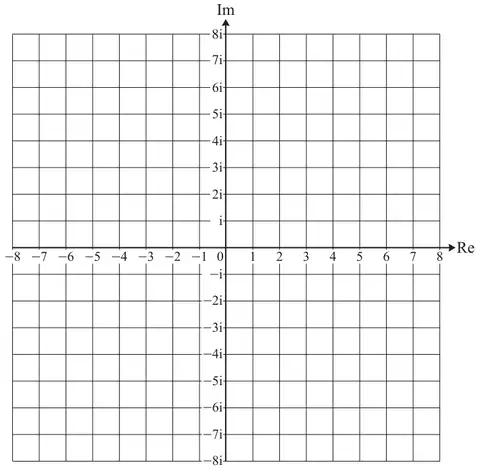
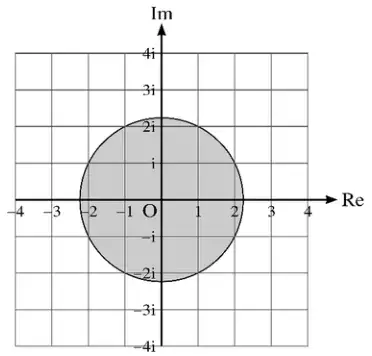
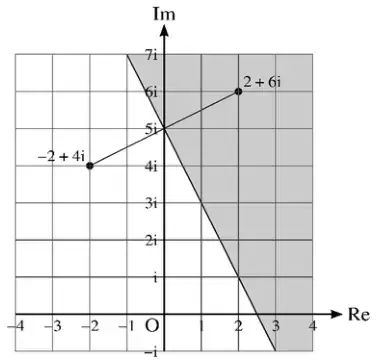
(b) Show that there is a unique value of \(z\), which should be determined, for which both \(|z| \leqslant \sqrt{5}\) and \(|z + 2 - 4\mathrm{i}| \geqslant |z - 2 - 6\mathrm{i}|\). [8]
Mark scheme (a)
Scheme
Marks
AO
(i)
M1 A1 A1
1.1 1.1 1.1
[3]
(ii)
M1 A1 A1
1.1 1.1 1.1
[3]
Notes
(a)(i)
M1: circle, centre O
A1: radius \(\sqrt{5}\)
A1: shaded inside (oe). Candidates may shade the region that is not required, but should clearly indicate that what they have shaded is not required.
(a)(ii)
M1: \((-2, 4)\) and \((2, 6)\) identified
A1: perpendicular bisector of \((-2, 4)\) and \((2, 6)\)
A1: shaded on RHS of line (oe). Candidates may shade the region that is not required, but should clearly indicate that what they have shaded is not required.
Mark scheme (b)
Scheme
Marks
AO
gradient \(= -2\)
M1
1.1
passing through \((0, 5)\)
B1
3.1a
equation \(y = -2x + 5\)
A1
1.1
circle is \(x^2 + y^2 = 5\)
B1
3.1a
\(x^2 + (5 - 2x)^2 = 5\)
M1
2.1
\(\Rightarrow 5x^2 - 20x + 20 = 0\)
M1
1.1
\(\Rightarrow x = 2\) [only]
A1*
2.2a
[unique solution is] \(z = 2 + \mathrm{i}\)
A1dep
3.2a
[8]
Notes
A1: (1st) oe. Allow inequality. Could be obtained from diagram in (a).
B1: (2nd) allow inequality
M1: (2nd) or \(\left(\frac{5}{2} - \frac{y}{2}\right)^2 + y^2 = 5\). Must be an equation.
M1: (3rd) simplifying to a three-term quadratic equation
A1*: or \(y = 1\) [only]
Alternative method
Scheme
Marks
\((x + 2)^2 + (y - 4)^2 = (x - 2)^2 + (y - 6)^2\)
M1 M1
\(y = -2x + 5\)
A1
circle is \(x^2 + y^2 = 5\)
B1
\(x^2 + (5 - 2x)^2 = 5\)
M1
\(\Rightarrow 5x^2 - 20x + 20 = 0\)
M1
\(\Rightarrow x = 2\) [only]
A1*
[unique solution is] \(z = 2 + \mathrm{i}\)
A1dep
M1: (1st) squaring both sides of equations or inequality
M1: (2nd) expanding all four sets of brackets
A1: oe. Allow inequality.
B1: allow inequality
M1: (3rd) or \(\left(\frac{5}{2} - \frac{y}{2}\right)^2 + y^2 = 5\). Must be an equation.
M1: (4th) simplifying to a three term quadratic equation