Using Roots of Polynomials

Edexcel

AQA

OCR A

OCR MEI

AS June 2025 Paper 1 Q11

EdexcelCurrent spec7 marksUsing Roots of Polynomials

11.

In this question you must show detailed reasoning.

\[\mathrm{f}(x) = x^3 - 21x^2 + Ax - 91 \qquad \text{where } A \text{ is a real constant}\]

The roots of \(\mathrm{f}(x) = 0\) are

\[\alpha,\ \alpha + 3\beta \text{ and } \alpha + 6\beta\]

where \(\alpha\) and \(\beta\) are real constants.

Use algebra to determine the value of each of these roots. (7)

A2 June 2025 Paper 2 Q6

EdexcelCurrent spec8 marksUsing Roots of Polynomials

6. The quartic equation

\[2x^4 + Ax^3 - Ax^2 - 5x + 6 = 0\]

where \(A\) is a real constant, has roots \(\alpha\), \(\beta\), \(\gamma\) and \(\delta\)

(a) Determine the value of\[\frac{3}{\alpha} + \frac{3}{\beta} + \frac{3}{\gamma} + \frac{3}{\delta}\] (3)

Given that \(\alpha^2 + \beta^2 + \gamma^2 + \delta^2 = -\dfrac{3}{4}\)

(b) determine the possible values of \(A\) (5)

A2 June 2024 Paper 1 Q2

EdexcelCurrent spec8 marksUsing Roots of Polynomials

2. The roots of the equation

\[2x^3 - 3x^2 + 12x + 7 = 0\]

are \(\alpha\), \(\beta\) and \(\gamma\)

Without solving the equation,

(a) write down the value of each of\[\alpha + \beta + \gamma \qquad \alpha\beta + \alpha\gamma + \beta\gamma \qquad \alpha\beta\gamma\] (1)
(b) Use the answers to part (a) to determine the value of
(i) \(\dfrac{2}{\alpha} + \dfrac{2}{\beta} + \dfrac{2}{\gamma}\)
(ii) \((\alpha - 1)(\beta - 1)(\gamma - 1)\)
(iii) \(\alpha^2 + \beta^2 + \gamma^2\) (7)

AS June 2024 Paper 1 Q1

EdexcelCurrent spec9 marksUsing Roots of Polynomials

1. The cubic equation

\[2x^3 - 3x^2 + 5x + 7 = 0\]

has roots \(\alpha\), \(\beta\) and \(\gamma\).

Without solving the equation, determine the exact value of

(i) \(\alpha^2 + \beta^2 + \gamma^2\) (3)
(ii) \(\dfrac{3}{\alpha} + \dfrac{3}{\beta} + \dfrac{3}{\gamma}\) (3)
(iii) \((5 - \alpha)(5 - \beta)(5 - \gamma)\) (3)

AS June 2023 Paper 1 Q10

EdexcelCurrent spec12 marksUsing Roots of Polynomials

10.

In this question you must show all stages of your working.

Solutions relying on calculator technology are not acceptable.

(i) The quartic equation\[z^4 + 5z^2 - 30 = 0\]has roots \(p\), \(q\), \(r\) and \(s\).

Without solving the equation, determine the quartic equation whose roots are

\[(3p - 1),\ (3q - 1),\ (3r - 1) \text{ and } (3s - 1)\]Give your answer in the form \(w^4 + aw^3 + bw^2 + cw + d = 0\), where \(a\), \(b\), \(c\) and \(d\) are integers to be found. (5)
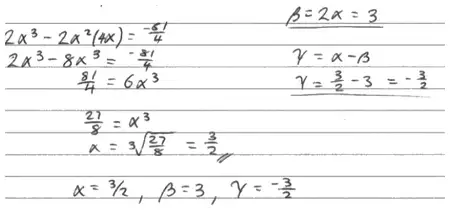
(ii) The roots of the cubic equation\[4x^3 + nx + 81 = 0 \qquad \text{where } n \text{ is a real constant}\]are \(\alpha\), \(2\alpha\) and \(\alpha - \beta\)

Determine

(a) the values of the roots of the equation, (5)
(b) the value of \(n\). (2)

A2 June 2023 Paper 1 Q1

EdexcelCurrent spec5 marksUsing Roots of Polynomials

1. The cubic equation

\[x^3 - 7x^2 - 12x + 6 = 0\]

has roots \(\alpha\), \(\beta\) and \(\gamma\).

Without solving the equation, determine a cubic equation whose roots are \((\alpha + 2)\), \((\beta + 2)\) and \((\gamma + 2)\), giving your answer in the form \(w^3 + pw^2 + qw + r = 0\), where \(p\), \(q\) and \(r\) are integers to be found.

(5)

A2 June 2022 Paper 2 Q6

EdexcelCurrent spec10 marksUsing Roots of Polynomials

6. The cubic equation

\[4x^3 + px^2 - 14x + q = 0\]

where \(p\) and \(q\) are real positive constants, has roots \(\alpha\), \(\beta\) and \(\gamma\)

Given that \(\alpha^2 + \beta^2 + \gamma^2 = 16\)

(a) show that \(p = 12\) (3)

Given that \(\dfrac{1}{\alpha} + \dfrac{1}{\beta} + \dfrac{1}{\gamma} = \dfrac{14}{3}\)

(b) determine the value of \(q\) (3)

Without solving the cubic equation,

(c) determine the value of \((\alpha - 1)(\beta - 1)(\gamma - 1)\) (4)

AS June 2022 Paper 1 Q4

EdexcelCurrent spec9 marksUsing Roots of Polynomials

4. The roots of the quartic equation

\[3x^4 + 5x^3 - 7x + 6 = 0\]

are \(\alpha\), \(\beta\), \(\gamma\) and \(\delta\)

Making your method clear and without solving the equation, determine the exact value of

(i) \(\alpha^2 + \beta^2 + \gamma^2 + \delta^2\) (3)
(ii) \(\dfrac{2}{\alpha} + \dfrac{2}{\beta} + \dfrac{2}{\gamma} + \dfrac{2}{\delta}\) (3)
(iii) \((3 - \alpha)(3 - \beta)(3 - \gamma)(3 - \delta)\) (3)

A2 October 2021 Paper 1 Q3

EdexcelCurrent spec6 marksUsing Roots of Polynomials

3. The cubic equation

\[ax^3 + bx^2 - 19x - b = 0\]

where \(a\) and \(b\) are constants, has roots \(\alpha\), \(\beta\) and \(\gamma\)

The cubic equation

\[w^3 - 9w^2 - 97w + c = 0\]

where \(c\) is a constant, has roots \((4\alpha - 1)\), \((4\beta - 1)\) and \((4\gamma - 1)\)

Without solving either cubic equation, determine the value of \(a\), the value of \(b\) and the value of \(c\). (6)

AS October 2020 Paper 1 Q9

EdexcelCurrent spec6 marksUsing Roots of Polynomials

9. The cubic equation

\[3x^3 + x^2 - 4x + 1 = 0\]

has roots \(\alpha\), \(\beta\), and \(\gamma\).

Without solving the cubic equation,

(a) determine the value of \(\dfrac{1}{\alpha} + \dfrac{1}{\beta} + \dfrac{1}{\gamma}\) (3)
(b) find a cubic equation that has roots \(\dfrac{1}{\alpha}\), \(\dfrac{1}{\beta}\) and \(\dfrac{1}{\gamma}\), giving your answer in the form \(x^3 + ax^2 + bx + c = 0\), where \(a\), \(b\) and \(c\) are integers to be determined. (3)

AS June 2019 Paper 1 Q7

7.

\[\mathrm{f}(z) = z^3 - 8z^2 + pz - 24\]

where \(p\) is a real constant.

Given that the equation \(\mathrm{f}(z) = 0\) has distinct roots

\[\alpha,\ \beta\ \text{ and } \left(\alpha + \frac{12}{\alpha} - \beta\right)\]
(a) solve completely the equation \(\mathrm{f}(z) = 0\) (6)
(b) Hence find the value of \(p\). (2)

AS June 2019 Paper 1 Q2

EdexcelCurrent spec5 marksUsing Roots of Polynomials

2. The cubic equation

\[2x^3 + 6x^2 - 3x + 12 = 0\]

has roots \(\alpha\), \(\beta\) and \(\gamma\).

Without solving the equation, find the cubic equation whose roots are \((\alpha + 3)\), \((\beta + 3)\) and \((\gamma + 3)\), giving your answer in the form \(pw^3 + qw^2 + rw + s = 0\), where \(p\), \(q\), \(r\) and \(s\) are integers to be found. (5)

A2 June 2019 Paper 2 Q2

EdexcelCurrent spec8 marksUsing Roots of Polynomials

2. The roots of the equation

\[x^3 - 2x^2 + 4x - 5 = 0\]

are \(p\), \(q\) and \(r\).

Without solving the equation, find the value of

(i) \(\dfrac{2}{p} + \dfrac{2}{q} + \dfrac{2}{r}\)
(ii) \((p - 4)(q - 4)(r - 4)\)
(iii) \(p^3 + q^3 + r^3\) (8)

AS June 2018 Paper 1 Q2

EdexcelCurrent spec5 marksUsing Roots of Polynomials

2. The cubic equation

\[z^3 - 3z^2 + z + 5 = 0\]

has roots \(\alpha\), \(\beta\) and \(\gamma\).

Without solving the equation, find the cubic equation whose roots are \((2\alpha + 1)\), \((2\beta + 1)\) and \((2\gamma + 1)\), giving your answer in the form \(w^3 + pw^2 + qw + r = 0\), where \(p\), \(q\) and \(r\) are integers to be found. (5)

A2 June 2025 Paper 1 Q7

AQACurrent spec4 marksUsing Roots of Polynomials

7 The cubic equation

\[5z^3 + 4z^2 - z + 3 = 0\]

has roots \(\alpha\), \(\beta\) and \(\gamma\)

Find an equation, with integer coefficients, that has roots \(2\alpha - 1\), \(2\beta - 1\) and \(2\gamma - 1\) [4 marks]

AS June 2025 Paper 1 Q5

AQACurrent spec2 marksUsing Roots of Polynomials

5 The quartic equation

\[3x^4 + x^2 - 5x - 11 = 0\]

has roots \(\alpha, \beta, \gamma\) and \(\delta\)

(a) Write down the value of \(\alpha\beta\gamma\delta\) [1 mark]
(b) Write down the value of \(\alpha\beta\gamma + \alpha\beta\delta + \alpha\gamma\delta + \beta\gamma\delta\) [1 mark]

AS June 2024 Paper 1 Q13

AQACurrent spec5 marksUsing Roots of Polynomials

13 The cubic equation \(x^3 - x - 7 = 0\) has roots \(\alpha\), \(\beta\) and \(\gamma\)

The cubic equation \(\mathrm{p}(x) = 0\) has roots \(\alpha - 1\), \(\beta - 1\) and \(\gamma - 1\)

The coefficient of \(x^3\) in \(\mathrm{p}(x)\) is 1

(a) Describe fully the transformation that maps the graph of \(y = x^3 - x - 7\) onto the graph of \(y = \mathrm{p}(x)\) [2 marks]
(b) Find \(\mathrm{p}(x)\) [3 marks]

A2 June 2024 Paper 2 Q6

AQACurrent spec3 marksUsing Roots of Polynomials

6 The cubic equation

\[x^3 + 5x^2 - 4x + 2 = 0\]

has roots \(\alpha\), \(\beta\) and \(\gamma\)

Find a cubic equation, with integer coefficients, whose roots are \(3\alpha\), \(3\beta\) and \(3\gamma\) [3 marks]

A2 June 2024 Paper 1 Q1

AQACurrent spec1 markUsing Roots of Polynomials

1 The roots of the equation \(20x^3 - 16x^2 - 4x + 7 = 0\) are \(\alpha\), \(\beta\) and \(\gamma\)

Find the value of \(\alpha\beta + \beta\gamma + \gamma\alpha\)

Circle your answer. [1 mark]

  • \(-\dfrac{4}{5}\)
  • \(-\dfrac{1}{5}\)
  • \(\dfrac{1}{5}\)
  • \(\dfrac{4}{5}\)

AS June 2023 Paper 1 Q14

14 The inequality

\[(x^2 - 5x - 24)(x^2 + 7x + a) \lt 0\]

has the solution set

\[\{x : -9 \lt x \lt -3\} \cup \{x : 2 \lt x \lt b\}\]

Find the values of integers \(a\) and \(b\) [4 marks]

A2 June 2023 Paper 2 Q13

AQACurrent spec11 marksUsing Roots of Polynomials

13 The quadratic equation \(z^2 - 5z + 8 = 0\) has roots \(\alpha\) and \(\beta\)

(a) Write down the value of \(\alpha + \beta\) and the value of \(\alpha\beta\) [2 marks]
(b) Without finding the value of \(\alpha\) or the value of \(\beta\), show that \(\alpha^4 + \beta^4 = -47\) [4 marks]
(c) Find a quadratic equation, with integer coefficients, which has roots \(\alpha^3 + \beta\) and \(\beta^3 + \alpha\) [5 marks]

AS June 2023 Paper 1 Q4

AQACurrent spec1 markUsing Roots of Polynomials

4 The roots of the equation

\[5x^3 + 2x^2 - 3x + p = 0\]

are \(\alpha\), \(\beta\) and \(\gamma\)

Given that \(p\) is a constant, state the value of \(\alpha\beta + \beta\gamma + \gamma\alpha\)

Circle your answer. [1 mark]

  • \(-\dfrac{3}{5}\)
  • \(-\dfrac{2}{5}\)
  • \(\dfrac{2}{5}\)
  • \(\dfrac{3}{5}\)

AS June 2022 Paper 1 Q15

15 The two values of \(\theta\) that satisfy the equation

\[\sinh^2\theta - \sinh\theta - 2 = 0\]

are \(\theta_1\) and \(\theta_2\)

(a) Hamzah is asked to find the value of \(\theta_1 + \theta_2\)

He writes his answer as follows:

The quadratic coefficients are \(a = 1\), \(b = -1\), \(c = -2\)

The sum of the roots is \(-\dfrac{b}{a}\)

So \(\theta_1 + \theta_2 = -\dfrac{-1}{1} = 1\)

Explain Hamzah’s error. [1 mark]

(b) Find the correct value of \(\theta_1 + \theta_2\)

Give your answer as a single logarithm. [5 marks]

A2 June 2021 Paper 2 Q5

AQACurrent spec5 marksUsing Roots of Polynomials

5 The equation

\[z^3 + 2z^2 - 5z - 3 = 0\]

has roots \(\alpha\), \(\beta\) and \(\gamma\)

Find a cubic equation with roots

\[\frac{1}{2}\alpha - 1,\ \frac{1}{2}\beta - 1 \ \text{ and } \ \frac{1}{2}\gamma - 1\]

[5 marks]

AS June 2020 Paper 1 Q9

AQACurrent spec8 marksUsing Roots of Polynomials

9 The quadratic equation \(2x^2 + px + 3 = 0\) has two roots, \(\alpha\) and \(\beta\), where \(\alpha \gt \beta\).

(a)
(i) Write down the value of \(\alpha\beta\). [1 mark]
(ii) Express \(\alpha + \beta\) in terms of \(p\). [1 mark]
(b) Hence find \((\alpha - \beta)^2\) in terms of \(p\). [2 marks]
(c) Hence find, in terms of \(p\), a quadratic equation with roots \(\alpha - 1\) and \(\beta + 1\) [4 marks]

A2 June 2020 Paper 1 Q8

AQACurrent spec6 marksUsing Roots of Polynomials

8 The three roots of the equation

\[4x^3 - 12x^2 - 13x + k = 0\]

where \(k\) is a constant, form an arithmetic sequence.

Find the roots of the equation. [6 marks]

A2 June 2020 Paper 1 Q3

AQACurrent spec1 markUsing Roots of Polynomials

3 The quadratic equation \(ax^2 + bx + c = 0\) \((a, b, c \in \mathbb{R})\) has real roots \(\alpha\) and \(\beta\).

One of the four statements below is incorrect.

Which statement is incorrect?

Tick (✓) one box. [1 mark]

  • \(c = 0 \Rightarrow \alpha = 0 \text{ or } \beta = 0\)
  • \(c = a \Rightarrow \alpha \text{ is the reciprocal of } \beta\)
  • \(b \lt 0 \text{ and } c \lt 0 \Rightarrow \alpha \gt 0 \text{ and } \beta \gt 0\)
  • \(b = 0 \Rightarrow \alpha = -\beta\)

AS June 2019 Paper 1 Q14

AQACurrent spec7 marksUsing Roots of Polynomials

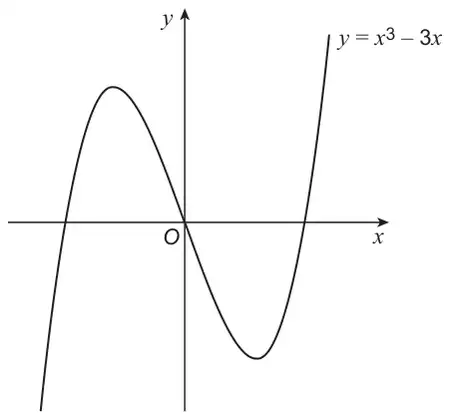
14 The graph of \(y = x^3 - 3x\) is shown below.

Graph of the cubic y = x³ − 3x, passing through O, with a maximum to the left of the y-axis and a minimum to the right

The two stationary points have \(x\)-coordinates of \(-1\) and \(1\)

The cubic equation

\[x^3 - 3x + p = 0\]

where \(p\) is a real constant, has the roots \(\alpha\), \(\beta\) and \(\gamma\).

The roots \(\alpha\) and \(\beta\) are not real.

(a) Explain why \(\alpha + \beta = -\gamma\) [1 mark]
(b) Find the set of possible values for the real constant \(p\). [2 marks]
(c) \(\mathrm{f}(x) = 0\) is a cubic equation with roots \(\alpha + 1\), \(\beta + 1\) and \(\gamma + 1\)
(i) Show that the constant term of \(\mathrm{f}(x)\) is \(p + 2\) [3 marks]
(ii) Write down the \(x\)-coordinates of the stationary points of \(y = \mathrm{f}(x)\) [1 mark]

A2 June 2019 Paper 1 Q13

AQACurrent spec14 marksUsing Roots of Polynomials

13 The equation \(z^3 + kz^2 + 9 = 0\) has roots \(\alpha\), \(\beta\) and \(\gamma\).

(a)
(i) Show that\[\alpha^2 + \beta^2 + \gamma^2 = k^2\] [3 marks]
(ii) Show that\[\alpha^2\beta^2 + \beta^2\gamma^2 + \gamma^2\alpha^2 = -18k\] [4 marks]
(b) The equation \(9z^3 - 40z^2 + rz + s = 0\) has roots \(\alpha\beta + \gamma\), \(\beta\gamma + \alpha\) and \(\gamma\alpha + \beta\).
(i) Show that\[k = -\frac{40}{9}\] [1 mark]
(ii) Without calculating the values of \(\alpha\), \(\beta\) and \(\gamma\), find the value of \(s\).

Show working to justify your answer. [6 marks]

AS June 2018 Paper 1 Q18

AQACurrent spec4 marksUsing Roots of Polynomials

18 \(\alpha\), \(\beta\) and \(\gamma\) are the real roots of the cubic equation

\[x^3 + mx^2 + nx + 2 = 0\]

By considering \((\alpha - \beta)^2 + (\gamma - \alpha)^2 + (\beta - \gamma)^2\), prove that

\[m^2 \geqslant 3n\]

[4 marks]

A2 June 2025 Paper 1 Q4

OCR ACurrent spec9 marksUsing Roots of Polynomials

4 The equation \(5x^3 - 4x^2 + 10 = 0\) has roots \(\alpha\), \(\beta\) and \(\gamma\).

(a) Write down the values of \(\alpha + \beta + \gamma\), \(\alpha\beta + \beta\gamma + \gamma\alpha\) and \(\alpha\beta\gamma\). [2]
(b) By expanding \((\alpha\beta + \beta\gamma + \gamma\alpha)^2\), determine the value of \(\alpha^2\beta^2 + \beta^2\gamma^2 + \gamma^2\alpha^2\). [3]
(c) By expanding a suitable expression, find the value of \(\alpha^2 + \beta^2 + \gamma^2\). [2]
(d) Hence find a cubic equation with integer coefficients that has roots \(\alpha^2\), \(\beta^2\), and \(\gamma^2\). [2]

AS June 2025 Paper 1 Q3

OCR ACurrent spec6 marksUsing Roots of Polynomials

3 The roots of the equation \(2x^2 + 3x + 5 = 0\) are denoted by \(\alpha\) and \(\beta\).

(a) Write down the value of \(\alpha + \beta\) and the value of \(\alpha\beta\). [2]
(b) Using the answers to part (a) determine the value of each of the following.
  • \(\alpha^2 + \beta^2\)
  • \(\dfrac{1}{\alpha} + \dfrac{1}{\beta}\)
[4]

AS June 2024 Paper 1 Q7

OCR ACurrent spec6 marksUsing Roots of Polynomials

7 In this question you must show detailed reasoning.

The roots of the equation \(2x^3 - 3x^2 - 3x + 5 = 0\) are \(\alpha\), \(\beta\) and \(\gamma\).

By considering \((\alpha + \beta + \gamma)^2\) and \((\alpha\beta + \beta\gamma + \gamma\alpha)^2\), determine a cubic equation with integer coefficients whose roots are \(\dfrac{\alpha\beta}{\gamma}\), \(\dfrac{\beta\gamma}{\alpha}\) and \(\dfrac{\gamma\alpha}{\beta}\). [6]

A2 June 2024 Paper 1 Q4

OCR ACurrent spec3 marksUsing Roots of Polynomials

4 In this question you must show detailed reasoning.

The equation \(2x^3 + 3x^2 + 6x - 3 = 0\) has roots \(\alpha\), \(\beta\) and \(\gamma\).

Determine a cubic equation with integer coefficients that has roots \(\alpha^2\beta\gamma, \alpha\beta^2\gamma\) and \(\alpha\beta\gamma^2\). [3]

AS June 2023 Paper 1 Q5

OCR ACurrent spec4 marksUsing Roots of Polynomials

5 In this question you must show detailed reasoning.

The roots of the equation \(5x^2 - 3x + 12 = 0\) are \(\alpha\) and \(\beta\).

By considering the symmetric functions of the roots, \(\alpha + \beta\) and \(\alpha\beta\), determine the exact value of \(\dfrac{1}{\alpha^2} + \dfrac{1}{\beta^2}\). [4]

A2 June 2023 Paper 1 Q2

2 In this question you must show detailed reasoning.

The equation \(z^4 + 4z^3 + 9z^2 + 10z + 6 = 0\) has roots \(\alpha\), \(\beta\), \(\gamma\) and \(\delta\).

(a) Show that a quartic equation whose roots are \(\alpha + 1\), \(\beta + 1\), \(\gamma + 1\) and \(\delta + 1\) is \(w^4 + 3w^2 + 2 = 0\). [3]
(b) Hence determine the exact roots of the equation \(z^4 + 4z^3 + 9z^2 + 10z + 6 = 0\). [3]

AS June 2023 Paper 1 Q1

OCR ACurrent spec5 marksUsing Roots of Polynomials

1 The roots of the equation \(4x^4 - 2x^3 - 3x + 2 = 0\) are \(\alpha\), \(\beta\), \(\gamma\) and \(\delta\). By using a suitable substitution, find a quartic equation whose roots are \(\alpha + 2\), \(\beta + 2\), \(\gamma + 2\) and \(\delta + 2\) giving your answer in the form \(at^4 + bt^3 + ct^2 + dt + e = 0\), where \(a\), \(b\), \(c\), \(d\), and \(e\) are integers. [5]

A2 June 2022 Paper 1 Q9

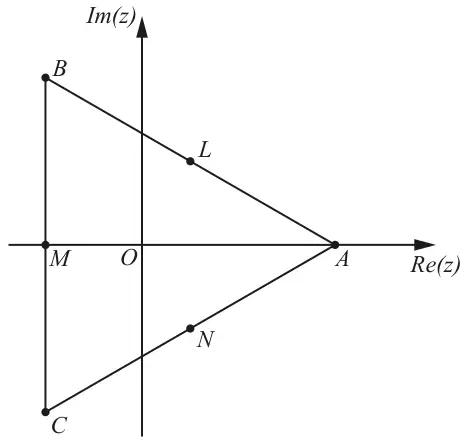
9 The cube roots of unity are represented on the Argand diagram below by the points \(A\), \(B\) and \(C\).

Argand diagram with axes Re(z) and Im(z): A on the positive real axis, B in the second quadrant and C in the third quadrant directly below B, forming triangle ABC; M is the midpoint of BC on the negative real axis, L the midpoint of AB and N the midpoint of CA

The points \(L\), \(M\) and \(N\) are the midpoints of the line segments \(AB\), \(BC\) and \(CA\) respectively.

Determine a degree 6 polynomial equation with integer coefficients whose roots are the complex numbers represented by the points \(A\), \(B\), \(C\), \(L\), \(M\) and \(N\). [5]

A2 June 2022 Paper 2 Q3

OCR ACurrent spec6 marksUsing Roots of Polynomials

3 In this question you must show detailed reasoning.

The roots of the equation \(4x^3 + 6x^2 - 3x + 9 = 0\) are \(\alpha\), \(\beta\) and \(\gamma\).

Find a cubic equation with integer coefficients whose roots are \(\alpha + \beta\), \(\beta + \gamma\) and \(\gamma + \alpha\). [6]

AS June 2022 Paper 1 Q3

OCR ACurrent spec6 marksUsing Roots of Polynomials

3 In this question you must show detailed reasoning.

The roots of the equation \(5x^3 - 3x^2 - 2x + 9 = 0\) are \(\alpha\), \(\beta\) and \(\gamma\).

Find a cubic equation with integer coefficients whose roots are \(\alpha\beta\), \(\beta\gamma\) and \(\gamma\alpha\). [6]

A2 October 2021 Paper 1 Q3

OCR ACurrent spec8 marksUsing Roots of Polynomials

3 A function \(\mathrm{f}(z)\) is defined on all complex numbers \(z\) by \(\mathrm{f}(z) = z^3 - 3z^2 + kz - 5\) where \(k\) is a real constant. The roots of the equation \(\mathrm{f}(z) = 0\) are \(\alpha, \beta\) and \(\gamma\). You are given that \(\alpha^2 + \beta^2 + \gamma^2 = -5\).

(a) Explain why \(\mathrm{f}(z) = 0\) has only one real root. [3]
(b) Find the value of \(k\). [3]
(c) Find a cubic equation with integer coefficients that has roots \(\dfrac{1}{\alpha}, \dfrac{1}{\beta}\) and \(\dfrac{1}{\gamma}\). [2]

AS October 2021 Paper 1 Q2

OCR ACurrent spec4 marksUsing Roots of Polynomials

2 The equation \(2x^3 + 3x^2 - 2x + 5 = 0\) has roots \(\alpha\), \(\beta\) and \(\gamma\).

Use a substitution to find a cubic equation with integer coefficients whose roots are \(\alpha + 1\), \(\beta + 1\) and \(\gamma + 1\). [4]

A2 October 2020 Paper 1 Q9

9 You are given that the cubic equation \(2x^3 + px^2 + qx - 3 = 0\), where \(p\) and \(q\) are real numbers, has a complex root \(\alpha = 1 + \mathrm{i}\sqrt{2}\).

(a) Write down a second complex root, \(\beta\). [1]
(b) Determine the third root, \(\gamma\). [2]
(c) Find the value of \(p\) and the value of \(q\). [2]
(d) Show that if \(n\) is an integer then \(\alpha^n + \beta^n + \gamma^n = 2 \times 3^{\frac{1}{2}n} \times \cos n\theta + \dfrac{1}{2^n}\) where \(\tan\theta = \sqrt{2}\). [4]

AS October 2020 Paper 1 Q5

OCR ACurrent spec7 marksUsing Roots of Polynomials

5 In this question you must show detailed reasoning.

The cubic equation \(5x^3 + 3x^2 - 4x + 7 = 0\) has roots \(\alpha\), \(\beta\) and \(\gamma\).

Find a cubic equation with integer coefficients whose roots are \(\alpha + \beta\), \(\beta + \gamma\) and \(\gamma + \alpha\). [7]

A2 October 2020 Paper 2 Q2

OCR ACurrent spec6 marksUsing Roots of Polynomials

2 In this question you must show detailed reasoning.

The roots of the equation \(3x^3 - 2x^2 - 5x - 4 = 0\) are \(\alpha\), \(\beta\) and \(\gamma\).

(a) Find a cubic equation with integer coefficients whose roots are \(\alpha^2\), \(\beta^2\) and \(\gamma^2\). [4]
(b) Find the exact value of \(\dfrac{\alpha^2\beta^2 + \beta^2\gamma^2 + \gamma^2\alpha^2}{\alpha\beta\gamma}\). [2]

AS June 2019 Paper 1 Q5

OCR ACurrent spec9 marksUsing Roots of Polynomials

5 In this question you must show detailed reasoning.

You are given that \(\alpha\), \(\beta\) and \(\gamma\) are the roots of the equation \(5x^3 - 2x^2 + 3x + 1 = 0\).

(a) Find the value of \(\alpha^2\beta^2 + \beta^2\gamma^2 + \gamma^2\alpha^2\). [5]
(b) Find a cubic equation whose roots are \(\alpha^2\), \(\beta^2\) and \(\gamma^2\) giving your answer in the form \(ax^3 + bx^2 + cx + d = 0\) where \(a\), \(b\), \(c\) and \(d\) are integers. [4]

A2 June 2019 Paper 1 Q1

OCR ACurrent spec4 marksUsing Roots of Polynomials

1 In this question you must show detailed reasoning.

The quadratic equation \(x^2 - 2x + 5 = 0\) has roots \(\alpha\) and \(\beta\).

(a) Write down the values of \(\alpha + \beta\) and \(\alpha\beta\). [1]
(b) Hence find a quadratic equation with roots \(\alpha + \dfrac{1}{\beta}\) and \(\beta + \dfrac{1}{\alpha}\). [3]

AS June 2018 Paper 1 Q2

OCR ACurrent spec3 marksUsing Roots of Polynomials

2 In this question you must show detailed reasoning.

The cubic equation \(2x^3 + 3x^2 - 5x + 4 = 0\) has roots \(\alpha\), \(\beta\) and \(\gamma\). By making an appropriate substitution, or otherwise, find a cubic equation with integer coefficients whose roots are \(\dfrac{1}{\alpha}\), \(\dfrac{1}{\beta}\) and \(\dfrac{1}{\gamma}\). [3]

A2 June 2025 Paper 1 Q12

12 In this question you must show detailed reasoning.

The roots of the equation \(z^4 - z^3 + cz^2 + dz + 18 = 0\) are \(\alpha\), \(\dfrac{2}{\alpha}\), \(\beta\) and \(-\beta\).

Determine, in any order, the exact values of the following.

  • The four roots of the equation
  • The value of \(c\)
  • The value of \(d\) [8]

AS June 2025 Paper 1 Q8

8 The three distinct roots of the equation \(z^3 - 4z^2 + pz + q = 0\), where \(p\) and \(q\) are real, are drawn on an Argand diagram. The three points which represent these roots do not lie on a straight line but instead form a triangle T.

(a) Show that T is isosceles. [3]
(b) In this question you must show detailed reasoning.
You are given the following information.
  • The area of T is 10 square units.
  • One of the roots of the equation \(z^3 - 4z^2 + pz + q = 0\) is \(z = -2\).
Find the other roots of the equation. [5]

A2 June 2025 Paper 1 Q5

OCR MEICurrent spec4 marksUsing Roots of Polynomials

5 The cubic equation \(2x^3 - 3x + 4 = 0\) has roots \(\alpha\), \(\beta\) and \(\gamma\).

Determine a cubic equation with integer coefficients whose roots are \(\tfrac{1}{2}(\alpha + 1)\), \(\tfrac{1}{2}(\beta + 1)\) and \(\tfrac{1}{2}(\gamma + 1)\). [4]

AS June 2024 Paper 1 Q4

OCR MEICurrent spec7 marksUsing Roots of Polynomials

4 In this question you must show detailed reasoning.

The roots of the cubic equation \(x^3 - 3x^2 + 19x - 17 = 0\) are \(\alpha\), \(\beta\) and \(\gamma\).

(a) Find a cubic equation with integer coefficients whose roots are \(\tfrac{1}{2}(\alpha - 1)\), \(\tfrac{1}{2}(\beta - 1)\) and \(\tfrac{1}{2}(\gamma - 1)\). [4]
(b) Hence or otherwise solve the equation \(x^3 - 3x^2 + 19x - 17 = 0\). [3]

A2 June 2024 Paper 1 Q3

OCR MEICurrent spec4 marksUsing Roots of Polynomials

3 The equation \(2x^3 - 2x^2 + 8x - 15 = 0\) has roots \(\alpha\), \(\beta\) and \(\gamma\).

Determine the value of \(\alpha^2 + \beta^2 + \gamma^2\). [4]

A2 June 2023 Paper 1 Q10

10 The equation \(x^3 - 4x^2 + 7x + c = 0\), where \(c\) is a constant, has roots \(\alpha\), \(\beta\) and \(\alpha + \beta\).

(a) Determine the roots of the equation. [6]
(b) Find \(c\). [1]

AS June 2023 Paper 1 Q2

OCR MEICurrent spec4 marksUsing Roots of Polynomials

2 In this question you must show detailed reasoning.

The equation \(x^2 - kx + 2k = 0\), where \(k\) is a non-zero constant, has roots \(\alpha\) and \(\beta\).

Find \(\dfrac{\alpha}{\beta} + \dfrac{\beta}{\alpha}\) in terms of \(k\), simplifying your answer. [4]

A2 June 2022 Paper 1 Q10

10 The equation

\(4x^4 + 16x^3 + ax^2 + bx + 6 = 0\),

where \(a\) and \(b\) are real, has roots \(\alpha\), \(\dfrac{2}{\alpha}\), \(\beta\) and \(3\beta\).

(a) Given that \(\beta \lt 0\), determine all 4 roots. [6]
(b) Determine the values of \(a\) and \(b\). [4]

AS June 2022 Paper 1 Q4

4 In this question you must show detailed reasoning.

The equation \(z^3 + 2z^2 + kz + 3 = 0\), where \(k\) is a constant, has roots \(\alpha\), \(\dfrac{1}{\alpha}\) and \(\beta\).

Determine the roots in exact form. [6]

A2 October 2021 Paper 1 Q8

OCR MEICurrent spec9 marksUsing Roots of Polynomials

8 The equation \(4x^4 - 4x^3 + px^2 + qx - 9 = 0\), where \(p\) and \(q\) are constants, has roots \(\alpha, -\alpha, \beta\) and \(\dfrac{1}{\beta}\).

(a) Determine the exact roots of the equation. [5]
(b) Determine the values of \(p\) and \(q\). [4]

AS October 2021 Paper 1 Q8

8 In this question you must show detailed reasoning.

The equation \(x^3 + kx^2 + 15x - 25 = 0\) has roots \(\alpha\), \(\beta\) and \(\dfrac{\alpha}{\beta}\). Given that \(\alpha \gt 0\), find, in any order,

  • the roots of the equation,
  • the value of \(k\). [7]

AS October 2021 Paper 1 Q2

OCR MEICurrent spec3 marksUsing Roots of Polynomials

2 The equation \(3x^2 - 4x + 2 = 0\) has roots \(\alpha\) and \(\beta\).

Find an equation with integer coefficients whose roots are \(3 - 2\alpha\) and \(3 - 2\beta\). [3]

A2 October 2020 Paper 1 Q4

OCR MEICurrent spec8 marksUsing Roots of Polynomials

4 The roots of the equation \(2x^3 - 5x + 7 = 0\) are \(\alpha\), \(\beta\) and \(\gamma\).

(a) Find \(\dfrac{1}{\alpha} + \dfrac{1}{\beta} + \dfrac{1}{\gamma}\). [4]
(b) Find an equation with integer coefficients whose roots are \(2\alpha - 1\), \(2\beta - 1\) and \(2\gamma - 1\). [4]

AS October 2020 Paper 1 Q3

3 In this question you must show detailed reasoning.

The roots of the equation \(x^2 - 2x + 4 = 0\) are \(\alpha\) and \(\beta\).

(a) Find \(\alpha\) and \(\beta\) in modulus-argument form. [4]
(b) Hence or otherwise show that \(\alpha\) and \(\beta\) are both roots of \(x^3 + \lambda = 0\), where \(\lambda\) is a real constant to be determined. [3]

A2 June 2019 Paper 1 Q8

8 In this question you must show detailed reasoning.

The roots of the equation \(x^3 - x^2 + kx - 2 = 0\) are \(\alpha\), \(\dfrac{1}{\alpha}\) and \(\beta\).

(a) Evaluate, in exact form, the roots of the equation. [6]
(b) Find \(k\). [2]

AS June 2019 Paper 1 Q2

OCR MEICurrent spec3 marksUsing Roots of Polynomials

2 The roots of the equation \(3x^2 - x + 2 = 0\) are \(\alpha\) and \(\beta\).
Find a quadratic equation with integer coefficients whose roots are \(2\alpha - 3\) and \(2\beta - 3\). [3]

AS June 2018 Paper 1 Q4

4 Find a cubic equation with real coefficients, two of whose roots are \(2 - \mathrm{i}\) and 3. [5]