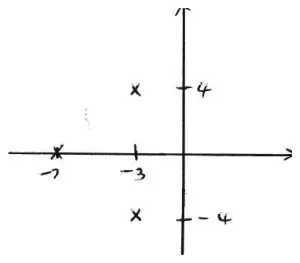
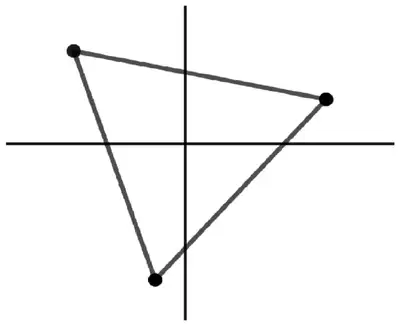
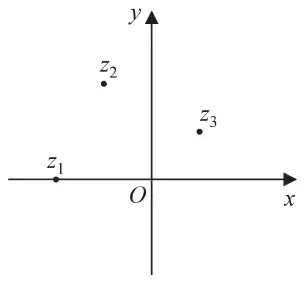
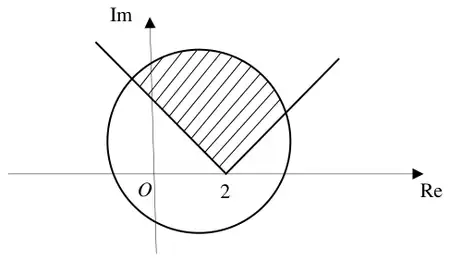
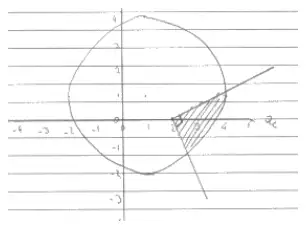
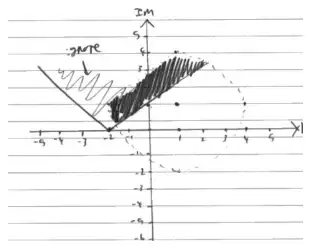
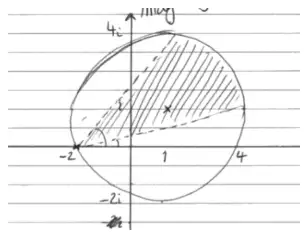
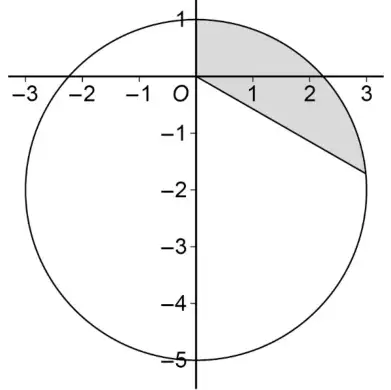
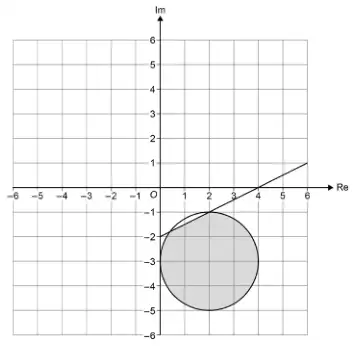
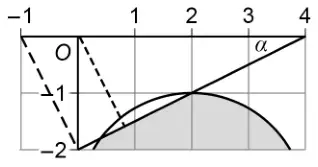
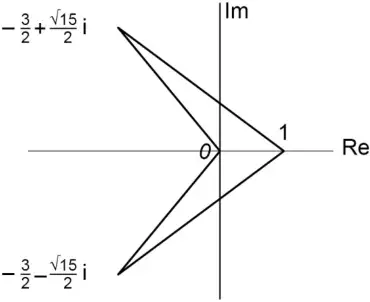
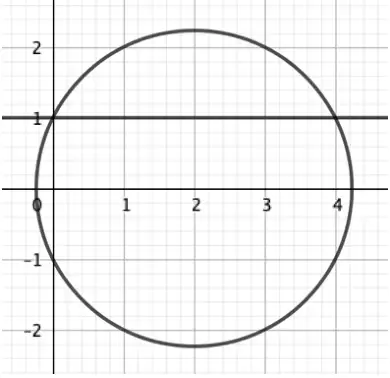
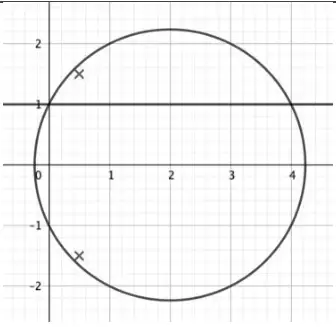
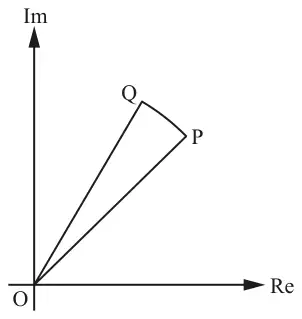
B1: States the other complex root. May be implied by later working.
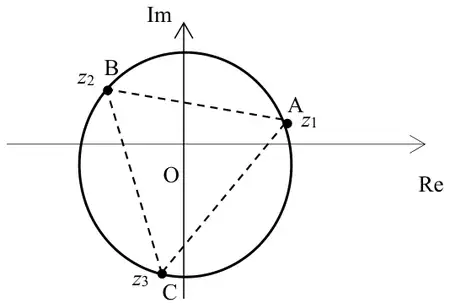
M1: Uses the area of the triangle to determine at least one value for the real root. You can award for sight of one correct value of \(z_3\) (Note: \(h = 3 \Rightarrow z_3 = 5\) or \(-1\))
dM1: Dependent on the previous method mark. Deduces a correct expression for one of their real roots. Award for \(\big(z - (2 - 4\mathrm{i})\big)\big(z - (2 + 4\mathrm{i})\big)(z - z_3)\) or equivalent e.g. \(\left(z^2 - 4z + 20\right)(z - z_3)\) \(z_3\) must be real.
ddM1: Dependent on previous method marks. Multiplies out to find values for the constants \(a\), \(b\) and \(c\). Award for the sight of at least 2 correct values of the constants \(a\), \(b\) and \(c\) in any one of their attempts at the function.
A1: Deduces the correct two functions.
Method 2:
B1: States the other complex root. May be implied by later working.
M1: Uses the area of the triangle to determine at least one value for the real root, You can award for sight of one correct value of \(z_3\) (Note: \(h = 3 \Rightarrow z_3 = 5\) or \(-1\))
dM1: Dependent on the previous method mark. Attempts sum, pair sum and product for at least one of their real roots.
ddM1: Dependent on previous method marks. Multiplies out to find values for the constants \(a\), \(b\) and \(c\) Award for the sight of at least 2 correct values of the constants \(a\), \(b\) and \(c\) in any one of their attempts at the function.
A1: Deduces the correct two functions.
Note: There are several methods that can be used to obtain the first method mark:
Uses vertices \((2,\ 4)\), \((2,\ -4)\) and \((x_3,\ 0)\) to determine at least one value for the real root. Alternatively uses \((x_3,\ y_3)\). This may come from a diagram. Do not be concerned about the variables they use. e.g. \(12 = \dfrac{1}{2} \times 8 \times \lvert x_3 - 2\rvert \Rightarrow z_3 =\) or \(x_3 =\)
Uses the formula for the area of a triangle with vertices \((x_1,\ y_1),\ (x_2,\ y_2),\ (x_3,\ y_3)\) to determine at least one value for the real root. Do not be concerned about the variables they use. \(\left[\dfrac{1}{2}\left\lvert x_1(y_2 - y_3) + x_2(y_3 - y_1) + x_3(y_1 - y_2)\right\rvert\right]\) \(12 = \dfrac{1}{2}\left\lvert 2(-4 - y_3) + 2(y_3 - 4) + x_3(4 - {-4})\right\rvert\) \(24 = \lvert -16 + 8x_3\rvert\) \(\Rightarrow z_3 =\) or \(x_3 =\)
Uses the shoelace method with no sign errors. e.g. Area \(= \dfrac{1}{2}\begin{vmatrix}2 & 2 & x_3 & 2\\ 4 & -4 & 0 & 4\end{vmatrix}\) \(12 = \dfrac{1}{2}\left\lvert (2 \times {-4} + 4x_3) - (2 \times 4 - 4x_3)\right\rvert\) \(24 = \lvert -16 + 8x_3\rvert\) \(\Rightarrow z_3 =\) or \(x_3 =\)
If you are uncertain in how to apply a method, then please send to review.
\(\{\theta =\}\ \dfrac{\pi}{6}\) or 30 or \(\arg(z + 1) = \dfrac{\pi}{6}\) or 30
A1
1.1b
\(\{\theta =\}\ -\dfrac{\pi}{6}\) or \(\dfrac{11\pi}{6}\) or \(-30\) or 330 or \(\arg(z + 1) = -\dfrac{\pi}{6}\) or \(\dfrac{11\pi}{6}\) or \(-30\) or 330
A1
2.2a
(3)
Notes
(Corrected from the printed mark scheme: in Alternative 1 the term \(2x\tan^2\theta\) is printed as \(2x\tan^2 x\).)
M1: Complete method to find one possible value of \(\theta\)
Alternative 1: condone slips with algebra as long as intention is clear
A1: One correct value \(\theta\)
A1: Deduces the other correct value of \(\theta\) and no other incorrect angles
Mark scheme (c)
Scheme
Marks
AO
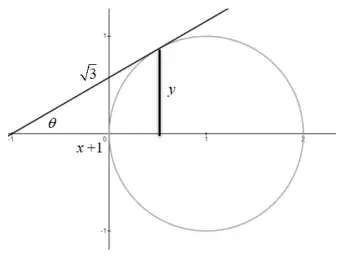
\(\sin\theta = \dfrac{y}{\sqrt{3}} \Rightarrow y = \ldots\) \(\cos\theta = \dfrac{x + 1}{\sqrt{3}} \Rightarrow x = \ldots\)
Alternative 1 \((x - 1)^2 + y^2 = 1\) and \(y = \tan\{\text{their } \theta\}(x + 1) \Rightarrow y = \ldots\left\{\dfrac{\sqrt{3}}{3}x + \dfrac{\sqrt{3}}{3}\right\}\) \((x - 1)^2 + \left(\dfrac{\sqrt{3}}{3}x + \dfrac{\sqrt{3}}{3}\right)^2 = 1\) leading to \(4x^2 - 4x + 1 = 0 \Rightarrow x = \ldots\) and \(y = \ldots\)
Alternative 2 \(z + 1 = \text{their}\sqrt{3}\left(\cos\text{their}\theta + \mathrm{i}\sin\text{their}\theta\right)\) leading to \(z = \ldots\)
M1: A correct method to find a complex number using one of their values of \(\theta\)
A1: One correct complex number check special case for coordinates only
A1ft: Deduces the other correct complex number. Follow through on \(z = a + b\mathrm{i}\) so scored for \(z = a - b\mathrm{i}\) as long as the method mark is scored
Special case: If leave as two correct coordinates or give values for \(x\) and \(y\) then SC M1 A1 A0
Alternative
Scheme
Marks
AO
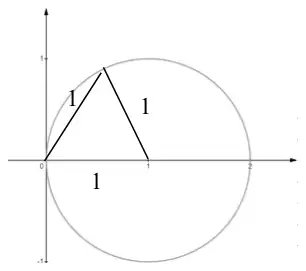
Using equilateral triangles to find \(z = \ldots\)
(i) \[z_1 = a + b\mathrm{i} \quad \text{and} \quad z_2 = c + d\mathrm{i}\]
where \(a\), \(b\), \(c\) and \(d\) are real constants.
Given that
\(b \gt d\)
\(z_1 + z_2\) is real
\(\lvert z_1\rvert = \sqrt{13}\)
\(\lvert z_2\rvert = 5\)
\(\mathrm{Re}(z_2 - z_1) = 2\)
show that \(a = 2\) and determine the value of each of \(b\), \(c\) and \(d\) (5)
(ii)
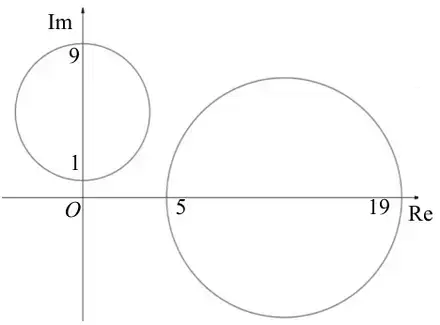
(a) On the same Argand diagram
sketch the locus of points \(z\) which satisfy \(\lvert z - 12\rvert = 7\)
sketch the locus of points \(w\) which satisfy \(\lvert w - 5\mathrm{i}\rvert = 4\)
showing the coordinates of any points of intersection with the axes. (2)
(b) Determine the range of possible values of \(\lvert z - w\rvert\) (3)
Mark scheme (i)
Scheme
Marks
AO
\(z_1 + z_2 = a + b\mathrm{i} + c + d\mathrm{i}\) leading to \(b + d = 0\) (oe) or \(z_2 - z_1 = (c + d\mathrm{i}) - (a + b\mathrm{i})\) leading to \(c - a = 2\) (oe)
B1
1.1b
Forms equations using modulus information \(\lvert z_1\rvert = \sqrt{13} \Rightarrow a^2 + b^2 = 13\) and \(\lvert z_2\rvert = 5 \Rightarrow c^2 + d^2 = 25\)
M1
3.1a
Uses their equations to solve simultaneously to find at least one value e.g Method 1 \(c = 2 + a,\ d = -b\) leading to \((2 + a)^2 + (-b)^2 = 25 \Rightarrow a^2 + 4a + 4 + b^2 = 25\) Solve with \(a^2 + b^2 = 13\) gives \(13 + 4a + 4 = 25 \Rightarrow 4a = 8 \Rightarrow a = \ldots\)
e.g. Method 2 \(\left.\begin{aligned}a^2 + b^2 &= 13\\ c^2 + d^2 &= 25\end{aligned}\right\} \Rightarrow a^2 - c^2 = -12\) and solves simultaneous with \(c - a = 2\) to find a value for \(a\) or \(c\).
M1
3.1a
Uses their equations to find values for all the constants
ddM1
2.1
\(a = 2,\ b = 3,\ c = 4,\ d = -3\)
A1
2.3
(5)
Notes
B1: States either \(b + d = 0\) or \(c - a = 2\) (oe)
M1: Uses the modulus information to write down two more equations (need not be squared). Accept if they forget to square one of the moduli but the sum of squares must be correct.
M1: Uses their equations to solve simultaneously to find at least one value. If they assume \(a = 2\), you may allow this mark for finding at least one of \(b\) or \(d\).
ddM1: Dependent on both previous method marks. Uses their equations to find values for all of the constants. This mark is not available if \(a = 2\) is assumed. All must be found from algebra.
A1: Correct values from correct work.
Mark scheme (ii)(a)
Scheme
Marks
AO
B1
B1
1.1b
1.1b
(2)
Notes
B1: One circle drawn with correct intercepts OR both circles drawn in correct position, not overlapping, but with no intercepts shown. Be tolerant on the shape but must be a clear attempt at a circle – a closed loop with no obvious kinks. Labels on imaginary axis may be just numbers or i and 9i.
B1: Both circles drawn with correct intercepts and the circles does not intersect each other. Again be tolerant as per first B mark.
Mark scheme (ii)(b)
Scheme
Marks
AO
Distance between centres \(= \sqrt{5^2 + 12^2} = 13\)
M1
1.1b
\(13 \pm (7 + 4)\)
dM1
3.1a
\(2 \leqslant \lvert z - w\rvert \leqslant 24\)
A1
1.1b
(3)
(10 marks)
Notes
M1: Finds the distance between the centres of the circles.
dM1: Dependent on previous method mark. Full method to find the nearest and furthest points of circles. E.g. Uses their distance +/- sum of radii. If their distance between circles is less than 11, there must a check seen to show this has been considered. If by error they show the circles touch (not cross) then note that finding twice the sum of radii is a valid method for the greatest distance.
A1: Correct answer. Allow if the centres were on the negative axes.
Alt: There may be attempts via finding the line through the centres.
M1: Full method to find the equation of the line through the two centres: \(m = \dfrac{0 - 5}{12 - 0} = -\dfrac{5}{12} \Rightarrow y = -\dfrac{5}{12}(x - 12)\) (oe)
dM1: Full method to find the nearest and furthest points of circles, so finds the intersection points of this line with the circles and finds distances between the relevant points. \(x^2 + \left(-\dfrac{5}{12}x + 5 - 5\right)^2 = 16 \Rightarrow \dfrac{169}{144}x^2 = 16 \Rightarrow x = \pm\dfrac{48}{13} \Rightarrow y = \dfrac{45}{13},\ \dfrac{85}{13}\) \((x - 12)^2 + \left(-\dfrac{5}{12}x + 5\right)^2 = 49 \Rightarrow \dfrac{169}{144}x^2 - \dfrac{169}{6}x + 120 = 0 \Rightarrow x = \dfrac{72}{13},\ \dfrac{240}{13} \Rightarrow y = \pm\dfrac{35}{13}\) nearest \(= \sqrt{\left(\dfrac{72}{13} - \dfrac{48}{13}\right)^2 + \left(\dfrac{35}{13} - \dfrac{45}{13}\right)^2} = 2\), furthest \(= \sqrt{\left(\dfrac{240}{13} + \dfrac{48}{13}\right)^2 + \left(-\dfrac{35}{13} - \dfrac{85}{13}\right)^2} = 24\)
M1: Finds an expression for \(\dfrac{z}{z^*}\) by rationalising the denominator and collects real parts, eliminating \(\mathrm{i}^2\) terms. e.g. Accept \(\dfrac{a^2 - b^2 + 2ab\mathrm{i}}{a^2 + b^2}\) or \(\dfrac{a^2 - b^2}{a^2 + b^2} + \dfrac{2ab\mathrm{i}}{a^2 + b^2}\) but \(\dfrac{a^2 + 2ab\mathrm{i} - b^2}{a^2 + b^2}\) is insufficient unless they then go on to identify the real parts Allow sign slips but must be a correct use of rationalising the denominator.
A1*: Sets real part equal to zero and then achieves the correct equation, with no errors seen. \(\dfrac{z}{z^*} = \dfrac{a^2 - b^2 + 2ab\mathrm{i}}{a^2 + b^2} \Rightarrow a^2 = b^2\) is insufficient, as they have not set or identified their real part as zero.
\(\Rightarrow a = kb,\ b = ka\) e.g. \(a = \dfrac{b}{a} \times b\) or \((k =)\dfrac{a}{b} = \dfrac{b}{a}\) \(\Rightarrow a^2 = b^2\)
A1*
1.1b
(2)
M1: Substitutes \(z = a + b\mathrm{i}\) and \(z^* = a - b\mathrm{i}\), sets equal to an imaginary number such as \(k\mathrm{i}\) but not \(\mathrm{i}\). Then expands brackets, eliminating \(\mathrm{i}^2\) terms, achieving an equation equivalent to \(a + b\mathrm{i} = ka\mathrm{i} + kb\)
A1*: Equates real parts and imaginary parts and uses their pair of equations to eliminate \(k\) and then achieve the correct equation, with no errors seen.
If you see a method that involves using exponentials, or modulus argument form, or working backwards, or any other method which may be worthy of credit, please send to review.
Mark scheme (b)
Scheme
Marks
AO
\(zz^* = (a + b\mathrm{i})(a - b\mathrm{i}) = a^2 + b^2 = 50\) Solves simultaneously with \(a^2 = b^2\) to find a value for \(a\) or \(b\) \(2a^2 = 50 \Rightarrow a = \ldots\) or \(2b^2 = 50 \Rightarrow b = \ldots\)
M1: Uses the information \(zz^* = 50\) to form another equation for \(a\) and \(b\), with no imaginary terms present. Then solves simultaneously to find a value for \(a\) or \(b\) If they obtain \(a^2 - b^2 = 50\) this will be M0
A1: At least two correct complex numbers. Accept e.g. \(\pm(5 + 5\mathrm{i})\)
A1: Deduces all 4 correct complex numbers. Accept e.g. \(\pm 5 \pm 5\mathrm{i}\) or \(\pm(5 \pm 5\mathrm{i})\)
Note: Correct answers with no workings can achieve M1A1A1
(a) Write \(z\) in the form \(r(\cos\theta + \mathrm{i}\sin\theta)\) where \(-\pi \lt \theta \leqslant \pi\) (2)
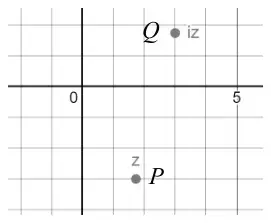
(b) Show and label on a single Argand diagram
(i) the point \(P\) representing \(z\)
(ii) the point \(Q\) representing \(\mathrm{i}z\)
(2)
(c) Describe the geometrical transformation that maps \(P\) onto \(Q\) (2)
Mark scheme (a)
Scheme
Marks
AO
\(z = \sqrt{3} - 3\mathrm{i}\) so \(r = \sqrt{\left(\sqrt{3}\right)^2 + (\pm 3)^2}\) or \(\sqrt{12}\) or \(2\sqrt{3}\) or awrt 3.46 \(\theta = -\dfrac{\pi}{3}\) or \(-60\) or awrt \(-1.05\)
B1
1.1b
\(\{z=\}\ \sqrt{12}\left(\cos\left(-\dfrac{\pi}{3}\right) + \mathrm{i}\sin\left(-\dfrac{\pi}{3}\right)\right)\) or \(2\sqrt{3}\left(\cos\left(-\dfrac{\pi}{3}\right) + \mathrm{i}\sin\left(-\dfrac{\pi}{3}\right)\right)\) or \(\{z=\}\ \sqrt{12}\left(\cos\left(\dfrac{\pi}{3}\right) - \mathrm{i}\sin\left(\dfrac{\pi}{3}\right)\right)\) or \(\{z=\}\ 2\sqrt{3}\left(\cos\left(\dfrac{\pi}{3}\right) - \mathrm{i}\sin\left(\dfrac{\pi}{3}\right)\right)\)
B1
1.1b
(2)
Notes
B1: Correct modulus or correct argument may be correct to 3 s.f for this mark
B1: Fully correct must be exact values for this mark, angle must be in radians
M1: If no coordinates given then it must be in the correct quadrant and either z below the line \(y = -x\) or i\(z\) below the line \(y = x\) or the correct coordinate shown. If incorrect coordinates shown then M0
A1: Both \(z\) and i\(z\) drawn correctly on an Argand diagram. with i\(z\) below the line \(y = x\) and z below the line \(y = -x\) or correct coordinates indicated
If there are no coordinates and the points line close to the lines \(y = x\) and \(y = -x\) send to review
Mark scheme (c)
Scheme
Marks
AO
Rotation
B1
1.1a
\(\dfrac{\pi}{2}\) or 90° (anticlockwise) about the origin or \(\dfrac{3\pi}{2}\) or 270° clockwise about the origin
B1
1.1b
(2)
(6 marks)
Notes
(c) Note must be a single transformation, there is no follow through
B1: Deduces rotation
B1: Correct angle (radians or degrees), direction and centre
Alternative
Alternatives must have scored M1A1 in (b)
Reflection
Matrix
Translation
Marks
AO
B1
1.1a
\(\arg z = -\dfrac{\pi}{12}\) or \(y = \left(\sqrt{3} - 2\right)x\)
B1: Correct values for \(\lvert z\rvert\) and \(\lvert w\rvert\). No need for method, may see modulus-argument forms (polar or exponential) used. Alternatively, correctly identifies \(z = -2w\)
M1: Finds \(\dfrac{z}{w}\) and then \(\left\lvert\dfrac{z}{w}\right\rvert\). Look for multiplication of numerator and denominator by the conjugate of the denominator for finding \(\dfrac{z}{w}\). In the look for alternative factoring out the \(-2\) and cancelling \(z\) oe. Allow this mark if modulus-argument forms (polar or exponential) are used to deduce the modulus.
A1: Correctly shows that \(\dfrac{\lvert z\rvert}{\lvert w\rvert} = 2\) and \(\left\lvert\dfrac{z}{w}\right\rvert = 2\) hence state that \(\left\lvert\dfrac{z}{w}\right\rvert = \dfrac{\lvert z\rvert}{\lvert w\rvert}\) cso. If the result is not stated at the end, we require both \(\left\lvert\dfrac{z}{w}\right\rvert\) and \(\dfrac{\lvert z\rvert}{\lvert w\rvert}\) to have explicitly been seen at some stage in their work and a minimal conclusion (e.g. “LHS=RHS”) to be given. Note \(\dfrac{z}{w} = \ldots = -2\) followed by \(\lvert -2\rvert = 2\) without ever seeing \(\left\lvert\dfrac{z}{w}\right\rvert\) will be A0. If modulus-argument forms (polar or exponential) were used all working must have been correct.
Mark scheme (b)
Scheme
Marks
AO
\(\arg(z) = -\dfrac{\pi}{3}\) or \(\dfrac{5\pi}{3}\) and \(\arg(w) = \dfrac{2\pi}{3}\) Alt: \(\arg(w) = \dfrac{2\pi}{3}\) and \(\arg\left(w^2\right) = \dfrac{4\pi}{3}\)
B1: Correct values for \(\arg(z)\) and \(\arg(w)\). Accept degrees equivalents here and throughout. Alternatively, correct values for \(\arg(w)\) and \(\arg\left(w^2\right)\).
M1: Finds \(zw\) and then \(\arg(zw)\). Do not allow attempts via modulus-argument forms (polar or exponential) that use the sum of arguments to prove the sum of arguments of the product. Alternatively, finds both \(\arg(z)\) and \(\arg(zw)\) in terms of \(\arg(w)\) using \(\arg(-p) = \arg(p) \pm \pi\).
A1: Shows that \(\arg(z) + \arg(w) = \dfrac{\pi}{3}\) and following \(\arg(zw) = \dfrac{\pi}{3}\) hence that \(\arg(zw) = \arg(z) + \arg(w)\) cso If the result is not stated at the end, we require both sides of the result to have been seen at some stage in their work and a minimal conclusion (e.g. “LHS=RHS”) to be given. Alternatively, correctly establishes the result using \(\arg(zw) = \arg\left(w^2\right) \pm \pi = 2\arg(w) \pm \pi\) and \(\arg z + \arg w = \arg w \pm \pi + \arg w = 2\arg w \pm \pi\) with \(\arg w^2 = 2\arg w\) verified.
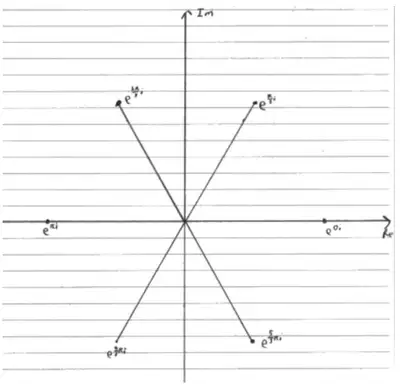
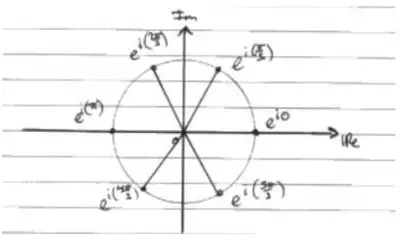
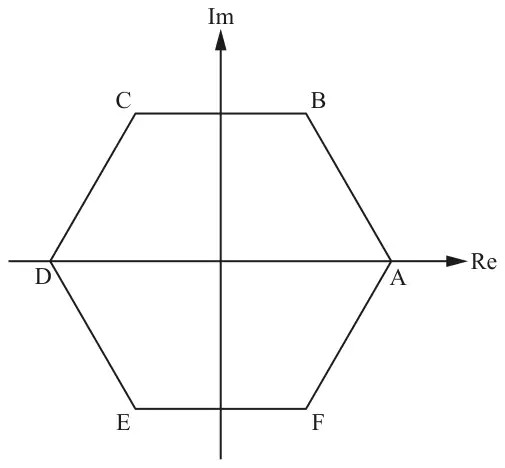
(a) Determine the roots of the equation\[z^6 = 1\]giving your answers in the form \(\mathrm{e}^{\mathrm{i}\theta}\) where \(0 \leqslant \theta \lt 2\pi\) (2)
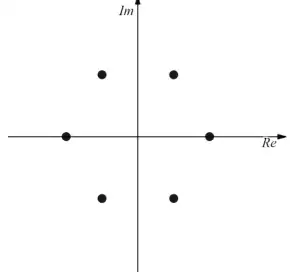
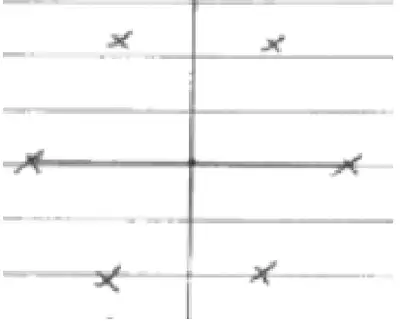
(b) Show the roots of the equation in part (a) on a single Argand diagram. (2)
(c) Show that\[\left(\sqrt{3} + \mathrm{i}\right)^6 = -64\] (2)
(d) Hence, or otherwise, solve the equation\[z^6 + 64 = 0\]giving your answers in the form \(r\mathrm{e}^{\mathrm{i}\theta}\) where \(0 \leqslant \theta \lt 2\pi\) (3)
M1: For sight of \(\mathrm{e}^{\frac{k\pi}{3}\mathrm{i}}\) Accept any value for \(k\)
A1: All six roots fully defined as shown or listed separately with their values of \(\theta\) within the given range with no incorrect or extra values. Ensure i and \(\pi\) are present in each term.
Note: Roots if listed are \(\mathrm{e}^0, \mathrm{e}^{\frac{\pi}{3}\mathrm{i}}, \mathrm{e}^{\frac{2\pi}{3}\mathrm{i}}, \mathrm{e}^{\pi\mathrm{i}}, \mathrm{e}^{\frac{4\pi}{3}\mathrm{i}}, \mathrm{e}^{\frac{5\pi}{3}\mathrm{i}}\), condone 1 for \(\mathrm{e}^0\) and/or \(-1\) for \(\mathrm{e}^{\pi\mathrm{i}}\)
Mark scheme (b)
Scheme
Marks
AO
B1 dB1
2.2a 1.1b
(2)
Notes
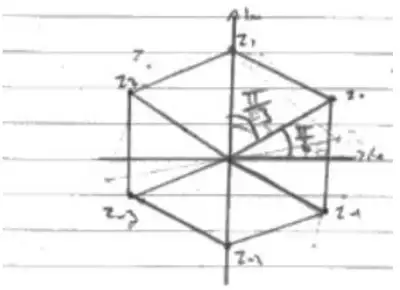
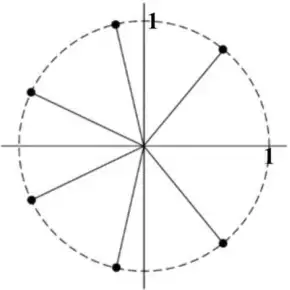
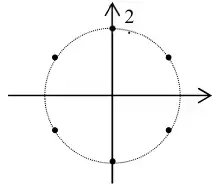
B1: Plots 6 points that form a hexagon, with a point on the positive real axis and a point on the negative real axis, and one point in each quadrant. Do not be concerned about the position of each point from the centre, however the sketch must convey a hexagon.
dB1: The points form a hexagon, centre the origin (see diagram), axes need not be labelled. Look for the axes acting as lines of symmetry. (Drawing line/vectors to each point is acceptable but not necessary for either mark)
M1: Converts \(\sqrt{3} + \mathrm{i}\) to polar form to obtain \(r\mathrm{e}^{\mathrm{i}\theta}\) with at least \(r = 2\) or \(\theta = \dfrac{\pi}{6}\) and applies the power of 6 correctly to obtain \(r^6\mathrm{e}^{6\theta\mathrm{i}}\)
A1*: Obtains the given answer with sufficient working shown. As a minimum need to see \(2^6\mathrm{e}^{\frac{6\pi i}{6}} = -64\) or \(2^6\mathrm{e}^{\pi\mathrm{i}} = -64\) If \(r = -2\) is seen in their workings withhold this mark.
OR
M1: Converts \(\sqrt{3} + \mathrm{i}\) to modulus-argument form \(r(\cos\theta + \mathrm{i}\sin\theta)\) with at least \(r = 2\) or \(\theta = \dfrac{\pi}{6}\) and applies the power of 6 correctly to obtain \(r^6(\cos 6\theta + \mathrm{i}\sin 6\theta)\)
A1*: Obtains the given answer with sufficient working shown.
OR
M1: Attempts to expand \(\left(\sqrt{3} + \mathrm{i}\right)^6\) fully using an attempt at the binomial expansion. Must have 7 terms for \((a + b)^n\) and correct binomial coefficients with \(a = \sqrt{3}\), \(b = \mathrm{i}\) and \(n = 6\)
A1*: Obtains the given answer with at least one intermediate line.
OR
M1: Attempts the full expansion of \(\left(\sqrt{3} + \mathrm{i}\right)^6 = \left(\sqrt{3} + \mathrm{i}\right)\left(\sqrt{3} + \mathrm{i}\right)\left(\sqrt{3} + \mathrm{i}\right)\ldots\left(\sqrt{3} + \mathrm{i}\right) =\) There must be no brackets, no irrational numbers and no terms in i in their simplified answer.
A1*: Obtains the given answer with sufficient working shown including correct full expansion, with at least one intermediate line.
M1: Obtains at least one value of \(z\) in the form \(r\mathrm{e}^{\mathrm{i}\theta}\) with their consistent value of \(r\), and \(\theta\) taking one of \(\left\{\dfrac{\pi}{6}, \dfrac{\pi}{2}, \dfrac{5\pi}{6}, \dfrac{7\pi}{6}, \dfrac{3\pi}{2}, \dfrac{11\pi}{6}\right\}\)
A1: For \(2\mathrm{e}^{\frac{\pi}{6}\mathrm{i}}, 2\mathrm{e}^{\frac{\pi}{2}\mathrm{i}}, 2\mathrm{e}^{\frac{5\pi}{6}\mathrm{i}}, 2\mathrm{e}^{\frac{7\pi}{6}\mathrm{i}}, 2\mathrm{e}^{\frac{3\pi}{2}\mathrm{i}}, 2\mathrm{e}^{\frac{11\pi}{6}\mathrm{i}}\) with no incorrect or extra values. Accept unsimplified arguments such as having a solution of \(2\mathrm{e}^{\frac{9\pi}{6}\mathrm{i}}\). Ensure i and \(\pi\) are present in each term. Accept \(2\mathrm{e}^{\frac{\pi}{2}\mathrm{i}}\) as \(2\mathrm{i}\) and \(2\mathrm{e}^{\frac{3\pi}{2}\mathrm{i}}\) as \(-2\mathrm{i}\)
(d) Determine the area of the region defined by \(A\), giving your answer to 3 significant figures. (4)
Mark scheme (a)
Scheme
Marks
AO
(i) \((-5, 12)\) or \(-5 + 12\mathrm{i}\)
B1
1.1b
(ii) \(r = 10\)
B1
1.1b
(2)
Notes
(a)(i) B1: Correct centre, condone \((-5, 12\mathrm{i})\)
(a)(ii) B1: Correct radius
Mark scheme (b)
Scheme
Marks
AO
B1ft
1.1b
(1)
Notes
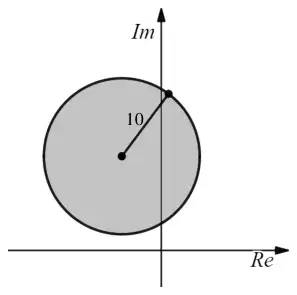
B1ft: A circle drawn with the inside shaded. Follow through their centre and radius. The centre must be in the correct quadrant and intercept the axes as appropriate. If they have the correct centre and radius then the centre must be in the second quadrant and the circle must only intercept the imaginary-axis. If diagram is correct consider this a restart B1.
Mark scheme (c)
Scheme
Marks
AO
\(OC = \sqrt{5^2 + 12^2}\)
M1
1.1b
\(|z|_{\max} = \sqrt{5^2 + 12^2} + 10\)
M1
3.1a
= 23
A1
1.1b
(3)
Notes
M1: Calculates the distance from \(O\) to the centre of their circle.
M1: Fully correct strategy for the maximum. E.g. Finds distance from \(O\) to centre of their circle and adds their radius.
A1: Correct answer. Correct answer with no working and following a correct centre and radius scores M1M1A1
\(x = \text{‘}-\dfrac{115}{13}\text{’} \Rightarrow y = \ldots\left\{\dfrac{276}{13}\right\}\) \(|z|_{\max} = \sqrt{\left(-\dfrac{115}{13}\right)^2 + \left(\dfrac{276}{13}\right)^2}\) Or \(x = \text{‘}-\dfrac{15}{13}\text{’} \Rightarrow y = \ldots\left\{\dfrac{36}{13}\right\}\) \(|z|_{\max} = \sqrt{\left(-\dfrac{15}{13}\right)^2 + \left(\dfrac{36}{13}\right)^2} + 2 \times 10\)
M1
3.1a
= 23
A1
1.1b
(3)
M1: Finds the equation of the line from the origin to centre and the Cartesian equation of the circle. Solves simultaneously to find the \(x\) values (or \(y\)) where the line intersects the circle.
M1: Selects the \(x\) coordinate to give the largest distance, find the corresponding \(y\) value and then the distance from the origin. Selects the \(x\) coordinate to give the smallest distance, find the corresponding \(y\) value and then adds on 2 times the radius.
A1: Correct answer
Mark scheme (d)
Scheme
Marks
AO
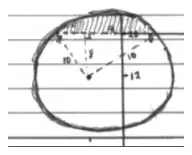
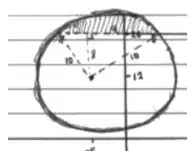
\(\left\{z : 0 \leqslant \arg(z + 5 - 20\mathrm{i}) \leqslant \pi\right\} \Rightarrow y = 20\) \(\Rightarrow (x + 5)^2 + 8^2 = 100 \Rightarrow x = \ldots\) AND finds an angle \(\cos\theta = \dfrac{10^2 + 10^2 - 12^2}{2 \times 10 \times 10} = 0.28\) Or \(a^2 = 10^2 - 8^2 \Rightarrow a = \ldots\{6\}\quad \sin\left(\dfrac{1}{2}\theta\right) = \dfrac{6}{10}\) Or \(\cos\left(\dfrac{1}{2}\theta\right) = \dfrac{8}{10}\)
M1
3.1a
\(\theta = 1.287\ldots\) or 73.7° or \(\dfrac{1}{2}\theta = 0.6435\ldots\) or 36.9°
A1
1.1b
Area \(= \dfrac{1}{2} \times 10^2 \times \theta - \dfrac{1}{2} \times 12 \times 8\) angle in radians Area \(= \pi \times 10^2 \times \dfrac{\theta}{360} - \dfrac{1}{2} \times 12 \times 8\) angle in degrees or Area \(= \dfrac{1}{2} \times 10^2 \times \theta - \dfrac{1}{2} \times 10 \times 10 \times \sin\theta\) angle in radians Area \(= \pi \times 10^2 \times \dfrac{\theta}{360} - \dfrac{1}{2} \times 10 \times 10 \times \sin\theta\) angle in degrees Or Area \(= 2\left[\dfrac{1}{2} \times 10^2 \times \theta - \dfrac{1}{2} \times 8 \times 6\right]\)
M1
3.1a
= awrt 16.4
A1
1.1b
(4)
(10 marks)
Notes
M1: Recognises that \(\left\{z : 0 \leqslant \arg(z + 5 - 20\mathrm{i}) \leqslant \pi\right\}\) represents the line \(y = 20\) and uses this with the circle in an attempt to find the angle or half angle at the centre.
A1: Correct value for the angle or half angle at the centre.
M1: Fully correct strategy for the area of the segment using their values.
A1: Awrt 16.4
Note: finding the area of the major segment using \(100\pi - 16.4 = \ldots\) scores M1A1M1A0
(b) Show, by shading on your Argand diagram, the set of points \(A\) (1)
(c) Find the area of the region defined by \(A\), giving your answer in the form \(p\pi + q\sqrt{3}\) where \(p\) and \(q\) are constants to be determined. (4)
Mark scheme (a)
Scheme
Marks
AO
M1 A1 M1 A1
1.1b 1.1b 1.1b 1.1b
(4)
Notes
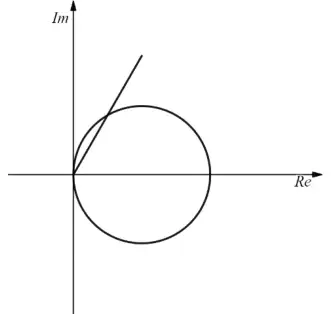
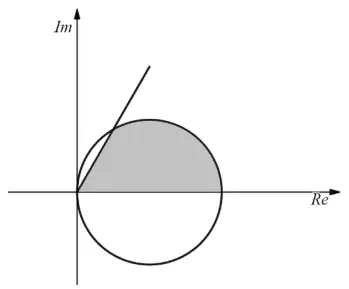
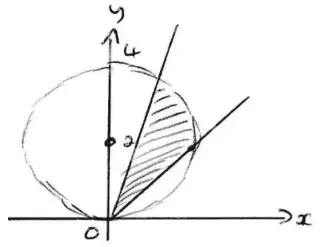
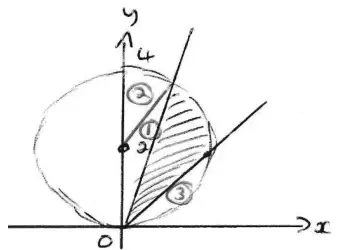
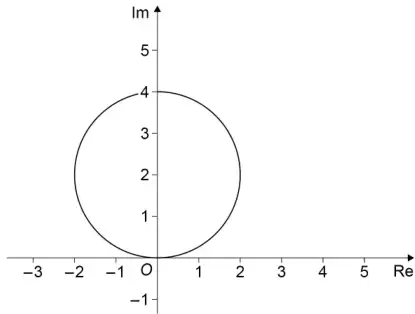
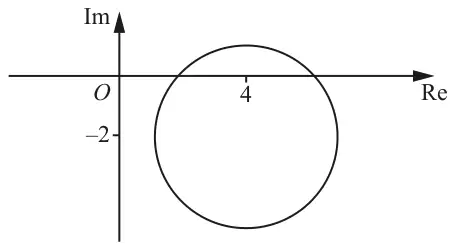
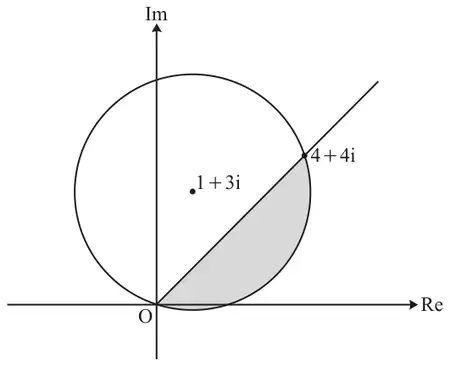
M1: Circle drawn with centre on the real axis Look for real axis acting as a line of symmetry of the circle.
A1: Circle in the correct position with the imaginary axis as a tangent Centre need not be labelled for either mark.
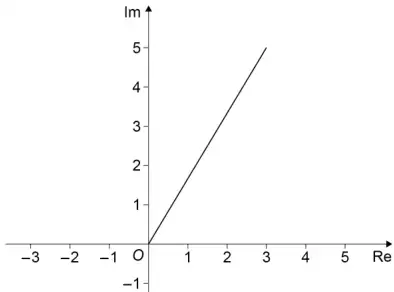
M1: Half line starting at the origin, must be in the first quadrant. Do not award if their line continues into the third quadrant
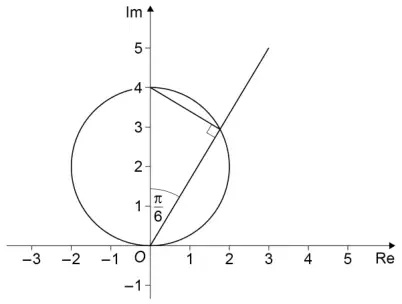
A1: Fully correct diagram that requires
A circle in the correct position
A half line intersecting the circle at the origin and in the first quadrant
The \(x\) coordinate of the intersection in the first quadrant must be to the left of the centre of the circle
Q5 (a) and (b) examples
a) M1A1M1A1 b) B1
a) M1A1M1A1 b) B0
a) M0A0M1A0 b) B1
a) M1A0M1A0 b) B1
Mark scheme (b)
Scheme
Marks
AO
B1ft
2.3
(1)
Notes
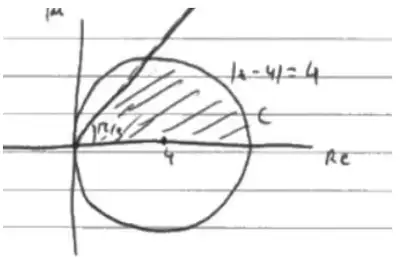
B1ft: Shades the region in their circle above the real axis and below the half line For this mark to be awarded their line must intersect the circle.
This is not for finding their shaded area of their diagram in part (a) but is for a correct process for finding the correct required area.
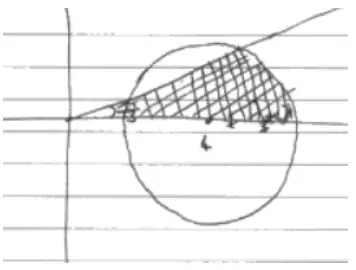
M1: Correct strategy for identifying both coordinates of the point of intersection. Award for substituting a line of the form \(y = kx\) into the equation of a circle \((x - 4)^2 + y^2 = 16\) then proceeds to find a value for \(x\) from a quadratic, where \(x \neq 0\) and then find their \(y\) coordinate.
A1: Correct coordinates, either written separately, or as \(\left(2, 2\sqrt{3}\right)\) or \(2 + 2\sqrt{3}\,\mathrm{i}\)
dM1: Fully correct strategy for the area, must be consistent with a half line making an angle of \(\dfrac{\pi}{3}\) with the real axis. Can be found by subtracting the area of a segment from the area of a semicircle or by adding the area of a sector to the area of a triangle. The candidate may do combinations of semicircles, triangles and sectors so look carefully for the method.
A1: Correct answer in the required form.
Alternative 1 M1: Deduces that since the half line makes an angle of \(\dfrac{\pi}{3}\) with the real axis, the horizontal and vertical distances from the origin to the point of intersection are \(4\cos\dfrac{\pi}{3}\) and \(4\sin\dfrac{\pi}{3}\).
A1: \(4\cos\dfrac{\pi}{3}\) and \(4\sin\dfrac{\pi}{3}\) oe are seen or used in their workings
dM1: Fully correct strategy for the area, must be consistent with a half line making an angle of \(\dfrac{\pi}{3}\) with the real axis. Can be found by subtracting the area of a segment from the area of a semicircle or by adding the area of a sector to the area of a triangle. The candidate may do combinations of semicircles, triangles and sectors so look carefully for the method.
A1: Correct answer in the required form.
Alternative 2 M1: Alternatively deduces that the angle implies that there is an equilateral triangle of radius 4
A1: 4 and \(\sin\dfrac{\pi}{3}\) are seen or used in their workings
dM1: Fully correct strategy for the area, must be consistent with a half line making an angle of \(\dfrac{\pi}{3}\) with the real axis. Can be found by subtracting the area of a segment from the area of a semicircle or by adding the area of a sector to the area of a triangle. The candidate may do combinations of semicircles, triangles and sectors so look carefully for the method.
A1: Correct answer in the required form.
Alternative 3: using polar coordinates M1: Achieves a polar equation of the form \(r = k\cos\theta\) and uses \(\left(\dfrac{1}{2}\right)\displaystyle\int r^2\,\mathrm{d}\theta\) to obtain \(k\displaystyle\int \cos^2\theta\,\mathrm{d}\theta\)
A1: Obtains \(\displaystyle\int (16 + 16\cos 2\theta)\,\mathrm{d}\theta\) oe, \(\mathrm{d}\theta\) may be missing
dM1: Integrates to obtain an expression of the form \(a\theta + b\sin 2\theta\), substitutes in limits of 0 and \(\dfrac{\pi}{3}\) and subtracts. If they reach a correct answer with no integration seen then withhold this mark.
B1: Identifies the correct complex conjugate as another root
M1: Formulates a correct strategy – sum and product approach. Attempts formulae for sum and product of the two know roots and all four roots – allow sign errors, \(\alpha + \beta = 4,\ \alpha\beta = 2^2 + 5^2 = \ldots\) \(\alpha + \beta + \gamma + \delta = \pm 6,\ \alpha\beta\gamma\delta = \pm 145\)
M1: Uses the sum and product of known roots to reduce to equations in just the unknown roots and attempts to solve simultaneously. Note allow if they assume complex roots and use \(\lambda \pm \mu\mathrm{i}\) for the two unknown roots.
A1: Deduces the correct quadratic for remaining roots.
B1: Identifies the correct complex conjugate as another root- seen anywhere
M1: Formulates a correct strategy – factor theorem approach. Applies the factor theorem with either complex root and equates real and imaginary terms to form simultaneous equations in \(a\) and \(b\)
A1: Correct equations need not be simplified.
M1: Solves the equations to find values for \(a\) and \(b\). Do not be concerned with the algebra.
A1: Correct values
M1: Solves the resulting quartic – may be by calculator. Note that if roots are stated by calculator they must correspond to their found \(a\) and \(b\), but allow for rounding to nearest integer.
A1: Correct second conjugate pair from fully correct work.
Mark scheme (b)
Scheme
Marks
AO
B1ft
B1
1.1b
1.1b
(2)
(9 marks)
Notes
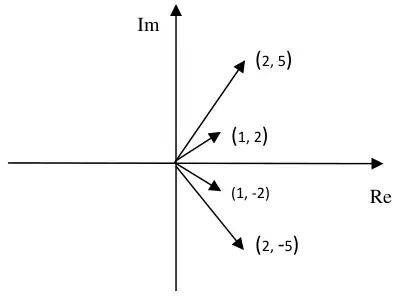
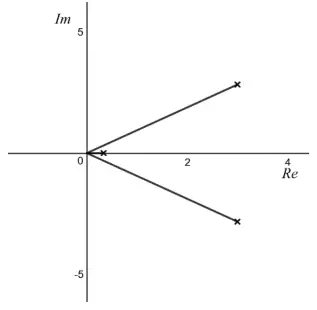
B1ft: A pair of complex roots plotted correctly, either both \(2 \pm 5\mathrm{i}\) or follow through their second pair of complex roots. Just the points are needed. Allow if there is no labelling for this mark, as long as there is a pair of roots symmetric in the real axis.
B1: Fully correct and labelled sketch with both sets of roots shown in approximately the correct locations. Just the points are needed. Labelling may be by coordinates or labels on axes, and accept tick marks as unit increments for labels. The \((1,\ \pm 2)\) roots must be within the sector spanned by \((2,\ \pm 5)\) (as in the diagram).
8. Given that a cubic equation has three distinct roots that all lie on the same straight line in the complex plane,
(a) describe the possible lines the roots can lie on. (2)
\[\mathrm{f}(z) = 8z^3 + bz^2 + cz + d\]
where \(b\), \(c\) and \(d\) are real constants.
The roots of \(\mathrm{f}(z)\) are distinct and lie on a straight line in the complex plane.
Given that one of the roots is \(\dfrac{3}{2} + \dfrac{3}{2}\mathrm{i}\)
(b) state the other two roots of \(\mathrm{f}(z)\) (1)
\[\mathrm{g}(z) = z^3 + Pz^2 + Qz + 12\]
where \(P\) and \(Q\) are real constants, has 3 distinct roots.
The roots of \(\mathrm{g}(z)\) lie on a different straight line in the complex plane than the roots of \(\mathrm{f}(z)\)
Given that
\(\mathrm{f}(z)\) and \(\mathrm{g}(z)\) have one root in common
one of the roots of \(\mathrm{g}(z)\) is \(-4\)
(c)
(i) write down the value of the common root, (1)
(ii) determine the value of the other root of \(\mathrm{g}(z)\) (3)
(d) Hence solve the equation \(\mathrm{f}(z) = \mathrm{g}(z)\) (4)
Mark scheme (a)
Scheme
Marks
AO
The real axis. Horizontal line through (0, 0) Line \(y = 0\) Accept on a diagram
The other possibility is that all three roots have the same real part so lie on a vertical line/perpendicular to the real axis/parallel to the imaginary axis Line \(x = k\) where \(k\) is a real number Accept on a diagram
B1 B1
3.1a 2.2a
(2)
Notes
B1: One correct line described
B1: Two correct lines described
Special case: If candidate states that "any line is possible" score B1B1 (as they may be considering a cubic with complex coefficients).
Mark scheme (b)
Scheme
Marks
AO
Other roots are \(\dfrac{3}{2}\) and \(\dfrac{3}{2} - \dfrac{3}{2}\mathrm{i}\)
B1
3.2a
(1)
Notes
B1: Interprets the conclusion from (a) in context by identifying the correct two roots.
Mark scheme (c)
Scheme
Marks
AO
(i) Common root must be \(\dfrac{3}{2}\)
B1
2.2a
(1)
(ii) Sets product of roots = – 12 using their \(\dfrac{3}{2} \times -4 \times \alpha = -12\) Or \(\mathrm{g}(z) = \left(z - \dfrac{3}{2}\right)(z + 4)(z - \alpha)\)
M1
1.1b
Solves to find a value of the third root their \(\dfrac{3}{2} \times -4 \times \alpha = -12 \Rightarrow \alpha = 2\) Or \(\mathrm{g}(z) = \left(z - \dfrac{3}{2}\right)(z \pm 4)(z - \alpha) \Rightarrow -\dfrac{3}{2} \times 4 \times -\alpha = 12 \Rightarrow \alpha = 2\)
M1 A1
3.1a 1.1b
(3)
Notes
B1: Deduces the real root is the one in common.
M1: Sets product of roots = – 12 using their \(\dfrac{3}{2} \times -4 \times \alpha = -12\). Alternatively forms an equation for \(\mathrm{g}(z)\) using the roots
M1: Solves their equation to find the third root, condone use of 12 for this mark. Alternatively multiply their constant and sets = 12 to find the third root. Condone a sign slip for this mark
\(7z^2 - 26z + 44 = 0 \Rightarrow z = \ldots\) or \(7z^3 - \dfrac{73}{2}z^2 + 83z - 66 = 0 \Rightarrow z = \ldots\)
M1
1.1b
So solutions are \(\dfrac{3}{2}\), \(\dfrac{13 \pm \mathrm{i}\sqrt{139}}{7}\)
A1
1.1b
(4)
(11 marks)
Notes
M1: Uses their roots of \(\mathrm{f}(z)\) to form a cubic expression for \(\mathrm{f}(z)\), and expands to at least a linear term times a quadratic with real coefficients (which may be seen later). May just expand the complex brackets. They must have the factor 8 for this mark Alternative uses \(b = -8(\text{sum of their roots})\) \(c = 8(\text{pair sum of their roots})\) and \(d = -8(\text{product of their roots})\) Note: \(\mathrm{f}(z) = 8z^3 - 36z^2 + 72z - 54\)
M1: Sets their expressions equal and factorises out or cancels the common term to achieve a quadratic expression in \(z\). Allow if \(\mathrm{f}(z)\) is not yet expanded or factor of 8 is missing. Alternatively finds the expression for \(\mathrm{g}(z)\) by multiplying out bracket or uses P = - sum roots and Q = pair sum. Sets their \(\mathrm{f}(z)\) = their \(\mathrm{g}(z)\) both must be cubic
M1: Expands, gathers terms and solves the resulting quadratic. Allow this mark if the \(z = \dfrac{3}{2}\) solution is not given. Alternatively simplifies for form a cubic = 0 and solves using calculator to find complex roots
A1: All three correct solutions given. Note decimals \(\dfrac{13}{7} \pm \mathrm{i}1.68\ldots\) is A0
Special case If the candidate just forgets the factor of 8 for \(\mathrm{f}(z)\) this scores M0M1M0A0
(i) Shade, on an Argand diagram, the set of points for which\[|z - 3| \leqslant |z + 6\mathrm{i}|\] (3)
(ii) Determine the exact complex number \(w\) which satisfies both\[\arg(w - 2) = \frac{\pi}{3} \quad \text{and} \quad \arg(w + 1) = \frac{\pi}{6}\] (6)
Mark scheme (i)
Scheme
Marks
AO
M1 A1 B1
3.1a 1.1b 1.1b
(3)
Notes
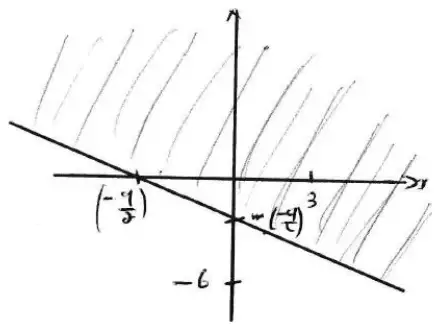
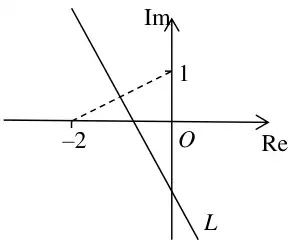
M1: Draws a single straight line through both axes with a negative gradient. Ignore any line joining (3, 0) and (0, −6)
A1: Draws a single straight line through both axes with a negative gradient which has a negative \(y\) intercept. Ignore any intercept marked on the axes. Ignore any line joining (3, 0) and (0, −6)
B1: Shades the area above their straight line (not a bounded region such as a triangle bounded by the axes and the line)
Mark scheme (ii)
Scheme
Marks
AO
\(m = \tan\left(\dfrac{\pi}{3}\right)\left\{= \sqrt{3}\right\}\) and \(y - 0 = m(x - 2)\) leads to \(y - 0 = \sqrt{3}(x - 2)\) or \(y = \sqrt{3}x - 2\sqrt{3}\) \(m = \tan\left(\dfrac{\pi}{6}\right)\left\{= \dfrac{\sqrt{3}}{3}\right\}\) and \(y - 0 = m(x - (-1))\) leads to \(y - 0 = \dfrac{\sqrt{3}}{3}(x - (-1))\) or \(y = \dfrac{\sqrt{3}}{3}x + \dfrac{\sqrt{3}}{3}\)
M1: Finds the Cartesian equations for both loci by using the gradient as tan(argument) and correct coordinate. Must be an attempt at both equations but one correct equation scores this mark
A1: One equation correct, need not be simplified A1: Both equations correct, need not be simplified M1: Solve simultaneously to find either the real or imaginary component. M1: Finds the other component to complete the process of finding \(w\). A1: Correct exact answer
Note: If leaves the answer as a coordinate this is A0. If defines \(w = a + b\mathrm{i}\) and then states \(a = \dfrac{7}{2}\) and \(b = \dfrac{3\sqrt{3}}{2}\) this is A1
Note: If candidates use decimal instead of exact values throughout allow the method marks \(y = 1.73x - 3.46\) and \(y = 0.58x + 0.58\)
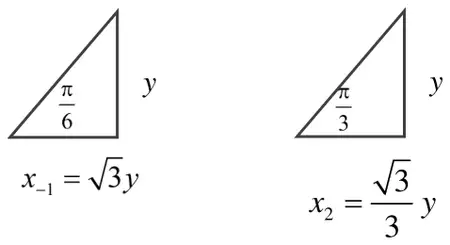
M1: Use both arguments to form equations involving \(x\) and \(y\) A1: (One correct triangle) value for \(x\) in terms of \(y\) A1: (Two correct triangles), values for \(x\) in terms of \(y\)
M1: Forms and solves an equation \(y\sqrt{3} = y\dfrac{\sqrt{3}}{3} + 3 \Rightarrow y = \ldots\) must be come from \(x_2 = x_{-1} + 3\)
M1: Uses their \(y\) value and \(x = y\sqrt{3} - 1\) or \(x = \dfrac{\sqrt{3}}{3}y + 2\) to find a value for \(x\) A1: Correct exact answer
Q7(ii) Two alternatives seen
Alternative 3
Scheme
Marks
AO
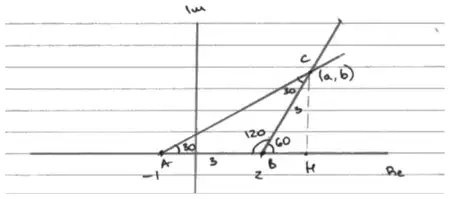
\(b = 3\sin\left(\dfrac{\pi}{3}\right)\) and \(c = 3\cos\left(\dfrac{\pi}{3}\right)\)
M1: Uses correct geometry to form equations involving \(a\) and \(c\) A1: One correct equation A1: Two correct equations M1: Finds the imaginary component M1: Uses 2 + their \(c\) to find the real component A1: Correct exact answer
(Corrected from the printed mark scheme: \(AC = \dfrac{7}{2}\). \(AC = 3\sqrt{3}\sin 60 = \dfrac{9}{2}\); the real part of \(w\) is then \(\dfrac{9}{2} - 1 = \dfrac{7}{2}\).)
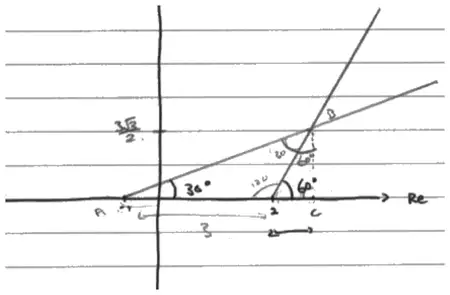
M1: Uses the sine rule to find the length \(AB\) A1: Correct length \(AB\) M1: Uses trigonometry to find either the real or imaginary component A1: Correct real or imaginary component M1: Uses trigonometry to find the other component A1: Correct exact answer
5. The points representing the complex numbers \(z_1 = 35 - 25\mathrm{i}\) and \(z_2 = -29 + 39\mathrm{i}\) are opposite vertices of a regular hexagon, \(H\), in the complex plane.
The centre of \(H\) represents the complex number \(\alpha\)
(a) Show that \(\alpha = 3 + 7\mathrm{i}\) (2)
Given that \(\beta = \dfrac{1 + \mathrm{i}}{64}\)
(b) show that\[\beta(z_1 - \alpha) = 1\] (2)
The vertices of \(H\) are given by the roots of the equation
\[\left(\beta(z - \alpha)\right)^6 = 1\]
(c)
(i) Write down the roots of the equation \(w^6 = 1\) in the form \(r\mathrm{e}^{\mathrm{i}\theta}\) (1)
(ii) Hence, or otherwise, determine the position of the other four vertices of \(H\), giving your answers as complex numbers in Cartesian form. (4)
M1: Substitutes into the equation with \(z_1\) and \(\alpha\) and \(\beta\), simplifies and expands and applies \(\mathrm{i}^2 = -1\), this may be implied by their working.
A1*: Completes the proof to find the correct answer with no errors seen, all necessary brackets as required
Mark scheme (c)
Scheme
Marks
AO
(i) Roots are \(\left\{\mathrm{e}^0\left(\text{or } 1 \text{ or } \mathrm{e}^{\mathrm{i}2\pi}\right)\right\}, \mathrm{e}^{\mathrm{i}\frac{\pi}{3}}, \mathrm{e}^{\mathrm{i}\frac{2\pi}{3}}, \mathrm{e}^{\mathrm{i}\pi}, \mathrm{e}^{\mathrm{i}\frac{4\pi}{3}}, \mathrm{e}^{\mathrm{i}\frac{5\pi}{3}}\) or \(\mathrm{e}^{\mathrm{i}\frac{k\pi}{3}},\ k = 0, 1, 2, 3, 4, 5\)
\(\left\{\mathrm{e}^0\left(\text{or } 1 \text{ or } \mathrm{e}^{\mathrm{i}2\pi}\right)\right\}, \mathrm{e}^{\mathrm{i}\frac{\pi}{3}}, \mathrm{e}^{\mathrm{i}\frac{2\pi}{3}}, \mathrm{e}^{\mathrm{i}\pi}, \mathrm{e}^{-\mathrm{i}\frac{\pi}{3}}, \mathrm{e}^{-\mathrm{i}\frac{2\pi}{3}}\) or \(\mathrm{e}^{\mathrm{i}\frac{k\pi}{3}},\ k = -2, -1, 0, 1, 2, 3,\)
B1
1.1b
(1)
(ii) \(w = \beta(z - \alpha) = \mathrm{e}^{\mathrm{i}\frac{k\pi}{3}} \Rightarrow z = \dfrac{\mathrm{e}^{\mathrm{i}\frac{k\pi}{3}}}{\beta} + \alpha\)
\(\left(\beta(z - \alpha)\right)^6 = 1^6 \Rightarrow (z - \alpha)^6 = \dfrac{1}{\beta^6} = 8589934592\mathrm{i}\) \(r = \sqrt[6]{8589934592} = 32\sqrt{2}\) or 45.25... and \(\theta = \dfrac{\pi}{12} + \dfrac{k\pi}{3}\) or \(\theta = -\dfrac{\pi}{4} + \dfrac{k\pi}{3}\) (corrected from the printed mark scheme: \(\dfrac{1}{\beta^6} = 2^{33}\mathrm{i}\) is printed as 8589934459i, and the number under the root as 858993459)
M1
3.1a
\(z = r(\cos\theta + \mathrm{i}\sin\theta) + 3 + 7\mathrm{i} = \ldots\) (corrected from the printed mark scheme: printed as \(r(\cos\theta - \mathrm{i}\sin\theta)\), which with these values of \(\theta\) does not give the vertices)
Rotation matrix \(\begin{pmatrix}\frac{1}{2} & -\frac{\sqrt{3}}{2}\\ \frac{\sqrt{3}}{2} & \frac{1}{2}\end{pmatrix}\) and \(\begin{pmatrix}35\\ -25\end{pmatrix} - \begin{pmatrix}3\\ 7\end{pmatrix}\) or \(\begin{pmatrix}-29\\ 39\end{pmatrix} - \begin{pmatrix}3\\ 7\end{pmatrix}\) Or find the exponential form for \(\begin{pmatrix}35\\ -25\end{pmatrix} - \begin{pmatrix}3\\ 7\end{pmatrix}\) or \(\begin{pmatrix}-29\\ 39\end{pmatrix} - \begin{pmatrix}3\\ 7\end{pmatrix}\) \(32\sqrt{2}\mathrm{e}^{\frac{\pi}{4}}\) or \(32\sqrt{2}\mathrm{e}^{-\frac{\pi}{4}}\)
(c) (i) B1: Correct roots, accept all 6 listed or given in general form as in the scheme. Need not show the 1.
(c)(ii) M1: Realises the need to set the roots of unity equal to \(\beta(z - \alpha)\) and solve for \(z\). Must be attempted at least once with any of their roots. M1: Finds the Cartesian form for their equation for at least one of the roots other than \(z_1\) and \(z_2\) A1: At least two correct other roots than \(z_1\) and \(z_2\) in Cartesian form. A1: Deduces all four correct in Cartesian form and no extra solutions
Alternative 1 M1: Finds the modulus and argument of \((z - \alpha)^6\) M1: Finds the Cartesian form for one of their modulus and arguments A1A1: same as above
Alternative 2 M1: Finds the rotation matrix and subtracts the centre from \(z_1\) or \(z_2\). Or finds the exponential from for \(z_1 - \alpha\) or \(z_2 - \alpha\) M1: Finds the Cartesian form by multiplying by the rotation matrix and adding the centre. Or multiplies by \(\mathrm{e}^{\frac{\pi}{3}\mathrm{i}}\) write in Cartesian form and adds on the centre A1A1: same as above
Note all four correct decimal answers or written as coordinates score A1A0 46.7 + 18.7i – 40.7 – 4.7i 14.7 + 50.7i – 8.7 – 36.7i Note: Correct answers implies the method marks
(a) Show that\[\frac{2 + 3\mathrm{i}}{5 + \mathrm{i}} = k(1 + \mathrm{i})\]where \(k\) is a constant to be determined. (Solutions relying on calculator technology are not acceptable.) (3)
Given that
\(n\) is a positive integer
\(\left(\dfrac{2 + 3\mathrm{i}}{5 + \mathrm{i}}\right)^n\) is a real number
(b) use the answer to part (a) to write down the smallest possible value of \(n\). (1)
(ii) The complex number \(z = a + b\mathrm{i}\) where \(a\) and \(b\) are real constants.
Given that
\(\left|z^{10}\right| = 59\,049\)
\(\arg\left(z^{10}\right) = -\dfrac{5\pi}{3}\)
determine the value of \(a\) and the value of \(b\). (4)
M1: Selects the process \(\dfrac{2 + 3\mathrm{i}}{5 + \mathrm{i}} \times \dfrac{5 - \mathrm{i}}{5 - \mathrm{i}}\)
dM1: Evidence of multiplying out brackets
A1: Achieves \(\dfrac{1}{2}(1 + \mathrm{i})\) or \(\dfrac{13}{26}(1 + \mathrm{i})\) with no errors cso, isw.
Note: Correct answer from no working score no marks
Note: Going from \(\dfrac{13 + 13\mathrm{i}}{26}\) and then stating \(k = \dfrac{1}{2}\) is A0, they have not shown the form asked for
Alternative M1: Multiplies across by \((5 + \mathrm{i})\) and expands the brackets dM1: Collects terms A1: Achieves \(2 + 3\mathrm{i} = k(4 + 6\mathrm{i})\) and draws the conclusion that therefore \(\dfrac{2 + 3\mathrm{i}}{5 + \mathrm{i}} = k(1 + \mathrm{i})\) where \(k = \dfrac{1}{2}\)
\(z = \dfrac{3\sqrt{3}}{2} - \dfrac{3}{2}\mathrm{i}\) or \(a = \dfrac{3\sqrt{3}}{2}\) and \(b = -\dfrac{3}{2}\)
A1
1.1b
(4)
(8 marks)
Notes
Note: Send to review any attempts where they are finding additional solutions such as arguments of \(\boldsymbol{z}\) is \(\dfrac{(6k - 5)\pi}{30}\) For example correctly uses \(\arg(z) = \dfrac{\pi}{30}\)
B1 (M1 on ePen): \(|z| = 3\) can be implied by \(a^2 + b^2 = 9\) isw
M1: Uses \(\arg(z_1z_2) = \arg(z_1) + \arg(z_2)\) to find \(\arg(z) = -\dfrac{5\pi}{3} \div 10\) or \(\arg(z) = \dfrac{\pi}{3} \div 10\)
M1: Uses \(z = \text{their } |z|\left(\cos(\text{their arg}) + \mathrm{i}\sin(\text{their arg})\right)\) to find the complex number \(z\) or values for \(a\) or \(b\). As long as the modulus has changed.
A1: Correct complex number or values for \(a\) and \(b\).
Alternative
Scheme
Marks
AO
\(a^2 + b^2 = 9\)
B1
1.2
\(10\arg z = -\dfrac{5\pi}{3} \Rightarrow \arg z = -\dfrac{5\pi}{3} \div 10\) Or e.g \(10\arg(z) = \dfrac{\pi}{3} \Rightarrow \arg(z) = \ldots\left\{\dfrac{\pi}{30}\right\}\)
M1
1.1b
Forming and solving simultaneous equations to find a value for \(a\) or \(b\) \(\dfrac{b}{a} = \tan\left(-\dfrac{\pi}{6}\right) \Rightarrow \dfrac{b}{a} = -\dfrac{\sqrt{3}}{3} \Rightarrow b = -a\dfrac{\sqrt{3}}{3}\) or \(\dfrac{b}{a} = \tan\dfrac{\pi}{30} \Rightarrow b = 0.105\ldots a\)
M1
2.1
\(z = \dfrac{3\sqrt{3}}{2} - \dfrac{3}{2}\mathrm{i}\) or \(a = \dfrac{3\sqrt{3}}{2}\) and \(b = -\dfrac{3}{2}\)
A1
1.1b
(4)
(Corrected from the printed mark scheme: the printed scheme has \(\dfrac{b}{a} = \arctan\left(-\dfrac{\pi}{6}\right)\) and \(\dfrac{b}{a} = \arctan\dfrac{\pi}{30} \Rightarrow b = 0.104\ldots a\); it should be \(\tan\), giving \(b = 0.105\ldots a\).)
M1: Uses the argument of \(z\) find an equation in \(a\) and \(b\). Then solve simultaneously to find a value for \(a\) or \(b\). As long as \(\boldsymbol{\sqrt{a^2 + b^2} \neq 59049}\)
A1: Correct complex number or values for \(a\) and \(b\).
In this question you must show all stages of your working.
Solutions relying on calculator technology are not acceptable.
\[z_1 = -4 + 4\mathrm{i}\]
(a) Express \(z_1\) in the form \(r(\cos\theta + \mathrm{i}\sin\theta)\), where \(r \in \mathbb{R}\), \(r \gt 0\) and \(0 \leqslant \theta \lt 2\pi\) (2)
(b) Determine in the form \(a + \mathrm{i}b\), where \(a\) and \(b\) are exact real numbers,
(i) \(\dfrac{z_1}{z_2}\) (2)
(ii) \((z_2)^4\) (2)
(c) Show on a single Argand diagram
(i) the complex numbers \(z_1\), \(z_2\) and \(\dfrac{z_1}{z_2}\)
(ii) the region defined by \(\left\{z \in \mathbb{C} : |z - z_1| \lt |z - z_2|\right\}\) (4)
Mark scheme (a)
Scheme
Marks
AO
e.g. \(|z_1| = \sqrt{(-4)^2 + 4^2}\) or \(\arg z_1 = \pi - \dfrac{\pi}{4}\) oe
M1
1.1b
\((z_1 =)\,4\sqrt{2}\left(\cos\dfrac{3\pi}{4} + \mathrm{i}\sin\dfrac{3\pi}{4}\right)\) or e.g. \((z_1 =)\sqrt{32}\left(\cos\dfrac{3\pi}{4} + \mathrm{i}\sin\dfrac{3\pi}{4}\right)\)
A1
1.1b
(2)
Notes
(a) Correct answer with no working scores both marks in (a)
M1: Any correct expression for \(|z_1|\) or \(\arg z_1\) e.g. \(|z_1| = \sqrt{(-4)^2 + 4^2}\) or \(\arg z_1 = \pi - \dfrac{\pi}{4}\)
A1: Correct expression. The "\(z_1 =\)" is not required. This mark is not for correct modulus and correct argument it is for the complex number written in the required form. Condone the missing closing bracket e.g. \((z_1 =)\sqrt{32}\left(\cos\dfrac{3\pi}{4} + \mathrm{i}\sin\dfrac{3\pi}{4}\right.\)
\(= -\dfrac{2\sqrt{2}}{3} - \dfrac{2\sqrt{6}}{3}\mathrm{i}\) or \(-\dfrac{2\sqrt{2}}{3} - \mathrm{i}\dfrac{2\sqrt{6}}{3}\) or \(-\dfrac{2\sqrt{2}}{3} + \mathrm{i}\left(-\dfrac{2\sqrt{6}}{3}\right)\)
A1
1.1b
(2)
(ii) \(z_2^4 = 3^4\left(\cos\left(4 \times \dfrac{17\pi}{12}\right) + \mathrm{i}\sin\left(4 \times \dfrac{17\pi}{12}\right)\right)\) or \((z_2)^4 = \left(3\mathrm{e}^{\frac{17\pi}{12}\mathrm{i}}\right)^4 = 3^4\mathrm{e}^{\frac{17\pi}{12} \times 4\mathrm{i}}\) or \(z_2^4 = \left\{3\left(\left(\dfrac{\sqrt{2} - \sqrt{6}}{4}\right) - \mathrm{i}\left(\dfrac{\sqrt{2} + \sqrt{6}}{4}\right)\right)\right\}^4 = \ldots\)
M1
1.1b
\(= \dfrac{81}{2} - \dfrac{81\sqrt{3}}{2}\mathrm{i}\) or \(\dfrac{81}{2} - \mathrm{i}\dfrac{81\sqrt{3}}{2}\) or \(\dfrac{81}{2} + \mathrm{i}\left(-\dfrac{81\sqrt{3}}{2}\right)\)
A1
1.1b
(2)
Notes
(b)(i) Correct answer with no working scores no marks in (b)(i)
M1: Employs a correct method to find the quotient. E.g.
uses modulus argument form and divides moduli and subtracts arguments the right way round
uses exponential form and divides moduli and subtracts arguments the right way round
converts \(z_2\) to Cartesian form and multiplies numerator and denominator by the complex conjugate of the denominator. Allow if the “3” is missing for this method. Allow with decimals for this method e.g. \(\dfrac{z_1}{z_2} = \dfrac{-4 + 4\mathrm{i}}{-0.258\ldots - 0.965\ldots\mathrm{i}} \times \dfrac{-0.258\ldots + 0.965\ldots\mathrm{i}}{-0.258\ldots + 0.965\ldots\mathrm{i}} = \ldots\)
If they convert \(z_2\) to Cartesian form it must be correct as shown or correct decimals.
A1: Correct exact answer in the required form. Do not allow e.g. \(-\dfrac{2}{3}\left(\sqrt{2} + \sqrt{6}\mathrm{i}\right)\) or \(\dfrac{-2\sqrt{2} - 2\sqrt{6}\mathrm{i}}{3}\) unless a correct form is seen previously then apply isw.
Provided a correct method is shown as above, allow to go from the forms in the main scheme to the correct exact answer with no intermediate step.
(b)(ii) Correct answer with no working scores no marks in (b)(ii)
M1: Applies De Moivre’s theorem correctly to \(z_2\). E.g. uses polar form or exponential form and calculates the modulus as \(3^4\) and the argument as \(4 \times \dfrac{17\pi}{12}\) For attempts at \(z_2^4 = \left\{3\left(\left(\dfrac{\sqrt{2} - \sqrt{6}}{4}\right) - \mathrm{i}\left(\dfrac{\sqrt{2} + \sqrt{6}}{4}\right)\right)\right\}^4\) you would need to see:
the correct exact form used
a clear and convincing attempt to expand the brackets e.g. by using a full binomial expansion or a complete attempt to multiply all 4 brackets together but you are not expected to check every detail
a final answer in the required form with no obvious errors seen
So \(z_2^4 = \left\{3\left(\left(\dfrac{\sqrt{2} - \sqrt{6}}{4}\right) - \mathrm{i}\left(\dfrac{\sqrt{2} + \sqrt{6}}{4}\right)\right)\right\}^4 = \dfrac{81}{2} - \dfrac{81\sqrt{3}}{2}\mathrm{i}\) scores no marks. Similar guidance applies if they attempt to expand \(\left\{3\left(\cos\dfrac{17\pi}{12} + \mathrm{i}\sin\dfrac{17\pi}{12}\right)\right\}^4\)
A1: Correct exact answer in the required form. Do not allow e.g. \(\dfrac{81}{2}\left(1 - \dfrac{81\sqrt{3}}{2}i\right)\) or \(\dfrac{81 - 81\sqrt{3}\mathrm{i}}{2}\) unless a correct form is seen previously then apply isw.
Provided a correct method is shown as above, allow to go from the forms in the main scheme to the correct exact answer with no intermediate step.
Mark scheme (c)
Scheme
Marks
AO
Notes: (c)(i) B1: \(z_1\) and \(z_2\) correctly positioned. Look for correct quadrants with \(z_1\) approximately on \(y = -x\) and \(z_2\) below \(y = x\) closer to the origin than \(z_1\). Note that the points are usually labelled but mark positively if it is clear which points are which if there is no labelling.
B1
1.1b
B1ft: \(\dfrac{z_1}{z_2}\) in the correct quadrant. Follow through their answer to (b)(i). Note that the point is usually labelled but mark positively if it is clear which point it is. It is sometimes labelled as \(z_3\) which is fine.
B1ft
1.1b
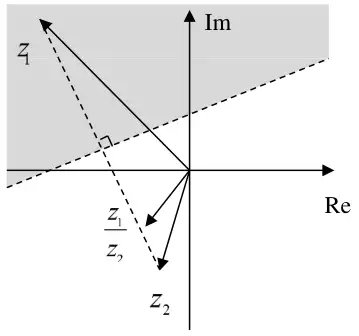
(ii) M1: Draws a line (solid or dashed) that is the perpendicular bisector of \(z_1z_2\) or draws a line that crosses \(z_1z_2\) and shades one of the sides of this line.
M1
3.1a
A1: A line drawn (solid or dashed) that is the perpendicular bisector of \(z_1z_2\) with either side shaded as long as it is clear they are not discounting the upper region. The B1 in part (i) may not have been scored but \(z_1\) must be in quadrant 2 and \(z_2\) in quadrant 3. Note that some candidates are drawing the region on a separate diagram and this is acceptable. You do not need to see a line joining \(z_1\) to \(z_2\).
\(z^3 + 13z^2 + 67z + 175\) or \(a = 13,\ b = 67\)
A1
1.1b
(4)
Notes
M1: Uses the given root and its complex conjugate to form a quadratic equation. Uses the quadratic equation to write \(\mathrm{f}(z)\) in the form \(\left(z^2 + pz + q\right)(z + r)\) where \(p\), \(q\) and \(r\) are real values
M1: Multiplies out and simplifies to find the \(z^2\) or \(z\) term. A1: Correct values for \(a\) and \(b\) or cubic
Alternative 1
Scheme
Marks
AO
\(z^* = -3 - 4\mathrm{i}\) and uses product of roots = −175 to find the third root
M1
3.1a
Third root = −7
A1
1.1b
Either Uses sum roots = \(-a\) to find a value for \(a\) or uses pair sum = \(b\) to find a value for \(b\) Or \((z - (-3 + 4\mathrm{i}))(z - (-3 - 4\mathrm{i}))(z - \text{their third root}) = \ldots\)
M1
1.1b
\(a = 13,\ b = 67\)
A1
1.1b
(4)
M1: Uses the complex conjugate and product of roots = −175 to find the third root. A1: Correct third root M1: A complete method to find the values of \(a\) or \(b\). Either uses the sum and pairs sum or multiplies out three brackets \((z - (-3 + 4\mathrm{i}))(z - (-3 - 4\mathrm{i}))(z - \text{their third root})\) to find the \(z^2\) or \(z\) term. A1: Correct values for \(a\) and \(b\) or cubic
Alternative 2
Scheme
Marks
AO
\((-3 + 4\mathrm{i})^3 + a(-3 + 4\mathrm{i})^2 + b(-3 + 4\mathrm{i}) + 175 = 0\) \(\Rightarrow 117 + 44\mathrm{i} + a(-7 - 24\mathrm{i}) + b(-3 + 4\mathrm{i}) + 175 = 0\) Equates real and imaginary to form two linear simultaneous equations
Solves simultaneously to find values for \(a\) or \(b\)
M1
1.1b
\(a = 13,\ b = 67\)
A1
1.1b
(4)
M1: Substitutes \(-3 + 4\mathrm{i}\) or \(-3 - 4\mathrm{i}\) into \(\mathrm{f}(z)\), sets the real and imaginary parts = 0 to form two simultaneous equations in \(a\) and \(b\). A1: Correct, unsimplified equations. M1: Solves simultaneous equations to find values for \(a\) or \(b\) following an attempt at \(\mathrm{f}(-3 + 4\mathrm{i}) = 0\) or \(\mathrm{f}(-3 - 4\mathrm{i}) = 0\). Allow this mark for seeing a value for \(a\) or \(b\) following simultaneous equation, you do not need to check. A1: Correct values for \(a\) and \(b\).
(b) determine the possible complex numbers \(z\) (5)
Mark scheme (a)
Scheme
Marks
AO
\(z^* = a - b\mathrm{i}\) then \(zz^* = (a + b\mathrm{i})(a - b\mathrm{i}) = \ldots\)
M1
1.1b
\(zz^* = a^2 + b^2\) therefore, a real number
A1
2.4
(2)
Notes
M1: States or implies \(z^* = a - b\mathrm{i}\) and finds an expression for \(zz^*\)
A1: Achieves \(zz^* = a^2 + b^2\) and draws the conclusion that \(zz^*\) is a real number. Accept \(\in \mathbb{R}\) as conclusion, but not just “no imaginary part”.
Forms two equations from \(a^2 + b^2 = 18\) or \(\dfrac{a^2 - b^2}{18} = \dfrac{7}{9}\) or \(\dfrac{a^2 - b^2}{a^2 + b^2} = \dfrac{7}{9}\) or \(\dfrac{2ab}{18} = \dfrac{4\sqrt{2}}{9}\) or \(\dfrac{2ab}{a^2 + b^2} = \dfrac{4\sqrt{2}}{9}\) or \(a = \dfrac{7}{9}a + \dfrac{4\sqrt{2}}{9}b\) oe
M1 A1
3.1a 1.1b
Solves the equations simultaneously e.g. \(a^2 + b^2 = 18\) and \(a^2 - b^2 = 14\) leading to a value for \(a\) or \(b\)
dM1
1.1b
\(z = \pm\left(4 + \sqrt{2}\mathrm{i}\right)\)
A1
2.2a
(5)
(7 marks)
Notes
M1: Starts the process of solving by using the conjugate to form an equation with real denominators, and without \(z^*\) or \(\mathrm{i}^2\) in the equation. Accept as shown in scheme, or may multiply through by \(a - b\mathrm{i}\) and expand and gather terms. May be implied by correct extraction of equation(s).
M1: Uses the given information to form two equations involving \(a\) and \(b\) at least one of which includes both. It must involve equating real or imaginary parts of \(\dfrac{z}{z^*} = \dfrac{7}{9} + \dfrac{4\sqrt{2}\mathrm{i}}{9}\)
A1: Any two correct equations arising from use of both given facts. (Note: if multiplying through by \(a - b\mathrm{i}\) then equating real and imaginary terms gives the same equation.)
dM1: Dependent on previous method mark, solves the equations to find a value for either \(a\) or \(b\).
A1: Deduces the correct complex numbers and no extras. Do not accept \(\pm 4 \pm \sqrt{2}\mathrm{i}\)
Note: it is possible to solve via polar coordinates, but unlikely to succeed. If you see responses you think are worthy of credit but are unsure how to mark, use review. Example solutions shown below.
Alt (b)
Scheme
Marks
AO
\(\dfrac{z}{z^*} = \dfrac{z^2}{zz^*} = \dfrac{z^2}{18} \Rightarrow z^2 = 14 + 8\sqrt{2}\mathrm{i}\) or let \(\arg z = \theta\). then \(\dfrac{z}{z^*} = \dfrac{r\mathrm{e}^{\mathrm{i}\theta}}{r\mathrm{e}^{-\mathrm{i}\theta}} = \mathrm{e}^{2\mathrm{i}\theta} = \cos 2\theta + \mathrm{i}\sin 2\theta\)
(ii) Given that\[\arg(z - 5) = \frac{2\pi}{3}\]determine the least value of \(|z|\) as \(z\) varies. (3)
Mark scheme (i)
Scheme
Marks
AO
\(z_1 = 6\left[\cos\left(\dfrac{\pi}{3}\right) + \mathrm{i}\sin\left(\dfrac{\pi}{3}\right)\right] = \ldots\left\{3 + 3\sqrt{3}\mathrm{i}\right\}\) \(z_2 = 6\sqrt{3}\left[\cos\left(\dfrac{5\pi}{6}\right) + \mathrm{i}\sin\left(\dfrac{5\pi}{6}\right)\right] = \ldots\left\{-9 + 3\sqrt{3}\mathrm{i}\right\}\) \(\{z_1 + z_2 =\}\left(3 + 3\sqrt{3}\mathrm{i}\right) + \left(-9 + 3\sqrt{3}\mathrm{i}\right) = \ldots\left\{-6 + 6\sqrt{3}\mathrm{i}\right\}\) Or \(\{z_1 + z_2 =\}\,6\left[\cos\left(\dfrac{\pi}{3}\right) + \mathrm{i}\sin\left(\dfrac{\pi}{3}\right)\right] + 6\sqrt{3}\left[\cos\left(\dfrac{5\pi}{6}\right) + \mathrm{i}\sin\left(\dfrac{5\pi}{6}\right)\right] = a + b\mathrm{i}\) where \(a\) and \(b\) are constants, the trig function must be evaluated
M1
3.1a
Clearly show the method to find modulus and argument for \(z_1 + z_2\) \(\arg(z_1 + z_2) = \pi - \tan^{-1}\left(\dfrac{6\sqrt{3}}{6}\right)\) or \(\tan^{-1}\left(\dfrac{6\sqrt{3}}{-6}\right) = \ldots\left\{\dfrac{2\pi}{3}\right\}\) and \(|z_1 + z_2| = \sqrt{6^2 + \left(6\sqrt{3}\right)^2} = \ldots\{12\}\)
M1: A complete method to find both \(z_1\) and \(z_2\) in the form \(a + b\mathrm{i}\) and adds them together.
dM1: Dependent on previous method mark, finds the modulus and argument of \(z_1 + z_2\). They must show their method, just stating modulus = 12 and argument \(= \dfrac{2\pi}{3}\) is not sufficient as this is a show question.
Alternative 1: Factorises out 12 and find the argument
Alternative 2: uses \(12\mathrm{e}^{\frac{2\pi}{3}\mathrm{i}} = 12\left(\cos\dfrac{2\pi}{3} + \mathrm{i}\sin\dfrac{2\pi}{3}\right) = \ldots\)
A1*: Achieves the correct answer following no errors or omissions. Alternatively shows that \(12\mathrm{e}^{\frac{2\pi}{3}\mathrm{i}} = -6 + 6\sqrt{3}\mathrm{i}\) and concludes therefore \(z_1 + z_2 = 12\mathrm{e}^{\frac{2\pi}{3}\mathrm{i}}\) *
Alternative 1 and Alternative 2 (for the dM1 and A1*)
M1: Factorises out 12 and writes in the form \(12\left[\ldots\cos\left(\dfrac{\pi}{3}\right) + \ldots\mathrm{i}\sin\left(\dfrac{\pi}{3}\right) + \ldots\cos\left(\dfrac{5\pi}{6}\right) + \ldots\mathrm{i}\sin\left(\dfrac{5\pi}{6}\right)\right]\)
dM1: Dependent on previous mark. Writes in the form \(12(a + b\mathrm{i})\) leading to the form \(12(\cos\theta + \mathrm{i}\sin\theta)\)
A1*: Achieves the correct answer following no errors or omissions.
M1: Factorises out 6 and writes in the form \(6\mathrm{e}^{\frac{\pi}{3}\mathrm{i}}\left(1 + \sqrt{3}\,\mathrm{e}^{\frac{\pi}{2}\mathrm{i}}\right) = 6\mathrm{e}^{\frac{\pi}{3}\mathrm{i}}(1 + a\mathrm{i})\)
dM1: Dependent on previous method mark, finds the modulus and argument of \((1 + a\mathrm{i})\) or \(12(a + b\mathrm{i})\) leading to the form \(12(\cos\theta + \mathrm{i}\sin\theta)\)
A1*: Achieves the correct answer following no errors or omissions.
Alternative 5
Scheme
Marks
AO
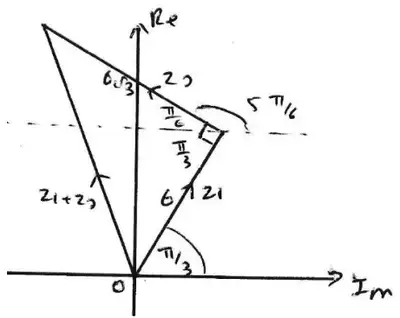
Uses geometry to show that \(z_1\), \(z_2\) and \(z_1 + z_2\) form a right-angled triangle
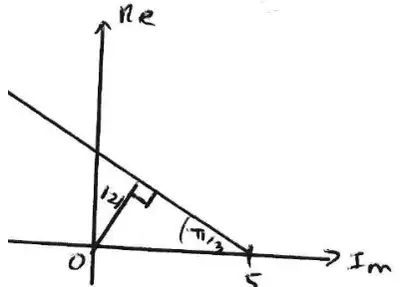
M1: Finds the equation of the half-line by attempting \(m = -\tan\left(\dfrac{\pi}{3}\right)\) \(c = 5\tan\left(\dfrac{\pi}{3}\right)\). Finds \(x^2 + y^2\) in terms of \(x\), differentiates, sets \(= 0\) and finds the value of \(x\).
M1: Uses their value of \(x\) to find the minimum value of \(\sqrt{x^2 + y^2}\)
A1: Correct exact value.
Alternative 2
Scheme
Marks
AO
Gradient \(= -\tan\left(\dfrac{\pi}{3}\right)\) \(c = 5\tan\left(\dfrac{\pi}{3}\right)\) leading to \(y = -\sqrt{3}x + 5\sqrt{3}\) Perpendicular line through the origin \(y = \dfrac{1}{\sqrt{3}}x\) and find the point of intersection of the two lines \(\left(\dfrac{15}{4}, \dfrac{5\sqrt{3}}{4}\right)\)
M1
3.1a
Finds the distance from the origin to their point of intersection \(|z| = \sqrt{\left(\text{their } \dfrac{15}{4}\right)^2 + \left(\text{their } \dfrac{5\sqrt{3}}{4}\right)^2} = \ldots\)
M1
1.1b
\(|z| = \dfrac{5\sqrt{3}}{2}\)
A1
1.1b
(3)
M1: Finds the equation of the half-line by attempting \(m = -\tan\left(\dfrac{\pi}{3}\right)\) \(c = 5\tan\left(\dfrac{\pi}{3}\right)\). Finds the equation of the line perpendicular which passes through the origin. Finds the point of intersection of the lines
M1: Finds the distance from the origin to their point of intersection
(a) Express the complex number \(w = 4\sqrt{3} - 4\mathrm{i}\) in the form \(r(\cos\theta + \mathrm{i}\sin\theta)\) where \(r > 0\) and \(-\pi < \theta \leqslant \pi\) (4)
(b) Show, on a single Argand diagram,
(i) the point representing \(w\)
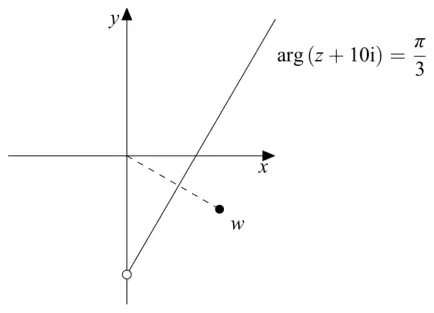
(ii) the locus of points defined by \(\arg(z + 10\mathrm{i}) = \dfrac{\pi}{3}\)
(3)
(c) Hence determine the minimum distance of \(w\) from the locus \(\arg(z + 10\mathrm{i}) = \dfrac{\pi}{3}\) (3)
\(\arg w = \arctan\left(\dfrac{\pm 4}{4\sqrt{3}}\right) = \arctan\left(\pm\dfrac{1}{\sqrt{3}}\right)\)
M1
1.1b
\(= -\dfrac{\pi}{6}\)
A1
1.1b
So \((w =)\,8\left(\cos\left(-\dfrac{\pi}{6}\right) + \mathrm{i}\sin\left(-\dfrac{\pi}{6}\right)\right)\)
A1
1.1b
(4)
Notes
B1: Correct modulus
M1: Attempts the argument. Allow for \(\arctan\left(\dfrac{\pm 4}{\pm 4\sqrt{3}}\right)\) or equivalents using the modulus (may be in wrong quadrant for this mark).
A1: Correct argument \(-\dfrac{\pi}{6}\) (must be in fourth quadrant but accept \(\dfrac{11\pi}{6}\) or other difference of \(2\pi\) for this mark).
A1: Correct expression found for \(w\), in the correct form, must have positive \(r = 8\) and \(\theta = -\dfrac{\pi}{6}\).
Note: using degrees B1 M1 A0 A0
Mark scheme (b)
Scheme
Marks
AO
(i) \(w\) in 4th quadrant with either \(\left(4\sqrt{3}, -4\right)\) seen or \(-\dfrac{\pi}{4} < \arg w < 0\)
B1
1.1b
(ii) half line with positive gradient emanating from imaginary axis.
M1
1.1b
The half line should pass between \(O\) and \(w\) starting from a point on the imaginary axis below \(w\)
A1
1.1b
(3)
Notes
(b)(i)&(ii) B1: \(w\) plotted in correct quadrant with either the correct coordinate clearly seen or above the line \(y = -x\)
M1: Half line drawn starting on the imaginary axis away from \(O\) with positive gradient (need not be labelled)
A1: Sketch on one diagram – both previous marks must have been scored and the half line should pass between \(O\) and \(w\) starting from a point on the imaginary axis below \(w\). (You may assume it starts at \(-10\mathrm{i}\) unless otherwise stated by the candidate)
Note: If candidates draw the loci on separate diagrams the maximum they can score is B1 M1 A0
Mark scheme (c)
Scheme
Marks
AO
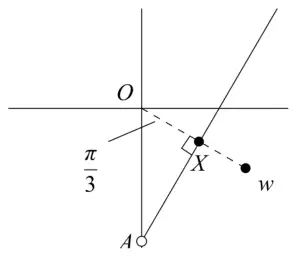
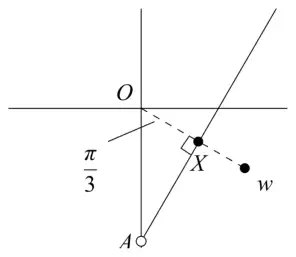
\(\Delta OAX\) is right angled at \(X\) so \(OX = 10\sin\dfrac{\pi}{6} = 5\) (oe)
M1
3.1a
So shortest distance is \(WX = OW - OX = \text{‘}8\text{’} - 5 = \ldots\)
M1
1.1b
So min distance is 3
A1
1.1b
Alternative 1
A complete method to find the coordinates of \(X\). Finds the equation of the line from \(O\) to \(w\), \(y = -\dfrac{1}{\sqrt{3}}x\) and the equation of the half line \(y = \sqrt{3}x - 10\), solves to find the point of intersection \(X\left(\dfrac{5\sqrt{3}}{2}, -\dfrac{5}{2}\right)\)
M1
3.1a
Finds the length \(WX\)\[\sqrt{\left(4\sqrt{3} - \frac{5\sqrt{3}}{2}\right)^2 + \left(-4 - -\frac{5}{2}\right)^2}\]
M1
1.1b
So min distance is 3
A1
1.1b
Alternative 2 Finds the length \(AW = \sqrt{\left(4\sqrt{3} - 0\right)^2 + (-4 - -10)^2} = \ldots\left\{\sqrt{84}\right\}\) Finds the angle between the horizontal and the line \(AW\) \(= \tan^{-1}\left(\dfrac{-4 - -10}{4\sqrt{3}}\right) = \ldots\{0.7137\ldots\text{radians or } 40.89\ldots^\circ\}\)
M1
3.1a
Finds the length of \(WX = \sqrt{84} \times \sin\left(\dfrac{\pi}{3} - 0.7137\right) = \ldots\) Or \(= \sqrt{84} \times \sin(60 - 40.89) = \ldots\)
M1: Formulates a correct strategy to find the shortest distance, e.g. uses right angle \(OXA\) where \(X\) is where the lines meet and proceeds at least as far as \(OX\).
M1: Full method to achieve the shortest distance, e.g. for \(WX = OW - OX\).
A1: cao shortest distance is 3
Alternative 1: M1: Uses a correct method to find the equation of the line from \(O\) to \(w\), \(y = -\dfrac{1}{\sqrt{3}}x\) and the equation of the half line \(y = \sqrt{3}x - 10\), solves to find the point of intersection \(X\left(\dfrac{5\sqrt{3}}{2}, -\dfrac{5}{2}\right)\) If the incorrect gradient(s) is used with no valid method seen this is M0
M1: Finds the length \(WX = \sqrt{\left(\text{their }\dfrac{5\sqrt{3}}{2} - 4\sqrt{3}\right)^2 + \left(\text{their } -\dfrac{5}{2} - -4\right)^2} = \ldots\) condone a sign slip in the brackets.
A1: cao shortest distance is 3
Alternative 2: M1: Uses a correct method to find the length \(AW\) and a correct method to find the angle between the horizontal and the line \(AW\)
M1: Finds the length of \(WX = \text{their }\sqrt{84} \times \sin\left(\dfrac{\pi}{3} - \text{their } 0.7137\right) = \ldots\)
A1: cao shortest distance is 3
Alternative 3 M1: Finds the vector equation of the half line, then \(XW\). Then either: Sets dot product \(XW\) and the line = 0 and solves for \(\lambda\). Substitutes their \(\lambda\) into the equation of the half line to find the point of intersection. Or finds the length of \(XW\) and differentiates, set = 0 and solve for \(\lambda\)
M1: Finds the length \(WX = \sqrt{\left(\text{their }\dfrac{5\sqrt{3}}{2} - 4\sqrt{3}\right)^2 + \left(\text{their } -\dfrac{5}{2} - -4\right)^2} = \ldots\) condone a sign slip in the brackets. Or substitutes their value for \(\lambda\) into the length of (d)
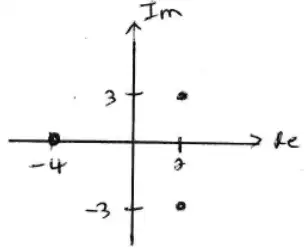
(ii) \(\left(z^2 - 4z + 13\right)(z + 4)\) expands the brackets to find value for \(a\) Or \(a\) = pair sum \(= -4(2 + 3\mathrm{i} + 2 - 3\mathrm{i}) + 13 = \ldots\) Or \(\mathrm{f}(-4)/\mathrm{f}(2 \pm 3\mathrm{i}) = 0 \Rightarrow \ldots \Rightarrow a = \ldots\)
M1
1.1b
\(a = -3\)
A1
2.2a
(4)
Notes
(i)
M1: A complete method to find the third root. E.g. forms the quadratic factor and uses this to find the linear factor leading to roots. Alternatively uses sum of roots \(= 0\) or product of roots \(= \pm 52\) (condone sign error) with their complex roots to find the third. Note they may have used the factor theorem to find \(a\) first, which is fine. If they have found \(a\) first, then the correct third root seen implies this mark. The method may be implied by the third root seen on the diagram.
A1: Correct roots, all three must be clearly stated somewhere in (b), not just seen on a diagram in part (c).
(ii)
M1: Complete method to find a value for \(a\) e.g. multiplies out their quadratic and linear factors to find the coefficient of \(z\), or uses pair sum, or uses factor theorem with one of the roots (may be done before finding the third root) but must reach a value for \(a\).
A1: Deduces the correct value of \(a\). May be seen as the \(z\) coefficient in the cubic (need not be extracted, but if it is it must be correct).
Mark scheme (c)
Scheme
Marks
AO
B1ft
1.1b
(1)
(6 marks)
Notes
B1ft: Correctly plots all three roots following through their third root in part (b). Must be labelled with the \(\text{``}{-4}\text{''}\) further from \(O\) than 2, but don’t be concerned about \(x\) and \(y\) scale. If correct look for one root on the negative real axis, with the other two symmetric about real axis in quadrants 1 and 4, but follow through their real root if positive. Accept \((0, -4)\) labelled on the real axis in correct place as a label.
(b) Write down the correct value of \(\arg\left(\dfrac{z_1}{z_2}\right)\) (1)
Mark scheme (a)
Scheme
Marks
AO
(i) \(\{\arg(z_1) =\}\tan^{-1}\left(\dfrac{-3}{3}\right)\) or \(\{\arg(z_1) =\}\tan^{-1}(-1)\) or \(\{\arg(z_1) =\} -\tan^{-1}\left(\dfrac{3}{3}\right)\) or \(\{\arg(z_1) =\} -\dfrac{\pi}{4}\) or \(\{\arg(z_1) =\}\, 2\pi - \dfrac{\pi}{4} = \dfrac{7\pi}{4}\) or states should be \(-3\) not 3 on top
B1
2.3
(ii) States that \(\left\{\arg\left(\dfrac{z_1}{z_2}\right) =\right\}\arg(z_1) - \arg(z_2)\) Or states that the arguments should be subtracted
B1
2.3
(2)
Notes
(i) B1: See scheme, Condone \(-45\) Any incorrect arguments seen is B0. \(\arg(z_1) = \tan^{-1}\left(\dfrac{3}{-3}\right)\) is B0 Note: They used 3 instead of \(-3\) is B0, there are two 3’s in line 1 do they mean both should \(-3\) It should be negative is B0
(i) The point \(P\) is one vertex of a regular pentagon in an Argand diagram. The centre of the pentagon is at the origin. Given that \(P\) represents the complex number \(6 + 6\mathrm{i}\), determine the complex numbers that represent the other vertices of the pentagon, giving your answers in the form \(r\mathrm{e}^{\mathrm{i}\theta}\) (5)
(ii) (a) On a single Argand diagram, shade the region, \(R\), that satisfies both\[|z - 2\mathrm{i}| \leqslant 2 \quad \text{and} \quad \frac{1}{4}\pi \leqslant \arg z \leqslant \frac{1}{3}\pi\] (2)
(b) Determine the exact area of \(R\), giving your answer in simplest form. (4)
Mark scheme (i)
Scheme
Marks
AO
\(|z| = \sqrt{6^2 + 6^2} = \ldots\ 6\sqrt{2}\) or \(\sqrt{72}\) and \(\arg z = \tan^{-1}\left(\dfrac{6}{6}\right) = \ldots\left\{\dfrac{\pi}{4}\right\}\) Can be implied by \(r = 6\sqrt{2}\mathrm{e}^{\frac{\pi}{4}\mathrm{i}}\)
M1 A1
3.1a 1.1b
Adding multiples of \(\dfrac{2\pi}{5}\) to their argument \(z = 6\sqrt{2}\mathrm{e}^{\frac{\pi}{4}\mathrm{i}} \times \mathrm{e}^{\frac{2\pi k}{5}\mathrm{i}}\) or \(z = 6\sqrt{2}\left[\cos\left(\dfrac{\pi}{4} + \dfrac{2\pi k}{5}\right) + \mathrm{i}\sin\left(\dfrac{\pi}{4} + \dfrac{2\pi k}{5}\right)\right]\)
(i) M1: Finds the modulus and argument of \(z\) A1: Correct modulus and argument of \(z\) M1: Uses a correct method to find all the other 4 vertices of the pentagon. Must be doing the equivalent of adding/ subtracting multiples of \(\dfrac{2\pi}{5}\) to the argument. A1ft: All 4 vertices following through on their modulus and argument. Does not need to be simplified for this mark. A1: All 4 vertices correct in the required form
(corrected from the printed mark scheme: in the second A1ft list the last vertex \(r\mathrm{e}^{\left(\theta - \frac{4\pi}{5}\right)\mathrm{i}}\) is printed as \(r\mathrm{e}^{\left(\theta - \frac{8\pi}{5}\right)\mathrm{i}}\), which is the same point as \(r\mathrm{e}^{\left(\theta + \frac{2\pi}{5}\right)\mathrm{i}}\))
Mark scheme (ii)(a)
Scheme
Marks
AO
Circle centre \((0, 2)\) and radius 2 or the two half-lines \(\arg z = \dfrac{\pi}{4}\) and \(\arg z = \dfrac{\pi}{3}\) (a wedge) with the point on the origin
B1
1.1b
Fully correct
B1
1.1b
(2)
Notes
(ii)(a) B1: Circle centre \((0, 2)\) and radius 2 or the two half-lines (a wedge) with the vertex on the origin. B1: Fully correct region shaded.
Mark scheme (ii)(b)
Scheme
Marks
AO
\(\text{area} = \dfrac{1}{2}\displaystyle\int_{\frac{\pi}{4}}^{\frac{\pi}{3}}\left(4\sin\theta\right)^2\mathrm{d}\theta\) or \(\text{area} = \dfrac{1}{2}\displaystyle\int_{\frac{\pi}{4}}^{\frac{\pi}{3}}\left(\alpha\sin\theta\right)^2\mathrm{d}\theta\)
M1
3.1a
Uses \(\sin^2\theta = \dfrac{1}{2} - \dfrac{1}{2}\cos 2\theta\) and integrates to the form \(A\theta + B\sin 2\theta\) \(\text{area} = 8\displaystyle\int_{\frac{\pi}{4}}^{\frac{\pi}{3}}\sin^2\theta\,\mathrm{d}\theta = 4\int_{\frac{\pi}{4}}^{\frac{\pi}{3}}1 - \cos 2\theta\,\mathrm{d}\theta = 4\theta - 2\sin 2\theta\)
M1
3.1a
Uses the limits of \(\dfrac{\pi}{4}\) and \(\dfrac{\pi}{3}\) and subtracts the correct way around \(\left[4\left(\dfrac{\pi}{3}\right) - 2\sin\left(\dfrac{2\pi}{3}\right)\right] - \left[4\left(\dfrac{\pi}{4}\right) - 2\sin\left(\dfrac{2\pi}{4}\right)\right]\)
M1
1.1b
Area \(= \dfrac{\pi}{3} - \sqrt{3} + 2\)
A1
1.1b
(4)
Alternative
Scheme
Marks
AO
Finds either the areas 1 or 2 Area 1 \(= \dfrac{1}{2} \times 2^2 \times \sin\left(\dfrac{2\pi}{3}\right)\left\{= \sqrt{3}\right\}\) Area 2 \(= \dfrac{1}{2} \times 2^2 \times \dfrac{\pi}{3}\left\{= \dfrac{2\pi}{3}\right\}\)
M1
1.1b
A complete method to find area 3 Area 3 \(= \dfrac{1}{4}\pi \times 2^2 - \dfrac{1}{2} \times 2^2\ \{= \pi - 2\}\)
M1
3.1a
A complete method to find the required area Shaded area \(=\) Area of semi circle \(-\) area 1 \(-\) area 2 \(-\) area 3 \(= \left[\dfrac{1}{2}\pi \times 2^2\right] - \left[\dfrac{1}{2} \times 2^2 \times \sin\left(\dfrac{2\pi}{3}\right)\right] - \left[\dfrac{1}{2} \times 2^2 \times \dfrac{\pi}{3}\right] - \left[\dfrac{1}{4}\pi \times 2^2 - \dfrac{1}{2} \times 2^2\right]\) \(= 2\pi - \sqrt{3} - \dfrac{2\pi}{3} - (\pi - 2)\) Or Shaded area \(=\) Area of sector \(-\) area 1 \(-\) area 3 \(= \left[\dfrac{1}{2} \times 4 \times \left(\dfrac{2\pi}{3}\right)\right] - \left[\dfrac{1}{2} \times 2^2 \times \sin\left(\dfrac{2\pi}{3}\right)\right] - \left[\dfrac{1}{4}\pi \times 2^2 - \dfrac{1}{2} \times 2^2\right]\) \(= \dfrac{4\pi}{3} - \sqrt{3} - (\pi - 2)\)
M1
3.1a
Area \(= \dfrac{\pi}{3} - \sqrt{3} + 2\)
A1
1.1b
(4)
(11 marks)
Notes
(ii)(b) M1: Writes the required area using polar coordinates M1: Uses \(\sin^2\theta = \dfrac{1}{2} - \dfrac{1}{2}\cos 2\theta\) and integrates to the form \(A\theta + B\sin 2\theta\) M1: Uses the limits of \(\dfrac{\pi}{4}\) and \(\dfrac{\pi}{3}\) and subtracts the correct way around. Must be some attempt at \(\text{area} = \dfrac{1}{2}\displaystyle\int\left(\alpha\sin\theta\right)^2\mathrm{d}\theta\) and integration. A1: Correct exact area \(= \dfrac{\pi}{3} - \sqrt{3} + 2\)
Alternative M1: Finds either area 1 or area 2 M1: A complete method to find the area 3 M1: A complete method to find the required area \(=\) Area of semi circle \(-\) area 1 \(-\) area 2 \(-\) area 3 or \(=\) Area of sector \(-\) area 1 \(-\) area 3 A1: Correct exact area \(= \dfrac{\pi}{3} - \sqrt{3} + 2\)
(a) write down the exact value of (i) \(|z_1 z_2|\) (ii) \(\arg(z_1 z_2)\) (2)
Given that \(w = z_1 z_2\) and that \(\arg(w^n) = 0\), where \(n \in \mathbb{Z}^+\)
(b) determine (i) the smallest positive value of \(n\) (ii) the corresponding value of \(|w^n|\) (3)
Mark scheme (a)
Scheme
Marks
AO
(i) \(|z_1 z_2| = 3\sqrt{2}\)
B1
1.1b
(ii) \(\arg(z_1 z_2) = \dfrac{\pi}{3} + \left(-\dfrac{\pi}{12}\right) = \dfrac{\pi}{4}\) o.e.
B1
1.1b
(2)
Notes
(a)(i) B1: Deduces \(|z_1 z_2| = 3\sqrt{2}\) (ii) B1: Deduces \(\arg(z_1 z_2) = \dfrac{\pi}{4}\) o.e. These marks may be awarded for \(z_1 z_2 = 3\sqrt{2}\left(\cos\dfrac{\pi}{4} + \mathrm{i}\sin\dfrac{\pi}{4}\right)\)
Mark scheme (b)
Scheme
Marks
AO
(i) \(n = 8\)
B1ft
2.2a
(ii) \(|w^n| = \left(\text{their } |z_1 z_2|\right)^{\text{their } n}\)
M1
1.1b
\(|w^n| = 104\,976\)
A1
1.1b
(3)
(5 marks)
Notes
(b)(i) B1ft: \(2\pi\) divided by their \(\arg(z_1 z_2)\) found in part (a)(ii) to give an integer. Alternatively smallest positive integer multiple required to make their argument a multiple of \(2\pi\) (ii) M1: Their answer to (a)(i) to the power of their \(n\) A1: 104 976
Finds a maximum value for \(r\) \((2r)^2 = 5^2 + (3 - 2)^2 \Rightarrow r = \ldots\)
M1
3.1a
\(\dfrac{3\sqrt{2}}{2} \lt r \lt \dfrac{\sqrt{26}}{2}\) o.e.
A1 A1
1.1b 1.1b
(7)
(7 marks)
Notes
(Corrected from the printed mark scheme: the second method prints \(x^2 = 9 - 2r^2 \Rightarrow 9 - 2r^2 \gt 0\); from \(2x^2 + 18 - 4r^2 = 0\), \(x^2 = 2r^2 - 9\), so the condition is \(2r^2 - 9 \gt 0\).)
B1: Correct equations for each loci of points
M1: A complete method to find a 3TQ involving one variable using equations of the form \((x \pm 3)^2 + (y \pm 5)^2 = (2r)^2\) or \(2r^2\) or \(r^2\) and \(y = \pm x \pm 2\)
A1: Correct quadratic equation
dM1: Dependent on previous method mark. A complete method uses \(b^2 - 4ac \gt 0\) or rearranges to find \(x^2 = \mathrm{f}(r)\) and uses \(\mathrm{f}(r) \gt 0\) to the minimum value of \(r\).
M1: Realises there will be an upper limit for \(r\) and uses Pythagoras theorem \((2r)^2 = (y\text{ coord of centre})^2 + (x\text{ coord of centre} - 2)^2\) condone \((r)^2 = (y\text{ coord of centre})^2 + (x\text{ coord of centre} - 2)^2\)
A1: One correct limit, either \(\dfrac{3\sqrt{2}}{2} \lt r\) or \(r \lt \dfrac{\sqrt{26}}{2}\) o.e.
A1: Fully correct inequality
Alternative
Scheme
Marks
AO
Using a circle with centre (3, 5) and radius \(2r\) and \(y = -x + 2\)
B1
1.1b
\(y - 5 = 1(x - 3) \Rightarrow y = x + 2\) \(x + 2 = -x + 2 \Rightarrow x = \ldots\)
Finds a maximum value for \(r\) \((2r)^2 = 5^2 + (3 - 2)^2 \Rightarrow r = \ldots\)
M1
3.1a
\(\dfrac{3\sqrt{2}}{2} \lt r \lt \dfrac{\sqrt{26}}{2}\) o.e.
A1 A1
1.1b 1.1b
(7)
B1: Using a circle with centre (3, 5) and radius \(2r\) and \(y = -x + 2\)
M1: A complete method to find the point of intersection of the line \(y = \pm x \pm 2\) and circle where the line is a tangent to the circle.
A1: Correct point of intersection
dM1: Finds the distance between the point of intersection and the centre and uses this to find the minimum value of \(r\). Condone radius of r.
M1: Realises there will be an upper limit for \(r\) and uses Pythagoras theorem \((2r)^2 = (y\text{ coord of centre})^2 + (x\text{ coord of centre} - 2)^2\)
A1: One correct limit, either \(\dfrac{3\sqrt{2}}{2} \lt r\) or \(r \lt \dfrac{\sqrt{26}}{2}\) o.e.
where \(a\), \(b\), \(c\) and \(d\) are real constants.
The equation \(\mathrm{f}(z) = 0\) has complex roots \(z_1\), \(z_2\), \(z_3\) and \(z_4\) When plotted on an Argand diagram, the points representing \(z_1\), \(z_2\), \(z_3\) and \(z_4\) form the vertices of a square, with one vertex in each quadrant. Given that \(z_1 = 2 + 3\mathrm{i}\), determine the values of \(a\), \(b\), \(c\) and \(d\). (6)
Mark scheme
Scheme
Marks
AO
\(z_2 = 2 - 3\mathrm{i}\)
B1
1.1b
\((z_3 =)\ p - 3\mathrm{i}\) and \((z_4 =)\ p + 3\mathrm{i}\) May be seen in an Argand diagram
M1
3.1a
\((z_3 =)\ {-4} - 3\mathrm{i}\) and \((z_4 =)\ {-4} + 3\mathrm{i}\) May be seen in an Argand diagram, but the complex numbers used in their method takes precedence
(a) write \(z_1\) in the form \(r(\cos\theta + \mathrm{i}\sin\theta)\) Give the exact value of \(r\) and give the value of \(\theta\) in radians to 4 significant figures. (2)
(b) Find \(z_2\) giving your answer in the form \(a + \mathrm{i}b\) where \(a\) and \(b\) are integers. (6)
Mark scheme (a)
Scheme
Marks
AO
\(|z_1| = \sqrt{13}\) and \(\arg z_1 = \tan^{-1}\left(\dfrac{3}{2}\right)\)
B1: Correct exact value for \(|z_1| = \sqrt{13}\) and \(\arg z_1 = \tan^{-1}\left(\dfrac{3}{2}\right)\). The value for \(\arg z_1\) can be implied by sight of awrt 0.98 or awrt 56.3°
B1ft: Follow through on \(r = |z_1|\) and \(\theta = \arg z_1\) and writes \(z_1 = r(\cos\theta + \mathrm{i}\sin\theta)\) where \(r\) is exact and \(\theta\) is correct to 4 s.f. do not follow through on rounding errors.
Mark scheme (b)
Scheme
Marks
AO
A complete method to find the modulus of \(z_2\) e.g. \(|z_1| = \sqrt{13}\) and uses \(|z_1z_2| = |z_1| \times |z_2| = 39\sqrt{2} \Rightarrow |z_2| = 3\sqrt{26}\) or \(\sqrt{234}\)
M1 A1
3.1a 1.1b
A complete method to find the argument of \(z_2\) e.g. \(\arg(z_1z_2) = \arg(z_1) + \arg(z_2) = \dfrac{\pi}{4} \Rightarrow \arg(z_2) = \ldots\) \(\arg(z_2) = \dfrac{\pi}{4} - \tan^{-1}\left(\dfrac{3}{2}\right)\) or \(\dfrac{\pi}{4} - 0.9828\) or \(-0.1974\ldots\)
M1 A1
3.1a 1.1b
\(z_2 = 3\sqrt{26}\left(\cos(\text{‘}{-0.1974\ldots}\text{’}) + \mathrm{i}\sin(\text{‘}{-0.1974\ldots}\text{’})\right)\) or \(z_2 = a + b\mathrm{i} \Rightarrow a^2 + b^2 = 234\) and \(\tan(-0.1974) = \dfrac{b}{a} \Rightarrow \dfrac{b}{a} = -0.2\) \(\Rightarrow a = \ldots\) and \(b = \ldots\)
ddM1
1.1b
Deduces that \(z_2 = 15 - 3\mathrm{i}\) only
A1
2.2a
(6)
(8 marks)
Notes
(Corrected from the printed mark scheme: the printed scheme has \(\tan^{-1}(-0.1974) = \dfrac{b}{a}\); it should be \(\tan(-0.1974) = \dfrac{b}{a}\), which gives \(\dfrac{b}{a} = -0.2\).)
M1: A complete method to find the modulus of \(z_2\)
A1: \(|z_2| = 3\sqrt{26}\)
M1: A complete method to find the argument of \(z_2\)
A1: \(\arg(z_2) = \dfrac{\pi}{4} - \tan^{-1}\left(\dfrac{3}{2}\right)\) or \(\dfrac{\pi}{4} - 0.9828\) or \(-0.1974\ldots\)
ddM1: Writes \(z_2\) in the form \(r(\cos\theta + \mathrm{i}\sin\theta)\), dependent on both previous M marks. Alternative forms two equations involving \(a\) and \(b\) using the modulus and argument of \(z_2\) and solve to find values for \(a\) and \(b\)
M1: A complete method to find an equation involving \(a\) and \(b\) using the argument. Note \(\tan^{-1}\left(\dfrac{2a - 3b}{3a + 2b}\right) = \dfrac{\pi}{4}\) this would score M0 A0 ddM0 A0
A1: Correct simplified equation \(a = -5b\) o.e.
ddM1: Dependent on both the previous method marks. Solves their equations to find values for \(a\) and \(b\)
2. In an Argand diagram, the points \(A\) and \(B\) are represented by the complex numbers \(-3 + 2\mathrm{i}\) and \(5 - 4\mathrm{i}\) respectively. The points \(A\) and \(B\) are the end points of a diameter of a circle \(C\).
(a) Find the equation of \(C\), giving your answer in the form\[|z - a| = b \qquad a \in \mathbb{C},\ b \in \mathbb{R}\] (3)
The circle \(D\), with equation \(|z - 2 - 3\mathrm{i}| = 2\), intersects \(C\) at the points representing the complex numbers \(z_1\) and \(z_2\)
(b) Find the complex numbers \(z_1\) and \(z_2\) (6)
(a) B1: Correct coordinates of centre M1: Fully correct strategy for identifying the radius. If the diameter is calculated this must be halved to achieve this mark. A1: Correct equation using the required notation
(b) M1: Begins the process of finding \(z_1\) and \(z_2\) by using the Cartesian equations to obtain the equation of the line of intersection M1: Substitutes back into the equation of one of the circles to obtain an equation in one variable A1: Correct 3 term quadratic M1: Solves their 3TQ M1: Substitutes to find values of the other variable to complete the process of finding \(z_1\) and \(z_2\) A1: Correct complex numbers
(a) B1: Identifies the correct complex conjugate as another root B1: Correct values for the sum and product for the conjugate pair M1: Correct application of the pair sum M1: Identifies a complete and correct strategy for identifying the third root A1: Deduces the correct third root B1: \(3 \pm 2\sqrt{2}\,\mathrm{i}\) plotted correctly, in quadrants 1 and 4 which are reflections in the real axis. Do not be concerned about labelling or scaling. B1ft: Their real root plotted correctly, in correct relative position to the two complex roots. Scales are not needed but if correct, the real root must be close to the origin compared to the complex roots.
(a) Alternative:
Scheme
Marks
AO
\(\beta = 3 + 2\sqrt{2}\,\mathrm{i}\) is also a root
Alternative: B1: Identifies the correct complex conjugate as another root B1: Correct quadratic factor obtained M1: Expands their quadratic\(\times\)(\(3z\) + “\(a\)”) or attempts to factor out the quadratic, or use long division, leading to a factor (\(3z\) + “\(a\)”). Implied by seeing \(\left(z^2 - 6z + 17\right)(3z + a)\) with any value of \(a\) (or with their quadratic). M1: Proceeds to extract the root from their third factor of from (\(3z\) + “\(a\)”). A1: Deduces the correct third root. If not explicitly stated, look for it on their diagram. B1: \(3 \pm 2\sqrt{2}\,\mathrm{i}\) plotted correctly, as above B1ft: Their real root plotted correctly as above.
Note: some may attempt to use the factor theorem with the complex root. \(\mathrm{f}\left(3 - 2\mathrm{i}\sqrt{2}\right) = 36 + p + q + \mathrm{i}\left(-228\sqrt{2} - 12\sqrt{2}p\right) = 0\) 2nd B1: equate real and imaginary components to 0 to get correct equations \(36 + p + q = 0,\ -228\sqrt{2} - 12\sqrt{2}p = 0\) 1st M1: solves their equations \(\Rightarrow p = -19,\ q = -17\) 2nd M1: Solves the cubic (may be from calculator). The 1st B1 may then be implied for the second complex root, and the rest as main scheme.
Alternative: M1: Correct strategy by expanding their quadratic and linear factors to identifying at least one of \(p\) or \(q\) A1: At least one value correct A1: Both values correct
6. In an Argand diagram, the points \(A\), \(B\) and \(C\) are the vertices of an equilateral triangle with its centre at the origin. The point \(A\) represents the complex number \(6 + 2\mathrm{i}\).
(a) Find the complex numbers represented by the points \(B\) and \(C\), giving your answers in the form \(x + \mathrm{i}y\), where \(x\) and \(y\) are real and exact. (6)
The points \(D\), \(E\) and \(F\) are the midpoints of the sides of triangle \(ABC\).
(b) Find the exact area of triangle \(DEF\). (3)
Mark scheme (a)
Scheme
Marks
AO
Examples: \(\begin{pmatrix}\cos 120 & -\sin 120\\ \sin 120 & \cos 120\end{pmatrix}\begin{pmatrix}6\\ 2\end{pmatrix} = \ldots\) or \((6 + 2\mathrm{i})\left(-\dfrac{1}{2} + \dfrac{\sqrt{3}}{2}\mathrm{i}\right)\) or \(\sqrt{40}\left(\cos\arctan\left(\frac{2}{6}\right) + \mathrm{i}\sin\arctan\left(\frac{2}{6}\right)\right)\left(\cos\left(\dfrac{2\pi}{3}\right) + \mathrm{i}\sin\left(\dfrac{2\pi}{3}\right)\right)\) or \(\sqrt{40}\left(\cos\left(\arctan\left(\frac{2}{6}\right) + \frac{2\pi}{3}\right) + \mathrm{i}\sin\left(\arctan\left(\frac{2}{6}\right) + \frac{2\pi}{3}\right)\right)\) or \(\sqrt{40}\mathrm{e}^{\mathrm{i}\arctan\left(\frac{2}{6}\right)}\mathrm{e}^{\mathrm{i}\left(\frac{2\pi}{3}\right)}\)
M1
3.1a
\(\left(-3 - \sqrt{3}\right)\) or \(\left(3\sqrt{3} - 1\right)\mathrm{i}\)
M1: Identifies a suitable method to rotate the given point by 120° (or equivalent) about the origin. May see equivalent work with modulus/argument or exponential form e.g. an attempt to multiply by \(\cos\dfrac{2\pi}{3} + \mathrm{i}\sin\dfrac{2\pi}{3}\) or \(\mathrm{e}^{\frac{2\pi}{3}\mathrm{i}}\)
A1: Correct real part or correct imaginary part
A1: Completely correct complex number
M1: Identifies a suitable method to rotate the given point by 240° (or equivalent e.g. rotate their \(B\) by 120°) about the origin
May see equivalent work with modulus/argument or exponential form e.g. an attempt to multiply \(6 + 2\mathrm{i}\) by \(\cos\dfrac{4\pi}{3} + \mathrm{i}\sin\dfrac{4\pi}{3}\) or \(\mathrm{e}^{\frac{4\pi}{3}\mathrm{i}}\) or their \(B\) by \(\cos\dfrac{2\pi}{3} + \mathrm{i}\sin\dfrac{2\pi}{3}\) or \(\mathrm{e}^{\frac{2\pi}{3}\mathrm{i}}\)
A1: Correct real part or correct imaginary part
A1: Completely correct complex number
Mark scheme (b)
Way 1
Scheme
Marks
AO
Area \(ABC = 3 \times \dfrac{1}{2}\sqrt{6^2 + 2^2}\sqrt{6^2 + 2^2}\sin 120^\circ\) or Area \(AOB = \dfrac{1}{2}\sqrt{6^2 + 2^2}\sqrt{6^2 + 2^2}\sin 120^\circ\)
M1
2.1
Area \(DEF = \dfrac{1}{4}ABC\) or \(\dfrac{3}{4}AOB\)
In general, the marks in (b) should be awarded as follows: M1: Attempts to find the area of a relevant triangle dM1: completes the problem by multiplying by an appropriate factor to find the area of \(DEF\) Dependent on the first method mark A1: Correct exact area In some cases it may not be possible to distinguish the 2 method marks. In such cases they can be awarded together for a direct method that finds the area of \(DEF\)
Examples:
Way 1
M1: A correct strategy for the area of a relevant triangle such as \(ABC\) or \(AOB\)
dM1: Completes the problem by linking the area of \(DEF\) correctly with \(ABC\) or with \(AOB\)
M1dM1: A correct strategy for the area of \(DEF\). Finds 2 midpoints and attempts one side of \(DEF\) and uses a correct triangle area formula. By implication this scores both M marks.
The complex numbers \(z_1 = -2\), \(z_2 = -1 + 2\mathrm{i}\) and \(z_3 = 1 + \mathrm{i}\) are plotted in Figure 1, on an Argand diagram for the complex plane with \(z = x + \mathrm{i}y\)
(a) Explain why \(z_1\), \(z_2\) and \(z_3\) cannot all be roots of a quartic polynomial equation with real coefficients. (2)
(b) Show that \(\arg\left(\dfrac{z_2 - z_1}{z_3 - z_1}\right) = \dfrac{\pi}{4}\) (3)
(c) Hence show that \(\arctan(2) - \arctan\left(\dfrac{1}{3}\right) = \dfrac{\pi}{4}\) (2)
A copy of Figure 1, labelled Diagram 1, is given below.
(d) Shade, on Diagram 1, the set of points of the complex plane that satisfy the inequality\[|z + 2| \leqslant |z - 1 - \mathrm{i}|\] (2)
Diagram 1
Mark scheme (a)
Scheme
Marks
AO
Complex roots of a real polynomial occur in conjugate pairs
M1
1.2
so a polynomial with \(z_1\), \(z_2\) and \(z_3\) as roots also needs \(z_2^*\) and \(z_3^*\) as roots, so 5 roots in total, but a quartic has at most 4 roots, so no quartic can have \(z_1\), \(z_2\) and \(z_3\) as roots.
A1
2.4
(2)
Notes
M1: Some evidence that complex roots occur as conjugate pairs shown, e.g. stated as in scheme, or e.g. identifying if \(-1 + 2\mathrm{i}\) is a root then so is \(-1 - 2\mathrm{i}\). Mere mention of complex conjugates is sufficient for this mark.
A1: A complete argument, referencing that a quartic has at most 4 roots, but would need at least 5 for all of \(z_1\), \(z_2\) and \(z_3\) as roots. There should be a clear statement about the number of roots of a quartic (e.g. a quartic has four roots), and that this is not enough for the two conjugate pairs and real root.
As \(\dfrac{1}{2} + \dfrac{1}{2}\mathrm{i}\) is in the first quadrant (may be shown by diagram), hence \(\arg\left(\dfrac{z_2 - z_1}{z_3 - z_1}\right) = \arctan\left(\dfrac{1/2}{1/2}\right) \bigl(= \arctan(1)\bigr) = \dfrac{\pi}{4}\) *
A1*
2.1
(3)
Notes
M1: Substitutes the numbers in expression and attempts multiplication of numerator and denominator by the conjugate of their denominator or uses calculator to find the quotient. (May be implied.) NB Applying the difference of arguments and using decimals is M0 here.
A1: Obtains \(\dfrac{1}{2} + \dfrac{1}{2}\mathrm{i}\). (May be from calculator.) Accepted equivalent Cartesian forms.
A1*: Uses arctan on their quotient and makes reference to first quadrant or draws diagram to show they are in the first quadrant, to justify the argument.
M1: Applies the formula for the argument of a difference of complex numbers and substitutes values (may go directly to arctans if the arguments have already been established). If used in (b) it must be seen or referred to in (c) for this mark to be awarded. Allow for \(\arg(z_2 - z_1) - \arg(z_3 - z_1)\) if \(z_2 - z_1\) and \(z_3 - z_1\) have been clearly identified in earlier work.
A1*: Completes the proof clearly by identifying the required arguments and using the result of (b). Use of decimal approximations is A0.
Mark scheme (d)
Scheme
Marks
AO
Line passing through \(z_2\) and the negative imaginary axis drawn.
B1
1.1b
Area below and left of their line shaded, where the line must have negative gradient passing through negative imaginary axis but need not pass through \(z_2\)
B1
1.1b
Unless otherwise indicated by the student mark Diagram 1 (if used) if there are multiple attempts.
(2)
(9 marks)
Notes
B1: Draws a line through \(z_2\) and passing through negative imaginary axis.
B1: Correct side of bisector shaded. Allow this mark if the line does not pass through \(z_2\). But it should be an attempt at the perpendicular bisector of the other two points – so have negative gradient and pass through the negative real axis.
M1: Identifies at least one correct complex conjugate as another root (can be seen/implied by Argand diagram)
A1: Both complex conjugate roots identified correctly (can be seen/implied by Argand diagram)
For the next two marks allow either a cross, dot or line drawn where the end point is labelled with the correct coordinate, corresponding complex number or clearly plotted with correct numbers labelled on the axis or indication of the correct coordinates by use of scale markers. Condone (3, i) etc. The axes do not need to be labelled with Re and Im.
B1: One complex conjugate pair correctly plotted.
B1: Both complex conjugate pair correctly plotted. The \(3 \pm \mathrm{i}\) must be closer to the real axes than the \(-1 \pm 2\mathrm{i}\)
If there is no indication of the coordinates, scale or complex numbers on the Argand diagram this is B0 B0.
\(\mathrm{f}(z) = \left(z^2 + 2z + 5\right)\left(z^2 - 6z + 10\right)\) Expands the brackets to forms a quartic
M1
3.1a
\(\mathrm{f}(z) = z^4 - 4z^3 + 3z^2 - 10z + 50\) or States \(a = -4,\ b = 3,\ c = -10,\ d = 50\)
A1
1.1b
(5)
(9 marks)
Notes
Way 1
M1: Correct strategy for forming at least one of the quadratic factors. Follow through their roots.
A1: At least one correct simplified quadratic factor.
A1: Both simplified quadratic factors correct or a correct simplified cubic factor
M1: A complete strategy to find values for \(a\), \(b\), \(c\) and \(d\) e.g. uses their quadratic factors or cubic and linear factor to form a quartic.
A1: Correct quartic in terms of \(z\) or correct values for \(a\), \(b\), \(c\) and \(d\) stated.
M1: Correct strategy for finding at least three of the sum roots, pair sum, triple sum and product. Follow through their roots. This can be implied by at least three correct values for the sum roots, pair sum, triple sum and product with no working shown. If the calculations are not shown for the sums and product and they have at least two incorrect values this is M0.
A1: At least two correct values for the sum roots, pair sum, triple sum or product.
A1: All correct values for the sum, pair sum, triple sum and product.
M1: Must have real values of \(a\), \(b\), \(c\) and \(d\) and use \(a = -\)their sum roots, \(b =\) their pair sum, \(c = -\)their triple sum and \(d =\) their product.
A1: Correct quartic in terms of \(z\) or correct values for \(a\), \(b\), \(c\) and \(d\) stated.
The equation \(\mathrm{f}(z) = 0\) has roots \(z_1\), \(z_2\) and \(z_3\) When plotted on an Argand diagram, the points representing \(z_1\), \(z_2\) and \(z_3\) form the vertices of a triangle of area 35
Given that \(z_1 = 3\), find the values of \(p\) and \(q\). (7)
Mark scheme
Scheme
Marks
AO
Complex roots are e.g. \(\alpha \pm \beta\mathrm{i}\) or \(\left(z^3 + z^2 + pz + q\right) \div (z - 3) = z^2 + 4z + p + 12\) or \(\mathrm{f}(3) = 0 \Rightarrow 3^3 + 3^2 + 3p + q = 0\) or One of: \(3 + z_2 + z_3 = -1,\ \ 3z_2z_3 = -q,\ \ 3z_2 + 3z_3 + z_2z_3 = p\)
\(3p + q = -36 \Rightarrow p = \dfrac{-36 - q}{3} = 41\) and \(q = -159\)
A1
1.1b
(7)
Notes
B1: Recognises that the other roots must form a conjugate pair or obtains \(z^2 + 4z + p + 12\) (or \(z^2 + 4z - \dfrac{q}{3}\)) as the quadratic factor or writes down a correct equation for \(p\) and \(q\) or writes down a correct equation involving “\(z_2\)” and “\(z_3\)”
M1: Uses the sum of the roots of the cubic or the sum of the roots of their quadratic to find a value for “\(\alpha\)”
A1: Correct value for “\(\alpha\)”
M1: Uses their value for “\(\alpha\)” and the given area to find a value for “\(\beta\)”. Must be using the area and triangle dimensions correctly e.g. \(\dfrac{1}{2} \times \beta \times 5 = 35 \Rightarrow \beta = 14\) scores M0
M1: Uses an appropriate method to find \(p\) or \(q\)
A1: A correct value for \(p\) or \(q\)
A1: Correct values for \(p\) and \(q\)
Alternative
Scheme
Marks
AO
\(\left(z^3 + z^2 + pz + q\right) \div (z - 3) = z^2 + 4z + p + 12\)
B1: Obtains \(z^2 + 4z + p + 12\) (or \(z^2 + 4z - \dfrac{q}{3}\)) as the quadratic factor
M1: Solves their quadratic factor by completing the square or using the quadratic formula
A1: Correct value for “\(\alpha\)”
M1: Uses their imaginary part to find “\(\beta\)” in terms of \(p\)
M1: Draws together the fact that the imaginary parts of their complex conjugate pair and the real root form the sides of the required triangle and forms an equation in terms of \(p\), sets equal to 35 and solves for \(p\)
(b) Find, in simplest form, the exact value of \(|w|^2\) (4)
Mark scheme (a)
Scheme
Marks
AO
M1 M1 A1 M1 A1
1.1b 1.1b 2.2a 3.1a 1.1b
(5)
Notes
M1: Circle or arc of a circle with centre in first quadrant and with the circle in all 4 quadrants or arc of circle in quadrants 1 and 2
M1: A “V” shape i.e. with both branches above the \(x\)-axis and with the vertex on the positive real axis. Ignore any branches below the \(x\)-axis.
A1: Two half lines that meet on the positive real axis where the right branch intersects the circle or arc of a circle in the first quadrant and the left branch intersects the circle or arc of a circle in the second quadrant but not on the \(y\)-axis.
M1: Shades the region between the half-lines and within the circle
A1: Cso. A fully correct diagram including 2 marked (or implied by ticks) at the vertex on the real axis with the correct region shaded and all the previous marks scored.
Example marking for 3(a)
M1: Circle with centre in first quadrant M0: The branches of the “V” must be above the x-axis A0: Follows M0 M1: Shades the region between the half-lines and within the circle A0: Depends on all previous marks
M1: Circle with centre in first quadrant M0: The vertex of the “V” must be on the positive x-axis A0: Follows M0 M1: Shades the region between the half-lines and within the circle (BOD) A0: Depends on all previous marks
M1: Circle with centre in first quadrant M0: The vertex of the “V” must be on the positive x-axis A0: Follows M0 M1: Shades the region between the half-lines and within the circle A0: Depends on all previous marks
M1: Circle with centre in first quadrant M1: A “V” shape i.e. with both branches above the x-axis and with the vertex on the positive real axis. Ignore any branches below the x-axis. A1: Two half lines that meet on the positive real axis where the right branch intersects the circle in the first quadrant and the left branch intersects the circle in the second quadrant. M1: Shades the region between the half-lines and within the circle A1: A fully correct diagram including 2 marked at the vertex on the real axis with the correct region shaded and all the previous marks scored.
Mark scheme (b)
Scheme
Marks
AO
\((x - 1)^2 + (y - 1)^2 = 9,\ \ y = x - 2 \Rightarrow x = \ldots,\) or \(y = \ldots\)
M1
3.1a
\(x = 2 + \dfrac{\sqrt{14}}{2},\ y = \dfrac{\sqrt{14}}{2}\)
M1: Identifies a suitable strategy for finding the \(x\) or \(y\) coordinate of the point of intersection. Look for an attempt to solve equations of the form \((x \pm 1)^2 + (y \pm 1)^2 = 9 \text{ or } 3\) and \(y = \pm x \pm 2\)
A1: Correct coordinates for the intersection (there may be other points but allow this mark if the correct coordinates are seen). (The correct coordinates may be implied by subsequent work.) Allow equivalent exact forms and allow as a complex number e.g. \(2 + \dfrac{\sqrt{14}}{2} + \dfrac{\sqrt{14}}{2}\mathrm{i}\)
M1: Correct use of Pythagoras on their coordinates (There must be no i’s)
A1: Correct exact value by cso
Note that solving \((x - 1)^2 + (y - 1)^2 = 9,\ \ y = x + 2\) gives \(x = \dfrac{\sqrt{14}}{2},\ y = 2 + \dfrac{\sqrt{14}}{2}\) and hence the correct answer fortuitously so scores M1A0M1A0
(b) Explain briefly why the centre of \(C\) must lie on the real axis. [1 mark]
(c) The point \(7 + \mathrm{i}\sqrt{14}\) also lies on \(C\)
(i) Find the real number which represents the centre of \(C\) [2 marks]
(ii) Find the equation of \(C\)
Give your answer in the form \(|z - a| = b\) where \(a\) and \(b\) are constants. [3 marks]
Mark scheme (a)
Scheme
Marks
AO
Completes the square to obtain \((w + 2)^2 = -5\) or Substitutes \(a = 1\), \(b = 4\), \(c = 9\) into the quadratic formula. or Calculates the sum and product of the roots. or Substitutes at least one of the given roots into the equation. or Expands \(\left(w - \left(-2 + \mathrm{i}\sqrt{5}\right)\right)\left(w - \left(-2 - \mathrm{i}\sqrt{5}\right)\right)\) or Rearranges the equation \(w = -2 \pm \mathrm{i}\sqrt{5}\) to obtain \((w + 2)^2 = -5\)
M1
1.1a
Completes a reasoned argument to prove the required result. Must include a conclusion which could be \(w^2 + 4w + 9 = 0\) or \(w = -2 \pm \mathrm{i}\sqrt{5}\)
Explains why the centre lies on the real axis. Condone an incomplete explanation, eg the real axis is the perpendicular bisector of the chord. Accept an algebraic proof that the imaginary part is 0
E1
2.4
(1)
Typical solution
Only points on the real axis are equidistant from \(-2 + \mathrm{i}\sqrt{5}\) and \(-2 - \mathrm{i}\sqrt{5}\)
Mark scheme (c)
Scheme
Marks
AO
(i) Forms a correct equation in terms of the centre of \(C\)
One of the roots of the equation \(\mathrm{f}(z) = 0\) is \(-4 + 3\mathrm{i}\)
(a) Find the other two roots of the equation \(\mathrm{f}(z) = 0\) [4 marks]
(b) Find the value of \(r\) and the value of \(s\) [3 marks]
Mark scheme (a)
Scheme
Marks
AO
Obtains \(-4 - 3\mathrm{i}\)
B1
1.2
Selects a correct method; for example, uses the pairwise sum of roots, or substitutes the given root into the equation, or expands \((z - (-4 + 3\mathrm{i}))(z - (-4 - 3\mathrm{i}))\)
M1
3.1a
Sets the pairwise sum \(= \pm\dfrac{92}{4}\) or Finds \(\mathrm{f}(z)\) as a product of a quadratic and a linear factor or in expanded form PI by \((4z - 1)\) PI by correct values for \(r\) and \(s\)
(a) It is given that, for the complex number \(z\),\[\left|\frac{z}{z + 1}\right| = 1\]
Find \(\mathrm{Re}(z)\) [3 marks]
(b) Show that the only solutions of the equation\[\left(\frac{w}{w + 1}\right)^3 = 1\]
are \(w = \dfrac{\mathrm{e}^{\frac{2\pi\mathrm{i}}{3}}}{1 - \mathrm{e}^{\frac{2\pi\mathrm{i}}{3}}}\) and \(w = \dfrac{\mathrm{e}^{-\frac{2\pi\mathrm{i}}{3}}}{1 - \mathrm{e}^{-\frac{2\pi\mathrm{i}}{3}}}\) [4 marks]
(c) Use the results of part (a) and part (b) to find \(\mathrm{Re}\left(\dfrac{\mathrm{e}^{\frac{2\pi\mathrm{i}}{3}}}{1 - \mathrm{e}^{\frac{2\pi\mathrm{i}}{3}}}\right)\)
Fully justify your answer. [2 marks]
Mark scheme (a)
Scheme
Marks
AO
Deduces that \(|z| = |z + 1|\) or \(\dfrac{|z|}{|z + 1|} = 1\)
B1
2.2a
Obtains and solves an equation in \(\mathrm{Re}(z)\)
Uses the complex cube roots of unity Or Expands and obtains a quadratic equation.
M1
3.1a
Solves an equation in \(w\) to obtain at least one correct root.
M1
1.1a
Explains why one root is impossible Or Converts at least one of the given solutions into the form \(a + \mathrm{i}b\)
E1
2.4
Completes a reasoned argument to show that the (only) solutions of the equation are \(w = \dfrac{\mathrm{e}^{\frac{2\pi\mathrm{i}}{3}}}{1 - \mathrm{e}^{\frac{2\pi\mathrm{i}}{3}}}\) and \(w = \dfrac{\mathrm{e}^{-\frac{2\pi\mathrm{i}}{3}}}{1 - \mathrm{e}^{-\frac{2\pi\mathrm{i}}{3}}}\) May use \(\pm\) notation.
5 The complex number \(z_1\) has argument \(\tan^{-1}\left(\dfrac{1}{5}\right)\)
The complex number \(z_2 = -2 - 4\mathrm{i}\)
Find \(\arg\left(\dfrac{z_1}{z_2}\right)\)
Give your answer as a number in the range \(-\pi \lt \alpha \lt \pi\), to two decimal places. [3 marks]
Mark scheme
Scheme
Marks
AO
Obtains a correct expression or value for \(\arg z_2\) Condone use of degrees. or Obtains \(\dfrac{z_1}{z_2} = k(-0.7 + 0.9\mathrm{i})\) PI AWRT 2.23 rad or AWRT 128 degrees
B1
1.1b
Uses \(\arg\left(\dfrac{z_1}{z_2}\right) = \arg z_1 - \arg z_2\) or Obtains argument of their \(\dfrac{z_1}{z_2}\) PI AWRT 2.23 rad or AWRT 128 degrees
(a) Write down the equation of the locus of \(C\) in the form\[|z - w| = a\]
where \(w\) is a complex number whose real and imaginary parts are integers, and \(a\) is an integer. [2 marks]
(b) It is given that \(z_1\) is a complex number representing a point on \(C\). Of all the complex numbers which represent points on \(C\), \(z_1\) has the least argument.
(i) Find \(|z_1|\)
Give your answer in an exact form. [3 marks]
(ii) Show that \(\arg z_1 = \arcsin\left(\dfrac{6\sqrt{3} - 2}{13}\right)\) [4 marks]
(i) Correctly identifies the point representing \(z_1\) PI by correct method. or Obtains \(m = \dfrac{6 - 2\sqrt{3}}{3}\) as the gradient of the tangent at \(z_1\)
B1
2.2a
(i) Uses Pythagoras or other correct method to obtain \(|z_1|\)
M1
3.1a
(i) Obtains \(4\sqrt{3}\) Accept any exact correct value eg \(\sqrt{48}\)
A1
1.1b
(3)
(ii) Deduces that \(\arg z_1 = P\hat{O}R - P\hat{O}Q\) or Uses \(\tan(\arg(z_1)) = \dfrac{6 - 2\sqrt{3}}{3}\) or Obtains \(x = \dfrac{48 + 12\sqrt{3}}{13}\) or \(y = \dfrac{72 - 8\sqrt{3}}{13}\) where \(z_1 = x + \mathrm{i}y\)
B1
2.2a
(ii) Uses a suitable trigonometric identity or Uses a correct method to obtain \(\sin(\arg(z_1))\) from \(\tan(\arg(z_1))\) or Obtains \(x = \dfrac{48 + 12\sqrt{3}}{13}\) and \(y = \dfrac{72 - 8\sqrt{3}}{13}\) where \(z_1 = x + \mathrm{i}y\)
M1
1.1a
(ii) Obtains sines and cosines of \(P\hat{O}R\) and \(P\hat{O}Q\) (at least three correct) or Obtains \(\sin^2(\arg(z_1))\) or \(\cos^2(\arg(z_1))\) or Obtains the values of the sides of a right-angled triangle with an angle equal to \(\arg(z_1)\)
M1
3.1a
(ii) Uses correct reasoning to obtain the required result. Condone omission of “\(\arg(z_1)\) is acute”. AG
(ii) Deduces that \(b = 3\) Accept \(|z - a\mathrm{i}| = 3\)
B1
2.2a
(1)
Typical solution
(i) \(a = 5\)
(ii) \(b = 3\)
Mark scheme (b)
Scheme
Marks
AO
(i) Forms a correct equation in \(OP\) FT their \(a\) and \(b\)
M1
3.1a
Obtains \(OP = 4\) FT their \(a\) and \(b\)
A1F
1.1b
(2)
(ii) Obtains a correct expression or equation for an acute angle in the 3,4,5 triangle. FT their \(a\), \(b\) and \(OP\)
M1
3.1a
Deduces that \(k = \dfrac{4}{3}\)
A1
2.2a
(2)
(iii) Forms a correct equation in the real and/or imaginary part of \(P\) eg \(x^2 + (y - 5)^2 = 3^2\), \(y = \dfrac{4}{3}x\) FT their \(a\), \(b\) and \(OP\)
11 Latifa and Sam are studying polynomial equations of degree greater than 2, with real coefficients and no repeated roots.
Latifa says that if such an equation has exactly one real root, it must be of degree 3
Sam says that this is not correct.
State, giving reasons, whether Latifa or Sam is right. [3 marks]
Mark scheme
Scheme
Marks
AO
Refers to polynomials of odd and/or even degree. Or States that a polynomial of a particular odd degree greater than 3 can have exactly one real root or sketches a graph to show this. or Obtains a polynomial of degree greater than three with exactly one real root.
M1
2.4
Explains that complex roots occur in conjugate pairs (condone “imaginary roots”). or Explains that their specific polynomial is a counter example to Latifa’s statement.
M1
2.4
Completes a reasoned argument to conclude that Sam is right (do not condone “imaginary roots”) and States clearly that Sam is right. OE
R1
2.3
(3 marks)
Typical solution
The polynomial equation \(z^5 - 1 = 0\) is of degree 5 and has exactly one real root.
States \(\dfrac{\pi}{4} + \dfrac{\pi}{6} = \dfrac{5\pi}{12}\)
B1
1.1b
Uses their \(zw = \dfrac{\sqrt{6}}{4} - \dfrac{\sqrt{2}}{4} + \mathrm{i}\left(\dfrac{\sqrt{6}}{4} + \dfrac{\sqrt{2}}{4}\right)\) to deduce an expression for \(\tan\dfrac{5\pi}{12}\)
M1
2.2a
Completes a reasoned argument to obtain \(\tan\dfrac{5\pi}{12} = 2 + \sqrt{3}\) AG
(a) The complex number \(z\) is given by \(z = x + \mathrm{i}y\) where \(x, y \in \mathbb{R}\)
(i) Write down the complex conjugate \(z^*\) in terms of \(x\) and \(y\) [1 mark]
(ii) Hence prove that \(zz^*\) is real for all \(z \in \mathbb{C}\) [2 marks]
(b) The complex number \(w\) satisfies the equation\[3w + 10\mathrm{i} = 2w^* + 5\]
(i) Find \(w\) [3 marks]
(ii) Calculate the value of \(w^2(w^*)^2\) [1 mark]
Mark scheme (a)
Scheme
Marks
AO
(i) States \(x - y\mathrm{i}\)
B1
1.2
(1)
(ii) Obtains a correct expansion and replaces \(\mathrm{i}^2\) with \(-1\) PI
M1
1.1a
Simplifies to \(x^2 + y^2\) and explains \(zz^*\) (for all \(z \in \mathbf{C}\)) is real with a reference to \(x\) and \(y\) being real. Condone \(x^2\) and \(y^2\) for \(x\) and \(y\) in their explanation.
7 The complex numbers \(z\) and \(w\) satisfy the simultaneous equations
\[z + w^* = 5\]\[3z^* - w = 6 + 4\mathrm{i}\]
Find \(z\) and \(w\) [5 marks]
Mark scheme
Scheme
Marks
AO
Writes \(z = x + \mathrm{i}y \qquad z^* = x - \mathrm{i}y\) \(w = u + \mathrm{i}v \qquad w^* = u - \mathrm{i}v\) OE PI or Obtains the conjugate of one of the equations Eg \(z^* + w = 5\)
M1
1.1a
Forms two of \(x + u = 5\) \(y - v = 0\) \(3x - u = 6\) \(-3y - v = 4\) OE or eliminates one complex unknown
M1
1.1a
Obtains at least two correct values of \(x\), \(y\), \(u\) or \(v\) or obtains one of \(z^* = \dfrac{11}{4} + \mathrm{i}\), \(w^* = \dfrac{9}{4} + \mathrm{i}\)
M1
1.1a
Obtains the values \(\dfrac{11}{4}, -1, \dfrac{9}{4}, -1\)
(a) Show that \((1 + \mathrm{i})^4 = -4\) [3 marks]
(b) The function f is defined by\[\mathrm{f}(z) = z^4 + 3z^2 - 6z + 10 \qquad z \in \mathbb{C}\]
(i) Show that \((1 + \mathrm{i})\) is a root of \(\mathrm{f}(z) = 0\) [2 marks]
(ii) Hence write down another root of \(\mathrm{f}(z) = 0\) [1 mark]
(iii) One of the linear factors of \(\mathrm{f}(z)\) is\[\big(z - (1 + \mathrm{i})\big)\]
Write down another linear factor and hence, or otherwise, find a quadratic factor of \(\mathrm{f}(z)\) with real coefficients. [3 marks]
(iv) Find another quadratic factor of \(\mathrm{f}(z)\) with real coefficients. [2 marks]
(v) Hence explain why the graph of \(y = \mathrm{f}(x)\) does not intersect the \(x\)-axis. [2 marks]
Mark scheme (a)
Scheme
Marks
AO
Applies the binomial expansion to \((1 + \mathrm{i})^4\) or \((1 + \mathrm{i})^3\) Allow one incorrect term.
Or \((1 + \mathrm{i})^2 = 1 + 2\mathrm{i} + \mathrm{i}^2\) (or just \(2\mathrm{i}\))
M1
1.1a
Replaces \(\mathrm{i}^2\) with \(-1\), or \(\mathrm{i}^3\) with \(-\mathrm{i}\), or \(\mathrm{i}^4\) with 1
B1
1.2
Completes a reasoned argument to reach the required result. Must include the LHS, at least two intermediate steps, and the RHS. Accept \((1 + \mathrm{i})^2\) replaced with \(2\mathrm{i}\) without explanation.
Equates to 0 and concludes that \((1 + \mathrm{i})\) is a root.
R1
2.1
(2)
(ii) Identifies \(1 - \mathrm{i}\) as a root.
Accept \(-1 + 2\mathrm{i}\) or \(-1 - 2\mathrm{i}\)
B1
1.2
(1)
(iii) Identifies a correct linear factor. Accept \(\big(z - (-1 + 2\mathrm{i})\big)\) or \(\big(z - (-1 - 2\mathrm{i})\big)\) Follow through their part (b)(ii).
B1F
1.1b
Forms the product \((z - w)(z - w^*)\) for any non-real \(w\)
M1
3.1a
Obtains \(z^2 - 2z + 2\) Accept \(z^2 + 2z + 5\)
A1
1.1b
(3)
(iv) Obtains a second quadratic factor of \(\mathrm{f}(z)\) with at least two correct terms.
M1
3.1a
Obtains a correct second quadratic factor. Accept \(z^2 - 2z + 2\) if \(z^2 + 2z + 5\) is the answer to their part (b)(iii)
A1
1.1b
(2)
(v) Explains that \(\mathrm{f}(z) = 0\) has no real roots. Condone “no real roots” with an incorrect or no other statement.
M1
2.4
Completes a reasoned argument to conclude that \(y = \mathrm{f}(x)\) does not intersect the \(x\)-axis.
10 The region \(R\) on an Argand diagram satisfies both \(|z + 2\mathrm{i}| \leqslant 3\) and \(-\dfrac{\pi}{6} \leqslant \arg(z) \leqslant \dfrac{\pi}{2}\)
(a) Sketch \(R\) on the Argand diagram below. [3 marks]
(b) Find the maximum value of \(|z|\) in the region \(R\), giving your answer in exact form. [5 marks]
Mark scheme (a)
Scheme
Marks
AO
Draws correct arc or circle, intersecting the imaginary axis at 1.
B1
1.1b
Draws correct half-line or line at an angle between \(-\dfrac{\pi}{4}\) and 0.
B1
1.1b
Shades or clearly labels correct region.
B1
1.1b
(3)
Typical solution
Mark scheme (b)
Scheme
Marks
AO
Deduces that the maximum value occurs where the half-line \(\arg z = -\dfrac{\pi}{6}\) and the circle intersect. PI
M1
2.2a
Selects a method to form a quadratic equation in \(x\), \(y\) or \(|z|\)
M1
3.1a
Forms a correct quadratic in \(x\), \(y\) or \(|z|\)
A1
2.2a
Obtains an expression for the maximum value of \(|z|\)
M1
1.1a
Obtains the correct exact value for the maximum value of \(|z|\) ACF e.g. \(\sqrt{7 + 2\sqrt{6}}\)
A1
1.1b
(5)
(8 marks)
Typical solution
Maximum value of \(|z|\) occurs where circle and half-line intersect.
8 Abdoallah wants to write the complex number \(-1 + \mathrm{i}\sqrt{3}\) in the form \(r(\cos\theta + \mathrm{i}\sin\theta)\) where \(r \geqslant 0\) and \(-\pi \lt \theta \leqslant \pi\)
(a) Express \(-5 - 5\mathrm{i}\) in the form \(r\mathrm{e}^{\mathrm{i}\theta}\), where \(-\pi \lt \theta \leqslant \pi\) [2 marks]
(b) The point on an Argand diagram that represents \(-5 - 5\mathrm{i}\) is one of the vertices of an equilateral triangle whose centre is at the origin.
Find the complex numbers represented by the other two vertices of the triangle.
Give your answers in the form \(r\mathrm{e}^{\mathrm{i}\theta}\), where \(-\pi \lt \theta \leqslant \pi\) [3 marks]
Mark scheme (a)
Scheme
Marks
AO
Obtains correct modulus (allow \(\sqrt{50}\)) or argument.
(a) Sketch, on the Argand diagram below, the locus of points satisfying the equation\[|z - 2\mathrm{i}| = 2\] [2 marks]
(b) Sketch, also on the Argand diagram above, the locus of points satisfying the equation\[\arg z = \frac{\pi}{3}\] [1 mark]
(c) For the complex number \(w\) find the maximum value of \(|w|\) such that\[|w - 2\mathrm{i}| \leqslant 2 \quad \text{and} \quad 0 \leqslant \arg w \leqslant \frac{\pi}{3}\] [3 marks]
Mark scheme (a)
Scheme
Marks
AO
Draws a circle with radius 2 or centre \(2\mathrm{i}\) Condone a freehand circle if intention is clear.
M1
1.1a
Draws a circle with radius 2 and centre \(2\mathrm{i}\)
and no other curves seen.
Condone a freehand circle if intention is clear.
A1
1.1b
(2)
Typical solution
Mark scheme (b)
Scheme
Marks
AO
Draws a half-line from \(O\) into the 1st quadrant at an angle of more than \(45^\circ\) to the real axis.
and
no other straight lines seen.
B1
1.1b
(1)
Typical solution
Mark scheme (c)
Scheme
Marks
AO
Selects a method to find the maximum value of \(|w|\) eg identifies a triangle with the diameter (or radius) as a side and the intersections of their loci as two of the vertices.
eg forms a suitable equation in \(\max|w|\) or \(x_{\max|w|}\) or \(y_{\max|w|}\)
Sketch the region \(R\) on the Argand diagram below. [4 marks]
(c) \(z_1\) is the point in \(R\) at which \(|z|\) is minimum.
(i) Calculate the exact value of \(|z_1|\) [3 marks]
(ii) Express \(z_1\) in the form \(a + \mathrm{i}b\), where \(a\) and \(b\) are real. [2 marks]
Mark scheme (a)
Scheme
Marks
AO
Deduces correct gradient or intercept PI
M1
2.2a
Obtains correct equation with \(y\) as the subject
A1
1.1b
(2)
Typical solution
Gradient = \(\dfrac{1}{2}\)
Line passes through \((0, -2)\)
\[y = \frac{1}{2}x - 2\]
Mark scheme (b)
Scheme
Marks
AO
Draws a half line from \(-2\mathrm{i}\) passing through 4. Condone full line ft their linear equation in part (a)
B1F
1.1b
Draws circle or arc of a circle, with centre at \(2 - 3\mathrm{i}\) or radius 2
M1
2.2a
Draws circle or arc of a circle, centre at \(2 - 3\mathrm{i}\) and radius 2
A1
1.1b
Correct region indicated
A1
2.2a
(4)
Typical solution
Mark scheme (c)
Scheme
Marks
AO
(i) Identifies the point in their region nearest to the origin. For example draws the perpendicular from the half-line to the origin or Finds \(y = -2x\)
B1F
3.1a
Finds the distance between their valid point and the origin For example uses \(\sin\left(\tan^{-1}\frac{1}{2}\right)\) or Finds the distance between the origin and the point of intersection of the lines \(y = \frac{1}{2}x - 2\) and \(y = -2x\)
M1
3.1a
Obtains correct exact value of \(|z_1|\)
A1
1.1b
(3)
(ii) Uses their values from part (c)(i) to obtain value of \(a\) or \(b\)
5 Show that \((2 + \mathrm{i})^3\) is \(2 + 11\mathrm{i}\) [3 marks]
Mark scheme
Scheme
Marks
AO
Expands \((2 + \mathrm{i})^3\) to produce an expression of four terms with no more than one incorrect term.
Or correctly expands \((2 + \mathrm{i})^2\) to two, three or four terms equivalent to \(4 + 4\mathrm{i} + \mathrm{i}^2\) and then multiplies by \(2 + \mathrm{i}\) to produce an expression of at least three terms with no more than one incorrect term.
The terms may be unsimplified.
M1
1.1a
At least one instance of \(\mathrm{i}^2\) replaced with \(-1\) or \(\mathrm{i}^3\) replaced with \(-\mathrm{i}\)
PI by \(3 + 4\mathrm{i}\)
B1
1.2
Completes a reasoned argument to show that \((2 + \mathrm{i})^3\) is \(2 + 11\mathrm{i}\)
(a) Show that \(\det \mathbf{A} = a + \mathrm{i}\) where \(a\) is an integer to be determined. [2 marks]
(b) Matrix \(\mathbf{B}\) is given by\[\mathbf{B} = \begin{bmatrix} 14 - 2\mathrm{i} & b \\ c & d \end{bmatrix} \quad \text{and} \quad \mathbf{AB} = p\mathbf{I}\]
where \(b, c, d \in \mathbb{C}\) and \(p \in \mathbb{N}\)
Find \(b\), \(c\), \(d\) and \(p\) [6 marks]
Mark scheme (a)
Scheme
Marks
AO
Writes a correct unsimplified expression for \(\det \mathbf{A}\)
M1
1.1a
Completes a fully correct proof to reach the required result. Must have \(a = 7\)
Recognises that \(\mathbf{B}\) is equal to a multiple of \(\mathbf{A}^{-1}\) Or multiplies \(\mathbf{A}\) and \(\mathbf{B}\) to find at least one correct unsimplified element of \(\mathbf{AB}\)
M1
3.1a
Sets up at least one correct non-matrix equation in one or two unknowns by equating a pair of corresponding elements.
M1
1.1a
Sets up another correct non-matrix equation in one unknown only.
M1
1.1a
Obtains at least one correct value of \(p\), \(b\), \(c\) or \(d\). Could be seen as an element of a matrix, e.g. \(\tfrac{1}{50}\begin{bmatrix} 14 - 2\mathrm{i} & * \\ * & * \end{bmatrix}\) or \(k\begin{bmatrix} 14 - 2\mathrm{i} & 6 - 8\mathrm{i} \\ * & * \end{bmatrix}\) or \(k\begin{bmatrix} 14 - 2\mathrm{i} & * \\ -1 - 7\mathrm{i} & * \end{bmatrix}\) or \(k\begin{bmatrix} 14 - 2\mathrm{i} & * \\ * & 21 - 3\mathrm{i} \end{bmatrix}\)
A1
1.1b
Obtains at least two correct values of \(p\), \(b\), \(c\) or \(d\). Could be seen as an element of a matrix, e.g. \(\tfrac{1}{50}\begin{bmatrix} 14 - 2\mathrm{i} & * \\ * & * \end{bmatrix}\) or \(k\begin{bmatrix} 14 - 2\mathrm{i} & 6 - 8\mathrm{i} \\ * & * \end{bmatrix}\) or \(k\begin{bmatrix} 14 - 2\mathrm{i} & * \\ -1 - 7\mathrm{i} & * \end{bmatrix}\) or \(k\begin{bmatrix} 14 - 2\mathrm{i} & * \\ * & 21 - 3\mathrm{i} \end{bmatrix}\)
A1
1.1b
Obtains all four correct values of \(p\), \(b\), \(c\) and \(d\). Accept \(p = 50\) and \(\mathbf{B} = \begin{bmatrix} 14 - 2\mathrm{i} & 6 - 8\mathrm{i} \\ -1 - 7\mathrm{i} & 21 - 3\mathrm{i} \end{bmatrix}\)
8 Stephen is correctly told that \((1 + \mathrm{i})\) and \(-1\) are two roots of the polynomial equation
\[z^3 - 2\mathrm{i}z^2 + pz + q = 0\]
where \(p\) and \(q\) are complex numbers.
(a) Stephen states that \((1 - \mathrm{i})\) must also be a root of the equation because roots of polynomial equations occur in conjugate pairs.
Explain why Stephen’s reasoning is wrong. [1 mark]
(b) Find \(p\) and \(q\) [5 marks]
Mark scheme (a)
Scheme
Marks
AO
Gives a correct explanation. Condone an explanation which suggests that conjugate pairs only occur if the coefficients are real.
B1
2.3
(1)
Typical solution
Can only assume that complex roots of a polynomial equation are in conjugate pairs if the coefficients are all real.
Mark scheme (b)
Scheme
Marks
AO
Writes an equation for the 3rd root using the sum of roots. Condone \(-2\mathrm{i}\) or \(2\) or \(-2\) for the sum of roots. Or writes an equation in \(p\) and \(q\) (may be unsimplified) from substitution of one known root into the equation.
M1
3.1a
Obtains correct 3rd root. PI by a factor of \((z - \mathrm{i})\) Or writes two correct simultaneous equations in \(p\) and \(q\) from substitution of both known roots into the equation (any \(\mathrm{i}^2\) must be replaced with \(-1\)).
A1
1.1b
Writes an expression for \(p\) using the sum of pairwise products of roots with their 3rd root and the two given roots. Or eliminates \(q\) from their simultaneous equations. Or multiplies \(\big(z - (1 + \mathrm{i})\big)(z + 1)(z - \alpha)\) to obtain a cubic expression where \(\alpha\) is their 3rd root. May be unsimplified. Allow sign errors.
M1
3.1a
Writes an expression for \(q\) using the product of roots with their 3rd root and the two given roots. Or eliminates \(p\) from their simultaneous equations. Or compares the coefficients of the given polynomial and their cubic expansion. Allow sign errors.
has exactly four solutions and state these solutions. [7 marks]
(b)
(i) Plot the four solutions to the equation in part (a) on the Argand diagram below and join them together to form a quadrilateral with one line of symmetry. [2 marks]
(ii) Show that the area of this quadrilateral is \(\dfrac{\sqrt{15}}{2}\) square units. [1 mark]
Mark scheme (a)
Scheme
Marks
AO
Defines \(z\) and \(z^*\) in terms of two variables for example \(x\) and \(y\)
M1
1.1a
Obtains correct expressions for \((2z - z^*)^*\) and \(z^2\)
A1
1.1b
Uses their expressions for \((2z - z^*)^*\) and \(z^2\) to form a pair of simultaneous equations
M1
3.1a
Deduces that the second equation implies the result “\(y = 0\) or \(x = -\dfrac{3}{2}\)”
A1
2.2a
Deduces that \(y = 0\) Implies the result “\(x = 0\) or 1” PI \(z = 0\) and \(z = 1\)
A1
2.2a
Obtains any two correct solutions in the form \(z = \cdots\)
A1
1.1b
Produces a clear argument to conclude that there are exactly four solutions stating them in the form \(z = \cdots\)
R1
2.1
(7)
Typical solution
Let \(z = x + \mathrm{i}y\) then \(z^* = x - \mathrm{i}y\)
18 The locus of points \(L_1\) satisfies the equation \(|z| = 2\)
The locus of points \(L_2\) satisfies the equation \(\arg(z + 4) = \dfrac{\pi}{4}\)
(a) Sketch \(L_1\) on the Argand diagram below. [1 mark]
(b) Sketch \(L_2\) on the Argand diagram above. [1 mark]
(c) The complex number \(a + \mathrm{i}b\), where \(a\) and \(b\) are real, lies on \(L_1\)
The complex number \(c + \mathrm{i}d\), where \(c\) and \(d\) are real, lies on \(L_2\)
Calculate the least possible value of the expression
\[(c - a)^2 + (d - b)^2\]
[3 marks]
Mark scheme (a)
Scheme
Marks
AO
Draws a circle with centre \((0, 0)\) and radius 2. Accept a reasonably accurate freehand circle.
B1
1.1b
Typical solution
Mark scheme (b)
Scheme
Marks
AO
Draws a straight line from \((-4, 0)\) at \(\frac{\pi}{4}\) to the real axis. Accept a reasonably accurate unruled line.
B1
1.1b
Typical solution
Mark scheme (c)
Scheme
Marks
AO
Selects a method to find the required expression by relating it to the shortest distance between the circle and the line. e.g. a perpendicular drawn from the line to the origin (or to the circle). or an indication of the use of the point \((-2, 2)\).
M1
3.1a
Calculates the distance from \((-2, 2)\) to the origin, or the distance from \((-2, 2)\) to \((-\sqrt{2}, \sqrt{2})\).
M1
1.1a
Obtains the correct value = \(12 - 8\sqrt{2}\) ACF, need not be simplified, exact value not required.
Use \(\mathbf{C}\) to show that \(\cos\dfrac{\pi}{12}\) can be written in the form \(\dfrac{\sqrt{\sqrt{m} + n}}{2}\), where \(m\) and \(n\) are integers. [7 marks]
Mark scheme
Scheme
Marks
AO
Explains that \(\mathbf{C}^2\) represents a rotation of \(\dfrac{\pi}{6}\) or that \(\mathbf{C}\) represents a rotation of \(\dfrac{\pi}{12}\)
E1
2.4
Squares matrix \(\mathbf{C}\) with at least two correct elements.
M1
3.1a
Forms two simultaneous equations in \(a\) and \(b\) using their squared \(\mathbf{C}\) and the given \(\mathbf{C}^2\)
M1
1.1a
Forms two correct simultaneous equations.
A1
1.1b
Eliminates \(a\) or \(b\) and forms a quadratic equation in \(b^2\) or \(a^2\)
M1
1.1a
Finds the correct value of \(a^2 = \dfrac{\sqrt{3} + 2}{4}\)
A1
1.1b
Completes a rigorous argument to show that \(\cos\dfrac{\pi}{12} = \dfrac{\sqrt{\sqrt{3} + 2}}{2}\) by explaining that \(\mathbf{C}\) represents a rotation of \(\dfrac{\pi}{12}\)
R1
2.1
(7 marks)
Typical solution
\[\begin{bmatrix} a & -b \\ b & a \end{bmatrix}\begin{bmatrix} a & -b \\ b & a \end{bmatrix} = \begin{bmatrix} a^2 - b^2 & -2ab \\ 2ab & a^2 - b^2 \end{bmatrix}\]\[2ab = \frac{1}{2}\]\[a^2 - b^2 = \frac{\sqrt{3}}{2}\]\[b = \frac{1}{4a}\]\[a^2 - \frac{1}{16a^2} = \frac{\sqrt{3}}{2}\]\[16a^4 - 8\sqrt{3}a^2 - 1 = 0\]\[a^2 = \frac{\sqrt{3} + 2}{4}\]\[a = \frac{\sqrt{\sqrt{3} + 2}}{2} \quad \text{since } a \gt 0\]
\(\mathbf{C}^2\) represents a rotation of \(\dfrac{\pi}{6}\), therefore \(\mathbf{C}\) represents a rotation of \(\dfrac{1}{2}\left(\dfrac{\pi}{6}\right) = \dfrac{\pi}{12}\)
So \(a = \cos\dfrac{\pi}{12}\) and \(\cos\dfrac{\pi}{12} = \dfrac{\sqrt{\sqrt{3} + 2}}{2}\)
Completes a rigorous argument to show that \(w^n\) satisfies the equation \(z^7 = 1\)
R1
2.1
Typical solution
\[(w^n)^7 = w^{7n} = (w^7)^n = 1^n = 1\]
\(\therefore w^n\) satisfies the equation \(z^7 = 1\)
Mark scheme (b)
Scheme
Marks
AO
Deduces that the LHS is the sum of the roots of \(z^7 = 1\) or factorises \(w^7 - 1\) or uses the sum of a geometric series with values for \(n\) and \(a\).
M1
2.2a
Completes a rigorous argument to show \(1 + w + w^2 + w^3 + w^4 + w^5 + w^6 = 0\)
R1
2.1
Typical solution
The roots of \(z^7 - 1 = 0\) are \(1\), \(w\), \(w^2\), \(w^3\), \(w^4\), \(w^5\), and \(w^6\)
\(z^6\) term \(= 0 \therefore\) sum of roots \(= 0\)
and
\[1 + w + w^2 + w^3 + w^4 + w^5 + w^6 = 0\]
as required.
Mark scheme (c)
Scheme
Marks
AO
Shows the six required points or vectors with correct arguments, approximately correctly spaced and approximately symmetric in the real axis.
M1
1.1a
Clearly shows that points/vectors have modulus 1. PI by “1” marked on an axis. Labelling of points not required.
A1
1.1b
Typical solution
Mark scheme (d)
Scheme
Marks
AO
States that \(w = \cos\frac{2\pi}{7} + \cdots\)
B1
1.1b
Explains that complex conjugate pairs have the same real part.
E1
2.4
Deduces that a sum of pairs of powers of \(w\) equals twice the cosine of a correct angle.
M1
2.2a
Completes a rigorous argument, using \(1 + w + w^2 + w^3 + w^4 + w^5 + w^6 = 0\) to show \(\cos\frac{2\pi}{7} + \cos\frac{4\pi}{7} + \cos\frac{6\pi}{7} = -\frac{1}{2}\)
Substitutes \(1 + 3i\) or \(1 - 3i\) or one of their roots from their factorisation in (a) into the quartic equation and compares Re and Im parts or compares the coefficients of \(z^2\) and \(z\) from the (possibly partial) expansion of their product of quadratics with the given quartic.
M1
1.1a
Finds the correct values of \(p = 18\) and \(r = -16\)
2 Given that \(\arg(a + b\mathrm{i}) = \varphi\), where \(a\) and \(b\) are positive real numbers and \(0 \lt \varphi \lt \dfrac{\pi}{2}\), three of the following four statements are correct.
12 Abel and Bonnie are trying to solve this mathematical problem:
\(z = 2 - 3\mathrm{i}\) is a root of the equation \(2z^3 + mz^2 + pz + 91 = 0\)
Find the value of \(m\) and the value of \(p\).
Abel says he has solved the problem.
Bonnie says there is not enough information to solve the problem.
(a) Abel’s solution begins as follows:
Since \(z = 2 - 3\mathrm{i}\) is a root of the equation, \(z = 2 + 3\mathrm{i}\) is another root.
State one extra piece of information about \(m\) and \(p\) which could be added to the problem to make the beginning of Abel’s solution correct. [1 mark]
(b) Prove that Bonnie is right. [4 marks]
Mark scheme (a)
Scheme
Marks
AO
States appropriate extra piece of information. Condone “\(m\) and \(p\) are integers”
R1
2.3
Typical solution
\(m\) and \(p\) are real numbers.
Mark scheme (b)
Scheme
Marks
AO
Finds one possible pair of values for \(m\) and \(p\) or finds the root ±7/2 in Abel’s case or substitutes \(z = 2 - 3\mathrm{i}\) in the cubic and expands or uses the sum of roots or the sum of pairwise products of roots (not using \(z = 2 + 3\mathrm{i}\)) to form an equation (condone sign errors)
R1
2.1
Uses product of roots = ±91/2 to find another possible pair of complex roots of the cubic or expresses \(m\) and \(p\) as complex numbers in their expansion or uses product of roots = ±91/2 to form another equation (not using \(z = 2 + 3\mathrm{i}\))
M1
3.1a
Finds another possible correct pair of complex roots of the cubic (condone sign errors) or forms simultaneous equations for real and imaginary parts or reduces their system of equations to a system of linear equations
M1
2.1
Completes a rigorous argument to prove that Bonnie is correct; for example, explains that they have shown that there is more than one possible set of values for \(m\) and \(p\) or explains why their simultaneous linear equations have no unique solution
R1
2.4
(5 marks)
Typical solution
Product of roots = − 91/2
One possible solution to the cubic is given by (for example)
\[z = 2 - 3\mathrm{i},\ z = 2 + 3\mathrm{i},\ z = -\frac{7}{2}\]
Because there is more than one possible set of values of \(m\) and \(p\), there is not sufficient information to solve the problem, and Bonnie is right.
8 Given that \(z_1 = 2\left(\cos\dfrac{\pi}{6} + \mathrm{i}\sin\dfrac{\pi}{6}\right)\) and \(z_2 = 2\left(\cos\dfrac{3\pi}{4} + \mathrm{i}\sin\dfrac{3\pi}{4}\right)\)
(a) Find the value of \(|z_1z_2|\) [1 mark]
(b) Find the value of \(\arg\left(\dfrac{z_1}{z_2}\right)\) [1 mark]
(c) Sketch \(z_1\) and \(z_2\) on the Argand diagram below, labelling the points as \(P\) and \(Q\) respectively. [2 marks]
(d) A third complex number \(w\) satisfies both \(|w| = 2\) and \(-\pi \lt \arg w \lt 0\) Given that \(w\) is represented on the Argand diagram as the point \(R\), find the angle \(P\hat{R}Q\). Fully justify your answer. [3 marks]
Draws a point (or line from \(O\)) labelled \(P\) (or \(z_1\)) in the first quadrant.
B1
1.1b
Draws a point (or line from \(O\)) labelled \(Q\) (or \(z_2\)) in the second quadrant.
B1
1.1b
Typical solution
Mark scheme (d)
Scheme
Marks
AO
Recognises that \(P\), \(Q\) and \(R\) are points on the circumference of a circle – possibly implied by circle drawn on diagram. Or recognises \(|w| = 2\) is a circle.
B1
3.1a
Correctly deduces the angle \(P\hat{R}Q\) as \(\frac{7\pi}{24}\) Accept any exact equivalent angle, e.g. \(0.291\dot{6}\pi\) or \(52.5^\circ\)
B1
2.2a
Explains why the angle \(P\hat{R}Q\) is half that of the angle \(P\hat{O}Q\) for any position of \(R\). Award 3/3 for a complete and correct algebraic solution.
6 A circle \(C\) in the complex plane has equation \(|z - 2 - 5\mathrm{i}| = a\)
The point \(z_1\) on \(C\) has the least argument of any point on \(C\), and \(\arg(z_1) = \dfrac{\pi}{4}\)
Prove that \(a = \dfrac{3\sqrt{2}}{2}\) [6 marks]
Mark scheme
Scheme
Marks
AO
Sets as equal the real and imaginary parts of \(z_1\) or uses the line \(y = x\)
M1
2.2a
Uses the fact that the half-line is a tangent to the circle
M1
2.2a
Forms an equation for the gradient of the line joining (2, 5) and \((k, k)\) or the gradient of a tangent at any point on \(C\) or uses a right angled triangle containing the line joining (2, 5) and \((k, k)\) or correctly substitutes \(y = x\) into the equation of the circle
M1
3.1a
Forms a correct equation based on their method. PI by \(k = 3.5\)
M1
2.2a
Obtains the value of \(a\) from their equation
A1
1.1b
Produces a completely correct, rigorous proof leading to exact value of \(a\). Must show all steps clearly
R1
2.1
(6 marks)
Typical solution
\[z_1 = k + k\mathrm{i}\]
Radius is perpendicular to tangent \(\therefore\) Gradient of line connecting (2,5) and \((k, k) = -1\)
(a) Sketch, on the Argand diagram below, the locus of points satisfying the equation\[|z - 3| = 2\]
[1 mark]
(b) There is a unique complex number \(w\) that satisfies both\[|w - 3| = 2 \quad \text{and} \quad \arg(w + 1) = \alpha\]
where \(\alpha\) is a constant such that \(0 \lt \alpha \lt \pi\)
(i) Find the value of \(\alpha\). [2 marks]
(ii) Express \(w\) in the form \(r(\cos\theta + \mathrm{i}\sin\theta)\). Give each of \(r\) and \(\theta\) to two significant figures. [4 marks]
Mark scheme (a)
Scheme
Marks
AO
Draws a circle with centre \((3, 0)\) and radius 2. Accept freehand circle. Ignore any straight lines drawn on the diagram.
B1
1.1b
Typical solution
Mark scheme (b)
Scheme
Marks
AO
(i) Uses fully correct method for \(\sin\alpha\) or \(\cos\alpha\) or \(\tan\alpha\) \(\sin\alpha = \frac{2}{4} \qquad \cos\alpha = \frac{\sqrt{4^2 - 2^2}}{4} \qquad \tan\alpha = \frac{2}{\sqrt{4^2 - 2^2}}\)
M1
3.1a
Obtains correct value for \(\alpha\) Accept \(0.52(35987756)\) Condone \(30^\circ\)
A1
1.1b
(ii) Forms an equation in \(r\) using cosine rule or equivalent. Follow through their \(\alpha\). Or forms a correct equation in \(x\) and \(y\).
M1
3.1a
Forms an equation in \(\theta\) using sine rule or equivalent. Follow through their \(\alpha\). Or forms a second correct equation in \(x\) and \(y\).
M1
1.1a
Obtains correct value for \(r\) or \(\theta\). Or obtains correct values for \(x\) and \(y\).
A1
1.1b
Expresses \(w\) in the required form. Accept \(2.6[45751311]\) or \(\sqrt{7}\) for \(r\) Accept \(0.71[37243789]\) or \(\sin^{-1}\left(\frac{\sqrt{21}}{7}\right)\) or \(\sin^{-1}\left(\sqrt{\frac{3}{7}}\right)\) for \(\theta\)
Correctly identifies the complex conjugate as a root.
B1
1.1b
Forms one of the following equations (or their equivalents) \(\alpha + \beta + 2 - 3\mathrm{i} = 0\) or \(\alpha\beta(2 - 3\mathrm{i}) = \pm 52\) or \(\alpha\beta + \beta(2 - 3\mathrm{i}) + (2 - 3\mathrm{i})\beta = \pm m\) with an equation to find \(m\). Or forms an equation to find \(m\) and then solves the cubic for their value of \(m\).
B1: AG Must see either \((a + b\mathrm{i})(a - b\mathrm{i})\) Or: \(z = a + b\mathrm{i}\) \(z^* = a - b\mathrm{i}\) \(zz^* = a^2 + b^2\) Allow \(\left(\sqrt{(a^2 + b^2)}\right)^2\) for \(|z|^2\) BOD lack of explicit equality shown Must clearly attempt both sides (Corrected from the printed mark scheme: the second line is printed as \(z = a - b\mathrm{i}\); it means \(z^* = a - b\mathrm{i}\).)
Mark scheme (b)
Scheme
Marks
AO
(\(z = a + b\mathrm{i}\), \(w = c + d\mathrm{i}\), \(a\), \(b\), \(c\), \(d\) real) \(\Rightarrow\) LHS \(= (ac - bd + (ad + bc)\mathrm{i})^*\) \(= ac - bd - (ad + bc)\mathrm{i}\)
M1
2.1
RHS \(= (a - b\mathrm{i})(c - d\mathrm{i}) = ac - bd - (ad + bc)\mathrm{i}\)
A1
1.1
[2]
Notes
M1: AG. Setting up proof and finding one side. \(w\) and \(z\) must be different. For M1 BOD missing “big brackets”
A1: Finding other side and completing proof. Must be complete and correct proof including insertion of all relevant brackets
M1: Considering \(v(v^*)\) as the product of four complex numbers Could be for awarded for finding \((10 + 3\mathrm{i})(10 - 3\mathrm{i}) = 109\) or \((9 + 4\mathrm{i})(9 - 4\mathrm{i}) = 97\)
A1: No need to assert primality of 109 and 97. Need to see evidence that they have expressed \(v(v^*)\) as the product of four complex numbers.
8In this question you must show detailed reasoning.
In this question, arguments of complex numbers are in the interval \([0, 2\pi)\).
(a) Given that \(z = -5 + 5\mathrm{i}\), express \(z\) in exact exponential form. [2]
(b) Given that \(w = \dfrac{36\cos\left(\frac{1}{7}\pi\right) - 36\mathrm{i}\sin\left(\frac{1}{7}\pi\right)}{27\sin\left(\frac{3}{7}\pi\right) + 27\mathrm{i}\cos\left(\frac{3}{7}\pi\right)}\), express \(w\) in exact exponential form. [5]
Mark scheme (a)
Scheme
Marks
AO
DR \(|z| = \sqrt{5^2 + 5^2} \quad \left(= 5\sqrt{2}\right)\) or \(\arg(z) = \pi - \tan^{-1}\left(\dfrac{5}{5}\right) \quad \left(= \dfrac{3}{4}\pi\right)\) or \(5\sqrt{2}\mathrm{e}^{\mathrm{i}\frac{3}{4}\pi}\)
B1*
1.1
\(5\sqrt{2}\mathrm{e}^{\mathrm{i}\frac{3}{4}\pi}\) from complete working
B1dep*
1.1
[2]
Notes
B1*: For completely correct working for either \(|z|\) or \(\arg(z)\) or for the correct answer of \(5\sqrt{2}\mathrm{e}^{\mathrm{i}\frac{3}{4}\pi}\) (accept \(\sqrt{50}\) and any exact equivalent for \(\frac{3}{4}\pi\)) For \(|z|\) must see either \(\sqrt{25 + 25}\) or \(\sqrt{(-5)^2 + 5^2}\) or \(\sqrt{5^2 + 5^2}\) but not just \(\sqrt{50}\) or \(5\sqrt{2}\) For \(\arg(z)\) must see either \(\pi - \tan^{-1}\left(\frac{5}{5}\right)\) or \(\frac{1}{2}\pi + \tan^{-1}\left(\frac{5}{5}\right)\) or \(\pi + \tan^{-1}\left(-\frac{5}{5}\right)\) or equivalent with \(\tan\theta = \frac{5}{5}\)
B1dep*: www must have shown complete working for both \(|z|\) and \(\arg(z)\) as DR – accept \(\sqrt{50}\) and any exact equivalent for \(\frac{3}{4}\pi\)
\(\cos\left(\frac{1}{7}\pi\right) - \mathrm{i}\sin\left(\frac{1}{7}\pi\right) = \cos\left(-\frac{1}{7}\pi\right) + \mathrm{i}\sin\left(-\frac{1}{7}\pi\right)\) or \(\mathrm{e}^{-\mathrm{i}\frac{1}{7}\pi}\)
M1
2.1
\(\sin\left(\frac{3}{7}\pi\right) + \mathrm{i}\cos\left(\frac{3}{7}\pi\right) = \mathrm{i}\left(\cos\left(\frac{3}{7}\pi\right) - \mathrm{i}\sin\left(\frac{3}{7}\pi\right)\right)\) or \(\mathrm{i}\mathrm{e}^{-\mathrm{i}\frac{3}{7}\pi}\) or \(\mathrm{e}^{\mathrm{i}\frac{1}{2}\pi}\mathrm{e}^{-\mathrm{i}\frac{3}{7}\pi}\) or \(\dfrac{\mathrm{i}}{-\cos\left(\frac{3}{7}\pi\right) + \mathrm{i}\sin\left(\frac{3}{7}\pi\right)}\)
B1:DR Correct modulus of \(|w|\) seen anywhere (check final answer)
M1: Correctly re-writes \(\cos\left(\frac{1}{7}\pi\right) - \mathrm{i}\sin\left(\frac{1}{7}\pi\right)\) in either modulus-argument or exponential form, or states that the argument of the numerator is \(-\frac{1}{7}\pi\) or \(\frac{13}{7}\pi\)
M1: Correct first step to re-write \(\sin\left(\frac{3}{7}\pi\right) + \mathrm{i}\cos\left(\frac{3}{7}\pi\right)\) in either modulus-argument (so in terms of c + is) or exponential form e.g. \(\cos\left(\frac{1}{2}\pi - \frac{3}{7}\pi\right) + \mathrm{i}\sin\left(\frac{1}{2}\pi - \frac{3}{7}\pi\right)\) or \(-\mathrm{i}\left(-\cos\left(\frac{3}{7}\pi\right) + \mathrm{i}\sin\left(\frac{3}{7}\pi\right)\right)\) If argument of \(\sin\left(\frac{3}{7}\pi\right) + \mathrm{i}\cos\left(\frac{3}{7}\pi\right)\) stated as \(\frac{1}{14}\pi\) without one step of correct intermediate working, then M0
A1: Correct simplified \(\arg w\) which follows directly from their working – allow as a minimum \(\dfrac{\mathrm{e}^{-\mathrm{i}\frac{1}{7}\pi}}{\mathrm{e}^{\mathrm{i}\frac{1}{14}\pi}} = \mathrm{e}^{-\mathrm{i}\frac{3}{14}\pi}\) (oe) provided \(\frac{1}{14}\pi\) in denominator derived convincingly (see previous M mark). Note that \(\arg w = -\frac{3}{14}\pi\) stated with no working is A0
A1: Dependent on all previous marks – allow \(\dfrac{36}{27}\mathrm{e}^{\mathrm{i}\frac{25}{14}\pi}\) and any positive multiple of \(\frac{25}{14}\). Common incorrect answers are \(\frac{4}{3}\mathrm{e}^{-\mathrm{i}\frac{4}{7}\pi}\) or \(\frac{4}{3}\mathrm{e}^{\mathrm{i}\frac{10}{7}\pi}\) - these score B1 M1 only
B1: Correct modulus of \(|w|\) seen anywhere (check final answer)
M1: Multiplying numerator and denominator by a correct suitable conjugate For reference: \(\dfrac{\cos\left(\frac{1}{7}\pi\right)\sin\left(\frac{3}{7}\pi\right) - \sin\left(\frac{1}{7}\pi\right)\cos\left(\frac{3}{7}\pi\right) - \mathrm{i}\left(\sin\left(\frac{1}{7}\pi\right)\sin\left(\frac{3}{7}\pi\right) + \cos\left(\frac{1}{7}\pi\right)\cos\left(\frac{3}{7}\pi\right)\right)}{\sin^2\left(\frac{3}{7}\pi\right) + \cos^2\left(\frac{3}{7}\pi\right)}\)
M1: For correctly writing the numerator as a single term in sine and a single term in cosine – the angle must be seen as two separate terms e.g. \(-\sin\left(\frac{1}{7}\pi - \frac{3}{7}\pi\right) - \mathrm{i}\cos\left(\frac{1}{7}\pi - \frac{3}{7}\pi\right)\)
A1: Correct simplified \(\arg w\) with at least two terms shown e.g. \(\frac{1}{2}\pi - \frac{2}{7}\pi\). Note that \(\arg w = -\frac{3}{14}\pi\) stated or implied with no working is A0
A1: Dependent on all previous marks – allow \(\dfrac{36}{27}\mathrm{e}^{\mathrm{i}\frac{25}{14}\pi}\) and any positive multiple of \(\frac{25}{14}\). A common incorrect answer is \(\frac{4}{3}\mathrm{e}^{-\mathrm{i}\frac{4}{7}\pi}\) or \(\frac{4}{3}\mathrm{e}^{\mathrm{i}\frac{10}{7}\pi}\) - these scores B1 M1 only
5In this question you must show detailed reasoning.
(a) Use an algebraic method to determine the two square roots of \(-3 + \left(4\sqrt{7}\right)\mathrm{i}\). Give your answers in the form \(a + b\mathrm{i}\) where \(a\) and \(b\) are exact. [5]
(b) State the relationship between the two arguments of the two square roots found in part (a). [1]
\((a^2 + 7)(a^2 - 4) = 0 \Rightarrow a^2 = -7\) or \(a^2 = 4\) (\(a\) is real so) \(a^2 \neq -7\)
A1
2.3
\(a = 2 \Rightarrow b = \sqrt{7}\) and \(a = -2 \Rightarrow b = -\sqrt{7}\) (So square roots are \(\pm\left(2 + \sqrt{7}\mathrm{i}\right)\))
A1
1.1
[5]
Notes
M1: Setting up the square root, squaring and equating. May be implied by correctly equated real and imaginary parts.
M1: Equating real and imaginary parts
M1: Using one equation to eliminate one unknown and rearranging to correct quadratic in the square of the other (condone \(a^4\) or \(b^4\)). \(\left(\frac{2\sqrt{7}}{b}\right)^2 - b^2 = -3 \quad \therefore (b^2)^2 - 3b^2 - 28 = 0\)
A1: Solving and rejecting negative root (may be implicit e.g. by asserting that \(a^2 \gt 0\) or not using negative root in subsequent working). \((b^2 - 7)(b^2 + 4) = 0 \Rightarrow b^2 = 7\) or \(b^2 = -4\) (\(b\) is real so) \(b^2 \neq -4\)
A1: Root need not be assembled but values must be clearly paired. i.e. \(a = \pm 2, b = \pm\sqrt{7}\) is insufficient for A1. \(b = \sqrt{7} \Rightarrow a = 2\) and \(b = -\sqrt{7} \Rightarrow a = -2\) Correct answers without working is 0/5. Use of polar form 0/5 unless via an equivalent algebraic method.
Mark scheme (b)
Scheme
Marks
AO
DR Their arguments differ by \(\pi\) (radians) oe
B1
2.4
[1]
Notes
B1: Accept 180°. Answer must give a connection that could be used to find one argument from the other. Do not accept e.g.: ‘they each make the same angle with the real axis’ B0; ‘one is \(-1 \times\) the other’ B0 Accept e.g.: ‘Arguments have the same tangents’ B1; ‘They are \(\pi\) apart’ B1; ‘The argument of one is \(\pi\) away from the argument of the other’ B1; ‘Rotation by \(\pi\) or 180°’ B1
5 The locus \(L\) is defined by \(L = \{z : z \in \mathbb{C}, |z - (20 + 15\mathrm{i})| \leqslant 7\}\).
(a) On the Argand diagram in the Printed Answer Booklet, sketch and label \(L\). [2]
Argand diagram printed in the Printed Answer Booklet:
(b) Determine the value of \(z \in L\) for which the value of \(|z|\) is smallest. Give your answer in cartesian form. [3]
(c) Determine the largest value of \(\arg(z)\) for \(z \in L\). [3]
Mark scheme (a)
Scheme
Marks
AO
Circle drawn in the first quadrant
M1
1.1
Circle has radius and centre \((20 + 15\mathrm{i})\) with a solid circumference and the interior labelled \(L\).
A1
1.1
[2]
Notes
A1: Allow labelled on diagram or in words next to diagram. Ignore lines clearly added by candidates when attempting (b) and/or (c). Allow \(r = 7\) to be implied from other points marked on diagram Allow BOD if not labelled \(L\) as long as it is clear the correct region is being identified Allow BOD if L outside the circle as long as the circle is shaded (or statement such as “inside the circle”)
If M0 then SCB1 for centre of form \((\pm 20, \pm 15\mathrm{i})\) and radius 7 soi
Mark scheme (b)
Scheme
Marks
AO
Distance from \(O\) to centre \(= \sqrt{20^2 + 15^2} = 25\)
B1
3.1a
\(\therefore |z|_{\min} = 25 - 7 = 18\) so
M1
2.2a
\(\therefore z = \dfrac{18}{25}(20 + 15\mathrm{i}) = \dfrac{72}{5} + \dfrac{54}{5}\mathrm{i}\)
A1
1.1
[3]
Notes
B1: Must be used in solution. Can be implied by sight of 25 in working BOD centres of the form \((\pm 20, \pm 15\mathrm{i})\)
M1: Finding the minimum value of \(|z|\) (could be embedded in calculation).
A1: \(14.4 + 10.8\mathrm{i}\) Condone answer left as \(\dfrac{18}{25}(20 + 15\mathrm{i})\) and ISW once allowable form seen.
If M0, SCB2 in total for correct answer. Maximum mark with no working shown (other than finding distance of O from the centre) is SCB2.
Alternative method (ALT)
Scheme
Marks
(Let the origin be \(O\), the centre of the circle \(C\) and the closest point be \(X\)) The angle between the \(x\)-axis and line \(OC\) is \(\tan^{-1}\frac{15}{20}\) \((= 0.6435\ldots)\) \(\overrightarrow{XC} = \begin{pmatrix} 7\cos 0.6435 \\ 7\sin 0.6435 \end{pmatrix}\)
\(\begin{pmatrix} 20 \\ 15 \end{pmatrix} - \begin{pmatrix} 5.6 \\ 4.2 \end{pmatrix} = \begin{pmatrix} 14.4 \\ 10.8 \end{pmatrix}\) So point is at \(14.4 + 10.8\mathrm{i}\)
A1
M1: Finding angle from origin to centre and attempt at finding either the vertical or horizontal distance from centre to closest point Only one distance needs to be attempted. Must be using a radius of 7
A1FT: Both correct, FT on centres of the form \((\pm 20, \pm 15\mathrm{i})\) \(= \begin{pmatrix} \pm 5.6 \\ \pm 4.2 \end{pmatrix}\)
\((5x - 72)(5x - 128) = 0\) \(x = 14.4\) So point is at \(14.4 + 10.8\mathrm{i}\)
A1
B1: Finding the equation of the line between \(O\) and \(C\)
M1: Solving simultaneous equations which have come from valid attempts at the equation of the straight line \(OC\) and the circle equation. Must have eliminated one variable. Might have some errors Could use \(x^2 + y^2 = 18^2\)
A1: If both roots seen for \(x\) must both be correct.
Mark scheme (c)
Scheme
Marks
AO
Either \(\tan^{-1}\dfrac{15}{20}\left(= \dfrac{3}{4}\right)\) or \(\sin^{-1}\dfrac{7}{25}\) (oe) seen
M1
3.1a
So required angle \(= \tan^{-1}\dfrac{3}{4} + \sin^{-1}\dfrac{7}{25}\)
M1
2.2a
\(=\) awrt 0.927 rads
A1
1.1
[3]
Notes
M1: Their 25. Might see \(\tan^{-1}\dfrac{7}{24}\) or \(\cos^{-1}\dfrac{24}{25}\) \(\arctan(3/4) = 0.6435\ldots\) \(\arcsin(7/25) = 0.28379\ldots\) Allow BOD for sight of 0.644 or 0.284 or degree equivalents \(36.87^\circ\), \(16.263^\circ\)
M1: For reference, relevant point is \(\dfrac{72}{5} + \dfrac{96}{5}\mathrm{i}\) or \(14.4 + 19.2\mathrm{i}\)
A1: Or \(53.1^\circ\) If either M0, SCB2 for correct answer.
Alternative method (ALT)
Scheme
Marks
Either \(\tan^{-1}\frac{20}{15}\left(= \frac{4}{3}\right)\) or \(\sin^{-1}\dfrac{7}{25}\) (oe) seen
M1
So required angle \(= \dfrac{\pi}{2} - \tan^{-1}\dfrac{4}{3} + \sin^{-1}\dfrac{7}{25}\)
M1
\(=\) awrt 0.927 rads
A1
Alternative method (ALT 2)
Scheme
Marks
\(y = mx\) is a tangent to \((x - 20)^2 + (y - 15)^2 = 49\) Therefore \(x^2 - 40x + 400 + m^2x^2 - 30mx + 225 = 49\) has a repeated root, hence the discriminant is 0
M1: Finding sum or product of known roots (could be embedded) Or dividing cubic by one of \((x - (-7 + 5\mathrm{i}))\), \((x - (-7 - 5\mathrm{i}))\) and the quotient by the other Or by multiplying \((x - (-7 + 5\mathrm{i}))(x - (-7 - 5\mathrm{i})) = \ldots\) (corrected from the printed mark scheme: the sum is printed as \((-7 + 5\mathrm{i}) + (-7 + 5\mathrm{i}) = -14\); the two roots are \(-7 + 5\mathrm{i}\) and \(-7 - 5\mathrm{i}\))
A1: No need to reassemble if both factors correct and unambiguous SCB1 for correct answer without evidence of use of (a) (max 1/3).
M1: Finding product of known roots and \(\alpha\beta\gamma = -\frac{d}{a}\) to find the real root. (corrected from the printed mark scheme, which has \(\alpha\beta\gamma = -\frac{c}{a}\); for \(ax^3 + bx^2 + cx + d = 0\) the product of the roots is \(-\frac{d}{a}\))
A1: No need to reassemble if both factors correct and unambiguous
(a) The complex number \(z\) is such that \(|z| = 7\) and \(\arg(z) = 2.2\) radians. Express \(z\) in cartesian form. [3]
(b) Use an algebraic method to determine the exact square roots of \(1 + \left(4\sqrt{3}\right)\mathrm{i}\). [5]
Mark scheme (a)
Scheme
Marks
AO
\(x = 7\cos 2.2\) or \(y = 7\sin 2.2\)
M1
1.1
\(z = -4.12\ldots\)
A1
1.1
\(\ldots + 5.66\mathrm{i}\)
A1
1.1
[3]
Notes
M1: Allow for \(7\cos\theta\) where \(\theta\) from an attempt to convert to degrees Allow for related angle Note: \(\cos 2.2 = -0.5885\ldots\) \(\sin 2.2 = 0.8084964\ldots\)
A1 A1: Allow answers rounding to \(-4.12 + 5.66\mathrm{i}\) Must be in Cartesian form \((-4.12 + 5.66\mathrm{i})\) for full marks \(-4.11950782\ldots + 5.6594748\ldots\mathrm{i}\) If written as \((\pm 4.12, \pm 5.66)\) then allow SC B1 as long as one sign correct
M1: Setting up simultaneous equations and substituting to find an equation in \(x\) or \(y\) only. Allow errors in substitution for M1 Allow \(x^2 + y^2 = 7\) or \(\tan 2.2 = \dfrac{x}{y}\) Do not allow \(\tan\left(\dfrac{y}{x}\right) = 2.2\)
A1 A1:A0 if any other values given as well unless clearly rejected
so \(\pm\left(2 + \sqrt{3}\mathrm{i}\right)\) oe only
A1
1.1
[5]
Notes
B1: soi in solution
M1: Condone loss of exact form for M1M1A1 This correct line implies B1 Allow M1 for sign mistake when expanding
M1: Eliminating \(b\) or \(a\) to obtain 3 term quadratic in \(a^2\) or \(b^2\). Non-zero terms on same side. “\(= 0\)” seen or can be implied by solution. \(\left(a^2\right)^2\) or \(a^4\). Eliminating \(a\) leads to \(b^4 + b^2 - 12 = 0\) Factorised forms: \(\left(a^2 - 4\right)\left(a^2 + 3\right)\) or \(\left(b^2 + 4\right)\left(b^2 - 3\right)\)
A1: Or equivalent in \(b\) Some indication of root rejection Evidence could be just the positive value of \(a^2\) appearing, but if both roots appear both must be correct and one must be rejected
A1: Allow \(2 + \sqrt{3}\mathrm{i}\), \(-2 - \sqrt{3}\mathrm{i}\) Not \(\pm 2 \pm \sqrt{3}\mathrm{i}\). Not \(\pm 2 + \sqrt{3}\mathrm{i}\). Not after loss of exact form unless recovery clear. Independent of previous A mark
9 In this question, the argument of a complex number is defined as being in the range \([0, 2\pi)\).
You are given that \(\omega_k\), where \(k = 0, 1, 2, \ldots, n - 1\), are the \(n\) \(n^{\text{th}}\) roots of unity for some integer \(n\), \(n \geqslant 3\), and that these are given in order of increasing argument (so that \(\omega_0 = 1\)).
(a) With the help of a diagram explain why \(\omega_k = (\omega_1)^k\) for \(k = 2, \ldots, n - 1\). [3]
(b) Using the identity given in part (a), show that \(\displaystyle\sum_{k=0}^{n-1}\omega_k = 0\). [2]
(c) Show that if \(z\) is a complex number then \(z + z^* = 2\operatorname{Re}(z)\). [1]
(d) Using the results from parts (b) and (c) show that \(\displaystyle\sum_{k=0}^{n-1}\operatorname{Re}(\omega_k) = 0\). [1]
(e) With the help of a diagram explain why \(\operatorname{Re}(\omega_k) = \operatorname{Re}(\omega_{n-k})\) for \(k = 1, 2, \ldots, n - 1\). [1]
You should now consider the case where \(n = 5\).
(f)
(i) Use parts (d) and (e) to deduce that \(\cos\dfrac{4\pi}{5} = a + b\cos\dfrac{2\pi}{5}\), for some rational constants \(a\) and \(b\). [2]
(ii) Hence determine the exact value of \(\cos\dfrac{2\pi}{5}\). [2]
Mark scheme (a)
Scheme
Marks
AO
Diagram showing \(\omega_1\) as the ‘first’ non-real vertex of a regular \(n\)-gon with 1 as the 0th vertex and at least one other vertex shown with the correct relationship (ie on unit circle with same angular distance).
B1
2.1
(Since it is a root of unity) the modulus of \(\omega_1\) is 1 so multiplying by it leaves the modulus unchanged....
B1
2.2a
...(since the \(n\) roots of unity are represented by the \(n\) vertices on the unit circle of a regular \(n\)-gon then) rotation by the argument of the first \((\omega_1)\) (ie adding an angle) takes you to the second and so on.
B1
2.4
[3]
Notes
B1: Diagram should clearly show equal angular distance between the roots and an equal distance (of 1) from \(O\) to each root. At least 3 points including \(\omega_0\) and \(\omega_1\) shown. For this B1 allow an \(n\)-gon with a specific value of \(n\) chosen.
B1: Dealing with modulus (could be incorporated in the below). \(|\omega_k| = 1\) since it is a root of unity \(|\omega_1| = 1 \Rightarrow \left|\omega_1^k\right| \left(= |\omega_1|^k\right) = 1\)
B1: Dealing with argument. Accept a well-reasoned argument based on multiplication by \(\omega_1\) representing a pure rotation (by the required angle). Could be argued by induction if rigorous.
B1: \(\omega_1\) can be implied if appearing in the equation below
Mark scheme (b)
Scheme
Marks
AO
\((\omega_1^0 = 1 = \omega_0\) and so\()\ \displaystyle\sum_{k=0}^{n-1}\omega_k = \displaystyle\sum_{k=0}^{n-1}\omega_1^k\) which is a GP with \((a = 1)\), \(r = \omega_1\ (\neq 1)\) and \(n\) terms.
M1
3.1a
\(= \dfrac{1 \times \left(\omega_1^n - 1\right)}{\omega_1 - 1} = \dfrac{1 - 1}{\omega_1 - 1} = \dfrac{0}{\omega_1 - 1} = 0\) (since \(\omega_1\) is an \(n^{\text{th}}\) root of unity so \(\omega_1^n = 1\)).
A1
2.2a
[2]
Notes
M1: Using the identity from (a) and recognising the GP (can be implied by the formula). \(\displaystyle\sum_{k=0}^{n-1}\omega_k = \displaystyle\sum_{k=0}^{n-1}\omega_1^k\) and recognition of \(\omega_1^n - 1 = (\omega_1 - 1)\left(\omega_1^{n-1} + \omega_1^{n-2} + \ldots + \omega_1 + 1\right)\)
A1:AG so reasoning must be shown, If GP not recognised then justification for \(\omega_1 - 1 \neq 0\) must also be given.
Mark scheme (c)
Scheme
Marks
AO
\(z = a + b\mathrm{i}\) \(z^* = a - b\mathrm{i}\) \(\therefore z + z^* = 2a = 2\operatorname{Re}(z)\)
The roots of unity form a regular \(n\)-gon which is symmetrical in the real axis.
B1
2.1
[1]
Notes
B1: Or the (non-real) roots of unity come in complex conjugate pairs (since they are roots of the real polynomial \(z^n = 1\)). Could use symmetry of cos function in geometric context (eg \(\cos\frac{2}{5}\pi = \cos\left(2\pi - \frac{2}{5}\pi\right)\) etc)
Mark scheme (f)
Scheme
Marks
AO
(i) \(\arg\omega_1 = \dfrac{2\pi}{5}\) soi
M1
3.1a
So from (d) and (e), \(\begin{aligned} &1 + 2\cos\dfrac{2\pi}{5} + 2\cos\dfrac{4\pi}{5} = 0 \\ &\left(\therefore 2\cos\dfrac{4\pi}{5} = -1 - 2\cos\dfrac{2\pi}{5}\right) \\ &\therefore \cos\dfrac{4\pi}{5} = -\dfrac{1}{2} - \cos\dfrac{2\pi}{5} \\ &a = -\dfrac{1}{2},\ b = -1 \end{aligned}\)
\(1^4 + 1^3 + 3 \times 1^2 - 5 \times 1 = 0\) so \(a = 1\) (is another possibility)
B1
3.1a
\(x^4 + x^3 + 3x^2 - 5x = x(x^2(x - 1) + 2x(x - 1) + 5(x - 1)) = x(x - 1)(x^2 + 2x + 5)\) and discriminant of quadratic \(= 2^2 - 4 \times 1 \times 5 = -16 \lt 0\) so no further real roots.
B1
2.3
\(a = 0 \Rightarrow 2 + 3\mathrm{i}\) is a root of \(z^4 - 2z^3 - 10z^2 + 86z - 195\) [\(= 0\)] so \(2 - 3\mathrm{i}\) is also a root OR \(a = 1 \Rightarrow 3 + 3\mathrm{i}\) is a root of \(z^4 - 4z^3 + 11z^2 + 6z + 90\) [\(= 0\)] so \(3 - 3\mathrm{i}\) is also a root
M1
3.1a
\(2 + 3\mathrm{i} + 2 - 3\mathrm{i} = 4\) and \((2 + 3\mathrm{i})(2 - 3\mathrm{i}) = 13\) so \(z^2 - 4z + 13\) is a factor OR \(3 + 3\mathrm{i} + 3 - 3\mathrm{i} = 6\) and \((3 + 3\mathrm{i})(3 - 3\mathrm{i}) = 18\) so \(z^2 - 6z + 18\) is a factor
\(z^2 + 2z - 15 = 0 \Rightarrow z = -5\), \(z = 3\) and \(2 \pm 3\mathrm{i}\) stated as roots (possibly earlier).
A1
2.2a
\(z^2 + 2z + 5 = 0 \Rightarrow z = -1 \pm 2\mathrm{i}\) and \(3 \pm 3\mathrm{i}\) stated as roots (possibly earlier).
A1
2.2a
[8]
Notes
B1: (2nd) or eg \(\mathrm{f}(1) = 0\) if intent is clear but must be some justification.
B1: (3rd) Some justification must be given that there are no more real roots. Allow for finding the two complex roots \((-1 \pm 2\mathrm{i})\) - must have seen the correct \(x^2 + 2x + 5\) If B1B0B0 or B0B0B0 then SC1 for “\(a = 1\) and no others” or “\(a = 1\), \((-1 \pm 2\mathrm{i})\)” without justification.
M1: Condone small errors in calculation of coefficients in equation Need both the pair of complex roots SOI and the quartic shown (allow sign slips). Only need one case for the M1.
M1: oe eg expanding \((z - (2 + 3\mathrm{i}))(z - (2 - 3\mathrm{i}))\) or \((z - (3 + 3\mathrm{i}))(z - (3 - 3\mathrm{i}))\) Attempt to find quadratic factor from the complex roots. Only one case needed for M1 Allow with no working
M1: Attempt to factorise their quartic with their quadratic factor (at least \(z^3\) and constant terms consistent). Only one case needed. MUST see some evidence of factorisation here
A1: All four roots SOI for the \(a = 0\) case DR so need to see evidence of where the roots came from i.e. factorisation into two quadratics
A1: All four roots SOI for the \(a = 1\) case If extra values of \(z\) found (from complex \(a\) or incorrect \(a\) values) then A0
Alternate for 1st and 2nd M mark
Scheme
Marks
\((a + 2 + 3\mathrm{i}) + (a + 2 - 3\mathrm{i}) = 2a + 4\) and \((a + 2 + 3\mathrm{i})(a + 2 - 3\mathrm{i}) = (a + 2)^2 + 9\) so \(z^2 - (2a + 4)z + [a^2 + 4a + 13]\) is a factor
M1
\(a = 0 \Rightarrow z^2 - 4z + 13\) is a factor OR \(a = 1 \Rightarrow z^2 - 6z + 18\) is a factor
M1
M1: Quadratic factor found in general case. Can also be found by expanding \([z - (a + 2 + 3\mathrm{i})][z - (a + 2 - 3\mathrm{i})]\) Constant term can be either \((a + 2)^2 + 9\) or \([a^2 + 4a + 13]\)
Alternate 2 if only the quartic in \(z\) with \(a = 0\) considered via linear factors
Scheme
Marks
\(a = 0\) (is one possibility)
B1
\(1^4 + 1^3 + 3 \times 1^2 - 5 \times 1 = 0\) so \(a = 1\) (is another possibility)
B1
\(x^4 + x^3 + 3x^2 - 5x = x(x^2(x - 1) + 2x(x - 1) + 5(x - 1)) = x(x - 1)(x^2 + 2x + 5)\) and discriminant of quadratic \(= 2^2 - 4 \times 1 \times 5 = -16 \lt 0\) so no further real roots.
B1
If \(a = 0\) quartic is \(z^4 - 2z^3 - 10z^2 + 86z - 195\) \(\mathrm{f}(3) = 0\) so \((z - 3)\) is a factor \(\mathrm{f}(z) = (z - 3)(z^3 + z^2 - 7z + 65)\)
M1
\(\mathrm{f}(-5) = 0\) so \((z + 5)\) is a factor \(\mathrm{f}(z) = (z - 3)(z + 5)(z^2 - 4z + 13)\)
M1
So the roots are \(3\), \(-5\), \(2 + 3\mathrm{i}\), \(2 - 3\mathrm{i}\)
A1
B1: (2nd) or eg \(\mathrm{f}(1) = 0\) if intent is clear but must be some justification.
B1: (3rd) Some justification must be given that there are no more real roots. Allow for finding the two complex roots \((-1 \pm 2\mathrm{i})\) (must have seen correct quadratic) If B1B0B0 or B0B0B0 then SC1 for “\(a = 1\) and no others” or “\(a = 1\), \((-1 \pm 2\mathrm{i})\)” without justification.
M1: (1st) Identifying linear factor and factorising
M1: Any solution which involves \(|z - (4 - 2\mathrm{i})|\) or \(|z - 4 + 2\mathrm{i}|\) M1 for \((x - 4)^2 + (y + 2)^2 = 9\)
A1: Must show the { } brackets and correct set notation used, i.e. the form shown but BOD lack of comma. or \(\left\{\begin{aligned} &z = x + y\mathrm{i} : x, y \in \mathbb{R}, \\ &(x - 4)^2 + (y + 2)^2 = 9 \text{ (or } 3^2\text{)} \end{aligned}\right\}\)
Mark scheme (b)
Scheme
Marks
AO
(need points equidistant from) \(\mathrm{i}\) and \(-2\)
B1
1.1
B1FT
1.1
[2]
Notes
B1: \(\mathrm{i}\) and \(-2\) both clearly identified either on the sketch or in words. Ignore other points. If points not explicitly identified then 1stB1 can be implied by either correct equation of line or both intercepts of line given.
B1FT: Their two identified points (joined and) perpendicularly bisected by a single, straight, solid line which should be labelled \(L\) or otherwise unambiguously indicated. NB The equation of this line (which need not be shown) is \(y = -2x - 3/2\) so the \(x\)- & \(y\)-intercepts are \(-\frac{3}{4}\) and \(-1\frac{1}{2}\) respectively. These need not be shown but if shown must be correct. Line must be indicated as perpendicular or implied to be per perpendicular e.g. from two correct points on line or correct equation.
SC If B0 for not labelling the points but the points are located correctly, and line indicated appears to be the perpendicular bisector then allow B1
Mark scheme (c)
Scheme
Marks
AO
Either \(x = 3\) or \(\tan^{-1}\left(\dfrac{y}{x - 1}\right) = \dfrac{1}{4}\pi\) stated or indicated.
M1
3.1a
\(\tan^{-1}\left(\dfrac{y}{x - 1}\right) = \dfrac{1}{4}\pi \Rightarrow \dfrac{y}{3 - 1} = 1 \Rightarrow y = 2\) so the number is \(3 + 2\mathrm{i}\)
A1
3.2a
[2]
Notes
M1: Understanding of one of the conditions. Could be shown on a diagram (eg the line \(x = 3\) drawn or 3 as a clear, special label on the real axis or the half-line with gradient 1 drawn from \((1, 0)\), etc) \(y = x - 1\) implies M1 answer of \(3 + b\mathrm{i}\) implies M1
A1: Could be shown on a diagram Find - might not be much (or even any) working shown
2 The locus \(C_1\) is defined by \(C_1 = \left\{z : 0 \leqslant \arg(z + \mathrm{i}) \leqslant \tfrac{1}{4}\pi\right\}\).
(a) Indicate by shading on the Argand diagram below the region representing \(C_1\).[2]
(b) Determine whether the complex number \(1.2 + 0.8\mathrm{i}\) is in \(C_1\). [2]
The locus \(C_2\) is the set of complex numbers represented by the interior of the circle with radius 2 and centre 3. The locus \(C_2\) is illustrated on the Argand diagram below.
(c) Use set notation to define \(C_2\). [2]
(d) Determine whether the complex number \(1.2 + 0.8\mathrm{i}\) is in \(C_2\). [2]
Mark scheme (a)
Scheme
Marks
AO
M1
A1
1.1
1.1
[2]
Notes
M1: Half-line starting at one of \((-1, 0), (1, 0)\) \((0, 1)\), or \((0, -1)\) at an angle of approx. \(\frac{\pi}{4}\) to the positive horizontal. This mark can be awarded if the line is shown dashed rather than solid. This mark can be implied by shading that begins/ends where this line is meant to be even if the line is not explicitly shown.
A1: Solid half-line starting at \((0, -1)\) passing through \((1, 0)\) with region between half-line and \(y = -1\) shaded. Neither line needs to be shown if the shading alone exactly defines the correct region. Condone dashed line for \(y = -1\). If shading the outside, then must label the inside as \(C_1\).
\(= 0.98\ldots \gt \dfrac{\pi}{4}\) so no, \(1.2 + 0.8\mathrm{i}\) is not in \(C_1\).
A1
2.2a
[2]
Notes
M1: Correct calculation for \(\arg(1.2 + 1.8\mathrm{i})\) – allow \(\tan\theta = \frac{1.8}{1.2}\) (oe) for M1.
A1: Correct justification and conclusion. Evaluation of arctan must be given to at least 2 d.p. rot (0.982793…). For reference: \(\frac{\pi}{4} = 0.78(5398\ldots)\). ‘No’ is sufficient as a conclusion. Award A1 for both values (0.98… and 0.78…) together with correct conclusion but if \(\frac{\pi}{4}\) not evaluated must see comparison with 0.98… e.g. \(0.98\ldots \gt \dfrac{\pi}{4}\)
Alternative method
Scheme
Marks
Cartesian equation of half-line is \(y = x - 1\) so when \(x = 1.2, y = \ldots\)
M1
\(0.2 \lt 0.8\) so no, \(1.2 + 0.8\mathrm{i}\) is not in \(C_1\).
A1
[2]
M1: Substitutes \(x = 1.2\) into \(y = x - 1\)
A1: Correct justification and conclusion. Must see comparison of 0.2 and 0.8 for this mark.
SC B2 For stating that \(1.8 \gt 1.2\) or \(1.5 \gt 1\) and ‘no’ cwo.
Mark scheme (c)
Scheme
Marks
AO
\(\{z : |z - 3| \lt 2\}\)
M1 A1
1.1 2.5
[2]
Notes
M1: For \(|z - 3|\) and 2 seen. Allow any letter for \(z\). Allow use of \(\operatorname{mod}(z - 3)\) for both marks.
A1: Set notation and inequality must be correct. Allow any letter for \(z\). Condone \(\{z : |z - 3|^2 \lt 2^2\}\)
SC1 for \(\{z : |z + 3| \lt 2\}\) or \(\{z : |z - 3| \lt 4\}\)
\(\sqrt{3.88} \lt 2\), so yes, \(1.2 + 0.8\mathrm{i}\) is in \(C_2\).
A1
2.2a
[2]
Notes
M1: Calculating \(|1.2 + 0.8\mathrm{i} \pm 3|\) or \(|1.2 + 0.8\mathrm{i} \pm 3|^2\) correctly for their 3 (which must be real) from part (c). Or for calculating \(|\pm(3 - (1.2 + 0.8\mathrm{i}))|\).
A1: Comparing modulus with 2 (or modulus squared with 4) and concluding that \(1.2 + 0.8\mathrm{i}\) is contained in \(C_2\). Allow just \(\sqrt{3.88} \lt 2\) as a comparison. For reference \(\sqrt{3.88} = 1.96(977\ldots)\). Allow \(\sqrt{3.88} \leqslant 2\). ‘Yes’ is sufficient as a conclusion. Allow other correct surds for comparison e.g. \(\frac{\sqrt{97}}{5}\).
M1:DR. Correctly using formula or completing the square. Condone “\(-6 \pm \sqrt{\Delta}\)” for M1. Condone missing brackets under root if \(-6\) squares to 36 (ie \(\Delta = -196\) rather than \(-268\)).
B1FT: FT their negative discriminant. Writing square root of negative number as the correct multiple of i. “\(-196\)” (or “\(-49\)”) must be seen.
A1: Must be \(a + b\mathrm{i}\).
Alternative method
Scheme
Marks
The roots are \(\alpha = a + b\mathrm{i}\) and \(\beta = a - b\mathrm{i}\) (where \(a\) and \(b\) are real)
B1
\(\alpha + \beta = -(-6)/1 = 6\) and \(\alpha\beta = 58/1 = 58\) So \(2a = 6\) \((\Rightarrow a = 3)\) and \(a^2 + b^2 = 58\)
M1
So \(b^2 = 58 - 9 = 49\) so roots are \(3 \pm 7\mathrm{i}\)
A1
[3]
B1: Using the fact that the roots of a real quadratic form a complex conjugate pair. May be embedded.
M1: Finding the numerical value of the sum and product of the roots. Could also be found by expanding \((x - (a + b\mathrm{i}))(x - (a - b\mathrm{i}))\) and comparing with equation. Could also substitute \((a + b\mathrm{i})\) into the equation to derive \((2ab - 6b) = 0\) and \(a^2 - b^2 - 6a + 58 = 0\).
A1: Must be \(a + b\mathrm{i}\). \(a\) real \(\Rightarrow b \neq 0 \Rightarrow a = 3 \Rightarrow b = \pm 7\)
so required angle is \(-\dfrac{2}{3}\pi\ \left(\text{or } \dfrac{4}{3}\pi\right)\)
A1
1.1
[3]
Notes
M1:DR. Using correct formula for argument of complex number with non-zero real and imaginary parts. Condone \(\tan\alpha = \frac{5\sqrt{12}}{-10} \Rightarrow \alpha = -\frac{\pi}{3}\) or \(\tan^{-1}\frac{5\sqrt{12}}{10} \Rightarrow \alpha = \frac{2\pi}{3}\) or \(-\frac{\pi}{3}\) for M1.
M1: Using De Moivre’s Theorem for their angle. Condone error in modulus if shown. or using a valid method for finding \(z^5\) explicitly (eg by expansion or by writing \(-10 + 5\sqrt{12}\mathrm{i} = 20\mathrm{e}^{\frac{2}{3}\pi\mathrm{i}}\)) \(z^5 = -1600000 - 1600000\sqrt{3}\,\mathrm{i}\) or \(\left(20^5\right)\mathrm{e}^{5 \times \frac{2}{3}\pi\mathrm{i}}\)
\(= \dfrac{15 + 10\mathrm{i}}{5} = 3 + 2\mathrm{i}\) cao
A1
1.1
[2]
Notes
M1: Multiplying top and bottom by the conjugate of the bottom and attempting expansion involving \(\mathrm{i}^2 = -1\). Allow appearance of 5 in denominator with no working shown as long as clear what numerator multiplied by.
A1: Answer must be in the requested form. Must have at least one line of working before answer (DR)
Alternate method
Scheme
Marks
DR \((8 + \mathrm{i}) = (2 - \mathrm{i})(a + b\mathrm{i})\) \(8 = 2a + b\) \(1 = -a + 2b\)
M1
\(\Rightarrow a = 3, b = 2\) \(3 + 2\mathrm{i}\) cao
A1
M1: Equating to \(a + b\mathrm{i}\) and rearranging to real and imaginary parts
A1: Answer must be in the requested form. Must have at least one line of working before answer (DR)
\(= 1 + \dfrac{1}{2}\mathrm{i}\) or \(1 - \dfrac{1}{2}\mathrm{i}\)
A1
1.1
[2]
Notes
M1: Use of formula and finding the square root of a negative number in terms of i (can be awarded even if error in calculation under square root). Condone one sign error (eg \(-8\) rather than \(-(-8)\) or \((-8)^2 = -64\)). Could also use completing the square. Must get as far as attempting “\(x = \ldots\)” but might make some slips.
A1: or \(1 \pm \dfrac{1}{2}\mathrm{i}\) or \(1 \pm 0.5\mathrm{i}\) but must be in correct form so eg \(\dfrac{2 \pm \mathrm{i}}{2}\) is A0 Condone \(1 \pm \dfrac{\mathrm{i}}{2}\)
(b) Prove algebraically that, for non-zero \(z\), \(z = -z^*\) if and only if \(z\) is purely imaginary. [2]
(c) The complex numbers \(z\) and \(z^*\) are represented on an Argand diagram by the points \(A\) and \(B\) respectively.
(i) State, for any \(z\), the single transformation which transforms \(A\) to \(B\). [1]
(ii) Use a geometric argument to prove that \(z = z^*\) if and only if \(z\) is purely real. [2]
Mark scheme (a)
Scheme
Marks
AO
\(\omega = a + \mathrm{i}b\) oe
M1
3.1a
\(a + 2 = 3a\) \(b + 7 = -3b - 1\)
M1
1.1
\(a = 1\) or \(b = -2\)
A1
1.1
\((\omega =)\ 1 - 2\mathrm{i}\)
A1
1.1
[4]
Notes
M1: (1st) Writing \(\omega\) in a form which allows 2 equations to be found oe (eg taking Re and Im of both sides)
M1: (2nd) Equating real and imaginary parts. Aef This might happen after some simplification.
A1: (2nd) Need to see answer as a complex number. Ignore presence of \(\omega^* = 1 + 2\mathrm{i}\) as long as \(1 - 2\mathrm{i}\) identified as \(\omega\).
Mark scheme (b)
Scheme
Marks
AO
If \(z\) is purely imaginary, so \(z = k\mathrm{i}\) for some real \(k\), then \(z^* = -k\mathrm{i} = -z\) as required
B1
2.1
If \(z = r + s\mathrm{i}\) (\(r\), \(s\) real) then \(z^* = r - s\mathrm{i}\) so \(z = -z^* \Rightarrow r + s\mathrm{i} = -(r - s\mathrm{i}) = -r + s\mathrm{i} \Rightarrow r = 0\) (so \(s \ne 0\) since \(z\) is non-zero) so \(z\) is purely imaginary
B1
2.1
[2]
Notes
B1: (1st) \(\Leftarrow\). This could, with care, be included in the \(\Rightarrow\) proof.
B1: (2nd) \(\Rightarrow\). \(z\) being non-zero does not have to be rigorously dealt with. Could instead consider if \(z\) is not purely imaginary and show this means \(z^* \ne -z\)
Mark scheme (c)
Scheme
Marks
AO
(i) Reflection in the real axis
B1
1.2
[1]
(ii) \(z = z^*\) means that \(A\) and \(B\) are coincident so \(A\) is an invariant point so \(A\) must lie on the mirror line, which is the real axis, so \(A\) must represent a purely real number so \(z\) is purely real.
B1
2.4
If \(z\) is purely real then \(A\) lies on the real axis so it is invariant under a reflection in the real axis so the conjugate \(z^*\) is also represented by the same point so \(z = z^*\)
B1
2.4
[2]
Notes
(c)(i)
B1: Must be real, rather than \(x\), axis. If mention of real axis, can ignore \(x\)
(c)(ii)
B1: (1st) \(\Rightarrow\). Could, with care, be included in the \(\Leftarrow\) proof. Needs to be a geometric explanation.
(a) Show that \(\dfrac{-3 + \sqrt{3}\,\mathrm{i}}{2} = \sqrt{3}\,\mathrm{e}^{\frac{5}{6}\pi\mathrm{i}}\). [2]
(b) Hence determine the exact roots of the equation \(z^5 = \dfrac{9\left(-3 + \sqrt{3}\,\mathrm{i}\right)}{2}\), giving the roots in the form \(r\mathrm{e}^{\mathrm{i}\theta}\) where \(r \gt 0\) and \(0 \leqslant \theta \lt 2\pi\). [3]
B1: AG so must show use of \(|z| = \sqrt{a^2 + b^2}\)
B1:AG. Or \(\theta = \pi - \arctan\left(\frac{\sqrt{3}}{3}\right)\), may be indicated on a diagram, but clear reasoning must be shown (eg. finding complementary angle, or use of Pythagoras’ theorem and then arcsin or arccos)
\(\Rightarrow z = \sqrt{3}\mathrm{e}^{\frac{1}{6}\pi\mathrm{i}}, \sqrt{3}\mathrm{e}^{\frac{17}{30}\pi\mathrm{i}}, \sqrt{3}\mathrm{e}^{\frac{29}{30}\pi\mathrm{i}}, \sqrt{3}\mathrm{e}^{\frac{41}{30}\pi\mathrm{i}}, \sqrt{3}\mathrm{e}^{\frac{53}{30}\pi\mathrm{i}}\)
A1
[3]
Notes
B1: For \(r = \sqrt{3}\) oe (including 1.73....)
M1: For their \(\frac{5}{6}\pi + 2\pi n\) from (a) divided by 5 (either in terms of \(n\), or for at least two values of \(n\)).
A1: Allow \(\sqrt{3}\mathrm{e}^{\frac{1}{30}(5 + 12n)\pi\mathrm{i}}\) for \(n = 0, 1, 2, 3, 4\). Accept only \(r = \sqrt{3}\) or \((3)^{\frac{1}{2}}\) For last two marks, If M0 then SC B1 for all five roots
B1: Not \(\pm\) unless later corrected. Allow modulus of 13 for the B1 as long as no incorrect working Treat attempt to write \(z_1\) or \(z_1z_2\) in mod/arg form as MR so B0M1A1 available
M1: Evidence of using trigonometry towards finding the correct angle, perhaps by finding a related angle. Treat \(\tan^{-1}\left(\dfrac{12}{5}\right)\) as such evidence for M1 but not \(\tan^{-1}\left(-\dfrac{5}{12}\right)\) or \(\tan^{-1}\left(\dfrac{5}{12}\right)\) unless supported eg by a diagram or by working leading to correct answer.
A1: For argument accept awrt 1.97 only. Do not accept answers not written correctly in mod-arg form. Do not accept \(-1.18\) or \(-4.32\) as argument. Answer must be in radians for A1. Accept \([r, \theta]\) or \(r\,\mathrm{cis}\,\theta\) Is \(1.965587446\ldots\) eg do not accept the following \(13\cos 1.97 + 13\mathrm{i}\sin 1.97\) \(13(\cos 4.32 - \mathrm{i}\sin 4.32)\) NB \(z_1 = 5(\cos 0.927 + \mathrm{i}\sin 0.927)\) \(z_1z_2 = 65(\cos 2.89 + \mathrm{i}\sin 2.89)\)
Mark scheme (c)
Scheme
Marks
AO
DR \((\arg(z_1z_2) =)\tan^{-1}\left(\dfrac{16}{-63}\right)\)
\(\arg(z_1z_2) = -0.2487099\ldots + \pi = 2.892882\ldots\) so they are equal
A1
2.2a
[3]
Notes
M1:Using trigonometry to find the argument. Do not accept any other form unless supported by clear evidence (eg diagram) This mark may be awarded if \(z_1z_2\) was incorrect from (a).
M1: Attempt to calculate RHS using their values (either value could have been found earlier but both must be in \([0, 2\pi)\)). Could accept \(0.927\ldots\) as evidence of \(\arctan(4/3)\)
A1: Accept rounding to 3 sf or better but rounding must be correct (e.g. \(0.927 + 1.96 = 2.89\) would score A0). Answer must be in radians for A1. If MR \(z_1\) or \(z_1z_2\) in part (b) then full credit available for a correct solution here.
M1: Attempt to find modulus or argument using a correct formula (values must be real) If \(\frac{7}{24}\) allow only if supported by explanation, further working or clear diagram. May use alternative trig function
A1: (1st) Condone use of degrees for this mark (\(-16.3^\circ\) or \(163.7^\circ\)). Accept \(\arctan\left(-\frac{7}{24}\right)\)
A1: (2nd) Final answer. Accept equivalent notation, e.g. cis, \((r, \theta)\) or exponential form, not \((-C + \mathrm{i}S)\) nor \(rC + r\mathrm{i}S\).
*M1: Scaling both equations (using \(\mathrm{i}^2 = -1\)) so that the coefficient of \(z\) or \(w\) is the same in magnitude. Or \(-5z + 15\mathrm{i}w = 35\) and \(-18z + 15\mathrm{i}w = 9 + 39\mathrm{i}\)
A1: (1st) or \(13z = 26 - 39\mathrm{i}\) so \(z = 2 - 3\mathrm{i}\)
dep*M1: Substituting back into one equation and attempt to solve by collecting real and imaginary parts. Or \(\mathrm{i}(2 - 3\mathrm{i}) + 3w = -7\mathrm{i}\) or \(-6(2 - 3\mathrm{i}) + 5\mathrm{i}w = 3 + 13\mathrm{i}\), i.e. reaches \(kz = a + b\mathrm{i}\) for real \(a, b\)
M1: (1st) Using one equation to express one unknown in terms of the other. Or \(z = \frac{-7\mathrm{i} - 3w}{\mathrm{i}}\) or \(z = \frac{3 + 13\mathrm{i} - 5\mathrm{i}w}{-6}\)
M1: (2nd) Substituting into the other equation and using \(\mathrm{i}^2 = -1\) at least once
9 The cube roots of unity are represented on the Argand diagram below by the points \(A\), \(B\) and \(C\).
The points \(L\), \(M\) and \(N\) are the midpoints of the line segments \(AB\), \(BC\) and \(CA\) respectively.
Determine a degree 6 polynomial equation with integer coefficients whose roots are the complex numbers represented by the points \(A\), \(B\), \(C\), \(L\), \(M\) and \(N\). [5]
Mark scheme
Scheme
Marks
AO
Vertices of \(ABC\) satisfy \(z^3 - 1\ (= 0)\)
B1
1.1
(Complex number represented by) \(M = -\frac{1}{2}\)
B1: Or \((z - 1)\left(z - \mathrm{e}^{\frac{2}{3}\pi\mathrm{i}}\right)\left(z - \mathrm{e}^{\frac{4}{3}\pi\mathrm{i}}\right)(= 0)\) Or all three values stated
B1: Or one of \(M = \frac{1}{2}\mathrm{e}^{\pi\mathrm{i}}, L = \frac{1}{2}\mathrm{e}^{\frac{1}{3}\pi\mathrm{i}}, N = \frac{1}{2}\mathrm{e}^{-\frac{1}{3}\pi\mathrm{i}}\)
M1: Attempt at polynomial relating to \(LMN\). \(\left(z - \frac{1}{2}\mathrm{e}^{\pi\mathrm{i}}\right)\left(z - \frac{1}{2}\mathrm{e}^{\frac{1}{3}\pi\mathrm{i}}\right)\left(z - \frac{1}{2}\mathrm{e}^{-\frac{1}{3}\pi\mathrm{i}}\right)\) suffices for this mark.
M1: Attempt product of their two cubic factors.
A1:A0 without justification of \(8z^3 + 1 = 0\). Must see \(= 0\).
9In this question you must show detailed reasoning.
(a) Show that \(\mathrm{Re}\left(\mathrm{e}^{4\mathrm{i}\theta}\left(\mathrm{e}^{\mathrm{i}\theta} + \mathrm{e}^{-\mathrm{i}\theta}\right)^4\right) = a\cos 4\theta\cos^4\theta\), where \(a\) is an integer to be determined. [3]
(b) Hence show that \(\cos\dfrac{1}{12}\pi = \dfrac{1}{2}\sqrt[4]{b + c\sqrt{3}}\), where \(b\) and \(c\) are integers to be determined. [6]
Mark scheme (a)
Scheme
Marks
AO
DR \(\mathrm{e}^{\mathrm{i}\theta} + \mathrm{e}^{-\mathrm{i}\theta} = 2\cos\theta\) oe
*M1: Expands correct brackets using binomial theorem. Terms can be unsimplified but must have correct numerical coefficients. eg \(\left(\mathrm{e}^{2\mathrm{i}\theta} + 1\right)^4\) or \(\left(z + z^{-1}\right)^4\) or \(\left(\dfrac{\sqrt{3}}{2} + 1 + \dfrac{1}{2}\mathrm{i}\right)^4\) etc if expansion seen in 9(a), must be used in 9(b) to gain mark here
dep*M1: Use of Euler’s formula to convert exponential form to trigonometric form
dep*M1: Taking real parts
dep*M1: Choice of \(\theta\) soi and substituted into identity with their 16.
dep*M1: Gives correct numerical values to all \(\cos\dfrac{n\pi}{6}\) terms. Also dependent on use of Euler’s formula and choice of \(\theta\).
A1: So \(b = 7\) and \(c = 4\) (can be embedded). cao.
\(C_1 \cap C_2 = \{2 + 5\mathrm{i}\}\) (or in words: “so the required locus contains only the number \(2 + 5\mathrm{i}\)”)
A1
3.2a
[7]
Notes
B1: (1st) soi in solution Must be connect to the gradients of the lines (soi)
M1: (1st) Identifying a point on the extended line (condone sign errors) and using it and their gradient to form the equation of a line Don’t need to see equation in \(z\) first Gradient must have come from considering angle of \((\pi/4)\)
M1: (2nd) Identifying a point on the extended line (condone sign errors) and using it and their gradient to form the equation of a line Don’t need to see equation in \(z\) first Gradient must have come from considering angle of \((2\pi/3)\) or \((\pi/3)\)
M1: (3rd) Eliminating one unknown and solving for the other
B1: (2nd) A sketch to show \(C_1\) and \(C_2\) as half lines with correct start points clearly indicated. PoI lies on both half lines in approximately the right positions. Angles should look approximately correct. Lines need to intersect. Or : \(C_1\): Need \(x \gt -2\). \(C_2\): Need \(x \lt 2 + \sqrt{3}\), therefore solution with \(x = 2\) is valid Or: \(C_1\): Need \(y \gt 1\). \(C_2\) Need \(y \gt 2\), so solution with \(y = 5\) is valid
A1: (2nd) A1 can be awarded if answer represented unambiguously on an Argand Diagram either as \(2 + 5\mathrm{i}\), or 2 and \(5\mathrm{i}\) marked on axes. Not just \((2, 5)\) or \((2, 5\mathrm{i})\) Needs to be an indication that the locus is a single point, expressed as a complex number. Cannot be expressed as coordinates.
5In this question you must show detailed reasoning.
(a) Use an algebraic method to find the square roots of \(-16 + 30\mathrm{i}\). [5]
(b) By finding the cube of one of your answers to part (a) determine a cube root of \(\dfrac{-99 + 5\mathrm{i}}{4}\). Give your answer in the form \(a + b\mathrm{i}\). [2]
Mark scheme (a)
Scheme
Marks
AO
DR \((a + b\mathrm{i})^2 = a^2 - b^2 + 2ab\mathrm{i}\)
B1
1.1
\(a^2 - b^2 = -16\) and \(2ab = 30\) (where \(a\) and \(b\) are real)
\(a\) (\(b\)) real so \(a^2 = 9\) (or \(b^2 = 25\)) only
A1
1.1
\(3 + 5\mathrm{i}\) and \(-3 - 5\mathrm{i}\)
A1
2.2a
[5]
Notes
B1: Seen or implied in solution
M1: (1st) Comparing real and imaginary parts (no i unless later recovered) from a 3 (or 4) term expansion. Allow sign slips
M1: (2nd) Eliminating \(b\) or \(a\) to obtain 3 term quadratic in \(a^2\) or \(b^2\). Unknowns must not be in denominator. Must be an equation. \((b^4 - 16b^2 - 225 = 0)\) Factorised forms: \((a^2 - 9)(a^2 + 25)\) \((b^2 - 25)(b^2 + 9)\)
\(= \dfrac{-99 + 5\mathrm{i}}{4} \times 2^3\) so \(\dfrac{3}{2} + \dfrac{5\mathrm{i}}{2}\)
A1
3.1a
[2]
Notes
M1: Can awarded this for cubing an incorrect answer to 5(a) Or \((-3 - 5\mathrm{i})^3 = 198 - 10\mathrm{i}\ldots\) Could be done by expansion either in two steps or binomial: \(3^3 + 3 \times 3^2 \times 5\mathrm{i} + 3 \times 3 \times (5\mathrm{i})^2 + (5\mathrm{i})^3\) For binomial want to see 4 terms and either 2nd or 3rd term correct (up to sign error) Do not need to see intermediate step before correct answer. If incorrect need to see proof of expanding three brackets
A1: Correct answer must follow a correct root \(= \dfrac{-99 + 5\mathrm{i}}{4} \times (-2)^3\)
M1:ft For calculating modulus of their \(|z - 2|\) for at least one of their values of \(z\).
A1:AG. Must see clear statement of inequality (eg as shown or by values). Both roots If shown that \(|z - 2|^2 \lt 5\), must explain that \(|z - 2| \lt \sqrt{5}\) follows from \(|z - 2| \geqslant 0\).
Scheme
Marks
AO
(ii) \(\dfrac{1}{2} - \dfrac{3}{2}\mathrm{i}\) because \(\operatorname{Im}\left(\dfrac{1}{2} - \dfrac{3}{2}\mathrm{i}\right) = -\dfrac{3}{2} \lt 1\)
B1
2.2a
[1]
Notes
(ii) B1: Or \(\left|\dfrac{1}{2} - \dfrac{3}{2}\mathrm{i}\right| = \sqrt{\dfrac{5}{2}} \lt \left|\dfrac{1}{2} - \dfrac{3}{2}\mathrm{i} - 2\mathrm{i}\right| = \dfrac{5\sqrt{2}}{2}\) fttheir roots as long as their roots are conjugate pairs with imaginary part of magnitude greater than one. Could be explained in terms of loci (ie “because (the point representing) \(\frac{1}{2} - \frac{3}{2}\mathrm{i}\) is closer to \(O\) than it is to (the point representing) \(2\mathrm{i}\)”) but must be consistent with their diagram after (d). Or “below the perpendicular bisector” or “below axis” isw after acceptable answer
Mark scheme (d)
Scheme
Marks
AO
M1
A1
3.1a
1.1
[2]
Notes
M1: For a complex conjugate pair.
A1: Approximate positions inside their circle above and below the line
(a) A locus \(C_1\) is defined by \(C_1 = \{z : |z + \mathrm{i}| \leqslant |z - 2|\}\).
(i) Indicate by shading on the Argand diagram in the Printed Answer Booklet the region representing \(C_1\). [2]
(ii) Find the cartesian equation of the boundary line of the region representing \(C_1\), giving your answer in the form \(ax + by + c = 0\). [2]
(b) A locus \(C_2\) is defined by \(C_2 = \{z : |z + 1| \leqslant 3\} \cap \{z : |z - 2\mathrm{i}| \geqslant 2\}\). Indicate by shading on the Argand diagram in the Printed Answer Booklet the region representing \(C_2\). [3]
Mark scheme (a)
Scheme
Marks
AO
(i) Line drawn, perpendicular to line segment joining \((0, -1)\) and \((2, 0)\)
M1
1.1
Region below line indicated as being the required region.
A1
1.1
[2]
(ii) \(m = -1/(\tfrac{1}{2}) = -2\)
M1
1.1
\(4x + 2y - 3 = 0\)
A1
1.1
[2]
Notes
(a)(i)
M1: Line needs to have negative gradient with \(|\text{gradient}| \gt 1\) and to intersect the \(y\) axis at a positive value If “shading out” is used then there needs to be an indication that the required region is below the line, such as “R” placed below line or “This region” written in etc.
A1: Exact perpendicularity not needed, but should be approximately perpendicular.
(a)(ii)
A1: Explicitly stated Note must be in required form \(ax + by + c = 0\)
Mark scheme (b)
Scheme
Marks
AO
Circle centre \((-1, 0)\) radius 3 or circle centre \((0, 2)\) radius 2.
M1
1.1
Both circles correct
A1
1.1
Correct region shaded or otherwise indicated
A1
1.1
[3]
Notes
M1: Radius can be implied by axis labels or tick-marks.
A1: (1st) If M0A0 then SC1 for two circles with correct radii but centres \((1, 0)\) and \((0, -2)\)
A1: (2nd) Region inside circle with radius 3 but outside circle with radius 2.
B1: Need to see statement that \(3 + 5\mathrm{i}\) is a root. May happen at end of question
M1: (1st) Attempt to use the conjugate pair to derive a real quadratic May see \((3 + 5\mathrm{i})(3 - 5\mathrm{i}) = 9 + 25 = 34\) and \((3 + 5\mathrm{i}) + (3 - 5\mathrm{i}) = 6\) instead of expansion
M1: (2nd) Attempt to factorise or divide resulting in \(x^2\) and one other term NB: This question required detailed reasoning
A1: (3rd) \(3 + 5\mathrm{i}\) may be mentioned as a root earlier in the solution
M1: Attempted expansion with \(\mathrm{i}^2 = -1\) used and at least 3 correctly expanded terms \(-28(-1)\) can be simply \(+28\)
(a)(iii)
M1: Multiplying top and bottom by (real multiple of) conjugate of bottom
A1: Must see some evidence of expansion Allow \(\dfrac{-11 - 13\mathrm{i}}{10}\) or \(-\dfrac{11 + 13\mathrm{i}}{10}\)
Mark scheme (b)
Scheme
Marks
AO
DR \(\sqrt{3^2 + (-7)^2}\) or \(\tan^{-1}\left(\dfrac{-7}{3}\right)\)
M1
1.1
\(|z_1| = \sqrt{58}\) or awrt 7.62 or \(\arg z_1 =\) awrt \(-1.17\) or 5.12 rads
A1
1.1
\(z_1 = \sqrt{58}\,\mathrm{cis}(-1.17)\) or \(z_1 = \sqrt{58}\,\mathrm{e}^{-1.17\mathrm{i}}\) or \(z_1 = \sqrt{58}\left(\cos(-1.17) + \mathrm{i}\sin(-1.17)\right)\) or \(\left[\sqrt{58}, -1.17\right]\)
A1
2.5
[3]
Notes
M1: Explicit working must be seen Other trig calculations could be sufficient for M1 provided that these are being used to find the argument.
A1: (second) Must be in correct form with \(\sqrt{58}\) exact and could be awrt 5.12 instead of \(-1.17\). Do not condone degrees Condone round brackets
(a) Sketch on a single Argand diagram the loci given by
(i) \(|z - 1 + 2\mathrm{i}| = 3\), [2]
(ii) \(|z + 1| = |z - 2|\). [2]
(b) Indicate, by shading, the region of the Argand diagram for which \(|z - 1 + 2\mathrm{i}| \leqslant 3\) and \(|z + 1| \leqslant |z - 2|\). [2]
Mark scheme (a)
Scheme
Marks
AO
(i) Circle Centre \(1 - 2\mathrm{i}\), Radius 3
B1 B1
1.1 2.2a
[2]
(ii) Straight vertical line
B1
1.1
\(x = \dfrac{1}{2}\)
B1
2.2a
[2]
Notes
(a)(i)
Be generous over circles drawn freehand If the axes are scaled then a mark at \((1, -2)\) will do. For radius, an indication that the radius is 3 will do (e.g. passing through \((4, -2)\) etc if marked will do.)
(a)(ii)
B1: Can be seen by \(x = \frac{1}{2}\) being labelled on the axis and vertical line through it
\(\dfrac{2\pi}{3} + 2\pi k\) for \(k = 1\) and 2 oe seen
M1
2.2a
\(2\mathrm{e}^{\frac{2}{9}\pi\mathrm{i}},\ 2\mathrm{e}^{\frac{8}{9}\pi\mathrm{i}}\) and \(2\mathrm{e}^{-\frac{4}{9}\pi\mathrm{i}}\)
A1
1.1
[6]
Notes
M1: Correct use of relevant formula(e). Some working must be seen. Correct answer with no working: M0A0
A1: Not \(\pm 8\) unless later corrected or eg \(\theta = 8\pi/3\)
B1ft: Modulus of cube root(s) is the cube root of their modulus
B1ft: Argument of (principal) cube root is one third of their argument
M1: Considering further arguments at angular distance \(2\pi\)
A1: or eg \(2\mathrm{e}^{\frac{2}{9}\pi\mathrm{i}},\ 2\mathrm{e}^{\frac{8}{9}\pi\mathrm{i}}\) and \(2\mathrm{e}^{\frac{14}{9}\pi\mathrm{i}}\) Must be in exponential form, not just \(r =\) and \(\theta =\). Do not condone any missing i’s.
Mark scheme (b)
Scheme
Marks
AO
DR The cube roots form an equilateral triangle which has (3) lines of symmetry, (one) through each vertex
B1
2.2a
\(\theta = \dfrac{2\pi}{9},\ \theta = \dfrac{8\pi}{9}\) and \(\theta = -\dfrac{4\pi}{9}\) soi
B1 B1
2.2a 2.2a
[3]
Notes
B1 B1: for one; for all three without extras ft their angles if \(2\pi/3\) apart. If valid alternatives, must come from clear explanation/diagram
(a) Find, in terms of \(d\), the complex number which is represented on an Argand diagram by the point of intersection of \(C_1\) and \(C_2\). [You may assume that \(C_1 \cap C_2 \ne \varnothing\).] [6]
(b) Explain why the solution found in part (a) is not valid when \(d = 3\). [2]
Mark scheme (a)
Scheme
Marks
AO
\(C_1\) is (represented by) the line \(x = 2d^2 + 18\)
B1
3.1a
\(C_2\) is (represented by) the (half-)line \(y = x + c\)
M1
3.1a
\(3 = 12d + c\)
M1
3.1a
\(y = x + 3 - 12d\)
A1
1.1
When \(x = 2d^2 + 18\), \(y = 2d^2 - 12d + 21\)
M1
1.1
\(2d^2 + 18 + (2d^2 - 12d + 21)\mathrm{i}\)
A1
3.2a
[6]
Notes
B1: Seen or implied in solution
M1: (1st) For understanding the \(C_2\) is a line or half-line whose gradient is 1.
M1: (2nd) Complete line would pass through the point \((12d, 3)\) or \(12d + 3\mathrm{i}\). Half line starting at \((12d, c)\) and with angle \(\frac{\pi}{4}\)
M1: (3rd) Attempt at \(y\) coordinate
A1: (2nd) Must be in complex number form or eg \(2(d^2 + 9) + (2(d - 3)^2 + 3)\mathrm{i}\)
Alternative Method
Scheme
Marks
\(C_1\) is (represented by) the line \(x = 2d^2 + 18\)
B1
\(C_2\) is (represented by) the (half-)line starting at the point \(12d + 3\mathrm{i}\)
M1
\(C_2\) half line has gradient 1
M1
Right-angled triangle indicated with base length \((2d^2 + 18) - 12d\)
M1
\(y\) coordinate at \(3 + ((2d^2 + 18) - 12d)\)
M1
POI at \(2d^2 + 18 + (2d^2 - 12d + 21)\mathrm{i}\)
A1
B1: SOI
M1: (2nd) Correct half line needed here Could be shown by making angle \(\frac{\pi}{4}\) with positive \(x\) direction
M1: (3rd) Follow through \(C_1\) line and start of \(C_2\) half line
M1: (4th) Attempt at \(y\) coordinate using base of triangle = height of triangle and adding on 3i
A1: Must be in complex number form or eg \(2(d^2 + 9) + (2(d - 3)^2 + 3)\mathrm{i}\)
Mark scheme (b)
Scheme
Marks
AO
When \(d = 3\), the PoI would be \(36 + 3\mathrm{i}\) and \(C_2 = \left\{z : \arg\left(z - (36 + 3\mathrm{i})\right) = \dfrac{1}{4}\pi\right\}\)
M1
3.1a
But \(36 + 3\mathrm{i}\) is not in \(C_2\) since \(\arg 0\) is not defined
A1
3.2b
[2]
Notes
M1: Both NB \(C_1 \cap C_2 = \varnothing\) without justification is M0A0.
A1: AG. Or \(\arg 0\) is not \(\pi/4\)
Alternative Method
Scheme
Marks
For the intersection to exist we need \(2d^2 + 18 \gt 12d\)
(corrected from the printed mark scheme: the last line of this method is printed as \(5\mathrm{e}^{\frac{1}{4}\pi}\) and \(5\mathrm{e}^{\frac{5}{4}\pi}\), without the \(\mathrm{i}\) in the exponents)
Mark scheme (b)
Scheme
Marks
AO
B1
1.1
[1]
Notes
B1: All three but no extras. Scales etc are not required but if no scale then the lines representing the roots should be at \(45^\circ\) to axis. Accept points. No extras Line representing \(25\mathrm{i}\) must be at least two times as long
M1: Allow \(\tan^{-1}\left(\dfrac{7}{4}\right)\) if it is clear that this being used correctly (eg from diagram) to find the argument
A1: or \(\sqrt{65}\operatorname{cis}(-0.519)\) or \([\sqrt{65}, -0.519]\) or \(\sqrt{65}\operatorname{cis}(5.76)\) etc Must be in the correct form ie c + is not c – is. If using \([r, \theta]\) then square brackets must be seen.
Mark scheme (c)
Scheme
Marks
AO
DR 3
B1ft
1.1
\(0.5 - -0.519\)
M1
1.1
awrt 1.02
A1ft
1.1
[3]
Notes
B1ft: \(\sqrt{585} \div\) their \(|z|\)
M1: Use of \(\arg(z_1z_2) = \arg z_1 + \arg z_2\) Must be seen
A1ft: \(0.5 -\) their \(\arg(z)\) in \([0, \pi/2]\)
M1: Term by term substituting into formula. If formula quoted, allow one slip … Or correctly completes the square Condone anything correct of the form \(\dfrac{p \pm \sqrt{q}}{r}\) eg \(4\left(\left(z - \dfrac{5}{2}\right)^2 - \dfrac{25}{4}\right) + 169 = 0\)
B1ft: Ft workings from complex conjugate distinct pair (with real component)
M1: Attempting to find argument using trigonometry \(\theta = \cos^{-1}\dfrac{2.5}{6.5},\quad \theta = \sin^{-1}\dfrac{6}{6.5}\)
A1: Angle must be in radians. oe eg \(\dfrac{13}{2}\operatorname{cis}1.18\) or \(\left[\dfrac{13}{2}, 1.18\right]\) Argument could be 5.11 but both angles must be the same. Not 5.10 (rounding error) Not e.g. \(\cos(-1.18) + \mathrm{i}\sin(5.11)\)
M1: (1st) Comparing real and imaginary parts (no i unless later recovered) from a 3 term expansion Allow equating real and imaginary considering \((a + \mathrm{i}b)(c + \mathrm{i}d)\)
M1: (2nd) Eliminating \(b\) or \(a\) to obtain 3 term quadratic in \(a^2\) or \(b^2\). Unknowns must not be in denominator and non-zero terms on same side. \(= 0\) seen or implied by solution. \((b^4 - 77b^2 - 324 = 0)\) Factorised forms: \((b^2 - 81)(b^2 + 4)\)
B1: (2nd) DR requires evidence of solving quadratic in \(a^2\) (or \(b^2\)). Can be implied by sight of all 4 solutions.
A1ft: Rogue solutions; \(a^2 = -81\), \(b^2 = -4\). Any rogue solutions must be discarded before A1 awarded. For follow through need to discard rogue solutions
A1: Both roots. Can use \(\pm\) but not \(\pm 2 \pm 9\mathrm{i}\) and not \(\pm 2 - 9\mathrm{i}\). \(\pm(2 - 9\mathrm{i})\), \(\pm(-2 + 9\mathrm{i})\) or \(\pm 2 \mp 9\mathrm{i}\) are all acceptable. \(2 - 9\mathrm{i}\) and \(-2 + 9\mathrm{i}\) without working from quartic could score B1M1M1B0A0A1
9In this question you must show detailed reasoning.
You are given the complex number \(\omega = \cos\frac{2}{5}\pi + \mathrm{i}\sin\frac{2}{5}\pi\) and the equation \(z^5 = 1\).
(a) Show that \(\omega\) is a root of the equation. [2]
(b) Write down the other four roots of the equation. [1]
(c) Show that \(\omega + \omega^2 + \omega^3 + \omega^4 = -1\). [2]
(d) Hence show that \(\left(\omega + \dfrac{1}{\omega}\right)^2 + \left(\omega + \dfrac{1}{\omega}\right) - 1 = 0\). [3]
(e) Hence determine the value of \(\cos\frac{2}{5}\pi\) in the form \(a + b\sqrt{c}\) where \(a\), \(b\) and \(c\) are rational numbers to be found. [4]
*M1: Method to find a complex number representing perpendicular side. Can be implied by \(\pm(4 - \mathrm{i})\). Or vector form if take geometric approach
dep*M1: Method to find both pairs of numbers
A1: Both clearly paired and in complex number form for final A1
If M1M0A0A0 then add SC1 for any two correct vertices
4In this question you must show detailed reasoning.
You are given that \(\mathrm{f}(z) = 4z^4 - 12z^3 + 41z^2 - 128z + 185\) and that \(2 + \mathrm{i}\) is a root of the equation \(\mathrm{f}(z) = 0\).
(a) Express \(\mathrm{f}(z)\) as the product of two quadratic factors with integer coefficients. [5]
(b) Solve \(\mathrm{f}(z) = 0\). [3]
Two loci on an Argand diagram are defined by \(C_1 = \{z : |z| = r_1\}\) and \(C_2 = \{z : |z| = r_2\}\) where \(r_1 \gt r_2\). You are given that two of the points representing the roots of \(\mathrm{f}(z) = 0\) are on \(C_1\) and two are on \(C_2\). \(R\) is the region on the Argand diagram between \(C_1\) and \(C_2\).
(c) Find the exact area of \(R\). [4]
(d) \(\omega\) is the sum of all the roots of \(\mathrm{f}(z) = 0\). Determine whether or not the point on the Argand diagram which represents \(\omega\) lies in \(R\). [2]
M1: (1st) Correctly determining the form of the quadratic in factor form
A1: (1st) Working needs to be shown here (Show detailed reasoning). At least 1 step between factor form and final answer
M1: (2nd) With non-zero \(z\) term. Or attempt at symbolic division resulting in at least \(4z^2\). Or genuine attempt at method comparing coefficients leading to at least one useful equation (eg \(z^4\): \(A = 4\)) Must be a product of two quadratics Multiplication table might be used (backwards) Inspection is fine here, so candidates might just write down the correct two quadratic factors.
M1*: Correct method for finding a root of a quadratic (\(\pm\) not necessary) or \(4\left(\left(z + \tfrac{1}{2}\right)^2 - \tfrac{1}{4}\right) + 37\) oe Need to see some method
A1dep(*): Simplification of the square root to include i (\(\pm\) is now necessary) Must be of the form \(z = a + b\mathrm{i}\) (or \(z = \frac{a + b\mathrm{i}}{c}\)) No square roots left in.
A1(ft) dep(*): All four - aef Follow through on incorrect roots from previous mark as long as method mark awarded i.e. this mark is for realising that there are four roots and including the two from part (a). A0 if more than 4 roots given. SC: If M0 awarded but all four correct roots are given with no extra then award SC B1
The area between the two circles is \(\dfrac{17}{4}\pi\)
A1ft
3.2a
[4]
Notes
B1: Need to see \(|2 + \mathrm{i}|\) or \(|2 - \mathrm{i}|\) Or \(\sqrt{2^2 + 1^2} = \sqrt{5}\) etc.
B1ft: ft the magnitude of the other of their conjugate pairs Same comment as above.
M1: Either way round. Their \(r_1\) and/or \(r_2\).
A1ft: \(\pi(r_1^2 - 5)\) simplified www Positive area needed here. Must follow B1B1(ft)M1
Mark scheme (d)
Scheme
Marks
AO
\(\omega = -\dfrac{-12}{4} = 3\ldots\)
B1
2.2a
\(\ldots\)and \(\sqrt{5} \lt 3 \lt \dfrac{\sqrt{37}}{2}\) so \(\omega\) is in \(R\)
E1
2.3
[2]
Notes
B1: or \(\dfrac{-1 + 6\mathrm{i}}{2} + \dfrac{-1 - 6\mathrm{i}}{2} + 2 + \mathrm{i} + 2 - \mathrm{i} = 3\) Some justification needed, not just \(\omega = 3\). Allow \(3 + 0\mathrm{i}\)
E1: Or \(5 \lt 9 \lt 37/4\) Or \(2.23\ldots \lt 3 \lt 3.04\ldots\) Both end comparisons needed for E1 No follow through given in this part Conclusion needed Can be smaller radius is 2.24, larger radius is 3.04 so \(\omega\) is in \(R\) Diagram is ok for E1 if it implies both end comparisons
So the solution of the cubic is \(\Rightarrow x = -2,\ 2 \pm 5\mathrm{i}\)
A1
1.1
[4]
Notes
B1: Soi by correct quadratic \(x^2 - 4x + 29\)
M1: Attempt to factorise using complex conjugate. Any valid method to find real root by reasoning, including division, or listing or using the factor theorem or sum of roots.
A1: Shown convincingly oe (i.e. \((x + 2)\) seen)
NB. A DR question so full reasoning must be shown.
B1: Correct circle. Centre \(3 + 2\mathrm{i}\) radius 2. “correct” requires clear indication of centre and touching \(x\)-axis
B1: Correct line \(\mathrm{Re}(z) = 2\)
B1: Correct shading. Alternatively, candidates may shade the region that is not required, but should indicate clearly that what they have shaded is not required.
On an Argand diagram the complex number \(w\) is represented by the point \(A\) and \(w^*\) is represented by the point \(B\).
(b) Describe the geometrical relationship between the points \(A\) and \(B\). [2]
Mark scheme (a)
Scheme
Marks
AO
\(|z| = 5\)
B1
1.1
\(\arg z = -0.927\) rads or \(-53.1^\circ\)
B1
1.1
\(z^* = 3 + 4\mathrm{i}\)
B1
1.1
[3]
Notes
B1: (1st) From \(\sqrt{3^2 + 4^2}\) or BC
B1: (2nd) Or 5.36 rads (5.35589…) or \(307^\circ\) (or 306.8698…) From \(\tan^{-1}\left(-\tfrac{4}{3}\right)\), \(\tan\theta = \tfrac{4}{3}\) or BC
Mark scheme (b)
Scheme
Marks
AO
\(A\) and \(B\) are reflections of each other...
M1
1.1
... in the real (or horizontal or \(x\)) axis
A1
1.1
[2]
Notes
M1: Reflection / Reflected Allow references to \(w\) and \(w^*\) (or \(z\) and \(z^*\) etc) rather than \(A\) and \(B\). Do not allow “mirrored” unless also a reference to “reflection”
A1: Correct mirror line \(y = 0\) ok Do not allow “positive real axis”
Could describe the geometrical relationship in terms not involving the word “reflection” but would need to be entirely correct and un-ambiguous. Diagram only is no marks. Diagram with accompanying description for a general case is fine.
M1: Binomial expansion. Must be 4 terms with 1, 3, 3, 1 soi and correct powers. Condone missing brackets Or by \((2 + 3\mathrm{i})^2 \times (2 + 3\mathrm{i})\) but marks only to awarded once all binomial brackets expanded.
A1: (1st) All correct and \(\mathrm{i}^2 = -1\) twice. Must see evidence of \(\mathrm{i}^2\) becoming \(-1\) (could be in a table, expanding brackets etc)
A1: (2nd) SC if the only working seen is \((-5 + 12\mathrm{i})(2 + 3\mathrm{i}) = -46 + 9\mathrm{i}\) award B1
3In this question you must show detailed reasoning.
The complex numbers \(z_1\) and \(z_2\) are given by \(z_1 = 2 - 3\mathrm{i}\) and \(z_2 = a + 4\mathrm{i}\) where \(a\) is a real number.
(i) Express \(z_1\) in modulus-argument form, giving the modulus in exact form and the argument correct to 3 significant figures. [3]
(ii) Find \(z_1z_2\) in terms of \(a\), writing your answer in the form \(c + \mathrm{i}d\). [2]
(iii) The real and imaginary parts of a complex number on an Argand diagram are \(x\) and \(y\) respectively. Given that the point representing \(z_1z_2\) lies on the line \(y = x\), find the value of \(a\). [2]
(iv) Given instead that \(z_1z_2 = (z_1z_2)^*\) find the value of \(a\). [2]
M1: Allow \(\arctan(3/2)\) for M1 M0 if no working i.e. just an angle of \(-0.983\) or \(-56.3^\circ\) (Do not penalise here if degree sign is missing). Allow finding another angle as long as part of a method to find a correct argument. Need to see some evidence of use of arctan or \(\tan^{(-1)}\) \(\tan\theta = \frac{3}{2}\) and \(\theta = 0.983\) is enough E.g. \(\frac{3}{2}\pi + \arctan\left(\frac{2}{3}\right)\)
A1: Any equivalent mod-arg form (including exponential). Condone \(-56.3^\circ\) or \(304^\circ\) if degree symbol shown, or has been shown somewhere in the working. Must not have a \(\pi\) attached to \(-0.983\) A1 cannot be awarded if M0 awarded. Must have some evidence of use of arctan. Condone \(-0.98\) or \(-56^\circ\) if correct angle to 3s.f. seen before Condone 5.3 \([\sqrt{13}, -0.983]\) \(\sqrt{13}e^{-0.983\mathrm{i}}\) \(\sqrt{13}(\cos(-0.983) + \mathrm{i}\sin(-0.983))\) Allow \(\sqrt{13}(\cos(0.983) - \mathrm{i}\sin(0.983))\)
9 The figure below shows an Argand diagram with a regular pentagon ABCDE. The point A represents the real number 1. The point B represents the complex number \(w\).
(a)
(i) Write down, in terms of \(w\), the complex numbers represented by the points C, D and E. [1]
(ii) Write down an equation whose roots are the complex numbers represented by the points A, B, C, D and E. [1]
(iii) Show that the sum of these roots is zero. [2]
(b)
(i) Find \(w\). Give your answer in the form \(r(\cos\theta + \mathrm{i}\sin\theta)\), where \(r \gt 0\) and \(\theta = k\pi\), where \(k\) is a positive constant to be found. [1]
(ii) By considering the line segment AB, show that the length of each side of the pentagon is \(2\sin\dfrac{\pi}{5}\). [5]
B1: or \(w\mathrm{e}^{\frac{2\pi}{5}\mathrm{i}}\), \(w\mathrm{e}^{\frac{4\pi}{5}\mathrm{i}}\) and \(w\mathrm{e}^{\frac{-4\pi}{5}\mathrm{i}}\) (or \(w\mathrm{e}^{\frac{6\pi}{5}\mathrm{i}}\) or \(w^*\)) oe. Allow misattribution between C, D, E.
(a)(ii)
B1: allow any variable for \(z\) or \(z^5 = \cos 2\pi + \mathrm{i}\sin 2\pi\) or \(z^5 = \cos 2k\pi + \mathrm{i}\sin 2k\pi\) (or \(\mathrm{e}^{2k\pi\mathrm{i}}\)) provided \(k \in \mathbb{Z}\) seen
(a)(iii)
M1: correct use of geometric series formula in terms of \(w\) or exponentials. Cannot be implied.
A1: \(w^5 = 1\) or \(1 - \mathrm{e}^{2\pi\mathrm{i}}\) seen before completion.
Alternative method
Scheme
Marks
Sum of roots = coefficient of \(z^4\) [in \(z^5 - 1 = 0\)]
M1
This coefficient is zero so sum of roots is zero
A1
“sum of roots \(= -\frac{b}{a} = 0\)” alone is insufficient
M1: or \(\begin{pmatrix} \cos\frac{2\pi}{5} - 1 \\ \sin\frac{2\pi}{5} \end{pmatrix}\); or equivalent for \(1 - w\). Soi by correct modulus calculation.
M1: finding the modulus or modulus2 of their \(w - 1\) (or \(1 - w\))
A1: or \(\sqrt{2 - 2\cos\frac{2\pi}{5}}\) or correct expression for AB2
M1: correct use of double angle formula, must be seen. Accept \(2\left(1 - \cos\frac{2\pi}{5}\right) = 2\left(2\sin^2\frac{\pi}{5}\right)\) without intermediate step but not \(2 - 2\cos\frac{2\pi}{5} = 2\left(2\sin^2\frac{\pi}{5}\right)\).
M2: correct use of cosine rule; or correct expression for AB
A1: simplified expression for AB2 or AB
M1: correct use of double angle formula, must be seen. Accept \(2\left(1 - \cos\frac{2\pi}{5}\right) = 2\left(2\sin^2\frac{\pi}{5}\right)\) without intermediate step but not \(2 - 2\cos\frac{2\pi}{5} = 2\left(2\sin^2\frac{\pi}{5}\right)\).
A1:AG
Alternative method 2
Scheme
Marks
Considering triangle AOB
M1
Considering right angled triangle OAM or OBM where M is the midpoint of AB
M1
\(\frac{1}{2}\mathrm{AB} = \sin\frac{\pi}{5}\) or \(\mathrm{AM} = \sin\frac{\pi}{5}\)
A1
\(\mathrm{AB} = 2\sin\frac{\pi}{5}\)
A2
M1: may be stated or seen in diagram; condone missing labels if the triangle is clearly isosceles
M1: may be stated or seen in diagram; condone missing labels
8 The three distinct roots of the equation \(z^3 - 4z^2 + pz + q = 0\), where \(p\) and \(q\) are real, are drawn on an Argand diagram. The three points which represent these roots do not lie on a straight line but instead form a triangle T.
(a) Show that T is isosceles. [3]
(b)In this question you must show detailed reasoning. You are given the following information.
The area of T is 10 square units.
One of the roots of the equation \(z^3 - 4z^2 + pz + q = 0\) is \(z = -2\).
Find the other roots of the equation. [5]
Mark scheme (a)
Scheme
Marks
AO
If all roots are real, they would lie on real axis and so would not form a triangle
B1
2.1
The two complex roots are complex conjugates
M1
2.1
These points are reflections in the real axis, so triangle is isosceles.
A1
2.2a
[3]
Notes
B1: Allow: to form a triangle, only one of the roots is real
A1: Allow a correct diagram to illustrate symmetry about real axis
Mark scheme (b)
Scheme
Marks
AO
DR Suppose complex roots are \(\alpha = a + b\mathrm{i}\) and \(\beta = a - b\mathrm{i}\)
M1
3.1a
Sum of roots \(= \alpha + \beta - 2 = 4\)
M1
1.1
\(\Rightarrow 2a = 6\), \(a = 3\)
A1
1.1
Area of triangle \(= \frac{1}{2}(a + 2).2b = 10\) \(\Rightarrow b = 2\)
M1
3.1a
[so other roots are \(3 + 2\mathrm{i}\) and \(3 - 2\mathrm{i}\)]
A1
3.2a
[5]
Notes
M1: Allow M1 for sum of roots \(= -4\)
M1: Forming equation in \(a\) and \(b\) using given area of the triangle
Alternative solution
Scheme
Marks
\(z + 2\) is a factor \(\Rightarrow \mathrm{f}(z) = (z + 2)(z^2 - 6z + p + 12)\)
M1
roots \(3 \pm \mathrm{i}\sqrt{p + 3}\)
M1 A1
Area of triangle \(= \frac{1}{2}(3 + 2).2\sqrt{(p + 3)} = 10\) \(\Rightarrow p = 1\)
M1
so other roots are \(3 + 2\mathrm{i}\) and \(3 - 2\mathrm{i}\)
A1
M1: Long division (oe) to get \(z^2 - 6z \ldots\)
M1: Solving quadratic
A1: roots \(3 \pm \mathrm{i}k\) or Re(roots) \(= 3\)
M1: or \(\frac{1}{2}(3 + 2).2k = 10 \Rightarrow k = 2\)
5In this question you must show detailed reasoning.
The complex number \(w\) is given by \(w = -4\sqrt{2} + \left(4\sqrt{2}\right)\mathrm{i}\).
(a)
(i) Find \(|w|\). [2]
(ii) Find \(\arg(w)\). [2]
The complex numbers \(z_1\) and \(z_2\) are given by \(z_1 = a + \mathrm{i}\) and \(z_2 = 4(\cos\theta + \mathrm{i}\sin\theta)\), where \(a\) is a positive real constant and \(-\pi \lt \theta \leqslant \pi\).
(b) You are given that \(z_1z_2 = w\).
(i) Find the exact value of \(a\). [3]
(ii) Find the value of \(\theta\). Give your answer as an exact multiple of \(\pi\). [3]
Mark scheme (a)
Scheme
Marks
AO
(i) DR \(|w| = \sqrt{(-4\sqrt{2})^2 + (4\sqrt{2})^2}\)
M1
1.1
\(= 8\)
A1
1.1
[2]
(ii) DR \([\arg(w) =]\arctan\left(\dfrac{4\sqrt{2}}{-4\sqrt{2}}\right)\)
M1
1.1
\(= \dfrac{3\pi}{4}\) [as 2nd quadrant]
A1
3.2a
[2]
Notes
(a)(i)
M1: modulus formula
A1: no working scores 0 as DR
(a)(ii)
M1: argument formula (oe, e.g. using triangle)
A1: no working scores 0 as DR
Mark scheme (b)
Scheme
Marks
AO
(i) DR \(|z_1| = \sqrt{a^2 + 1}\)
B1
1.1
so \(4\sqrt{a^2 + 1} = 8\)
M1
3.1a
\(\Rightarrow a^2 = 3\), \(a = \sqrt{3}\)
A1
1.1
[3]
(ii) DR \(\arg(z_1) = \arctan\left(\dfrac{1}{\sqrt{3}}\right) = \dfrac{\pi}{6}\)
A1: (i) but must show exact working for final A1 (Corrected from the printed mark scheme: the first line of (i) is printed as \(a = 2\cos\left(\frac{3\pi}{4} - \theta\right) = \frac{1}{2}\); the “\(= \frac{1}{2}\)” is a slip and has been removed.)
13 The complex number \(z\) is defined as \(z = \frac{1}{3}\mathrm{e}^{\mathrm{i}\theta}\) where \(0 \lt \theta \lt \frac{1}{2}\pi\).
On an Argand diagram, the point O represents the complex number 0, and the points \(\mathrm{P}_1, \mathrm{P}_2, \mathrm{P}_3, \ldots\) represent the complex numbers \(z, z^2, z^3, \ldots\) respectively.
(a) Write down each of the following.
(i) The ratio of the lengths \(\mathrm{OP}_{n+1} : \mathrm{OP}_n\) [1]
(ii) The angle \(\mathrm{P}_{n+1}\mathrm{OP}_n\) [1]
(b)
(i) Show that \((3 - \mathrm{e}^{\mathrm{i}\theta})(3 - \mathrm{e}^{-\mathrm{i}\theta}) = a + b\cos\theta\), where \(a\) and \(b\) are integers to be determined. [2]
(ii) By considering the sum to infinity of the series \(z + z^2 + z^3 + \ldots\), show that \(\frac{1}{3}\sin\theta + \frac{1}{9}\sin 2\theta + \frac{1}{27}\sin 3\theta + \ldots = \dfrac{3\sin\theta}{10 - 6\cos\theta}\). [6]
M1: Expanding correctly to give at least three terms. Condone \(e^0 = 1\).
A1: www. Condone only incorrect values quoted for \(a\) and \(b\). Intermediate step not required here.
(b)(ii)
M1: At least two terms of series in exponential form soi by correct GP formula or \(\frac{z}{1 - z}\) seen. Condone modulus-argument form.
A1: Using sum to infinity formula correctly
M1*: Multiplying their numerator and denominator by a multiple of \(3 - \mathrm{e}^{-\mathrm{i}\theta}\). Must be a clear attempt at a sum to infinity.
A1: oe
M1dep: \(\mathrm{e}^{\mathrm{i}\theta} = \cos\theta + \mathrm{i}\sin\theta\) used when denominator has been simplified to a real expression. No errors allowed.
8 In an Argand diagram, the point P representing the complex number \(w\) lies on the locus defined by \(\left\{z : \arg(z - 7) = \tfrac{3}{4}\pi\right\}\). You are given that \(\mathrm{Re}(w) = 1\).
(a) Find \(w\). [2]
The point P also lies on the locus defined by \(\{z : |z + 3 - 9\mathrm{i}| = k\}\), where \(k\) is a constant.
(b) Find the complex number represented by the other point of intersection of the loci defined by \(\{z : |z + 3 - 9\mathrm{i}| = k\}\) and \(\left\{z : \arg(z - 7) = \tfrac{3}{4}\pi\right\}\). [7]
A1: soi. Can be seen beside sketch as long as sketch not contradicted. Circle must enter all four quadrants.
A1: Line for circle must be solid. Candidates may shade the region that is not required but should clearly indicate that what they have shaded is not required.
Mark scheme (b)
Scheme
Marks
AO
Half line
M1
1.2
starting at \(-\mathrm{i}\)
A1
1.1
at \(\frac{\pi}{3}\) rad to real axis
A1
1.1
[3]
Notes
M1: Intention for a half line must be clear
A1: Can be seen beside sketch as long as sketch not contradicted.
A1: Labelled acute angle made with any horizontal line. Accept \(60^\circ\). Accept \(x\)-intercept at \(\frac{\sqrt{3}}{3}\) without angle drawn if half line starts at \(-\mathrm{i}\). Condone incorrect \(x\)-intercept if correct angle shown. Do not accept \(-\frac{\pi}{3}\) rad.
M1*: \(\times\) numerator and denominator by \((-2 + \mathrm{i})\) or \((2 - \mathrm{i})\)
M1dep: Numerator expanded to include at least three terms with correct denominator seen (must be expanded but need not be simplified). Allow one sign slip in numerator only.
A1: Or simplified equivalent, e.g. \(\frac{1 - 3\mathrm{i}}{5}\)
(b) Show that there is a unique value of \(z\), which should be determined, for which both \(|z| \leqslant \sqrt{5}\) and \(|z + 2 - 4\mathrm{i}| \geqslant |z - 2 - 6\mathrm{i}|\). [8]
Mark scheme (a)
Scheme
Marks
AO
(i)
M1 A1 A1
1.1 1.1 1.1
[3]
(ii)
M1 A1 A1
1.1 1.1 1.1
[3]
Notes
(a)(i)
M1: circle, centre O
A1: radius \(\sqrt{5}\)
A1: shaded inside (oe). Candidates may shade the region that is not required, but should clearly indicate that what they have shaded is not required.
(a)(ii)
M1: \((-2, 4)\) and \((2, 6)\) identified
A1: perpendicular bisector of \((-2, 4)\) and \((2, 6)\)
A1: shaded on RHS of line (oe). Candidates may shade the region that is not required, but should clearly indicate that what they have shaded is not required.
Mark scheme (b)
Scheme
Marks
AO
gradient \(= -2\)
M1
1.1
passing through \((0, 5)\)
B1
3.1a
equation \(y = -2x + 5\)
A1
1.1
circle is \(x^2 + y^2 = 5\)
B1
3.1a
\(x^2 + (5 - 2x)^2 = 5\)
M1
2.1
\(\Rightarrow 5x^2 - 20x + 20 = 0\)
M1
1.1
\(\Rightarrow x = 2\) [only]
A1*
2.2a
[unique solution is] \(z = 2 + \mathrm{i}\)
A1dep
3.2a
[8]
Notes
A1: (1st) oe. Allow inequality. Could be obtained from diagram in (a).
B1: (2nd) allow inequality
M1: (2nd) or \(\left(\frac{5}{2} - \frac{y}{2}\right)^2 + y^2 = 5\). Must be an equation.
M1: (3rd) simplifying to a three-term quadratic equation
A1*: or \(y = 1\) [only]
Alternative method
Scheme
Marks
\((x + 2)^2 + (y - 4)^2 = (x - 2)^2 + (y - 6)^2\)
M1 M1
\(y = -2x + 5\)
A1
circle is \(x^2 + y^2 = 5\)
B1
\(x^2 + (5 - 2x)^2 = 5\)
M1
\(\Rightarrow 5x^2 - 20x + 20 = 0\)
M1
\(\Rightarrow x = 2\) [only]
A1*
[unique solution is] \(z = 2 + \mathrm{i}\)
A1dep
M1: (1st) squaring both sides of equations or inequality
M1: (2nd) expanding all four sets of brackets
A1: oe. Allow inequality.
B1: allow inequality
M1: (3rd) or \(\left(\frac{5}{2} - \frac{y}{2}\right)^2 + y^2 = 5\). Must be an equation.
M1: (4th) simplifying to a three term quadratic equation
7In this question you must show detailed reasoning.
The complex number \(\sqrt{3} + \mathrm{i}\) is denoted by \(z\).
(a) By expanding \(\left(\sqrt{3} + \mathrm{i}\right)^5\), express \(z^5\) in the form \(a + b\mathrm{i}\) where \(a\) and \(b\) are real and exact. [3]
(b)
(i) Express \(z\) in modulus-argument form. [3]
(ii) Hence find \(z^5\) in modulus-argument form. [2]
(iii) Use this result to verify your answers to part (a). [2]
If fully correct (condone \(150^\circ\)) by converting \(-16\sqrt{3} + 16\mathrm{i}\) then allow SC B2 (but see below)
(b)(iii)
Condone no intermediate working for B2 provided 7(b)(ii) correct and from using de Moivre Or \(32^2 = (-16\sqrt{3})^2 + 16^2\) oe B1, \(\tan^{-1}(-16/16\sqrt{3}) = 5\pi/6\) as in 2nd quadrant B1 (but do not allow if (b)(ii) done by converting). In this case, if de Moivre used here: \(32 = 2^5\) or \(\sqrt[5]{32} = 2\) SCB1, and \(\pi/6 \times 5 = 5\pi/6\) or \(5\pi/6\ /\ 5 = \pi/6\) SCB1 NB if (b)(ii) is not fully correct, award no marks for part (iii)
(a)In this question you must show detailed reasoning. Determine the sixth roots of \(-64\), expressed in \(r\mathrm{e}^{\mathrm{i}\theta}\) form. [4]
(b) Represent the roots on the Argand diagram below.[3]
Mark scheme (a)
Scheme
Marks
AO
DR Let \(z = r(\cos\theta + \mathrm{i}\sin\theta)\) or \(z = r\mathrm{e}^{\mathrm{i}\theta}\) \(z^6 = 64(\cos\pi + \mathrm{i}\sin\pi)\) or \(64\mathrm{e}^{\mathrm{i}\pi}\)
B1: (1st) must see some substitution, [so \(\mathrm{f}\left(\frac{3}{2}\right) = 0\) alone is B0]
M1: (1st) or \(z - 3/2\)
M1 A1: attempt to factorise (oe, e.g. long division) or \((z - 3/2)(2z^2 - 4z + 10)\)
M1: (3rd) or by completing the square or using sum and prod of roots [\(z = a \pm \mathrm{i}b\), \(2a = 2\), \(a^2 + b^2 = 5 \Rightarrow a = 1\), \(b = \pm 2\)]
B1: (2nd) [3/2 may be stated as a root earlier] If no working shown then award no marks
Alternative solution
Scheme
Marks
Other roots are \(\alpha\) and \(\beta\) where \(\alpha + \beta + \dfrac{3}{2} = \dfrac{7}{2},\ \dfrac{3}{2}\alpha + \dfrac{3}{2}\beta + \alpha\beta = 8,\ \dfrac{3}{2}\alpha\beta = \dfrac{15}{2}\)
M1: (1st) symmetric property of roots used (condone 7, 15, 16 or sign errors) – must have at least 2 of the 3
M1: (2nd) or by completing the square or using sum and prod of roots [\(z = a \pm \mathrm{i}b\), \(2a = 2\), \(a^2 + b^2 = 5 \Rightarrow a = 1\), \(b = \pm 2\)]
11 An Argand diagram with the point A representing a complex number \(z_1\) is shown below.
The complex numbers \(z_2\) and \(z_3\) are \(z_1\mathrm{e}^{\frac{2}{3}\mathrm{i}\pi}\) and \(z_1\mathrm{e}^{\frac{4}{3}\mathrm{i}\pi}\) respectively.
(a)
(i) On the copy of the Argand diagram below, mark the points B and C representing the complex numbers \(z_2\) and \(z_3\). [2]
(ii) Show that \(z_1 + z_2 + z_3 = 0\). [2]
(b) Given now that \(z_1\), \(z_2\) and \(z_3\) are roots of the equation \(z^3 = 8\mathrm{i}\), find these three roots, giving your answers in the form \(a + \mathrm{i}b\), where \(a\) and \(b\) are real and exact. [4]
Mark scheme (a)
Scheme
Marks
AO
(i)
M1
A1
1.1
1.1
[2]
Notes
M1: on a circle centre O
A1: form an approximate equilateral triangle B and C must be labelled
8 Two sets of complex numbers are given by \(\left\{z : \arg(z - 10) = \tfrac{3}{4}\pi\right\}\) and \(\{z : |z - 3 - 6\mathrm{i}| = k\}\), where \(k\) is a positive constant. In an Argand diagram, one of the points of intersection of the two loci representing these sets lies on the imaginary axis.
(a) Sketch the loci on an Argand diagram. [4]
(b)In this question you must show detailed reasoning. Find the complex numbers represented by the points of intersection. [7]
Mark scheme (a)
Scheme
Marks
AO
M1 A1
B1 B1
1.1 1.1
1.1 1.1
[4]
Notes
M1: half line from 10
A1: at \(45^\circ\) to Real axis implied by angle shown or meeting the Imaginary axis at 10
B1: circle centre \(3 + 6i\)
B1: circle meeting half line on Imaginary axis
Mark scheme (b)
Scheme
Marks
AO
DR one point is \(10\mathrm{i}\)
B1
1.1
\(k^2 = (3 - 0)^2 + (6 - 10)^2\)
M1*
3.1a
\(\Rightarrow k = 5\)
A1
1.1
line \(x + y = 10\) \((x - 3)^2 + (10 - x - 6)^2 = 25\)
M1dep*
3.1a
\(\Rightarrow 2x^2 - 14x = 0\)
M1
1.1
\(\Rightarrow x = 7,\ y = 3\)
A1
1.1
other point is \(7 + 3i\)
A1
3.2a
[7]
Notes
A1: soi
M1dep*: solving \(x + y = 10\) and circle equation simultaneously
M1: Rearranging into a quadratic = 0
A1: Could see solutions as \(\sqrt{58}(\cos 0.405 + i\sin 0.405)\) or \(\sqrt{58}e^{0.405i}\)
Alternative solution
Scheme
Marks
one point is \(10\mathrm{i}\)
B1
eqn of perp from (3, 6) to chord is \(y = x + 3\)
M1
solving with \(x + y = 10\) midpoint of chord is \(\left(3\frac{1}{2},\ 6\frac{1}{2}\right)\)
M1 A1
other end of chord is \(\left(2 \times 3\frac{1}{2} - 0,\ 2 \times 6\frac{1}{2} - 10\right)\)
M1
\(\Rightarrow\) other point of intersection is (7, 3)
A1
this represents \(7 + 3i\)
A1
[7]
M1: oe, e.g. midpoint of chord has equal \(x\) and \(y\) displacements from (3, 6) or by inspection
A1: oe
A1: Could see solutions as \(\sqrt{58}(\cos 0.405 + i\sin 0.405)\) or \(\sqrt{58}e^{0.405i}\)
7 On an Argand diagram, the point A represents the complex number \(z\) with modulus 2 and argument \(\tfrac{1}{3}\pi\). The point B represents \(\dfrac{1}{z}\).
(a) Sketch an Argand diagram showing the origin O and the points A and B. [2]
(b) The point C is such that OACB is a parallelogram. C represents the complex number \(w\).
Determine each of the following.
The modulus of \(w\), giving your answer in exact form.
The argument of \(w\), giving your answer correct to 3 significant figures. [7]
Mark scheme (a)
Scheme
Marks
AO
B1 B1
1.1 1.1
[2]
Notes
B1: (1st) A approx. \(60^\circ\) to real axis or \(1 + \mathrm{i}\sqrt{3}\) indicated
B1: (2nd) B approx. \(60^\circ\) to real axis and OB = \(\tfrac{1}{4}\)OA or \(\tfrac{1}{4}(1 - \mathrm{i}\sqrt{3})\) indicated
5 An Argand diagram is shown below. The circle has centre at the point representing \(1 + 3\mathrm{i}\), and the half line intersects the circle at the origin and at the point representing \(4 + 4\mathrm{i}\).
State the two conditions that define the set of complex numbers represented by points in the shaded segment, including its boundaries. [5]
Mark scheme
Scheme
Marks
AO
\(|z - 1 - 3\mathrm{i}| \leqslant \sqrt{10}\)
M1 B1 A1
2.5 1.1 1.1
\(\arg(z) \leqslant \pi/4\)
M1 A1
1.1 1.1
[5]
Notes
M1: (1st) circle of form \(|z - a| = b\) used
B1: radius \(\sqrt{10}\) soi
A1: (1st) all correct (must be \(\leqslant\))
M1: (2nd) half line \(\arg(z) = a\) used
A1: (2nd) all correct, condone \(\arg(z) \leqslant 45^\circ\) Accept alternatives, e.g. \(\mathrm{Re}(z) \geqslant \mathrm{Im}(z)\), or \(|z - 1| \leqslant |z - \mathrm{i}|\)
so roots are \(-3\), \(\dfrac{1}{2} + \dfrac{\sqrt{3}}{2}\mathrm{i}\) and \(\dfrac{1}{2} - \dfrac{\sqrt{3}}{2}\mathrm{i}\)
A1
3.2a
[6]
Notes
M1: (1st) product of roots = −3 (condone 3 for M1)
M1: (2nd) sum of roots = −2 (condone 2 for M1)
M1: (3rd) getting quadratic in \(\alpha\) or \(k = -2\) found \(\Rightarrow z^2 - z + 1\) by factorising
A1: (2nd) \(\Rightarrow z = \dfrac{1}{2} + \dfrac{\sqrt{3}}{2}\mathrm{i}\) or \(\dfrac{1}{2} - \dfrac{\sqrt{3}}{2}\mathrm{i}\)
[ … ] not required for final A1
(corrected from the printed mark scheme: the last line printed only “so roots are \(\frac{1}{2} + \frac{\sqrt{3}}{2}\mathrm{i}\) and \(\frac{1}{2} - \frac{\sqrt{3}}{2}\mathrm{i}\)”, leaving out the third root \(\beta = -3\) found above)
(a) Show on an Argand diagram the points representing the three cube roots of unity. [2]
(b)
(i) Find the exact roots of the equation \(z^3 - 1 = \sqrt{3}\,\mathrm{i}\), expressing them in the form \(r\mathrm{e}^{\mathrm{i}\theta}\), where \(r \gt 0\) and \(-\pi \lt \theta \lt \pi\). [5]
(ii) The points representing the cube roots of unity form a triangle \(\Delta_1\). The points representing the roots of the equation \(z^3 - 1 = \sqrt{3}\,\mathrm{i}\) form a triangle \(\Delta_2\). State a sequence of two transformations that maps \(\Delta_1\) onto \(\Delta_2\). [2]
(iii) The three roots in part (b)(i) are \(z_1\), \(z_2\) and \(z_3\). By simplifying \(z_1 + z_2 + z_3\), verify that the sum of these roots is zero. [2]
(iv) Hence show that \(\sin 20^\circ + \sin 140^\circ = \sin 100^\circ\). [2]
Mark scheme (a)
Scheme
Marks
AO
B1 B1
1.1 1.1
[2]
Notes
B1: \(z = 1\)
B1: other two roots forming correct equilateral triangle
(a) On a single Argand diagram, sketch the loci defined by
\(\arg(z - 2) = \tfrac{3}{4}\pi\),
\(|z| = |z + 2 - \mathrm{i}|\). [4]
(b)In this question you must show detailed reasoning. The point of intersection of the two loci in part (a) represents the complex number \(w\). Find \(w\), giving your answer in exact form. [5]
Mark scheme (a)
Scheme
Marks
AO
1st locus: line at \(135^\circ\) to +ve real axis
M1
1.1
half line only starting at 2
A1
1.1
2nd locus: perp bisector of OP
M1
1.1
where P represents \(-2 + \mathrm{i}\)
A1
1.1
[4]
Notes
M1: (2nd) Allow M1 for errors in P
Mark scheme (b)
Scheme
Marks
AO
DR 1st locus is line \(y = 2 - x\)
B1
3.1a
Midpoint of OP is \(\left(-1, \tfrac{1}{2}\right)\) Gradient of perpendicular bisector is 2
B1FT
1.1
Equation is \(y - \tfrac{1}{2} = 2(x + 1)\) \(\Rightarrow y = 2x + 2\tfrac{1}{2}\)
B1FT
3.1a
Hence \(2 - x = 2x + 2\tfrac{1}{2}\) \(\Rightarrow x = -\tfrac{1}{6},\ y = \tfrac{13}{6}\)
M1
1.1
\(\Rightarrow w = -\tfrac{1}{6} + \tfrac{13}{6}\mathrm{i}\)
A1
3.2a
[5]
Notes
B1: oe
B1FT: (1st) midpoint and gradient ft their \((-2, 1)\)
(i) Find the modulus and argument of \(z_1\), where \(z_1 = 1 + \mathrm{i}\). [2]
(ii) Given that \(|z_2| = 2\) and \(\arg(z_2) = \tfrac{1}{6}\pi\), express \(z_2\) in \(a + b\mathrm{i}\) form, where \(a\) and \(b\) are exact real numbers. [2]
(b) Using these results, find the exact value of \(\sin\tfrac{5}{12}\pi\), giving the answer in the form \(\dfrac{\sqrt{m} + \sqrt{n}}{p}\), where \(m\), \(n\) and \(p\) are integers. [5]
Mark scheme (a)
Scheme
Marks
AO
(i) \(|z_1| = \sqrt{2}\)
B1
1.1
\(\arg(z_1) = \tfrac{1}{4}\pi\)
B1
1.1
[2]
(ii) \(z_2 = 2\left(\cos\tfrac{1}{6}\pi + \mathrm{i}\sin\tfrac{1}{6}\pi\right)\)
3In this question you must show detailed reasoning.
The complex numbers \(z_1\) and \(z_2\) are given by \(z_1 = -2 + 2\mathrm{i}\) and \(z_2 = 2\left(\cos\frac{1}{6}\pi + \mathrm{i}\sin\frac{1}{6}\pi\right)\).
(a) Find the modulus and argument of \(z_1\). [2]
(b) Hence express \(\dfrac{z_1}{z_2}\) in exact modulus-argument form. [4]
Mark scheme (a)
Scheme
Marks
AO
DR \(|z_1| = \sqrt{8}\)
B1
1.1
\(\arg(z_1) = \dfrac{3\pi}{4}\)
E1
1.1
[2]
Notes
E1: Must see some reasoning for \(\arg(z)\)
Mark scheme (b)
Scheme
Marks
AO
DR \(\left|\dfrac{z_1}{z_2}\right| = \dfrac{\sqrt{8}}{2} = \sqrt{2}\)
11In this question you must show detailed reasoning.
In Fig. 11, the points A, B, C, D, E and F represent the complex sixth roots of 64 on an Argand diagram. The midpoints of AB, BC, CD, DE, EF and FA are G, H, I, J, K and L respectively.
Fig. 11
(a) Write down, in exponential \((r\mathrm{e}^{\mathrm{i}\theta})\) form, the complex numbers represented by the points A, B, C, D, E and F. [2]
(b) When these complex numbers are multiplied by the complex number \(w\), the resulting complex numbers are represented by the points G, H, I, J, K and L. Find \(w\) in exponential form. [4]
(c) You are given that G, H, I, J, K and L represent roots of the equation \(z^6 = p\). Find \(p\). [2]
Mark scheme (a)
Scheme
Marks
AO
DR \(2,\ 2\mathrm{e}^{\mathrm{i}\pi/3},\ 2\mathrm{e}^{2\mathrm{i}\pi/3},\ -2,\ 2\mathrm{e}^{4\mathrm{i}\pi/3},\ 2\mathrm{e}^{5\mathrm{i}\pi/3}\)
M1 A1
2.5 2.5
[2]
Notes
M1: modulus 2
Mark scheme (b)
Scheme
Marks
AO
DR modulus of G \(= \sqrt{3}\) modulus of \(w\) \(= \frac{\sqrt{3}}{2}\) argument \(= \pi/6\)
B1 B1 B1
3.1a 1.1 1.1
So \(w = \dfrac{\sqrt{3}}{2}\mathrm{e}^{\frac{\mathrm{i}\pi}{6}}\)
B1
1.1
[4]
Mark scheme (c)
Scheme
Marks
AO
DR \(\left(\sqrt{3}\mathrm{e}^{\frac{\mathrm{i}\pi}{6}}\right)^6 = 27\mathrm{e}^{\mathrm{i}\pi} = -27\)
M1
1.1
so \(p = -27\)
A1
1.1
[2]
Notes
M1: taking the \(6^{\text{th}}\) power of one of the midpoints
3In this question you must show detailed reasoning.
The roots of the equation \(x^2 - 2x + 4 = 0\) are \(\alpha\) and \(\beta\).
(a) Find \(\alpha\) and \(\beta\) in modulus-argument form. [4]
(b) Hence or otherwise show that \(\alpha\) and \(\beta\) are both roots of \(x^3 + \lambda = 0\), where \(\lambda\) is a real constant to be determined. [3]
Mark scheme (a)
Scheme
Marks
AO
DR \(x = \dfrac{2 \pm \sqrt{-12}}{2} = 1 \pm \sqrt{3}\,\mathrm{i}\)
2 Fig. 2 shows two complex numbers \(z_1\) and \(z_2\) represented on an Argand diagram.
Fig. 2
(a) On a copy of Fig. 2, mark points representing each of the following complex numbers.
\(z_1^*\)
\(z_2 - z_1\) [2]
(b)In this question you must show detailed reasoning. In the case where \(z_1 = 1 + 2\mathrm{i}\) and \(z_2 = 3 + \mathrm{i}\), find \(\dfrac{z_2 - z_1}{z_1^*}\) in the form \(a + \mathrm{i}b\), where \(a\) and \(b\) are real numbers. [2]
10In this question you must show detailed reasoning.
(a) You are given that \(-1 + \mathrm{i}\) is a root of the equation \(z^3 = a + b\mathrm{i}\), where \(a\) and \(b\) are real numbers. Find \(a\) and \(b\). [3]
(b) Find all the roots of the equation in part (a), giving your answers in the form \(r\mathrm{e}^{\mathrm{i}\theta}\), where \(r\) and \(\theta\) are exact. [4]
(c) Chris says “the complex roots of a polynomial equation come in complex conjugate pairs”. Explain why this does not apply to the polynomial equation in part (a). [1]
B1: (3rd) or using \(1 + \mathrm{i}\), \(1 - \mathrm{i}\) from \(\alpha^2 - 2\alpha + 2 = 0\) AG (corrected from the printed mark scheme, which has \(\alpha^2 - 2a + 2 = 0\)) if \(1 + \mathrm{i}\), \(1 - \mathrm{i}\) roots used but not established allow B0 B0 B1 B1
B1: (4th) or using \(1 + \mathrm{i}\), \(1 - \mathrm{i}\) AG
Alternative solution
Scheme
Marks
\((z + \mathrm{i})(z - \mathrm{i}) = z^2 + 1\)
B1
\(z^4 - 2z^3 + 3z^2 + az + b = (z^2 + cz + d)(z^2 + 1)\)