
A2 October 2021 Paper 2 Q8
8.
Given that \(P\) represents the complex number \(6 + 6\mathrm{i}\), determine the complex numbers that represent the other vertices of the pentagon, giving your answers in the form \(r\mathrm{e}^{\mathrm{i}\theta}\) (5)
| Scheme | Marks | AO |
|---|---|---|
| \(|z| = \sqrt{6^2 + 6^2} = \ldots\ 6\sqrt{2}\) or \(\sqrt{72}\) and \(\arg z = \tan^{-1}\left(\dfrac{6}{6}\right) = \ldots\left\{\dfrac{\pi}{4}\right\}\) Can be implied by \(r = 6\sqrt{2}\mathrm{e}^{\frac{\pi}{4}\mathrm{i}}\) | M1 A1 | 3.1a 1.1b |
| Adding multiples of \(\dfrac{2\pi}{5}\) to their argument \(z = 6\sqrt{2}\mathrm{e}^{\frac{\pi}{4}\mathrm{i}} \times \mathrm{e}^{\frac{2\pi k}{5}\mathrm{i}}\) or \(z = 6\sqrt{2}\left[\cos\left(\dfrac{\pi}{4} + \dfrac{2\pi k}{5}\right) + \mathrm{i}\sin\left(\dfrac{\pi}{4} + \dfrac{2\pi k}{5}\right)\right]\) | M1 | 1.1b |
\(z = r\mathrm{e}^{\left(\theta + \frac{2\pi}{5}\right)\mathrm{i}}, r\mathrm{e}^{\left(\theta + \frac{4\pi}{5}\right)\mathrm{i}}, r\mathrm{e}^{\left(\theta + \frac{6\pi}{5}\right)\mathrm{i}}, r\mathrm{e}^{\left(\theta + \frac{8\pi}{5}\right)\mathrm{i}}\) o.e. or \(z = r\mathrm{e}^{\left(\theta + \frac{2\pi}{5}\right)\mathrm{i}}, r\mathrm{e}^{\left(\theta - \frac{2\pi}{5}\right)\mathrm{i}}, r\mathrm{e}^{\left(\theta - \frac{6\pi}{5}\right)\mathrm{i}}, r\mathrm{e}^{\left(\theta - \frac{4\pi}{5}\right)\mathrm{i}}\) o.e. | A1ft | 1.1b |
\(z = 6\sqrt{2}\mathrm{e}^{\frac{13\pi}{20}\mathrm{i}}, 6\sqrt{2}\mathrm{e}^{\frac{21\pi}{20}\mathrm{i}}, 6\sqrt{2}\mathrm{e}^{\frac{29\pi}{20}\mathrm{i}}, 6\sqrt{2}\mathrm{e}^{\frac{37\pi}{20}\mathrm{i}}\) o.e. or \(z = 6\sqrt{2}\mathrm{e}^{\frac{13\pi}{20}\mathrm{i}}, 6\sqrt{2}\mathrm{e}^{-\frac{19\pi}{20}\mathrm{i}}, 6\sqrt{2}\mathrm{e}^{-\frac{11\pi}{20}\mathrm{i}}, 6\sqrt{2}\mathrm{e}^{-\frac{3\pi}{20}\mathrm{i}}\) o.e. | A1 | 1.1b |
| (5) |
Notes
(i)
M1: Finds the modulus and argument of \(z\)
A1: Correct modulus and argument of \(z\)
M1: Uses a correct method to find all the other 4 vertices of the pentagon. Must be doing the equivalent of adding/ subtracting multiples of \(\dfrac{2\pi}{5}\) to the argument.
A1ft: All 4 vertices following through on their modulus and argument. Does not need to be simplified for this mark.
A1: All 4 vertices correct in the required form
(corrected from the printed mark scheme: in the second A1ft list the last vertex \(r\mathrm{e}^{\left(\theta - \frac{4\pi}{5}\right)\mathrm{i}}\) is printed as \(r\mathrm{e}^{\left(\theta - \frac{8\pi}{5}\right)\mathrm{i}}\), which is the same point as \(r\mathrm{e}^{\left(\theta + \frac{2\pi}{5}\right)\mathrm{i}}\))
| Scheme | Marks | AO |
|---|---|---|
| Circle centre \((0, 2)\) and radius 2 or the two half-lines \(\arg z = \dfrac{\pi}{4}\) and \(\arg z = \dfrac{\pi}{3}\) (a wedge) with the point on the origin | B1 | 1.1b |
Fully correct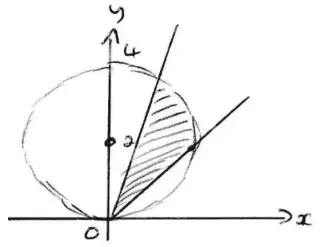 | B1 | 1.1b |
| (2) |
Notes
(ii)(a)
B1: Circle centre \((0, 2)\) and radius 2 or the two half-lines (a wedge) with the vertex on the origin.
B1: Fully correct region shaded.
| Scheme | Marks | AO |
|---|---|---|
| \(\text{area} = \dfrac{1}{2}\displaystyle\int_{\frac{\pi}{4}}^{\frac{\pi}{3}}\left(4\sin\theta\right)^2\mathrm{d}\theta\) or \(\text{area} = \dfrac{1}{2}\displaystyle\int_{\frac{\pi}{4}}^{\frac{\pi}{3}}\left(\alpha\sin\theta\right)^2\mathrm{d}\theta\) | M1 | 3.1a |
| Uses \(\sin^2\theta = \dfrac{1}{2} - \dfrac{1}{2}\cos 2\theta\) and integrates to the form \(A\theta + B\sin 2\theta\) \(\text{area} = 8\displaystyle\int_{\frac{\pi}{4}}^{\frac{\pi}{3}}\sin^2\theta\,\mathrm{d}\theta = 4\int_{\frac{\pi}{4}}^{\frac{\pi}{3}}1 - \cos 2\theta\,\mathrm{d}\theta = 4\theta - 2\sin 2\theta\) | M1 | 3.1a |
| Uses the limits of \(\dfrac{\pi}{4}\) and \(\dfrac{\pi}{3}\) and subtracts the correct way around \(\left[4\left(\dfrac{\pi}{3}\right) - 2\sin\left(\dfrac{2\pi}{3}\right)\right] - \left[4\left(\dfrac{\pi}{4}\right) - 2\sin\left(\dfrac{2\pi}{4}\right)\right]\) | M1 | 1.1b |
| Area \(= \dfrac{\pi}{3} - \sqrt{3} + 2\) | A1 | 1.1b |
| (4) |
Alternative
| Scheme | Marks | AO |
|---|---|---|
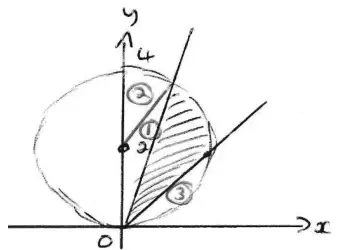 | ||
| Finds either the areas 1 or 2 Area 1 \(= \dfrac{1}{2} \times 2^2 \times \sin\left(\dfrac{2\pi}{3}\right)\left\{= \sqrt{3}\right\}\) Area 2 \(= \dfrac{1}{2} \times 2^2 \times \dfrac{\pi}{3}\left\{= \dfrac{2\pi}{3}\right\}\) | M1 | 1.1b |
| A complete method to find area 3 Area 3 \(= \dfrac{1}{4}\pi \times 2^2 - \dfrac{1}{2} \times 2^2\ \{= \pi - 2\}\) | M1 | 3.1a |
A complete method to find the required area Shaded area \(=\) Area of semi circle \(-\) area 1 \(-\) area 2 \(-\) area 3 \(= \left[\dfrac{1}{2}\pi \times 2^2\right] - \left[\dfrac{1}{2} \times 2^2 \times \sin\left(\dfrac{2\pi}{3}\right)\right] - \left[\dfrac{1}{2} \times 2^2 \times \dfrac{\pi}{3}\right] - \left[\dfrac{1}{4}\pi \times 2^2 - \dfrac{1}{2} \times 2^2\right]\) \(= 2\pi - \sqrt{3} - \dfrac{2\pi}{3} - (\pi - 2)\) Or Shaded area \(=\) Area of sector \(-\) area 1 \(-\) area 3 \(= \left[\dfrac{1}{2} \times 4 \times \left(\dfrac{2\pi}{3}\right)\right] - \left[\dfrac{1}{2} \times 2^2 \times \sin\left(\dfrac{2\pi}{3}\right)\right] - \left[\dfrac{1}{4}\pi \times 2^2 - \dfrac{1}{2} \times 2^2\right]\) \(= \dfrac{4\pi}{3} - \sqrt{3} - (\pi - 2)\) | M1 | 3.1a |
| Area \(= \dfrac{\pi}{3} - \sqrt{3} + 2\) | A1 | 1.1b |
| (4) | ||
| (11 marks) |
Notes
(ii)(b)
M1: Writes the required area using polar coordinates
M1: Uses \(\sin^2\theta = \dfrac{1}{2} - \dfrac{1}{2}\cos 2\theta\) and integrates to the form \(A\theta + B\sin 2\theta\)
M1: Uses the limits of \(\dfrac{\pi}{4}\) and \(\dfrac{\pi}{3}\) and subtracts the correct way around. Must be some attempt at \(\text{area} = \dfrac{1}{2}\displaystyle\int\left(\alpha\sin\theta\right)^2\mathrm{d}\theta\) and integration.
A1: Correct exact area \(= \dfrac{\pi}{3} - \sqrt{3} + 2\)
Alternative
M1: Finds either area 1 or area 2
M1: A complete method to find the area 3
M1: A complete method to find the required area \(=\) Area of semi circle \(-\) area 1 \(-\) area 2 \(-\) area 3 or \(=\) Area of sector \(-\) area 1 \(-\) area 3
A1: Correct exact area \(= \dfrac{\pi}{3} - \sqrt{3} + 2\)