
AS June 2025 Paper 1 Q7
7 The region R of the Argand diagram consists of the set of points representing complex numbers \(z\) which satisfy the following inequalities.
\(\mathrm{Im}(z) \geqslant 0 \qquad\quad \arg(z + 2) \leqslant \tfrac{1}{4}\pi \qquad\quad |z| \leqslant |z - 4 - 2\mathrm{i}|\)
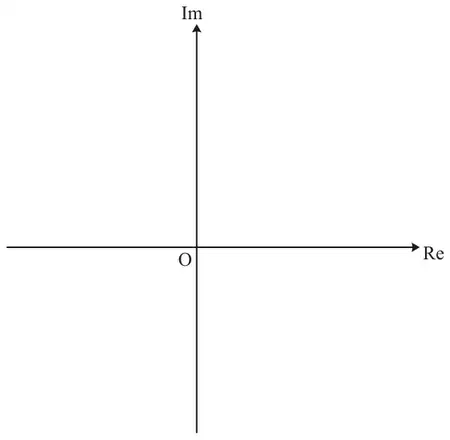
Axes printed in the Printed Answer Booklet for part (a):
Find the largest value of \(\mathrm{Im}(z)\) in the region R. [7]
| Scheme | Marks | AO |
|---|---|---|
 | B1 B1 B1 B1cao | 1.1 1.1 1.1 1.1 |
| [4] |
Notes
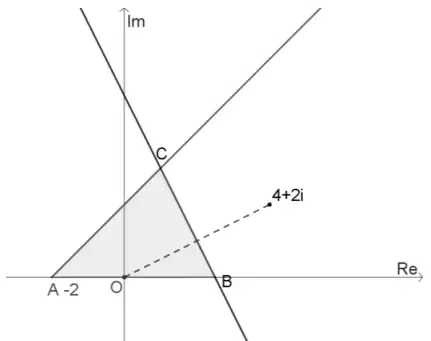
B1: Region all above real axis
B1: Half line at \(45^\circ\) to Re axis from \(-2\) on Re axis
B1: Perpendicular bisector of line joining O to \(4 + 2\mathrm{i}\)
B1cao: correct region indicated (may be by shading outside)
condone dotted or dashed boundaries
| Scheme | Marks | AO |
|---|---|---|
| DR Gradient of line from O to \(4 + 2\mathrm{i} = \frac{1}{2}\) | B1ft | 3.1a |
| Equation of BC \(y = -2x + c\) | M1 | 2.1 |
| \(1 = -4 + c \Rightarrow c = 5\) so \(y = -2x + 5\) | A1ft | 2.2a |
| half line \(y = x + 2\) | B1ft | 2.1 |
| solving \(y = x + 2\) with \(y = -2x + 5\) | M1 | 1.1 |
| \(x = 1\), \(y = 3\) [so C is \((1, 3)\)] | A1 | 2.2a |
| largest value of \(\mathrm{Im}(z) = 3\) | B1cao | 3.2a |
| [7] |
Notes
B1ft: soi ft their \(4 + 2\mathrm{i}\)
M1: using the gradient is the negative reciprocal of the gradient from O to their \(4 + 2\mathrm{i}\)
A1ft: [may be inequality]
Alternative for the first three marks (or)
| Scheme | Marks |
|---|---|
| \(x^2 + y^2 = (x - 4)^2 + (y - 2)^2\) | M1 |
| \(\Rightarrow x^2 + y^2 = x^2 - 8x + 16 + y^2 - 4y + 4\) | A1 |
| \(\Rightarrow y = -2x + 5\) | A1 |
A1: [may be inequality]
B1ft: ft their A