
AS June 2019 Paper 1 Q5
5.
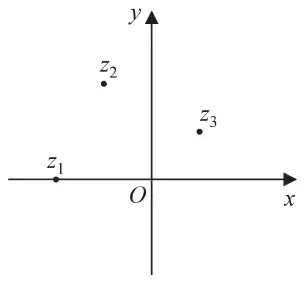
The complex numbers \(z_1 = -2\), \(z_2 = -1 + 2\mathrm{i}\) and \(z_3 = 1 + \mathrm{i}\) are plotted in Figure 1, on an Argand diagram for the complex plane with \(z = x + \mathrm{i}y\)
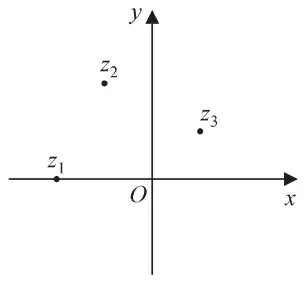
A copy of Figure 1, labelled Diagram 1, is given below.
| Scheme | Marks | AO |
|---|---|---|
| Complex roots of a real polynomial occur in conjugate pairs | M1 | 1.2 |
| so a polynomial with \(z_1\), \(z_2\) and \(z_3\) as roots also needs \(z_2^*\) and \(z_3^*\) as roots, so 5 roots in total, but a quartic has at most 4 roots, so no quartic can have \(z_1\), \(z_2\) and \(z_3\) as roots. | A1 | 2.4 |
| (2) |
Notes
M1: Some evidence that complex roots occur as conjugate pairs shown, e.g. stated as in scheme, or e.g. identifying if \(-1 + 2\mathrm{i}\) is a root then so is \(-1 - 2\mathrm{i}\). Mere mention of complex conjugates is sufficient for this mark.
A1: A complete argument, referencing that a quartic has at most 4 roots, but would need at least 5 for all of \(z_1\), \(z_2\) and \(z_3\) as roots. There should be a clear statement about the number of roots of a quartic (e.g. a quartic has four roots), and that this is not enough for the two conjugate pairs and real root.
| Scheme | Marks | AO |
|---|---|---|
| \(\dfrac{z_2 - z_1}{z_3 - z_1} = \dfrac{-1 + 2\mathrm{i} - (-2)}{1 + \mathrm{i} - (-2)} = \dfrac{1 + 2\mathrm{i}}{3 + \mathrm{i}} \times \dfrac{3 - \mathrm{i}}{3 - \mathrm{i}} = \ldots\) | M1 | 1.1b |
| \(= \dfrac{3 - \mathrm{i} + 6\mathrm{i} + 2}{9 + 1} = \dfrac{5 + 5\mathrm{i}}{10} = \dfrac{1}{2} + \dfrac{1}{2}\mathrm{i}\) oe | A1 | 1.1b |
| As \(\dfrac{1}{2} + \dfrac{1}{2}\mathrm{i}\) is in the first quadrant (may be shown by diagram), hence \(\arg\left(\dfrac{z_2 - z_1}{z_3 - z_1}\right) = \arctan\left(\dfrac{1/2}{1/2}\right) \bigl(= \arctan(1)\bigr) = \dfrac{\pi}{4}\) * | A1* | 2.1 |
| (3) |
Notes
M1: Substitutes the numbers in expression and attempts multiplication of numerator and denominator by the conjugate of their denominator or uses calculator to find the quotient. (May be implied.)
NB Applying the difference of arguments and using decimals is M0 here.
A1: Obtains \(\dfrac{1}{2} + \dfrac{1}{2}\mathrm{i}\). (May be from calculator.) Accepted equivalent Cartesian forms.
A1*: Uses arctan on their quotient and makes reference to first quadrant or draws diagram to show they are in the first quadrant, to justify the argument.
| Scheme | Marks | AO |
|---|---|---|
| \(\arg\left(\dfrac{z_2 - z_1}{z_3 - z_1}\right) = \arg(z_2 - z_1) - \arg(z_3 - z_1) = \arg(1 + 2\mathrm{i}) - \arg(3 + \mathrm{i})\) | M1 | 1.1b |
| Hence \(\arctan(2) - \arctan\left(\dfrac{1}{3}\right) = \dfrac{\pi}{4}\) * | A1* | 2.1 |
| (2) |
Notes
M1: Applies the formula for the argument of a difference of complex numbers and substitutes values (may go directly to arctans if the arguments have already been established). If used in (b) it must be seen or referred to in (c) for this mark to be awarded. Allow for \(\arg(z_2 - z_1) - \arg(z_3 - z_1)\) if \(z_2 - z_1\) and \(z_3 - z_1\) have been clearly identified in earlier work.
A1*: Completes the proof clearly by identifying the required arguments and using the result of (b). Use of decimal approximations is A0.
| Scheme | Marks | AO |
|---|---|---|
 | B1 | 1.1b |
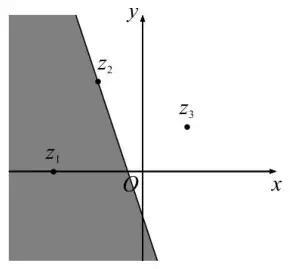
| Area below and left of their line shaded, where the line must have negative gradient passing through negative imaginary axis but need not pass through \(z_2\) | B1 | 1.1b |
| Unless otherwise indicated by the student mark Diagram 1 (if used) if there are multiple attempts. | ||
| (2) | ||
| (9 marks) |
Notes
B1: Draws a line through \(z_2\) and passing through negative imaginary axis.
B1: Correct side of bisector shaded. Allow this mark if the line does not pass through \(z_2\). But it should be an attempt at the perpendicular bisector of the other two points – so have negative gradient and pass through the negative real axis.
Ignore any other lines drawn for these two marks.