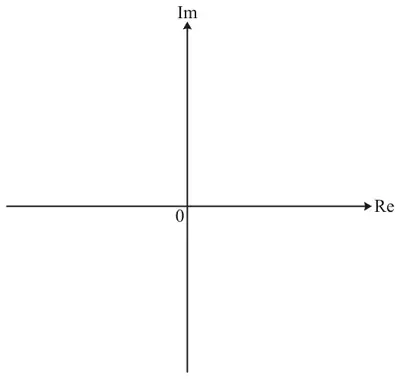
(a) A locus \(C_1\) is defined by \(C_1 = \{z : |z + \mathrm{i}| \leqslant |z - 2|\}\).
(i) Indicate by shading on the Argand diagram in the Printed Answer Booklet the region representing \(C_1\). [2]
(ii) Find the cartesian equation of the boundary line of the region representing \(C_1\), giving your answer in the form \(ax + by + c = 0\). [2]
(b) A locus \(C_2\) is defined by \(C_2 = \{z : |z + 1| \leqslant 3\} \cap \{z : |z - 2\mathrm{i}| \geqslant 2\}\). Indicate by shading on the Argand diagram in the Printed Answer Booklet the region representing \(C_2\). [3]
Mark scheme (a)
Scheme
Marks
AO
(i) Line drawn, perpendicular to line segment joining \((0, -1)\) and \((2, 0)\)
M1
1.1
Region below line indicated as being the required region.
A1
1.1
[2]
(ii) \(m = -1/(\tfrac{1}{2}) = -2\)
M1
1.1
\(4x + 2y - 3 = 0\)
A1
1.1
[2]
Notes
(a)(i)
M1: Line needs to have negative gradient with \(|\text{gradient}| \gt 1\) and to intersect the \(y\) axis at a positive value If “shading out” is used then there needs to be an indication that the required region is below the line, such as “R” placed below line or “This region” written in etc.
A1: Exact perpendicularity not needed, but should be approximately perpendicular.
(a)(ii)
A1: Explicitly stated Note must be in required form \(ax + by + c = 0\)
Mark scheme (b)
Scheme
Marks
AO
Circle centre \((-1, 0)\) radius 3 or circle centre \((0, 2)\) radius 2.
M1
1.1
Both circles correct
A1
1.1
Correct region shaded or otherwise indicated
A1
1.1
[3]
Notes
M1: Radius can be implied by axis labels or tick-marks.
A1: (1st) If M0A0 then SC1 for two circles with correct radii but centres \((1, 0)\) and \((0, -2)\)
A1: (2nd) Region inside circle with radius 3 but outside circle with radius 2.