
A2 June 2025 Paper 2 Q4
4.
where \(a\), \(b\), \(c\) and \(d\) are real constants.
Given that
- \(b \gt d\)
- \(z_1 + z_2\) is real
- \(\lvert z_1\rvert = \sqrt{13}\)
- \(\lvert z_2\rvert = 5\)
- \(\mathrm{Re}(z_2 - z_1) = 2\)
show that \(a = 2\) and determine the value of each of \(b\), \(c\) and \(d\) (5)
- sketch the locus of points \(z\) which satisfy \(\lvert z - 12\rvert = 7\)
- sketch the locus of points \(w\) which satisfy \(\lvert w - 5\mathrm{i}\rvert = 4\)
| Scheme | Marks | AO |
|---|---|---|
| \(z_1 + z_2 = a + b\mathrm{i} + c + d\mathrm{i}\) leading to \(b + d = 0\) (oe) or \(z_2 - z_1 = (c + d\mathrm{i}) - (a + b\mathrm{i})\) leading to \(c - a = 2\) (oe) | B1 | 1.1b |
| Forms equations using modulus information \(\lvert z_1\rvert = \sqrt{13} \Rightarrow a^2 + b^2 = 13\) and \(\lvert z_2\rvert = 5 \Rightarrow c^2 + d^2 = 25\) | M1 | 3.1a |
| Uses their equations to solve simultaneously to find at least one value e.g Method 1 \(c = 2 + a,\ d = -b\) leading to \((2 + a)^2 + (-b)^2 = 25 \Rightarrow a^2 + 4a + 4 + b^2 = 25\) Solve with \(a^2 + b^2 = 13\) gives \(13 + 4a + 4 = 25 \Rightarrow 4a = 8 \Rightarrow a = \ldots\) e.g. Method 2 \(\left.\begin{aligned}a^2 + b^2 &= 13\\ c^2 + d^2 &= 25\end{aligned}\right\} \Rightarrow a^2 - c^2 = -12\) and solves simultaneous with \(c - a = 2\) to find a value for \(a\) or \(c\). | M1 | 3.1a |
| Uses their equations to find values for all the constants | ddM1 | 2.1 |
| \(a = 2,\ b = 3,\ c = 4,\ d = -3\) | A1 | 2.3 |
| (5) |
Notes
B1: States either \(b + d = 0\) or \(c - a = 2\) (oe)
M1: Uses the modulus information to write down two more equations (need not be squared). Accept if they forget to square one of the moduli but the sum of squares must be correct.
M1: Uses their equations to solve simultaneously to find at least one value. If they assume \(a = 2\), you may allow this mark for finding at least one of \(b\) or \(d\).
ddM1: Dependent on both previous method marks. Uses their equations to find values for all of the constants. This mark is not available if \(a = 2\) is assumed. All must be found from algebra.
A1: Correct values from correct work.
| Scheme | Marks | AO |
|---|---|---|
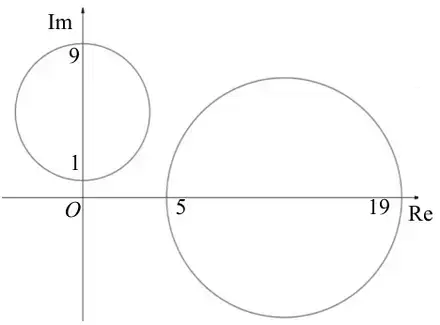 | B1 B1 | 1.1b 1.1b |
| (2) |
Notes
B1: One circle drawn with correct intercepts OR both circles drawn in correct position, not overlapping, but with no intercepts shown. Be tolerant on the shape but must be a clear attempt at a circle – a closed loop with no obvious kinks. Labels on imaginary axis may be just numbers or i and 9i.
B1: Both circles drawn with correct intercepts and the circles does not intersect each other. Again be tolerant as per first B mark.
| Scheme | Marks | AO |
|---|---|---|
| Distance between centres \(= \sqrt{5^2 + 12^2} = 13\) | M1 | 1.1b |
| \(13 \pm (7 + 4)\) | dM1 | 3.1a |
| \(2 \leqslant \lvert z - w\rvert \leqslant 24\) | A1 | 1.1b |
| (3) | ||
| (10 marks) |
Notes
M1: Finds the distance between the centres of the circles.
dM1: Dependent on previous method mark. Full method to find the nearest and furthest points of circles. E.g. Uses their distance +/- sum of radii. If their distance between circles is less than 11, there must a check seen to show this has been considered. If by error they show the circles touch (not cross) then note that finding twice the sum of radii is a valid method for the greatest distance.
A1: Correct answer. Allow if the centres were on the negative axes.
Alt: There may be attempts via finding the line through the centres.
M1: Full method to find the equation of the line through the two centres:
\(m = \dfrac{0 - 5}{12 - 0} = -\dfrac{5}{12} \Rightarrow y = -\dfrac{5}{12}(x - 12)\) (oe)
dM1: Full method to find the nearest and furthest points of circles, so finds the intersection points of this line with the circles and finds distances between the relevant points.
\(x^2 + \left(-\dfrac{5}{12}x + 5 - 5\right)^2 = 16 \Rightarrow \dfrac{169}{144}x^2 = 16 \Rightarrow x = \pm\dfrac{48}{13} \Rightarrow y = \dfrac{45}{13},\ \dfrac{85}{13}\)
\((x - 12)^2 + \left(-\dfrac{5}{12}x + 5\right)^2 = 49 \Rightarrow \dfrac{169}{144}x^2 - \dfrac{169}{6}x + 120 = 0 \Rightarrow x = \dfrac{72}{13},\ \dfrac{240}{13} \Rightarrow y = \pm\dfrac{35}{13}\)
nearest \(= \sqrt{\left(\dfrac{72}{13} - \dfrac{48}{13}\right)^2 + \left(\dfrac{35}{13} - \dfrac{45}{13}\right)^2} = 2\), furthest \(= \sqrt{\left(\dfrac{240}{13} + \dfrac{48}{13}\right)^2 + \left(-\dfrac{35}{13} - \dfrac{85}{13}\right)^2} = 24\)
A1: Correct answer.