
A2 June 2024 Paper 2 Q9
9 In this question, the argument of a complex number is defined as being in the range \([0, 2\pi)\).
You are given that \(\omega_k\), where \(k = 0, 1, 2, \ldots, n - 1\), are the \(n\) \(n^{\text{th}}\) roots of unity for some integer \(n\), \(n \geqslant 3\), and that these are given in order of increasing argument (so that \(\omega_0 = 1\)).
You should now consider the case where \(n = 5\).
| Scheme | Marks | AO |
|---|---|---|
Diagram showing \(\omega_1\) as the ‘first’ non-real vertex of a regular \(n\)-gon with 1 as the 0th vertex and at least one other vertex shown with the correct relationship (ie on unit circle with same angular distance).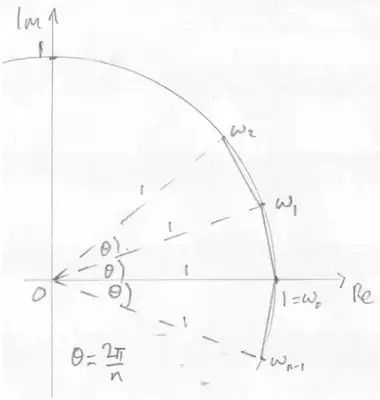 | B1 | 2.1 |
| (Since it is a root of unity) the modulus of \(\omega_1\) is 1 so multiplying by it leaves the modulus unchanged.... | B1 | 2.2a |
| ...(since the \(n\) roots of unity are represented by the \(n\) vertices on the unit circle of a regular \(n\)-gon then) rotation by the argument of the first \((\omega_1)\) (ie adding an angle) takes you to the second and so on. | B1 | 2.4 |
| [3] |
Notes
B1: Diagram should clearly show equal angular distance between the roots and an equal distance (of 1) from \(O\) to each root.
At least 3 points including \(\omega_0\) and \(\omega_1\) shown.
For this B1 allow an \(n\)-gon with a specific value of \(n\) chosen.
B1: Dealing with modulus (could be incorporated in the below).
\(|\omega_k| = 1\) since it is a root of unity
\(|\omega_1| = 1 \Rightarrow \left|\omega_1^k\right| \left(= |\omega_1|^k\right) = 1\)
B1: Dealing with argument. Accept a well-reasoned argument based on multiplication by \(\omega_1\) representing a pure rotation (by the required angle).
Could be argued by induction if rigorous.
\[\begin{aligned} &\arg(\omega_k) = \frac{2\pi k}{n} \\ &\arg(\omega_1) = \frac{2\pi}{n} \\ &\Rightarrow \arg\left(\omega_1^k\right) = k\arg(\omega_1) = \frac{2\pi k}{n} \end{aligned}\]
Alternative method for last B1B1
| Scheme | Marks |
|---|---|
| \(\omega_1 = \mathrm{e}^{\frac{2\pi}{n}\mathrm{i}}\) and \(\omega_k = \mathrm{e}^{\frac{2\pi k}{n}\mathrm{i}}\) | B1 |
| \(\therefore \omega_1^k = \left(\mathrm{e}^{\frac{2\pi}{n}\mathrm{i}}\right)^k = \mathrm{e}^{\frac{2\pi k}{n}\mathrm{i}} = \omega_k\) | B1 |
| [3] |
B1: \(\omega_1\) can be implied if appearing in the equation below
| Scheme | Marks | AO |
|---|---|---|
| \((\omega_1^0 = 1 = \omega_0\) and so\()\ \displaystyle\sum_{k=0}^{n-1}\omega_k = \displaystyle\sum_{k=0}^{n-1}\omega_1^k\) which is a GP with \((a = 1)\), \(r = \omega_1\ (\neq 1)\) and \(n\) terms. | M1 | 3.1a |
| \(= \dfrac{1 \times \left(\omega_1^n - 1\right)}{\omega_1 - 1} = \dfrac{1 - 1}{\omega_1 - 1} = \dfrac{0}{\omega_1 - 1} = 0\) (since \(\omega_1\) is an \(n^{\text{th}}\) root of unity so \(\omega_1^n = 1\)). | A1 | 2.2a |
| [2] |
Notes
M1: Using the identity from (a) and recognising the GP (can be implied by the formula).
\(\displaystyle\sum_{k=0}^{n-1}\omega_k = \displaystyle\sum_{k=0}^{n-1}\omega_1^k\) and recognition of \(\omega_1^n - 1 = (\omega_1 - 1)\left(\omega_1^{n-1} + \omega_1^{n-2} + \ldots + \omega_1 + 1\right)\)
A1: AG so reasoning must be shown,
If GP not recognised then justification for \(\omega_1 - 1 \neq 0\) must also be given.
| Scheme | Marks | AO |
|---|---|---|
| \(z = a + b\mathrm{i}\) \(z^* = a - b\mathrm{i}\) \(\therefore z + z^* = 2a = 2\operatorname{Re}(z)\) | B1 | 2.1 |
| [1] |
Notes
B1: AG
| Scheme | Marks | AO |
|---|---|---|
| \(\begin{aligned} &\left(\displaystyle\sum_{k=0}^{n-1}\omega_k = 0\right) \\ &\therefore \displaystyle\sum_{k=0}^{n-1}\omega_k^* = 0 \\ &\therefore \displaystyle\sum_{k=0}^{n-1}\omega_k + \displaystyle\sum_{k=0}^{n-1}\omega_k^* = 0 \text{ or } \displaystyle\sum_{k=0}^{n-1}\left(\omega_k + \omega_k^*\right) = 0 \\ &\therefore \displaystyle\sum_{k=0}^{n-1}2\operatorname{Re}(\omega_k) = 0 \\ &\therefore \displaystyle\sum_{k=0}^{n-1}\operatorname{Re}(\omega_k) = 0 \end{aligned}\) | B1 | 3.1a |
| [1] |
| Scheme | Marks | AO |
|---|---|---|
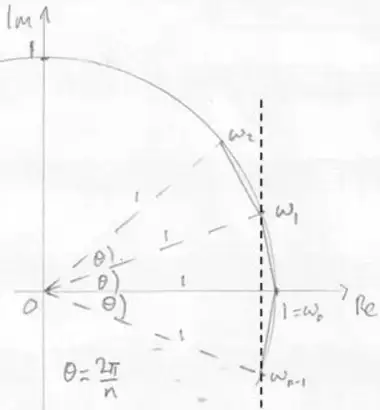 | B1 | 2.1 |
| [1] |
Notes
B1: Or the (non-real) roots of unity come in complex conjugate pairs (since they are roots of the real polynomial \(z^n = 1\)).
Could use symmetry of cos function in geometric context (eg \(\cos\frac{2}{5}\pi = \cos\left(2\pi - \frac{2}{5}\pi\right)\) etc)
| Scheme | Marks | AO |
|---|---|---|
| (i) \(\arg\omega_1 = \dfrac{2\pi}{5}\) soi | M1 | 3.1a |
| So from (d) and (e), \(\begin{aligned} &1 + 2\cos\dfrac{2\pi}{5} + 2\cos\dfrac{4\pi}{5} = 0 \\ &\left(\therefore 2\cos\dfrac{4\pi}{5} = -1 - 2\cos\dfrac{2\pi}{5}\right) \\ &\therefore \cos\dfrac{4\pi}{5} = -\dfrac{1}{2} - \cos\dfrac{2\pi}{5} \\ &a = -\dfrac{1}{2},\ b = -1 \end{aligned}\) | A1 | 2.2a |
| [2] | ||
| (ii) \(\begin{aligned} &\therefore 2\cos^2\dfrac{2\pi}{5} - 1 = -\dfrac{1}{2} - \cos\dfrac{2\pi}{5} \\ &\therefore 4c^2 + 2c - 1 = 0,\ c = \cos\dfrac{2\pi}{5} \\ &c = \dfrac{-1 \pm \sqrt{5}}{4} \end{aligned}\) | M1 | 3.1a |
| \(\dfrac{2\pi}{5}\) is an acute angle so \(\cos\dfrac{2\pi}{5} \gt 0\). So \(\dfrac{-1 - \sqrt{5}}{4}\) is rejected so \(\cos\dfrac{2\pi}{5} = \dfrac{-1 + \sqrt{5}}{4}\). | A1 | 2.3 |
| [2] |
Notes
(f)(i)
M1: Finding the first argument. Could be embedded.
Could see sum of all 5 real parts.
A1: \(a\) and \(b\) can be embedded.
(f)(ii)
M1: Using correct double angle formula to derive and solve a quadratic equation in \(\cos\frac{2\pi}{5}\) (must have real solutions). Could be BC.
A1: Clear rejection after valid argument leading to correct answer.