
AS June 2024 Paper 1 Q4
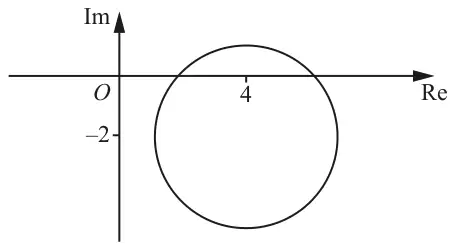
4 The Argand diagram shows a circle of radius 3. The centre of the circle is the point which represents the complex number \(4 - 2\mathrm{i}\).
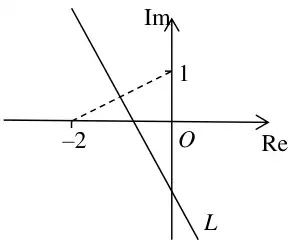
The locus \(L\) is defined by \(L = \{z : z \in \mathbb{C}, |z - \mathrm{i}| = |z + 2|\}\).
Argand diagram printed in the Printed Answer Booklet:
You are given that the locus \(\left\{z : z \in \mathbb{C}, \arg(z - 1) = \dfrac{1}{4}\pi, \mathrm{Re}(z) = 3\right\}\) contains only one number.
| Scheme | Marks | AO |
|---|---|---|
| \(|z - (4 - 2\mathrm{i})|\) | M1 | 1.1 |
| \(\{z : z \in \mathbb{C}, |z - (4 - 2\mathrm{i})| = 3\}\) | A1 | 2.5 |
| [2] |
Notes
M1: Any solution which involves \(|z - (4 - 2\mathrm{i})|\) or \(|z - 4 + 2\mathrm{i}|\)
M1 for \((x - 4)^2 + (y + 2)^2 = 9\)
A1: Must show the { } brackets and correct set notation used, i.e. the form shown but BOD lack of comma.
or \(\left\{\begin{aligned} &z = x + y\mathrm{i} : x, y \in \mathbb{R}, \\ &(x - 4)^2 + (y + 2)^2 = 9 \text{ (or } 3^2\text{)} \end{aligned}\right\}\)
| Scheme | Marks | AO |
|---|---|---|
| (need points equidistant from) \(\mathrm{i}\) and \(-2\) | B1 | 1.1 |
 | B1FT | 1.1 |
| [2] |
Notes
B1: \(\mathrm{i}\) and \(-2\) both clearly identified either on the sketch or in words.
Ignore other points.
If points not explicitly identified then 1st B1 can be implied by either correct equation of line or both intercepts of line given.
B1FT: Their two identified points (joined and) perpendicularly bisected by a single, straight, solid line which should be labelled \(L\) or otherwise unambiguously indicated.
NB The equation of this line (which need not be shown) is \(y = -2x - 3/2\) so the \(x\)- & \(y\)-intercepts are \(-\frac{3}{4}\) and \(-1\frac{1}{2}\) respectively. These need not be shown but if shown must be correct.
Line must be indicated as perpendicular or implied to be per perpendicular e.g. from two correct points on line or correct equation.
SC If B0 for not labelling the points but the points are located correctly, and line indicated appears to be the perpendicular bisector then allow B1
| Scheme | Marks | AO |
|---|---|---|
| Either \(x = 3\) or \(\tan^{-1}\left(\dfrac{y}{x - 1}\right) = \dfrac{1}{4}\pi\) stated or indicated. | M1 | 3.1a |
| \(\tan^{-1}\left(\dfrac{y}{x - 1}\right) = \dfrac{1}{4}\pi \Rightarrow \dfrac{y}{3 - 1} = 1 \Rightarrow y = 2\) so the number is \(3 + 2\mathrm{i}\) | A1 | 3.2a |
| [2] |
Notes
M1: Understanding of one of the conditions. Could be shown on a diagram (eg the line \(x = 3\) drawn or 3 as a clear, special label on the real axis or the half-line with gradient 1 drawn from \((1, 0)\), etc)
\(y = x - 1\) implies M1
answer of \(3 + b\mathrm{i}\) implies M1
A1: Could be shown on a diagram
Find - might not be much (or even any) working shown