
A2 June 2023 Paper 1 Q3
3.
In this question you must show all stages of your working.
Solutions relying on calculator technology are not acceptable.
\[z_1 = -4 + 4\mathrm{i}\]| Scheme | Marks | AO |
|---|---|---|
| e.g. \(|z_1| = \sqrt{(-4)^2 + 4^2}\) or \(\arg z_1 = \pi - \dfrac{\pi}{4}\) oe | M1 | 1.1b |
| \((z_1 =)\,4\sqrt{2}\left(\cos\dfrac{3\pi}{4} + \mathrm{i}\sin\dfrac{3\pi}{4}\right)\) or e.g. \((z_1 =)\sqrt{32}\left(\cos\dfrac{3\pi}{4} + \mathrm{i}\sin\dfrac{3\pi}{4}\right)\) | A1 | 1.1b |
| (2) |
Notes
(a) Correct answer with no working scores both marks in (a)
M1: Any correct expression for \(|z_1|\) or \(\arg z_1\) e.g. \(|z_1| = \sqrt{(-4)^2 + 4^2}\) or \(\arg z_1 = \pi - \dfrac{\pi}{4}\)
A1: Correct expression. The "\(z_1 =\)" is not required.
This mark is not for correct modulus and correct argument it is for the complex number written in the required form. Condone the missing closing bracket e.g. \((z_1 =)\sqrt{32}\left(\cos\dfrac{3\pi}{4} + \mathrm{i}\sin\dfrac{3\pi}{4}\right.\)
| Scheme | Marks | AO |
|---|---|---|
| (i) \(\dfrac{z_1}{z_2} = \dfrac{\text{"}4\sqrt{2}\text{"}}{3}\left(\cos\left(\text{"}\dfrac{3\pi}{4}\text{"} - \dfrac{17\pi}{12}\right) + \mathrm{i}\sin\left(\text{"}\dfrac{3\pi}{4}\text{"} - \dfrac{17\pi}{12}\right)\right) = \ldots\) or \(\dfrac{z_1}{z_2} = \dfrac{\text{"}4\sqrt{2}\text{"}\mathrm{e}^{\text{"}\frac{3\pi}{4}\mathrm{i}\text{"}}}{3\mathrm{e}^{\frac{17\pi}{12}\mathrm{i}}} = \dfrac{\text{"}4\sqrt{2}\text{"}}{3}\mathrm{e}^{\left(\text{"}\frac{3\pi}{4}\text{"} - \frac{17\pi}{12}\right)\mathrm{i}}\) or \(\dfrac{z_1}{z_2} = \dfrac{-4 + 4\mathrm{i}}{3\left(\left(\dfrac{\sqrt{2} - \sqrt{6}}{4}\right) - \mathrm{i}\left(\dfrac{\sqrt{2} + \sqrt{6}}{4}\right)\right)} \times \dfrac{\left(\dfrac{\sqrt{2} - \sqrt{6}}{4}\right) + \mathrm{i}\left(\dfrac{\sqrt{2} + \sqrt{6}}{4}\right)}{\left(\dfrac{\sqrt{2} - \sqrt{6}}{4}\right) + \mathrm{i}\left(\dfrac{\sqrt{2} + \sqrt{6}}{4}\right)} = \ldots\) | M1 | 3.1a |
| \(= -\dfrac{2\sqrt{2}}{3} - \dfrac{2\sqrt{6}}{3}\mathrm{i}\) or \(-\dfrac{2\sqrt{2}}{3} - \mathrm{i}\dfrac{2\sqrt{6}}{3}\) or \(-\dfrac{2\sqrt{2}}{3} + \mathrm{i}\left(-\dfrac{2\sqrt{6}}{3}\right)\) | A1 | 1.1b |
| (2) | ||
| (ii) \(z_2^4 = 3^4\left(\cos\left(4 \times \dfrac{17\pi}{12}\right) + \mathrm{i}\sin\left(4 \times \dfrac{17\pi}{12}\right)\right)\) or \((z_2)^4 = \left(3\mathrm{e}^{\frac{17\pi}{12}\mathrm{i}}\right)^4 = 3^4\mathrm{e}^{\frac{17\pi}{12} \times 4\mathrm{i}}\) or \(z_2^4 = \left\{3\left(\left(\dfrac{\sqrt{2} - \sqrt{6}}{4}\right) - \mathrm{i}\left(\dfrac{\sqrt{2} + \sqrt{6}}{4}\right)\right)\right\}^4 = \ldots\) | M1 | 1.1b |
| \(= \dfrac{81}{2} - \dfrac{81\sqrt{3}}{2}\mathrm{i}\) or \(\dfrac{81}{2} - \mathrm{i}\dfrac{81\sqrt{3}}{2}\) or \(\dfrac{81}{2} + \mathrm{i}\left(-\dfrac{81\sqrt{3}}{2}\right)\) | A1 | 1.1b |
| (2) |
Notes
(b)(i) Correct answer with no working scores no marks in (b)(i)
M1: Employs a correct method to find the quotient. E.g.
- uses modulus argument form and divides moduli and subtracts arguments the right way round
- uses exponential form and divides moduli and subtracts arguments the right way round
- converts \(z_2\) to Cartesian form and multiplies numerator and denominator by the complex conjugate of the denominator. Allow if the “3” is missing for this method. Allow with decimals for this method e.g. \(\dfrac{z_1}{z_2} = \dfrac{-4 + 4\mathrm{i}}{-0.258\ldots - 0.965\ldots\mathrm{i}} \times \dfrac{-0.258\ldots + 0.965\ldots\mathrm{i}}{-0.258\ldots + 0.965\ldots\mathrm{i}} = \ldots\)
If they convert \(z_2\) to Cartesian form it must be correct as shown or correct decimals.
A1: Correct exact answer in the required form.
Do not allow e.g. \(-\dfrac{2}{3}\left(\sqrt{2} + \sqrt{6}\mathrm{i}\right)\) or \(\dfrac{-2\sqrt{2} - 2\sqrt{6}\mathrm{i}}{3}\) unless a correct form is seen previously then apply isw.
Provided a correct method is shown as above, allow to go from the forms in the main scheme to the correct exact answer with no intermediate step.
(b)(ii) Correct answer with no working scores no marks in (b)(ii)
M1: Applies De Moivre’s theorem correctly to \(z_2\). E.g. uses polar form or exponential form and calculates the modulus as \(3^4\) and the argument as \(4 \times \dfrac{17\pi}{12}\)
For attempts at \(z_2^4 = \left\{3\left(\left(\dfrac{\sqrt{2} - \sqrt{6}}{4}\right) - \mathrm{i}\left(\dfrac{\sqrt{2} + \sqrt{6}}{4}\right)\right)\right\}^4\) you would need to see:
- the correct exact form used
- a clear and convincing attempt to expand the brackets e.g. by using a full binomial expansion or a complete attempt to multiply all 4 brackets together but you are not expected to check every detail
- a final answer in the required form with no obvious errors seen
So \(z_2^4 = \left\{3\left(\left(\dfrac{\sqrt{2} - \sqrt{6}}{4}\right) - \mathrm{i}\left(\dfrac{\sqrt{2} + \sqrt{6}}{4}\right)\right)\right\}^4 = \dfrac{81}{2} - \dfrac{81\sqrt{3}}{2}\mathrm{i}\) scores no marks.
Similar guidance applies if they attempt to expand \(\left\{3\left(\cos\dfrac{17\pi}{12} + \mathrm{i}\sin\dfrac{17\pi}{12}\right)\right\}^4\)
A1: Correct exact answer in the required form.
Do not allow e.g. \(\dfrac{81}{2}\left(1 - \dfrac{81\sqrt{3}}{2}i\right)\) or \(\dfrac{81 - 81\sqrt{3}\mathrm{i}}{2}\) unless a correct form is seen previously then apply isw.
Provided a correct method is shown as above, allow to go from the forms in the main scheme to the correct exact answer with no intermediate step.
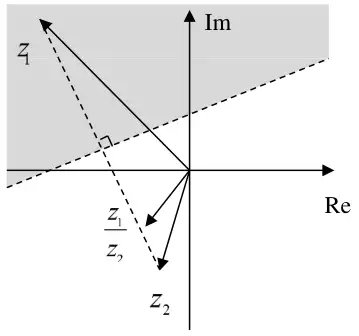
| Scheme | Marks | AO |
|---|---|---|
| Notes: (c)(i) B1: \(z_1\) and \(z_2\) correctly positioned. Look for correct quadrants with \(z_1\) approximately on \(y = -x\) and \(z_2\) below \(y = x\) closer to the origin than \(z_1\). Note that the points are usually labelled but mark positively if it is clear which points are which if there is no labelling. | B1 | 1.1b |
| B1ft: \(\dfrac{z_1}{z_2}\) in the correct quadrant. Follow through their answer to (b)(i). Note that the point is usually labelled but mark positively if it is clear which point it is. It is sometimes labelled as \(z_3\) which is fine. | B1ft | 1.1b |
| (ii) M1: Draws a line (solid or dashed) that is the perpendicular bisector of \(z_1z_2\) or draws a line that crosses \(z_1z_2\) and shades one of the sides of this line. | M1 | 3.1a |
| A1: A line drawn (solid or dashed) that is the perpendicular bisector of \(z_1z_2\) with either side shaded as long as it is clear they are not discounting the upper region. The B1 in part (i) may not have been scored but \(z_1\) must be in quadrant 2 and \(z_2\) in quadrant 3. Note that some candidates are drawing the region on a separate diagram and this is acceptable. You do not need to see a line joining \(z_1\) to \(z_2\). | A1 | 1.1b |
| (4) | ||
| (10 marks) |