
AS June 2023 Paper 1 Q2
2.
\[\mathrm{f}(z) = z^3 + az^2 + bz + 175 \qquad \text{where } a \text{ and } b \text{ are real constants}\]Given that \(-3 + 4\mathrm{i}\) is a root of the equation \(\mathrm{f}(z) = 0\)
| Scheme | Marks | AO |
|---|---|---|
| \(z^* = -3 - 4\mathrm{i}\) \((z - (-3 + 4\mathrm{i}))(z - (-3 - 4\mathrm{i})) = z^2 + pz + q\) \(\{\mathrm{f}(z) =\}\left(z^2 + pz + q\right)(z + r)\) | M1 | 3.1a |
| \(\left(z^2 + 6z + 25\right)(z + 7)\) | A1 | 1.1b |
| Multiplies out \(\left(z^2 + 6z + 25\right)(z + 7) = \ldots\alpha z^2 + \beta z\ldots\) | M1 | 1.1b |
| \(z^3 + 13z^2 + 67z + 175\) or \(a = 13,\ b = 67\) | A1 | 1.1b |
| (4) |
Notes
M1: Uses the given root and its complex conjugate to form a quadratic equation. Uses the quadratic equation to write \(\mathrm{f}(z)\) in the form \(\left(z^2 + pz + q\right)(z + r)\) where \(p\), \(q\) and \(r\) are real values
A1: Correct expression for \(\mathrm{f}(z) = \left(z^2 + 6z + 25\right)(z + 7)\)
M1: Multiplies out and simplifies to find the \(z^2\) or \(z\) term.
A1: Correct values for \(a\) and \(b\) or cubic
Alternative 1
| Scheme | Marks | AO |
|---|---|---|
| \(z^* = -3 - 4\mathrm{i}\) and uses product of roots = −175 to find the third root | M1 | 3.1a |
| Third root = −7 | A1 | 1.1b |
| Either Uses sum roots = \(-a\) to find a value for \(a\) or uses pair sum = \(b\) to find a value for \(b\) Or \((z - (-3 + 4\mathrm{i}))(z - (-3 - 4\mathrm{i}))(z - \text{their third root}) = \ldots\) | M1 | 1.1b |
| \(a = 13,\ b = 67\) | A1 | 1.1b |
| (4) |
M1: Uses the complex conjugate and product of roots = −175 to find the third root.
A1: Correct third root
M1: A complete method to find the values of \(a\) or \(b\). Either uses the sum and pairs sum or multiplies out three brackets \((z - (-3 + 4\mathrm{i}))(z - (-3 - 4\mathrm{i}))(z - \text{their third root})\) to find the \(z^2\) or \(z\) term.
A1: Correct values for \(a\) and \(b\) or cubic
Alternative 2
| Scheme | Marks | AO |
|---|---|---|
| \((-3 + 4\mathrm{i})^3 + a(-3 + 4\mathrm{i})^2 + b(-3 + 4\mathrm{i}) + 175 = 0\) \(\Rightarrow 117 + 44\mathrm{i} + a(-7 - 24\mathrm{i}) + b(-3 + 4\mathrm{i}) + 175 = 0\) Equates real and imaginary to form two linear simultaneous equations | M1 | 3.1a |
| \(117 - 7a - 3b + 175 = 0 \Rightarrow -7a - 3b = -292\) \(44 - 24a + 4b = 0 \Rightarrow -24a + 4b = -44\) | A1 | 1.1b |
| Solves simultaneously to find values for \(a\) or \(b\) | M1 | 1.1b |
| \(a = 13,\ b = 67\) | A1 | 1.1b |
| (4) |
M1: Substitutes \(-3 + 4\mathrm{i}\) or \(-3 - 4\mathrm{i}\) into \(\mathrm{f}(z)\), sets the real and imaginary parts = 0 to form two simultaneous equations in \(a\) and \(b\).
A1: Correct, unsimplified equations.
M1: Solves simultaneous equations to find values for \(a\) or \(b\) following an attempt at \(\mathrm{f}(-3 + 4\mathrm{i}) = 0\) or \(\mathrm{f}(-3 - 4\mathrm{i}) = 0\). Allow this mark for seeing a value for \(a\) or \(b\) following simultaneous equation, you do not need to check.
A1: Correct values for \(a\) and \(b\).
| Scheme | Marks | AO |
|---|---|---|
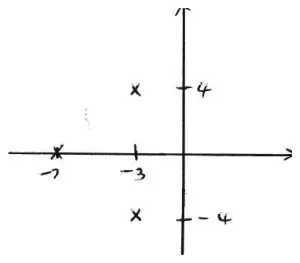 \(-7\) | B1 B1 | 1.1b 2.2a |
| (2) |
Notes
B1: Correctly plotting \(-3 + 4\mathrm{i},\ -3 - 4\mathrm{i}\)
B1: Correctly plotting −7
| Scheme | Marks | AO |
|---|---|---|
| \(-5 + 4\mathrm{i},\ -5 - 4\mathrm{i},\ -9\) | B1ft | 2.2a |
| (1) | ||
| (7 marks) |
Notes
B1ft: \(-5 + 4\mathrm{i},\ -5 - 4\mathrm{i}\) and subtracts 2 from their real root shown on their Argand diagram