Finding Roots of Polynomials

Edexcel

AQA

OCR A

OCR MEI

A2 June 2025 Paper 1 Q6

6.

\[\mathrm{f}(z) = z^3 + az^2 + bz + c \qquad \text{where } a,\ b \text{ and } c \text{ are real constants}\]

The roots of the equation \(\mathrm{f}(z) = 0\) are \(z_1\), \(z_2\) and \(z_3\)

When plotted on an Argand diagram, the points representing these roots form the vertices of a triangle.

Given that

  • \(z_1 = 2 + 4\mathrm{i}\)
  • the area of the triangle is 12

Determine the two possible functions \(\mathrm{f}(z)\) (5)

AS June 2025 Paper 1 Q2

EdexcelCurrent spec7 marksFinding Roots of Polynomials

2.

In this question you must show all stages of your working.

Solutions relying entirely on calculator technology are not acceptable.

\[\mathrm{f}(z) = 4z^3 - 12z^2 - 95z + 325\]

Given that \(\mathrm{f}(-5) = 0\)

(a) determine \(\mathrm{f}(z)\) in the form \((z + a)(bz^2 + cz + d)\) where \(a\), \(b\), \(c\) and \(d\) are integers. (3)
(b) Hence show that the complex roots of \(\mathrm{f}(z) = 0\) are \(\dfrac{8 \pm \mathrm{i}}{2}\) (2)
(c) Determine the values of \(z\) such that \(\mathrm{f}(2z - 1) = 0\) (2)

A2 June 2024 Paper 1 Q1

1.

\[\mathrm{f}(z) = z^4 - 6z^3 + az^2 + bz + 145\]

where \(a\) and \(b\) are real constants.

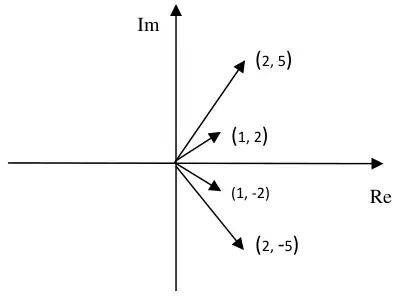
Given that \(2 + 5\mathrm{i}\) is a root of the equation \(\mathrm{f}(z) = 0\)

(a) determine the other roots of the equation \(\mathrm{f}(z) = 0\) (7)
(b) Show all the roots of \(\mathrm{f}(z) = 0\) on a single Argand diagram. (2)

A2 June 2023 Paper 2 Q8

8. Given that a cubic equation has three distinct roots that all lie on the same straight line in the complex plane,

(a) describe the possible lines the roots can lie on. (2)
\[\mathrm{f}(z) = 8z^3 + bz^2 + cz + d\]

where \(b\), \(c\) and \(d\) are real constants.

The roots of \(\mathrm{f}(z)\) are distinct and lie on a straight line in the complex plane.

Given that one of the roots is \(\dfrac{3}{2} + \dfrac{3}{2}\mathrm{i}\)

(b) state the other two roots of \(\mathrm{f}(z)\) (1)
\[\mathrm{g}(z) = z^3 + Pz^2 + Qz + 12\]

where \(P\) and \(Q\) are real constants, has 3 distinct roots.

The roots of \(\mathrm{g}(z)\) lie on a different straight line in the complex plane than the roots of \(\mathrm{f}(z)\)

Given that

  • \(\mathrm{f}(z)\) and \(\mathrm{g}(z)\) have one root in common
  • one of the roots of \(\mathrm{g}(z)\) is \(-4\)
(c)
(i) write down the value of the common root, (1)
(ii) determine the value of the other root of \(\mathrm{g}(z)\) (3)
(d) Hence solve the equation \(\mathrm{f}(z) = \mathrm{g}(z)\) (4)

AS June 2023 Paper 1 Q2

2.

\[\mathrm{f}(z) = z^3 + az^2 + bz + 175 \qquad \text{where } a \text{ and } b \text{ are real constants}\]

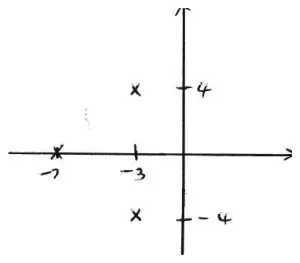
Given that \(-3 + 4\mathrm{i}\) is a root of the equation \(\mathrm{f}(z) = 0\)

(a) determine the value of \(a\) and the value of \(b\). (4)
(b) Show all the roots of the equation \(\mathrm{f}(z) = 0\) on a single Argand diagram. (2)
(c) Write down the roots of the equation \(\mathrm{f}(z + 2) = 0\) (1)

A2 June 2022 Paper 1 Q1

1.

\[\mathrm{f}(z) = z^3 + az + 52 \qquad \text{where } a \text{ is a real constant}\]

Given that \(2 - 3\mathrm{i}\) is a root of the equation \(\mathrm{f}(z) = 0\)

(a) write down the other complex root. (1)
(b) Hence
(i) solve completely \(\mathrm{f}(z) = 0\)
(ii) determine the value of \(a\) (4)
(c) Show all the roots of the equation \(\mathrm{f}(z) = 0\) on a single Argand diagram. (1)

AS October 2020 Paper 1 Q7

7.

\[\mathrm{f}(z) = z^4 + az^3 + bz^2 + cz + d\]

where \(a\), \(b\), \(c\) and \(d\) are real constants.

The equation \(\mathrm{f}(z) = 0\) has complex roots \(z_1\), \(z_2\), \(z_3\) and \(z_4\)
When plotted on an Argand diagram, the points representing \(z_1\), \(z_2\), \(z_3\) and \(z_4\) form the vertices of a square, with one vertex in each quadrant.
Given that \(z_1 = 2 + 3\mathrm{i}\), determine the values of \(a\), \(b\), \(c\) and \(d\). (6)

A2 October 2020 Paper 2 Q4

4.

(a) Use de Moivre’s theorem to prove that\[\sin 7\theta = 7\sin\theta - 56\sin^3\theta + 112\sin^5\theta - 64\sin^7\theta\] (5)
(b) Hence find the distinct roots of the equation\[1 + 7x - 56x^3 + 112x^5 - 64x^7 = 0\]giving your answer to 3 decimal places where appropriate. (5)

A2 October 2020 Paper 1 Q1

1.

\[\mathrm{f}(z) = 3z^3 + pz^2 + 57z + q\]

where \(p\) and \(q\) are real constants.

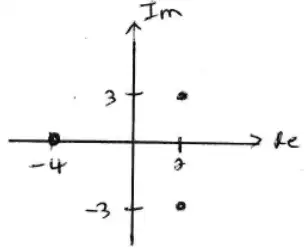
Given that \(3 - 2\sqrt{2}\,\mathrm{i}\) is a root of the equation \(\mathrm{f}(z) = 0\)

(a) show all the roots of \(\mathrm{f}(z) = 0\) on a single Argand diagram, (7)
(b) find the value of \(p\) and the value of \(q\). (3)

AS June 2019 Paper 1 Q7

7.

\[\mathrm{f}(z) = z^3 - 8z^2 + pz - 24\]

where \(p\) is a real constant.

Given that the equation \(\mathrm{f}(z) = 0\) has distinct roots

\[\alpha,\ \beta\ \text{ and } \left(\alpha + \frac{12}{\alpha} - \beta\right)\]
(a) solve completely the equation \(\mathrm{f}(z) = 0\) (6)
(b) Hence find the value of \(p\). (2)

A2 June 2019 Paper 1 Q1

1.

\[\mathrm{f}(z) = z^4 + az^3 + bz^2 + cz + d\]

where \(a\), \(b\), \(c\) and \(d\) are real constants.

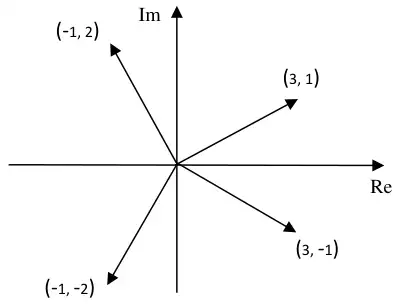
Given that \(-1 + 2\mathrm{i}\) and \(3 - \mathrm{i}\) are two roots of the equation \(\mathrm{f}(z) = 0\)

(a) show all the roots of \(\mathrm{f}(z) = 0\) on a single Argand diagram, (4)
(b) find the values of \(a\), \(b\), \(c\) and \(d\). (5)

AS June 2018 Paper 1 Q7

7.

\[\mathrm{f}(z) = z^3 + z^2 + pz + q\]

where \(p\) and \(q\) are real constants.

The equation \(\mathrm{f}(z) = 0\) has roots \(z_1\), \(z_2\) and \(z_3\)
When plotted on an Argand diagram, the points representing \(z_1\), \(z_2\) and \(z_3\) form the vertices of a triangle of area 35

Given that \(z_1 = 3\), find the values of \(p\) and \(q\). (7)

AS June 2025 Paper 1 Q16

16 A circle \(C\) is drawn on an Argand diagram.

The roots of the equation \(w^2 + 4w + 9 = 0\) lie on \(C\)

(a) Show that the roots of the equation\[w^2 + 4w + 9 = 0\]

are

\[-2 + \mathrm{i}\sqrt{5} \quad \text{and} \quad -2 - \mathrm{i}\sqrt{5}\] [2 marks]
(b) Explain briefly why the centre of \(C\) must lie on the real axis. [1 mark]
(c) The point \(7 + \mathrm{i}\sqrt{14}\) also lies on \(C\)
(i) Find the real number which represents the centre of \(C\) [2 marks]
(ii) Find the equation of \(C\)

Give your answer in the form \(|z - a| = b\) where \(a\) and \(b\) are constants. [3 marks]

A2 June 2025 Paper 1 Q13

13 The function \(\mathrm{f}\) is defined by

\[\mathrm{f}(z) = 4z^3 + rz^2 + 92z + s\]

where \(r\) and \(s\) are real numbers.

One of the roots of the equation \(\mathrm{f}(z) = 0\) is \(-4 + 3\mathrm{i}\)

(a) Find the other two roots of the equation \(\mathrm{f}(z) = 0\) [4 marks]
(b) Find the value of \(r\) and the value of \(s\) [3 marks]

A2 June 2024 Paper 2 Q11

11 Latifa and Sam are studying polynomial equations of degree greater than 2, with real coefficients and no repeated roots.

Latifa says that if such an equation has exactly one real root, it must be of degree 3

Sam says that this is not correct.

State, giving reasons, whether Latifa or Sam is right. [3 marks]

A2 June 2024 Paper 2 Q4

4 The function \(\mathrm{f}\) is a quartic function with real coefficients.

The complex number \(5\mathrm{i}\) is a root of the equation \(\mathrm{f}(x) = 0\)

Which one of the following must be a factor of \(\mathrm{f}(x)\)?

Circle your answer. [1 mark]

  • \((x^2 - 25)\)
  • \((x^2 - 5)\)
  • \((x^2 + 5)\)
  • \((x^2 + 25)\)

AS June 2023 Paper 1 Q12

12

(a) Show that \((1 + \mathrm{i})^4 = -4\) [3 marks]
(b) The function f is defined by\[\mathrm{f}(z) = z^4 + 3z^2 - 6z + 10 \qquad z \in \mathbb{C}\]
(i) Show that \((1 + \mathrm{i})\) is a root of \(\mathrm{f}(z) = 0\) [2 marks]
(ii) Hence write down another root of \(\mathrm{f}(z) = 0\) [1 mark]
(iii) One of the linear factors of \(\mathrm{f}(z)\) is\[\big(z - (1 + \mathrm{i})\big)\]

Write down another linear factor and hence, or otherwise, find a quadratic factor of \(\mathrm{f}(z)\) with real coefficients. [3 marks]

(iv) Find another quadratic factor of \(\mathrm{f}(z)\) with real coefficients. [2 marks]
(v) Hence explain why the graph of \(y = \mathrm{f}(x)\) does not intersect the \(x\)-axis. [2 marks]

A2 June 2023 Paper 1 Q11

11 The function \(\mathrm{f}\) is defined by

\[\mathrm{f}(x) = 4x^3 - 8x^2 - 51x - 45 \qquad (x \in \mathbb{R})\]
(a)
(i) Fully factorise \(\mathrm{f}(x)\) [2 marks]
(ii) Hence, solve the inequality \(\mathrm{f}(x) \lt 0\) [2 marks]
(b) The graph of \(y = \mathrm{f}(x)\) is translated by the vector \(\begin{bmatrix} 7 \\ 0 \end{bmatrix}\)

The new graph is then reflected in the \(x\)-axis, to give the graph of \(y = \mathrm{g}(x)\)

Solve the inequality \(\mathrm{g}(x) \leqslant 0\) [3 marks]

A2 June 2022 Paper 1 Q12

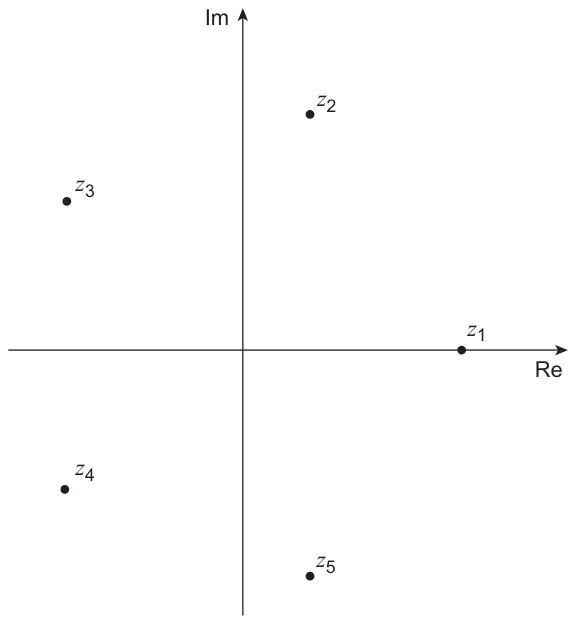
12 The Argand diagram shows the solutions to the equation \(z^5 = 1\)

Argand diagram with Re and Im axes showing five points: z1 on the positive real axis, z2 above and slightly right of the imaginary axis, z3 to the upper left, z4 to the lower left and z5 below and slightly right of the imaginary axis
(a) Solve the equation\[z^5 = 1\]

giving your answers in the form \(z = \cos\theta + \mathrm{i}\sin\theta\), where \(0 \leqslant \theta \lt 2\pi\) [2 marks]

(b) Explain why the points on an Argand diagram which represent the solutions found in part (a) are the vertices of a regular pentagon. [2 marks]
(c) Show that if \(c = \cos\theta\), where \(z = \cos\theta + \mathrm{i}\sin\theta\) is a solution to the equation \(z^5 = 1\), then \(c\) satisfies the equation\[16c^5 - 20c^3 + 5c - 1 = 0\] [5 marks]
(d) The Argand diagram above is repeated below.
Argand diagram with Re and Im axes showing the five points z1, z2, z3, z4 and z5

Explain, with reference to the Argand diagram, why the expression

\[16c^5 - 20c^3 + 5c - 1\]

has a repeated quadratic factor. [3 marks]

(e) \(O\) is the centre of a regular pentagon \(ABCDE\) such that \(OA = OB = OC = OD = OE = 1\) unit.
The distance from \(O\) to \(AB\) is \(h\)

By solving the equation \(16c^5 - 20c^3 + 5c - 1 = 0\), show that

\[h = \frac{\sqrt{5} + 1}{4}\] [5 marks]

A2 June 2022 Paper 1 Q5

5 It is given that \(z = -\dfrac{3}{2} + \mathrm{i}\dfrac{\sqrt{11}}{2}\) is a root of the equation

\[z^4 - 3z^3 - 5z^2 + kz + 40 = 0\]

where \(k\) is a real number.

(a) Find the other three roots. [5 marks]
(b) Given that \(x \in \mathbb{R}\), solve\[x^4 - 3x^3 - 5x^2 + kx + 40 \lt 0\] [1 mark]

AS June 2021 Paper 1 Q12

12 The equation \(x^3 - 2x^2 - x + 2 = 0\) has three roots. One of the roots is 2

(a) Find the other two roots of the equation. [1 mark]
(b) Hence, or otherwise, solve\[\cosh^3\theta - 2\cosh^2\theta - \cosh\theta + 2 = 0\]

giving your answers in an exact form. [4 marks]

AS June 2021 Paper 1 Q8

8 Stephen is correctly told that \((1 + \mathrm{i})\) and \(-1\) are two roots of the polynomial equation

\[z^3 - 2\mathrm{i}z^2 + pz + q = 0\]

where \(p\) and \(q\) are complex numbers.

(a) Stephen states that \((1 - \mathrm{i})\) must also be a root of the equation because roots of polynomial equations occur in conjugate pairs.

Explain why Stephen’s reasoning is wrong. [1 mark]

(b) Find \(p\) and \(q\) [5 marks]

A2 June 2020 Paper 1 Q4

4 It is given that \(1 - 3\mathrm{i}\) is one root of the quartic equation

\[z^4 - 2z^3 + pz^2 + rz + 80 = 0\]

where \(p\) and \(r\) are real numbers.

(a) Express \(z^4 - 2z^3 + pz^2 + rz + 80\) as the product of two quadratic factors with real coefficients. [4 marks]
(b) Find the value of \(p\) and the value of \(r\). [2 marks]

AS June 2020 Paper 1 Q2

2 Given that \(1 - \mathrm{i}\) is a root of the equation \(z^3 - 3z^2 + 4z - 2 = 0\), find the other two roots.

Tick (✓) one box. [1 mark]

  • \(-1 + \mathrm{i}\) and \(-1\)
  • \(1 + \mathrm{i}\) and \(1\)
  • \(-1 + \mathrm{i}\) and \(1\)
  • \(1 + \mathrm{i}\) and \(-1\)

A2 June 2019 Paper 2 Q12

12 Abel and Bonnie are trying to solve this mathematical problem:

\(z = 2 - 3\mathrm{i}\) is a root of the equation
\(2z^3 + mz^2 + pz + 91 = 0\)

Find the value of \(m\) and the value of \(p\).

Abel says he has solved the problem.

Bonnie says there is not enough information to solve the problem.

(a) Abel’s solution begins as follows:

Since \(z = 2 - 3\mathrm{i}\) is a root of the equation,
\(z = 2 + 3\mathrm{i}\) is another root.

State one extra piece of information about \(m\) and \(p\) which could be added to the problem to make the beginning of Abel’s solution correct. [1 mark]

(b) Prove that Bonnie is right. [4 marks]

AS June 2018 Paper 1 Q8

8 \(2 - 3\mathrm{i}\) is one root of the equation

\[z^3 + mz + 52 = 0\]

where \(m\) is real.

(a) Find the other roots. [3 marks]
(b) Determine the value of \(m\). [2 marks]

A2 June 2025 Paper 1 Q10

10 In this question you must show detailed reasoning.

(a) Use de Moivre’s Theorem to show that, if \(\cos 5\theta \neq 0\),
\(\tan 5\theta \equiv \dfrac{\tan^5\theta - 10\tan^3\theta + 5\tan\theta}{5\tan^4\theta - 10\tan^2\theta + 1}\). [4]
(b)
(i) By considering the equation \(\tan 5\theta = 1\), use the result in part (a) to find the exact roots of the equation
\(t^4 - 4t^3 - 14t^2 - 4t + 1 = 0\).
Give the roots in the form \(t = \tan\phi\) where \(0 \lt \phi \lt \pi\). [4]
(ii) By first expressing \(t^4 - 4t^3 - 14t^2 - 4t + 1 = 0\) in the form \((t - 1)^4 = kt^2\), where \(k\) is a constant to be determined, show that
\(\tan\left(\dfrac{9}{20}\pi\right) = 1 + \sqrt{5} + \sqrt{5 + 2\sqrt{5}}\). [3]

A2 June 2025 Paper 2 Q2

2 You are given that \(-7 - 5\mathrm{i}\) is one root of the equation \(x^3 + 10x^2 + 18x - 296 = 0\).

(a) Write down another complex root of the equation \(x^3 + 10x^2 + 18x - 296 = 0\). [1]
(b) Using your answer to part (a), express \(x^3 + 10x^2 + 18x - 296\) as a product of a real linear factor and a real quadratic factor. [3]

AS June 2024 Paper 1 Q9

9 In this question you must show detailed reasoning.

You are given that \(a\) is a real root of the equation \(x^4 + x^3 + 3x^2 - 5x = 0\).

You are also given that \(a + 2 + 3\mathrm{i}\) is one root of the equation

\(z^4 - 2(1 + a)z^3 + (21a - 10)z^2 + (86 - 80a)z + (285a - 195) = 0\).

Determine all possible values of \(z\). [8]

AS June 2023 Paper 1 Q7

OCR ACurrent spec6 marksFinding Roots of PolynomialsMatrices

7 In this question you must show detailed reasoning.

Matrix \(\mathbf{A}\) is given by \(\mathbf{A} = \begin{pmatrix} a & -6 & a - 3 \\ a + 9 & a & 4 \\ 0 & -13 & a - 1 \end{pmatrix}\) where \(a\) is a constant.

Find all possible values of \(a\) for which \(\det\mathbf{A}\) has the same value as it has when \(a = 2\). [6]

A2 June 2023 Paper 1 Q2

2 In this question you must show detailed reasoning.

The equation \(z^4 + 4z^3 + 9z^2 + 10z + 6 = 0\) has roots \(\alpha\), \(\beta\), \(\gamma\) and \(\delta\).

(a) Show that a quartic equation whose roots are \(\alpha + 1\), \(\beta + 1\), \(\gamma + 1\) and \(\delta + 1\) is \(w^4 + 3w^2 + 2 = 0\). [3]
(b) Hence determine the exact roots of the equation \(z^4 + 4z^3 + 9z^2 + 10z + 6 = 0\). [3]

AS October 2021 Paper 1 Q3

3 In this question you must show detailed reasoning.

The equation \(x^4 - 7x^3 - 2x^2 + 218x - 1428 = 0\) has a root \(3 - 5\mathrm{i}\).

Find the other three roots of this equation. [6]

AS June 2019 Paper 1 Q4

4 In this question you must show detailed reasoning.

You are given that \(\mathrm{f}(z) = 4z^4 - 12z^3 + 41z^2 - 128z + 185\) and that \(2 + \mathrm{i}\) is a root of the equation \(\mathrm{f}(z) = 0\).

(a) Express \(\mathrm{f}(z)\) as the product of two quadratic factors with integer coefficients. [5]
(b) Solve \(\mathrm{f}(z) = 0\). [3]

Two loci on an Argand diagram are defined by \(C_1 = \{z : |z| = r_1\}\) and \(C_2 = \{z : |z| = r_2\}\) where \(r_1 \gt r_2\). You are given that two of the points representing the roots of \(\mathrm{f}(z) = 0\) are on \(C_1\) and two are on \(C_2\). \(R\) is the region on the Argand diagram between \(C_1\) and \(C_2\).

(c) Find the exact area of \(R\). [4]
(d) \(\omega\) is the sum of all the roots of \(\mathrm{f}(z) = 0\).
Determine whether or not the point on the Argand diagram which represents \(\omega\) lies in \(R\). [2]

A2 June 2019 Paper 1 Q3

3 In this question you must show detailed reasoning.

You are given that \(x = 2 + 5\mathrm{i}\) is a root of the equation \(x^3 - 2x^2 + 21x + 58 = 0\).

Solve the equation. [4]

AS June 2018 Paper 1 Q5

5 In this question you must show detailed reasoning.

(i) Express \((2 + 3\mathrm{i})^3\) in the form \(a + \mathrm{i}b\). [3]
(ii) Hence verify that \(2 + 3\mathrm{i}\) is a root of the equation \(3z^3 - 8z^2 + 23z + 52 = 0\). [3]
(iii) Express \(3z^3 - 8z^2 + 23z + 52\) as the product of a linear factor and a quadratic factor with real coefficients. [4]

A2 June 2025 Paper 1 Q12

12 In this question you must show detailed reasoning.

The roots of the equation \(z^4 - z^3 + cz^2 + dz + 18 = 0\) are \(\alpha\), \(\dfrac{2}{\alpha}\), \(\beta\) and \(-\beta\).

Determine, in any order, the exact values of the following.

  • The four roots of the equation
  • The value of \(c\)
  • The value of \(d\) [8]

AS June 2024 Paper 1 Q1

1 The quadratic equation \(x^2 + ax + b = 0\), where \(a\) and \(b\) are real constants, has a root \(2 - 3\mathrm{i}\).

(a) Write down the other root. [1]
(b) Hence or otherwise determine the values of \(a\) and \(b\). [3]

A2 June 2023 Paper 1 Q10

10 The equation \(x^3 - 4x^2 + 7x + c = 0\), where \(c\) is a constant, has roots \(\alpha\), \(\beta\) and \(\alpha + \beta\).

(a) Determine the roots of the equation. [6]
(b) Find \(c\). [1]

AS June 2023 Paper 1 Q3

3 In this question you must show detailed reasoning.

The function \(\mathrm{f}(z)\) is given by \(\mathrm{f}(z) = 2z^3 - 7z^2 + 16z - 15\).

By first evaluating \(\mathrm{f}\left(\frac{3}{2}\right)\), find the roots of \(\mathrm{f}(z) = 0\). [6]

A2 June 2022 Paper 1 Q10

10 The equation

\(4x^4 + 16x^3 + ax^2 + bx + 6 = 0\),

where \(a\) and \(b\) are real, has roots \(\alpha\), \(\dfrac{2}{\alpha}\), \(\beta\) and \(3\beta\).

(a) Given that \(\beta \lt 0\), determine all 4 roots. [6]
(b) Determine the values of \(a\) and \(b\). [4]

AS October 2021 Paper 1 Q8

8 In this question you must show detailed reasoning.

The equation \(x^3 + kx^2 + 15x - 25 = 0\) has roots \(\alpha\), \(\beta\) and \(\dfrac{\alpha}{\beta}\). Given that \(\alpha \gt 0\), find, in any order,

  • the roots of the equation,
  • the value of \(k\). [7]

AS October 2020 Paper 1 Q7

OCR MEICurrent spec7 marksFinding Roots of Polynomials

7 In the quartic equation \(2x^4 - 20x^3 + ax^2 + bx + 250 = 0\), the coefficients \(a\) and \(b\) are real. One root of the equation is \(2 + \mathrm{i}\).

Find the other roots. [7]

A2 June 2019 Paper 1 Q8

8 In this question you must show detailed reasoning.

The roots of the equation \(x^3 - x^2 + kx - 2 = 0\) are \(\alpha\), \(\dfrac{1}{\alpha}\) and \(\beta\).

(a) Evaluate, in exact form, the roots of the equation. [6]
(b) Find \(k\). [2]

AS June 2019 Paper 1 Q8

8 In this question you must show detailed reasoning.

You are given that i is a root of the equation \(z^4 - 2z^3 + 3z^2 + az + b = 0\), where \(a\) and \(b\) are real constants.

(a) Show that \(a = -2\) and \(b = 2\). [4]
(b) Find the other roots of this equation. [7]