
A2 June 2022 Paper 1 Q12
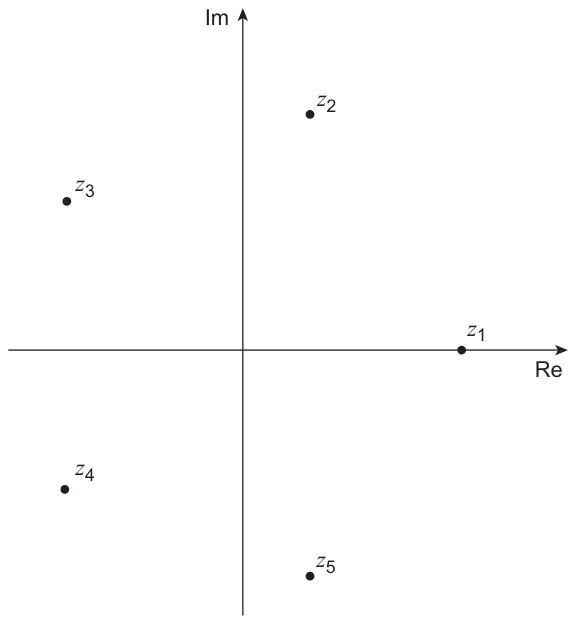
12 The Argand diagram shows the solutions to the equation \(z^5 = 1\)
giving your answers in the form \(z = \cos\theta + \mathrm{i}\sin\theta\), where \(0 \leqslant \theta \lt 2\pi\) [2 marks]
Explain, with reference to the Argand diagram, why the expression
\[16c^5 - 20c^3 + 5c - 1\]has a repeated quadratic factor. [3 marks]
The distance from \(O\) to \(AB\) is \(h\)
By solving the equation \(16c^5 - 20c^3 + 5c - 1 = 0\), show that
\[h = \frac{\sqrt{5} + 1}{4}\] [5 marks]| Scheme | Marks | AO |
|---|---|---|
| Obtains at least one correct non-zero argument/solution | M1 | 1.1a |
| Obtains completely correct solutions must be \(0 \leqslant \theta \lt 2\pi\) (condone \(z = 1\)) | A1 | 1.1b |
| (2) |
Typical solution
\[\cos 5\theta = 1\]\[5\theta = 2n\pi\]\[z = \cos 0 + \mathrm{i}\sin 0,\]\[\cos\frac{2\pi}{5} + \mathrm{i}\sin\frac{2\pi}{5},\]\[\cos\frac{4\pi}{5} + \mathrm{i}\sin\frac{4\pi}{5},\]\[\cos\frac{6\pi}{5} + \mathrm{i}\sin\frac{6\pi}{5},\]\[\cos\frac{8\pi}{5} + \mathrm{i}\sin\frac{8\pi}{5}\]| Scheme | Marks | AO |
|---|---|---|
| States that all the points are the same distance from the origin | E1 | 2.4 |
| States that the angles between lines from the origin to adjacent points are all equal | E1 | 2.1 |
| (2) |
Typical solution
Each of the solutions has modulus 1, and their arguments increase in steps of \(2\pi/5\)
| Scheme | Marks | AO |
|---|---|---|
| Expands \((\cos\theta + \mathrm{i}\sin\theta)^5\) Condone errors in or omissions of Imaginary part | M1 | 1.1a |
| Obtains correct unsimplified Real part of expansion | A1 | 1.1b |
| Equates real parts | M1 | 3.1a |
| Uses appropriate trig identity to express real part in terms of \(c\) | M1 | 3.1a |
| Completes a rigorous argument to obtain the required result | R1 | 2.1 |
| (5) |
Typical solution
\[(\cos\theta + \mathrm{i}\sin\theta)^5 = 1\]Let \(c = \cos\theta\), \(s = \sin\theta\)
\[c^5 + 5c^4\mathrm{i}s - 10c^3s^2 - 10c^2\mathrm{i}s^3 + 5cs^4 + \mathrm{i}s^5 = 1\]Real parts:
\[c^5 - 10c^3s^2 + 5cs^4 = 1\]\[c^5 - 10c^3(1 - c^2) + 5c(1 - c^2)^2 - 1 = 0\]\[c^5 - 10c^3 + 10c^5 + 5c - 10c^3 + 5c^5 - 1 = 0\]\[16c^5 - 20c^3 + 5c - 1 = 0\]as required
| Scheme | Marks | AO |
|---|---|---|
| Explains that \(z_3\) is the complex conjugate of \(z_4\) and that \(z_2\) is the complex conjugate of \(z_5\) | E1 | 2.4 |
| Explains that the Real parts of the points on the diagram are the solutions of \(16c^5 - 20c^3 + 5c - 1 = 0\) | M1 | 2.2a |
| Completes a rigorous argument to obtain the required result | R1 | 2.1 |
| (3) |
Typical solution
By symmetry
\(z_4^* = z_3\) so
\[\cos(\arg z_3) = \cos(\arg z_4) = a\]and
\(z_5^* = z_2\) so
\[\cos(\arg z_2) = \cos(\arg z_5) = b\]So \(c = a\) and \(c = b\) are both double roots of the equation \(16c^5 - 20c^3 + 5c - 1 = 0\) and, by the factor theorem, \((c - a)(c - b)\) is a repeated quadratic factor of \(16c^5 - 20c^3 + 5c - 1\)
| Scheme | Marks | AO |
|---|---|---|
| Deduces that \(h\) is a solution of the equation This may appear anywhere in the solution | B1 | 2.2a |
| Factorises to obtain a linear factor and a quartic factor or better | M1 | 3.1a |
| Solves the quartic or quadratic equation correctly to get only two solutions | A1 | 1.1b |
| Selects the correct solution | E1 | 3.2a |
| Completes a rigorous argument to explain the required result | R1 | 2.1 |
| (5) | ||
| (17 marks) |
Typical solution
\(h\) is a solution to the equation
\[16c^5 - 20c^3 + 5c - 1 = 0\]\[(c - 1)(16c^4 + 16c^3 - 4c^2 - 4c + 1) = 0\]Discard \(c = 1\)
\[(4c^2 + 2c - 1)^2 = 0\]\[4c^2 + 2c - 1 = 0\]\[c = \frac{-1 \pm \sqrt{5}}{4}\]Select the solution with the greater absolute value; so
\[h = \left|\frac{-1 - \sqrt{5}}{4}\right| = \frac{\sqrt{5} + 1}{4}\]as required