
AS June 2018 Paper 1 Q3
3.
The complex number \(w\) satisfies
\[|w - 1 - \mathrm{i}| = 3 \ \text{ and } \ \arg(w - 2) = \frac{\pi}{4}\]| Scheme | Marks | AO |
|---|---|---|
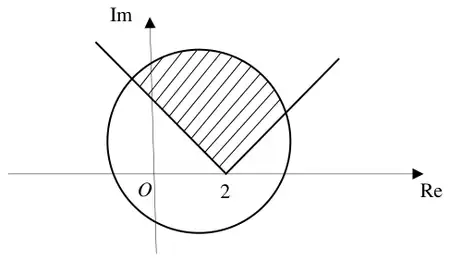 | M1 M1 A1 M1 A1 | 1.1b 1.1b 2.2a 3.1a 1.1b |
| (5) |
Notes
M1: Circle or arc of a circle with centre in first quadrant and with the circle in all 4 quadrants or arc of circle in quadrants 1 and 2
M1: A “V” shape i.e. with both branches above the \(x\)-axis and with the vertex on the positive real axis. Ignore any branches below the \(x\)-axis.
A1: Two half lines that meet on the positive real axis where the right branch intersects the circle or arc of a circle in the first quadrant and the left branch intersects the circle or arc of a circle in the second quadrant but not on the \(y\)-axis.
M1: Shades the region between the half-lines and within the circle
A1: Cso. A fully correct diagram including 2 marked (or implied by ticks) at the vertex on the real axis with the correct region shaded and all the previous marks scored.
Example marking for 3(a)
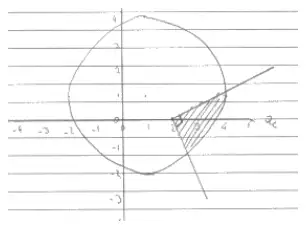
M1: Circle with centre in first quadrant
M0: The branches of the “V” must be above the x-axis
A0: Follows M0
M1: Shades the region between the half-lines and within the circle
A0: Depends on all previous marks
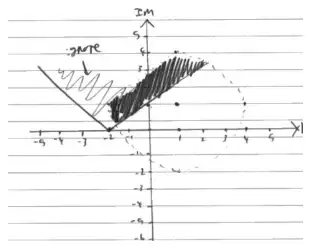
M1: Circle with centre in first quadrant
M0: The vertex of the “V” must be on the positive x-axis
A0: Follows M0
M1: Shades the region between the half-lines and within the circle (BOD)
A0: Depends on all previous marks
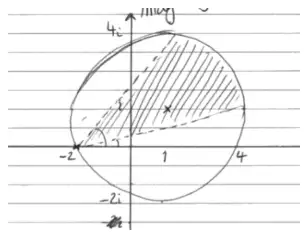
M1: Circle with centre in first quadrant
M0: The vertex of the “V” must be on the positive x-axis
A0: Follows M0
M1: Shades the region between the half-lines and within the circle
A0: Depends on all previous marks
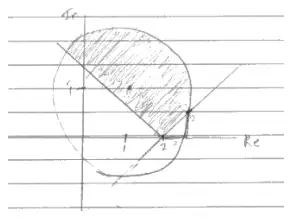
M1: Circle with centre in first quadrant
M1: A “V” shape i.e. with both branches above the x-axis and with the vertex on the positive real axis. Ignore any branches below the x-axis.
A1: Two half lines that meet on the positive real axis where the right branch intersects the circle in the first quadrant and the left branch intersects the circle in the second quadrant.
M1: Shades the region between the half-lines and within the circle
A1: A fully correct diagram including 2 marked at the vertex on the real axis with the correct region shaded and all the previous marks scored.
| Scheme | Marks | AO |
|---|---|---|
| \((x - 1)^2 + (y - 1)^2 = 9,\ \ y = x - 2 \Rightarrow x = \ldots,\) or \(y = \ldots\) | M1 | 3.1a |
| \(x = 2 + \dfrac{\sqrt{14}}{2},\ y = \dfrac{\sqrt{14}}{2}\) | A1 | 1.1b |
| \(|w|^2 = \left(2 + \dfrac{\sqrt{14}}{2}\right)^2 + \left(\dfrac{\sqrt{14}}{2}\right)^2\) | M1 | 1.1b |
| \(= 11 + 2\sqrt{14}\) | A1 | 1.1b |
| (4) | ||
| (9 marks) |
Notes
M1: Identifies a suitable strategy for finding the \(x\) or \(y\) coordinate of the point of intersection.
Look for an attempt to solve equations of the form \((x \pm 1)^2 + (y \pm 1)^2 = 9 \text{ or } 3\) and \(y = \pm x \pm 2\)
A1: Correct coordinates for the intersection (there may be other points but allow this mark if the correct coordinates are seen). (The correct coordinates may be implied by subsequent work.)
Allow equivalent exact forms and allow as a complex number e.g. \(2 + \dfrac{\sqrt{14}}{2} + \dfrac{\sqrt{14}}{2}\mathrm{i}\)
M1: Correct use of Pythagoras on their coordinates (There must be no i’s)
A1: Correct exact value by cso
Note that solving \((x - 1)^2 + (y - 1)^2 = 9,\ \ y = x + 2\) gives \(x = \dfrac{\sqrt{14}}{2},\ y = 2 + \dfrac{\sqrt{14}}{2}\) and hence the correct answer fortuitously so scores M1A0M1A0