Completes a rigorous argument to show that \(w^n\) satisfies the equation \(z^7 = 1\)
R1
2.1
Typical solution
\[(w^n)^7 = w^{7n} = (w^7)^n = 1^n = 1\]
\(\therefore w^n\) satisfies the equation \(z^7 = 1\)
Mark scheme (b)
Scheme
Marks
AO
Deduces that the LHS is the sum of the roots of \(z^7 = 1\) or factorises \(w^7 - 1\) or uses the sum of a geometric series with values for \(n\) and \(a\).
M1
2.2a
Completes a rigorous argument to show \(1 + w + w^2 + w^3 + w^4 + w^5 + w^6 = 0\)
R1
2.1
Typical solution
The roots of \(z^7 - 1 = 0\) are \(1\), \(w\), \(w^2\), \(w^3\), \(w^4\), \(w^5\), and \(w^6\)
\(z^6\) term \(= 0 \therefore\) sum of roots \(= 0\)
and
\[1 + w + w^2 + w^3 + w^4 + w^5 + w^6 = 0\]
as required.
Mark scheme (c)
Scheme
Marks
AO
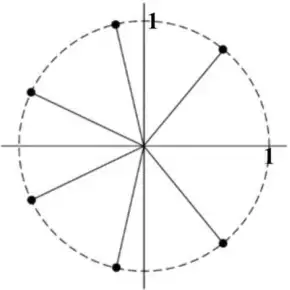
Shows the six required points or vectors with correct arguments, approximately correctly spaced and approximately symmetric in the real axis.
M1
1.1a
Clearly shows that points/vectors have modulus 1. PI by “1” marked on an axis. Labelling of points not required.
A1
1.1b
Typical solution
Mark scheme (d)
Scheme
Marks
AO
States that \(w = \cos\frac{2\pi}{7} + \cdots\)
B1
1.1b
Explains that complex conjugate pairs have the same real part.
E1
2.4
Deduces that a sum of pairs of powers of \(w\) equals twice the cosine of a correct angle.
M1
2.2a
Completes a rigorous argument, using \(1 + w + w^2 + w^3 + w^4 + w^5 + w^6 = 0\) to show \(\cos\frac{2\pi}{7} + \cos\frac{4\pi}{7} + \cos\frac{6\pi}{7} = -\frac{1}{2}\)