
A2 June 2024 Paper 2 Q5
5. The locus \(C\) is given by
\[|z - 4| = 4\]The locus \(D\) is given by
\[\arg z = \frac{\pi}{3}\]The set of points \(A\) is defined by
\[A = \left\{z \in \mathbb{C} : |z - 4| \leqslant 4\right\} \cap \left\{z \in \mathbb{C} : 0 \leqslant \arg z \leqslant \frac{\pi}{3}\right\}\]| Scheme | Marks | AO |
|---|---|---|
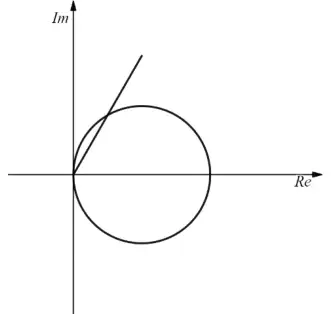 | M1 A1 M1 A1 | 1.1b 1.1b 1.1b 1.1b |
| (4) |
Notes
M1: Circle drawn with centre on the real axis
Look for real axis acting as a line of symmetry of the circle.
A1: Circle in the correct position with the imaginary axis as a tangent
Centre need not be labelled for either mark.
M1: Half line starting at the origin, must be in the first quadrant. Do not award if their line continues into the third quadrant
A1: Fully correct diagram that requires
- A circle in the correct position
- A half line intersecting the circle at the origin and in the first quadrant
- The \(x\) coordinate of the intersection in the first quadrant must be to the left of the centre of the circle
Q5 (a) and (b) examples
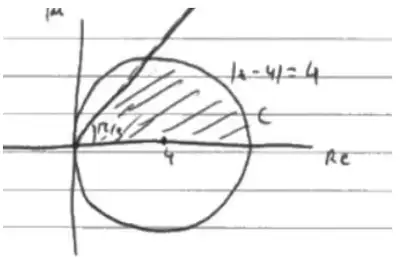
a) M1A1M1A1 b) B1
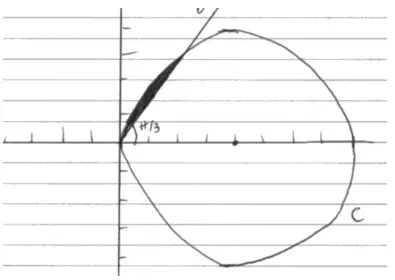
a) M1A1M1A1 b) B0
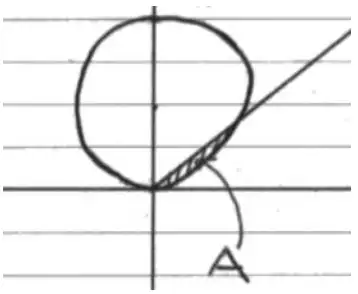
a) M0A0M1A0 b) B1
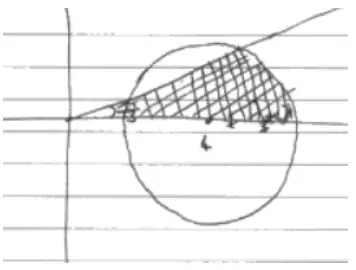
a) M1A0M1A0 b) B1
| Scheme | Marks | AO |
|---|---|---|
 | B1ft | 2.3 |
| (1) |
Notes
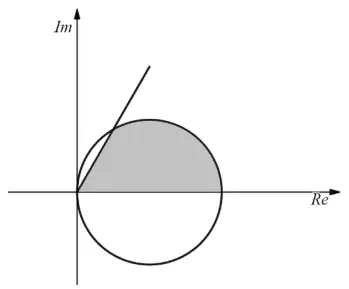
B1ft: Shades the region in their circle above the real axis and below the half line
For this mark to be awarded their line must intersect the circle.
See the examples in the notes for (a).
| Scheme | Marks | AO |
|---|---|---|
| \((x - 4)^2 + y^2 = 16,\ \ y = \sqrt{3}x \Rightarrow x^2 - 8x + 16 + 3x^2 = 16 \Rightarrow x = \ldots\) \(x = 2,\ y = 2\sqrt{3}\) | M1 A1 | 3.1a 1.1b |
| \(\dfrac{1}{2}\pi \times 4^2 - \left(\dfrac{1}{2} \times 4^2 \times \dfrac{\pi}{3} - \dfrac{1}{2} \times 4^2 \times \sin\dfrac{\pi}{3}\right)\) or \(\dfrac{1}{2} \times 4^2 \times \dfrac{2\pi}{3} + \dfrac{1}{2} \times 4 \times 2\sqrt{3}\) or \(\dfrac{1}{2} \times 4^2 \times \dfrac{2\pi}{3} + \dfrac{1}{2} \times 4 \times 4 \times \dfrac{\sqrt{3}}{2}\) | dM1 | 3.1a |
| \(= \dfrac{16}{3}\pi + 4\sqrt{3}\) | A1 | 1.1b |
| (4) | ||
| (9 marks) |
Notes
Alternative 1 for part (c)
| Scheme | Marks | AO |
|---|---|---|
| \(x = 4\cos\dfrac{\pi}{3},\ y = 4\sin\dfrac{\pi}{3}\) | M1 A1 | 3.1a 1.1b |
| \(\dfrac{1}{2}\pi \times 4^2 - \left(\dfrac{1}{2} \times 4^2 \times \dfrac{\pi}{3} - \dfrac{1}{2} \times 4^2 \times \sin\dfrac{\pi}{3}\right)\) or \(\dfrac{1}{2} \times 4^2 \times \dfrac{2\pi}{3} + \dfrac{1}{2} \times 4 \times 2\sqrt{3}\) or \(\dfrac{1}{2} \times 4^2 \times \dfrac{2\pi}{3} + \dfrac{1}{2} \times 4 \times 4 \times \dfrac{\sqrt{3}}{2}\) | dM1 | 3.1a |
| \(= \dfrac{16}{3}\pi + 4\sqrt{3}\) | A1 | 1.1b |
| (4) |
Alternative 2 for part (c)
| Scheme | Marks | AO |
|---|---|---|
| Deduces \(\dfrac{\pi}{3}\) means there is an equilateral triangle of length 4 4 and \(\sin\dfrac{\pi}{3}\) oe are seen or used in their workings | M1 A1 | 3.1a 1.1b |
| \(\dfrac{1}{2}\pi \times 4^2 - \left(\dfrac{1}{2} \times 4^2 \times \dfrac{\pi}{3} - \dfrac{1}{2} \times 4^2 \times \sin\dfrac{\pi}{3}\right)\) or \(\dfrac{1}{2} \times 4^2 \times \dfrac{2\pi}{3} + \dfrac{1}{2} \times 4 \times 2\sqrt{3}\) or \(\dfrac{1}{2} \times 4^2 \times \dfrac{2\pi}{3} + \dfrac{1}{2} \times 4 \times 4 \times \dfrac{\sqrt{3}}{2}\) | dM1 | 3.1a |
| \(= \dfrac{16}{3}\pi + 4\sqrt{3}\) | A1 | 1.1b |
| (4) |
Alternative 3 for part (c) Polar coordinates
| Scheme | Marks | AO |
|---|---|---|
| \((x - 4)^2 + y^2 = 16,\ \Rightarrow r^2 = 8r\cos\theta \Rightarrow r = 8\cos\theta\) Area \(= \displaystyle\int \frac{1}{2}r^2\,\mathrm{d}\theta = \int \frac{1}{2}.64\cos^2\theta\,\mathrm{d}\theta = \int (16 + 16\cos 2\theta)\,\mathrm{d}\theta\) | M1 A1 | 3.1a 1.1b |
| \(= \left[16\theta + 8\sin 2\theta\right]_0^{\frac{\pi}{3}} = \ldots\) | dM1 | 3.1a |
| \(= \dfrac{16}{3}\pi + 4\sqrt{3}\) | A1 | 1.1b |
| (4) |
Notes
This is not for finding their shaded area of their diagram in part (a) but is for a correct process for finding the correct required area.
M1: Correct strategy for identifying both coordinates of the point of intersection.
Award for substituting a line of the form \(y = kx\) into the equation of a circle \((x - 4)^2 + y^2 = 16\) then proceeds to find a value for \(x\) from a quadratic, where \(x \neq 0\) and then find their \(y\) coordinate.
A1: Correct coordinates, either written separately, or as \(\left(2, 2\sqrt{3}\right)\) or \(2 + 2\sqrt{3}\,\mathrm{i}\)
dM1: Fully correct strategy for the area, must be consistent with a half line making an angle of \(\dfrac{\pi}{3}\) with the real axis.
Can be found by subtracting the area of a segment from the area of a semicircle or by adding the area of a sector to the area of a triangle.
The candidate may do combinations of semicircles, triangles and sectors so look carefully for the method.
A1: Correct answer in the required form.
Alternative 1
M1: Deduces that since the half line makes an angle of \(\dfrac{\pi}{3}\) with the real axis, the horizontal and vertical distances from the origin to the point of intersection are \(4\cos\dfrac{\pi}{3}\) and \(4\sin\dfrac{\pi}{3}\).
A1: \(4\cos\dfrac{\pi}{3}\) and \(4\sin\dfrac{\pi}{3}\) oe are seen or used in their workings
dM1: Fully correct strategy for the area, must be consistent with a half line making an angle of \(\dfrac{\pi}{3}\) with the real axis.
Can be found by subtracting the area of a segment from the area of a semicircle or by adding the area of a sector to the area of a triangle.
The candidate may do combinations of semicircles, triangles and sectors so look carefully for the method.
A1: Correct answer in the required form.
Alternative 2
M1: Alternatively deduces that the angle implies that there is an equilateral triangle of radius 4
A1: 4 and \(\sin\dfrac{\pi}{3}\) are seen or used in their workings
dM1: Fully correct strategy for the area, must be consistent with a half line making an angle of \(\dfrac{\pi}{3}\) with the real axis.
Can be found by subtracting the area of a segment from the area of a semicircle or by adding the area of a sector to the area of a triangle.
The candidate may do combinations of semicircles, triangles and sectors so look carefully for the method.
A1: Correct answer in the required form.
Alternative 3: using polar coordinates
M1: Achieves a polar equation of the form \(r = k\cos\theta\) and uses \(\left(\dfrac{1}{2}\right)\displaystyle\int r^2\,\mathrm{d}\theta\) to obtain \(k\displaystyle\int \cos^2\theta\,\mathrm{d}\theta\)
A1: Obtains \(\displaystyle\int (16 + 16\cos 2\theta)\,\mathrm{d}\theta\) oe, \(\mathrm{d}\theta\) may be missing
dM1: Integrates to obtain an expression of the form \(a\theta + b\sin 2\theta\), substitutes in limits of 0 and \(\dfrac{\pi}{3}\) and subtracts. If they reach a correct answer with no integration seen then withhold this mark.
A1: Correct answer in the form required
e.g. \((x - 4)^2 + y^2 = 16,\ \Rightarrow r^2 = 8r\cos\theta \Rightarrow r = 8\cos\theta\)
Area \(= \displaystyle\int \frac{1}{2}r^2\,\mathrm{d}\theta = \int \frac{1}{2}.64\cos^2\theta\,\mathrm{d}\theta = \int \frac{32(1 + \cos 2\theta)}{2}\,\mathrm{d}\theta = \int (16 + 16\cos 2\theta)\,\mathrm{d}\theta = \left[16\theta + 8\sin 2\theta\right]\)
\(\left[16\theta + 8\sin 2\theta\right]_0^{\frac{\pi}{3}} = \left[16\left(\dfrac{\pi}{3}\right) + 8\sin 2\left(\dfrac{\pi}{3}\right)\right] - [0] = \dfrac{16}{3}\pi + 4\sqrt{3}\)