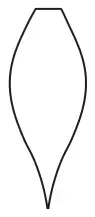
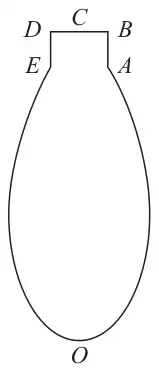
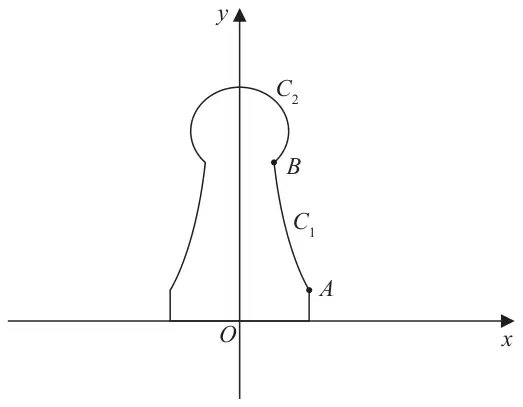
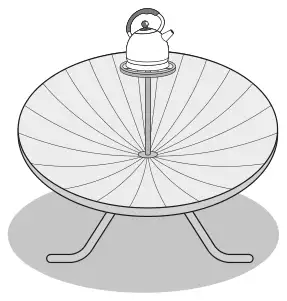
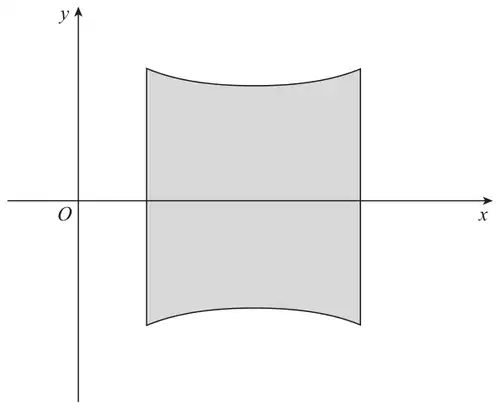
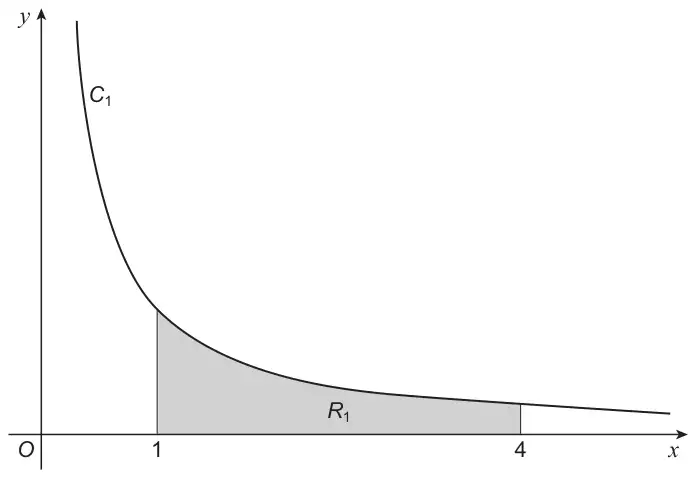
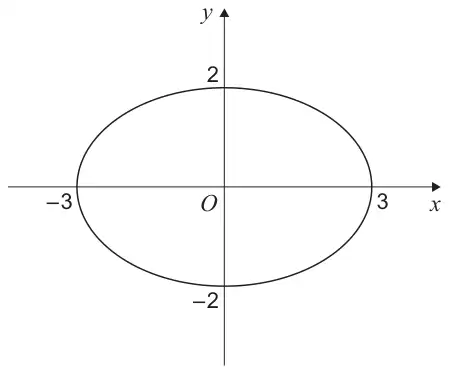
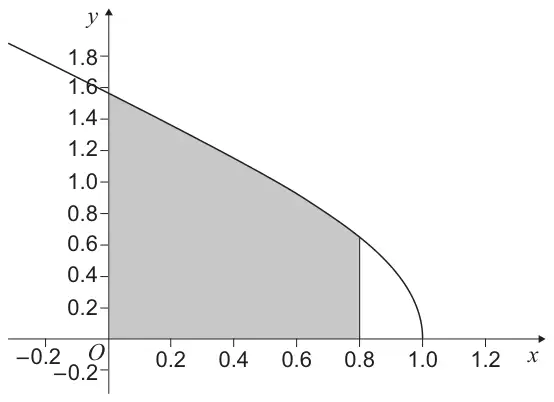
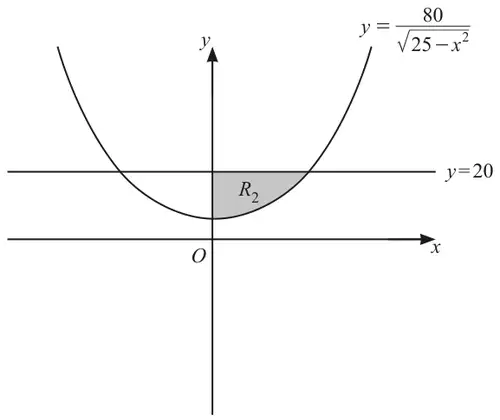
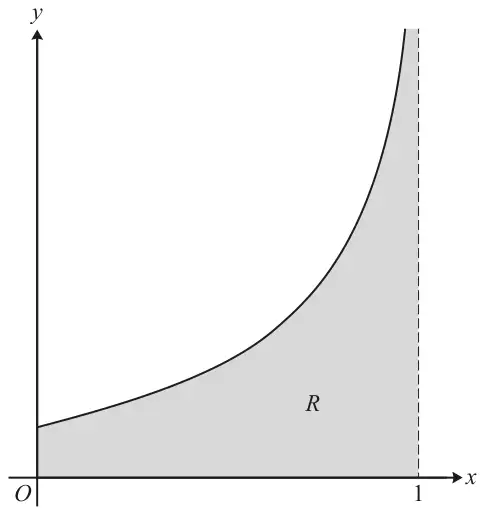
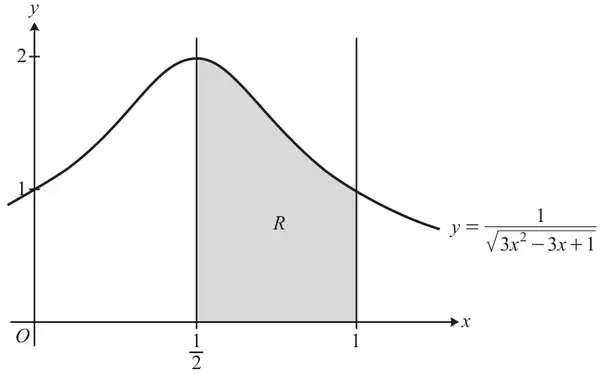
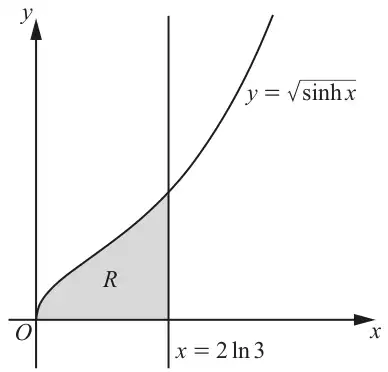
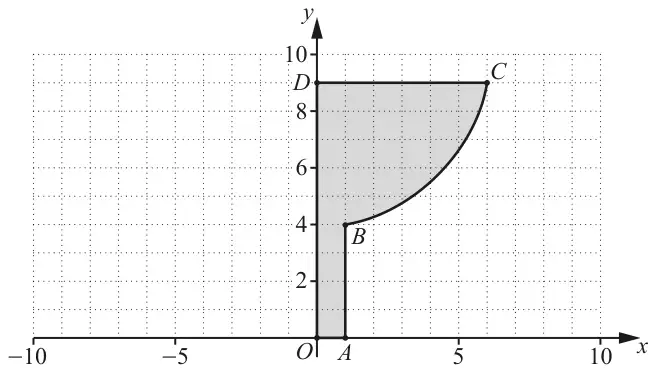
Figure 1 shows the central vertical cross-section of a solid wooden ornament.
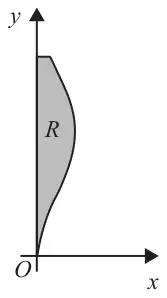
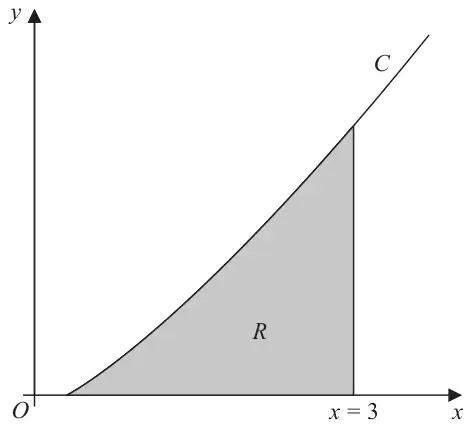
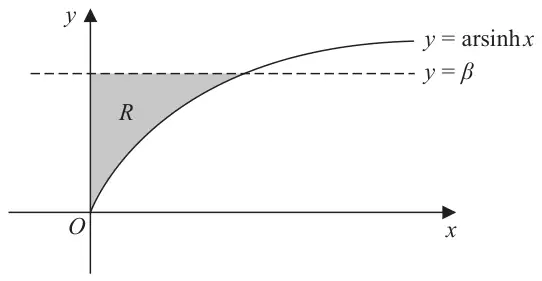
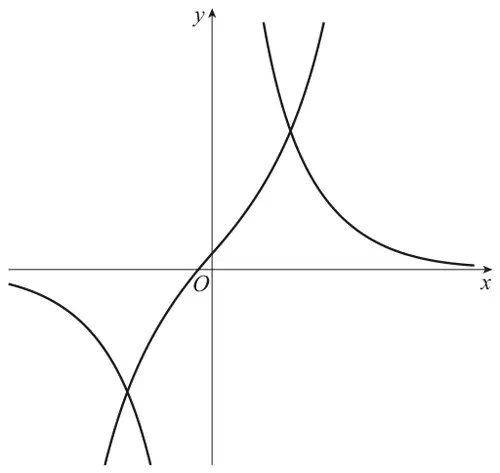
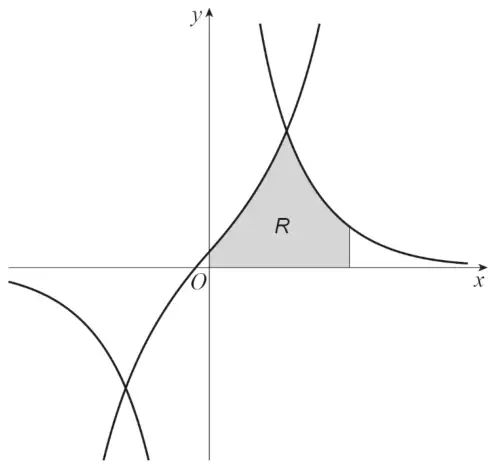
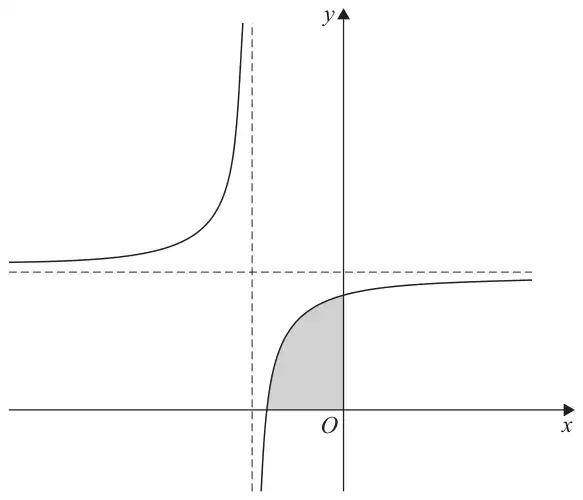
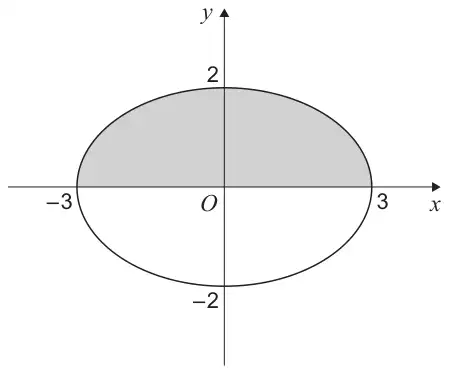
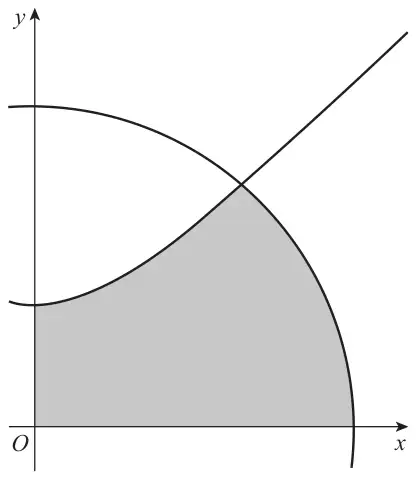
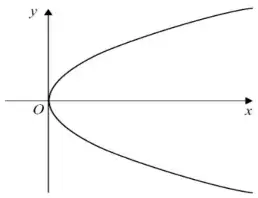
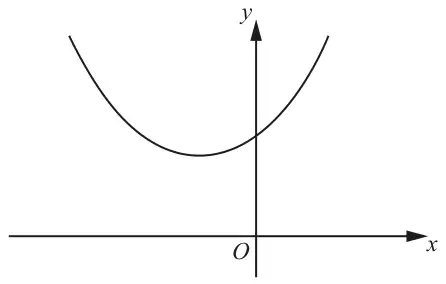
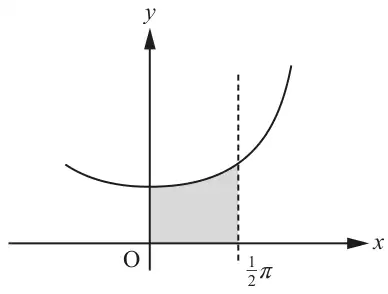
Figure 2 shows the curve with equation
\[x = \sin^2\left(\frac{1}{2}y\right) \qquad\qquad 0 \leqslant y \leqslant \frac{8\pi}{5}\]
The region \(R\), shown shaded in Figure 2, is bounded by the curve, the line with equation \(y = \dfrac{8\pi}{5}\) and the \(y\)-axis.
The ornament is modelled by the solid of revolution formed when \(R\) is rotated \(360^\circ\) about the \(y\)-axis. The units are centimetres.
(b) Using algebraic integration and the result in part (a), determine, in cm\(^3\), the volume of wood needed to make the ornament, according to the model. Give your answer to 2 significant figures. [Solutions based entirely on calculator technology are not acceptable.] (5)
B1: See scheme. This can appear anywhere in the proof. Accept \(2^4\sin^4\theta\) for \(16\sin^4\theta\), but not \((2\sin\theta)^4\) Alternatively, they may instead substitute \(\sin\theta = \dfrac{1}{2\mathrm{i}}\left(z - \dfrac{1}{z}\right)\) into the expression \(8\sin^4\theta\). This can be implied but must come from correct work. This can appear anywhere in their proof. e.g. \(8\sin^4\theta = 8\left[\dfrac{1}{2\mathrm{i}}\left(z - \dfrac{1}{z}\right)\right]^4\) or \(8\sin^4\theta = 8\left[\left(z - \dfrac{1}{z}\right)\right]^4\dfrac{1}{2^4}\) and allow \(8\sin^4\theta = \dfrac{1}{2}\left[\left(z - \dfrac{1}{z}\right)\right]^4\)
M1: Finds the expansion of \(\left(z - \dfrac{1}{z}\right)^4\) which may be unsimplified. All five terms must be present. Condone sign slips only
A1: Correct expansion, with terms grouped.
M1: Uses \(z^n + \dfrac{1}{z^n} = 2\cos n\theta\) to write in terms of \(\cos 4\theta\) and \(\cos 2\theta\)
A1*: Achieves the printed answer with no errors or omissions. Cso Follows A0.
B1: Correct formula \(\pi\displaystyle\int \left(\sin^2\left(\dfrac{1}{2}y\right)\right)^2\,\mathrm{d}y\) (but not \(\text{vol} = \pi\displaystyle\int x^2\,\mathrm{d}y\)) used to find a volume, stated or implied, ignore limits. If there is a missing \(\pi\) or d\(y\) in their integral, then withhold this mark only. However, this mark may be awarded if \(\pi\) and d\(y\) are seen together later in their integral.
Do not award the following marks if algebraic integration is not used. For example finding an answer of 7.3 without algebraic integration will obtain M0A0dM0A0
M1: Uses the result in part (a) to express the volume in an integrable form and attempts to integrate. Award for an integral of the form \(\displaystyle\int \dfrac{1}{8}\big(A\cos(2y) + B\cos(y) + C\big)\ (\mathrm{d}y)\) with at least one term integrated correctly. Do not be concerned if they use a different variable such as \(\theta\) for \(y\).
Special Case: If they have not used part (a) and instead use the double angle formulae: \(\sin^2\alpha = \dfrac{1}{2} - \dfrac{1}{2}\cos 2\alpha\) and \(\sin^4\alpha = \left(\dfrac{1}{2} - \dfrac{1}{2}\cos 2\alpha\right)^2\) with \(\alpha = \dfrac{1}{2}y\) In this case they must obtain an exact integral equivalent to \(\displaystyle\int \dfrac{1}{8}\big(\cos(2y) - 4\cos(y) + 3\big)\ (\mathrm{d}y)\) and proceed to integrate at least one term correctly.
A1: Correct integration. May be in terms of another variable such as \(\theta\). Ignore \(\pi\)
dM1: Dependent on previous method mark. Finds the required volume using \(\pi\displaystyle\int_0^{\frac{8\pi}{5}} x^2\,\mathrm{d}y\) and applies their limits to their integral and subtracts the correct way round. If there are no limits seen substituted, then a correct final answer implies the correct use of limits and the inclusion of \(\pi\). This is provided they have already achieved an integrated expression of \(\dfrac{1}{8}\left(\dfrac{1}{2}\sin(2y) - 4\sin(y) + 3y\right)\) oe with correct limits seen, possibly on their integral. If their integration is incorrect, then there must be evidence of substituting both limits in each of their terms and subtracting. Allow the omission of subtracting zero provided their integration would produce zero for the lower limit.
A1: awrt 7.3
Mark scheme (c)
Scheme
Marks
AO
Mass \(= \text{``}7.3\text{''} \times 0.85\) \(= \ldots\)
M1
2.2b
Mass \(= 6.2\) (grams) therefore a good model
A1ft
3.5a
(2)
(12 marks)
Notes
M1: Finds the mass of the ornament by multiplying their volume by 0.85
A1ft: Draws an appropriate conclusion about the suitability of the model, comparing their two masses. If the masses differ by 10% then they must conclude it is a good model. If the masses differ between 10% and 20% then they may conclude it is either a good model or poor model. If the masses differ by greater than 20% then they must conclude it is a poor model.
Alternative 1
Scheme
Marks
AO
Volume \(= 6 \div 0.85 = \ldots\)
M1
2.2b
Volume \(= 7.1\) (cm\(^3\)) therefore a good model
A1ft
3.5a
(2)
M1: Finds the volume of the ornament by dividing the mass of 6 grams by 0.85 g/cm\(^3\)
A1ft: Draws an appropriate conclusion about the suitability of the model, comparing their two volumes. If the volumes differ by 10% then they must conclude it is a good model. If the volumes differ between 10% and 20% then they may conclude it is either a good model or poor model. If the volumes differ by greater than 20% then they must conclude it is a poor model.
Alternative 2
Scheme
Marks
AO
Density \(= 6 \div \text{``}7.3\text{''}\)
M1
2.2b
Density \(= 0.82\) (g/cm\(^3\)) therefore a good model
A1ft
3.5a
(2)
M1: Finds the density of the ornament by dividing the mass of 6 grams by 7.3 cm\(^3\) (corrected from the printed mark scheme: printed as 7.3 g/cm\(^3\))
A1ft: Draws an appropriate conclusion about the suitability of the model, comparing their two densities. If the densities differ by 10% then they must conclude it is a good model. If the densities differ between 10% and 20% then they may conclude it is either a good model or poor model. If the densities differ by greater than 20% then they must conclude it is a poor model.
(i) The curves with equations\[y = \frac{3}{4}\sinh x \quad \text{and} \quad y = \tanh x + \frac{1}{5}\]intersect at just one point \(P\)
(a) Use algebra to show that the \(x\) coordinate of \(P\) satisfies the equation\[15\mathrm{e}^{4x} - 48\mathrm{e}^{3x} + 32\mathrm{e}^x - 15 = 0\] (3)
(b) Show that \(\mathrm{e}^x = 3\) is a solution of this equation. (1)
(c) Hence state the exact coordinates of \(P\). (1)
(ii) Show that\[\int_{-4}^{0} \frac{\mathrm{e}^{\frac{1}{x}}}{x^2}\,\mathrm{d}x = \mathrm{e}^{-\frac{1}{4}}\] (4)
Mark scheme (i)(a)
Scheme
Marks
AO
\(\sinh x = \left(\dfrac{\mathrm{e}^x - \mathrm{e}^{-x}}{2}\right)\) and \(\tanh x = \dfrac{\mathrm{e}^{2x} - 1}{\mathrm{e}^{2x} + 1}\) or \(\dfrac{\mathrm{e}^x - \mathrm{e}^{-x}}{\mathrm{e}^x + \mathrm{e}^{-x}}\)
B1
1.2
\(\dfrac{3}{4}\sinh x = \tanh x + \dfrac{1}{5} \Rightarrow \dfrac{3}{4}\left(\dfrac{\mathrm{e}^x - \mathrm{e}^{-x}}{2}\right) = \dfrac{\mathrm{e}^{2x} - 1}{\mathrm{e}^{2x} + 1} + \dfrac{1}{5}\) or \(\dfrac{3}{4}\left(\dfrac{\mathrm{e}^x - \mathrm{e}^{-x}}{2}\right) = \dfrac{\mathrm{e}^x - \mathrm{e}^{-x}}{\mathrm{e}^x + \mathrm{e}^{-x}} + \dfrac{1}{5}\) Leading to a quartic equation for \(\mathrm{e}^x\)
B1: Recalls the exponential definitions for \(\sinh x\) and at least one of \(\cosh x\) or \(\tanh x\), which may be embedded in their workings.
M1: Substitutes the correct exponential definitions to form an equation leading to a quartic equation for \(\mathrm{e}^x\). Any identities used such as \(\sinh 2x = 2\sinh x\cosh x\) must be correct
A1*: Correct equation following at least one intermediate stage, with no errors seen. They cannot go directly from their substitution to the given answer. cso
Mark scheme (i)(b)
Scheme
Marks
AO
\(15(3)^4 - 48(3)^3 + 32(3) - 15 = 0\) therefore \(\mathrm{e}^x = 3\) is a solution
B1
1.1b
(1)
Notes
B1: Substitutes \(\mathrm{e}^x = 3\) into each term of the equation, shows \(= 0\) and states therefore a solution or writes \(\left(\mathrm{e}^x - 3\right)\) is a factor. Allow a tick, box, QED or appropriate conclusion.
OR Substitutes \(x = \ln 3\) into each term of the equation, shows \(= 0\) and states therefore a solution or writes \(\left(\mathrm{e}^x - 3\right)\) is a factor. Allow a tick, box, QED or appropriate conclusion.
OR Factorises their equation: \(15\mathrm{e}^{4x} - 48\mathrm{e}^{3x} + 32\mathrm{e}^x - 15 = 0\) \(\Rightarrow \left(\mathrm{e}^x - 3\right)\left(15\mathrm{e}^{3x} - 3\mathrm{e}^{2x} - 9\mathrm{e}^x + 5\right) = 0\) and states hence \(\mathrm{e}^x = 3\) is a solution
Do not award this mark for simply solving a quartic such as \(15y^4 - 48y^3 + 32y - 15 = 0\) on the calculator and stating \(y = 3\), hence \(\mathrm{e}^x = 3\) is a solution.
Mark scheme (i)(c)
Scheme
Marks
AO
\((\ln 3,\ 1)\)
B1
1.1b
(1)
Notes
B1: States the correct exact coordinates. Allow \(x = \ldots,\ y = \ldots\) Do not accept decimals.
M1: Use the substitution \(u = \pm\dfrac{1}{x}\) to obtain an integral of the form \(\displaystyle\int \lambda\mathrm{e}^u\,\mathrm{d}u\) oe and integrates to \(\lambda\mathrm{e}^u\) Award for a sight of \(\pm\lambda\mathrm{e}^{\frac{1}{x}}\) as the answer to their integral. Alternatively applies the reverse of the chain rule \(\dfrac{\mathrm{d}}{\mathrm{d}x}\left(e^{\frac{1}{x}}\right) = \pm\dfrac{1}{x^2}e^{\frac{1}{x}}\) and integrates to reach \(\pm\lambda\mathrm{e}^{\frac{1}{x}}\) Answers using integration by parts are unlikely to lead to a correct solution.
A1: Correct integration. Award for correct answer with minimal workings as this can be done by inspection using the reverse of the chain rule. However, withhold this mark for incorrect workings.
M1: Uses correct notation to write the integral as the limit as \(t \to 0\), with the limits of \(t\) (or any such variable) and \(-4\). Applies correctly the limits of \(-4\) and \(t\) with correct limit notation, with limits seen substituted the right way round. Withhold this mark if there is no evidence of using the limiting process. We must see as a minimum \(\displaystyle\lim_{t \to 0}\) oe at some stage in their work.
A1*: Produces an argument that includes an upper limit that approaches 0. e.g. States that \(t \to 0 \Rightarrow \mathrm{e}^{\frac{1}{t}} \to 0\) and reaches a value of \(\mathrm{e}^{-\frac{1}{4}}\)
Alternative method: changing limits using \(u = \dfrac{1}{x}\)
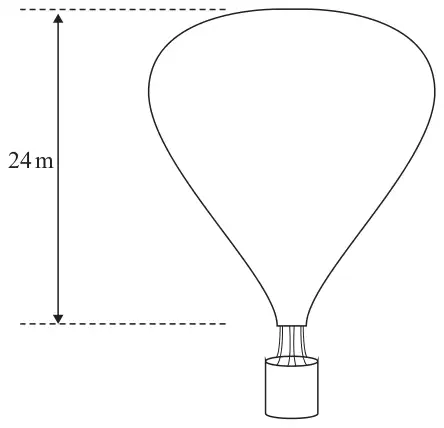
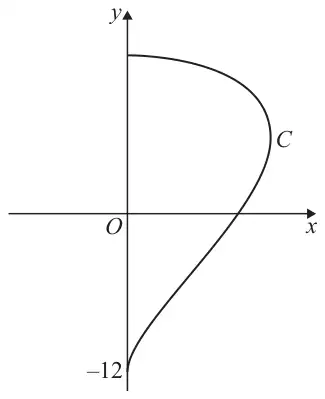
The balloon is modelled by rotating \(C\) through 360° about the \(y\)-axis.
Given that one \(y\) intercept of \(C\) is \(-12\)
(a) show that \(A = 144\) (1)
(b) Use algebraic integration to determine the volume of air needed to fill the balloon, according to the model, giving the answer to 2 significant figures. (5)
(c) Modify the equation \(350x^2 = (12 + y)^2\left(144 - y^2\right)\) to model a mathematically similar balloon with a height of 26 metres. (1)
(d) State one limitation of the models. (1)
Mark scheme (a)
Scheme
Marks
AO
\(x = 0\) and \(y = 12\) \(0 = (12 + 12)^2\left(A - 12^2\right) \Rightarrow A = 144\)
B1
3.3
(1)
Notes
B1: Uses \(x = 0\) and \(y = 12\) in the full equation to show that \(A = 144\)
(Corrected from the printed mark scheme: the value at the lower limit is printed as \(-74659.6\), here and in the notes; the correct value is \(-74649.6\).)
B1: Uses the model to set up the volume for the balloon, with limits, the d\(y\) may be implied
M1: Multiplies out the brackets and integrates \(\int x^n\,\mathrm{d}x \rightarrow x^{n+1}\). Alternatively uses integration by parts the correct way. Condone a slip when multiplying out
A1: Correct integration
M1: Uses the limits of \(-12\) and 12, subtracts the correct way round. If the integration is correct this can be evidenced by for example \((323481.6) - (-74649.6)\) or 2903.56 − (− 670.05) if including \(\dfrac{\pi}{350}\) If the integration is incorrect we must see the substitution of 12 and \(-12\) into their integrated function Candidates may use limits of \(-12\) to 0 and then 0 to 12 and add which is fine.
A1: Correct volume 3600 m3, unit required and 2 s.f.
Note: No Evidence of integration maximum B1 M0A0 M0A0 if a correct answer stated
e.g. the balloon may not be exactly the same shape as the curve The balloon’s material will have some thickness the balloon is not the same shape as the curve as the balloon does not taper to nothing at the bottom. Balloon may stretch B0 for balloon may not be smooth, comments on the basket
B1
3.5b
(1)
(8 marks)
Notes
B1: Correct limitation, see scheme, must be about the balloon part not the basket. Balloon might not be smooth is B0
M1: Selects the correct form for partial fractions. Must be of the form \(A + \dfrac{B}{x + 2} + \dfrac{Cx + D}{x^2 + 3}\) so do not award if their \(A\) is not present. Allow if they set up an expression of the form \(A + \dfrac{\mu x + B}{x + 2} + \dfrac{Cx + D}{x^2 + 3}\) or \(A + \mu x + \dfrac{B}{x + 2} + \dfrac{Cx + D}{x^2 + 3}\) provided they then go on to show their \(\mu = 0\)
dM1: Dependent on having the correct form for the partial fractions. Complete method for finding the value of at least 3 constants in \(A + \dfrac{B}{x + 2} + \dfrac{Cx + D}{x^2 + 3}\) Allow slips, provided their intention is clear.
B1: Correct value for \(A\). This is independent of any method and should be awarded regardless of an incorrect use of partial fractions.
A1: Correct solution written as partial fractions, but not for listing values for constants.
Alternative: long division
Scheme
Marks
AO
or states \(2 + \dfrac{\ldots}{2x^3 + 10x^2 + 9x + 22}\)
M1: Selects the correct form for partial fractions, (following an attempt at algebraic long division which led to an integer quotient, which may or may not be 2, and their remainder must be a 3TQ) Their partial fractions must be of the form \(\dfrac{P}{x + 2} + \dfrac{Qx + R}{x^2 + 3}\)
dM1: Complete method for finding the value of at least 2 constants. Dependent on having the correct form for the partial fractions. Allow slips, provided their intention is clear.
B1: Correct constant 2, may be seen in their long division and is likely to appear at the beginning of their workings. This is independent of any method and should be awarded regardless of any incorrect use of partial fractions.
A1: Correct solution written as partial fractions, but not for listing values for constants.
M1: Rewrites the integral (without the constant term) into an integrable form and integrates to the correct form \(\alpha\ln(x + 2) + \beta\ln\left(x^2 + 3\right) + \lambda\arctan\left(\dfrac{x}{\sqrt{3}}\right)\), where \(\alpha\), \(\beta\) and \(\lambda\) are non-zero constants.
A1: Fully correct integration for the whole expression.
dM1: Uses the limits of 0 and 1, subtracts the correct way round and combines their ln terms correctly.
A1*: Correct answer cso (but can be written in any order)
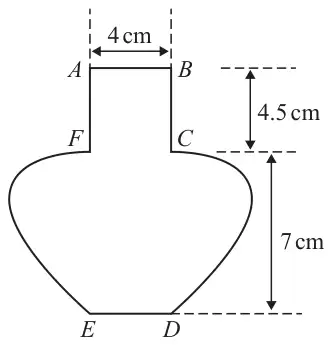
Figure 1 shows the central vertical cross-section \(ABCDEFA\) of a vase together with measurements that have been taken from the vase.
The horizontal cross-section between \(AB\) and \(FC\) is a circle with diameter 4 cm.
The base of the vase \(ED\) is horizontal and the point \(E\) is vertically below \(F\) and the point \(D\) is vertically below \(C\).
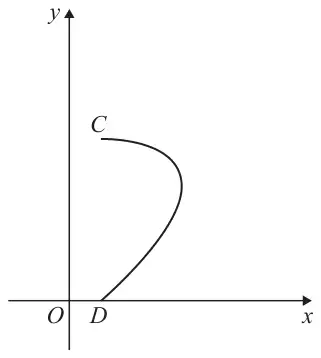
Using these measurements, the curve \(CD\) is modelled by the parametric equations
\[x = a + 3\sin 2t \qquad y = b\cos t \qquad 0 \leqslant t \leqslant \frac{\pi}{2}\]
where \(a\) and \(b\) are constants and \(O\) is the fixed origin, as shown in Figure 2.
(a) Determine the value of \(a\) and the value of \(b\) according to the model. (2)
(b) Using algebraic integration and showing all your working, determine, according to the model, the volume of the vase, giving your answer to the nearest cm3(7)
(c) State a limitation of the model. (1)
Mark scheme (a)
Scheme
Marks
AO
\(a = 2\) or \(b = 7\)
B1
3.3
\(a = 2\) and \(b = 7\)
B1
3.3
(2)
Notes
B1: Uses the model to obtain a correct value for \(a\) or \(b\)
B1: Uses the model to obtain correct values for \(a\) and \(b\)
\(= -7(\pi)\displaystyle\int \left(4\sin t + 12\sin 2t\sin t + 9\sin^2 2t\sin t\right)\mathrm{d}t\) \(= -7(\pi)\displaystyle\int \left(4\sin t + 24\sin^2 t\cos t + 36\sin^3 t\cos^2 t\right)\mathrm{d}t\)
M1
3.1a
\(= -7(\pi)\left[-4\cos t + 8\sin^3 t - 12\cos^3 t + \dfrac{36}{5}\cos^5 t\right]\)
A1ft A1
1.1b 1.1b
Cylinder volume is \(\pi \times 2^2 \times 4.5 = (18\pi)\)
B1
3.4
Total Volume \(= V +\) cylinder volume \(= -7\pi\left[-4\cos t + 8\sin^3 t - 12\cos^3 t + \dfrac{36}{5}\cos^5 t\right]_{\frac{\pi}{2}}^{0} + \pi \times 2^2 \times 4.5\) or \(= 7\pi\left[-4\cos t + 8\sin^3 t - 12\cos^3 t + \dfrac{36}{5}\cos^5 t\right]_{0}^{\frac{\pi}{2}} + \pi \times 2^2 \times 4.5\) (NB this is \(\dfrac{588}{5}\pi + 18\pi\))
ddM1
3.4
426 (cm3)
A1
2.2b
(7)
Notes
M1: Uses the parametric curve for the model and applies \((\pi)\displaystyle\int x^2\frac{\mathrm{d}y}{\mathrm{d}t}\,\mathrm{d}t\) The \(\pi\) symbol may be missing here. Also do not be concerned about a missing \(\mathrm{d}t\) at the end of their integral. Must see an attempt at squaring \(x\) and finding \(\dfrac{\mathrm{d}y}{\mathrm{d}t}\) where \(x = (a + 3\sin 2t)\) and \(\dfrac{\mathrm{d}y}{\mathrm{d}t} = k\sin t\) with their \(a\) and \(b\) or the letters \(a\) and \(b\) in their integral.
M1: Expands and makes progress to an integrable form by applying \(\sin 2t = 2\sin t\cos t\) at least once Integrals in terms of \(a\) and \(b\) will be equivalent to:
\[\pm(\pi)\int \left(a^2b\sin t + 6ab\sin 2t\sin t + 9b\sin^2 2t\sin t\right)\mathrm{d}t\]\[= \pm(\pi)\int a^2b\sin t + 12ab\sin^2 t\cos t + 36b\sin^3 t\cos^2 t\,\mathrm{d}t\]
Integrals with correct values of \(a\) and \(b\) will be equivalent to:
\[\pm(\pi)\int \left(28\sin t + 84\sin 2t\sin t + 63\sin^2 2t\sin t\right)\mathrm{d}t\]\[= \pm(\pi)\int \left(28\sin t + 168\sin^2 t\cos t + 252\sin^3 t\cos^2 t\right)\mathrm{d}t\]
A1ft: (dependent on both M marks) At least 2 terms integrated correctly; follow through their \(a\) and \(b\), however their \(a\) and \(b\) must now be numerical.
\[\pm(\pi)\left[-a^2b\cos t + 4ab\sin^3 t - \frac{36}{3}b\cos^3 t + \frac{36b}{5}\cos^5 t\right]\]\[= \pm(\pi)\left[28\cos t - 56\sin^3 t + 84\cos^3 t - \frac{252}{5}\cos^5 t\right]\]
A1: All correct from correct values for \(a\) and \(b\) Their integral will be equivalent to:
\[= \pm(\pi)\left[28\cos t - 56\sin^3 t + 84\cos^3 t - \frac{252}{5}\cos^5 t\right]\]
B1: Uses the model to deduce the correct volume of the cylinder; need not be simplified.
ddM1: Dependent on both previous M marks. Fully correct strategy for the volume. Applies the correct limits (either way round) and adds this to the volume of the cylinder which must have been obtained from \(\pi \times 2^2 \times 4.5\) but condone \(\pi \times 4^2 \times 4.5\) Both volumes must be positive when combined.
A1: Correct volume, allow awrt 426 (cm3), units are not required but if any are given, they should be correct.
Mark scheme (c)
Scheme
Marks
AO
Any one of e.g. The vase may not be completely smooth The vase may not be symmetrical The measurements may not be accurate The equation of the curve may not be a suitable model The thickness of the sides has not been considered Accept the base may have a dimple in it (the base may not be completely flat)
B1
3.5b
(1)
(10 marks)
Notes
B1: See scheme. Award for a correct statement. If there is more than one statement ignore any incorrect statements as long as there are no statements that contradict their correct statement.
Comments relating to facts about the shape that are not worthy of marks include:
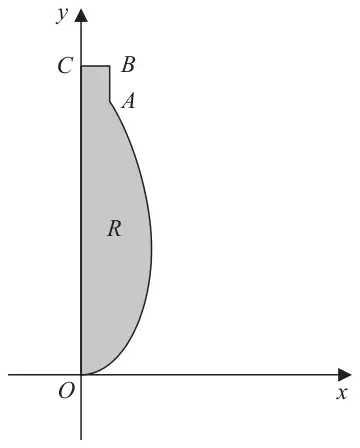
Figure 1 shows the central vertical cross-section, \(OABCDEO\), of the design for a solid glass ornament.
Figure 2 shows the finite region, \(R\), which is bounded by the \(y\)-axis, the horizontal line \(CB\), the vertical line \(BA\), and the curve \(AO\).
The ornament is formed by rotating the region \(R\) through 360° about the \(y\)-axis.
\(= \{\pi\}\displaystyle\int_0 \left(y - 0.2y^{\frac{5}{2}} + 0.01y^4\right)\{\mathrm{d}y\}\) \(\Rightarrow \{\pi\}\left[Ay^2 + By^{\frac{7}{2}} + Cy^5\right]\) at least one of their terms with the correct power
B1: Uses the information given in the model to establish the correct volume of the cylinder
M1: Uses the model and applies \(\pi\displaystyle\int x^2\{\mathrm{d}y\}\), d\(y\) not required and \(\pi\) may appear later in their solution. If they find an expression for \(x^2\) first and then substitutes into the formula score M1 even if an incorrect expansion.
A1ft: Correct expression for the volume generated by the curve with the bracket expanded (follow through their \(k\) value), d\(y\) not required and \(\pi\) may appear later in their solution. Indices need to be processed for this mark, may be seen later in the solution.
M1: Attempts to integrate with at least one power raised by 1
A1ft: Correct integration (follow through on their expression for \(x^2\) as long as there are 3 terms). Need not be simplified.
M1: Uses the correct limits and finds the sum of the 2 volumes. Must come from an attempt at \(\pi\displaystyle\int_0^4 x^2\{\mathrm{d}y\}\) and an attempt at the volume of the cylinder, condone incorrect formula used as long as it is 3 dimensional not an area.
A1: \(\dfrac{2462\pi}{875}\)
Use of calculator scores a maximum of B1M1A0M0A0M1A0 volume = \(\boldsymbol{\pi}\)2.7337…
Mark scheme (c)
Scheme
Marks
AO
E.g.
The equation of the curve may not be a suitable model
The sides of the ornament will not be perfectly smooth
There may be flaws/bubbles within the glass
The corner (ABC) may not be a perfect right angle
B1
3.5b
(1)
Notes
B1: States an acceptable limitation of the model, which is the curve but accept flaws/bubbles in the glass. Measurements may not be accurate, or anything related to thickness is B0
Mark scheme (d)
Scheme
Marks
AO
Makes an appropriate comment that is consistent with their value for the volume and 9 cm3. Some evidence of making a comparison and draws a conclusion E.g. a good estimate as 8.84 cm3 is only 0.16 cm3 less than 9 cm3
A volume between 8.5 and 9.5 is a good model
A volume between 8 and 10 can be either a good or bad model
A volume less than 8 or more than 10 is a bad model, over estimate or underestimate
model volume is less, not enough glass would be ordered so it is a bad model, following a correct answer to (b)
B1ft
3.5a
(1)
(11 marks)
Notes
B1ft: Compares the actual volume to their answer to part (b) and makes an assessment of the model with a reason. If using a percentage error then they must use 9 as the true volume.
(a) Explain why\[\int_{\frac{4}{3}}^{\infty} \frac{1}{9x^2 + 16}\,\mathrm{d}x\]is an improper integral. (1)
(b) Show that\[\int_{\frac{4}{3}}^{\infty} \frac{1}{9x^2 + 16}\,\mathrm{d}x = k\pi\]where \(k\) is a constant to be determined. (4)
Mark scheme (a)
Scheme
Marks
AO
Because the upper limit is infinite
B1
2.4
(1)
Notes
B1: Suitable explanation stating that one of the bounds/limits is infinite oe isw e.g. “one of the limits is unbounded” or “the integral is unbounded”
Do not allow this mark if they only say the limit or integral is undefined, unless they go on to say it is undefined at infinity. Commenting that the function is undefined at infinity is not enough to award this mark on its own, this question concerns the limits. If the candidates state any extra incorrect comments about the limits withhold this mark e.g. not defined at \(\dfrac{4}{3}\)
M1: Integrates to obtain \(\alpha\arctan(\beta x)\) where \(\beta \neq 1\)
A1: Correct integration, unsimplified or simplified.
dM1: Applies correct limits, "\(t\)" and \(\dfrac{4}{3}\) with evidence of applying the infinite limit to obtain a non-zero value. Allow with \(\infty\) used as the limit (which may be implied by \(\dfrac{\pi}{2}\))
A1: Correct value obtained with evidence of use of limiting process on the upper bound. Withhold this mark if there is no evidence of using the limiting process. We must see as a minimum \(\displaystyle\lim_{t \to \infty}\) oe at some stage in their work.
e.g. \(\left[\dfrac{1}{12}\arctan\left(\dfrac{3x}{4}\right)\right]_{\frac{4}{3}}^{\infty} = \dfrac{1}{12}\left(\dfrac{\pi}{2} - \dfrac{\pi}{4}\right) = \dfrac{\pi}{48}\) would score dM1A0
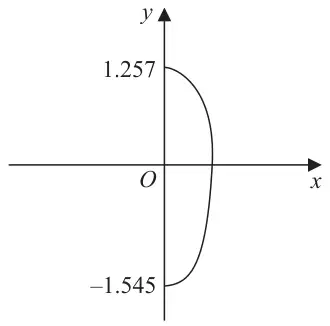
shown in Figure 2, about the \(y\)-axis through \(2\pi\) radians, where the units are cm.
Given that the \(y\) intercepts of the curve are \(-1.545\) and \(1.257\) to four significant figures,
(a) use algebraic integration to determine, according to the model, the volume of this berry. (6)
Given that the 100 berries John picked were then squeezed for juice,
(b) use your answer to part (a) to decide whether, in reality, there is likely to be enough juice to fill a \(200\,\text{cm}^3\) cup, giving a reason for your answer. (2)
B1: Selects the correct volume of revolution formula to use, with correct limits in evidence, could appear later in their working
M1: Attempts to integrate with the correct form for the constant and term in \(y^2\)
M1: Applies integration by parts fully on the \(y\cos\left(\frac{5}{2}y\right)\) term in the correct direction. Allow slips in the coefficients, but the form must be correct.
A1: Correct integration of the \(x^2\) equation.
M1: Applies the correct limits to their integral provided there was some attempt at integration. No need for the \(\pi\) for this mark. Condone working in degrees (5.74 …) - (-5.38…), award this mark following correct integration. If their integration is incorrect you will need to check the use of limits in radians only if they do not show the substitution.
A1: Correct volume including units. Accept awrt 2.26 cm3. Allow \(0.719\pi\) cm3. Correct solution only Note: All previous marks must have been scored to award this final accuracy mark Special case: Use of calculator for all the integration can score a maximum of B1M0M0A0M1A0
Mark scheme (b)
Scheme
Marks
AO
Max volume for 100 berries (as we know volume of the largest) is \(100 \times 2.26 \simeq 226\)
B1ft
1.1b
Reason e.g. not all the berries will become juice (e.g. skin, flesh, seeds may not pulp) or not all will be as big as the largest, 150 < 200 or 300 > 200 If their value
is less than 220 – so not likely to produce \(200\,\text{cm}^3\) of juice.
is between 220 and 250 – they can conclude either way
is greater than 250 – so likely to produce \(200\,\text{cm}^3\) of juice.
B1ft
2.2b
(2)
(8 marks)
Notes
(corrected from the printed mark scheme: the subtotal for (b) is printed as (1); part (b) carries 2 marks, B1ft B1ft)
B1ft: Attempts to estimate the volume of juice produced by 100 berries - look for their (a) multiplied by 100.
B1ft: Draws a suitable conclusion with reason given, see scheme
there are \(V\) litres of water in the tank at time \(t\) minutes after the water begins to flow
water enters the tank at a rate of \(\left(3 - \dfrac{4}{1 + \mathrm{e}^{0.8t}}\right)\) litres per minute
water leaves the tank at a rate proportional to the volume of water remaining in the tank
Given that when \(t = 0\) the volume of water in the tank is decreasing at a rate of 3 litres per minute, use the model to
(a) show that the volume of water in the tank at time \(t\) satisfies\[\frac{\mathrm{d}V}{\mathrm{d}t} = 3 - \frac{4}{1 + \mathrm{e}^{0.8t}} - 0.4V\] (3)
M1: Sets up the correct equation for the model using the information in the question.
dM1: Uses the initial conditions to find the constant of proportionality for flow out. Condone use of \(\dfrac{\mathrm{d}V}{\mathrm{d}t} = +3\). Depends on the first mark.
A1*: Correct equation shown from correct work proceeding via \(10k = 4\) to find \(k\).
Attempts in (a) using verification score no marks: E.g. \(\dfrac{\mathrm{d}V}{\mathrm{d}t} = 3 - \dfrac{4}{1 + \mathrm{e}^{0.8t}} - \dfrac{2}{5}V \Rightarrow -3 = 3 - \dfrac{4}{2} - 0.4V \Rightarrow V = \dfrac{4}{0.4} = 10\)
M1: Differentiates to achieve the form shown. Allow \(k = 1\)
A1: Correct derivative in any form. Need not be simplified.
Alternative: M1: Takes tan of both sides and differentiates implicitly and reaches \(\dfrac{1}{1 + \left(\mathrm{e}^{0.4t}\right)^2} \times k\mathrm{e}^{0.4t}\). Allow \(k = 1\). A1: Correct derivative in any form. Need not be simplified.
B1: Deduces the correct integrating factor for the equation. May be implied by sight of \(\dfrac{\mathrm{d}}{\mathrm{d}t}\left(\mathrm{e}^{0.4t}V\right) = \ldots\) or equivalent work.
M1: Fully multiplies through by their integrating factor and integrates the LHS (look for \(I.F. \times V = \displaystyle\int I.F. \times \left(3 - \frac{4}{1 + \mathrm{e}^{0.8t}}\right)\mathrm{d}t\) though condone missing \(\mathrm{d}t\).
M1: Attempts the integral of the RHS. Award for \(\displaystyle\int \alpha\mathrm{e}^{0.4t}\,\mathrm{d}t = \beta\mathrm{e}^{0.4t}\ \ \alpha \neq \beta\) or \(\displaystyle\int \frac{\alpha\mathrm{e}^{0.4t}}{1 + \mathrm{e}^{0.8t}}\,\mathrm{d}t = \beta\arctan\mathrm{e}^{0.4t},\ \ \beta \neq 0\)
A1: Correct integration, need not be simplified. Allow if the \(+ c\) is missing for this mark.
M1: Attempts to find their constant – which must have been treated correctly from point of integration. Note that this is not formally dependent but there must have been an attempt to integrate.
A1: Correct answer. The question says “simplest form” but allow equivalent expressions e.g. \(V = 7.5 - \dfrac{10\arctan\left(\mathrm{e}^{0.4t}\right)}{\mathrm{e}^{0.4t}} + \dfrac{5\pi}{2\mathrm{e}^{0.4t}} + \dfrac{5}{2\mathrm{e}^{0.4t}}\) but do not allow inexact values for the constants.
Mark scheme (d)
Scheme
Marks
AO
E.g. \(V(10) \approx 7.4\) litres so the model is not very accurate as it predicts approximately 7.5% below the actual level.
B1ft
3.5a
(1)
(12 marks)
Notes
B1ft: Evaluates \(V\) where \(V \gt 0\) at \(t = 10\) and makes an appropriate comment. For the evaluation, allow if a value of \(V\) is obtained even if there is no evidence of substitution provided that it is clear that \(t = 10\) has not been substituted into something that is not \(V\). So you do not need to check their value. For the tolerance you may need to use your own judgement but a general guide is:
\(0 \lt V \lt 7\)
Not a good model
\(7 \leqslant V \lt 7.7\) or \(8.3 \leqslant V \lt 9\)
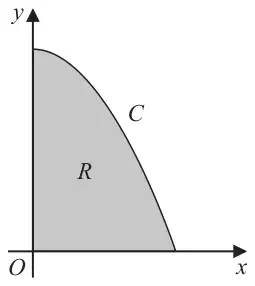
The region \(R\), shown shaded in Figure 2, is bounded by the \(y\)-axis, the \(x\)-axis and the curve \(C\).
The volume of concrete waste is modelled by the volume of revolution formed when \(R\) is rotated through 360° about the \(y\)-axis. The units are metres.
The density of the concrete waste is 900 kg m−3
(a) Use the model to estimate the mass of the concrete waste. Give your answer to 2 significant figures. (6)
(b) Give a limitation of the model. (1)
The mass of the concrete waste is approximately 5500 kg.
(c) Use this information and your answer to part (a) to evaluate the model, giving a reason for your answer. (1)
Uses their \(y\) limits correctly in a changed expression \(\pi\left[2y - \dfrac{1}{2}y^2\right]_0^2 = \pi\left(2(2) - \dfrac{1}{2}\left(2^2\right)\right) - 0 = \ldots\{2\pi \text{ or } 6.28\ldots\}\)
M1
3.4
mass = ‘their volume’ × 900
M1
3.1b
Mass = 5700 (kg) 2 s.f. cao
A1
2.2b
(6)
Notes
B1: Sets up the model to find a correct expression for the volume, including limits, d\(y\) may be implied. The limits may be seen later.
M1: Integrates to the form \(\alpha y \pm \beta y^2\)
A1: Correct integration M1: Substitutes their \(y\) limits the correct way round and subtracts, must be a changed expression M1: Multiplies their volume by 900 to find the mass A1: 5700 cao
Note incorrect upper limit of \(\sqrt{2}\) leads to 5200kg Scores B0 M1 A1 M1 M1 A0
Note: Finding the volume around the \(x\)-axis can score B0 M0 A0 M0 M1 A0 only
Note If they use their calculator to find the value of the definite integration and achieve the correct answer the maximum they can score is B1M0A0M1M1A1
Mark scheme (b)
Scheme
Marks
AO
eg The surface will not be smooth The pile will not follow the shape of the curve The pile will not be solid Equation of the curves may not be a suitable model Concrete is likely to be uneven/may have bumps The pile is unlikely to be symmetrical
B1
3.5b
(1)
Notes
B1: See scheme, must be referring to the model and not the value of the density etc
Mark scheme (c)
Scheme
Marks
AO
Makes a comparison about the difference between their mass and 5500 and draws a conclusion e.g. 200 difference which is a lot of concrete therefore not a good model e.g. the mass of 5700 is very close to 5500 kg and draws a conclusion about the model – e.g. therefore a good model e.g. Finds the percentage error and draw a conclusion about the model e.g. The masses are very close/significantly different and draws an appropriate conclusion Not sufficient to say 5700 > 5500 B0
B1ft
3.5a
(1)
(8 marks)
Notes
B1ft: See scheme, follow through on their answer to (a). If using a calculation, it must be correct. Ignore any contradictory comments e.g. 3.6% out so it’s fairly close so it’s a good model but it’s an overestimate which isn’t good. You may need to use your own judgement but any sensible comment comparing their value to 5500 is acceptable.
(a) Write \(x^2 + 4x - 5\) in the form \((x + p)^2 + q\) where \(p\) and \(q\) are integers. (1)
(b) Hence use a standard integral from the formula book to find\[\int \frac{1}{\sqrt{x^2 + 4x - 5}}\,\mathrm{d}x\] (2)
(c) Determine the mean value of the function\[\mathrm{f}(x) = \frac{1}{\sqrt{x^2 + 4x - 5}} \qquad 3 \leqslant x \leqslant 13\]giving your answer in the form \(A\ln B\) where \(A\) and \(B\) are constants in simplest form. (3)
Mark scheme (a)
Scheme
Marks
AO
\(x^2 + 4x - 5 = (x + 2)^2 - 9\)
B1
1.1b
(1)
Notes
B1: Correct completed square form. Allow \(3^2\) for 9.
Mark scheme (b)
Scheme
Marks
AO
\(\displaystyle\int \frac{1}{\sqrt{(x + p)^2 - q}}\,\mathrm{d}x = \operatorname{arcosh}\left(\frac{x + p}{\sqrt{q}}\right)(+c)\) or \(\ln\left(x + p + \sqrt{(x + p)^2 - q}\right)(+c)\)
M1: Achieves a correct form for the integration for their \(p\) and \(q\) from part (a):
\(\operatorname{arcosh}\left(\dfrac{x + p}{\sqrt{q}}\right)(+c)\) or \(\ln\left(x + p + \sqrt{(x + p)^2 - q}\right)(+c)\) or e.g. \(\ln\left(\dfrac{x + p}{\sqrt{q}} + \sqrt{\left(\dfrac{x + p}{\sqrt{q}}\right)^2 - 1}\right)(+c)\) where \(p \neq 0,\ q \neq 1\)
Allow \(\cosh^{-1}\) for arcosh Allow attempts that use substitution following an attempt to complete the square but must be an appropriate substitution e.g. \(x + p = \sqrt{q}\cosh u\) leading to a correct form as above.
A1: Correct integration. The “\(+ c\)” is not required. Apply isw once a correct expression is seen. Note that \(\ln\left(\dfrac{x + 2}{3} + \sqrt{\left(\dfrac{x + 2}{3}\right)^2 - 1}\right)(+c)\) is also correct
Mark scheme (c)
Scheme
Marks
AO
Mean \(= \dfrac{1}{13 - 3}\displaystyle\int_3^{13} \frac{1}{\sqrt{x^2 + 4x - 5}}\,\mathrm{d}x\)
\(= \dfrac{1}{10}\ln\left(\dfrac{5 + 2\sqrt{6}}{3}\right)\) or \(\dfrac{1}{20}\ln\left(\dfrac{49 + 20\sqrt{6}}{9}\right)\)
A1
3.2a
(3)
(6 marks)
Notes
B1: Recalls the definition of a mean function accurately. \(\dfrac{1}{13 - 3}\displaystyle\int_3^{13} \frac{1}{\sqrt{x^2 + 4x - 5}}\,\mathrm{d}x\) seen or implied. Note that the \(\dfrac{1}{13 - 3}\) may appear at the end. \(\dfrac{1}{13 - 3}\displaystyle\int_3^{13} \mathrm{f}(x)\,\mathrm{d}x\) is sufficient as f(\(x\)) is defined in the question. Also allow it to be implied by e.g. \(\dfrac{1}{10}\left[\mathrm{g}(x)\right]_3^{13}\) where g(\(x\)) is their integrated function.
M1: Applies the correct limits the right way round to whatever they think the answer to part (b) is. This can be awarded if the \(\dfrac{1}{10}\) is present or not.
A1: Correct answer in correct form. Allow equivalents e.g. \(\dfrac{1}{10}\ln\left(\dfrac{5}{3} + \dfrac{2\sqrt{6}}{3}\right)\), \(\dfrac{1}{20}\ln\left(\dfrac{49}{9} + \dfrac{20\sqrt{6}}{9}\right)\) And allow if the surd is not simplified e.g. \(\dfrac{1}{10}\ln\left(\dfrac{5 + \sqrt{24}}{3}\right)\), \(\dfrac{1}{20}\ln\left(\dfrac{49 + \sqrt{2400}}{9}\right)\) Apply isw once a correct answer is seen. The brackets must be present in forms such as \(\dfrac{1}{10}\ln\left(\dfrac{5}{3} + \dfrac{2\sqrt{6}}{3}\right)\), \(\dfrac{1}{20}\ln\left(\dfrac{49}{9} + \dfrac{20\sqrt{6}}{9}\right)\) but not in e.g. \(\dfrac{1}{10}\ln\dfrac{5 + \sqrt{24}}{3}\) If extra values are offered then score A0
(a) Explain why \(\displaystyle\int_0^{\infty}\cosh x\,\mathrm{d}x\) is an improper integral. (1)
(b) Show that \(\displaystyle\int_0^{\infty}\cosh x\,\mathrm{d}x\) is divergent. (3)
(ii) \[4\sinh x = p\cosh x \qquad \text{where } p \text{ is a real constant}\]Given that this equation has real solutions, determine the range of possible values for \(p\) (2)
Mark scheme (i)(a)
Scheme
Marks
AO
E. g.
Because the interval being integrated over is unbounded.
\(\cosh x\) is undefined at the limit of \(\infty\)
the upper limit is infinite
B1
1.2
(1)
Notes
B1: For a suitable explanation. Technically this should refer to the interval being unbounded, but this is unlikely to be seen. Accept “Because the upper limit is infinity”, but not “because it is infinity” without reference to what “it” is. Do not accept “the upper limit tends to infinity” or “the integral is unbounded”.
When \(t \to \infty\) \(\mathrm{e}^t \to \infty\) and \(\mathrm{e}^{-t} \to 0\) therefore the integral is divergent
A1
2.4
(3)
Notes
B1: Writes the integral in terms of a limit as \(t \to \infty\) (or other variable) with limits 0 and “\(t\)”, or implies the integral is a limit by subsequent working by correct language.
M1: Integrates \(\cosh x\) correctly either as \(\sinh x\) or in terms of exponentials and applies correctly the limits of 0 and “\(t\)”. The bottom limit zero may be implied. No need for the \(\lim\limits_{t \to \infty}\) for this mark but substitution of \(\infty\) is M0.
A1: cso States that (as \(t \to \infty\)) \(\sinh t \to \infty\) or \(\mathrm{e}^t \to \infty\) and \(\mathrm{e}^{-t} \to 0\) therefore divergent (or not convergent), or equivalent working. Accept \(\sinh t\) is undefined as \(t \to \infty\)
Mark scheme (ii)
Scheme
Marks
AO
\(4\sinh x = p\cosh x \Rightarrow \tanh x = \dfrac{p}{4}\) or \(4\tanh x = p\) Alternative \(\dfrac{4}{2}\left(\mathrm{e}^x - \mathrm{e}^{-x}\right) = \dfrac{p}{2}\left(\mathrm{e}^x + \mathrm{e}^{-x}\right) \Rightarrow 4\mathrm{e}^x - 4\mathrm{e}^{-x} = p\mathrm{e}^x + p\mathrm{e}^{-x}\) \(\mathrm{e}^{2x}(4 - p) = p + 4 \Rightarrow \mathrm{e}^{2x} = \dfrac{p + 4}{4 - p}\)
M1: Divides through by \(\cosh x\) to find an expression involving \(\tanh x\) Alternative: uses the correct exponential definitions and finds an expression for \(\mathrm{e}^{2x}\) or solves a quadratic in \(\mathrm{e}^{2x}\)
A1: Deduces the correct inequality for \(p\). Note \(|p| \lt 4\) is a correct inequality for \(p\).
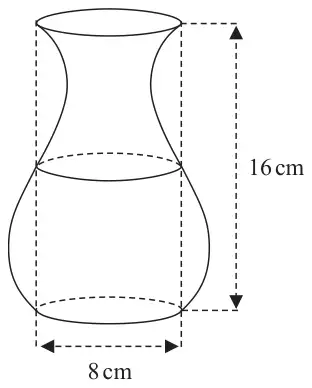
Figure 1 shows a sketch of a 16 cm tall vase which has a flat circular base with diameter 8 cm and a circular opening of diameter 8 cm at the top.
A student measures the circular cross-section halfway up the vase to be 8 cm in diameter.
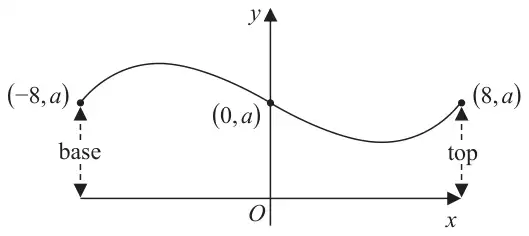
The student models the shape of the vase by rotating a curve, shown in Figure 2, through 360° about the \(x\)-axis.
(a) State the value of \(a\) that should be used when setting up the model. (1)
Two possible equations are suggested for the curve in the model.
\[\begin{aligned}&\text{Model A} \qquad y = a - 2\sin\left(\frac{45}{2}x\right)^\circ\\[4pt] &\text{Model B} \qquad y = a + \frac{x(x - 8)(x + 8)}{100}\end{aligned}\]
For each model,
(b)
(i) find the distance from the base at which the widest part of the vase occurs,
(ii) find the diameter of the vase at this widest point.
(7)
The widest part of the vase has diameter 12 cm and is just over 3 cm from the base.
(c) Using this information and making your reasoning clear, suggest which model is more appropriate. (1)
(d) Using algebraic integration, find the volume for the vase predicted by Model B. You must make your method clear. (5)
The student pours water from a full one litre jug into the vase and finds that there is 100 ml left in the jug when the vase is full.
(e) Comment on the suitability of Model B in light of this information. (1)
Mark scheme (a)
Scheme
Marks
AO
\(a = 4\)
B1
3.3
(1)
Notes
Units not required in this question
B1: For \(a = 4\), ignore any reference to units.
Mark scheme (b)
Scheme
Marks
AO
Model A: (i) Widest point will be 4 (cm) from the base
B1
3.4
(ii) Width at widest point is 12 (cm) \(\quad(2 \times (\text{‘}a\text{’} + 2)\text{ ft})\)
So max width is a distance \(8 - \dfrac{8}{\sqrt{3}} = 8 - \dfrac{8\sqrt{3}}{3} \approx 3.38\) (cm) from base.
A1
3.4
(ii) \(y\big|_{-4.61\ldots} = 4 + \dfrac{(-4.62\ldots)^3 - 64(-4.62\ldots)}{100} = \ldots\)
dM1
3.4
\(= 5.97\ldots\) so diameter is approximately 11.9 (cm) \(\quad[2a + 3.94\ldots\text{ ft}]\)
A1ft
3.2a
(7)
Notes
B1: Correct distance from base for Model A is 4
B1ft: Correct width at widest point. Follow through their ‘\(a\)’, so \(2 \times (\text{‘}a\text{’} + 2)\).
M1: Attempts the derivative for Model B’s equation, reduce any power by 1
A1: Sets \(\dfrac{\mathrm{d}y}{\mathrm{d}x} = 0\) and finds correct \(x\) coordinate of the stationary point (accept \(\pm\))
A1: For \(8 - \dfrac{8}{\sqrt{3}}\) or awrt 3.38 cso
dM1: Dependent on previous M mark. Uses their value of \(x\) to find the value of \(y\). If no working shown the value of \(y\) must come from their \(x\) value. Note using \(x = 4.62\) give \(y = 2.029\ldots\)
A1: Correct diameter, awrt 11.9 follow through their ‘\(a\)’, so \([2a + 3.94\ldots\text{ ft}]\)
Note: Correct answers with no working send to review
Trial and error approach Candidates could score B1 B1 for model A however if working in integers it is unlikely that they will find the correct value for \(x\) (they are using \(x = -5\)) not a valid method M0A0A0dM0A0
Mark scheme (c)
Scheme
Marks
AO
Model A and model B both have diameters closed to 12 Model B distance from base is closer to 3 than Model A so is more appropriate.
B1ft
3.5b
(1)
Notes
B1ft: They must have answers for all parts in (b). Accept any well-reasoned comment that follows their answers to (b) If the answers are correct, they must conclude that model B is more appropriate.
If answers for one model are correct ish but other incorrect, or one value is clearly closer For example
Distance (3)
Diameter (12)
Distance (3)
Diameter (12)
A
9.4
9.05
4
6
B
3.38
12.06
4.62
4.06
Conclusion
Selects B as distance/diameter closet
Select A as diameter closest
If distances and diameters are similar selects the model which has the most appropriate value for distance or diameter For example
Distance (3)
Diameter (12)
Distance (3)
Diameter (12)
A
0.76
6.8
4
20
B
1.28
10.5
3.38
19.94
Conclusion
selects B as the diameter is closet
Selects B as distance is closet
If all values of the distances and diameters are varied any sensible reason stated for selecting a model.
B1: Applies \(\pi\displaystyle\int_{-8}^{8} y^2\,\mathrm{d}x\) to the model. Must have \(\pi\) and correct limits, with \(y\) substituted in. Alternatively attempts to square \(y\) first and then substitute in.
M1: Attempts to expand \(y^2\) this can be a poor attempt but must include at least a constant and \(x^6\) terms as long a clear attempt at \(y^2\) (Limits not required for this mark.)
dM1: Attempts the integration, must first be rearranged to an integrable form then look for power increasing by at least 1 in at least two terms. (Limits not required for this mark.)
M1: Applies correct limits to their integral following an attempt at \(y^2\) with at least a constant and \(x^6\) terms. If there is no working shown, allow this method mark if the correct answer appears from a calculator as it implies correct limits have been applied the correct way round. (So M0dM0M1 is possible.)
A1: awrt 905 cso note it must come from a fully correct solution
Note: For answers that appear from calculator B1M0dM0M1A0 is possible, the question specifies algebraic integration to be used so the integration needs to be seen to score the other marks.
Mark scheme (e)
Scheme
Marks
AO
Compares their volume to 900 or compares their volume + 100 to 1 litre or 1000 and comments appropriately.
B1ft
3.5a
(1)
(15 marks)
Notes
B1ft: Compares their volume to 900 or compares their volume + 100 to 1 litre or 1000 and comments appropriately. Correct answer in (d) needs to conclude that it is suitable.
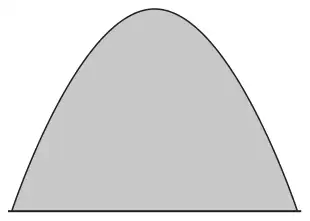
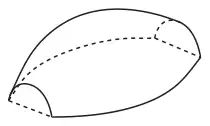
Figure 1 shows a solid paperweight with a flat base.
Figure 2 shows the curve with equation
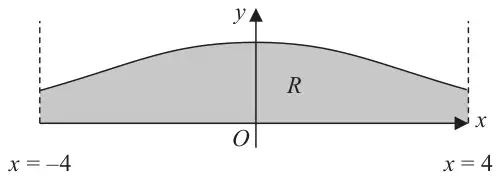
\[y = H\cos^3\left(\frac{x}{4}\right) \qquad\qquad {-4} \leqslant x \leqslant 4\]
where \(H\) is a positive constant and \(x\) is in radians.
The region \(R\), shown shaded in Figure 2, is bounded by the curve, the line with equation \(x = -4\), the line with equation \(x = 4\) and the \(x\)-axis.
The paperweight is modelled by the solid of revolution formed when \(R\) is rotated 180° about the \(x\)-axis.
Given that the maximum height of the paperweight is 2 cm,
(b) write down the value of \(H\). (1)
(c) Using algebraic integration and the result in part (a), determine, in \(\text{cm}^3\), the volume of the paperweight, according to the model. Give your answer to 2 decimal places.
[Solutions based entirely on calculator technology are not acceptable.]
B1: Correct identity or equivalent rearrangement. This can appear anywhere in the proof.
M1: Attempts the expansion of \(\left(z + \dfrac{1}{z}\right)^6\) must have at least 3 correct terms. Combining the powers when expanding is fine.
A1: Correct expansion with \(z\) terms simplified, need not be rearranged. (So a correct expansion will score M1A1.)
M1: Uses \(z^n + \dfrac{1}{z^n} = 2\cos n\theta\) to write the expression in terms multiple angles of \(\cos 6\theta,\ \cos 4\theta\) and \(\cos 2\theta\). Pairing of terms must be seen.
A1*: Achieves the printed answer with no errors or omissions. Cso
For approaches using De Moivre B0M1A1M0A0 may be scored if the binomial expansions is attempted (and correct for the A).
Note: The question instructs use of algebraic integration and part (a), so answer only can score at most B1 for implied correct formula.
B1ft: Correct expression for the volume of the paperweight or the solid formed through 360° rotation, stated or implied, ignore limits. No need to expand, but must be applied, not just a formula in \(y\), though allow a correct formula followed by correct integral if the \(\pi\) disappears. Follow through their \(H\)
M1: Uses the result in part part (a) to express the volume in an integrable form and attempts to integrate. Note use of \(\theta\) instead of \(x\) is permissible for this mark. Allow if one term is missing or miscopied.
A1: Correct integration in terms of \(x\). Ignore \(\pi\), their \(H^2\) and the \(\dfrac{1}{32}\). Note if \(\theta\) has been used it is A0 unless a correct substitution method has been implied as the coefficients will be incorrect.
dM1: Dependent on previous method mark and must have reached and integral of the correct form -- in terms of \(x\) with correct arguments allowing for one slip. Finds the required volume using either \(\pi\int_0^4 y^2\,\mathrm{d}x\) or \(\dfrac{1}{2}\pi\int_{-4}^{4} y^2\,\mathrm{d}x\) and applies their limits - accept any value following a valid attempt at the integration as an attempt at applying limits.
A1: cao 24.56
Mark scheme (d)
Scheme
Marks
AO
The equation of the curve may not be suitable The measurements may not be accurate The paperweight may not be smooth
B1
3.5b
(1)
(12 marks)
Notes
B1: States an appropriate limitation. See scheme for some examples. The limitation should refer to the paperweight, not to paper. Do not accept “it does not take into account thickness of material” as it is a solid, not a shell, being modelled. Award the mark for a correct reason if two reasons are given and one is incorrect.
e.g. \(x = -1 \Rightarrow A = \ldots,\ x = 0 \Rightarrow C = \ldots,\ \text{coeff } x^2 \Rightarrow B = \ldots\) or Compares coefficients and solves to find values for \(A\), \(B\) and \(C\) \(2 = A + B,\ 3 = B + C,\ 6 = 4A + C\)
dM1
1.1b
\(A = 1,\quad B = 1,\quad C = 2\)
A1
1.1b
(3)
Notes
M1: Selects the correct form for partial fractions and multiplies through to form suitable identity or uses a method to find at least one value (e.g. cover up rule).
dM1: Full method for finding values for all three constants. Dependent on first M. Allow slips as long as the intention is clear.
M1: Splits the integral into an integrable form and integrates at least two terms to the correct form. They may use a substitution on the arctan term
A1: Fully correct Integration.
dM1: Uses the limits of 0 and 2 (or appropriate for a substitution), subtracts the correct way round and combines the ln terms from separate integrals to a single term with evidence of correct ln laws at least once.
(a) Use a hyperbolic substitution and calculus to show that\[\int\frac{x^2}{\sqrt{x^2 - 1}}\,\mathrm{d}x = \frac{1}{2}\left[x\sqrt{x^2 - 1} + \operatorname{arcosh} x\right] + k\]where \(k\) is an arbitrary constant. (6)
Figure 1
Figure 1 shows a sketch of part of the curve \(C\) with equation
\[y = \frac{4}{15}x\operatorname{arcosh} x \qquad\qquad x \geqslant 1\]
The finite region \(R\), shown shaded in Figure 1, is bounded by the curve \(C\), the \(x\)-axis and the line with equation \(x = 3\)
(b) Using algebraic integration and the result from part (a), show that the area of \(R\) is given by\[\frac{1}{15}\left[17\ln\left(3 + 2\sqrt{2}\right) - 6\sqrt{2}\right]\] (5)
Mark scheme (a)
Scheme
Marks
AO
\(\displaystyle\int\frac{x^2}{\sqrt{x^2 - 1}}\,\mathrm{d}x \to \int\mathrm{f}(u)\,\mathrm{d}u\) Uses the substitution \(x = \cosh u\) fully to achieve an integral in terms of \(u\) only, including replacing the \(\mathrm{d}x\)
M1
3.1a
\(\displaystyle\int\frac{\cosh^2 u}{\sqrt{\cosh^2 u - 1}}\sinh u\,(\mathrm{d}u)\)
A1
1.1b
Uses correct identities \(\cosh^2 u - 1 = \sinh^2 u\) and \(\cosh 2u = 2\cosh^2 u - 1\) to achieve an integral of the form \(A\displaystyle\int(\cosh 2u \pm 1)\,\mathrm{d}u \qquad A \gt 0\)
M1
3.1a
Integrates to achieve \(A\left(\pm\dfrac{1}{2}\sinh 2u \pm u\right)(+c) \qquad A \gt 0\)
M1
1.1b
Uses the identity \(\sinh 2u = 2\sinh u\cosh u\) and \(\cosh^2 u - 1 = \sinh^2 u\) \(\to \sinh 2u = 2x\sqrt{x^2 - 1}\)
M1: Uses the substitution \(x = \cosh u\) fully to achieve an integral in terms of \(u\) only. Must have replaced the \(\mathrm{d}x\) but allow if the \(\mathrm{d}u\) is missing.
A1: Correct integral in terms of \(u\). (Allow if the \(\mathrm{d}u\) is missing.)
M1: Uses correct identities \(\cosh^2 u - 1 = \sinh^2 u\) and \(\cosh 2u = 2\cosh^2 u - 1\) to achieve an integrand of the required form
M1: Integrates to achieve the correct form, may be sign errors.
M1: Uses the identities \(\sinh 2u = 2\sinh u\cosh u\) and \(\cosh^2 u - 1 = \sinh^2 u\) to attempt to find \(\sinh 2u\) in terms of \(x\). If using exponentials there must be a full and complete method to attempt the correct form.
A1*: Achieves the printed answer with no errors seen, cso
NB attempts at integration by parts are not likely to make progress – to do so would need to split the integrand as \(x\dfrac{x}{\sqrt{x^2 - 1}}\). If you see any attempts that you feel merit credit, use review.
Mark scheme (b)
Scheme
Marks
AO
Uses integration by parts the correct way around to achieve \(\displaystyle\int\frac{4}{15}x\operatorname{arcosh} x\,\mathrm{d}x = Px^2\operatorname{arcosh} x - Q\int\frac{x^2}{\sqrt{x^2 - 1}}\,\mathrm{d}x\)
M1
2.1
\(= \dfrac{4}{15}\left(\dfrac{1}{2}x^2\operatorname{arcosh} x - \dfrac{1}{2}\displaystyle\int\frac{x^2}{\sqrt{x^2 - 1}}\,\mathrm{d}x\right)\)
A1
1.1b
\(= \dfrac{4}{15}\left(\dfrac{1}{2}x^2\operatorname{arcosh} x - \dfrac{1}{2}\left(\dfrac{1}{2}\left[x\sqrt{x^2 - 1} + \operatorname{arcosh} x\right]\right)\right)\)
B1ft
2.2a
Uses the limits \(x = 1\) and \(x = 3\) the correct way around and subtracts \(= \dfrac{4}{15}\left(\dfrac{1}{2}(3)^2\operatorname{arcosh} 3 - \dfrac{1}{2}\left(\dfrac{1}{2}\left[3\sqrt{(3)^2 - 1} + \operatorname{arcosh} 3\right]\right)\right) - \dfrac{4}{15}(0)\)
Solutions based entirely on graphical or numerical methods are not acceptable.
Figure 1
Figure 1 shows a sketch of part of the curve with equation
\[y = \operatorname{arsinh} x \qquad x \geqslant 0\]
and the straight line with equation \(y = \beta\)
The line and the curve intersect at the point with coordinates \((\alpha, \beta)\)
Given that \(\beta = \dfrac{1}{2}\ln 3\)
(a) show that \(\alpha = \dfrac{1}{\sqrt{3}}\) (3)
The finite region \(R\), shown shaded in Figure 1, is bounded by the curve with equation \(y = \operatorname{arsinh} x\), the \(y\)-axis and the line with equation \(y = \beta\)
The region \(R\) is rotated through \(2\pi\) radians about the \(y\)-axis.
(b) Use calculus to find the exact value of the volume of the solid generated. (6)
\(\alpha = \dfrac{\sqrt{3}}{3}\) or \(\dfrac{1}{\sqrt{3}}\)
A1
2.2a
(3)
Notes
(a) B1: Recalls the definition for \(\sinh\left(\dfrac{1}{2}\ln 3\right)\) or forms an equation for \(\operatorname{arsinh} x\) M1: Uses logarithms to find a value for \(\alpha\) or forms and solves a correct equation without log A1: Deduces the correct exact value for \(\alpha\)
Note using the result \(\ln\left(\dfrac{1}{\sqrt{3}} + \sqrt{\left(\dfrac{1}{\sqrt{3}}\right)^2 + 1}\right) = \ln\left(\dfrac{1}{\sqrt{3}} + \sqrt{\dfrac{4}{3}}\right) = \ln\sqrt{3} = \dfrac{1}{2}\ln 3\) therefore \(\operatorname{arsinh}\left(\dfrac{1}{\sqrt{3}}\right) = \dfrac{1}{2}\ln 3\) B1 for substituting in \(\alpha\) into \(\operatorname{arsinh} x\), M1 for rearranging to show \(\dfrac{1}{2}\ln 3\), A1 for conclusion
\(\dfrac{1}{4}\left(\dfrac{1}{2}\mathrm{e}^{2y} - 2y - \dfrac{1}{2}\mathrm{e}^{-2y}\right)\) or \(\dfrac{1}{4}\sinh 2y - \dfrac{1}{2}y\)
dM1 A1
1.1b 1.1b
Use limits \(y = 0\) and \(y = \dfrac{1}{2}\ln 3\) and subtracts the correct way round
M1
1.1b
\(\dfrac{\pi}{4}\left(\dfrac{4}{3} - \ln 3\right)\) or exact equivalent
A1
1.1b
(6)
(9 marks)
Notes
(b) B1: Correct expression for the volume \(\pi\displaystyle\int_0^{\frac{1}{2}\ln 3}\sinh^2 y\,\mathrm{d}y\) requires integration signs, \(\mathrm{d}y\) and correct limits. M1: Uses the exponential formula for \(\sinh y\) or the identity \(\cosh 2y = \pm 1 \pm 2\sinh^2 y\) to write in a form which can be integrated at least one term dM1: Dependent of previous method mark, integrates. A1: Correct integration. M1: Correct use of the limits \(y = 0\) and \(y = \dfrac{1}{2}\ln 3\) A1: Correct exact volume.
(i) Evaluate the improper integral\[\int_1^{\infty} 2\mathrm{e}^{-\frac{1}{2}x}\,\mathrm{d}x\] (3)
(ii) The air temperature, \(\theta\,{}^{\circ}\mathrm{C}\), on a particular day in London is modelled by the equation\[\theta = 8 - 5\sin\left(\frac{\pi}{12}t\right) - \cos\left(\frac{\pi}{6}t\right) \qquad\qquad 0 \leqslant t \leqslant 24\]where \(t\) is the number of hours after midnight.
(a) Use calculus to show that the mean air temperature on this day is \(8\,{}^{\circ}\mathrm{C}\), according to the model. (3)
Given that the actual mean air temperature recorded on this day was higher than \(8\,{}^{\circ}\mathrm{C}\),
M1: Attempt to integrate to a form \(\lambda\mathrm{e}^{-\frac{1}{2}x}\) where \(\lambda \neq 2\), and applies correct limits with some consideration of the infinite limit given (e.g. with the limit statement). Only allow with \(\infty\) used as the limit if subsequent work shows the term is zero.
A1: Correct value
Mark scheme (ii)(a)
Scheme
Marks
AO
Mean temperature \(= \dfrac{1}{24}\displaystyle\int_0^{24}\left(8 - 5\sin\left(\frac{\pi}{12}t\right) - \cos\left(\frac{\pi}{6}t\right)\right)\mathrm{d}t\)
B1: Recalls the correct formula for finding the mean value of a function. You may see the division by “24” only at the end. No integration is necessary, just a correct statement with an integral.
M1: Integrates to a form \(\alpha t + \beta\cos\left(\dfrac{\pi}{12}t\right) + \delta\sin\left(\dfrac{\pi}{6}t\right)\) and uses the limits of 0 and 24 (the correct way around). If no explicit substitution is seen, accept any value following the integral as an attempt. Answers from a calculator with no correct integral seen score M0 as the question requires calculus to be used.
A1*cso: Achieves 8 with no errors seen following a full attempt at the substitution. Must have seen some evidence of the limits used, minimum required for substitution is \(\left[\left(8(24) + \dfrac{60}{\pi}\right) - \left(\dfrac{60}{\pi}\right)\right]\).
Mark scheme (ii)(b)
Scheme
Marks
AO
E.g. increase the value of the constant 8 / adapt the constant 8 to a function which takes values greater than 8.
B1
3.5c
(1)
(7 marks)
Notes
B1: Accept any reasonable adaptation to the equation that will increase the mean value. E.g. as in scheme, or introduce another positive term, or decrease the constant 5 etc. It must be clear which constant they are referring to in their reason, not just “increase the constant”.
(a) Use the Maclaurin series expansion for \(\cos x\) to determine the series expansion of \(\cos^2\left(\dfrac{x}{3}\right)\) in ascending powers of \(x\), up to and including the term in \(x^4\) Give each term in simplest form. (2)
(b) Use the answer to part (a) and calculus to find an approximation, to 5 decimal places, for\[\int_{\frac{\pi}{6}}^{\frac{\pi}{2}}\left(\frac{1}{x}\cos^2\left(\frac{x}{3}\right)\right)\mathrm{d}x\] (3)
(c) Use the integration function on your calculator to evaluate\[\int_{\frac{\pi}{6}}^{\frac{\pi}{2}}\left(\frac{1}{x}\cos^2\left(\frac{x}{3}\right)\right)\mathrm{d}x\]Give your answer to 5 decimal places. (1)
(d) Assuming that the calculator answer in part (c) is accurate to 5 decimal places, comment on the accuracy of the approximation found in part (b). (1)
M1: Deduces the required series by using the Maclaurin series for \(\cos x\), replacing \(x\) with \(\dfrac{x}{3}\) and squares, or first applying the double angle identity (allow sign error) and then applying the series for \(\cos x\) with \(\dfrac{2x}{3}\). Attempts at finding from differentiation score M0 as the cosine series is required.
A1: Correct series
Mark scheme (b)
Scheme
Marks
AO
\(\displaystyle\int\frac{1 - \frac{x^2}{9} + \frac{1}{243}x^4}{x} = \int\frac{1}{x} - \frac{x}{9} + \frac{1}{243}x^3 = A\ln x + Bx^2 + Cx^4\) where \(A\), \(B\) and \(C \neq 0\)
M1
3.1a
\(\ln x - \dfrac{x^2}{18} + \dfrac{1}{972}x^4\)
A1ft
1.1b
= awrt 0.98295
A1
2.2a
(3)
Notes
M1: Divides their series in part (a) by \(x\) and integrates to the form \(A\ln x + Bx^2 + Cx^4\)
A1ft: Correct integration, follow through on their coefficients and need not be simplified.
A1: Deduces the definite integral awrt 0.98295
Mark scheme (c)
Scheme
Marks
AO
Calculator = awrt 0.98280
B1
1.1b
(1)
Notes
B1: Correct value.
Mark scheme (d)
Scheme
Marks
AO
E.g. the approximation is correct to 3 d.p.
B1
3.2b
(1)
(7 marks)
Notes
B1: Makes a quantitative statement about the accuracy, so e.g. how many decimal places or significant figures it is correct to, or calculates a percentage accuracy to deduce it is reasonable. Do not accept just “underestimate” or similar without quantitative evidence. Allow for a reasonable comment as long as (b) is correct to at least 2 s.f. but (c) must be the correct value.
A student wants to make plastic chess pieces using a 3D printer. Figure 1 shows the central vertical cross-section of the student’s design for one chess piece. The plastic chess piece is formed by rotating the region bounded by the \(y\)-axis, the \(x\)-axis, the line with equation \(x = 1\), the curve \(C_1\) and the curve \(C_2\) through \(360^\circ\) about the \(y\)-axis.
The point \(A\) has coordinates \((1, 0.5)\) and the point \(B\) has coordinates \((0.5, 2.5)\) where the units are centimetres.
(a) Determine the value of \(a\) and the value of \(b\) according to the model. (2)
The curve \(C_2\) is modelled to be an arc of the circle with centre \((0, 3)\).
(b) Use calculus to determine the volume of plastic required to make the chess piece according to the model. (9)
Mark scheme (a)
Scheme
Marks
AO
\(1 = \dfrac{a}{0.5 + b},\ 0.5 = \dfrac{a}{2.5 + b} \Rightarrow a = \ldots,\ b = \ldots\)
M1
3.3
\(a = 2,\ b = 1.5\)
A1
1.1b
(2)
Notes
(a) M1: Uses the given coordinates correctly in the equation modelling the curve to obtain at least one correct equation and attempts to find the values of \(a\) and \(b\) A1: Correct values
(b) B1ft: Uses the model to obtain \(\displaystyle\pi\int \left(\frac{\text{their } a}{y + \text{their } b}\right)^2\mathrm{d}y\). Note the \(\pi\) can be recovered if appears later. M1: Chooses limits appropriate to the model i.e. 0.5 and 2.5 M1: Integrates to obtain an expression of the form \(k(y + \text{“}1.5\text{”})^{-1}\) B1: Deduces the correct equation for the circle M1: Uses their circle equation and \(\displaystyle\pi\int x^2\,\mathrm{d}y\) to attempt the top volume. Note the \(\pi\) can be recovered if appears later. M1: Identifies limits appropriate to the model i.e. 2.5 and 3 + their radius A1: Correct integration dM1: Uses the model to find the volume of the chess piece including the cylindrical base (dependent on all previous method marks) A1: Correct volume
(a) \[y = \tan^{-1}x\]Assuming the derivative of \(\tan x\), prove that\[\frac{\mathrm{d}y}{\mathrm{d}x} = \frac{1}{1 + x^2}\] (3)
\[\mathrm{f}(x) = x\tan^{-1}4x\]
(b) Show that\[\int \mathrm{f}(x)\,\mathrm{d}x = Ax^2\tan^{-1}4x + Bx + C\tan^{-1}4x + k\]where \(k\) is an arbitrary constant and \(A\), \(B\) and \(C\) are constants to be determined. (5)
(c) Hence find, in exact form, the mean value of \(\mathrm{f}(x)\) over the interval \(\left[0, \dfrac{\sqrt{3}}{4}\right]\) (2)
Mark scheme (a)
Scheme
Marks
AO
\(y = \tan^{-1}x \Rightarrow \tan y = x \Rightarrow \dfrac{\mathrm{d}x}{\mathrm{d}y} = \sec^2 y\) \(y = \tan^{-1}x \Rightarrow \tan y = x \Rightarrow \dfrac{\mathrm{d}y}{\mathrm{d}x}\sec^2 y = 1\)
(a) M1: Makes progress in establishing the derivative by taking the tan of both sides and differentiating with respect to \(y\) or implicitly with respect to \(x\) M1: Use of the correct identity A1*: Fully correct proof
(b) B1: Correct derivative M1: Uses integration by parts in the correct direction A1: Correct expression M1: Adopts a correct strategy for the integration by splitting into two fractions or using a substitution of \(4x = \tan u\) to get to an integrable form A1: Correct answer
(corrected from the printed mark scheme: \(\displaystyle\frac{1}{32}\int \left(\sec^2 u - 1\right)\mathrm{d}u\) is printed as \(\displaystyle\frac{1}{32}\int \sec^2 u - u\,\mathrm{d}u\))
\(= \dfrac{\sqrt{3}}{72}\left(4\pi - 3\sqrt{3}\right)\) or \(\dfrac{\sqrt{3}}{18}\pi - \dfrac{1}{8}\) oe
A1
1.1b
(2)
(10 marks)
Notes
(c) M1: Correctly applies the method for the mean value for their integration. The limit of zero can be implied if it comes to 0. A1: Correct exact answer. Allow exact equivalents e.g. \(\dfrac{4\pi\sqrt{3} - 9}{72},\ \dfrac{\pi\sqrt{3}}{18} - \dfrac{1}{8}\)
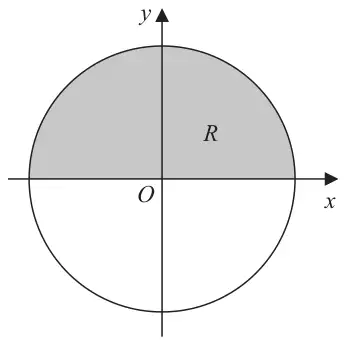
Figure 1 shows a circle with radius \(r\) and centre at the origin. The region \(R\), shown shaded in Figure 1, is bounded by the \(x\)-axis and the part of the circle for which \(y > 0\) The region \(R\) is rotated through 360° about the \(x\)-axis to create a sphere with volume \(V\)
Use integration to show that \(V = \dfrac{4}{3}\pi r^3\) (5)
Integrates to the form \(\alpha x \pm \beta x^3\) [note: the correct integration gives \(r^2x - \dfrac{1}{3}x^3\)]
M1
1.1b
Substitutes limits of \(-r\) and \(r\) and subtracts the correct way round\[\left(r^2(r) - \frac{1}{3}(r)^3\right) - \left(r^2(-r) - \frac{1}{3}(-r)^3\right)\]or Substitutes limits of 0 and \(r\) and subtracts the correct way round with twice the volume. Note the limit of 0 can be implied if gives and answer of 0\[\left(r^2(r) - \frac{1}{3}(r)^3\right) - (0)\]
dM1
1.1b
\(V = \dfrac{4}{3}\pi r^3\) * cso
A1*
1.1b
(5)
(5 marks)
Notes
B1: Correct equation of the circle, may be implied by correct integral
B1: Correct expression for the volume, including limits, d\(x\) may be implied and if using limits \(r\) and 0 the 2 could appear later with reasoning
M1: Integrates to the form \(\alpha x \pm \beta x^3\). Do not award if \(r^2 \to \lambda r^3\)
dM1: Dependent on previous method mark. Correct use of limits \(-r\) and \(r\) or limits of 0 and \(r\) with twice the volume.
A1*: \(V = \dfrac{4}{3}\pi r^3\) * cso
Note: rotation about the \(y\)-axis all marks are available, however for the final accuracy mark must refer to symmetry
(a) Explain why \(\displaystyle\int_{1}^{\infty} \frac{1}{x(2x + 5)}\,\mathrm{d}x\) is an improper integral. (1)
(b) Prove that\[\int_{1}^{\infty} \frac{1}{x(2x + 5)}\,\mathrm{d}x = a\ln b\]where \(a\) and \(b\) are rational numbers to be determined. (6)
Mark scheme (a)
Scheme
Marks
AO
E.g.
Because the interval being integrated over is unbounded
Accept because the upper limit is infinity
Accept because a limit is required to evaluate it
B1
2.4
(1)
Notes
(a) B1: For a suitable explanation with no contrary reasoning. Technically this should refer to the interval being unbounded, but this is unlikely to be seen. Accept “Because the upper limit is infinity”. Do not award if there are erroneous statements e.g. referring to as \(x = 0\) the integrand is not defined. Do not accept “because one of the limits is undefined” unless they state they mean \(\infty\). Do not accept “it is undefined when \(x = \infty\)” without reference to “it” being the upper limit.
Mark scheme (b)
Scheme
Marks
AO
\(\dfrac{1}{x(2x + 5)} = \dfrac{A}{x} + \dfrac{B}{2x + 5} \Rightarrow A = \ldots,\ B = \ldots\)
(b) M1: Selects the correct form for partial fractions and proceeds to find values for \(A\) and \(B\) A1: Correct constants or partial fractions A1ft: \(\displaystyle\int \frac{p}{x} + \frac{q}{2x + 5}\,\mathrm{d}x = p\ln x + \frac{q}{2}\ln(2x + 5)\) Note that \(\dfrac{1}{5}\ln 5x - \dfrac{1}{5}\ln(10x + 25)\) is correct. M1: Combines logs correctly. May see \(-\dfrac{1}{5}\ln\left(\dfrac{2x + 5}{x}\right) = -\dfrac{1}{5}\ln\left(2 + \dfrac{5}{x}\right)\) B1: Correct upper limit for \(x \to \infty\) by recognising the dominant terms. (Simply replacing \(x\) with \(\infty\) scores B0) A1: Deduces the correct value for the improper integral in the correct form
Note the method marks as MAMABA, and should be entered in this order on ePEN. M1: Expands the denominator and completes the square. A1: Correct expression M1: For \(\dfrac{1}{(x + p)^2 - a^2} \to k\ln\left|\dfrac{x + p - a}{x + p + a}\right|\) A1ft: \(\dfrac{1}{2}\dfrac{1}{(x + a)^2 - a^2} \to \dfrac{1}{2a}\ln\left|\dfrac{x}{x + 2a}\right|\) with their \(a\) (may be simplified as in scheme). B1: Correct upper limit for \(x \to \infty\) by recognising the dominant terms. (Simply replacing \(x\) with \(\infty\) scores B0) Note in this method the upper limit evaluates to zero. A1: Deduces the correct value for the improper integral in the correct form. Accept \(-\dfrac{1}{5}\ln\dfrac{2}{7}\)
\[\mathrm{f}(x) = 2x^{\frac{1}{3}} + x^{-\frac{2}{3}} \qquad x > 0\]
The finite region bounded by the curve \(y = \mathrm{f}(x)\), the line \(x = \dfrac{1}{8}\), the \(x\)-axis and the line \(x = 8\) is rotated through \(\theta\) radians about the \(x\)-axis to form a solid of revolution.
Given that the volume of the solid formed is \(\dfrac{461}{2}\) units cubed, use algebraic integration to find the angle \(\theta\) through which the region is rotated. (8)
Mark scheme
Scheme
Marks
AO
A correct overall strategy, an attempt at integrating \(y^2\) with respect to \(x\) combine in some way with the volume of revolution formula (use of \(\pi\displaystyle\int y^2\,\mathrm{d}x\) or \(\alpha\displaystyle\int y^2\,\mathrm{d}x\) for any variable \(\alpha\) is fine) followed by attempt to find an angle/form an equation in \(\theta\)
M1
3.1a
\(y^2 = kx^{\frac{2}{3}} + \ldots + \dfrac{m}{x^{\frac{4}{3}}}\) or \(y^2 = kx^{\frac{2}{3}} + \ldots + mx^{-\frac{4}{3}}\) where … is one or two more terms.
M1: A correct overall strategy, either finding full volume rotated by \(2\pi\) first, then performing some kind of scaling, or using \(\alpha\displaystyle\int y^2\,\mathrm{d}x\) for a variable \(\alpha\) (ideally \(\dfrac{\theta}{2}\), but for the strategy accept with any variable multiple), to form an equation in just the angle.
M1: Attempting to square \(y\) to a three or four term expression. Look for correct powers on first and last term with some term(s) in the middle.
A1: Correct expansion in three or four terms – award when first seen.
M1: Integrates \(y^2\) w.r.t. \(x\). Must have at least two terms in their \(y^2\) with fractional indices. Power to be increased by 1 in at least two terms.
A1ft: Two terms of integral correct. Follow through on their expansion. Need not be simplified.
A1: Fully correct integral. Need not be simplified. May still be four terms
M1: Either: Substitutes limits and subtracts correct way round (must be seen or implied by the answer), and equates to \(\dfrac{461}{2}\) if using \(\frac{1}{2}\theta\displaystyle\int y^2\,\mathrm{d}x\) and proceeds to find \(\theta\). Or: Substitutes limits and subtracts correct way round (seen or implied) and multiplies by \(\pi\) to get the full volume AND then multiplies the result by \(\dfrac{\theta}{2\pi}\) before equating to \(\dfrac{461}{2}\). The method must be correct for this mark – so they must be using \(\dfrac{\theta}{2}\displaystyle\int y^2\,\mathrm{d}x\) directly or \(\pi\displaystyle\int y^2\,\mathrm{d}x\) and scale by \(\dfrac{\theta}{2\pi}\) when setting equal to \(\dfrac{461}{2}\)
A1: Correct angle found. Accept \(\dfrac{40}{9}\), awrt 4.44 or awrt 255° (as long as the degrees units are made clear – do not accept just 255) isw once a correct value of \(\theta\) is found.
Special case The question specified that algebraic integration must be used, so use of a calculator to find the integral cannot score the marks for integration but may be allowed the strategy and answer marks. A maximum of M1M0A0M0A0A0M1A1 is available in such cases. Expanding \(y^2\) first but showing no integration can score the second M and first A (if earned) as well.
Note that \(\displaystyle\int_{1/8}^{8}\left(2x^{\frac{1}{3}} + x^{-\frac{2}{3}}\right)^2\mathrm{d}x = \frac{4149}{40} = 103.725\) but just this alone is worth no marks. There must be an attempt to incorporate this within a strategy to gain access to marks.
Figure 1 shows the central vertical cross section \(ABCD\) of a paddling pool that has a circular horizontal cross section. Measurements of the diameters of the top and bottom of the paddling pool have been taken in order to estimate the volume of water that the paddling pool can contain.
Using these measurements, the curve \(BD\) is modelled by the equation
B1ft: Uses the model to obtain \(x\) correctly in terms of \(y\) (follow through their \(k\))
M1: Uses the model to obtain an expression for the volume of the pool using \(\displaystyle\pi\int (\mathit{their}\ f(y))^2\,\mathrm{d}y\) – must expand in order to reach an integrable form (allow poor squaring e.g. \((a + b)^2 = a^2 + b^2\). Note that the \(\pi\) may be recovered later.
A1: Correct integration
M1: Selects limits appropriate to the model (\(h\) and 0) substitutes and clearly shows the use of both limits (i.e. including zero)
A1: Correct expression (allow unsimplified and isw if necessary)
M1: Recognises that \(\dfrac{\mathrm{d}V}{\mathrm{d}h}\) is required and attempts to find \(\dfrac{\mathrm{d}V}{\mathrm{d}h}\) or \(\dfrac{\mathrm{d}h}{\mathrm{d}V}\) from their integration or using the earlier result (before integrating). Must clearly be identified as \(\dfrac{\mathrm{d}V}{\mathrm{d}h}\) or \(\dfrac{\mathrm{d}h}{\mathrm{d}V}\) unless this implied by subsequent work.
M1: Evidence of the correct use of the chain rule (ignore any confusion with units). Look for an attempt to divide 15 or their converted 15 by their \(\dfrac{\mathrm{d}V}{\mathrm{d}h}\) or to multiply 15 or their converted 15 by \(\dfrac{\mathrm{d}h}{\mathrm{d}V}\) but must reach a value for \(\dfrac{\mathrm{d}h}{\mathrm{d}t}\) but you do not need to check their value.
A1: Interprets their solution correctly to obtain the correct answer (awrt 25.4) with the correct units
Alternative: Way 2
Scheme
Marks
AO
\(y = 0.2 \Rightarrow x = \dfrac{2.6 + \mathrm{e}^{0.2}}{3.6} \Rightarrow A = \pi\left(\dfrac{2.6 + \mathrm{e}^{0.2}}{3.6}\right)^2\ (= 3.54)\)
(a) Using a substitution, that should be stated clearly, show that\[\int \mathrm{f}(x)\,\mathrm{d}x = A\sinh^{-1}(Bx) + c\]where \(c\) is an arbitrary constant and \(A\) and \(B\) are constants to be found. (4)
(b) Hence find, in exact form in terms of natural logarithms, the mean value of \(\mathrm{f}(x)\) over the interval \([0, 3]\). (2)
B1: Selects an appropriate substitution leading to an integrable form
M1: Demonstrates a fully correct method for the substitution that includes substituting into the function and dealing with the “\(\mathrm{d}x\)”. The substitution being substituted does not need to be “correct” for this mark but the substitution must be an attempt at \(\displaystyle\int \frac{1}{\sqrt{4\left[\mathrm{f}(u)\right]^2 + 9}} \times \mathrm{f}^{\prime}(u)\,\mathrm{d}u\) with the \(\mathrm{f}^{\prime}(u)\) correct for their substitution. E.g. if \(x = \dfrac{1}{2}u\) is used, must see \(\mathrm{d}x = \dfrac{1}{2}\mathrm{d}u\) not \(2\mathrm{d}u\).
A1: Correct simplified integral in terms of \(u\) from correct work and from a correct substitution
A1: Correct answer including “\(+ c\)”. Allow arcsinh or arsinh for \(\sinh^{-1}\) from correct work and from a correct substitution
(Corrected from the printed mark scheme: the last line is printed as “\(u = \dfrac{1}{2}\sinh^{-1}\left(\dfrac{2x}{3}\right) + c\)”; it is the integral, not \(u\), that equals this.)
Alternative: Way 3
Scheme
Marks
AO
\(x = \dfrac{1}{2}u\) or \(x = ku\) where \(k \gt 0\ \ k \neq 1\)
Mean value \(=\) \(\dfrac{1}{3(-0)}\left[\dfrac{1}{2}\sinh^{-1}\left(\dfrac{2x}{3}\right)\right]_0^3 = \dfrac{1}{3} \times \dfrac{1}{2}\sinh^{-1}\left(\dfrac{2 \times 3}{3}\right)(-0)\)
M1
2.1
\(= \dfrac{1}{6}\ln\left(2 + \sqrt{5}\right)\) (Brackets are required)
A1ft
1.1b
(2)
(6 marks)
Notes
M1: Correctly applies the method for the mean value for their integration which must be of the form specified in part (a) and substitutes the limits 0 and 3 but condone omission of 0
A1: Correct exact answer (follow through their \(A\) and \(B\)). Brackets are required if appropriate.
\(8x - 12 = (Ax + B)(x + 1) + C\left(2x^2 + 3\right)\) E.g. \(x = -1 \Rightarrow C = -4,\ x = 0 \Rightarrow B = 0,\ x = 1 \Rightarrow A = 8\) Or Compares coefficients and solves \((A + 2C = 0 \quad A + B = 8 \quad B + 3C = -12)\) \(\Rightarrow A = \ldots,\ B = \ldots,\ C = \ldots\)
M1: Selects the correct form for partial fractions.
dM1: Full method for finding values for all three constants. Dependent on having the correct form for the partial fractions. Allow slips as long as the intention is clear.
A1: Correct constants or partial fractions.
A1ft: Integrates \(\displaystyle\int \frac{px}{2x^2 + 3} - \frac{q}{x + 1}\,\mathrm{d}x = \frac{p}{4}\ln\left(2x^2 + 3\right) - q\ln(x + 1)\) and no extra terms
M1: Combines two algebraic log terms correctly.
B1: Correct upper limit for \(x \to \infty\) by recognising the dominant terms. (Simply replacing \(x\) with \(\infty\) scores B0). This can be implied.
A1: Deduces the correct value for the improper integral in the correct form, cao A0 for \(2\ln\dfrac{2}{3}\)
Correct answer with no working seen is no marks.
Note: Incorrect partial fraction form, \(\dfrac{A}{2x^2 + 3} + \dfrac{B}{x + 1}\) or \(\dfrac{Ax}{2x^2 + 3} + \dfrac{B}{x + 1}\) the maximum it can score is M0M0A0A0M1B1A0
A mathematics student is modelling the profile of a glass bottle of water. Figure 1 shows a sketch of a central vertical cross-section \(ABCDEFGHA\) of the bottle with the measurements taken by the student.
The horizontal cross-section between \(CF\) and \(DE\) is a circle of diameter 8 cm and the horizontal cross-section between \(BG\) and \(AH\) is a circle of diameter 2 cm.
The student thinks that the curve \(GF\) could be modelled as a curve with equation
\[y = ax^2 + b \qquad 1 \leqslant x \leqslant 4\]
where \(a\) and \(b\) are constants and \(O\) is the fixed origin, as shown in Figure 2.
(a) Find the value of \(a\) and the value of \(b\) according to the model. (2)
(b) Use the model to find the volume of water that the bottle can contain. (7)
(c) State a limitation of the model. (1)
The label on the bottle states that the bottle holds approximately 750 cm3 of water.
(d) Use this information and your answer to part (b) to evaluate the model, explaining your reasoning. (1)
Mark scheme (a)
Scheme
Marks
AO
\((4, 14),\ (1, 18) \Rightarrow 14 = a(4)^2 + b,\ 18 = a(1)^2 + b \Rightarrow a = \ldots, b = \ldots\)
M1
3.3
\(a = -\dfrac{4}{15},\ b = \dfrac{274}{15}\)
A1
1.1b
(2)
Notes
M1: Chooses (4, 14) and (1, 18) and substitutes into the equation modelling the curve to obtain at least one correct equation and attempts to find the values of \(a\) and \(b\).
A1: Infers from the data in the model, the values of \(a\) and \(b\)
B1: Correct expressions for the 2 cylindrical parts. May be seen as a sum or as separate cylinders.
B1ft: Uses the model to obtain \(\pi\displaystyle\int\left(\frac{y - \text{their } b}{\text{their } a}\right)\mathrm{d}y\) (Note that the \(\pi\) may be recovered later)
M1: Chooses limits appropriate to the model i.e. 14 and 18
M1: Integrates to obtain an expression of the form \(\alpha y + \beta y^2\)
A1: Uses their model correctly to give \(274y - \dfrac{15y^2}{2}\)
ddM1: Uses the model to find the sum of their cylinders + their integrated volume. Must be a fully correct method here and is dependent on both previous method marks. So must have attempted the volumes of the cylinders “AHBG” and “CFED” and adds these to the magnitude of their integrated volume.
A1: \(268\pi\) or awrt 842
Mark scheme (c)
Scheme
Marks
AO
Any one of e.g. The measurements may not be accurate The equation of the curve may not be a suitable model The bottom of the bottle may not be flat The thickness of the glass may not have been considered The glass may not be smooth This part asks for a limitation of the model so their answer must refer to e.g. :
The measuring of the dimensions
The model used for the curve
The simplified model (the thickness of glass, the simplified shape, smoothness of the glass etc.)
B1
3.5b
(1)
Notes
B1: States an acceptable limitation of the model with no contradictory statements. (This is independent of part (b))
Mark scheme (d)
Scheme
Marks
AO
There are 2 criteria for this mark:
A comparison of their value to 750 e.g. larger, smaller, about the same or a difference demonstrated e.g. 810 – 750 = … but not just a percentage error or just a difference with no calculation
A conclusion that is consistent with their values e.g. this is not a good model, this is a good model etc.
If they reach an answer that is less than 750, they need to conclude that it is not a good model If they reach an answer that is greater than 750 then look for a sensible comment that is consistent with their value
B1ft
3.5a
(1)
(11 marks)
Notes
B1ft: Compares the actual volume to their answer to part (b) and makes an assessment of the model with a reason with no contradictory statements.
(c) The shaded region \(R\) is enclosed by the positive \(x\)-axis, the positive \(y\)-axis, the graph of \(y = 4\sinh x + \dfrac{1}{2}\), the graph of \(y = 15\operatorname{cosech} x\) and the line \(x = \ln 9\)
Find the area of \(R\)
Give your answer in the form \(\dfrac{p}{q} + \ln r + s\ln\left(\dfrac{t}{3}\right)\) where \(p\), \(q\), \(r\), \(s\) and \(t\) are integers. [7 marks]
Mark scheme (a)
Scheme
Marks
AO
Forms and solves a quadratic equation or inequality in \(\sinh x\) or Forms a quartic expression in \(\mathrm{e}^x\)
M1
3.1a
Obtains \(-2\) and \(\frac{15}{8}\) or Obtains \(4\mathrm{e}^{4x} + \mathrm{e}^{3x} - 68\mathrm{e}^{2x} - \mathrm{e}^x + 4\)
A1
1.1b
Obtains at least one of \(\ln 4\) or \(\ln(\sqrt{5} - 2)\) OE
M1
1.1a
Obtains \(\ln(\sqrt{5} - 2) \lt x \lt 0,\ x \gt \ln 4\) OE
Uses hyperbolic identities to express their \(\mathrm{f}^{\prime}(x)\) in terms of only \(\sinh\left(\tfrac{1}{2}x\right)\) and \(\cosh\left(\tfrac{1}{2}x\right)\)
M1
2.2a
Completes a reasoned argument to show that \(\mathrm{f}^{\prime}(x) = \operatorname{cosech} x\) AG
16 The picture shows a solar cooker. Part of the solar cooker is a parabolic dish.
The shape of the internal surface of the dish is formed by rotating the part of the parabola \(y^2 = 0.8x\) between \(x = 0\) and \(x = 0.25\) through \(2\pi\) radians about the \(x\)-axis, where \(x\) and \(y\) are measured in metres.
Use integration to show that the internal surface area of the dish, to three decimal places, is 0.796 square metres.
Fully justify your answer. [7 marks]
Mark scheme
Scheme
Marks
AO
Differentiates in order to obtain \(\dfrac{\mathrm{d}y}{\mathrm{d}x}\)
M1
3.1a
Obtains a correct expression for \(\left(\dfrac{\mathrm{d}y}{\mathrm{d}x}\right)^2\) or \(\dfrac{\mathrm{d}y}{\mathrm{d}x}\) in terms of \(x\) or \(y\)
A1
1.1b
Substitutes their \(y\) and their \(\dfrac{\mathrm{d}y}{\mathrm{d}x}\) into the formula for surface area in terms of one variable. Condone missing or incorrect limits
M1
1.1a
Writes integrand in the form \(k(x + 0.2)^{1/2}\) or \(k(5x + 1)^{1/2}\) or \(k(0.8x + 0.16)^{1/2}\) or \(k\cosh^2 u\,\sinh u\) or \(k\,y(y^2 + 0.16)^{1/2}\) OE
M1
2.2a
Obtains \(k(x + 0.2)^{3/2}\) or \(k(5x + 1)^{3/2}\) or \(k(0.8x + 0.16)^{3/2}\) or \(k\cosh^3 u\) or \(k(y^2 + 0.16)^{3/2}\) OE
A1
1.1b
Substitutes correct upper and lower limits into an integrated expression of the form \(k(ax + b)^{3/2}\) or \(k\cosh^3 u\) or \(k(ay^2 + b)^{3/2}\) and subtracts.
M1
1.1a
Completes a reasoned argument to obtain 0.796 Must see 0.7958… or \(\dfrac{19\pi}{75}\) Condone omission of units. AG
The table top is modelled as being bounded by the lines \(x = 0.5\) and \(x = 1.5\), and the curves defined by \(y^2 = \dfrac{0.27}{2x - x^2}\), where \(x\) and \(y\) are measured in metres.
Find the area of the table top according to this model.
Give your answer in the form \(\dfrac{\pi\sqrt{p}}{q}\) square metres, where \(p\) and \(q\) are integers.
Fully justify your answer. [5 marks]
Mark scheme
Scheme
Marks
AO
Obtains a correct expression for the area. Condone omission of “2 ×”
B1
3.1a
Completes the square for the denominator of the integrand to obtain \(1 - (x \pm 1)^2\)
M1
3.1a
Integrates to obtain an inverse sine function.
M1
1.1a
Obtains \(k\sin^{-1}(x - 1)\) and substitutes in the limits.
M1
1.1a
Completes a reasoned argument to obtain \(\dfrac{\pi\sqrt{3}}{5}\) Condone missing units.
Writes a correct expression for the stretched volume in terms of \(m\) (and \(x\)) eg \(\pi\displaystyle\int_1^4 \left(\frac{5m}{x}\right)^2 \mathrm{d}x\) or Writes their part (a) \(\times\, 5^2\)
M1
3.1a
Forms a correct equation in terms of \(m\) only or Forms the equation their part (a) \(\times\, 5^n = 6\pi\) where \(n = 1, 2\) or 3 PI by \(m^2 = \dfrac{8}{5}\) or \(m^2 = \dfrac{8}{125}\) oe
M1
1.1a
Obtains \(\dfrac{2}{5}\sqrt{2}\) oe eg \(\dfrac{\sqrt{8}}{5}\) Negative root does not have to be considered.
A1
1.1b
(3)
(5 marks)
Typical solution
\[\frac{3\pi m^2}{4} \times 5^2 = 6\pi\]\[m^2 = \frac{8}{25}\]\[m \gt 0 \text{ so } m = \frac{2}{5}\sqrt{2}\]
The graph of \(y = \mathrm{f}(x)\) has asymptotes \(x = -2\) and \(y = 3\)
(a) Write down the value of \(a\) and the value of \(b\) [2 marks]
(b) The diagram shows the graph of \(y = \mathrm{f}(x)\) and its asymptotes.
The shaded region \(R\) is enclosed by the graph of \(y = \mathrm{f}(x)\), the \(x\)-axis and the \(y\)-axis.
(i) The shaded region \(R\) is rotated through 360° about the \(x\)-axis to form a solid.
Find the volume of this solid.
Give your answer to three significant figures. [3 marks]
(ii) The shaded region \(R\) is rotated through 360° about the \(y\)-axis to form a solid.
Find the volume of this solid.
Give your answer to three significant figures. [4 marks]
Mark scheme (a)
Scheme
Marks
AO
Deduces that \(a = 3\)
B1
2.2a
Deduces that \(b = 2\)
B1
2.2a
(2)
Typical solution
\[a = 3,\ b = 2\]
Mark scheme (b)
Scheme
Marks
AO
(i) Deduces that \(x\)-intercept is \(-\dfrac{5}{3}\). PI by correct answer.
B1
2.2a
(i) Uses \(\pi\displaystyle\int y^2\,\mathrm{d}x\) Condone missing \(\mathrm{d}x\) and missing/incorrect limits. PI by correct answer.
M1
1.1a
(i) Obtains AWRT 21.2
A1
1.1b
(3)
(ii) Deduces that \(y\)-intercept \(= 2.5\) PI correct answer.
B1
2.2a
(ii) Deduces an expression for \(x\) in terms of \(y\) PI correct answer.
M1
2.2a
(ii) Uses \(\pi\displaystyle\int x^2\,\mathrm{d}y\) Condone missing \(\mathrm{d}y\), use of \(\mathrm{d}x\) and missing/incorrect limits. PI by correct answer.
\[\mathrm{f}(x) = \frac{1}{\sqrt{x}} \qquad 4 \leqslant x \leqslant 7\]
Find the mean value of f over the interval \(4 \leqslant x \leqslant 7\)
Give your answer in exact form. [3 marks]
Mark scheme
Scheme
Marks
AO
Writes a correct expression for the mean value, eg \(\dfrac{1}{7 - 4}\displaystyle\int_4^7 \frac{1}{\sqrt{x}}\,\mathrm{d}x\) PI by 0.430…
M1
1.1a
Integrates \(\dfrac{1}{\sqrt{x}}\) to an expression of the form \(ax^{\frac{1}{2}}\) where \(a\) is non-zero and substitutes 7 and 4 and subtracts. PI by 1.291… or 0.430… Note: \(\dfrac{1}{4}\left(\dfrac{1}{\sqrt{4}} + \dfrac{1}{\sqrt{5}} + \dfrac{1}{\sqrt{6}} + \dfrac{1}{\sqrt{7}}\right) = 0.433\) is M0
M1
1.1a
Obtains \(\dfrac{2}{3}\left(\sqrt{7} - 2\right)\) Ignore an approximated answer.
(a) Show that\[\int_{0.5}^{4} \frac{1}{t}\ln t\,\mathrm{d}t = a(\ln 2)^2\]
where \(a\) is a rational number to be found. [4 marks]
(b) A curve \(C\) is defined parametrically for \(t \gt 0\) by\[x = 2t \qquad y = \frac{1}{2}t^2 - \ln t\]
The arc formed by the graph of \(C\) from \(t = 0.5\) to \(t = 4\) is rotated through \(2\pi\) radians about the \(x\)-axis to generate a surface with area \(S\)
Find the exact value of \(S\), giving your answer in the form
\[S = \pi\left(b + c\ln 2 + d(\ln 2)^2\right)\]
where \(b\), \(c\) and \(d\) are rational numbers to be found. [7 marks]
Mark scheme (a)
Scheme
Marks
AO
Selects a suitable method to find the required result by integration by parts or making an appropriate substitution/inspection
M1
3.1a
Applies their correct integration method to obtain \(2\displaystyle\int \frac{1}{t}\ln t\,\mathrm{d}t = \left[(\ln t)^2\right]\) or \(\displaystyle\int \frac{1}{t}\ln t\,\mathrm{d}t = \left[\frac{u^2}{2}\right]\) OE
A1
1.1b
Substitutes limits and uses the laws of logs correctly to simplify their result of integration in terms of \(\ln 2\)
M1
1.1a
Completes a rigorous argument to show the required result. NMS = 0/4
Correctly obtains \(\left(\dfrac{\mathrm{d}x}{\mathrm{d}t}\right)^2 + \left(\dfrac{\mathrm{d}y}{\mathrm{d}t}\right)^2\) in any form.
B1
1.1b
Substitutes \(y\) and their \(\left(\dfrac{\mathrm{d}x}{\mathrm{d}t}\right)^2 + \left(\dfrac{\mathrm{d}y}{\mathrm{d}t}\right)^2\) into the integrand of the formula for Surface Area of Revolution.
M1
1.2
Obtains correctly expanded integrand
A1
1.1b
Selects integration by parts to calculate an integral of form \(k\displaystyle\int t\ln t\,\mathrm{d}t\)
M1
3.1a
Obtains correct result of integration by parts for their \(k\displaystyle\int t\ln t\,\mathrm{d}t\). No limits needed at this stage.
A1
1.1b
Substitutes limits into their expression of the form \(at^4 + bt^2 + ct^2\ln t\) and use of their answer to part (a).
(a) Show, without using calculus, that the graph of \(y = \mathrm{f}(x)\) has a stationary point at \(\left(-2, \dfrac{1}{3}\right)\) [3 marks]
(b) Show that \(\displaystyle\int_{-2}^{-\frac{1}{2}} \mathrm{f}(x)\,\mathrm{d}x = \frac{\pi\sqrt{3}}{18}\) [5 marks]
(c) Find the value of \(\displaystyle\int_{-2}^{\infty} \mathrm{f}(x)\,\mathrm{d}x\)
Fully justify your answer. [2 marks]
Mark scheme (a)
Scheme
Marks
AO
Completes the square for denominator. Or Sets \(\mathrm{f}(x) = k\) and forms a quadratic equation in \(x\)
M1
3.1a
Explains that \(\mathrm{f}\) has a stationary point when \(x = -2\) Or Equates the discriminant of the quadratic equation to 0 and solves for \(k\)
E1
2.4
Completes a reasoned argument, without using calculus, to show that the stationary point is at \(\left(-2, \dfrac{1}{3}\right)\) to obtain the required result.
Draws or describes thin strip(s) under graph – may fit curve exactly or may be rectangular
B1
3.1a
Obtains expression for (approximate) volume of a thin disc. Condone expression for volume of a cylinder of radius \(y\) or \(\mathrm{f}(x)\) and of any height
M1
2.4
Obtains expression for (approximate) total volume of discs
A1
2.4
Completes a correct argument to show the required result, including taking the limit as \(\delta x \to 0\)
R1
2.1
(4)
Typical solution
When a strip is rotated it forms a disc which is approximately cylindrical.
If thickness of disc is \(\delta x\) then volume of the disc is (approximately)
Obtains a correct expression for \(y^2\) (or \(y\)) in terms of \(x\) FT their ellipse equation.
B1F
1.1b
Uses the formula for volume of revolution to write any expression of the form \(\int (mx^2 + c)\) for any non-zero \(c\) Condone missing \(\pi\), \(\mathrm{d}x\) and missing or incorrect limits.
Condone \(\int (my^2 + c)\)
M1
3.1a
Writes a fully correct expression for the volume, eg \(\displaystyle\pi\int_{-3}^{3}\left(4 - \frac{4x^2}{9}\right)\mathrm{d}x\) Condone missing brackets.
6 The diagram below shows part of the graph of \(y = \mathrm{f}(x)\)
The line \(TPQ\) is a tangent to the graph of \(y = \mathrm{f}(x)\) at the point \(P\left(\dfrac{a + b}{2}, \mathrm{f}\left(\dfrac{a + b}{2}\right)\right)\)
The points \(S(a, 0)\) and \(T\) lie on the line \(x = a\)
The points \(Q\) and \(R(b, 0)\) lie on the line \(x = b\)
Sharon uses the mid-ordinate rule with one strip to estimate the value of the integral \(\displaystyle\int_a^b \mathrm{f}(x)\,\mathrm{d}x\)
By considering the area of the trapezium \(QRST\), state, giving reasons, whether you would expect Sharon’s estimate to be an under-estimate or an over-estimate. [3 marks]
Mark scheme
Scheme
Marks
AO
States that the area of the trapezium is greater than the integral Condone “the area of the trapezium is greater than the curve”.
B1
2.2a
Explains that the area of the trapezium equals Sharon’s estimate/ result of using mid-ordinate rule
E1
2.4
States that Sharon’s estimate is an over-estimate and completes a reasoned argument to explain the required result
R1
2.1
(3 marks)
Typical solution
The area of the trapezium is greater than the integral.
Area of trapezium \(= (b - a)y_{\frac{1}{2}}\)
The area of the trapezium is the same as the area of the rectangle from use of the mid-ordinate rule.
This is equal to Sharon’s estimate.
The trapezium includes the area represented by the integral, so Sharon’s estimate is an over-estimate.
Find \(x\)-coordinate of P using simultaneous equations
M1
3.1a
Obtains correct \(x\)-coordinate of P
A1
1.1b
Splits region into two or more parts, at least one of which is given as an integral. All integrals with correct limits. Follow through their \(x\)-coordinate of P
M1
3.1a
Makes appropriate substitution to obtain A1
M1
3.1a
Obtains correct integrand in terms of \(u\) Condone incorrect/omission of limits
A1
1.1b
Uses hyperbolic identity to integrate
M1
3.1a
Deduces that \(\sinh 2u = \sqrt{3}\)
M1
2.2a
Obtains correct value of A1
A1
1.1b
Subtracts area of triangle from area of sector to obtain value of A2 or makes appropriate substitution to obtain A2
M1
3.1a
Deduces that OP makes an angle of \(\dfrac{\pi}{3}\) with the \(x\)-axis or \(\left[\sin 2w\right]_{\pi/6}^{\pi/2} = \dfrac{-\sqrt{3}}{2}\)
M1
2.2a
Obtains correct value of A2
A1
1.1b
Uses a rigorous argument by adding together the two areas
\[\begin{gathered} x = 4\cos^3 t \\ y = 4\sin^3 t \\ (0 \leqslant t \lt 2\pi) \end{gathered}\]
The section of the curve from \(t = 0\) to \(t = \dfrac{\pi}{2}\) is rotated through \(2\pi\) radians about the \(x\)-axis.
Show that the curved surface area of the shape formed is equal to \(\dfrac{b\pi}{c}\), where \(b\) and \(c\) are integers. [7 marks]
Mark scheme
Scheme
Marks
AO
Obtains derivatives of \(x\) and \(y\)
M1
1.1a
Obtains correct expression for \(\dot{x}^2 + \dot{y}^2\)
A1
1.1b
Uses trig identity to simplify their expression for \(\dot{x}^2 + \dot{y}^2\)
B1
2.2a
Substitutes their expression for \(\dot{x}^2 + \dot{y}^2\) into the formula for surface area Condone missing limits of integration and missing “\(2\pi\)”
M1
1.1a
Obtains correct expression for the surface area including correct limits of integration
A1
1.1b
Obtains \(k\sin^5 t\) by integration Condone missing limits of integration
A1
1.1b
Completes a rigorous argument to show the required result
(a) Given that \(I = \displaystyle\int_a^b \mathrm{e}^{2t}\sin t\,\mathrm{d}t\), show that\[I = \Big[q\mathrm{e}^{2t}\sin t + r\mathrm{e}^{2t}\cos t\Big]_a^b\]
where \(q\) and \(r\) are rational numbers to be found. [6 marks]
(b) A small object is initially at rest. The subsequent motion of the object is modelled by the differential equation\[\frac{\mathrm{d}v}{\mathrm{d}t} + v = 5\mathrm{e}^t\sin t\]
where \(v\) is the velocity at time \(t\).
Find the speed of the object when \(t = 2\pi\), giving your answer in exact form. [6 marks]
Mark scheme (a)
Scheme
Marks
AO
Selects a method to find the required result by integrating by parts.
M1
3.1a
Obtains correct result of integration by parts.
A1
1.1b
Uses integration by parts a second time, consistent with their choice of \(u\) and \(v^{\prime}\) in their first integration by parts.
M1
1.1a
Obtains correct result of second integration by parts FT their first integration by parts.
A1
1.1b
Deduces that the second integration by parts gives an equation in \(I\) which can be solved
M1
2.2a
Completes rigorous argument to show that the result of the second integration by parts gives \(I = \left[\dfrac{2}{5}\mathrm{e}^{2t}\sin t - \dfrac{1}{5}\mathrm{e}^{2t}\cos t\right]_a^b\)
12 The mean value of the function \(\mathrm{f}\) over the interval \(1 \leqslant x \leqslant 5\) is \(m\).
The graph of \(y = \mathrm{g}(x)\) is a reflection in the \(x\)-axis of \(y = \mathrm{f}(x)\).
The graph of \(y = \mathrm{h}(x)\) is a translation of \(y = \mathrm{g}(x)\) by \(\begin{bmatrix} 3 \\ 7 \end{bmatrix}\)
Determine, in terms of \(m\), the mean value of the function \(\mathrm{h}\) over the interval \(4 \leqslant x \leqslant 8\) [2 marks]
Mark scheme
Scheme
Marks
AO
Selects a method to determine the mean value of \(h\) by describing the effect of either transformation on the graph of \(y = f(x)\). PI by \(-m\) or \(km \pm 7\).
(a) Find the general solution of the differential equation\[\frac{\mathrm{d}y}{\mathrm{d}x} + \frac{2y}{x} = \frac{x + 3}{x(x - 1)(x^2 + 3)} \qquad (x \gt 1)\] [8 marks]
(b) Find the particular solution for which \(y = 0\) when \(x = 3\)
Give your answer in the form \(y = \mathrm{f}(x)\) [2 marks]
Mark scheme (a)
Scheme
Marks
AO
Selects a method to solve the differential equation by finding an integrating factor.
M1
3.1a
Obtains the correct integrating factor \(= x^2\)
A1
1.1b
Multiplies the differential equation by their integrating factor
M1
1.1a
Correctly integrates their LHS to obtain their \(x^2y\)
A1F
1.1b
Splits their RHS into appropriate partial fractions, including numerators in the correct form.
M1
3.1a
Obtains partial fractions of the form \(\dfrac{A}{x - 1} + \dfrac{Bx + c}{x^2 + 3}\) with values for \(A, B, C\), with no extra fractions
M1
1.1a
Integrates \(\dfrac{1}{x^2 + 3}\) to obtain \(k\tan^{-1}\dfrac{x}{\sqrt{3}}\)
B1
1.1b
Obtains a completely correct expression for the general solution: \(x^2y = \ln(x - 1) + \sqrt{3}\tan^{-1}\dfrac{x}{\sqrt{3}} + c\) Condone omission of \(c\). ACF
7 The diagram shows part of the graph of \(y = \cos^{-1} x\)
The finite region enclosed by the graph of \(y = \cos^{-1} x\), the \(y\)-axis, the \(x\)-axis and the line \(x = 0.8\) is rotated by \(2\pi\) radians about the \(x\)-axis.
Use Simpson’s rule with five ordinates to estimate the volume of the solid formed.
Give your answer to four decimal places. [5 marks]
Mark scheme
Scheme
Marks
AO
Uses formula for volume of revolution Condone omission of \(\pi\)
M1
1.1a
Identifies and uses required \(x\)-values as 0, 0.2, 0.4, 0.6, 0.8 (PI by their \(y\), \(y^2\), \(\pi y^2\) values)
M1
1.1a
Correctly calculates values of \(y^2\) or \(\pi y^2\)
A1
1.1b
Substitutes their ordinates into Simpson’s rule with consistent \(h\) for their number of ordinates. Condone use of \(y\) rather than \(y^2\) or \(\pi y^2\)
(a) If \(z = \cos\theta + \mathrm{i}\sin\theta\), use de Moivre’s theorem to prove that\[z^n - \frac{1}{z^n} = 2\mathrm{i}\sin n\theta\] [3 marks]
(b) Express \(\sin^5\theta\) in terms of \(\sin 5\theta\), \(\sin 3\theta\) and \(\sin\theta\) [4 marks]
(c) Hence show that\[\int_0^{\frac{\pi}{3}} \sin^5\theta \,\mathrm{d}\theta = \frac{53}{480}\] [3 marks]
Mark scheme (a)
Scheme
Marks
AO
Obtains correct expression for \(z^n\) in terms of \(\cos n\theta\) and \(\sin n\theta\)
B1
1.1b
Obtains correct expression for \(\dfrac{1}{z^n}\) in terms of \(\cos n\theta\) and \(\sin n\theta\) Or expresses whole LHS as \(\dfrac{-2\sin^2 n\theta + 2\mathrm{i}\cos n\theta\sin n\theta}{\cos n\theta + \mathrm{i}\sin n\theta}\)
B1
1.1b
Completes a rigorous argument (with all intermediate steps) to show the required result, using properties of sine and cosine functions to obtain results in terms of \(\cos n\theta\) and \(\sin n\theta\)
[This can also be done by translating the curve by \(\begin{pmatrix} -b \\ 0 \end{pmatrix}\) and finding \(\pi\int_0^b 4ax\,\mathrm{d}x\), but this must be clearly explained to gain full marks.]
(a) Write down the equations of the asymptotes of \(H\). [1 mark]
(b) Sketch the hyperbola \(H\) on the axes below, indicating the coordinates of any points of intersection with the coordinate axes. The asymptotes have already been drawn. [2 marks]
(c) The finite region bounded by \(H\), the positive \(x\)-axis, the positive \(y\)-axis and the line \(y = a\) is rotated through \(360^\circ\) about the \(y\)-axis. Show that the volume of the solid generated is \(ma^3\), where \(m = 3.40\) correct to three significant figures. [5 marks]
Mark scheme (a)
Scheme
Marks
AO
Writes the correct equations with \(a\) removed. Accept any equivalent equations, e.g. \(x = \pm\frac{1}{2}y\)
B1
1.1b
Typical solution
\[\frac{x}{a} = \pm\frac{y}{2a}\]\[y = \pm 2x\]
Mark scheme (b)
Scheme
Marks
AO
Draws the correct graph, correctly approaching the asymptotes – mark the intention.
B1
1.1b
Writes \((a, 0)\) and \((-a, 0)\) Accept \(a\) and \(-a\) written close to the intercepts.
B1
1.1b
Typical solution
Mark scheme (c)
Scheme
Marks
AO
Formulates an expression for a volume generated by rotating the hyperbola about an axis – must be a clear intent to integrate. A volume expression must be of the form \(\int \mathrm{f}(x)\) or \(\int \mathrm{f}(y)\) where f is a polynomial function of degree 2. Condone missing limits and/or \(\pi\) and/or \(\mathrm{d}y\) (or \(\mathrm{d}x\)).
M1
3.1a
Expresses the volume as \(\pi\displaystyle\int\left(\frac{y^2}{4} + a^2\right)\mathrm{d}y\) or equivalent. Must include \(\pi\) – may be seen later. Condone missing limits and/or \(\mathrm{d}y\).
A1
1.1b
Correctly integrates their expression. Their expression must be of the form \(cy^2 + d\) or \(cx^2 + d\) where \(c\) and \(d\) are constants.
M1
1.1a
Substitutes correct limits into \(py^3 + qy\), where \(p\) and \(q\) are positive constants. May be unsimplified. Accept substitution of 0 not seen.
A1
1.1b
Completes a rigorous mathematical argument, including either \(ka^3\) where \(k \in [3.4005, 3.4045]\) or \(\frac{13}{12}\pi a^3\) (or equivalent), that the volume can be expressed as \(3.40a^3\) to 3 significant figures. Must use \(\mathrm{d}y\) correctly throughout. Must include an appropriate reference to 3 significant figures, e.g. \(\frac{13\pi}{12} = 3.40\) (3sf) Accept substitution of 0 not seen. This mark can only be awarded if M2A2 scored. NMS scores 0/5
(b) Ben is using a 3D printer to make a plastic bowl which holds exactly \(1000\,\text{cm}^3\) of water. Ben models the bowl as a region which is rotated through \(2\pi\) radians about the \(x\)-axis. He uses the finite region enclosed by the lines \(x = d\) and \(y = 0\) and the curve with equation \(y^2 = 4x\) for \(y \geqslant 0\)
(i) Find the depth of the bowl to the nearest millimetre. [4 marks]
(ii) What assumption has Ben made about the bowl? [1 mark]
Mark scheme (a)
Scheme
Marks
AO
Sketches correct parabola
B1
1.2
Typical solution
Mark scheme (b)
Scheme
Marks
AO
(i) Obtains \(\pi\displaystyle\int 4x\,\mathrm{d}x\) Limits not required for this mark. Condone missing \(\mathrm{d}x\)
M1
3.3
Obtains \(2x^2\) and uses limits of \(d\) and \(0\) (oe).
B1
1.1b
Forms an equation of the form \(kd^2 = \text{volume}\) (oe)
M1
3.4
Correct depth to nearest millimetre. Condone 126 or 12.6 without units. NMS: 126 or 12.6 scores 4/4. Using \(1000000\,\text{mm}^3\) leads to a correct answer of 399 mm for 4/4.
\(4A = -16 \Rightarrow A = -4\) \(-4 = -4 + B \Rightarrow B = 0\) \(-17 = -12 - C \Rightarrow C = 5\) \(\left(\text{so } \dfrac{5}{x^2 + 3} - \dfrac{4}{x - 1}\right)\)
A1 A1
1.1 1.1
[6]
Notes
M1: Using factor theorem in attempt to factorise denominator. Must come up with \(\mathrm{f}(a) = 0\) so \((x - a)\) is a factor. May be implied by correct factorisation seen (corrected from the printed mark scheme, which says “factorise numerator”; it is the denominator \(x^3 - x^2 + 3x - 3\) that is factorised)
A1: soi by denominators
B1: Correct partial fraction form. B0 if e.g. \(+D\) or \((A + Ex)\) unless recovered (i.e. unnecessary constants found to be 0).
M1: Suitable method for determining constants, including comparing coefficients directly. (Provided two fractions with linear or quadratic denominators and any additional polynomial terms). Condone minor errors e.g. \(Bx + C(x - 1)\) or denominator on one side provided intent is clear (can be determined by next step)
A1: Any constant correct from correct working (allow this mark following B0)
A1: All three constants (including \(B = 0\)) correct from correct working. Final 3 marks independent of first two marks. ISW once constants found.
Mark scheme (b)
Scheme
Marks
AO
DR \(\displaystyle\int \frac{\text{‘}4\text{’}}{x - 1}\,\mathrm{d}x = \text{‘}4\text{’}\ln(x - 1)\)
B1FT: Soi. May see \(\ln|1 - x|\). Ignore “\(+c\)”. FT their \(\int \frac{a}{bx + c}\,\mathrm{d}x = \frac{a}{b}\ln(bx + c)\)
M1: Recognising the integral as \(\tan^{-1}\) with any multiplicative constant. Condone 3 in the denominator. Could be their ‘\(C\)’.
A1: All correct. Ignore “\(+c\)”.
A1: oe e.g. \(\frac{5\pi}{6\sqrt{12}} + 2\ln\left(\frac{4 - 2\sqrt{3}}{4}\right)\) or \(\frac{5\sqrt{3}\pi}{36} + \ln\left(\frac{7 - 4\sqrt{3}}{4}\right)\) or \(\frac{5\pi}{\sqrt{432}} - \ln\left(28 + 16\sqrt{3}\right)\) or \(\frac{5\sqrt{3}\pi}{36} - 4\ln\left(1 + \sqrt{3}\right)\) but arctans must be evaluated and \(\pi\) terms must be combined into a single fraction and ln terms must be collected (allow \(\ln(\ldots)^4\) forms provided there is a single ln term). ISW once a complete, correct, acceptable form seen from correct working. Correct answers without working is 0/4.
\(\left(\sin^{-1}\left(\dfrac{1}{5}k\right) = \dfrac{1}{6}\pi \Rightarrow\right) \quad k = \dfrac{5}{2}\)
A1
1.1
[3]
Notes
B1: Correct integration – this mark can be implied by seeing \(80\sin^{-1}\left(\frac{1}{5}k\right)\) but www (so if \(x\) missing from the integrated expression before the limits were applied then B0) – this mark can also be awarded for \(\sin^{-1}\left(\frac{1}{5}x\right)\) from \(\displaystyle\int \frac{1}{\sqrt{25 - x^2}}\,\mathrm{d}x\)
M1: For setting up an equation of the form \(a\sin^{-1}(bk) - a\sin^{-1}(0) = \frac{40}{3}\pi\) or \(a\sin^{-1}(bk) = \frac{40}{3}\pi\) where \(a \neq 0, b \neq 0\) or 1 oe (e.g. may have divided both sides by 80). Must have come from their \(a\sin^{-1}(bx)\)
A1: cao – oe e.g. 2.5 - do not need to explicitly see \(\sin^{-1}(0) = 0\) for full marks
M1: Rearranging to make \(x^2\) the subject – allow sign errors only when re-arranging
M1: Integral of the form \(\pi\displaystyle\int_{16}^{20} \left(\frac{k_1}{y^2} + k_2\right)\mathrm{d}y\) for any non-zero \(k_1, k_2\) with correct limits, M0 if \(\pi\) missing but condone missing \(\mathrm{d}y\)
A1: BC – must be exact (ISW if correct exact answer seen and then replaced with non-exact). A correct answer with no working (or no incorrect working) can score full marks (as this part is not DR)
(a) Express \(17\cosh x - 15\sinh x\) in the form \(\mathrm{e}^{-x}\left(a\mathrm{e}^{bx} + c\right)\) where \(a\), \(b\) and \(c\) are integers to be determined. [3]
A function is defined by \(\mathrm{f}(x) = \dfrac{1}{\sqrt{17\cosh x - 15\sinh x}}\). The region bounded by the curve \(y = \mathrm{f}(x)\), the \(x\)-axis, the \(y\)-axis and the line \(x = \ln 3\) is rotated by \(2\pi\) radians about the \(x\)-axis to form a solid of revolution \(S\).
(b)In this question you must show detailed reasoning. Use a suitable substitution, together with known results from the formula book, to show that the volume of \(S\) is given by \(k\pi\tan^{-1}q\) where \(k\) and \(q\) are rational numbers to be determined. [7]
Mark scheme (a)
Scheme
Marks
AO
\(17\cosh x - 15\sinh x = 17\dfrac{\mathrm{e}^x + \mathrm{e}^{-x}}{2} - 15\dfrac{\mathrm{e}^x - \mathrm{e}^{-x}}{2}\)
M1:DR. Formula for VoR correctly used in solution (limits and/or \(\pi\) may come later) soi. \(\mathrm{d}x\) must be seen here but can be implied later.
M1: Squaring out and using their part (a) formula
M1: Useful substitution stated or used eg \(u = \mathrm{e}^{-x}\) or \(\mathrm{e}^x = 4\tan u\) etc
M1*: Making the substitution (including \(\mathrm{d}x\)) to reduce to integrable form. Ignore limits here. \(\mathrm{e}^x\,\mathrm{d}x = 4\sec^2 u\,\mathrm{d}u\) and \(V = \frac{\pi}{4}\int\mathrm{d}u\) if using \(\mathrm{e}^x = 4\tan u\)
B1FT: Correct arctan integration (ignore limits etc). FT their 16 and \(\sqrt{16}\) Could be implicit in the substitution. (ie \(\int\mathrm{d}u = [u]\) if using \(\mathrm{e}^x = 4\tan u\))
depM1*: Dealing with limits correctly (either converting to \(u\)-space or substituting back to \(x\)-space – if the latter ignore missing “\(x =\)” in the limits if correct at resubstitution) Could see \(\dfrac{\pi}{4}\left[\tan^{-1}\dfrac{\mathrm{e}^x}{4}\right]_0^{\ln 3}\)
A1: Formula for \(\tan(A - B)\) must be used. (NB It is possible to find 8/19 using tan and \(\tan^{-1}\) on a calculator) 0.3129987969... alone or used to derive \(k\) and/or \(q\) gets A0
M1*: For obtaining \(ax^{-\frac{3}{2}}\) where \(a \neq 0\).
M1: Correct use of 9 as a lower limit and any letter (except \(x\)) for the upper limit (so must be considering a finite upper limit) in their integrated expression (indicated by their power increased by 1). Need not see mention of limiting process for this mark.
B1dep*: Taking limit as \(k \to \infty\) for their expression of the form \(ax^{-\frac{3}{2}}\) (so \(\dfrac{1}{\sqrt{\infty^3}} = 0\) oe is B0). Implied by, for example, \(\displaystyle\lim_{k \to \infty}\left[-\frac{2}{3}k^{-\frac{3}{2}} - \ldots\right] = 0 - \ldots\) but not, for example, for \(-\dfrac{2}{3}k^{-\frac{3}{2}} - \ldots = 0 - \ldots\) without clear use of limiting process.
A1: cao from correct integrated expression and finite upper limit (so dependent on both previous M marks but not the B mark). Accept equivalent exact forms e.g. \(\frac{12}{27}\).
B1: Correct form (possibly implied by correct identity).
M1*: Identity without fractions. Follow through their partial fraction expression with one denominator of \(2x + 1\) and the other with \(2x^2 + 1\) - both numerators must contain at least a constant unknown. Some examples for M1 below:
M1dep*: Equates coefficients or substitutes to find an equation involving only their unknowns. Do not award this mark if only two unknowns in their partial fractions (so must be at least three unknowns (or implied unknowns)).
A1: Any two (\(A = 3\), \(B = -1\), \(C = -2\), \(D = -2\)) unknowns correct from a correct partial fraction form.
A1: All four unknowns correct – condone stating the correct form of the partial fractions anywhere together with all four unknowns correctly stated without necessarily bringing both parts together as a single expression at the end.
M1*: Re-writing \(\dfrac{\mathrm{f}(x)}{(2x + 1)(2x^2 + 1)}\), where \(\mathrm{f}(x)\) is quadratic, as \(\dfrac{B}{2x + 1} + \dfrac{Cx + D}{2x^2 + 1}\) or \(\dfrac{B}{2x + 1} + \dfrac{C}{2x^2 + 1}\) and correct identity not involving fractions following through their partial fractions and quadratic \(\mathrm{f}(x)\).
M1dep*: Equates coefficients or substitutes to find an equation involving only their unknown(s).
A1: Any (\(B = -1\), \(C = -2\), \(D = -2\)) one unknown correct from a correct partial fraction form (so must have had a correct \(\mathrm{f}(x)\)).
A1: All unknowns correct – condone stating the correct form of the partial fractions anywhere together with all four unknowns correctly stated without necessarily bringing both parts together as a single expression at the end. So must see correct partial fraction expression or \(A + \dfrac{B}{2x + 1} + \dfrac{Cx + D}{2x^2 + 1}\) stated and all correct values of \(A\), \(B\), \(C\) and \(D\) seen.
9In this question you must show detailed reasoning.
(a) Use de Moivre’s theorem to determine constants \(A\), \(B\) and \(C\) such that \(\sin^4\theta \equiv A\cos 4\theta + B\cos 2\theta + C\). [5]
The function f is defined by
\[\mathrm{f}(x) = \sin\left(4\sin^{-1}\left(x^{\frac{1}{5}}\right)\right) - 8\sin\left(2\sin^{-1}\left(x^{\frac{1}{5}}\right)\right) + 12\sin^{-1}\left(x^{\frac{1}{5}}\right), \qquad x \in \mathbb{R},\ 0 \leqslant x \lt 1.\]
(b) Show that \(\mathrm{f}^{\prime}(x) = \dfrac{32}{5\sqrt{1 - x^{\frac{2}{5}}}}\). [6]
The diagram shows the curve with equation \(y = \dfrac{1}{\sqrt{1 - x^{\frac{2}{5}}}}\) for \(0 \leqslant x \lt 1\) and the asymptote \(x = 1\). The region \(R\) is the unbounded region between the curve, the \(x\)-axis, the line \(x = 0\) and the line \(x = 1\).
You are given that the area of \(R\) is finite.
(c) Determine the exact area of \(R\). [3]
Mark scheme (a)
Scheme
Marks
DR \(\mathrm{e}^{\mathrm{i}\theta} - \mathrm{e}^{-\mathrm{i}\theta} = 2\mathrm{i}\sin\theta\)
\(\Rightarrow \sin^4\theta = \dfrac{1}{8}\cos 4\theta - \dfrac{1}{2}\cos 2\theta + \dfrac{3}{8}\) i.e. \(A = \dfrac{1}{8}, B = -\dfrac{1}{2}, C = \dfrac{3}{8}\)
A1
[5]
Notes
B1: Or \(\mathrm{e}^{\mathrm{i}\theta} + \mathrm{e}^{-\mathrm{i}\theta} = 2\cos\theta\) May use \(z\) without definition
M1:oe, eg. \((2\mathrm{i}\sin\theta)^4 = 16\sin^4\theta = \left(\mathrm{e}^{\mathrm{i}\theta} - \mathrm{e}^{-\mathrm{i}\theta}\right)^4\). Award this mark for \(\sin\theta\) to the power of four, and for \((2\mathrm{i})^4 = 16\). Note that 16 may appear later.
M1: Expanding \(\left(\mathrm{e}^{\mathrm{i}\theta} - \mathrm{e}^{-\mathrm{i}\theta}\right)^4\) with correct coefficients.
M1: Grouping terms and using \(\mathrm{e}^{\mathrm{i}\theta} + \mathrm{e}^{-\mathrm{i}\theta} = 2\cos\theta\).
A1: cao, from fully correct reasoning. Allow \(A\), \(B\), \(C\) seen in the expression only.
Mark scheme (b)
Scheme
Marks
DR Let \(u = x^{\frac{1}{5}} \Rightarrow \dfrac{\mathrm{d}u}{\mathrm{d}x} = \dfrac{1}{5}x^{-\frac{4}{5}}\) Let \(v = \sin^{-1}u \Rightarrow \dfrac{\mathrm{d}v}{\mathrm{d}u} = \dfrac{1}{\sqrt{1 - u^2}} = \dfrac{1}{\sqrt{1 - x^{\frac{2}{5}}}}\)
6In this question you must show detailed reasoning.
The power output, \(p\) watts, of a machine at time \(t\) hours after it is switched on can be modelled by the equation \(p = 20 - 20\tanh(1.44t)\) for \(t \geqslant 0\).
Determine, according to the model, the mean power output of the machine over the first half hour after it is switched on. Give your answer correct to 2 decimal places. [4]
Mark scheme
Scheme
Marks
DR \(\text{Mean value} = \dfrac{1}{0.5}\displaystyle\int_0^{0.5}\left(20 - 20\tanh(1.44t)\right)\mathrm{d}t\)
B1: For using the definition of the mean value of \(p\) wrt \(t\), correct limits and 1/0.5.
M1: For \(\int \tanh 1.44t\,\mathrm{d}t = k\ln\left|\mathrm{e}^{1.44t} + \mathrm{e}^{-1.44t}\right| (+c)\) \(k\) can \(= 1\) Or \(\int \tanh 1.44t\,\mathrm{d}t = k\ln|\cosh 1.44t| (+c)\) May see integration by substitution, eg. \(u = \mathrm{e}^{1.44t} + \mathrm{e}^{-1.44t}\) or \(u = \cosh 1.44t\). If so, award this mark for \(k\ln|u|\) seen
A1: For fully correct integration of \(\tanh 1.44t\). Either for \(\int \tanh 1.44t\,\mathrm{d}t = \frac{1}{1.44}\ln\left|\mathrm{e}^{1.44t} + \mathrm{e}^{-1.44t}\right| (+c)\) or \(\int \tanh 1.44t\,\mathrm{d}t = \frac{1}{1.44}\ln|\cosh 1.44t| (+c)\) or \(\int \tanh 1.44t\,\mathrm{d}t = \frac{1}{1.44}\ln|u| (+c)\) with \(u\) as above. Condone missing modulus.
4In this question you must show detailed reasoning.
The region \(R\) is bounded by the curve with equation \(y = \dfrac{1}{\sqrt{3x^2 - 3x + 1}}\), the \(x\)-axis and the lines with equations \(x = \dfrac{1}{2}\) and \(x = 1\) (see diagram). The units of the axes are cm.
A pendant is to be made out of a precious metal. The shape of the pendant is modelled as the shape formed when \(R\) is rotated by \(2\pi\) radians about the \(x\)-axis.
Find the exact value of the volume of precious metal required to make the pendant, according to the model. [4]
Mark scheme
Scheme
Marks
AO
DR \(V = \pi\displaystyle\int_{\frac{1}{2}}^{1}\left(\left(3x^2 - 3x + 1\right)^{-\frac{1}{2}}\right)^2\mathrm{d}x\)
M1: (1st) Using \(V = \pi\int_a^b y^2\,\mathrm{d}x\) with limits. Accept squared out expression. Condone omission of \(\mathrm{d}x\)
M1: (2nd) Expressing the integral in completed square form, or \(\pi\displaystyle\int\frac{1}{3\left(x - \frac{1}{2}\right)^2 + \frac{1}{4}}\,\mathrm{d}x\) or \(\pi\displaystyle\int\frac{1}{\left(\sqrt{3}x - \frac{\sqrt{3}}{2}\right)^2 + \frac{1}{4}}\,\mathrm{d}x\)
A1: (1st) \(= \left[\frac{2}{\sqrt{3}}\pi\tan^{-1}\left(\sqrt{3}(2x - 1)\right)\right]\); may be equivalent based on their form and their substitution. Could see a substitution, e.g. \(u = \sqrt{3}\left(x - \frac{1}{2}\right)\) with \(\mathrm{d}u = \sqrt{3}\,\mathrm{d}x\)
(a) Determine the values of \(A\), \(B\), \(C\) and \(D\) such that \(\dfrac{x^2 + 18}{x^2\left(x^2 + 9\right)} \equiv \dfrac{A}{x} + \dfrac{B}{x^2} + \dfrac{Cx + D}{x^2 + 9}\). [4]
(b)In this question you must show detailed reasoning. Hence determine the exact value of \(\displaystyle\int_3^{\infty} \frac{x^2 + 18}{x^2\left(x^2 + 9\right)}\,\mathrm{d}x\). [6]
e.g. \(x = 0 \Rightarrow 9B = 18 \Rightarrow B = 2\) \(x = 1 \Rightarrow 10A + 10B + C + D = 19\) \(x = -1 \Rightarrow -10A + 10B - C + D = 19\) \(\Rightarrow 10B + D = 19 \Rightarrow D = -1\) \(x = 3\mathrm{i} \Rightarrow -9(D + 3C\mathrm{i}) = 9 \Rightarrow C = 0\) \(\Rightarrow 10A + 20 - 1 = 19 \Rightarrow A = 0\)
M1
1.1
A1
1.1
i.e. \(A = 0\), \(B = 2\), \(C = 0\), \(D = -1\)
A1
1.1
[4]
Notes
B1: Correct multiplying out of fractions
M1: Any substitutions to get a set of (at least) four simultaneous equations solvable for \(A, B, C\) and \(D\). Or equating coefficients which gives \(A + C = 0, B + D = 1, 9A = 0, 9B = 18\).
A1: Any two coefficients correct.
A1: All four coefficients correct.
SC B1 after M0 if one or more coefficients are correct.
M1: Use of limiting process on their integrated function. Ignore notation for limits
A1: for \(\displaystyle\lim_{k \to \infty}\left(\frac{1}{k}\right) = 0\), or as \(k \to \infty\), \(\frac{1}{k} \to 0\), A0 for eg. \(\frac{1}{\infty} = 0\).
A1: \(\displaystyle\lim_{k \to \infty}\left(\tan^{-1}\frac{k}{c}\right) = \frac{1}{2}\pi\), or as \(k \to \infty\), \(\tan^{-1}\frac{k}{c} \to \frac{1}{2}\pi\), A0 for eg. \(\tan^{-1}\infty = \frac{1}{2}\pi\). In both cases must see some evidence of the limiting process.
6 A particle, \(P\), positioned at the origin, \(O\), is projected with a certain velocity along the \(x\)-axis. \(P\) is then acted on by a single force which varies in such a way that \(P\) moves backwards and forwards along the \(x\)-axis.
When the time after projection is \(t\) seconds, the displacement of \(P\) from the origin is \(x\) m and its velocity is \(v\) m s−1.
The motion of \(P\) is modelled using the differential equation \(\ddot{x} + \omega^2 x = 0\), where \(\omega\) rad s−1 is a positive constant.
(a) Write down the general solution of this differential equation. [1]
\(D\) is the point where \(x = d\) for some positive constant, \(d\). When \(P\) reaches \(D\) it comes to instantaneous rest.
(b) Using the answer to part (a), determine expressions, in terms of \(\omega\), \(d\) and \(t\) only, for the following quantities
\(x\)
\(v\)
[3]
(c) Hence show that, according to the model, \(v^2 = \omega^2\left(d^2 - x^2\right)\). [1]
The quantity \(z\) is defined by \(z = \dfrac{1}{v}\).
(d) Using part (c), determine an expression for \(z_m\), the mean value of \(z\) with respect to the displacement, as \(P\) moves directly from \(O\) to \(D\). [2]
One measure of the validity of the model is consideration of the value of \(z_m\). If \(z_m\) exceeds 8 then the model is considered to be valid.
The value of \(d\) is measured as 0.25 to 2 significant figures. The value of \(\omega\) is measured as \(0.75 \pm 0.02\).
(e) Determine what can be inferred about the validity of the model from the given information. [1]
(f) Find, according to the model, the least possible value of the velocity with which \(P\) was initially projected. Give your answer to 2 significant figures. [2]
Mark scheme (a)
Scheme
Marks
AO
\(x = A\sin\omega t + B\cos\omega t\) or \(R\cos(\omega t + \phi)\) or \(R\sin(\omega t + \phi)\)
B1
1.2
[1]
Notes
B1: Correct form with 2 arbitrary constants. Must be “\(x =\)”. Do not ISW; consider final answer as GS unless explicitly labelled otherwise. Candidates may derive GS from, eg, auxiliary equation but GS must be in real form.
Mark scheme (b)
Scheme
Marks
AO
\(t = 0,\ x = 0 \Rightarrow B = 0\) (so \(x = A\sin\omega t\))
M1
3.3
Stops when \(x = d \Rightarrow A = d\) so \(x = d\sin\omega t\)
A1
3.4
\(v = \omega d\cos\omega t\)
A1
2.2a
[3]
Notes
M1: Using one boundary condition (may be seen in (a)).
M1: Use of mean formula, over \(x\), with correct limits and \(z\) substituted
Mark scheme (e)
Scheme
Marks
AO
Using \(d = 0.25\) and \(\omega = 0.75\) leads to \(z_m = 8.38\ldots\), which suggests that the model is valid, but \(d\) could be as high as 0.255 and \(\omega\) as high as 0.77 which would lead to \(z_m = 7.99998\). So it is highly likely that the model is valid (although just possible that it is not).
B1
2.2b
[1]
Notes
B1: Indication that for most, but not all, of the possible combinations of values of \(d\) and \(\omega\) the value of \(z_m\) exceeds 8. \(7.99998129\ldots \lt z_m \lt 8.782758327\ldots\)
1In this question you must show detailed reasoning.
(a) Show that \(\cosh(2\ln 3) = \dfrac{41}{9}\). [2]
The region \(R\) is bounded by the curve with equation \(y = \sqrt{\sinh x}\), the \(x\)-axis and the line with equation \(x = 2\ln 3\) (see diagram). The units of the axes are centimetres.
A manufacturer produces bell-shaped chocolate pieces. Each piece is modelled as being the shape of the solid formed by rotating \(R\) completely about the \(x\)-axis.
(b) Determine, according to the model, the exact volume of one chocolate piece. [4]
Mark scheme (a)
Scheme
Marks
AO
DR \(\cosh(2\ln 3) = \dfrac{\mathrm{e}^{2\ln 3} + \mathrm{e}^{-2\ln 3}}{2}\)
M1: Correct use of definition of \(\cosh x\) must be seen
A1:AG, must see either \(\mathrm{e}^{\ln 9}\) and \(\mathrm{e}^{\ln\frac{1}{9}}\) or \(3^2\) and \(3^{-2}\) or \(\dfrac{1}{2}\left(9 + \dfrac{1}{9}\right)\)
Mark scheme (b)
Scheme
Marks
AO
DR \(\displaystyle V = \pi\int_0^{2\ln 3} \left(\sqrt{\sinh x}\right)^2\,\mathrm{d}x\)
(c) Using your answer to part (b), determine \(\displaystyle\int_0^2 \dfrac{x^3 + x^2 + 9x - 1}{x^3 + x^2 + 4x + 4}\,\mathrm{d}x\) expressing your answer in the form \(a + \ln b + c\pi\) where \(a\) is an integer, and \(b\) and \(c\) are both rational. [4]
B1: Attempt to divide out improper fraction. Could be by symbolic division or other valid method (eg comparing coefficients or substitution of values for \(x\)) Allow embedded answers
(Corrected from the printed mark scheme: the \(x = 0\) line is printed as \(-2 - F = -5\); with \(D = -2\), putting \(x = 0\) gives \(4D + F = -5\), i.e. \(-8 + F = -5\), as typed above.)
6 \(O\) is the origin of a coordinate system whose units are cm. The points \(A\), \(B\), \(C\) and \(D\) have coordinates \((1, 0)\), \((1, 4)\), \((6, 9)\) and \((0, 9)\) respectively. The arc \(BC\) is part of the curve with equation \(x^2 + (y - 10)^2 = 37\). The closed shape \(OABCD\) is formed, in turn, from the line segments \(OA\) and \(AB\), the arc \(BC\) and the line segments \(CD\) and \(DO\) (see diagram). A funnel can be modelled by rotating \(OABCD\) by \(2\pi\) radians about the \(y\)-axis.
Find the volume of the funnel according to the model. [3]
12 Show that \(\displaystyle\int_0^{\frac{1}{\sqrt{3}}} \frac{4}{1 - x^4}\,\mathrm{d}x = \ln\left(a + \sqrt{b}\right) + \frac{\pi}{c}\) where \(a\), \(b\) and \(c\) are integers to be determined. [6]
(ii) Determine the first two non-zero terms of the Maclaurin expansion for \(\mathrm{f}(x)\). [3]
(iii) By considering the first two non-zero terms of the Maclaurin expansion for \(\mathrm{f}(x)\), find an approximation to \(\displaystyle\int_0^{\frac{1}{2}} \mathrm{f}(x)\,\mathrm{d}x\). Give your answer correct to 6 decimal places. [2]
(b) By writing \(\mathrm{f}(x)\) as \(\sin^{-1}(x) \times 1\), determine the value of \(\displaystyle\int_0^{\frac{1}{2}} \mathrm{f}(x)\,\mathrm{d}x\). Give your answer in exact form. [3]
Mark scheme (a)
Scheme
Marks
AO
(i) \(\mathrm{f}'(x) = \dfrac{1}{\left(1 - x^2\right)^{\frac{1}{2}}}\) from the formula book
M1
1.1
so \(\mathrm{f}''(x) = -\frac{1}{2}.\dfrac{1}{\left(1 - x^2\right)^{\frac{3}{2}}}.(-2x)\)
(a) Using exponentials, show that \(\cosh 2u \equiv 2\sinh^2 u + 1\). [2]
(b) By differentiating both sides of the identity in part (a) with respect to \(u\), show that \(\sinh 2u \equiv 2\sinh u\cosh u\). [1]
(c) Use the substitution \(x = \sinh^2 u\) to find \(\displaystyle\int \sqrt{\frac{x}{x + 1}}\,\mathrm{d}x\). Give your answer in the form \(a\sinh^{-1} b\sqrt{x} + \mathrm{f}(x)\) where \(a\) and \(b\) are integers and \(\mathrm{f}(x)\) is a function to be determined. [5]
(d) Hence determine the exact area of the region between the curve \(y = \sqrt{\dfrac{x}{x + 1}}\), the \(x\)-axis, the line \(x = 1\) and the line \(x = 2\). Give your answer in the form \(p + q\ln r\) where \(p\), \(q\) and \(r\) are numbers to be determined. [2]
Mark scheme (a)
Scheme
Marks
AO
\(2\sinh^2 u + 1 \equiv 2\left(\dfrac{\mathrm{e}^u - \mathrm{e}^{-u}}{2}\right)^2 + 1\)
\(= \dfrac{1}{2}\sinh 2u - u + c = \sinh u\cosh u - u + c\)
A1
1.1
\(= \sqrt{x(1 + x)} - \sinh^{-1}\sqrt{x} + c\) So \(\mathrm{f}(x) = \sqrt{x(1 + x)} + c,\ a = -1,\ b = 1\)
A1
1.1
[5]
Notes
M1: Attempt to find \(\dfrac{\mathrm{d}x}{\mathrm{d}u}\)
M1: Use double angle formulae and attempt to integrate.
A1: Ignore \(c\).
A1: \(c\) must be included here as part of \(\mathrm{f}(x)\) – allow \(a\) and \(b\) not being stated explicitly but \(\mathrm{f}(x)\) must be [the guidance ends here in the printed mark scheme]
\(= \tfrac{1}{4}\mathrm{e}^{2u} - \tfrac{1}{4}\mathrm{e}^{-2u} - u + c = \tfrac{1}{2}\sinh 2u - u + c\)
A1
1.1
\(= \sqrt{x(1 + x)} - \sinh^{-1}\sqrt{x} + c\) So \(\mathrm{f}(x) = \sqrt{x(1 + x)} + c,\ a = -1,\ b = 1\)
A1
1.1
[5]
M1: Use exponentials and attempt to integrate.
A1: Ignore \(c\).
A1: \(c\) must be included here as part of \(\mathrm{f}(x)\) – allow \(a\) and \(b\) not being stated explicitly but \(\mathrm{f}(x)\) must be [the guidance ends here in the printed mark scheme]
(b) Show that \(\displaystyle\int_{\frac{1}{6}}^{\frac{1}{2}} \frac{\sqrt{x}}{(x + 2x^2)}\,\mathrm{d}x = k\pi\) where \(k\) is a number to be determined in exact form. [4]
(corrected from the printed mark scheme: the printed alternative has \((1 + \tan^2 x)\), which should be \((1 + \tan^2 y)\), and shows a total of [4] for this 2-mark part.)
5 The diagram shows part of the curve \(y = 5\cosh x + 3\sinh x\).
(a) Solve the equation \(5\cosh x + 3\sinh x = 4\) giving your solution in exact form. [4]
(b)In this question you must show detailed reasoning. Find \(\displaystyle\int_{-1}^{1} (5\cosh x + 3\sinh x)\,\mathrm{d}x\) giving your answer in the form \(a\mathrm{e} + \dfrac{b}{\mathrm{e}}\) where \(a\) and \(b\) are integers to be determined. [3]
Mark scheme (a)
Scheme
Marks
AO
\(5\cosh x + 3\sinh x = 4\) \(\Rightarrow 5\left(\dfrac{\mathrm{e}^x + \mathrm{e}^{-x}}{2}\right) + 3\left(\dfrac{\mathrm{e}^x - \mathrm{e}^{-x}}{2}\right) = 4\)
(corrected from the printed mark scheme: the printed alternative has \(\cosh(x + \alpha) = 0\); it should be \(\cosh(x + \alpha) = 1\), so \(x + \alpha = 0\).)
Mark scheme (b)
Scheme
Marks
AO
DR \(\displaystyle\int_{-1}^{1} (5\cosh x + 3\sinh x)\,\mathrm{d}x = \big[5\sinh x + 3\cosh x\big]_{-1}^{1}\)
16In this question you must show detailed reasoning.
The diagram shows the curve with equation \(y = \dfrac{x + 3}{\sqrt{x^2 + 9}}\).
The region R, shown shaded in the diagram, is bounded by the curve, the \(x\)-axis, the \(y\)-axis, and the line \(x = 4\).
(a) Determine the area of R. Give your answer in the form \(p + \ln q\) where \(p\) and \(q\) are integers to be determined. [6]
The region R is rotated through \(2\pi\) radians about the \(x\)-axis.
(b) Determine the volume of the solid of revolution formed. Give your answer in the form \(\pi\left(a + b\ln\left(\dfrac{c}{d}\right)\right)\) where \(a\), \(b\), \(c\) and \(d\) are integers to be determined. [6]
M1*: completing the square correctly on \(x^2 - x + 1\); need not be in integral but must be seen
A1: oe; condone missing or incorrect limits. Could be in terms of another variable if substitution used for integration, e.g. if \(u = x - \frac{1}{2}\) then \(\left[\frac{4}{\sqrt{3}}\arctan\left(\frac{u}{\frac{\sqrt{3}}{2}}\right)\right]_{-\frac{1}{2}}^{0}\) or if \(\frac{\sqrt{3}}{2}\tan u = x - \frac{1}{2}\) then \(\left[\frac{4}{\sqrt{3}}u\right]_{-\frac{\pi}{6}}^{0}\). Condone \(\left[\frac{4}{\sqrt{3}}\arctan\left(\frac{x}{\frac{\sqrt{3}}{2}}\right)\right]_{-\frac{1}{2}}^{0}\) if the correct substitution has been clearly made. Must be seen.
M1dep: using correct limits correctly, including following any substitution. Substitution into (or evaluation of) any non-zero terms must be seen
7In this question you must show detailed reasoning.
By first expressing \(\dfrac{1}{x^2 - 4}\) in partial fractions, show that \(\displaystyle\int_3^{\infty} \frac{1}{x^2 - 4}\,\mathrm{d}x = \frac{1}{m}\ln n\), where \(m\) and \(n\) are integers to be determined. [8]
Mark scheme
Scheme
Marks
AO
DR \(\dfrac{1}{x^2 - 4} = \dfrac{1}{(x - 2)(x + 2)}\)
B1: rewriting \(\frac{1}{x^2 - 4}\) as \(\frac{1}{(x - 2)(x + 2)}\) soi
M1: rewriting as partial fractions
M1: evaluating their \(A\) and \(B\) using substitution, or equating coeffs
A1: \(A = \frac{1}{4}\) and \(B = -\frac{1}{4}\) or \(\frac{1}{4(x - 2)} - \frac{1}{4(x + 2)}\)
M1*: integrate their \(\left(\frac{1}{x - 2} - \frac{1}{x + 2}\right)\) correctly (condone missing \(\frac{1}{4}\) or incorrect multiples). \(\frac{1}{4}\) could be incorporated into logarithms.
A1: \(\frac{1}{4}\left[\ln\left(\frac{x - 2}{x + 2}\right)\right]\). Fraction could be unsimplified.
A1: clear limit argument used to evaluate limit as \(k \to \infty\) or \(\lim_{k \to \infty}\left(\ln\frac{k - 2}{k + 2}\right) = 0\). Must work with a single term. \(\to\) or \(=\) must be used correctly, e.g. do not condone \(\lim_{k \to \infty}\left[\ln\frac{k - 2}{k + 2}\right] \to 0\) or “\(k \to \infty, \frac{k - 2}{k + 2} = 1\)”
16In this question you must show detailed reasoning.
Show that \(\displaystyle\int_0^1 \frac{1}{\sqrt{x^2 + x + 1}}\,\mathrm{d}x = \ln\left(\dfrac{a + b\sqrt{3}}{c}\right)\), where \(a\), \(b\) and \(c\) are integers to be determined. [6]
Mark scheme
Scheme
Marks
AO
DR \(\displaystyle\int_0^1 \frac{1}{\sqrt{x^2 + x + 1}}\,\mathrm{d}x = \int_0^1 \frac{1}{\sqrt{\left(x + \frac{1}{2}\right)^2 + \frac{3}{4}}}\,\mathrm{d}x\)
B1
3.1a
let \(u = x + \frac{1}{2} \Rightarrow \mathrm{d}u = \mathrm{d}x\), giving \(\displaystyle\int_{\frac{1}{2}}^{\frac{3}{2}} \frac{1}{\sqrt{u^2 + \frac{3}{4}}}\,\mathrm{d}u\)
M1*: Any correct substitution for their integral, e.g. \(x + \frac{1}{2} = \frac{\sqrt{3}}{2}\sinh u\)
A1: e.g. \([u]_{\operatorname{arsinh}\frac{1}{\sqrt{3}}}^{\operatorname{arsinh}\sqrt{3}}\), ignore limits. Correct substitution must have been made for this mark.
A1: A correct expression in logarithmic form (need not be simplified)
M1dep: Combining logs.
A1: www. Can be implied by correct final answer provided two log terms shown.
B1: Introducing an algebraic limit for ‘2’ in original integral or in integral of form \(k(a - 2)^{2/3}\). Soi by next B1. Do not allow \(x\) as a limit.
B1: Clear limit argument used for \(k(a - 2)^{2/3}\) as \(a \to 2\). Do not allow \(x\) used for \(a\). = or \(\to\) must be used correctly.
B1dep: Integral must have been explicitly evaluated for both limits. Do not accept “\(\to -\frac{3}{2}\)”. Withhold if two limit arguments considered.
Alternative method
Scheme
Marks
Let \(u = x - 2\) \(\displaystyle\int \frac{1}{\sqrt[3]{u}}\,\mathrm{d}u = \frac{3}{2}u^{\frac{2}{3}}\)
B1*
\(\displaystyle\lim_{a \to 0}\int_{-1}^a \frac{1}{\sqrt[3]{u}}\,\mathrm{d}u\) or \(\displaystyle\lim_{a \to 0}\left[\frac{3}{2}u^{\frac{2}{3}}\right]_{-1}^a\)
B1: Introducing an algebraic limit for ‘0’ in original integral in terms of \(u\) or in integral of form \(ku^{2/3}\). Soi by next B1. Do not allow \(u\) as a limit.
B1: Clear limit argument used for \(k(a)^{2/3}\) as \(a \to 0\). Do not allow \(x\) used for \(a\). = or \(\to\) must be used correctly.
B1dep: Integral must have been explicitly evaluated for both limits. Do not accept “\(\to -\frac{3}{2}\)”. Withhold if two limit arguments considered.
4 The equation of a curve is \(y = \dfrac{1}{\sqrt{k^2 + x^2}}\), where \(k\) is a positive constant. The region between the \(x\)-axis, the \(y\)-axis and the line \(x = k\) is rotated through \(2\pi\) radians about the \(x\)-axis.
Given that the volume of the solid of revolution formed is 1 unit3, find the exact value of \(k\). [4]
9 In an electrical circuit, the alternating current \(I\) amps is given by \(I = a\sin nt\), where \(t\) is the time in seconds and \(a\) and \(n\) are positive constants. The RMS value of the current, in amps, is defined to be the square root of the mean value of \(I^2\) over one complete period of \(\dfrac{2\pi}{n}\) seconds.
Show that the RMS value of the current is \(\dfrac{a}{\sqrt{2}}\) amps. [6]
M1: or \(\displaystyle u = 2x \Rightarrow \frac{1}{2}\int_{-2}^{2} \frac{1}{1 + u^2}\,\frac{1}{2}\,\mathrm{d}u\) M1 for rearranging denominator correctly into appropriate form or for \(k\arctan 2x\)
A1: or \(= \dfrac{1}{4}\left[\arctan u\right]_{-2}^{2}\)
10In this question you must show detailed reasoning.
The region in the first quadrant bounded by curve \(y = \cosh\frac{1}{2}x^2\), the \(y\)-axis, and the line \(y = 2\) is rotated through \(360^\circ\) about the \(y\)-axis.
Find the exact volume of revolution generated, expressing your answer in a form involving a logarithm. [7]
Mark scheme
Scheme
Marks
AO
DR \(V = \displaystyle\int_1^2 \pi x^2\,\mathrm{d}y = \int_1^2 2\pi\operatorname{arcosh} y\,\mathrm{d}y\)
M1
1.1
let \(u = 2\pi\operatorname{arcosh} y,\ u' = 2\pi/\sqrt{(y^2 - 1)}\) \(v' = 1,\ v = y\)
(a) Using the logarithmic form of \(\operatorname{arcosh} x\), prove that the derivative of \(\operatorname{arcosh} x\) is \(\dfrac{1}{\sqrt{x^2 - 1}}\). [5]
(b) Hence find \(\displaystyle\int_1^2 \operatorname{arcosh} x\,\mathrm{d}x\), giving your answer in exact logarithmic form. [5]
(c) Ali tries to evaluate \(\displaystyle\int_0^1 \operatorname{arcosh} x\,\mathrm{d}x\) using his calculator, and gets an ‘error’. Explain why. [1]
Mark scheme (a)
Scheme
Marks
AO
\(y = \operatorname{arcosh} x = \ln\left(x + \sqrt{x^2 - 1}\right)\)