
A2 June 2023 Paper 1 Q8
8 The function \(\mathrm{g}\) is defined by
\[\mathrm{g}(x) = \mathrm{e}^{\sin x} \qquad (0 \leqslant x \leqslant 2\pi)\]The diagram below shows the graph of \(y = \mathrm{g}(x)\)
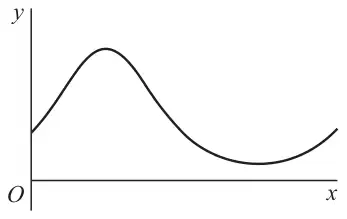
(a) Find the \(x\)-coordinate of each of the stationary points of the graph of \(y = \mathrm{g}(x)\), giving your answers in exact form. [1 mark]
(b) Use Simpson’s rule with 3 ordinates to estimate\[\int_0^{\pi} \mathrm{g}(x)\,\mathrm{d}x\]
giving your answer to two decimal places. [3 marks]
(c) Explain how Simpson’s rule could be used to find a more accurate estimate of the integral in part (b). [1 mark]
| Scheme | Marks | AO |
|---|---|---|
| Deduces \(x\)-coordinates of stationary points | B1 | 2.2a |
| (1) |
Typical solution
\(\dfrac{\pi}{2}\) and \(\dfrac{3\pi}{2}\)
| Scheme | Marks | AO |
|---|---|---|
| Obtains exactly three values of \(y\) for correct values of \(x\), can be unsimplified. | M1 | 1.1a |
| Uses Simpson’s rule correctly Condone 5 ordinates. | M1 | 1.1a |
| Obtains correct value AWRT 6.74 | A1 | 1.1b |
| (3) |
Typical solution
| \(x\) | \(0\) | \(\pi/2\) | \(\pi\) |
| \(y\) | \(1\) | \(\mathrm{e}\) | \(1\) |
| Scheme | Marks | AO |
|---|---|---|
| Infers that a larger number of ordinates/strips could give a more accurate result | E1 | 2.2b |
| (1) | ||
| (5 marks) |
Typical solution
By using Simpson’s rule with 5 ordinates