
A2 June 2022 Paper 2 Q6
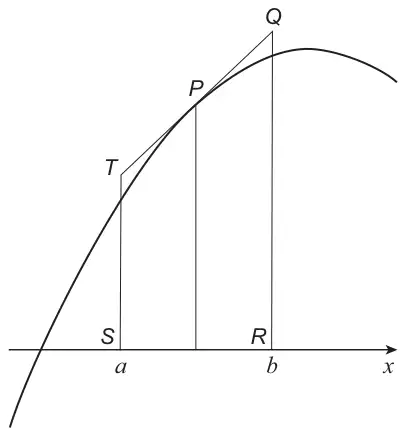
6 The diagram below shows part of the graph of \(y = \mathrm{f}(x)\)
The line \(TPQ\) is a tangent to the graph of \(y = \mathrm{f}(x)\) at the point \(P\left(\dfrac{a + b}{2}, \mathrm{f}\left(\dfrac{a + b}{2}\right)\right)\)
The points \(S(a, 0)\) and \(T\) lie on the line \(x = a\)
The points \(Q\) and \(R(b, 0)\) lie on the line \(x = b\)
Sharon uses the mid-ordinate rule with one strip to estimate the value of the integral \(\displaystyle\int_a^b \mathrm{f}(x)\,\mathrm{d}x\)
By considering the area of the trapezium \(QRST\), state, giving reasons, whether you would expect Sharon’s estimate to be an under-estimate or an over-estimate. [3 marks]
| Scheme | Marks | AO |
|---|---|---|
| States that the area of the trapezium is greater than the integral Condone “the area of the trapezium is greater than the curve”. | B1 | 2.2a |
| Explains that the area of the trapezium equals Sharon’s estimate/ result of using mid-ordinate rule | E1 | 2.4 |
| States that Sharon’s estimate is an over-estimate and completes a reasoned argument to explain the required result | R1 | 2.1 |
| (3 marks) |
Typical solution
The area of the trapezium is greater than the integral.
Area of trapezium \(= (b - a)y_{\frac{1}{2}}\)
The area of the trapezium is the same as the area of the rectangle from use of the mid-ordinate rule.
This is equal to Sharon’s estimate.
The trapezium includes the area represented by the integral, so Sharon’s estimate is an over-estimate.