
AS June 2024 Paper 1 Q8
8.
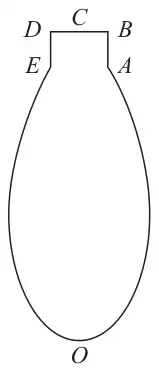
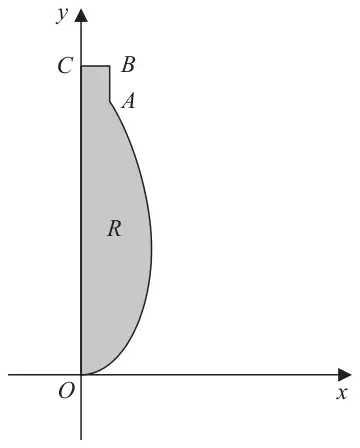
Figure 1 shows the central vertical cross-section, \(OABCDEO\), of the design for a solid glass ornament.
Figure 2 shows the finite region, \(R\), which is bounded by the \(y\)-axis, the horizontal line \(CB\), the vertical line \(BA\), and the curve \(AO\).
The ornament is formed by rotating the region \(R\) through 360° about the \(y\)-axis.
The curve \(AO\) is modelled by the equation
\[x = ky^2 + \sqrt{y} \qquad 0 \leqslant y \leqslant 4\]where \(k\) is a constant.
The point \(A\) has coordinates (0.4, 4) and the point \(B\) has coordinates (0.4, 4.5)
The units are centimetres.
When the ornament was manufactured, 9 cm3 of glass was required.
| Scheme | Marks | AO |
|---|---|---|
| \((0.4,\ 4) \Rightarrow 0.4 = k \times 4^2 + \sqrt{4} \Rightarrow k = \ldots\) | M1 | 3.3 |
| \(k = -0.1\) | A1 | 1.1b |
| (2) |
Notes
M1: Substitutes (0.4, 4) into the equation modelling the curve in an attempt to find the value of \(k\)
A1: Infers from the data in the model, the value of \(k\)
| Scheme | Marks | AO |
|---|---|---|
| Cylinder volume = \(\pi \times 0.4^2 \times 0.5 = 0.08\pi = \dfrac{2}{25}\pi\) | B1 | 3.4 |
| Volume generated by curve = \(\pi\displaystyle\int x^2\,\mathrm{d}y\) \(\pi\displaystyle\int \left(\sqrt{y} + ky^2\right)^2\{\mathrm{d}y\} = \pi\int \left(\sqrt{y} - 0.1y^2\right)^2\{\mathrm{d}y\}\) | M1 | 3.1b |
| \(= \{\pi\}\displaystyle\int \left(y + 2ky^{\frac{5}{2}} + k^2y^4\right)\{\mathrm{d}y\}\) \(= \{\pi\}\displaystyle\int \left(y - 0.2y^{\frac{5}{2}} + 0.01y^4\right)\{\mathrm{d}y\}\) | A1ft | 1.1b |
| \(= \{\pi\}\displaystyle\int_0 \left(y - 0.2y^{\frac{5}{2}} + 0.01y^4\right)\{\mathrm{d}y\}\) \(\Rightarrow \{\pi\}\left[Ay^2 + By^{\frac{7}{2}} + Cy^5\right]\) at least one of their terms with the correct power | M1 | 3.4 |
| \(= \{\pi\}\left[\dfrac{y^2}{2} + \dfrac{4k}{7}y^{\frac{7}{2}} + \dfrac{k^2}{5}y^5\right]\) \(= \{\pi\}\left[\dfrac{y^2}{2} - \dfrac{2}{35}y^{\frac{7}{2}} + \dfrac{1}{500}y^5\right]\) | A1ft | 1.1b |
| \(V = \pi\left(8 - \dfrac{256}{35} + \dfrac{256}{125}\right) - (0) + \dfrac{2}{25}\pi\) \(V = \dfrac{2392}{875}\pi + \dfrac{2}{25}\pi\) | M1 | 3.4 |
| \(V = \dfrac{2462\pi}{875}\text{ cm}^3\) | A1 | 2.2b |
| (7) |
Notes
B1: Uses the information given in the model to establish the correct volume of the cylinder
M1: Uses the model and applies \(\pi\displaystyle\int x^2\{\mathrm{d}y\}\), d\(y\) not required and \(\pi\) may appear later in their solution. If they find an expression for \(x^2\) first and then substitutes into the formula score M1 even if an incorrect expansion.
A1ft: Correct expression for the volume generated by the curve with the bracket expanded (follow through their \(k\) value), d\(y\) not required and \(\pi\) may appear later in their solution. Indices need to be processed for this mark, may be seen later in the solution.
M1: Attempts to integrate with at least one power raised by 1
A1ft: Correct integration (follow through on their expression for \(x^2\) as long as there are 3 terms). Need not be simplified.
M1: Uses the correct limits and finds the sum of the 2 volumes. Must come from an attempt at \(\pi\displaystyle\int_0^4 x^2\{\mathrm{d}y\}\) and an attempt at the volume of the cylinder, condone incorrect formula used as long as it is 3 dimensional not an area.
A1: \(\dfrac{2462\pi}{875}\)
Use of calculator scores a maximum of B1M1A0M0A0M1A0 volume = \(\boldsymbol{\pi}\)2.7337…
| Scheme | Marks | AO |
|---|---|---|
E.g.
| B1 | 3.5b |
| (1) |
Notes
B1: States an acceptable limitation of the model, which is the curve but accept flaws/bubbles in the glass. Measurements may not be accurate, or anything related to thickness is B0
| Scheme | Marks | AO |
|---|---|---|
| Makes an appropriate comment that is consistent with their value for the volume and 9 cm3. Some evidence of making a comparison and draws a conclusion E.g. a good estimate as 8.84 cm3 is only 0.16 cm3 less than 9 cm3
| B1ft | 3.5a |
| (1) | ||
| (11 marks) |
Notes
B1ft: Compares the actual volume to their answer to part (b) and makes an assessment of the model with a reason. If using a percentage error then they must use 9 as the true volume.