
A2 June 2024 Paper 2 Q9
9.
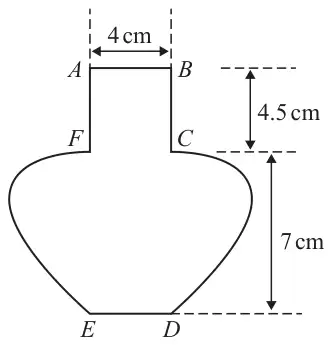
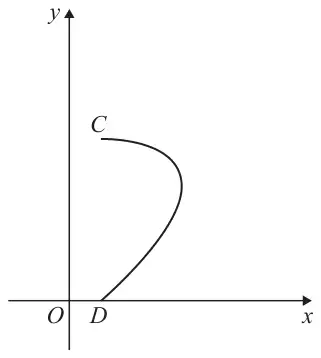
Figure 1 shows the central vertical cross-section \(ABCDEFA\) of a vase together with measurements that have been taken from the vase.
The horizontal cross-section between \(AB\) and \(FC\) is a circle with diameter 4 cm.
The base of the vase \(ED\) is horizontal and the point \(E\) is vertically below \(F\) and the point \(D\) is vertically below \(C\).
Using these measurements, the curve \(CD\) is modelled by the parametric equations
\[x = a + 3\sin 2t \qquad y = b\cos t \qquad 0 \leqslant t \leqslant \frac{\pi}{2}\]where \(a\) and \(b\) are constants and \(O\) is the fixed origin, as shown in Figure 2.
| Scheme | Marks | AO |
|---|---|---|
| \(a = 2\) or \(b = 7\) | B1 | 3.3 |
| \(a = 2\) and \(b = 7\) | B1 | 3.3 |
| (2) |
Notes
B1: Uses the model to obtain a correct value for \(a\) or \(b\)
B1: Uses the model to obtain correct values for \(a\) and \(b\)
| Scheme | Marks | AO |
|---|---|---|
| \(V = (\pi)\displaystyle\int x^2\frac{\mathrm{d}y}{\mathrm{d}t}\,\mathrm{d}t = \int (2 + 3\sin 2t)^2(-7\sin t)\,\mathrm{d}t\) | M1 | 3.4 |
| \(= -7(\pi)\displaystyle\int \left(4\sin t + 12\sin 2t\sin t + 9\sin^2 2t\sin t\right)\mathrm{d}t\) \(= -7(\pi)\displaystyle\int \left(4\sin t + 24\sin^2 t\cos t + 36\sin^3 t\cos^2 t\right)\mathrm{d}t\) | M1 | 3.1a |
| \(= -7(\pi)\left[-4\cos t + 8\sin^3 t - 12\cos^3 t + \dfrac{36}{5}\cos^5 t\right]\) | A1ft A1 | 1.1b 1.1b |
| Cylinder volume is \(\pi \times 2^2 \times 4.5 = (18\pi)\) | B1 | 3.4 |
| Total Volume \(= V +\) cylinder volume \(= -7\pi\left[-4\cos t + 8\sin^3 t - 12\cos^3 t + \dfrac{36}{5}\cos^5 t\right]_{\frac{\pi}{2}}^{0} + \pi \times 2^2 \times 4.5\) or \(= 7\pi\left[-4\cos t + 8\sin^3 t - 12\cos^3 t + \dfrac{36}{5}\cos^5 t\right]_{0}^{\frac{\pi}{2}} + \pi \times 2^2 \times 4.5\) (NB this is \(\dfrac{588}{5}\pi + 18\pi\)) | ddM1 | 3.4 |
| 426 (cm3) | A1 | 2.2b |
| (7) |
Notes
M1: Uses the parametric curve for the model and applies \((\pi)\displaystyle\int x^2\frac{\mathrm{d}y}{\mathrm{d}t}\,\mathrm{d}t\)
The \(\pi\) symbol may be missing here. Also do not be concerned about a missing \(\mathrm{d}t\) at the end of their integral.
Must see an attempt at squaring \(x\) and finding \(\dfrac{\mathrm{d}y}{\mathrm{d}t}\) where \(x = (a + 3\sin 2t)\) and \(\dfrac{\mathrm{d}y}{\mathrm{d}t} = k\sin t\) with their \(a\) and \(b\) or the letters \(a\) and \(b\) in their integral.
M1: Expands and makes progress to an integrable form by applying \(\sin 2t = 2\sin t\cos t\) at least once
Integrals in terms of \(a\) and \(b\) will be equivalent to:
Integrals with correct values of \(a\) and \(b\) will be equivalent to:
\[\pm(\pi)\int \left(28\sin t + 84\sin 2t\sin t + 63\sin^2 2t\sin t\right)\mathrm{d}t\]\[= \pm(\pi)\int \left(28\sin t + 168\sin^2 t\cos t + 252\sin^3 t\cos^2 t\right)\mathrm{d}t\]A1ft: (dependent on both M marks) At least 2 terms integrated correctly; follow through their \(a\) and \(b\), however their \(a\) and \(b\) must now be numerical.
\[\pm(\pi)\left[-a^2b\cos t + 4ab\sin^3 t - \frac{36}{3}b\cos^3 t + \frac{36b}{5}\cos^5 t\right]\]\[= \pm(\pi)\left[28\cos t - 56\sin^3 t + 84\cos^3 t - \frac{252}{5}\cos^5 t\right]\]A1: All correct from correct values for \(a\) and \(b\)
Their integral will be equivalent to:
B1: Uses the model to deduce the correct volume of the cylinder; need not be simplified.
ddM1: Dependent on both previous M marks. Fully correct strategy for the volume.
Applies the correct limits (either way round) and adds this to the volume of the cylinder which must have been obtained from \(\pi \times 2^2 \times 4.5\) but condone \(\pi \times 4^2 \times 4.5\)
Both volumes must be positive when combined.
A1: Correct volume, allow awrt 426 (cm3), units are not required but if any are given, they should be correct.
| Scheme | Marks | AO |
|---|---|---|
| Any one of e.g. The vase may not be completely smooth The vase may not be symmetrical The measurements may not be accurate The equation of the curve may not be a suitable model The thickness of the sides has not been considered Accept the base may have a dimple in it (the base may not be completely flat) | B1 | 3.5b |
| (1) | ||
| (10 marks) |
Notes
B1: See scheme. Award for a correct statement. If there is more than one statement ignore any incorrect statements as long as there are no statements that contradict their correct statement.
Comments relating to facts about the shape that are not worthy of marks include:
- the cross section is not a circle
- The vase is not solid
- the cylinder might not be vertical
- it depends on the material used to make the vase
- the vase may not have the same density throughout