Second Order Differentials

Edexcel

AQA

OCR A

OCR MEI

A2 June 2025 Paper 1 Q4

EdexcelCurrent spec8 marksSecond Order Differentials

4.

(a) Determine the general solution of the differential equation\[\frac{\mathrm{d}^2y}{\mathrm{d}x^2} - 4\frac{\mathrm{d}y}{\mathrm{d}x} + 4y = 2\mathrm{e}^{3x}\]giving your answer in the form \(y = \mathrm{f}(x)\) (5)

Given that \(y = 5\) and \(\dfrac{\mathrm{d}y}{\mathrm{d}x} = 12\) when \(x = 0\)

(b) determine the particular solution of the differential equation. (3)

A2 June 2024 Paper 1 Q8

EdexcelCurrent spec15 marksSecond Order Differentials

8. A scientist is studying the effect of introducing a population of type \(A\) bacteria into a population of type \(B\) bacteria.

At time \(t\) days, the number of type \(A\) bacteria, \(x\), and the number of type \(B\) bacteria, \(y\), are modelled by the differential equations

\[\begin{aligned}\frac{\mathrm{d}x}{\mathrm{d}t} &= x + y\\[6pt] \frac{\mathrm{d}y}{\mathrm{d}t} &= 3y - 2x\end{aligned}\]
(a) Show that\[\frac{\mathrm{d}^2x}{\mathrm{d}t^2} - 4\frac{\mathrm{d}x}{\mathrm{d}t} + 5x = 0\] (3)
(b) Determine a general solution for the number of type \(A\) bacteria at time \(t\) days. (4)
(c) Determine a general solution for the number of type \(B\) bacteria at time \(t\) days. (2)

The model predicts that, at time \(T\) hours, the number of bacteria in the two populations will be equal.

Given that \(x = 100\) and \(y = 275\) when \(t = 0\)

(d) determine the value of \(T\), giving your answer to 2 decimal places. (5)
(e) Suggest a limitation of the model. (1)

A2 June 2024 Paper 2 Q6

EdexcelCurrent spec14 marksSecond Order Differentials

6. The motion of a particle \(P\) along the \(x\)-axis is modelled by the differential equation

\[2\frac{\mathrm{d}^2x}{\mathrm{d}t^2} + 5\frac{\mathrm{d}x}{\mathrm{d}t} + 2x = 4t + 12\]

where \(P\) is \(x\) metres from the origin \(O\) at time \(t\) seconds, \(t \geqslant 0\)

(a) Determine the general solution of the differential equation. (6)
(b) Hence determine the particular solution for which \(x = 3\) and \(\dfrac{\mathrm{d}x}{\mathrm{d}t} = -2\) when \(t = 0\) (3)
(c)
(i) Show that, according to the model, the minimum distance between \(O\) and \(P\) is \((2 + \ln 2)\) metres.
(ii) Justify that this distance is a minimum. (4)

For large values of \(t\) the particle is expected to move with constant speed.

(d) Comment on the suitability of the model in light of this information. (1)

A2 June 2023 Paper 2 Q9

EdexcelCurrent spec14 marksSecond Order Differentials

9. A patient is treated by administering an antibiotic intravenously at a constant rate for some time.

Initially there is none of the antibiotic in the patient.

At time \(t\) minutes after treatment began

  • the concentration of the antibiotic in the blood of the patient is \(x\) mg/ml
  • the concentration of the antibiotic in the tissue of the patient is \(y\) mg/ml

The concentration of antibiotic in the patient is modelled by the equations

\[\frac{\mathrm{d}x}{\mathrm{d}t} = 0.025y - 0.045x + 2\]\[\frac{\mathrm{d}y}{\mathrm{d}t} = 0.032x - 0.025y\]
(a) Show that\[40\,000\frac{\mathrm{d}^2y}{\mathrm{d}t^2} + 2800\frac{\mathrm{d}y}{\mathrm{d}t} + 13y = 2560\] (3)
(b) Determine, according to the model, a general solution for the concentration of the antibiotic in the patient’s tissue at time \(t\) minutes after treatment began. (5)
(c) Hence determine a particular solution for the concentration of the antibiotic in the tissue at time \(t\) minutes after treatment began. (4)

To be effective for the patient the concentration of antibiotic in the tissue must eventually reach a level between 185 mg/ml and 200 mg/ml.

(d) Determine whether the rate of administration of the antibiotic is effective for the patient, giving a reason for your answer. (2)

A2 June 2022 Paper 1 Q10

EdexcelCurrent spec14 marksSecond Order Differentials

10.

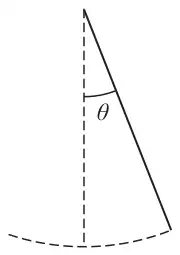
Figure 3: a pendulum hanging from a fixed point, displaced by angle theta from the dashed downward vertical, with a dashed arc showing its path
Figure 3

The motion of a pendulum, shown in Figure 3, is modelled by the differential equation

\[\frac{\mathrm{d}^2\theta}{\mathrm{d}t^2} + 9\theta = \frac{1}{2}\cos 3t\]

where \(\theta\) is the angle, in radians, that the pendulum makes with the downward vertical, \(t\) seconds after it begins to move.

(a)
(i) Show that a particular solution of the differential equation is\[\theta = \frac{1}{12}t\sin 3t\] (4)
(ii) Hence, find the general solution of the differential equation. (4)

Initially, the pendulum

  • makes an angle of \(\dfrac{\pi}{3}\) radians with the downward vertical
  • is at rest

Given that, 10 seconds after it begins to move, the pendulum makes an angle of \(\alpha\) radians with the downward vertical,

(b) determine, according to the model, the value of \(\alpha\) to 3 significant figures. (4)

Given that the true value of \(\alpha\) is 0.62

(c) evaluate the model. (1)

The differential equation

\[\frac{\mathrm{d}^2\theta}{\mathrm{d}t^2} + 9\theta = \frac{1}{2}\cos 3t\]

models the motion of the pendulum as moving with forced harmonic motion.

(d) Refine the differential equation so that the motion of the pendulum is simple harmonic motion. (1)

A2 October 2021 Paper 1 Q6

EdexcelCurrent spec12 marksSecond Order Differentials

6. A tourist decides to do a bungee jump from a bridge over a river.
One end of an elastic rope is attached to the bridge and the other end of the elastic rope is attached to the tourist.
The tourist jumps off the bridge.

At time \(t\) seconds after the tourist reaches their lowest point, their vertical displacement is \(x\) metres above a fixed point 30 metres vertically above the river.

When \(t = 0\)

  • \(x = {-20}\)
  • the velocity of the tourist is \(0\,\mathrm{m\,s^{-1}}\)
  • the acceleration of the tourist is \(13.6\,\mathrm{m\,s^{-2}}\)

In the subsequent motion, the elastic rope is assumed to remain taut so that the vertical displacement of the tourist can be modelled by the differential equation

\[5k\frac{\mathrm{d}^2x}{\mathrm{d}t^2} + 2k\frac{\mathrm{d}x}{\mathrm{d}t} + 17x = 0 \qquad\qquad t \geqslant 0\]

where \(k\) is a positive constant.

(a) Determine the value of \(k\) (2)
(b) Determine the particular solution to the differential equation. (7)
(c) Hence find, according to the model, the vertical height of the tourist above the river 15 seconds after they have reached their lowest point. (2)
(d) Give a limitation of the model. (1)

A2 October 2020 Paper 1 Q5

5. Two compounds, \(X\) and \(Y\), are involved in a chemical reaction. The amounts in grams of these compounds, \(t\) minutes after the reaction starts, are \(x\) and \(y\) respectively and are modelled by the differential equations

\[\begin{aligned}\frac{\mathrm{d}x}{\mathrm{d}t} &= -5x + 10y - 30\\[4pt] \frac{\mathrm{d}y}{\mathrm{d}t} &= -2x + 3y - 4\end{aligned}\]
(a) Show that\[\frac{\mathrm{d}^2x}{\mathrm{d}t^2} + 2\frac{\mathrm{d}x}{\mathrm{d}t} + 5x = 50\] (3)
(b) Find, according to the model, a general solution for the amount in grams of compound \(X\) present at time \(t\) minutes. (6)
(c) Find, according to the model, a general solution for the amount in grams of compound \(Y\) present at time \(t\) minutes. (3)

Given that \(x = 2\) and \(y = 5\) when \(t = 0\)

(d) find
(i) the particular solution for \(x\),
(ii) the particular solution for \(y\).
(4)

A scientist thinks that the chemical reaction will have stopped after 8 minutes.

(e) Explain whether this is supported by the model. (1)

A2 October 2020 Paper 2 Q3

EdexcelCurrent spec14 marksSecond Order Differentials

3. A scientist is investigating the concentration of antibodies in the bloodstream of a patient following a vaccination.
The concentration of antibodies, \(x\), measured in micrograms (μg) per millilitre (ml) of blood, is modelled by the differential equation

\[100\frac{\mathrm{d}^2x}{\mathrm{d}t^2} + 60\frac{\mathrm{d}x}{\mathrm{d}t} + 13x = 26\]

where \(t\) is the number of weeks since the vaccination was given.

(a) Find a general solution of the differential equation. (4)

Initially,

  • there are no antibodies in the bloodstream of the patient
  • the concentration of antibodies is estimated to be increasing at 10 μg/ml per week
(b) Find, according to the model, the maximum concentration of antibodies in the bloodstream of the patient after the vaccination. (8)

A second dose of the vaccine has to be given to try to ensure that it is fully effective. It is only safe to give the second dose if the concentration of antibodies in the bloodstream of the patient is less than 5 μg/ml.

(c) Determine whether, according to the model, it is safe to give the second dose of the vaccine to the patient exactly 10 weeks after the first dose. (2)

A2 June 2019 Paper 1 Q8

EdexcelCurrent spec18 marksSecond Order Differentials

8. A scientist is studying the effect of introducing a population of white-clawed crayfish into a population of signal crayfish.
At time \(t\) years, the number of white-clawed crayfish, \(w\), and the number of signal crayfish, \(s\), are modelled by the differential equations

\[\begin{aligned}\frac{\mathrm{d}w}{\mathrm{d}t} &= \frac{5}{2}(w - s)\\ \frac{\mathrm{d}s}{\mathrm{d}t} &= \frac{2}{5}w - 90\mathrm{e}^{-t}\end{aligned}\]
(a) Show that\[2\frac{\mathrm{d}^2w}{\mathrm{d}t^2} - 5\frac{\mathrm{d}w}{\mathrm{d}t} + 2w = 450\mathrm{e}^{-t}\] (3)
(b) Find a general solution for the number of white-clawed crayfish at time \(t\) years. (6)
(c) Find a general solution for the number of signal crayfish at time \(t\) years. (2)

The model predicts that, at time \(T\) years, the population of white-clawed crayfish will have died out.

Given that \(w = 65\) and \(s = 85\) when \(t = 0\)

(d) find the value of \(T\), giving your answer to 3 decimal places. (6)
(e) Suggest a limitation of the model. (1)

A2 June 2019 Paper 2 Q5

EdexcelCurrent spec12 marksSecond Order Differentials

5. An engineer is investigating the motion of a sprung diving board at a swimming pool.
Let \(E\) be the position of the end of the diving board when it is at rest in its equilibrium position and when there is no diver standing on the diving board.
A diver jumps from the diving board.
The vertical displacement, \(h\) cm, of the end of the diving board above \(E\) is modelled by the differential equation

\[4\frac{\mathrm{d}^2h}{\mathrm{d}t^2} + 4\frac{\mathrm{d}h}{\mathrm{d}t} + 37h = 0\]

where \(t\) seconds is the time after the diver jumps.

(a) Find a general solution of the differential equation. (2)

When \(t = 0\), the end of the diving board is 20 cm below \(E\) and is moving upwards with a speed of 55 cm s−1.

(b) Find, according to the model, the maximum vertical displacement of the end of the diving board above \(E\). (8)
(c) Comment on the suitability of the model for large values of \(t\). (2)

A2 June 2025 Paper 1 Q17

AQACurrent spec11 marksSecond Order Differentials

17 In this question use \(g = 10\) m s−2

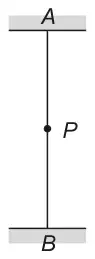
A particle \(P\) of mass 0.6 kg is attached to one end of each of two light elastic strings, \(AP\) and \(BP\)

The other ends of the strings, \(A\) and \(B\), are attached to fixed points which are 7 metres apart, with \(A\) vertically above \(B\)

The natural length of the string \(AP\) is 2 metres.

When the extension of the string \(AP\) is \(e\) metres, the tension in the string \(AP\) is \(5e\) newtons.

The natural length of the string \(BP\) is 3 metres.

When the extension of the string \(BP\) is \(e\) metres, the tension in the string \(BP\) is \(3e\) newtons.

The whole system is in a large tub of oil.

The diagram shows the particle \(P\), the strings and the points \(A\) and \(B\)

A vertical line from fixed point A at the top down to fixed point B at the bottom, with the particle P on the line between them

The particle \(P\) is held at the point between \(A\) and \(B\) which is 0.5 metres vertically below its equilibrium position.

The particle is then released from rest.

During the subsequent motion the oil causes a resistive force of magnitude \(\dfrac{4}{\sqrt{5}}v\) newtons to act on the particle, where \(v\) m s−1 is the speed of the particle.

At time \(t\) seconds after \(P\) is released, its displacement towards \(B\) from its equilibrium position is \(x\) metres.

(a) Show that during the subsequent motion the particle satisfies the differential equation\[0.6\frac{\mathrm{d}^2x}{\mathrm{d}t^2} + \frac{4}{\sqrt{5}}\frac{\mathrm{d}x}{\mathrm{d}t} + 8x = 0\]

Fully justify your answer. [5 marks]

(b) Find \(x\) in terms of \(t\), giving your answer in exact form. [6 marks]

A2 June 2024 Paper 2 Q19

AQACurrent spec10 marksSecond Order Differentials

19 Solve the differential equation

\[\frac{\mathrm{d}^2y}{\mathrm{d}x^2} + 4\frac{\mathrm{d}y}{\mathrm{d}x} - 45y = 21\mathrm{e}^{5x} - 0.3x + 27x^2\]

given that \(y = \dfrac{37}{225}\) and \(\dfrac{\mathrm{d}y}{\mathrm{d}x} = 0\) when \(x = 0\) [10 marks]

A2 June 2024 Paper 1 Q18

AQACurrent spec12 marksSecond Order Differentials

18 In this question use \(g = 9.8\) m s−2

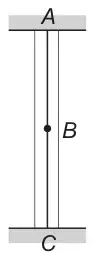
Two light elastic strings each have one end attached to a small ball \(B\) of mass 0.5 kg

The other ends of the strings are attached to the fixed points \(A\) and \(C\), which are 8 metres apart with \(A\) vertically above \(C\)

The whole system is in a thin tube of oil, as shown in the diagram below.

A narrow vertical tube between fixed point A at the top and fixed point C at the bottom, with the ball B on the string between them

The string connecting \(A\) and \(B\) has natural length 2 metres, and the tension in this string is \(7e\) newtons when the extension is \(e\) metres.

The string connecting \(B\) and \(C\) has natural length 3 metres, and the tension in this string is \(3e\) newtons when the extension is \(e\) metres.

(a) Find the extension of each string when the system is in equilibrium. [3 marks]
(b) It is known that in a large bath of oil, the oil causes a resistive force of magnitude \(4.5v\) newtons to act on the ball, where \(v\) m s−1 is the speed of the ball.

Use this model to answer part (b)(i) and part (b)(ii).

(i) The ball is pulled a distance of 0.6 metres downwards from its equilibrium position towards \(C\), and released from rest.

Show that during the subsequent motion the particle satisfies the differential equation

\[\frac{\mathrm{d}^2x}{\mathrm{d}t^2} + 9\frac{\mathrm{d}x}{\mathrm{d}t} + 20x = 0\]

where \(x\) metres is the displacement of the particle below the equilibrium position at time \(t\) seconds after the particle is released. [3 marks]

(ii) Find \(x\) in terms of \(t\) [5 marks]
(c) State one limitation of the model used in part (b) [1 mark]

A2 June 2024 Paper 2 Q2

AQACurrent spec1 markSecond Order Differentials

2 The movement of a particle is described by the simple harmonic equation

\[\ddot{x} = -25x\]

where \(x\) metres is the displacement of the particle at time \(t\) seconds, and \(\ddot{x}\) m s−2 is the acceleration of the particle.

The maximum displacement of the particle is 9 metres.

Find the maximum speed of the particle.

Circle your answer. [1 mark]

  • 15 m s−1
  • 45 m s−1
  • 75 m s−1
  • 135 m s−1

A2 June 2023 Paper 2 Q16

AQACurrent spec16 marksSecond Order Differentials

16 A bungee jumper of mass \(m\) kg is attached to an elastic rope.
The other end of the rope is attached to a fixed point.

The bungee jumper falls vertically from the fixed point.

At time \(t\) seconds after the rope first becomes taut, the extension of the rope is \(x\) metres and the speed of the bungee jumper is \(v\) m s\(^{-1}\)

(a) A model for the motion while the rope remains taut assumes that the forces acting on the bungee jumper are
  • the weight of the bungee jumper
  • a tension in the rope of magnitude \(kx\) newtons
  • an air resistance force of magnitude \(Rv\) newtons

where \(k\) and \(R\) are constants such that \(4km \gt R^2\)

(i) Show that this model gives the result\[x = \mathrm{e}^{-\frac{Rt}{2m}}\left(A\cos\left(\frac{\sqrt{4km - R^2}}{2m}\right)t + B\sin\left(\frac{\sqrt{4km - R^2}}{2m}\right)t\right) + \frac{mg}{k}\]

where \(A\) and \(B\) are constants, and \(g\) m s\(^{-2}\) is the acceleration due to gravity.

You do not need to find the value of \(A\) or the value of \(B\) [6 marks]

(ii) It is also given that:\[\begin{aligned} k &= 16 \\ R &= 20 \\ m &= 62.5 \\ g &= 9.8\ \text{m s}^{-2} \end{aligned}\]

and that the speed of the bungee jumper when the rope becomes taut is 14 m s\(^{-1}\)

Show that, to the nearest integer, \(A = -38\) and \(B = 16\) [6 marks]

(b) A second, simpler model assumes that the air resistance is zero.

The values of \(k\), \(m\) and \(g\) remain the same.

Find an expression for \(x\) in terms of \(t\) according to this simpler model, giving the values of all constants to two significant figures. [4 marks]

A2 June 2023 Paper 1 Q15

AQACurrent spec9 marksSecond Order Differentials

15 Find the general solution of the differential equation

\[\frac{\mathrm{d}^2y}{\mathrm{d}x^2} - 3\frac{\mathrm{d}y}{\mathrm{d}x} - 4y = \cos 2x + 5x\]

[9 marks]

A2 June 2023 Paper 1 Q4

AQACurrent spec1 markSecond Order Differentials

4 The solution of a second order differential equation is \(\mathrm{f}(t)\)

The differential equation models heavy damping.

Which one of the statements below could be true?

Tick (✓) one box. [1 mark]

  • \(\mathrm{f}(t) = 2\mathrm{e}^{-t}\cos(3t) + 5\mathrm{e}^{-t}\sin(3t)\)
  • \(\mathrm{f}(t) = 3\mathrm{e}^{-t} + 4t\mathrm{e}^{-t}\)
  • \(\mathrm{f}(t) = 7\mathrm{e}^{-t} + 2\mathrm{e}^{-2t}\)
  • \(\mathrm{f}(t) = 8\mathrm{e}^{-t}\cos(3t - 0.1)\)

A2 June 2022 Paper 2 Q14

AQACurrent spec14 marksSecond Order Differentials

14 On an isolated island some rabbits have been accidently introduced.

In order to eliminate them, conservationists have introduced some birds of prey.

At time \(t\) years \((t \geqslant 0)\) there are \(x\) rabbits and \(y\) birds of prey.

At time \(t = 0\) there are 1755 rabbits and 30 birds of prey.

When \(t \gt 0\) it is assumed that:

  • the rabbits will reproduce at a rate of \(a\)% per year
  • each bird of prey will kill, on average, \(b\) rabbits per year
  • the death rate of the birds of prey is \(c\) birds per year
  • the number of birds of prey will increase at a rate of \(d\)% of the rabbit population per year.

This system is represented by the coupled differential equations:

\[\frac{\mathrm{d}x}{\mathrm{d}t} = 0.4x - 13y \qquad (1)\]\[\frac{\mathrm{d}y}{\mathrm{d}t} = 0.01x - 1.95 \qquad (2)\]
(a) State the value of \(a\), the value of \(b\), the value of \(c\) and the value of \(d\) [2 marks]
(b) Solve the coupled differential equations to find both \(x\) and \(y\) in terms of \(t\) [9 marks]
(c) Given that \(x\) and \(y\) are both positive for \(0 \leqslant t \leqslant 5\), use your answer to part (b) to show that the conservationists’ plan will succeed. [3 marks]

A2 June 2022 Paper 1 Q11

AQACurrent spec19 marksSecond Order Differentials

11 In this question use \(g\) as 10 m s−2

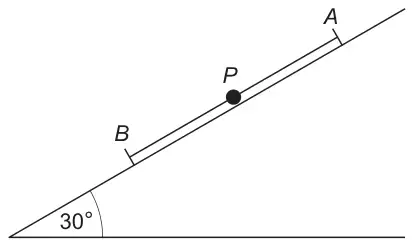
A smooth plane is inclined at \(30^\circ\) to the horizontal.
The fixed points \(A\) and \(B\) are 3.6 metres apart on the line of greatest slope of the plane, with \(A\) higher than \(B\)

A particle \(P\) of mass 0.32 kg is attached to one end of each of two light elastic strings.
The other ends of these strings are attached to the points \(A\) and \(B\) respectively.

The particle \(P\) moves on a straight line that passes through \(A\) and \(B\)

A plane inclined at 30 degrees to the horizontal, with B lower and A higher on a line of greatest slope and the particle P between them, joined to A and B by strings

The natural length of the string \(AP\) is 1.4 metres.
When the extension of the string \(AP\) is \(e_A\) metres, the tension in the string \(AP\) is \(7e_A\) newtons.
The natural length of the string \(BP\) is 1 metre.
When the extension of the string \(BP\) is \(e_B\) metres, the tension in the string \(BP\) is \(9e_B\) newtons.

The particle \(P\) is held at the point between \(A\) and \(B\) which is 0.2 metres from its equilibrium position and lower than its equilibrium position.
The particle \(P\) is then released from rest.

At time \(t\) seconds after \(P\) is released, its displacement towards \(B\) from its equilibrium position is \(x\) metres.

(a) Show that during the subsequent motion the object satisfies the equation\[\ddot{x} + 50x = 0\]

Fully justify your answer. [5 marks]

(b) The experiment is repeated in a large tank of oil.
During the motion the oil causes a resistive force of \(kv\) newtons to act on the particle, where \(v\) m s−1 is the speed of the particle.

The oil causes critical damping to occur.

(i) Show that \(k = \dfrac{16\sqrt{2}}{5}\) [3 marks]
(ii) Find \(x\) in terms of \(t\), giving your answer in exact form. [6 marks]
(iii) Calculate the maximum speed of the particle. [5 marks]

A2 June 2022 Paper 1 Q1

AQACurrent spec1 markSecond Order Differentials

1 The displacement of a particle from its equilibrium position is \(x\) metres at time \(t\) seconds.

The motion of the particle obeys the differential equation

\[\frac{\mathrm{d}^2x}{\mathrm{d}t^2} = -9x\]

Calculate the period of its motion in seconds.

Circle your answer. [1 mark]

  • \(\dfrac{\pi}{9}\)
  • \(\dfrac{2\pi}{9}\)
  • \(\dfrac{\pi}{3}\)
  • \(\dfrac{2\pi}{3}\)

A2 June 2021 Paper 1 Q15

AQACurrent spec13 marksSecond Order Differentials

15 In this question use \(g = 9.8\) m s−2

A particle \(P\) of mass \(m\) is attached to two light elastic strings, \(AP\) and \(BP\).

The other ends of the strings, \(A\) and \(B\), are attached to fixed points which are 4 metres apart on a rough horizontal surface at the bottom of a container.

The coefficient of friction between \(P\) and the surface is 0.68

  • When the extension of string \(AP\) is \(e_A\) metres, the tension in \(AP\) is \(24me_A\)
  • When the extension of string \(BP\) is \(e_B\) metres, the tension in \(BP\) is \(10me_B\)
  • The natural length of string \(AP\) is 1 metre
  • The natural length of string \(BP\) is 1.3 metres
A horizontal line from A to B with the particle P on it, between A and B
(a) Show that when \(AP = 1.5\) metres, the tension in \(AP\) is equal to the tension in \(BP\). [1 mark]
(b) \(P\) is held at the point between \(A\) and \(B\) where \(AP = 1.9\) metres, and then released from rest.

At time \(t\) seconds after \(P\) is released, \(AP = (1.5 + x)\) metres.

The line from A to B with P on it; the distance from A to P is marked (1.5 + x)

Show that when \(P\) is moving towards \(A\),

\[\frac{\mathrm{d}^2x}{\mathrm{d}t^2} + 34x = 6.664\]

[3 marks]

(c) The container is then filled with oil, and \(P\) is again released from rest at the point between \(A\) and \(B\) where \(AP = 1.9\) metres.

At time \(t\) seconds after \(P\) is released, the oil causes a resistive force of magnitude \(10mv\) newtons to act on the particle, where \(v\) m s−1 is the speed of the particle.

Find \(x\) in terms of \(t\) when \(P\) is moving towards \(A\). [9 marks]

A2 June 2020 Paper 1 Q13

AQACurrent spec12 marksSecond Order Differentials

13 Two light elastic strings each have one end attached to a particle \(B\) of mass \(3c\) kg, which rests on a smooth horizontal table.

The other ends of the strings are attached to the fixed points \(A\) and \(C\), which are 8 metres apart.

\(ABC\) is a horizontal line.

Horizontal line with fixed point A at the left end, particle B between them and fixed point C at the right end

String \(AB\) has a natural length of 4 metres and a stiffness of \(5c\) newtons per metre.

String \(BC\) has a natural length of 1 metre and a stiffness of \(c\) newtons per metre.

The particle is pulled a distance of \(\dfrac{1}{3}\) metre from its equilibrium position towards \(A\), and released from rest.

(a) Show that the particle moves with simple harmonic motion. [8 marks]
(b) Find the speed of the particle when it is at a point \(P\), a distance \(\dfrac{1}{4}\) metre from the equilibrium position. Give your answer to two significant figures. [4 marks]

A2 June 2020 Paper 2 Q13

AQACurrent spec10 marksSecond Order Differentials

13 Charlotte is trying to solve this mathematical problem:

Find the general solution of the differential equation

\[\frac{\mathrm{d}^2y}{\mathrm{d}x^2} + \frac{\mathrm{d}y}{\mathrm{d}x} - 2y = 10\mathrm{e}^{-2x}\]

Charlotte’s solution starts as follows:

Particular integral: \(\quad y = \lambda\mathrm{e}^{-2x}\)

so

\[\frac{\mathrm{d}y}{\mathrm{d}x} = -2\lambda\mathrm{e}^{-2x}\]

and

\[\frac{\mathrm{d}^2y}{\mathrm{d}x^2} = 4\lambda\mathrm{e}^{-2x}\]
(a) Show that Charlotte’s method will fail to find a particular integral for the differential equation. [2 marks]
(b) Explain how Charlotte should have started her solution differently and find the general solution of the differential equation. [8 marks]

A2 June 2019 Paper 2 Q15

AQACurrent spec14 marksSecond Order Differentials

15

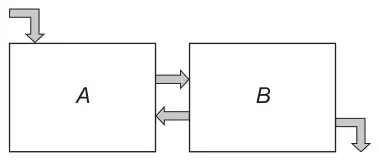
Diagram: two tanks A and B side by side; an arrow shows water flowing into the top of A, arrows show flow from A to B and from B to A, and an arrow shows water flowing out of B

Two tanks, \(A\) and \(B\), each have a capacity of 800 litres.

At time \(t = 0\) both tanks are full of pure water.

When \(t \gt 0\), water flows in the following ways:

  • Water with a salt concentration of \(\mu\) grams per litre flows into tank \(A\) at a constant rate
  • Water flows from tank \(A\) to tank \(B\) at a rate of 16 litres per minute
  • Water flows from tank \(B\) to tank \(A\) at a rate of \(r\) litres per minute
  • Water flows out of tank \(B\) through a waste pipe
  • The amount of water in each tank remains at 800 litres.

At time \(t\) minutes \((t \geqslant 0)\) there are \(x\) grams of salt in tank \(A\) and \(y\) grams of salt in tank \(B\).

This system is represented by the coupled differential equations

\[\begin{aligned} \frac{\mathrm{d}x}{\mathrm{d}t} &= 36 - 0.02x + 0.005y \qquad &(1) \\[4pt] \frac{\mathrm{d}y}{\mathrm{d}t} &= 0.02x - 0.02y \qquad &(2) \end{aligned}\]
(a) Find the value of \(r\). [2 marks]
(b) Show that \(\mu = 3\) [3 marks]
(c) Solve the coupled differential equations to find both \(x\) and \(y\) in terms of \(t\). [9 marks]

A2 June 2019 Paper 1 Q14

AQACurrent spec11 marksSecond Order Differentials

14 In this question use \(g = 10\) m s−2

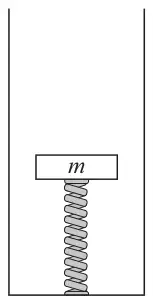
A light spring is attached to the base of a long tube and has a mass \(m\) attached to the other end, as shown in the diagram.

The tube is filled with oil.

When the compression of the spring is \(\varepsilon\) metres, the thrust in the spring is \(9m\varepsilon\) newtons.

Diagram: a long vertical tube with a spring standing on its base and a mass m resting on top of the spring

The mass is held at rest in a position where the compression of the spring is \(\dfrac{20}{9}\) metres.

The mass is then released from rest. During the subsequent motion the oil causes a resistive force of \(6mv\) newtons to act on the mass, where \(v\) m s−1 is the speed of the mass.

At time \(t\) seconds after the mass is released, the displacement of the mass above its starting position is \(x\) metres.

(a) Find \(x\) in terms of \(t\). [10 marks]
(b) State, giving a reason, the type of damping which occurs. [1 mark]

A2 June 2025 Paper 1 Q9

OCR ACurrent spec9 marksSecond Order Differentials

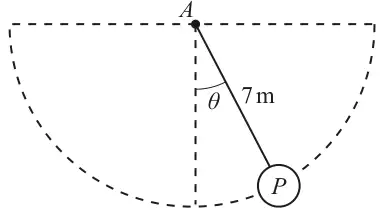
9 A pendulum comprises an object \(P\) of mass \(m\) kg and a string of length 7 m. One end of the string is attached to \(P\) and the other end is attached to a fixed point \(A\).

At time \(t\) seconds, \(t \geqslant 0\), the string forms an angle of \(\theta\) radians, measured anti-clockwise, from the downward vertical through \(A\), as shown in the diagram.

When \(t = 0\), \(\theta = \theta_0 \gt 0\) and \(P\) is released from rest. You may assume that in the subsequent motion \(P\) moves along the arc of a circle, centre \(A\) and radius 7 m, and that \(|\theta| \leqslant \theta_0\) for all \(t \geqslant 0\).

Pendulum: string of length 7 m from the fixed point A to the object P, at angle theta to the dashed downward vertical through A; a dashed semicircle of radius 7 m centred at A shows the path

The motion of \(P\) is modelled by the following differential equation.

\(\dfrac{\mathrm{d}^2\theta}{\mathrm{d}t^2} + \dfrac{7}{5}\sin\theta = 0 \; (*)\)

In some situations, it is appropriate to approximate \((*)\) with the following differential equation.

\(\dfrac{\mathrm{d}^2\theta}{\mathrm{d}t^2} + \dfrac{7}{5}\theta = 0 \; ({*}{*})\)

(a) Explain why it would be appropriate to model the motion of \(P\) with the differential equation \(({*}{*})\) when \(\theta_0 = \dfrac{1}{15}\pi\) but not when \(\theta_0 = \dfrac{1}{3}\pi\). [1]

You are now given that \(\theta_0 = \dfrac{1}{15}\pi\).

(b) By finding the particular solution to the differential equation \(({*}{*})\), determine the total distance travelled by \(P\) in the first 6 seconds of the motion according to \(({*}{*})\). [6]

An additional force now acts on \(P\). It can be shown that it is now appropriate to model the motion of \(P\) with the differential equation \(\dfrac{\mathrm{d}^2\theta}{\mathrm{d}t^2} + \dfrac{k}{m}\dfrac{\mathrm{d}\theta}{\mathrm{d}t} + \dfrac{7}{5}\theta = 0\) where \(k \gt 0\).

(c) Find the range of values of \(m\), in terms of \(k\), for which the motion of the pendulum is overdamped. [2]

A2 June 2025 Paper 2 Q9

OCR ACurrent spec13 marksSecond Order Differentials

9 When light hits a certain photo-sensitive cell, at time \(t = 0\), there is an electrical response in the cell which is denoted by \(y(t)\) where both \(y\) and \(t\) are measured in suitable units. A student wishes to model this response, \(y\).

In an attempt to model \(y\), the student sets up the differential equation

\(\dfrac{\mathrm{d}^2y}{\mathrm{d}t^2} + 6\dfrac{\mathrm{d}y}{\mathrm{d}t} + 9y = 10\mathrm{e}^{-3t} \quad (*)\)

which is subject to the following conditions.

  • \(y = 0\) when \(t = 5\)
  • \(y \geqslant 0\) for all \(t \geqslant 0\)
(a) By substituting into a suitable differential equation, verify that \(y = (A + Bt)\mathrm{e}^{-3t}\) is a complementary function of the differential equation \((*)\). [2]
(b) Determine the particular solution for \(y\) in terms of \(t\). [8]
(c) Using your answer to part (b), find the value of \(y\) immediately after the light hits the cell. [1]

The cell can be considered to be operating properly if \(y \lt 4\) when \(t = 1\).

(d) Discuss whether the cell can be inferred to be operating properly. [2]

A2 June 2024 Paper 2 Q8

OCR ACurrent spec13 marksSecond Order Differentials

8 A children’s play centre has two rooms, a room full of bouncy castles and a room full of ball pits. At any given instant, each child in the centre is playing either on the bouncy castles or in the ball pits. Each child can see one room from the other room and can decide to change freely between the two rooms. It is assumed that such changes happen instantaneously.

The number of children playing on the bouncy castles at time \(t\) hours, is denoted by \(C\) and the corresponding number of children playing in the ball pits is \(P\). Because the number of children is large for most of the time, \(C\) and \(P\) are modelled as being continuous.

When there is a different number of children in each room, some children will move from the room with more children to the room with fewer children. A researcher therefore decides to model \(C\) and \(P\) with the following coupled differential equations.

\[\begin{aligned} \dfrac{\mathrm{d}P}{\mathrm{d}t} &= \alpha(P - C) + \gamma t \\ \dfrac{\mathrm{d}C}{\mathrm{d}t} &= \alpha(C - P) \end{aligned}\]

(a) Explain why \(\alpha\) must be negative. [1]

After examining data, the researcher chooses \(\alpha = -2\) and \(\gamma = 32\).

(b) Show that \(P\) satisfies the second order differential equation \(\dfrac{\mathrm{d}^2P}{\mathrm{d}t^2} + 4\dfrac{\mathrm{d}P}{\mathrm{d}t} = 64t + 32\). [2]
(c)
(i) Find the complementary function for the differential equation from part (b). [1]
(ii) Explain why a particular integral of the form \(P = at + b\) will not work in this situation. [1]
(iii) Using a particular integral of the form \(P = at^2 + bt\), find the general solution of the differential equation from part (b). [3]

At a certain time there are 55 children playing in the ball pits and 24 children per hour are arriving at the ball pits.

(d) Use the model, starting from this time, to estimate the number of children in the ball pits 30 minutes later. [4]
(e) Explain why the model becomes unreliable as \(t\) gets very large. [1]

A2 June 2023 Paper 1 Q7

7 An engineer is modelling the motion of a particle \(P\) of mass 0.5 kg in a wind tunnel.

\(P\) is modelled as travelling in a straight line. The point \(O\) is a fixed point within the wind tunnel. The displacement of \(P\) from \(O\) at time \(t\) seconds is \(x\) metres, for \(t \geqslant 0\).

You are given that \(x \geqslant 0\) for all \(t \geqslant 0\) and that \(P\) does not reach the end of the wind tunnel.

If \(t \geqslant 0\), then \(P\) is subject to three forces which are modelled in the following way.

  • The first force has a magnitude of \(5(t + 1)\cosh t\) N and acts in the positive \(x\)-direction.
  • The second force has a magnitude of \(0.5x\) N and acts towards \(O\).
  • The third force has a magnitude of \(\left|\dfrac{\mathrm{d}x}{\mathrm{d}t}\right|\) N and acts in the direction of motion of the particle.
(a) The engineer applies the equation “\(F = ma\)” to the model of the motion of \(P\) and derives the following differential equation.\[5(t + 1)\cosh t - 0.5x + \dfrac{\mathrm{d}x}{\mathrm{d}t} = 0.5\dfrac{\mathrm{d}^2x}{\mathrm{d}t^2}\]
(i) Explain the sign of the \(\dfrac{\mathrm{d}x}{\mathrm{d}t}\) term in the engineer’s differential equation. [1]

When \(t = 0\) the displacement of \(P\) is 6 m, and it is travelling towards \(O\) with a speed of \(5\,\mathrm{m\,s^{-1}}\).

(ii) Without attempting to solve the differential equation, find the acceleration of \(P\) when \(t = 0\). [2]

Let the particular solution to the differential equation in part (a) be a function f such that \(x = \mathrm{f}(t)\) for \(t \geqslant 0\).

The particular solution to the differential equation can be expressed as a Maclaurin series.

(b)
(i) Show that the Maclaurin series for \(\mathrm{f}(t)\) up to and including the term in \(t\) is \(6 - 5t\). [1]
(ii) Use your answer to part (a)(ii) to show that the term in \(t^2\) in the Maclaurin series for \(\mathrm{f}(t)\) is \(-3t^2\). [1]
(iii) By differentiating the differential equation in part (a) with respect to \(t\), show that the term in \(t^3\) in the Maclaurin series for \(\mathrm{f}(t)\) is \(0.5t^3\). [4]

You are given that the complete Maclaurin series for the function f is valid for all values of \(t \geqslant 0\).

After 0.25 seconds \(P\) has travelled 1.43 m towards the origin.

(c)
(i) By using the Maclaurin series for \(\mathrm{f}(t)\) up to and including the term in \(t^3\), evaluate the suitability of the model for determining the displacement of \(P\) from \(O\) when \(t = 0.25\). [1]
(ii) Explain why it might not be sensible to use the Maclaurin series for \(\mathrm{f}(t)\) up to and including the term in \(t^3\) to evaluate the suitability of the model for determining the displacement of \(P\) from \(O\) when \(t = 10\). [1]

A2 June 2023 Paper 1 Q5

OCR ACurrent spec6 marksSecond Order Differentials

5

(a) Find the general solution of the differential equation \(\dfrac{\mathrm{d}^2y}{\mathrm{d}x^2} - 2\dfrac{\mathrm{d}y}{\mathrm{d}x} + 5y = 0\). [2]
(b) Hence find the general solution of the differential equation \(\dfrac{\mathrm{d}^2y}{\mathrm{d}x^2} - 2\dfrac{\mathrm{d}y}{\mathrm{d}x} + 5y = x(4 - 5x)\). [4]

A2 June 2022 Paper 1 Q8

8 A biologist is studying the effect of pesticides on crops. On a certain farm pesticide is regularly applied to a particular crop which grows in soil. Over time, pesticide is transferred between the crop and the soil at a rate which depends on the amount of pesticide in both the crop and the soil. The amount of pesticide in the crop after \(t\) days is \(x\) grams. The amount of pesticide in the soil after \(t\) days is \(y\) grams. Initially, when \(t = 0\), there is no pesticide in either the crop or the soil.

At first it is assumed that no pesticide is lost from the system. The biologist further assumes that pesticide is added to the crop at a constant rate of \(k\) grams per day, where \(k \gt 6\).

After collecting some initial data, the biologist suggests that for \(t \geqslant 0\), this situation can be modelled by the following pair of first order linear differential equations.

\(\dfrac{\mathrm{d}x}{\mathrm{d}t} = -2x + 78y + k\)

\(\dfrac{\mathrm{d}y}{\mathrm{d}t} = 2x - 78y\)

(a)
(i) Show that \(\dfrac{\mathrm{d}^2x}{\mathrm{d}t^2} + 80\dfrac{\mathrm{d}x}{\mathrm{d}t} = 78k\). [2]
(ii) Determine the particular solution for \(x\) in terms of \(k\) and \(t\). [7]

If more than 250 grams of pesticide is found in the crop, then it will fail food safety standards.

(iii) The crop is tested 50 days after the pesticide is first added to it.
Explain why, according to this model, the crop will fail food safety standards as a result of this test. [1]

Further data collection suggests that some pesticide decays in the soil and so is lost from the system. The model is refined in light of this data. The particular solution for \(x\) for this refined model is

\(x = k\left(20 - \mathrm{e}^{-41t}\left(20\cosh\left(\sqrt{1677}\,t\right) + \dfrac{819}{\sqrt{1677}}\sinh\left(\sqrt{1677}\,t\right)\right)\right)\).

(b) Given now that \(k \lt 12\), determine whether the crop will fail food safety standards in the long run according to this refined model. [2]

In the refined model, it is still assumed that pesticide is added to the crop at a constant rate.

(c) Suggest a reason why it might be more realistic to model the addition of pesticide as not being at a constant rate. [1]

A2 June 2022 Paper 2 Q6

OCR ACurrent spec10 marksIntegrationSecond Order Differentials

6 A particle, \(P\), positioned at the origin, \(O\), is projected with a certain velocity along the \(x\)-axis. \(P\) is then acted on by a single force which varies in such a way that \(P\) moves backwards and forwards along the \(x\)-axis.

When the time after projection is \(t\) seconds, the displacement of \(P\) from the origin is \(x\) m and its velocity is \(v\) m s−1.

The motion of \(P\) is modelled using the differential equation \(\ddot{x} + \omega^2 x = 0\), where \(\omega\) rad s−1 is a positive constant.

(a) Write down the general solution of this differential equation. [1]

\(D\) is the point where \(x = d\) for some positive constant, \(d\). When \(P\) reaches \(D\) it comes to instantaneous rest.

(b) Using the answer to part (a), determine expressions, in terms of \(\omega\), \(d\) and \(t\) only, for the following quantities
  • \(x\)
  • \(v\)
[3]
(c) Hence show that, according to the model, \(v^2 = \omega^2\left(d^2 - x^2\right)\). [1]

The quantity \(z\) is defined by \(z = \dfrac{1}{v}\).

(d) Using part (c), determine an expression for \(z_m\), the mean value of \(z\) with respect to the displacement, as \(P\) moves directly from \(O\) to \(D\). [2]

One measure of the validity of the model is consideration of the value of \(z_m\). If \(z_m\) exceeds 8 then the model is considered to be valid.

The value of \(d\) is measured as 0.25 to 2 significant figures. The value of \(\omega\) is measured as \(0.75 \pm 0.02\).

(e) Determine what can be inferred about the validity of the model from the given information. [1]
(f) Find, according to the model, the least possible value of the velocity with which \(P\) was initially projected. Give your answer to 2 significant figures. [2]

A2 October 2021 Paper 1 Q11

OCR ACurrent spec5 marksSecond Order Differentials

11 The displacement of a door from its equilibrium (closed) position is measured by the angle, \(\theta\) radians, which the door makes with its closed position. The door can swing either side of the equilibrium position so that \(\theta\) can take positive and negative values. The door is released from rest from an open position at time \(t = 0\).

A proposed differential equation to model the motion of the door for \(t \geqslant 0\) is

\(\dfrac{\mathrm{d}^2\theta}{\mathrm{d}t^2} + \lambda\dfrac{\mathrm{d}\theta}{\mathrm{d}t} + 3\theta = 0\) where \(\lambda\) is a constant and \(\lambda \geqslant 0\).

(a)
(i) According to the model, for what value of \(\lambda\) will the motion of the door be simple harmonic? [1]
(ii) Explain briefly why modelling the motion of the door as simple harmonic is unlikely to be realistic. [1]
(b) Find the range of values of \(\lambda\) for which the model predicts that the door will never pass through the equilibrium position. [2]
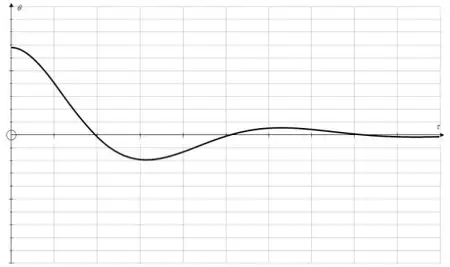
(c) Sketch a possible graph of \(\theta\) against \(t\) when \(\lambda\) lies outside the range found in part (b) but the motion is not simple harmonic. [1]

A2 October 2020 Paper 2 Q5

OCR ACurrent spec7 marksSecond Order Differentials

5 A capacitor is an electrical component which stores charge. The value of the charge stored by the capacitor, in suitable units, is denoted by \(Q\). The capacitor is placed in an electrical circuit.

At any time \(t\) seconds, where \(t \geqslant 0\), \(Q\) can be modelled by the differential equation

\[\frac{\mathrm{d}^2Q}{\mathrm{d}t^2} - 2\frac{\mathrm{d}Q}{\mathrm{d}t} - 15Q = 0.\]

Initially the charge is 100 units and it is given that \(Q\) tends to a finite limit as \(t\) tends to infinity.

(a) Determine the charge on the capacitor when \(t = 0.5\). [6]
(b) Determine the finite limit of \(Q\) as \(t\) tends to infinity. [1]

A2 June 2019 Paper 1 Q11

OCR ACurrent spec13 marksSecond Order Differentials

11 A particle is suspended in a resistive medium from one end of a light spring. The other end of the spring is attached to a point which is made to oscillate in a vertical line.

The displacement of the particle may be modelled by the differential equation

\[\frac{\mathrm{d}^2x}{\mathrm{d}t^2} + 2\frac{\mathrm{d}x}{\mathrm{d}t} + 5x = 10\sin t\]

where \(x\) is the displacement of the particle below the equilibrium position at time \(t\).

When \(t = 0\) the particle is stationary and its displacement is 2.

(a) Find the particular solution of the differential equation. [11]
(b) Write down an approximate equation for the displacement when \(t\) is large. [2]

A2 June 2019 Paper 2 Q6

OCR ACurrent spec6 marksSecond Order Differentials

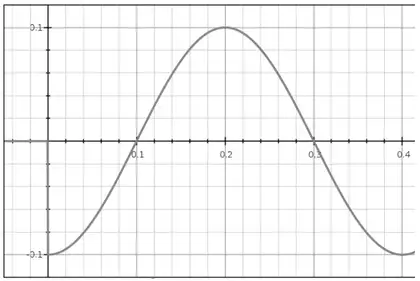
6 \(A\) is a fixed point on a smooth horizontal surface. A particle \(P\) is initially held at \(A\) and released from rest.

It subsequently performs simple harmonic motion in a straight line on the surface. After its release it is next at rest after 0.2 seconds at point \(B\) whose displacement is 0.2 m from \(A\). The point \(M\) is halfway between \(A\) and \(B\).

The displacement of \(P\) from \(M\) at time \(t\) seconds after release is denoted by \(x\) m.

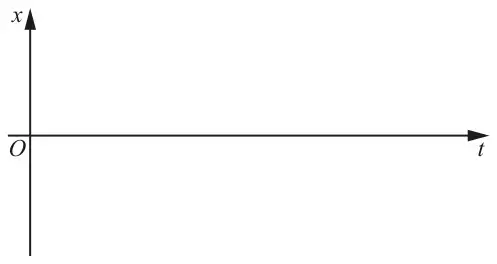
(a) On the axes below, sketch a graph of \(x\) against \(t\) for \(0 \leqslant t \leqslant 0.4\).
Blank axes from the Printed Answer Booklet: vertical x-axis and horizontal t-axis meeting at O
[4]
(b) Find the displacement of \(P\) from \(M\) at 0.75 seconds after release. [2]

A2 June 2025 Paper 1 Q17

17 A researcher is modelling the height of a particular type of tree over its lifetime.

Data suggests that the maximum possible height of this type of tree over its lifetime is double the height of the tree 5 years after planting.

It is given that, \(t\) years after planting a seed for this type of tree, the corresponding height of the tree is \(h\) m, and that \(h = 0\) when \(t = 0\).

(a) The researcher first models the height of the tree by assuming that the rate of increase of \(h\) is proportional to \((20 - h)\), with constant of proportionality 0.2.
(i) Write down the first order differential equation for this model. [1]
(ii) Show that this model predicts that the maximum possible height of the tree is 20 m. [1]
(iii) Show by integration that \(h = 20\left(1 - \mathrm{e}^{-0.2t}\right)\). [4]
(iv) Determine whether this model’s prediction for the height of the tree 5 years after planting is consistent with the maximum possible height of the tree being 20 m. [2]
(b) The researcher refines the model for the height of the tree using the following second order differential equation.
\(\dfrac{\mathrm{d}^2h}{\mathrm{d}t^2} + 0.3\dfrac{\mathrm{d}h}{\mathrm{d}t} + 0.02h = 0.4\)
(i) Determine the general solution of this second order differential equation. [4]
(ii) Show that the refined model also predicts that the maximum possible height of the tree is 20 m. [1]

Further research determines that the initial rate of growth of this type of tree is 2.9 metres per year.

(iii) By applying the initial conditions to find the particular solution of this differential equation, determine whether the refined model’s prediction for the height of the tree 5 years after planting is consistent with the maximum possible height of the tree being 20 m. [5]

A2 June 2024 Paper 1 Q14

OCR MEICurrent spec12 marksSecond Order Differentials

14

(a) Find the general solution of the differential equation \(\dfrac{\mathrm{d}^2y}{\mathrm{d}x^2} + \dfrac{\mathrm{d}y}{\mathrm{d}x} - 2y = 12\mathrm{e}^{-x}\). [7]

You are given that \(y\) tends to zero as \(x\) tends to infinity, and that \(\dfrac{\mathrm{d}y}{\mathrm{d}x} = 0\) when \(x = 0\).

(b) Find the exact value of \(x\) for which \(y = 0\). [5]

A2 June 2023 Paper 1 Q17

17 Two similar species, X and Y, of a small mammal compete for food and habitat. A model of this competition assumes, in a particular area, the following.

  • In the absence of the other species, each species would increase at a rate proportional to the number present with the same constant of proportionality in each case.
  • The competition reduces the rate of increase of each species by an amount proportional to the number of the other species present.

So if the numbers of species X and Y present at time \(t\) years are \(x\) and \(y\) respectively, the model gives the differential equations

\[\dfrac{\mathrm{d}x}{\mathrm{d}t} = kx - ay \quad \text{and} \quad \dfrac{\mathrm{d}y}{\mathrm{d}t} = ky - bx,\]

where \(k\), \(a\) and \(b\) are positive constants.

(a)
(i) Show that the general solution for \(x\) is \(x = A\mathrm{e}^{(k+n)t} + B\mathrm{e}^{(k-n)t}\), where \(n = \sqrt{ab}\) and \(A\) and \(B\) are arbitrary constants. [6]
(ii) Hence find the general solution for \(y\) in terms of \(A\), \(B\), \(k\), \(n\), \(a\) and \(t\). [2]

Observations suggest that suitable values for the model are \(k = 0.015\), \(a = 0.04\) and \(b = 0.01\). You should use these values in the rest of this question.

(b) When \(t = 0\), the numbers present of species X and Y in this area are \(x_0\) and \(y_0\) respectively.
(i) Show that \(x = \tfrac{1}{2}(x_0 - 2y_0)\mathrm{e}^{0.035t} + \tfrac{1}{2}(x_0 + 2y_0)\mathrm{e}^{-0.005t}\). [3]
(ii) Hence show that \(y = \tfrac{1}{4}(x_0 + 2y_0)\mathrm{e}^{-0.005t} - \tfrac{1}{4}(x_0 - 2y_0)\mathrm{e}^{0.035t}\). [1]
(c) Use initial values \(x_0 = 500\) and \(y_0 = 300\) with the results in part (b) to determine what the model predicts for each of the following questions.
(i) What numbers of each species will be present after 25 years? [2]
(ii) In this question you must show detailed reasoning.
When will the numbers of the two species be equal? [4]
(iii) Does either species ever disappear from the area? Justify your answer. [3]
(d) Different initial values will apply in other areas where the two species compete, but previous studies indicate that one species or the other will eventually dominate in any given area.
(i) Identify a relationship between \(x_0\) and \(y_0\) where the model does not predict this outcome. [1]
(ii) Explain what the model predicts in the long term for this exceptional case. [2]

A2 June 2022 Paper 1 Q15

OCR MEICurrent spec23 marksSecond Order Differentials

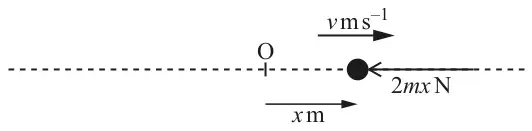
15 In an oscillating system, a particle of mass \(m\) kg moves in a horizontal line. Its displacement from its equilibrium position O at time \(t\) seconds is \(x\) metres, its velocity is \(v\) m s−1, and it is acted on by a force \(2mx\) newtons acting towards O as shown in the diagram.

A particle on a horizontal dashed line, displaced x m to the right of O, moving with velocity v m/s to the right, with a force 2mx N acting on it towards O

Initially, the particle is projected away from O with speed 1 m s−1 from a point 2 m from O in the positive direction.

(a)
(i) Show that the motion is modelled by the differential equation \(\dfrac{\mathrm{d}^2x}{\mathrm{d}t^2} + 2x = 0\). [1]
(ii) State the type of motion. [1]
(iii) Write down the period of the motion. [1]
(iv) Find \(x\) in terms of \(t\). [4]
(v) Find the amplitude of the motion. [2]
(b) The motion is now damped by a force \(2mv\) newtons.
(i) Show that \(\dfrac{\mathrm{d}^2x}{\mathrm{d}t^2} + 2\dfrac{\mathrm{d}x}{\mathrm{d}t} + 2x = 0\). [1]
(ii) State, giving a reason, whether the system is under-damped, critically damped or over-damped. [1]
(iii) Determine the general solution of this differential equation. [3]
(c) Finally, a variable force \(2m\cos 2t\) newtons is added, so that the motion is now modelled by the differential equation
\(\dfrac{\mathrm{d}^2x}{\mathrm{d}t^2} + 2\dfrac{\mathrm{d}x}{\mathrm{d}t} + 2x = 2\cos 2t\).
(i) Find \(x\) in terms of \(t\). [7]

In the long term, the particle is seen to perform simple harmonic motion with a period of just over 3 seconds.

(ii) Verify that this behaviour is consistent with the answer to part (c)(i). [2]

A2 October 2021 Paper 1 Q13

OCR MEICurrent spec7 marksSecond Order Differentials

13 Find the general solution of the differential equation \(\dfrac{\mathrm{d}^2y}{\mathrm{d}x^2} + 2\dfrac{\mathrm{d}y}{\mathrm{d}x} - 3y = 2\mathrm{e}^x\). [7]

A2 October 2020 Paper 1 Q14

OCR MEICurrent spec11 marksSecond Order Differentials

14 Solve the simultaneous differential equations

\[\frac{\mathrm{d}x}{\mathrm{d}t} + 2x = 4y, \qquad \frac{\mathrm{d}y}{\mathrm{d}t} + 3x = 5y,\]

given that when \(t = 0\), \(x = 0\) and \(y = 1\). [11]