
A2 June 2022 Paper 1 Q10
10.
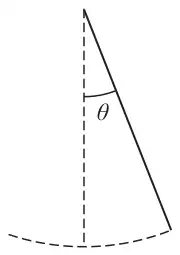
The motion of a pendulum, shown in Figure 3, is modelled by the differential equation
\[\frac{\mathrm{d}^2\theta}{\mathrm{d}t^2} + 9\theta = \frac{1}{2}\cos 3t\]where \(\theta\) is the angle, in radians, that the pendulum makes with the downward vertical, \(t\) seconds after it begins to move.
Initially, the pendulum
- makes an angle of \(\dfrac{\pi}{3}\) radians with the downward vertical
- is at rest
Given that, 10 seconds after it begins to move, the pendulum makes an angle of \(\alpha\) radians with the downward vertical,
Given that the true value of \(\alpha\) is 0.62
The differential equation
\[\frac{\mathrm{d}^2\theta}{\mathrm{d}t^2} + 9\theta = \frac{1}{2}\cos 3t\]models the motion of the pendulum as moving with forced harmonic motion.
| Scheme | Marks | AO |
|---|---|---|
| \(\dfrac{\mathrm{d}\theta}{\mathrm{d}t} = \alpha\sin 3t + \beta t\cos 3t\) and \(\dfrac{\mathrm{d}^2\theta}{\mathrm{d}t^2} = \delta\cos 3t + \gamma t\sin 3t\) | M1 | 1.1b |
| \(\dfrac{\mathrm{d}\theta}{\mathrm{d}t} = \dfrac{1}{12}\sin 3t + \dfrac{1}{4}t\cos 3t\) and \(\dfrac{\mathrm{d}^2\theta}{\mathrm{d}t^2} = \dfrac{1}{4}\cos 3t + \dfrac{1}{4}\cos 3t - \dfrac{3}{4}t\sin 3t\) \(= \dfrac{1}{2}\cos 3t - \dfrac{3}{4}t\sin 3t\) | A1 | 1.1b |
| \(\dfrac{1}{2}\cos 3t - \dfrac{3}{4}t\sin 3t + 9\left(\dfrac{1}{12}t\sin 3t\right) = \ldots\) | dM1 | 3.4 |
| \(= \dfrac{1}{2}\cos 3t\) so PI is \(\theta = \dfrac{1}{12}t\sin 3t\) * | A1* | 2.1 |
| (4) |
Notes
Note: mark (a) as a whole
M1: Differentiates the given PI twice using the product rule to achieve the required form.
Alternatively, uses a correct form for the PI and differentiates twice using the product rule to achieve the required form. A correct form may involve other terms with coefficients that will be zero, e.g. \(\theta = \lambda t\sin 3t + \mu t\cos 3t\) is fine. Also allow e.g \(\theta = \lambda t\sin\omega t\)
A1: Correct derivatives.
dM1: Depends on first M, substitutes into the given differential equation and attempts to simplify. In the Alt they must go on to find value for \(\lambda\).
A1*: Achieves \(\dfrac{1}{2}\cos 3t\) and makes a minimal conclusion (e.g //). Alternatively reaches the correct PI.
Alternative
| Scheme | Marks | AO |
|---|---|---|
| Let \(\theta = \lambda t\sin 3t\) \(\dfrac{\mathrm{d}\theta}{\mathrm{d}t} = \alpha\sin 3t + \beta t\cos 3t\) and \(\dfrac{\mathrm{d}^2\theta}{\mathrm{d}t^2} = \delta\cos 3t + \gamma t\sin 3t\) | M1 | 1.1b |
| \(\dfrac{\mathrm{d}\theta}{\mathrm{d}t} = \lambda\sin 3t + 3\lambda t\cos 3t\) and \(\dfrac{\mathrm{d}^2\theta}{\mathrm{d}t^2} = 3\lambda\cos 3t + 3\lambda\cos 3t - 9\lambda t\sin 3t\) \(= 6\lambda\cos 3t - 9\lambda t\sin 3t\) | A1 | 1.1b |
| \(6\lambda\cos 3t - 9\lambda t\sin 3t + 9(\lambda t\sin 3t) = \dfrac{1}{2}\cos 3t \Rightarrow \lambda = \ldots\) | dM1 | 3.4 |
| \(\theta = \dfrac{1}{12}t\sin 3t\) * | A1* | 2.1 |
| (4) |
| Scheme | Marks | AO |
|---|---|---|
| \(m^2 + 9 = 0 \Rightarrow m = \pm 3\mathrm{i}\) | M1 | 1.1b |
| \(\theta = A\cos 3t + B\sin 3t\) | A1 | 1.1b |
| \((\theta =)\,\text{CF} + \text{PI}\) | dM1 | 1.1b |
| \(\theta = A\cos 3t + B\sin 3t + \dfrac{1}{12}t\sin 3t\) | A1 | 1.1b |
| (4) |
Notes
M1: Uses the model to form and solve the auxiliary equation. Accept \(m^2 + 9 = 0 \to m = \pm 3\mathrm{i}\) or \(\pm 3\)
A1: Correct complementary function. Must be in terms of \(t\) but allow recovery if initially in terms of \(x\) but changed later.
dM1: Dependent on the previous method mark. Finds the general solution by adding the particular integral to the complementary function.
A1: Correct general solution including "\(\theta =\)", which may be recovered in part (b).
| Scheme | Marks | AO |
|---|---|---|
| \(t = 0,\ \theta = \dfrac{\pi}{3} \Rightarrow A = \ldots\left\{\dfrac{\pi}{3}\right\}\) | M1 | 3.4 |
| \(t = 0,\ \dfrac{\mathrm{d}\theta}{\mathrm{d}t} = -3A\sin 3t + 3B\cos 3t + \dfrac{1}{12}\sin 3t + \dfrac{1}{4}t\cos 3t = 0\) \(\Rightarrow B = \ldots\{0\}\) | M1 | 3.4 |
| \(\alpha = \dfrac{\pi}{3}\cos(3 \times 10) + \dfrac{1}{12}(10)\sin(3 \times 10) = \ldots\) | ddM1 | 1.1b |
| \(\alpha = \pm\)awrt 0.662 | A1 | 3.4 |
| (4) |
Notes
M1: Uses the initial conditions of the model, \(t = 0,\ \theta = \dfrac{\pi}{3}\) to find a value for a constant.
M1: Differentiates the general solution and uses the initial conditions of the model \(t = 0,\ \dfrac{\mathrm{d}\theta}{\mathrm{d}t} = 0\) to find a value for the other constant.
ddM1: Dependent on both previous method marks. Substitutes \(t = 10\) into their particular solution. If not substitution is seen, accept any value as the attempt as long as they have found all relevant constants.
A1: Accept awrt \(\pm 0.662\)
| Scheme | Marks | AO |
|---|---|---|
| 0.662 is close to 0.62 so a good model (at \(t = 10\)) | B1ft | 3.5a |
| (1) |
Notes
B1ft: Makes a quantitative comparison of the size of their answer to part (b) with 0.62 and makes conclusion (e.g. good model). Follow through on their answer to (b) and draws an appropriate conclusion about the model. Accept “not reasonable” as long as it is supported with evidence but there must be some instructive comparison and a conclusion about the model - not just stating how much it is out. The reason given must be correct.
Accept e.g. a correct percentage error with reasonable conclusion, or statement approximately equal with conclusion.
Do not accept e.g. “does not agree to 1 s.f.” or “out by 0.6” as these lacks context. Do not accept arguments based solely on a difference in sign, they must be referring to the relative size of angle.
| Scheme | Marks | AO |
|---|---|---|
| \(\dfrac{\mathrm{d}^2\theta}{\mathrm{d}t^2} + 9\theta = 0\) oe | B1 | 3.5c |
| (1) | ||
| (14 marks) |
Notes
B1: Refines the model, accept any constant on the right hand side.