
A2 June 2024 Paper 1 Q18
18 In this question use \(g = 9.8\) m s−2
Two light elastic strings each have one end attached to a small ball \(B\) of mass 0.5 kg
The other ends of the strings are attached to the fixed points \(A\) and \(C\), which are 8 metres apart with \(A\) vertically above \(C\)
The whole system is in a thin tube of oil, as shown in the diagram below.
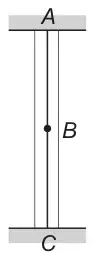
The string connecting \(A\) and \(B\) has natural length 2 metres, and the tension in this string is \(7e\) newtons when the extension is \(e\) metres.
The string connecting \(B\) and \(C\) has natural length 3 metres, and the tension in this string is \(3e\) newtons when the extension is \(e\) metres.
Use this model to answer part (b)(i) and part (b)(ii).
Show that during the subsequent motion the particle satisfies the differential equation
\[\frac{\mathrm{d}^2x}{\mathrm{d}t^2} + 9\frac{\mathrm{d}x}{\mathrm{d}t} + 20x = 0\]where \(x\) metres is the displacement of the particle below the equilibrium position at time \(t\) seconds after the particle is released. [3 marks]
| Scheme | Marks | AO |
|---|---|---|
| Forms equilibrium force equation with three correct terms. Condone sign errors. | M1 | 3.1b |
| Uses the equation \(3 = e_A + e_C\) and their force equation to obtain the extensions. | M1 | 3.1b |
| Obtains 1.39 and 1.61 | A1 | 1.1b |
| (3) |
Typical solution
\[7e_A = 3e_C + 0.5g\]\[3 = e_A + e_C\]\[e_A = 1.39,\quad e_C = 1.61\]| Scheme | Marks | AO |
|---|---|---|
| (i) Forms at least one correct expression in \(x\) for the tension ie \(7(e_A + x)\) or \(3(e_C - x)\) FT their \(e_A\) or \(e_C\) | B1F | 3.1b |
| Forms an equation of motion with five terms (with at least two terms correct). Accept “\(a\)” for \(\ddot{x}\) And “\(v\)” for \(\dot{x}\) Condone sign errors on the terms. | M1 | 3.1b |
| Completes a reasoned argument to obtain \(\ddot{x} + 9\dot{x} + 20x = 0\) OE AG | R1 | 2.1 |
| (3) | ||
| (ii) Obtains solution from their three term Auxiliary Equation. | M1 | 3.1a |
| Obtains \(A\mathrm{e}^{-4t} + B\mathrm{e}^{-5t}\) | A1 | 1.1b |
| Uses \(x = 0.6\) when \(t = 0\) to find an equation in two variables | M1 | 3.4 |
| Sets their correct \(\dot{x} = 0\) when \(t = 0\) to find an equation in two variables | M1 | 3.3 |
| Obtains \(x = 3\mathrm{e}^{-4t} - 2.4\mathrm{e}^{-5t}\) OE | A1 | 1.1b |
| (5) |
Typical solution
(i)
\[0.5\ddot{x} = 0.5g + 3(e_C - x) - 7(e_A + x) - 4.5\dot{x}\]\[0.5\ddot{x} = 0.5g + 3(1.61 - x) - 7(1.39 + x) - 4.5\dot{x}\]\[0.5\ddot{x} = 4.9 + 4.83 - 3x - 9.73 - 7x - 4.5\dot{x}\]\[\ddot{x} + 9\dot{x} + 20x = 0\](ii)
\[0 = \lambda^2 + 9\lambda + 20\]\[\lambda = -4 \text{ or } \lambda = -5\]\[x = A\mathrm{e}^{-4t} + B\mathrm{e}^{-5t}\]\[\dot{x} = -4A\mathrm{e}^{-4t} - 5B\mathrm{e}^{-5t}\]\[x = 0.6,\ \dot{x} = 0,\ t = 0\]\[0.6 = A + B\]\[0 = -4A - 5B\]\[\Rightarrow A = 3 \text{ and } B = -2.4\]\[x = 3\mathrm{e}^{-4t} - 2.4\mathrm{e}^{-5t}\]| Scheme | Marks | AO |
|---|---|---|
| Gives a valid limitation with reference to the size of the tube. | E1 | 3.5b |
| (1) | ||
| (12 marks) |
Typical solution
The resistance force in a thin tube might not be the same as in a large bath.