
A2 June 2019 Paper 2 Q15
15
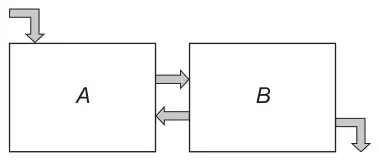
Two tanks, \(A\) and \(B\), each have a capacity of 800 litres.
At time \(t = 0\) both tanks are full of pure water.
When \(t \gt 0\), water flows in the following ways:
- Water with a salt concentration of \(\mu\) grams per litre flows into tank \(A\) at a constant rate
- Water flows from tank \(A\) to tank \(B\) at a rate of 16 litres per minute
- Water flows from tank \(B\) to tank \(A\) at a rate of \(r\) litres per minute
- Water flows out of tank \(B\) through a waste pipe
- The amount of water in each tank remains at 800 litres.
At time \(t\) minutes \((t \geqslant 0)\) there are \(x\) grams of salt in tank \(A\) and \(y\) grams of salt in tank \(B\).
This system is represented by the coupled differential equations
\[\begin{aligned} \frac{\mathrm{d}x}{\mathrm{d}t} &= 36 - 0.02x + 0.005y \qquad &(1) \\[4pt] \frac{\mathrm{d}y}{\mathrm{d}t} &= 0.02x - 0.02y \qquad &(2) \end{aligned}\]| Scheme | Marks | AO |
|---|---|---|
| Uses the capacity of either tank and the coefficients of the equations to find \(r\) | M1 | 3.4 |
| Obtains the correct answer | A1 | 3.2a |
Typical solution
\[r = 0.005 \times 800\]\[r = 4\]| Scheme | Marks | AO |
|---|---|---|
| Deduces that 12 L/min are flowing into A | M1 | 3.3 |
| Divides 36 by their 12 | M1 | 2.2a |
| Completes a rigorous argument to show the required result. | R1 | 2.1 |
Typical solution
Flow into A = flow out of A (to keep volume of water constant)
\[= 16 - 4 = 12\]\[12\mu = 36\]\[\mu = 3\]| Scheme | Marks | AO |
|---|---|---|
| Differentiates one equation | M1 | 3.1a |
| Substitutes both \(x\) and \(\dot{x}\) or \(y\) and \(\dot{y}\) in the other equation to eliminate one variable | M1 | 3.1a |
| Forms a correct second order differential equation | A1 | 1.1b |
| Obtains roots of their auxiliary equation | M1 | 1.1a |
| Uses a valid method to find a particular integral for their DE | M1 | 2.2a |
| States general solution for either \(x\) or \(y\) with their particular integral | A1F | 1.1b |
| States general solutions for both \(x\) and \(y\) CAO | A1 | 1.1b |
| Uses initial conditions to find a value for each constant | M1 | 3.4 |
| Writes correct solutions for both \(x\) and \(y\) | A1 | 1.1b |
| (14 marks) |
Typical solution
\[(2) \ldots 0.02x = \dot{y} + 0.02y\]\(x = 50\dot{y} + y\) and
\[\dot{x} = 50\ddot{y} + \dot{y}\]Sub in (1):
\[50\ddot{y} + \dot{y} = 36 - 0.02(50\dot{y} + y) + 0.005y\]\[50\ddot{y} + 2\dot{y} + 0.015y = 36\]CF: \(50m^2 + 2m + 0.015 = 0\)
\[m = -0.03, -0.01\]PI: \(y = \dfrac{36}{0.015} = 2400\)
\[\therefore y = A\mathrm{e}^{-0.03t} + B\mathrm{e}^{-0.01t} + 2400\]\[\dot{y} = -0.03A\mathrm{e}^{-0.03t} - 0.01B\mathrm{e}^{-0.01t}\]\(x = 50\dot{y} + y\) so
\[x = -0.5A\mathrm{e}^{-0.03t} + 0.5B\mathrm{e}^{-0.01t} + 2400\]When \(t = 0\), \(x = 0\) and \(y = 0\) so
\(A + B + 2400 = 0\) and
\(-0.5A + 0.5B + 2400 = 0\)
\(\Longrightarrow A = 1200\) and \(B = -3600\)
\[x = -600\mathrm{e}^{-0.03t} - 1800\mathrm{e}^{-0.01t} + 2400\]\[y = 1200\mathrm{e}^{-0.03t} - 3600\mathrm{e}^{-0.01t} + 2400\]Alternative
\[(1) \quad 0.005y = \dot{x} + 0.02x - 36\]\(y = 200\dot{x} + 4x - 7200\) and
\[\dot{y} = 200\ddot{x} + 4\dot{x}\]Sub in (2):
\[200\ddot{x} + 4\dot{x} = 0.02x - 0.02(200\dot{x} + 4x - 7200)\]\[200\ddot{x} + 8\dot{x} + 0.06x = 144\]CF: \(200m^2 + 8m + 0.06 = 0\)
\[m = -0.03, -0.01\]PI: \(x = \dfrac{144}{0.06} = 2400\)
\[\therefore x = A\mathrm{e}^{-0.03t} + B\mathrm{e}^{-0.01t} + 2400\]\[\dot{x} = -0.03A\mathrm{e}^{-0.03t} - 0.01B\mathrm{e}^{-0.01t}\]\[y = 200\dot{x} + 4x - 7200\]\[y = -2A\mathrm{e}^{-0.03t} + 2B\mathrm{e}^{-0.01t} + 2400\]When \(t = 0\), \(x = 0\) and \(y = 0\) so
\(A + B + 2400 = 0\) and
\(-2A + 2B + 2400 = 0\)
\(\Longrightarrow A = -600\) and \(B = -1800\)
\[x = -600\mathrm{e}^{-0.03t} - 1800\mathrm{e}^{-0.01t} + 2400\]\[y = 1200\mathrm{e}^{-0.03t} - 3600\mathrm{e}^{-0.01t} + 2400\](corrected from the printed mark scheme: the “Sub in (2)” line is printed as \(200\ddot{x} + 4\dot{x} = 0.02(200\dot{x} + 4x - 7200)\), and the PI as \(x = \dfrac{144}{0.006} = 2400\).)