
A2 June 2025 Paper 1 Q17
17 In this question use \(g = 10\) m s−2
A particle \(P\) of mass 0.6 kg is attached to one end of each of two light elastic strings, \(AP\) and \(BP\)
The other ends of the strings, \(A\) and \(B\), are attached to fixed points which are 7 metres apart, with \(A\) vertically above \(B\)
The natural length of the string \(AP\) is 2 metres.
When the extension of the string \(AP\) is \(e\) metres, the tension in the string \(AP\) is \(5e\) newtons.
The natural length of the string \(BP\) is 3 metres.
When the extension of the string \(BP\) is \(e\) metres, the tension in the string \(BP\) is \(3e\) newtons.
The whole system is in a large tub of oil.
The diagram shows the particle \(P\), the strings and the points \(A\) and \(B\)
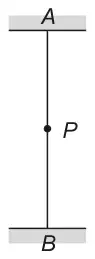
The particle \(P\) is held at the point between \(A\) and \(B\) which is 0.5 metres vertically below its equilibrium position.
The particle is then released from rest.
During the subsequent motion the oil causes a resistive force of magnitude \(\dfrac{4}{\sqrt{5}}v\) newtons to act on the particle, where \(v\) m s−1 is the speed of the particle.
At time \(t\) seconds after \(P\) is released, its displacement towards \(B\) from its equilibrium position is \(x\) metres.
Fully justify your answer. [5 marks]
| Scheme | Marks | AO |
|---|---|---|
| Obtains \(5e_A = 3e_B + 0.6 \times 10\) OE | B1 | 3.1b |
| Obtains \(3(e_B - x)\) or \(5(e_A + x)\) Condone their incorrect \(e_A\) or \(e_B\) | B1F | 2.2a |
| Forms five-term equation of motion in terms of \(x\) (with at least two terms correct). Condone “\(a\)” for \(\ddot{x}\) and “\(v\)” for \(\dot{x}\) Condone sign errors on the terms. Condone their incorrect \(e_A\) or \(e_B\) | M1 | 3.1b |
| Forms correct equation of motion in terms of \(x\). Can be in terms of \(e_A\) and \(e_B\) Condone “\(a\)” for \(\ddot{x}\) and “\(v\)” for \(\dot{x}\) Condone their incorrect \(e_A\) or \(e_B\) | A1F | 1.1b |
| Completes a reasoned argument to obtain \(0.6\dfrac{\mathrm{d}^2x}{\mathrm{d}t^2} + \dfrac{4}{\sqrt{5}}\dfrac{\mathrm{d}x}{\mathrm{d}t} + 8x = 0\) Accept \(0.6\ddot{x} + \dfrac{4}{\sqrt{5}}\dot{x} + 8x = 0\) AG | R1 | 2.1 |
| (5) |
Typical solution
In equilibrium position
\[5e_A = 3e_B + 0.6 \times 10\]\[2 = e_A + e_B\]\[e_A = 1.5,\ e_B = 0.5\]After release
\[3(e_B - x) + 0.6 \times 10 - \frac{4}{\sqrt{5}}\dot{x} - 5(e_A + x) = 0.6\ddot{x}\]\[3(0.5 - x) + 0.6 \times 10 - \frac{4}{\sqrt{5}}\dot{x} - 5(1.5 + x) = 0.6\ddot{x}\]\[1.5 - 3x + 6 - \frac{4}{\sqrt{5}}\dot{x} - 7.5 - 5x = 0.6\ddot{x}\]\[0.6\ddot{x} + \frac{4}{\sqrt{5}}\dot{x} + 8x = 0\]\[0.6\frac{\mathrm{d}^2x}{\mathrm{d}t^2} + \frac{4}{\sqrt{5}}\frac{\mathrm{d}x}{\mathrm{d}t} + 8x = 0\]| Scheme | Marks | AO |
|---|---|---|
| Obtains complex solutions of the Auxiliary Equation. | M1 | 3.1a |
| Obtains \(\mathrm{e}^{\frac{-2\sqrt{5}}{3}t}\left(A\cos\left(\dfrac{10}{3}t\right) + B\sin\left(\dfrac{10}{3}t\right)\right)\) | A1 | 1.1b |
| Obtains \(A = 0.5\) Condone \(A = -0.5\) | B1 | 3.3 |
| Sets their \(\dot{x} = 0\) when \(t = 0\) Must use the product rule | M1 | 3.3 |
| Obtains \(B = \dfrac{\sqrt{5}}{10}\) | A1 | 1.1b |
| Completes a reasoned argument to obtain \(x = \mathrm{e}^{\frac{-2\sqrt{5}}{3}t}\left(\dfrac{1}{2}\cos\left(\dfrac{10}{3}t\right) + \dfrac{\sqrt{5}}{10}\sin\left(\dfrac{10}{3}t\right)\right)\) | R1 | 2.1 |
| (6) | ||
| (11 marks) |