
A2 October 2021 Paper 1 Q11
11 The displacement of a door from its equilibrium (closed) position is measured by the angle, \(\theta\) radians, which the door makes with its closed position. The door can swing either side of the equilibrium position so that \(\theta\) can take positive and negative values. The door is released from rest from an open position at time \(t = 0\).
A proposed differential equation to model the motion of the door for \(t \geqslant 0\) is
\(\dfrac{\mathrm{d}^2\theta}{\mathrm{d}t^2} + \lambda\dfrac{\mathrm{d}\theta}{\mathrm{d}t} + 3\theta = 0\) where \(\lambda\) is a constant and \(\lambda \geqslant 0\).
| Scheme | Marks | AO |
|---|---|---|
| (i) For SHM \(\lambda = 0\) | B1 | 3.3 |
| [1] | ||
| (ii) The door should close, but in SHM the motion continues indefinitely | B1 | 3.5b |
| [1] |
| Scheme | Marks | AO |
|---|---|---|
| Over- or critical- damping implies \(\lambda^2 - 12 \geqslant 0\) So \(\lambda \geqslant 2\sqrt{3}\) | M1 A1 | 3.3 3.4 |
| [2] |
Notes
M1: Consider discriminant with \(\geqslant\) or \(\gt\)
Ignore \(\lambda \leqslant -2\sqrt{3}\)
| Scheme | Marks | AO |
|---|---|---|
e.g.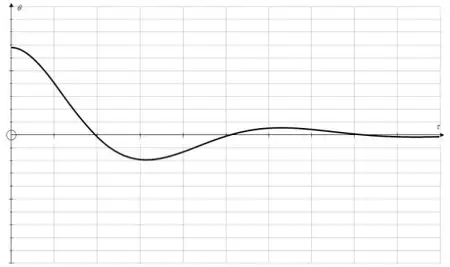 | B1 | 3.4 |
| [1] |
Notes
B1: Graph of under-damped system.
Start anywhere non-zero on \(\theta\)-axis with zero gradient.
Each peak must be lower than before
At least two peaks (not including start point)
The graph must look as though it is approaching the \(t\) axis