
AS June 2022 Paper 1 Q8
8.
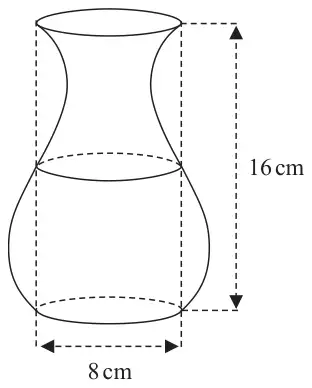
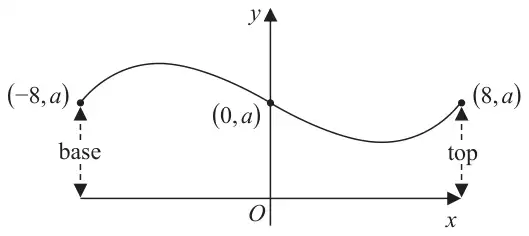
Figure 1 shows a sketch of a 16 cm tall vase which has a flat circular base with diameter 8 cm and a circular opening of diameter 8 cm at the top.
A student measures the circular cross-section halfway up the vase to be 8 cm in diameter.
The student models the shape of the vase by rotating a curve, shown in Figure 2, through 360° about the \(x\)-axis.
Two possible equations are suggested for the curve in the model.
\[\begin{aligned}&\text{Model A} \qquad y = a - 2\sin\left(\frac{45}{2}x\right)^\circ\\[4pt] &\text{Model B} \qquad y = a + \frac{x(x - 8)(x + 8)}{100}\end{aligned}\]For each model,
The widest part of the vase has diameter 12 cm and is just over 3 cm from the base.
You must make your method clear. (5)
The student pours water from a full one litre jug into the vase and finds that there is 100 ml left in the jug when the vase is full.
| Scheme | Marks | AO |
|---|---|---|
| \(a = 4\) | B1 | 3.3 |
| (1) |
Notes
Units not required in this question
B1: For \(a = 4\), ignore any reference to units.
| Scheme | Marks | AO |
|---|---|---|
| Model A: (i) Widest point will be 4 (cm) from the base | B1 | 3.4 |
| (ii) Width at widest point is 12 (cm) \(\quad(2 \times (\text{‘}a\text{’} + 2)\text{ ft})\) | B1ft | 3.4 |
| Model B: (i) \(y = 4 + \dfrac{x^3 - 64x}{100} \Rightarrow \dfrac{\mathrm{d}y}{\mathrm{d}x} = \dfrac{3x^2 - 64}{100}\) | M1 | 3.1b |
| \(\dfrac{\mathrm{d}y}{\mathrm{d}x} = 0 \Rightarrow x = \pm\sqrt{\dfrac{64}{3}} = \pm\dfrac{8\sqrt{3}}{3} = \pm\text{awrt } 4.62\) | A1 | 1.1b |
| So max width is a distance \(8 - \dfrac{8}{\sqrt{3}} = 8 - \dfrac{8\sqrt{3}}{3} \approx 3.38\) (cm) from base. | A1 | 3.4 |
| (ii) \(y\big|_{-4.61\ldots} = 4 + \dfrac{(-4.62\ldots)^3 - 64(-4.62\ldots)}{100} = \ldots\) | dM1 | 3.4 |
| \(= 5.97\ldots\) so diameter is approximately 11.9 (cm) \(\quad[2a + 3.94\ldots\text{ ft}]\) | A1ft | 3.2a |
| (7) |
Notes
B1: Correct distance from base for Model A is 4
B1ft: Correct width at widest point. Follow through their ‘\(a\)’, so \(2 \times (\text{‘}a\text{’} + 2)\).
M1: Attempts the derivative for Model B’s equation, reduce any power by 1
A1: Sets \(\dfrac{\mathrm{d}y}{\mathrm{d}x} = 0\) and finds correct \(x\) coordinate of the stationary point (accept \(\pm\))
A1: For \(8 - \dfrac{8}{\sqrt{3}}\) or awrt 3.38 cso
dM1: Dependent on previous M mark. Uses their value of \(x\) to find the value of \(y\). If no working shown the value of \(y\) must come from their \(x\) value.
Note using \(x = 4.62\) give \(y = 2.029\ldots\)
A1: Correct diameter, awrt 11.9 follow through their ‘\(a\)’, so \([2a + 3.94\ldots\text{ ft}]\)
Note: Correct answers with no working send to review
Trial and error approach
Candidates could score B1 B1 for model A however if working in integers it is unlikely that they will find the correct value for \(x\) (they are using \(x = -5\)) not a valid method M0A0A0dM0A0
| Scheme | Marks | AO |
|---|---|---|
| Model A and model B both have diameters closed to 12 Model B distance from base is closer to 3 than Model A so is more appropriate. | B1ft | 3.5b |
| (1) |
Notes
B1ft: They must have answers for all parts in (b). Accept any well-reasoned comment that follows their answers to (b) If the answers are correct, they must conclude that model B is more appropriate.
- If answers for one model are correct ish but other incorrect, or one value is clearly closer
For exampleDistance (3) Diameter (12) Distance (3) Diameter (12) A 9.4 9.05 4 6 B 3.38 12.06 4.62 4.06 Conclusion Selects B as distance/diameter closet Select A as diameter closest - If distances and diameters are similar selects the model which has the most appropriate value for distance or diameter
For exampleDistance (3) Diameter (12) Distance (3) Diameter (12) A 0.76 6.8 4 20 B 1.28 10.5 3.38 19.94 Conclusion selects B as the diameter is closet Selects B as distance is closet - If all values of the distances and diameters are varied any sensible reason stated for selecting a model.
| Scheme | Marks | AO |
|---|---|---|
| \[V_{\mathrm{B}} = \pi\int_{-8}^{8} y^2\,\mathrm{d}x = \pi\int_{-8}^{8}\left(4 + \frac{x^3 - 64x}{100}\right)^2\mathrm{d}x = \ldots\] | B1 | 1.1b |
| \[\begin{aligned}&= \frac{\{\pi\}}{10000}\int_{(-8)}^{(8)} 400^2 + x^6 + 64^2x^2 + 2\left(400x^3 - 400 \times 64x - 64x^4\right)\mathrm{d}x\\[4pt] &= \frac{\{\pi\}}{10000}\int_{(-8)}^{(8)} 160000 + x^6 + 4096x^2 + 800x^3 - 51200x - 128x^4\ \mathrm{d}x\\[4pt] &= \{\pi\}\int_{(-8)}^{(8)} 16 + \frac{x^6}{10000} + \frac{4096}{10000}x^2 + \frac{8}{100}x^3 - \frac{512}{100}x - \frac{128}{10000}x^4\ \mathrm{d}x\\[4pt] &= \{\pi\}\int_{(-8)}^{(8)} 16 + \frac{x^6}{10000} + \frac{256}{625}x^2 + \frac{2}{25}x^3 - \frac{128}{25}x - \frac{8}{625}x^4\ \mathrm{d}x\\[4pt] &= \{\pi\}\int_{(-8)}^{(8)} 16 + \frac{8x(x - 8)(x + 8)}{100} + \left(\frac{x(x - 8)(x + 8)}{100}\right)^2\mathrm{d}x\end{aligned}\] (Corrected from the printed mark scheme: the fourth line has \(\dfrac{x^6}{1000}\); it should be \(\dfrac{x^6}{10000}\), as in the line before it.) | M1 | 1.1b |
| \[\begin{aligned}&= \frac{\{\pi\}}{10000}\left[160000x + \frac{x^7}{7} + 4096\frac{x^3}{3} + 800\frac{x^4}{4} - 51200\frac{x^2}{2} - 128\frac{x^5}{5}\right]_{(-8)}^{(8)}\\[4pt] &= \{\pi\}\left[16x + \frac{x^7}{70000} + \frac{256}{1875}x^3 + \frac{1}{50}x^4 - \frac{64}{25}x^2 - \frac{8}{3125}x^5\right]_{(-8)}^{(8)}\end{aligned}\] | dM1 | 1.1b |
| \(= \dfrac{\{\pi\}}{10000}(620583.00\ldots - -2258983.01\ldots) \approx \dfrac{2879566\pi}{10000}\) | M1 | 3.4 |
| \(=\) awrt \(905\left(\mathrm{cm}^3\right)\) cso | A1 | 1.1b |
| (5) |
Notes
B1: Applies \(\pi\displaystyle\int_{-8}^{8} y^2\,\mathrm{d}x\) to the model. Must have \(\pi\) and correct limits, with \(y\) substituted in.
Alternatively attempts to square \(y\) first and then substitute in.
M1: Attempts to expand \(y^2\) this can be a poor attempt but must include at least a constant and \(x^6\) terms as long a clear attempt at \(y^2\) (Limits not required for this mark.)
dM1: Attempts the integration, must first be rearranged to an integrable form then look for power increasing by at least 1 in at least two terms. (Limits not required for this mark.)
M1: Applies correct limits to their integral following an attempt at \(y^2\) with at least a constant and \(x^6\) terms.
If there is no working shown, allow this method mark if the correct answer appears from a calculator as it implies correct limits have been applied the correct way round. (So M0dM0M1 is possible.)
A1: awrt 905 cso note it must come from a fully correct solution
Note: For answers that appear from calculator B1M0dM0M1A0 is possible, the question specifies algebraic integration to be used so the integration needs to be seen to score the other marks.
| Scheme | Marks | AO |
|---|---|---|
| Compares their volume to 900 or compares their volume + 100 to 1 litre or 1000 and comments appropriately. | B1ft | 3.5a |
| (1) | ||
| (15 marks) |
Notes
B1ft: Compares their volume to 900 or compares their volume + 100 to 1 litre or 1000 and comments appropriately. Correct answer in (d) needs to conclude that it is suitable.