
AS June 2021 Paper 1 Q16
16 Curve \(C\) has equation \(y = \dfrac{ax}{x + b}\) where \(a\) and \(b\) are constants.
The equations of the asymptotes to \(C\) are \(x = -2\) and \(y = 3\)
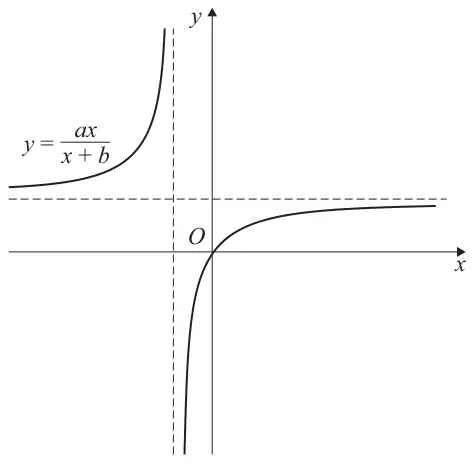
(a) Write down the value of \(a\) and the value of \(b\) [2 marks]
(b) The gradient of \(C\) at the origin is \(\dfrac{3}{2}\)
With reference to the graph, explain why there is exactly one root of the equation
\[\frac{ax}{x + b} = \frac{3x}{2}\][2 marks]
(c) Using the values found in part (a), solve the inequality\[\frac{ax}{x + b} \leqslant 1 - x\]
[4 marks]
| Scheme | Marks | AO |
|---|---|---|
| Obtains \(a = 3\) Accept \(y = \dfrac{3x}{x + b}\) with any non-zero value of \(b\) | B1 | 2.2a |
| Obtains \(b = 2\) Accept \(y = \dfrac{ax}{x + 2}\) with any non-zero value of \(a\) | B1 | 2.2a |
| (2) |
Typical solution
\[y = \frac{3x}{x + 2}\]\[a = 3 \quad \text{and} \quad b = 2\]| Scheme | Marks | AO |
|---|---|---|
| Explains that \(y = \frac{3x}{2}\) is a tangent to the curve. Condone ‘tangent’ only. | B1 | 2.4 |
| Explains that a tangent to a hyperbola meets the curve exactly once. Accept ‘conic’ instead of ‘hyperbola’. Condone no conclusion given. | B1 | 2.4 |
| (2) |
Typical solution
\(y = \frac{3x}{2}\) is a tangent to the hyperbola.
Any tangent to a hyperbola only intersects once.
So there is exactly one root of the equation.
| Scheme | Marks | AO |
|---|---|---|
| Forms a simplified quadratic equation from \(ax - (1 - x)(x + b) = 0\) Accept any inequality sign instead of = PI by \(x^2 + 4x - 2\) or \(-x^2 - 4x + 2\) PI by \(-2 + \sqrt{6}\) or \(-2 - \sqrt{6}\) Or forms a simplified cubic equation from \(ax(x + 2) - (1 - x)(x + b)(x + 2) = 0\) | M1 | 1.1a |
| Identifies \(-2 + \sqrt{6}\) or \(-2 - \sqrt{6}\) as a critical value. Follow through their \(a\) and \(b\) | A1F | 1.1b |
| Identifies \(-2\) as a critical value. | B1 | 1.1b |
| Obtains the correct set of values of \(x\) | A1 | 3.2a |
| (4) | ||
| (8 marks) |